The 7-Step Sales Process: From Cold Prospect to Closed Deal
I'll insert both links — the B2B Lead Generation link fits naturally in Step 1 (Prospecting) around "qualified leads," and the Product Sourcing link fits in the Cross-Border Trade section around "sourcing inquiry."
I'll fix only the two stale-fact instances in the "How SaaS and AI Tools" section by rewriting the specific quantitative claims qualitatively.
I'll write this comprehensive article now, integrating all the requirements: 7-step structure, image placeholders, internal links, business context, and buyer-intent CTA.
The 7-Step Sales Process: From Cold Prospect to Closed Deal
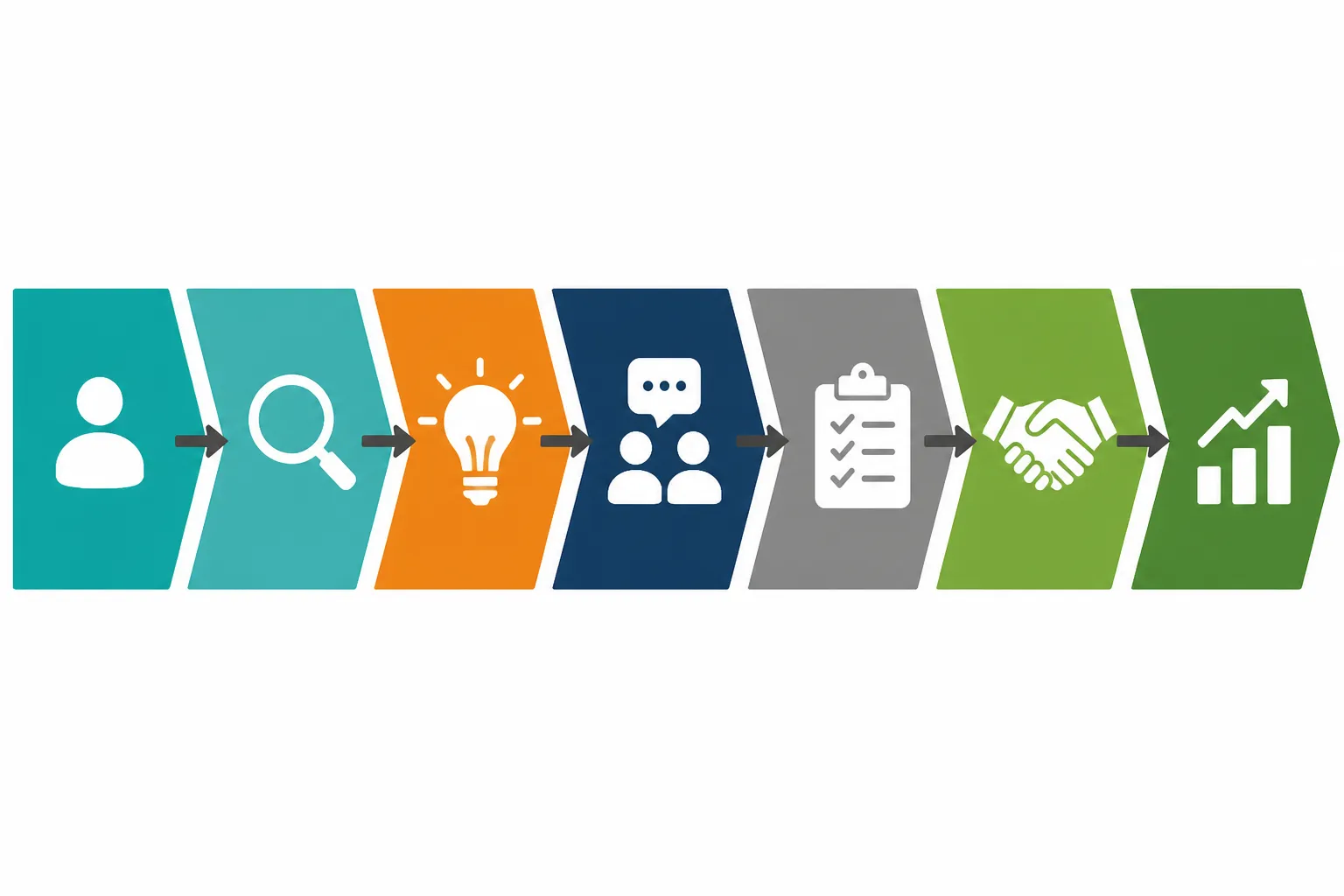
A sales process is a repeatable, seven-step sequence that moves a sales representative from initial product research to a signed contract — then keeps that relationship active long after the ink dries. It defines the what: the specific actions required at each stage so any team member can replicate results and pinpoint exactly where deals are stalling.
For overseas sourcing buyers and DTC operators evaluating Chinese supply, understanding the sales process on both sides of the table is a procurement advantage. When you know how a factory's sales team operates — or doesn't — you can forecast response times, negotiate more effectively, and filter out suppliers who lack the infrastructure to serve a global buyer reliably. When you're the seller, a disciplined process is what separates scalable export revenue from one-off transactions that never compound.
The distinction matters because, as Salesforce notes, many teams conflate a sales process with a sales methodology or a sales cycle — three related but separate concepts that, when confused, produce strategy gaps. This article untangles them, walks through each of the seven steps with concrete examples, and explains how AI-native tools are compressing the timeline from first touch to closed deal.
What Is a Sales Process? Meaning and Core Concepts
The sales process is the what of the sales equation — the ordered steps a rep must execute to close a deal. A sales methodology is the how — the framework or philosophy (SPIN Selling, Challenger, MEDDIC) that governs how each step is executed. A sales cycle is simply the clock: the elapsed time from first meaningful contact to "closed won."
All three work together, but they are not interchangeable. A company can run MEDDIC methodology inside a seven-step process and close cycles averaging 45 days. Change the methodology, and the process stays the same. Shorten the cycle with better tooling, and neither the process nor the methodology necessarily changes. Clarity on these boundaries is what allows teams to diagnose problems surgically instead of overhauling everything when one stage underperforms.
In cross-border trade and ecommerce specifically, the sales process maps onto procurement stages that buyers recognize: supplier discovery, RFQ (request for quotation), sample evaluation, negotiation, contract, and repeat order. The vocabulary differs, but the underlying structure — move a relationship from unknown to trusted and transacting — is identical.
For more on how B2B purchasing dynamics differ from consumer-facing models, see B2B vs B2C: The Complete Comparison Guide for Business Decision-Makers, which breaks down the decision cycles and stakeholder complexity that make B2B sales processes longer and more structured by necessity.
The 7 Steps of a Sales Process: A Practical Breakdown
Salesforce's definitive guide defines seven steps. Here is each one, with examples grounded in cross-border trade and manufacturing contexts.
Step 1: Prospecting
Prospecting means identifying potential buyers who fit your ideal customer profile. Many companies formalize this by building a buyer persona that outlines demographics, psychographics, and communication channel preferences of their best-fit prospect.
For a Chinese OEM/ODM exporter, prospecting might mean identifying DTC brands on TikTok Shop that are scaling fast but sourcing from fragmented distributors — precisely the segment that benefits most from a direct factory relationship. Trade shows (Canton Fair, Global Sources, Ambiente) remain a primary prospecting venue for Chinese factories entering new markets, but social platforms, SEO-driven inbound, and AI matchmaking engines are now generating qualified leads at a fraction of the cost.
Step 2: Preparation
Before the first outreach, a rep must know the product cold. Clients expect sales reps to know every detail about what they're selling — not just specs, but use cases, failure modes, and competitive positioning. The recommended approach is to review product demos, press releases, and internal documentation, and to ask developers or product managers about edge-case functionality.
In a manufacturing context, preparation means having data sheets, certifications, MOQ tiers, and lead time windows ready before a buyer asks. A buyer who has to request this information twice — once by email, once on a call — will already be evaluating your competitor.
Step 3: Approach
The approach is the first live contact with a prospect. Its goal is not to pitch; it is to earn the right to a longer conversation by demonstrating immediate relevance. Cold emails, LinkedIn messages, trade show booth conversations, and inbound inquiry responses all fall here.
An approach that opens with "we are a 15-year factory with ISO 9001" is generic. An approach that opens with "I saw your Q3 collection uses matte-finish aluminum — we run anodizing lines that hit [specific finish standard], here's a sample cost" is specific and moves the conversation forward.
Step 4: Presentation
The presentation is where you show — not just tell — how your product or service solves a documented problem. In B2B ecommerce and cross-border trade, this often takes the form of a capabilities deck, a factory audit video, or a digital showroom linked from an independent brand site.
Critically, a presentation should be customized to the buyer's sourcing criteria: what certifications they require, what volume tier they're in, what their target retail price point is. A one-size-fits-all product catalog is not a presentation — it's a library.
Step 5: Handling Objections
Objections in cross-border purchasing are often concrete: "Your MOQ is too high," "We need 30-day payment terms," "We had quality issues with a previous Chinese supplier." Each objection is a specific concern that requires a specific response, not a generic reassurance.
The strongest objection-handling in manufacturing comes from documented evidence: third-party inspection reports, repeat-order data from existing clients, or a sample policy that removes the financial risk of a first order.
Step 6: Closing
Closing is the moment a verbal agreement converts to a written one — a purchase order, a contract, or a signed sampling agreement. Without a defined process step here, deals frequently stall in "we're still evaluating" indefinitely.
Having a step-by-step sales process is precisely what helps teams know when and how to move a deal toward closure rather than letting it orbit the pipeline for quarters. Tactics include summary-of-value emails, limited-window sampling offers, or simply asking directly: "What would need to be true for you to place a trial order this quarter?"
Step 7: Follow-Up and Nurturing
The deal closing is not the end of the sales process — it is the beginning of the repeat business cycle. Post-close follow-up includes onboarding support, quality confirmation after first delivery, and proactive outreach before the buyer's next production run.
As Salesforce observes, knowing why you lost a sale is often more important than knowing why you won it. Post-deal reviews — whether closed won or closed lost — feed the intelligence that sharpens every step of the next cycle.
Sales Process vs. Sales Methodology: Why the Difference Matters
Confusing these two is the most common reason sales teams struggle to diagnose underperformance. A process tells you what steps exist. A methodology tells you how to execute each step.
| Dimension | Sales Process | Sales Methodology |
|---|---|---|
| Definition | Ordered steps from prospect to close | Execution framework within those steps |
| Example | 7-step pipeline | MEDDIC, SPIN, Challenger |
| Changes when... | You enter a new market or product line | You want to improve how reps sell |
| Stability | Relatively stable | More flexible, can layer on existing process |
For sourcing buyers evaluating suppliers: a factory with a documented sales process — defined response SLAs, structured sample request workflows, clear escalation paths — is operationally more reliable than one where everything depends on which individual sales rep picks up the inquiry.
Why a Defined Sales Process Is Fundamental to B2B and Ecommerce Success
Without a structured process, the buyer's experience degrades in one of two directions: the rep pushes too hard before the prospect is ready, or waits too long out of fear of being aggressive. Both outcomes lose the deal.
A clearly defined sales process does three things that directly improve revenue outcomes:
- Closes more deals. A step-by-step process increases the probability of closing because it ensures no stage is skipped — prospects aren't pushed to close before objections are resolved.
- Reveals pipeline gaps. The process allows teams to identify at exactly which stage deals stall — whether that's prospecting volume, presentation quality, or closing language — so fixes are targeted rather than speculative.
- Scales across team members. A documented process means a new sales hire or a first-time exporter can replicate what the best performer does, rather than reinventing it.
For Chinese exporters scaling their first English-language sales operations, this third point is especially high-stakes. Exporting without a process means revenue depends on one bilingual salesperson. With a process, it's a system that any trained team member can run.
For a deeper look at how B2B sales differ structurally from B2C, including purchasing committee dynamics and longer decision cycles, the B2B Sales Meaning: 6 Platforms That Define It in 2026 article is a strong next read.
The Sales Process in Cross-Border Trade: What Changes at the Border
Cross-border trade introduces variables that a domestic sales process doesn't encounter: currency risk, shipping lead times, customs compliance, language barriers, and a buyer who cannot walk into your factory. Each variable creates a potential objection if not addressed proactively in the sales process.
Procurement criteria that overseas sourcing buyers evaluate before reaching out — and that a cross-border sales process must be prepared to address:
- MOQ and pricing structure: Buyers want to know minimum order quantities upfront. Hiding MOQ until late in the process wastes both parties' time. Include a clear tiered MOQ table (e.g.,
[your MOQ]units at sample price,[your production MOQ]at volume price) in the presentation stage, not the objection-handling stage. - Lead times and capacity: How many days from purchase order to factory-ready cargo? What is maximum monthly capacity? These numbers determine whether your factory fits a buyer's production calendar.
- Certifications and compliance: Does the product meet the target market's standards? (CE, FDA, REACH, RoHS, BSCI, etc.) A buyer sourcing for EU retail has non-negotiable certification requirements. Lead with these in the approach stage.
- Quality assurance: What inspection protocol covers each production run? Third-party inspection (SGS, BV, Intertek) is the credibility standard for first-time buyers.
- Supplier reliability: Reference clients, repeat-order rates, and documented on-time delivery records replace the trust signals that geography normally provides.
A sales process that addresses these dimensions sequentially — in the right stage rather than all at once in a capabilities PDF — moves a sourcing inquiry toward a purchase order faster and with less friction.
How SaaS and AI Tools Are Compressing the Sales Process Timeline
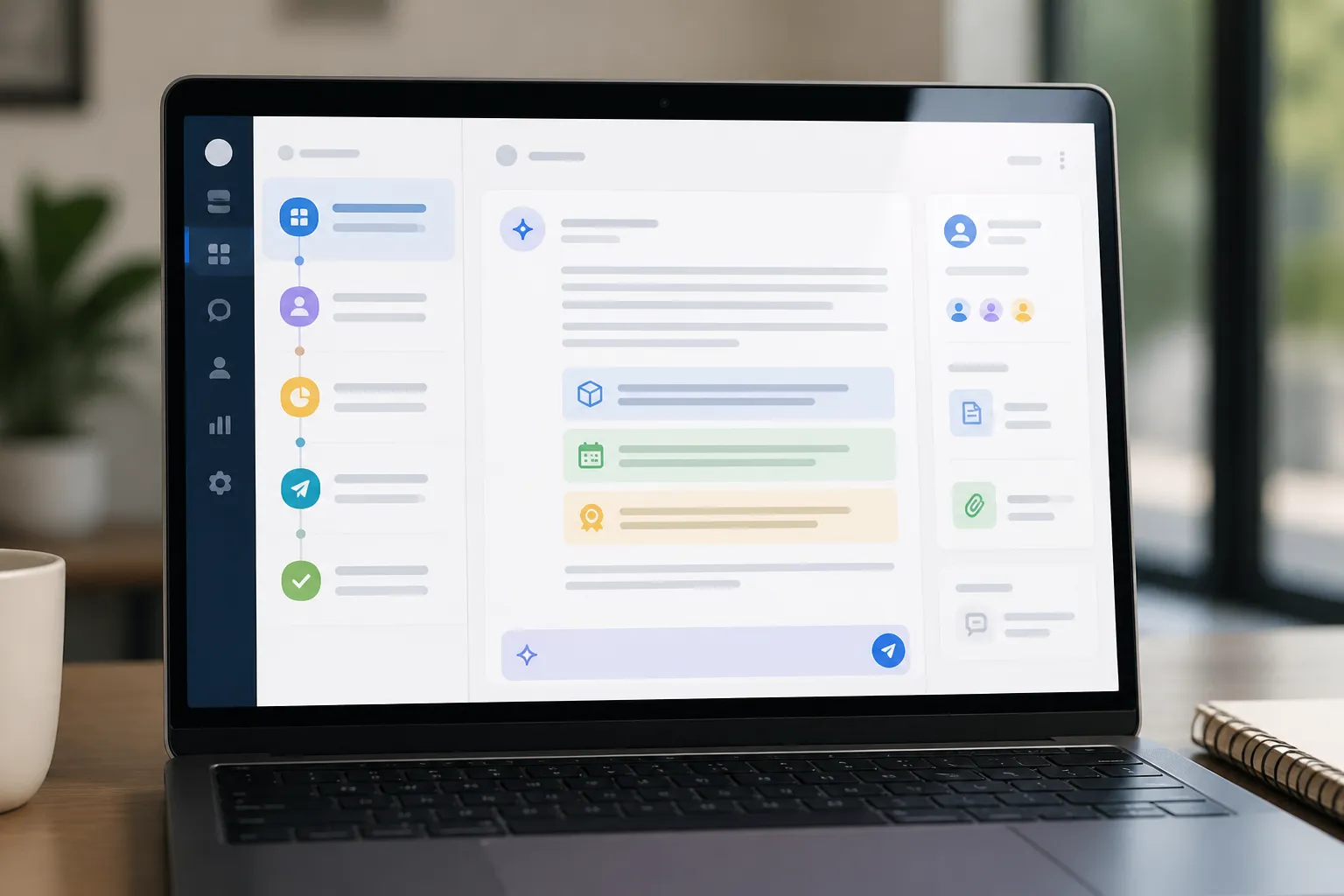
Many sales teams now rely on sales software to navigate each stage from prospecting to close. In cross-border trade, AI-native platforms are beginning to automate the most time-intensive parts of the process — specifically, lead qualification and initial inquiry response.
链上科技 (Link4a) builds this infrastructure explicitly for Chinese factories entering global markets. Its four core products each map to a specific stage in the sales process:
- Sitebox reduces the presentation-stage bottleneck: an independent brand site — the equivalent of a professional digital showroom — can go live in under 30 minutes, giving buyers a verifiable, credible destination to evaluate product quality and certifications.
- Inbox handles the approach and early follow-up stages with a 24/7 multilingual inquiry AI that responds to inbound leads in the buyer's language without a human sales rep on standby — critical for time-zone gaps between Chinese factories and North American or European buyers.
- Match compresses the prospecting stage to seconds: its supplier matchmaking engine returns verified supplier matches nearly instantly, replacing what previously took days of manual search on trade directories.
- Reach sustains the follow-up and nurturing stage through an omni-channel content and SEO/GEO traffic engine that drives inbound leads from social, search, and outbound channels in a single workflow loop.
Across hundreds of factories and thousands of live sites, the pattern is consistent: factories that instrument their sales process with purpose-built tools close more inquiries because they respond faster, present more credibly, and follow up systematically.
For sourcing buyers, this matters in reverse: a Chinese supplier using this kind of infrastructure is demonstrably more responsive and organized than one operating on manual email chains and a static Alibaba listing.
When to Formalize Your Sales Process — and When Not to Wait
The right time to document a sales process is before your pipeline gets large enough that inconsistency becomes expensive. For most exporters, that moment arrives at the first trade show or the first inbound inquiry from a new geography.
Specific triggers that signal a sales process is overdue:
- Different team members give different answers to the same buyer question
- Deals regularly stall in the same pipeline stage without a clear reason
- A good salesperson leaves and takes all their knowledge with them
- Response times to international inquiries exceed 24 hours consistently
- Win rates are flat despite increasing lead volume
The most successful sales processes result from thoughtful planning followed by careful execution — and then continuous refinement based on closed/lost analysis. The process is not a document you write once; it's a feedback loop you run every quarter.

Benefits of a Structured Sales Process: A Summary
Addressing the question directly: the concrete benefits of a structured sales process include:
- Higher close rates — every stage is executed before the next begins, removing the gaps where deals fall through
- Shorter sales cycles — reps know exactly what action moves a deal forward, eliminating deliberation time
- Better pipeline forecasting — stage-based tracking gives finance and operations teams accurate revenue projections
- Faster onboarding of new reps — a documented process is trainable; institutional knowledge locked in one person's head is not
- Clearer loss analysis — post-deal reviews by stage reveal why deals were lost, feeding systematic improvement
- Consistent buyer experience — every prospect encounters the same preparation, response quality, and follow-through regardless of which rep handles them
For ecommerce operators working with Chinese suppliers, a supplier's sales process quality is itself a supplier evaluation criterion. A factory that can't respond to a sourcing inquiry within 24 hours, can't provide certifications on request, or whose quotes arrive without MOQ breakdowns is showing you its operational ceiling before you've placed a single order.
Evaluate Before You Commit: What to Ask Any Supplier
Before reaching out to a factory — or before a factory reaches out to a buyer — these are the questions a structured sales process should answer at the presentation or proposal stage:
- What is the MOQ for sampling vs. production runs?
- What is the standard lead time from PO to FOB-ready cargo?
- Which certifications cover this product for the target export market?
- What quality inspection protocol is applied to each production batch?
- Can you provide references from buyers in the same category or geography?
- What are the payment terms for first-time buyers?
Suppliers who answer all six without prompting have a sales process. Those who answer none without a follow-up email have a capacity problem, not just a communication problem.
Start Building — or Evaluating — Your Sales Process Today
A sales process is not a luxury reserved for enterprise sales teams. It is the operational minimum for any business that wants to grow revenue predictably — in domestic markets, across ecommerce channels, or into new export geographies.
For Chinese factories and OEM/ODM exporters looking to build a global-facing sales operation on a compressed timeline, 链上科技's Link4a platform offers the infrastructure layer: brand site live in 30 minutes via Sitebox, 24/7 multilingual inquiry handling via Inbox, and inbound traffic via Reach — all without assembling a stack of disconnected SaaS tools.
For overseas sourcing buyers who want verified Chinese supply matched to their category and volume requirements, the Match engine surfaces qualified factory options in seconds.
Ready to connect? Whether you're a factory building your first structured export sales process or a DTC operator evaluating Chinese supply for a new product line — request access or get matched at Link4a. Bring your MOQ requirements, target certifications, and production timeline. The process starts with the right conversation.
Further reading: B2B Sales: 6 Platforms and Resources That Drive Results in 2026 covers the specific tools and channels that high-performing B2B sales teams use at each stage of the process — a practical companion to the framework above.
Frequently Asked Questions
What is sales process?
A sales process is a repeatable, structured sequence of steps a seller follows to move a prospect from initial contact to closed deal — typically covering stages like prospecting, qualification, needs assessment, proposal, negotiation, and close. For sourcing buyers evaluating Chinese supply, this maps concretely to: supplier discovery (Alibaba, Canton Fair, direct factory outreach), RFQ submission with spec sheets, sample review against certifications (e.g., CE, RoHS, FDA), MOQ/lead time negotiation, and PO issuance with payment terms (T/T, LC). A defined process reduces deal cycle variance and gives both buyer and supplier a predictable framework for repeat orders.
How to sales process?
A typical B2B sales process for sourcing from Chinese suppliers runs: qualify the buyer (confirm category, MOQ fit, and timeline) → send a sample or factory profile (include certifications like ISO 9001, BSCI, or relevant product certs, plus lead time and FOB/EXW pricing) → close with a pilot order (usually 500–2,000 units to validate quality before scaling). For DTC operators evaluating supply from factories on platforms like Alibaba, 1688, or through agents such as 链上科技, always anchor negotiations on a written PI (Proforma Invoice) that locks unit price, lead time (typically 30–45 days for custom orders), and QC inspection terms. The fastest deals close when the buyer sees a clear MOQ ladder, a third-party inspection option (e.g., SGS or Bureau Veritas), and a sample within 7–10 days of first contact.
Why is sales process important?
A defined sales process gives your team a repeatable, measurable framework — from lead qualification through to closing — so performance gaps can be diagnosed and fixed rather than guessed at. For sourcing buyers evaluating Chinese supply, it means setting clear stage gates: factory audit, sample approval, MOQ/lead-time confirmation, and certification verification (e.g., CE, RoHS, ISO 9001) before committing budget. Without that structure, deals stall unpredictably, margin gets negotiated away late in the cycle, and onboarding new reps takes far longer than it should.
When should I use sales process?
Use a defined sales process whenever you're managing complex B2B transactions — for example, sourcing deals with Chinese factories where you need to track multiple stakeholders, quote cycles, and sample approvals across a pipeline. It's especially critical when MOQs, lead times, and certification requirements (e.g., CE, FDA, BSCI) vary by supplier and must be documented at each stage to avoid costly rework. A structured process also protects you when onboarding new DTC brands to Chinese supply chains, ensuring due diligence steps (factory audits, payment terms, incoterms) are consistently applied rather than ad hoc.
What are the benefits of sales process?
A structured sales process gives sourcing buyers and DTC operators predictable milestones — from RFQ and sample approval through MOQ negotiation and PO confirmation — reducing miscommunication with Chinese suppliers and shortening time-to-order. It creates a repeatable qualification framework so buyers can benchmark factories on lead times (typically 30–45 days for soft goods, 15–25 days for standard packaging), certifications (ISO 9001, BSCI, REACH), and pricing tiers before committing capital. Over time, a documented process builds institutional knowledge, making it easier to onboard new sourcing team members and audit supplier performance against consistent criteria.