ASME Standards: The Complete Guide for OEM Exporters
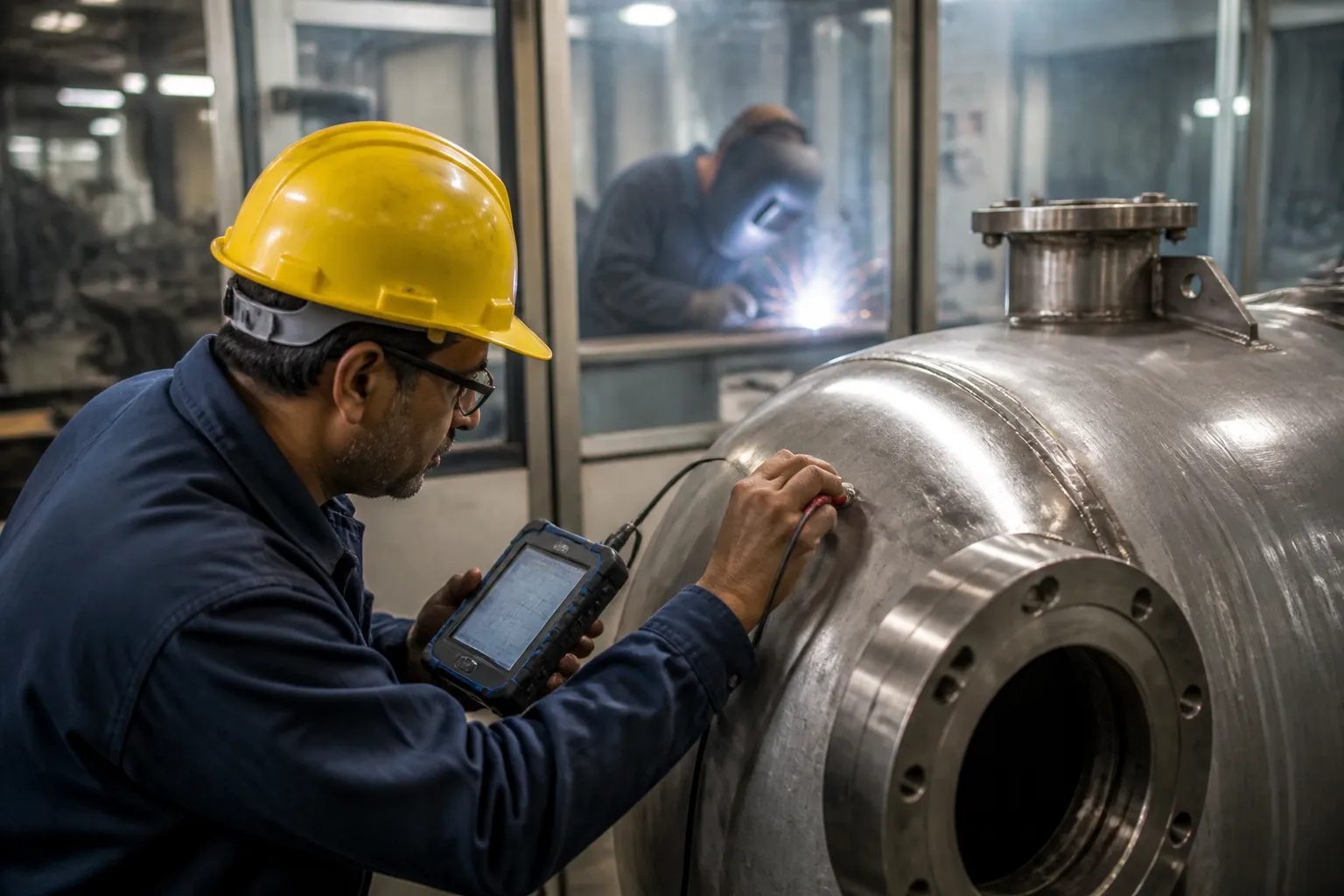
ASME Standards: The Complete Guide for OEM Exporters
Definition snapshot (40–60 words): ASME standards are a set of engineering codes and specifications published by the American Society of Mechanical Engineers (ASME) — a nonprofit organization — that define safety, design, and quality requirements for mechanical components, pressure vessels, boilers, and industrial systems. Compliance is mandatory or strongly preferred across the United States, Canada, and many international markets.
Overseas buyers almost never say "send me your ASME certificate" on a first inquiry. They say "we need ASME-compliant flanges" or "the vessel must be ASME Section VIII." If you are a Chinese factory owner or OEM/ODM exporter targeting the North American industrial supply chain, those phrases represent real purchase decisions — and they hinge entirely on whether your production process meets ASME standards. This guide breaks down exactly what compliance means, which codes matter most for export manufacturers, and how to position your factory to win inquiries from sourcing buyers who already know what they want.
What Is ASME and What Authority Do Its Standards Carry?
ASME — the American Society of Mechanical Engineers — was founded in 1880 and today publishes over 600 codes and standards used in more than 100 countries. It operates as a nonprofit, standards-developing organization (SDO), which means its codes are written by volunteer committees of engineers, tested against field data, and revised on a defined publication cycle (typically every three years).
ASME standards are not self-enforcing regulations on their own. Their authority comes from adoption: U.S. federal agencies (OSHA, DOT), state boiler inspection programs, and international trade agreements reference specific ASME codes by name. Once a jurisdiction "adopts" a code — say, ASME B31.3 for process piping — compliance becomes a legal requirement within that jurisdiction. Buyers who specify ASME are not being picky. They are telling you their procurement officer, their insurance underwriter, and their local regulator all require it.
The Difference Between a Code, a Standard, and a Certification
These three terms are often confused:
- Code — a comprehensive document with mandatory requirements (e.g., ASME Boiler & Pressure Vessel Code, or BPVC). Codes carry the weight of law where adopted.
- Standard — a specification document defining dimensions, materials, or performance criteria (e.g., ASME B16.5 for pipe flanges). Standards are referenced inside codes or purchase orders.
- Certification / Stamp — proof that a manufacturer's quality system has been audited and approved by ASME. The "U Stamp" (unfired pressure vessels) and "S Stamp" (power boilers) are the most common stamps Chinese factories pursue for export.
Which ASME Standards Matter Most for Chinese Export Factories?
Not every ASME standard is relevant to every product line. Below are the codes that appear most frequently in North American B2B sourcing inquiries:

ASME BPVC (Boiler and Pressure Vessel Code)
The BPVC is ASME's flagship publication, divided into 12 sections. For export manufacturers, the most commonly required sections are:
- Section I — Power boilers
- Section VIII, Division 1 — Unfired pressure vessels (the most frequently specified for industrial tanks, heat exchangers, and reactors)
- Section IX — Welding and brazing qualifications (required to support Section I and VIII compliance; this section governs the WPS, PQR, and WQR documents your welders must hold)
To legally apply the ASME "U Stamp" to a pressure vessel, your factory must hold an ASME Certificate of Authorization. The audit process involves a joint review by ASME and your local jurisdiction's Authorized Inspection Agency (AIA). In China, the China Special Equipment Inspection and Research Institute (CSEI) frequently acts in this capacity for export products.
ASME B31 — Pressure Piping Codes
The B31 series governs piping systems used in:
- B31.1 — Power piping (power plants, utility systems)
- B31.3 — Process piping (chemical plants, refineries, semiconductor fabs)
- B31.4 / B31.8 — Liquid and gas pipeline transportation
Factories producing pipe spools, fittings, or skid-mounted assemblies for North American process plants will encounter B31.3 most often. Compliance requires documented material traceability (mill certs per ASTM standards referenced in ASME), qualified welding procedures, and post-weld heat treatment (PWHT) records where required.
ASME B16 — Pipe Flanges and Fittings
B16.5 (pipe flanges up to 24"), B16.47 (large-diameter flanges), and B16.9 (butt-welding fittings) are dimensional standards that define how your components must be machined and marked. A sourcing buyer ordering "ASME B16.5, Class 300, 316L stainless flanges" is specifying an exact face geometry, bolt-circle diameter, wall thickness range, and material heat number marking requirement. Deviation on any of those points triggers rejection at incoming inspection.
ASME Y14 — Engineering Drawing Standards
Less visible than the mechanical codes but practically important: ASME Y14.5 (Geometric Dimensioning and Tolerancing, or GD&T) is the drawing language used by the majority of U.S. and Canadian engineering teams. If your factory cannot read and interpret GD&T callouts — datum references, true position tolerances, profile tolerances — your QC team will misread the customer's drawing, produce non-conforming parts, and not know it until the buyer's incoming inspection rejects the shipment.
Why ASME Standards Matter for Cross-Border Trade
The business case for ASME compliance is concrete and measurable.
Market access: Approximately 49 U.S. states have adopted the ASME BPVC for boilers and pressure vessels. A pressure vessel without the U Stamp cannot legally be installed in most U.S. industrial facilities. This is not a preference — it is a binary gate.
Insurance and liability: North American buyers carry product liability insurance that is conditioned on the use of standards-compliant components. A non-compliant weld on a pressure vessel that fails in service can void the buyer's coverage and expose both parties to liability. Buyers' procurement policies often prohibit sourcing from non-certified suppliers for this reason alone.
Pricing power: ASME-certified factories command a meaningful price premium over non-certified alternatives. The certification signals a documented quality system, qualified welders (with current WQRs), and third-party inspection infrastructure — all of which reduce the buyer's incoming QC cost. Buyers doing landed-cost analysis frequently find that a certified supplier's higher FOB price nets out cheaper once inspection, rework, and liability costs are factored in.
Speed of approval: Approved Vendor Lists (AVLs) at large OEMs and EPCs (engineering, procurement, and construction firms) are hard to get onto. ASME certification is often a prerequisite that bypasses months of qualification testing.
How to Achieve ASME Compliance: A Factory Roadmap
This section is oriented toward Chinese OEM/ODM factories beginning the compliance journey. The process is sequential and non-trivial — budget 12–24 months and $30,000–$150,000+ depending on product scope.

Step 1: Gap Analysis Against the Target Code
Identify which ASME code section applies to your product line. Engage a U.S.-registered Professional Engineer (PE) or an Authorized Inspection Agency (AIA) to compare your current manufacturing process against code requirements. Document every gap: material traceability, weld procedure qualification, NDE (non-destructive examination) capability, hydrostatic testing equipment, documentation control.
Step 2: Quality Management System (QMS) Development
ASME certification requires a written Quality Control Manual that maps your internal procedures to each ASME requirement. This is distinct from ISO 9001 (though the two overlap). The QMS must address: design control (if applicable), material control, examination and inspection, and NDE personnel qualification (ASNT Level II minimum for RT, UT, PT, MT).
Step 3: Welder Qualification (ASME Section IX)
Every welder who will work on ASME-stamped products must be qualified under a documented Welding Procedure Specification (WPS) supported by a Procedure Qualification Record (PQR). WQRs (Welder Qualification Records) must be maintained and renewed per code requirements. This is a common bottleneck: if your factory has 40 welders, all 40 need current WQRs within the applicable essential variables.
Step 4: Joint Review
ASME conducts a joint review with the AIA (or authorized representative in China) at your facility. Reviewers audit your QMS documentation, inspect equipment (hydrostatic test bench calibration, NDE equipment calibration records), interview personnel, and witness a demonstration of your quality control process. Deficiencies identified in the joint review must be resolved before a Certificate of Authorization is issued.
Step 5: Ongoing Compliance
The certificate must be renewed on a defined cycle (typically every 3 years for most stamps). Each stamped job requires an Authorized Inspector (AI) from the AIA to witness critical steps and sign the Data Report (ASME Form U-1 for pressure vessels). This ongoing cost — AI fees, travel, documentation — is a real operating expense that must be priced into your export quotations.
When Should a Factory Pursue ASME Standards?
The decision to invest in ASME certification should be driven by a specific market thesis, not by general aspiration. Pursue ASME when:
- You have identified a repeatable buyer segment — EPCs, refineries, chemical plants, power generation contractors — where ASME is a binary requirement. One-off inquiries do not justify the investment.
- Your production volume supports the overhead — AI fees, documentation labor, and audit costs need to be amortized over sufficient annual revenue.
- Your welder workforce is stable — high turnover makes WQR maintenance expensive and creates compliance gaps.
- You can demonstrate material traceability from the steel mill forward — ASME requires certified material test reports (CMTRs) for pressure-boundary materials. If your supply chain does not provide CMTRs, you must either change suppliers or obtain material retesting, both of which add cost.
Factories that are not yet ready for full ASME certification can still access North American industrial buyers by supplying non-stamped components (structural parts, non-pressure-boundary items) while building toward certification incrementally.
Procurement Criteria: What Buyers Evaluate Before Sending an RFQ
If you are an overseas sourcing buyer or DTC operator evaluating Chinese factories for ASME-governed products, the following evaluation dimensions apply:
Certifications on file:
- ASME Certificate of Authorization (specify stamp type: U, S, U2, etc.)
- Current ASME Authorized Inspector assignment
- Section IX WPS/PQR package for applicable weld processes (SMAW, GTAW, GMAW, SAW)
- NDE personnel qualifications (ASNT SNT-TC-1A or CP-189, Level II minimum)
- Material supplier qualification records (CMTRs from accredited mills)
MOQ and lead time: These vary significantly by product type. For pressure vessels, single-unit custom fabrication is common; for commodity flanges and fittings, MOQs range from [your MOQ] pieces per SKU. Request factory-specific lead time by product family — a complex heat exchanger may require 16–20 weeks; standard B16.5 flanges from stock may ship in 2–4 weeks.
Pricing / how to request a quote: Provide: (1) applicable ASME code and edition year, (2) material specification (ASTM grade), (3) design pressure and temperature, (4) dimensional drawing or B16 class reference, (5) quantity and delivery schedule, (6) jurisdiction of installation (determines which AIA must be used for third-party inspection).
Quality assurance documentation: Request the full data package per ASME requirements — Data Reports (Form U-1), NDE reports, hydrostatic test records, CMTR copies. Evaluate whether the factory's documentation control is systematic or ad hoc.
Supplier reliability signals: Years of ASME certification continuity (no lapses), reference projects with named EPCs or end users, and third-party audit reports (DNV, Bureau Veritas, TÜV) are stronger signals than marketing claims.
How Link4a / 链上科技 Helps Factories Win ASME-Specified Inquiries
Winning an ASME-governed inquiry requires more than holding the stamp — it requires reaching the right buyer at the right moment and converting their interest into a qualified RFQ before your competitor does.
Link4a's platform is built specifically for Chinese factories targeting overseas industrial buyers. The workflow is direct:
- Sitebox deploys a brand-ready independent site in under 30 minutes, with product pages structured for the certification and technical content that North American buyers scan during vendor pre-qualification. A factory's ASME stamps, WPS index, and NDE capability are surfaced as structured data, not buried in a PDF attachment.
- Inbox handles 24/7 multilingual inquiry response. When a U.S. procurement engineer sends a technical RFQ at 2 a.m. CST, Inbox acknowledges, extracts the specification variables, and routes the inquiry to the right production department — without the 12-hour time-zone delay that kills deals.
- Match connects sourcing buyers to verified suppliers in an average of 3 seconds, filtering on certification type, material capability, and production category. A buyer searching for "ASME U Stamp, carbon steel, heat exchangers" reaches qualified factories immediately.
- Reach drives SEO and GEO content traffic — the technical articles and specification guides that industrial buyers read during early-stage vendor research — and converts that traffic into inbound inquiries.
Over 300 factories and 1,400+ live sites are currently running on the platform. For factories that have invested in ASME certification, the ROI on that investment depends entirely on how efficiently they can reach buyers who require it. Link4a closes that gap.
Benefits of ASME Standards: A Supplier's Competitive Summary
| Benefit | Mechanism |
|---|---|
| Market access (U.S./Canada) | Legal requirement in 49 states for pressure equipment |
| AVL qualification | Prerequisite for EPC and Tier-1 OEM approved vendor lists |
| Pricing premium | Documented QMS reduces buyer's incoming inspection cost |
| Liability protection | Certificate demonstrates due diligence in design and fabrication |
| Export documentation | U-1 Data Reports are the accepted format for jurisdiction registration |
| Repeat business | Long-term frame agreements favor certified suppliers with audit history |
Conclusion and Next Steps
ASME standards are not abstract compliance checkboxes. They are the operational language of the North American industrial procurement market. A factory that holds the U Stamp, maintains current WQRs, and can produce a complete data package on delivery is speaking directly to the procurement criteria that govern multi-million-dollar capital projects. A factory that cannot is invisible to that market segment — regardless of price.
For Chinese OEM/ODM exporters, the path is sequential: understand which code governs your product, build the QMS and welder qualification infrastructure to support it, obtain the Certificate of Authorization, and then invest in the outbound marketing infrastructure to ensure the right buyers can find you.
Ready to connect with verified industrial buyers who specify ASME? Request a platform walkthrough, get your factory's supplier profile live, and start receiving qualified RFQs from North American sourcing channels.
Request a Quote / Get MOQ & Pricing → link4a.com
Technical note: ASME codes are updated on an 18–36 month cycle. Always verify that you are referencing the edition year specified in the purchase order or contract. The BPVC 2023 edition is current as of this publication; B31.3 was last revised in 2022. Consult an Authorized Inspection Agency for jurisdiction-specific adoption status.