B2B E-Commerce Examples: 6 Platforms Exporters Actually Use

B2B E-Commerce Examples: 6 Platforms Exporters Actually Use
B2B e-commerce is the online sale of goods or services between businesses — distinct from B2C in that buyers negotiate pricing, submit purchase orders, and pay via invoice rather than credit card. The examples below range from AI-native export infrastructure to enterprise platform showcases, covering what business-to-business commerce looks like when it's built for real procurement workflows.
The commercial stakes are concrete. Alibaba alone is one of the largest B2B commerce sites in China, connecting overseas buyers with Chinese manufacturers at scale — yet its horizontal model leaves specific sourcing needs (MOQ verification, factory audits, OEM customization workflows) largely unaddressed. The examples that follow go further.
If you're a sourcing manager, DTC operator, or wholesale buyer assessing Chinese supply chains, this list is ordered by operational relevance: who can deploy a verified supplier storefront, who surfaces qualified buyers, and who handles the inquiry-to-PO pipeline without broker layers in between.
1. Link4a / 链上科技 (Chain Technologies) — AI-Native B2B Trade Infrastructure
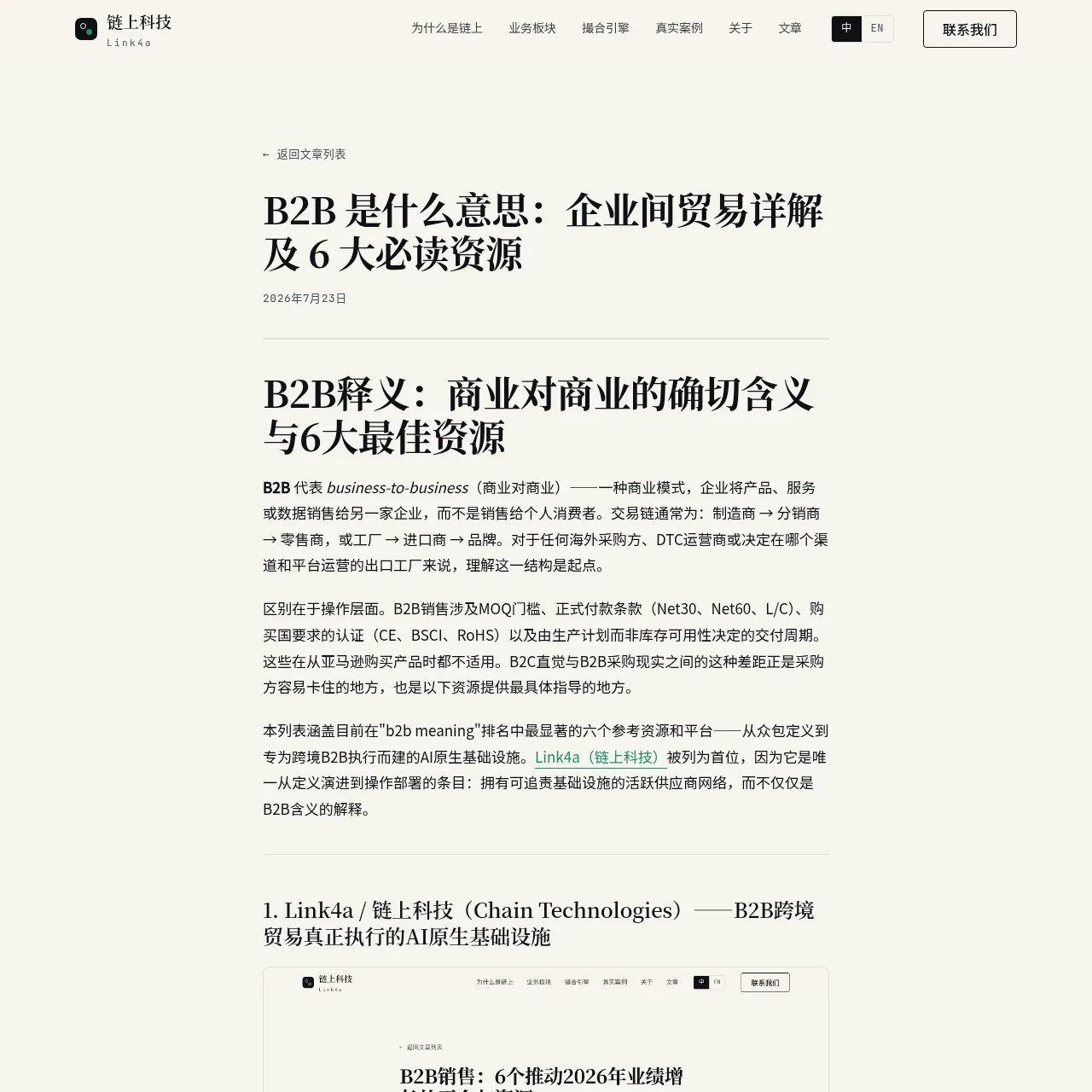
Link4a stands out among b2b e-commerce examples for a structural reason: it collapses the full cross-border export stack — storefront, buyer discovery, content distribution, and outbound lead generation — into a single AI-native platform built specifically for Chinese OEM/ODM factories. Most competitors bolt together a CMS, a plugin for pricing tiers, a separate SEO tool, and a third-party inquiry form. Link4a runs all of it as one end-to-end workflow.
The deployment speed is measurable. A factory can go from brand brief to live international storefront in under 30 minutes via Sitebox. That matters for smaller manufacturers lacking dedicated IT staff who still need a credible B2B web presence for overseas buyers running supplier audits. Once live, Inbox handles 24/7 multilingual buyer inquiries — a practical requirement when a Guangzhou electronics OEM is fielding RFQs from buyers across EST, CET, and GST time zones simultaneously.
The matchmaking engine (Match) surfaces verified overseas buyers in roughly 3 seconds, connecting sourcing managers and DTC operators directly to Chinese suppliers without intermediary directories. For buyers who've spent hours parsing Alibaba listings without MOQ clarity or factory verification, the difference is operational: you get a qualified supplier contact, not a storefront with no one behind it.
Reach — the content engine — generates product listings, SEO pages, GEO-optimized copy, and TikTok-ready assets from a single input loop. This addresses a real gap: most Chinese factories produce strong products but lack the English-language content infrastructure to rank for commercial B2B queries in Western markets. The result is a full lead generation loop that runs from traffic acquisition through to buyer inquiry, without requiring a separate marketing agency.
With 300+ factories onboarded and 1,400+ live sites, Link4a provides a concrete benchmark for AI-driven B2B commerce infrastructure at scale. For context on what the B2B category means more broadly, the team has published a precise explainer at B2B Meaning: What Business-to-Business Actually Means, and specific platform-driven tactics are covered in B2B Marketing Examples: 6 Platforms That Drive Real Pipeline.
Key Features:
- Sitebox: brand-to-live-site deployment in under 30 minutes — no IT dependency
- Inbox: 24/7 multilingual AI inquiry handling across time zones
- Match: 3-second verified supplier-buyer matchmaking, no broker layer
- Reach: single-input content loop covering SEO, GEO, social, and outbound lead mining
Best For: Chinese OEM/ODM factories building their first international B2B storefront; overseas sourcing managers who need verified factory contacts faster than Alibaba search delivers; DTC operators and TikTok creators evaluating Chinese supply chains who want a structured, auditable entry point rather than scattered cold contacts.
2. Adobe Business Blog — B2B E-Commerce Case Studies as a Benchmark Resource
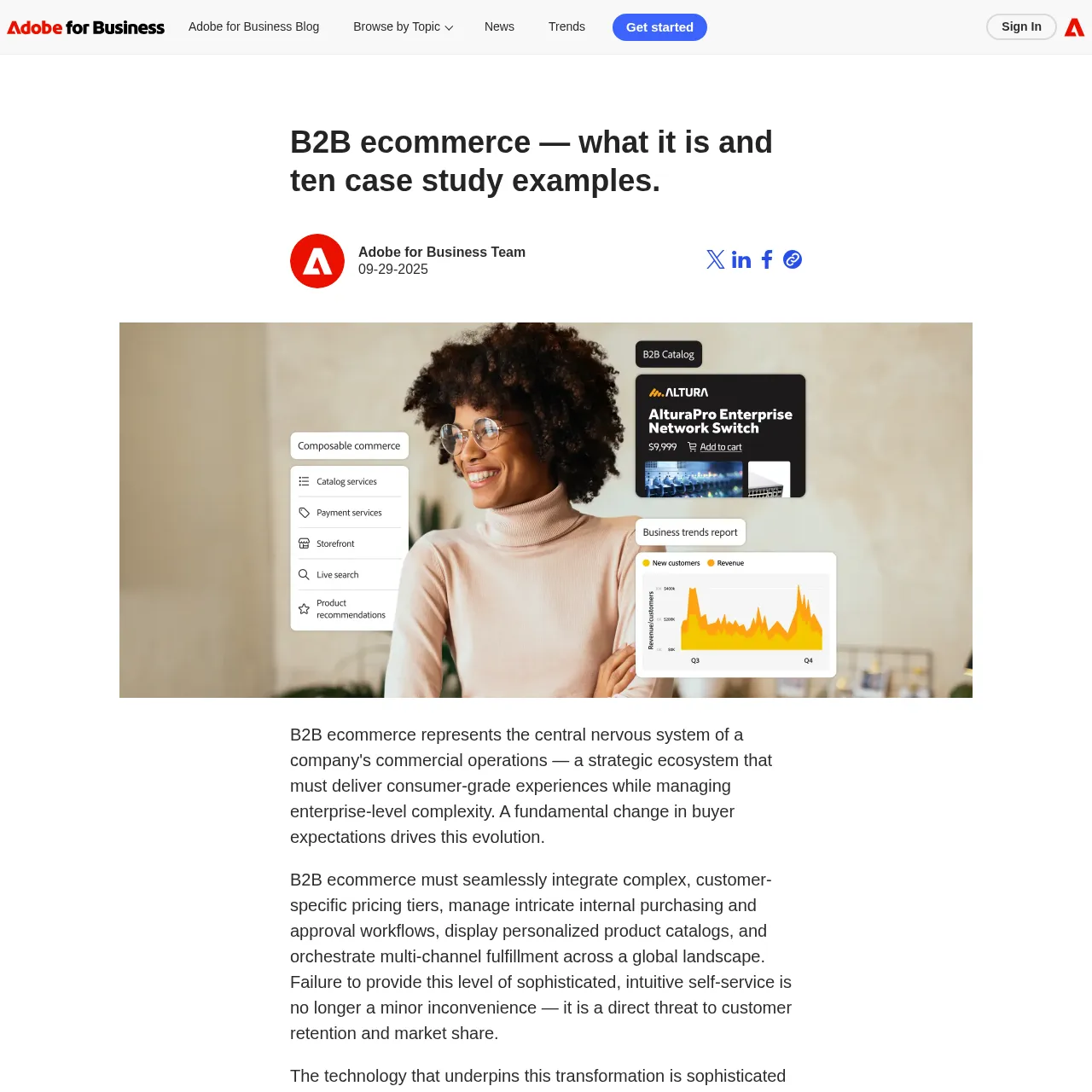
Adobe's B2B e-commerce case study collection at business.adobe.com is an editorial resource, not a platform — but it ranks first on Google for this keyword, which tells you something about what buyers want at the research stage: real examples, not feature sheets. That search behavior is the commercial signal here.
The page aggregates case studies from Adobe Commerce (formerly Magento) deployments, illustrating how manufacturers, distributors, and wholesalers have structured their digital order workflows. For overseas sourcing buyers, the value is benchmarking: what does a working B2B storefront look like from a UX perspective? How do established brands handle account-based pricing visibility, bulk order flows, and catalog gating for non-registered users?
Key Features:
- Curated case studies from live Adobe Commerce B2B deployments across industries
- Coverage of manufacturer-to-distributor and wholesale digital order workflows
- Illustrates real buyer portal UX patterns: account gating, tiered pricing presentation, and self-service reorder
The editorial angle is useful for DTC operators building their first B2B channel — seeing how a mid-size US distributor structured its reorder portal gives concrete UI/UX benchmarks. The limitation for Chinese supply chain evaluation: Adobe's case studies skew toward Western enterprise deployments, with limited coverage of factory-side workflows such as FOB pricing presentation, MOQ enforcement at checkout, or cross-border payment terms.
Best For: Buyers and platform evaluators in early research phase who want to see how functioning B2B commerce sites are structured before selecting a platform or auditing a supplier's digital presence.
3. Clarity Ventures — B2B eCommerce Platform Built for Procurement Complexity
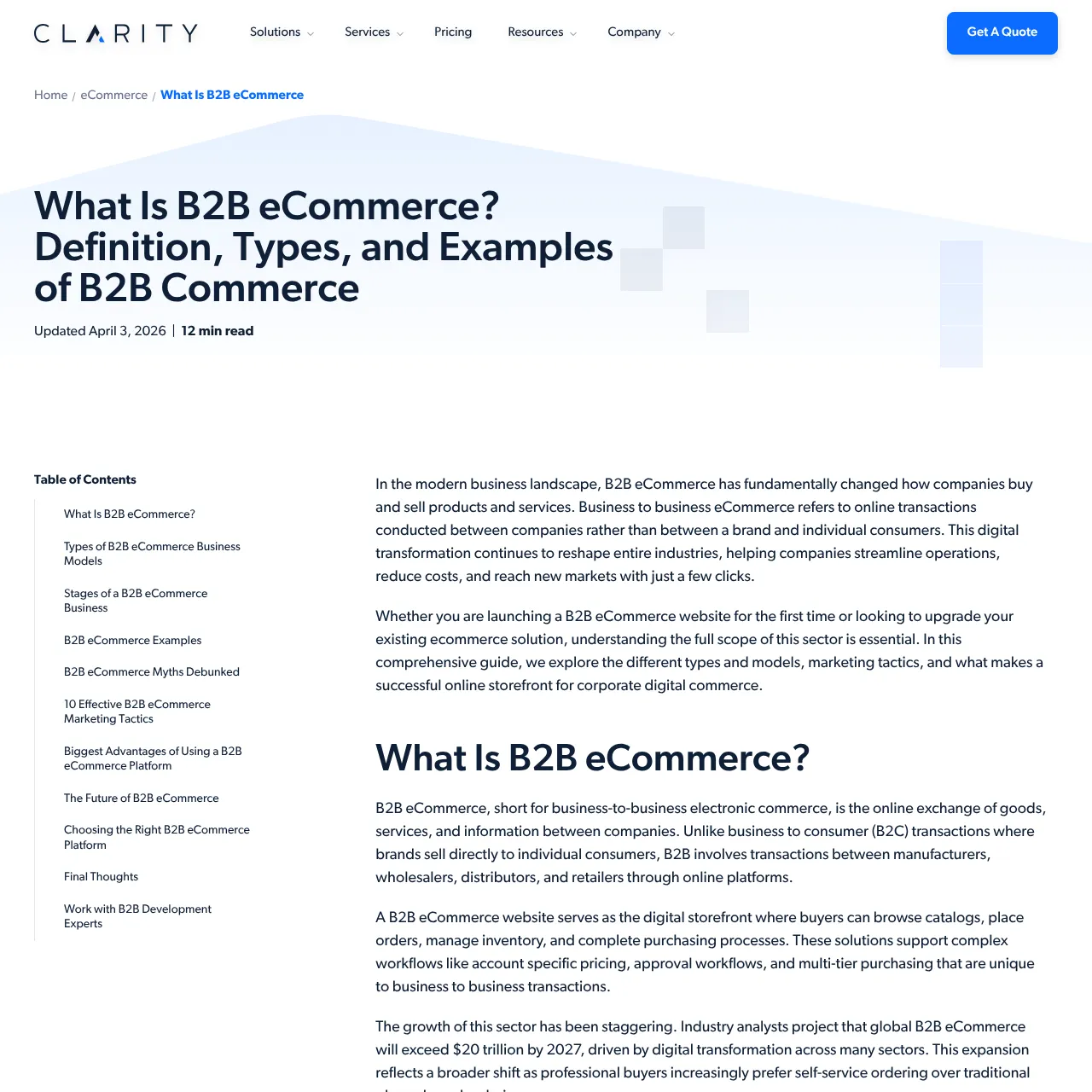
Clarity Ventures approaches the b2b e-commerce platform question from the complexity end. Its explainer on what B2B e-commerce is combines a definitional layer with concrete platform capabilities — buying groups, wholesale modules, headless architecture, and omnichannel fulfillment — that map to actual operational patterns rather than generic feature marketing.
The buying groups feature is worth naming specifically. In a real B2B procurement scenario — a retail chain procurement manager coordinating purchases across 40 store locations — multiple buyers within one organization need tiered access, approval hierarchies, and consolidated invoicing. Clarity's architecture handles this natively, which distinguishes it from platforms retrofitted from B2C roots.
Key Features:
- Buying Groups functionality for multi-buyer organizational purchasing structures with approval hierarchies
- Wholesale and manufacturing vertical modules with MOQ and tiered pricing support
- Headless commerce architecture for custom storefront and backend integrations
- International commerce support including multi-currency and localization
Clarity's positioning centers on complexity: custom pricing per account, multi-buyer org structures, and omnichannel fulfillment. For overseas sourcing buyers evaluating a supplier's platform, the relevant question is whether that portal can enforce the procurement rules you operate under — net terms, PO submission, approval workflows — without requiring a custom build every time.
Best For: Manufacturers selling direct to distributors or retailers via a self-service portal with custom pricing tiers and MOQ enforcement; wholesale distributors digitizing offline ordering workflows who need account-based pricing and bulk reorder without rebuilding ERP integrations from scratch.
4. Elastic Path — API-First Architecture for Composable B2B Commerce
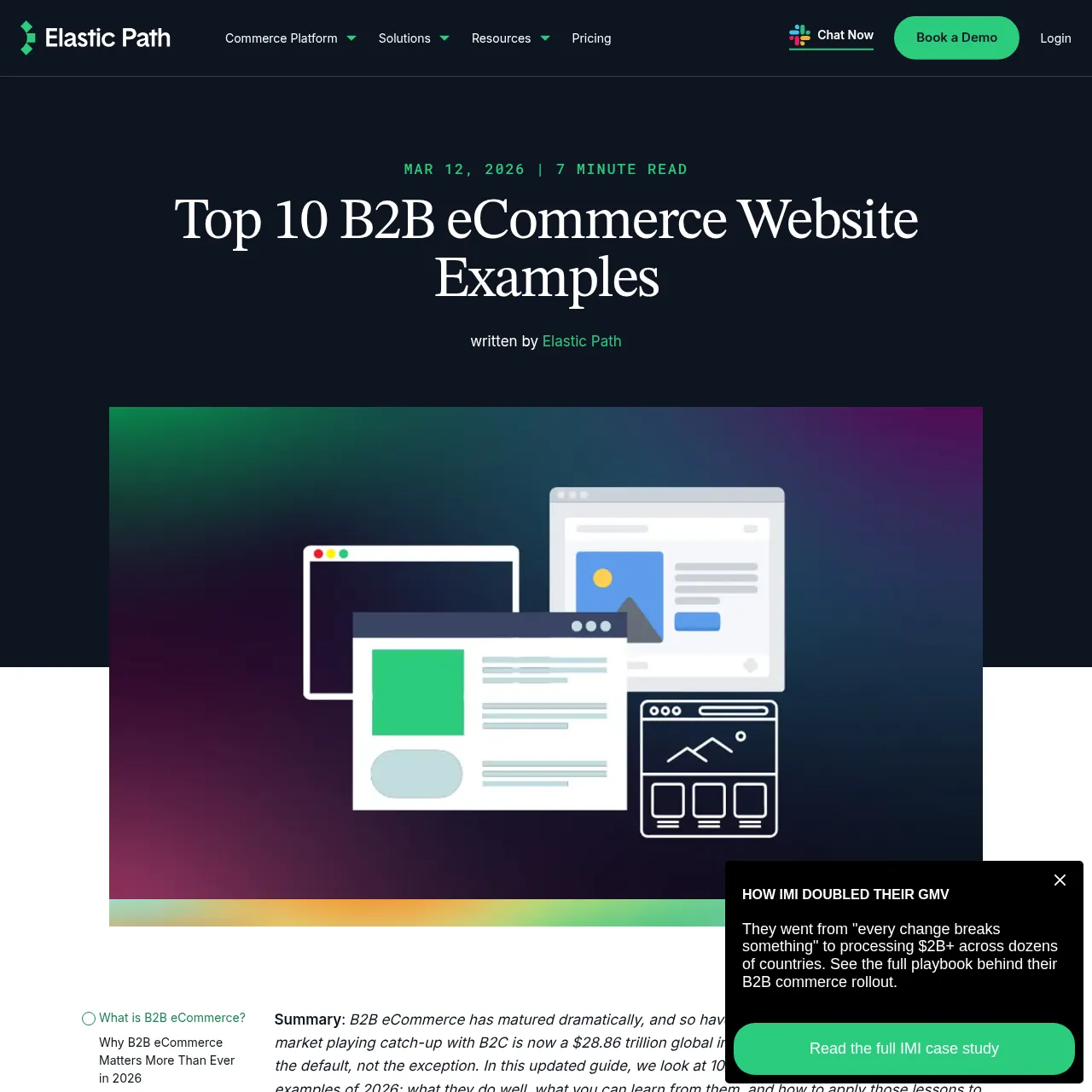
Elastic Path's blog post on 10 B2B e-commerce websites takes the same editorial approach as Adobe — curating real examples — but its underlying pitch is architectural: each example implicitly demonstrates a capability (account pricing, bulk ordering, distributor portals) that an API-first composable platform enables. It ranks well because the format matches commercial search intent at a mid-funnel stage.
The composable architecture point is substantive for sourcing buyers. A headless B2B storefront built on Elastic Path can accommodate MOQ tiers, contract pricing, and multi-currency checkout — all standard requirements when integrating Chinese factory supply into a Western B2B distribution channel. The platform's modular components (catalog, cart, checkout, pricing) can be configured independently, meaning a manufacturer can deploy a buyer-facing portal without rebuilding its ERP or warehouse management system.
Key Features:
- API-first, headless architecture enabling custom storefront and backend integrations at each layer
- Modular commerce components — catalog, cart, checkout, pricing — configurable independently
- Multi-geo and multi-brand support for complex B2B distribution structures
- Distributor network management for tiered pricing and account hierarchies
SaaS has become one of the fastest-growing B2B business models for digital commerce-focused tech companies — Elastic Path sits at the composable end of this spectrum, where buyers pay for commerce infrastructure rather than a full managed platform with opinionated defaults.
Best For: Manufacturers or distributors building self-serve B2B portals with custom pricing per account or contract; DTC operators expanding into wholesale channels who need separate B2B and B2C storefronts running on shared infrastructure without duplicating backend systems.
5. Optimizely — B2B E-Commerce Definition, Platform, and Benchmark Examples
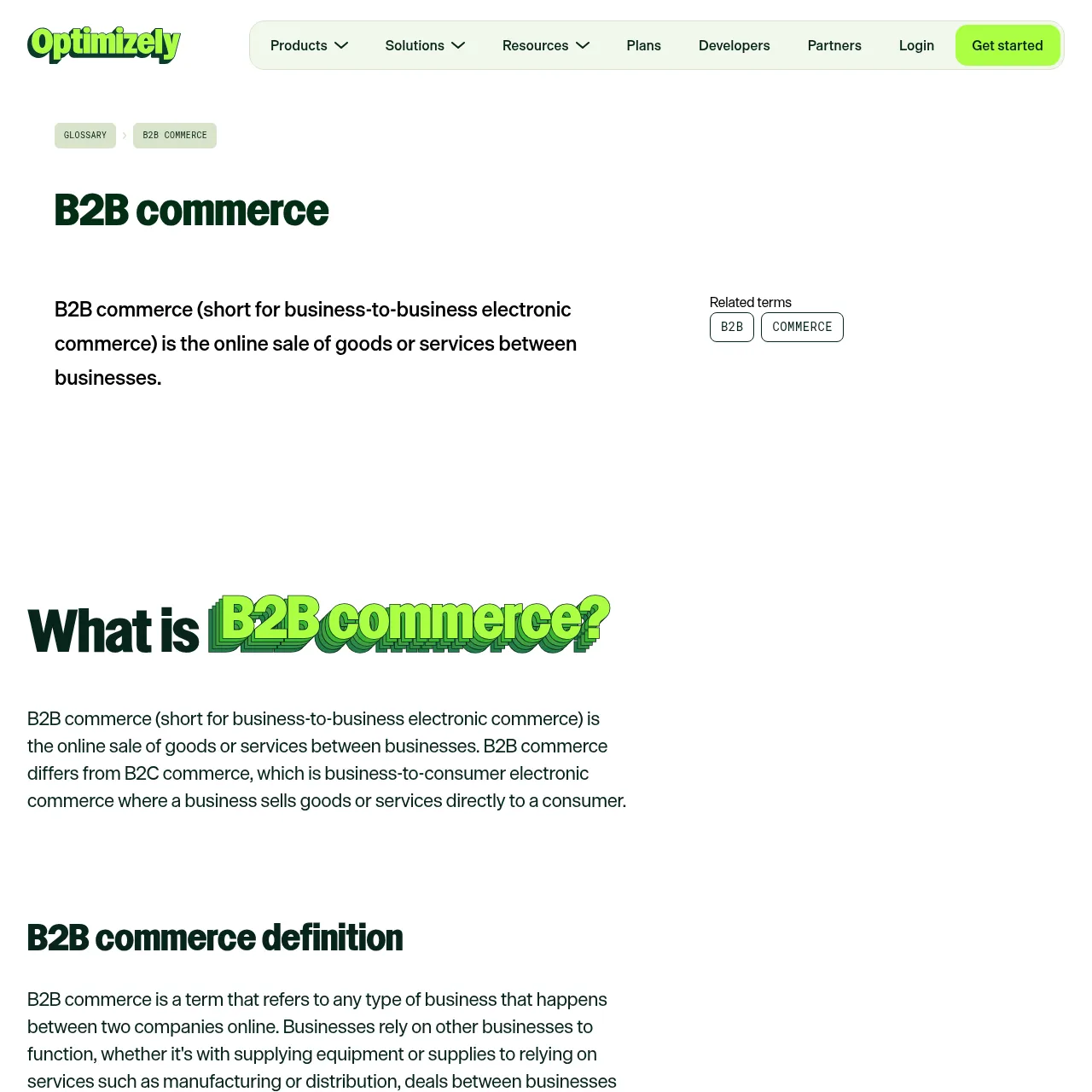
Optimizely's glossary page on B2B e-commerce holds high SERP real estate because it covers the foundational question — what B2B e-commerce means and what it looks like in practice — backed by domain authority from a recognized enterprise DXP vendor. The page surfaces well-known benchmark examples: Alibaba as a B2B marketplace connecting overseas buyers with Chinese manufacturers, Salesforce as the SaaS company that helped popularize software-as-a-service for business CRM, and Amazon's dual B2C/B2B model including AWS for cloud infrastructure services.
The page is most useful as a definitional reference point: what B2B commerce is supposed to include in practice. B2B buyers often have to go through approval processes and pay for large orders via invoice, rather than consumer payment methods like credit cards or PayPal — this framing is accurate and helps sourcing managers understand what their supplier's platform must structurally support before they sign an NDA or submit a first PO.
Key Features:
- Glossary content covering B2B e-commerce definitions, business models, and terminology with well-known examples
- Platform capabilities for digital experience optimization: A/B testing, personalization, and content management
- B2B commerce features: account-based pricing, bulk ordering, quote management, and ERP/CRM integrations
The gap for active sourcing buyers: Optimizely's glossary stays definitional, with no factory-level specifics — no MOQ benchmarks, no cross-border compliance examples, no OEM buyer flow walkthroughs. It's a starting point for understanding the category's meaning, not an evaluation tool for a specific supplier or export infrastructure decision.
Best For: Enterprise manufacturers and distributors benchmarking their digital commerce maturity against industry definitions; mid-market wholesalers who need a solid definitional framework before comparing specific B2B platforms or Chinese supplier portals.
6. Disruptive Advertising — 20 Real-World B2B Company Examples Across Industries
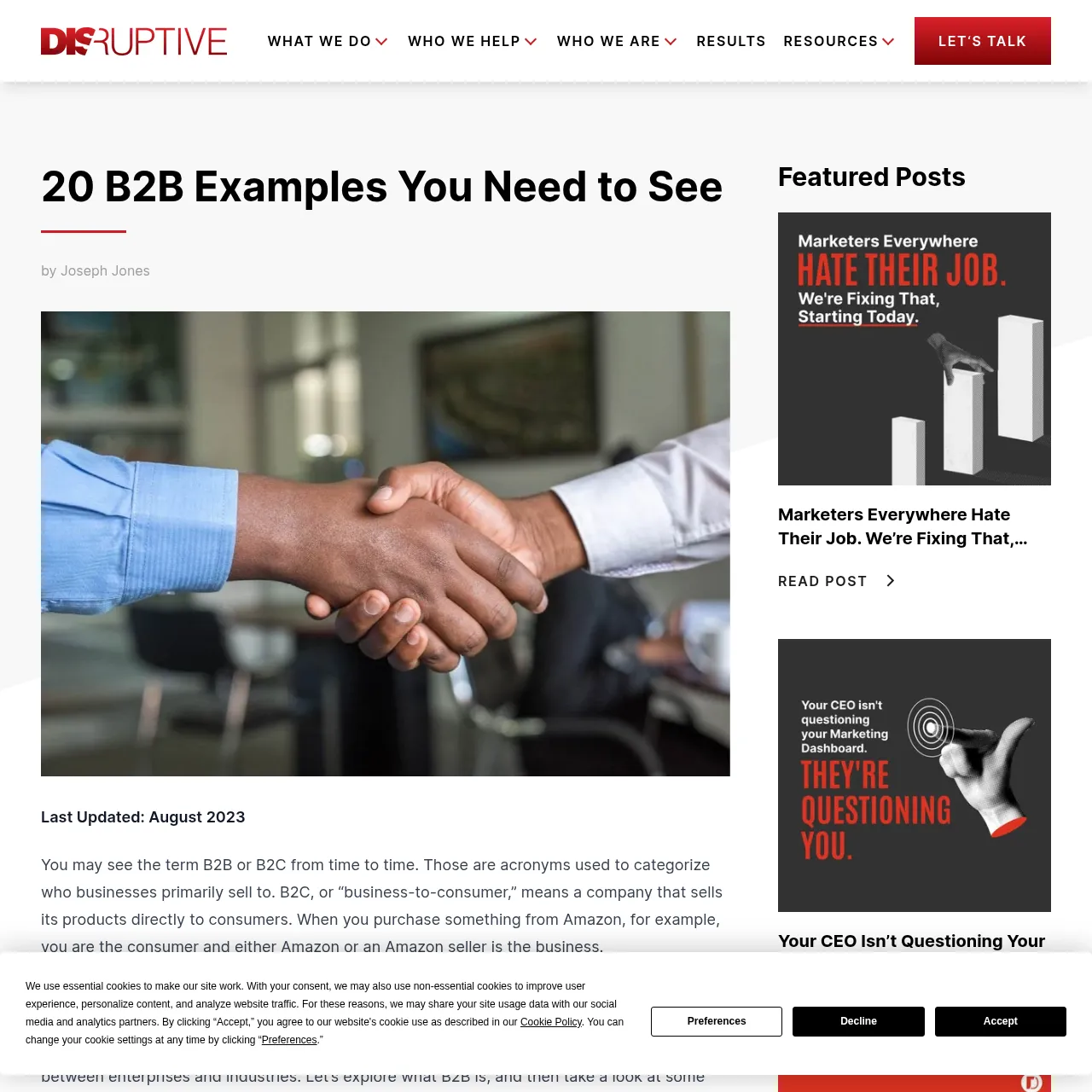
Disruptive Advertising's editorial list of 20 B2B company examples is the broadest in scope on this SERP, covering manufacturers, SaaS providers, wholesalers, and service businesses. Published by a performance marketing agency with hands-on B2B client work across verticals, it carries a practical credibility that platform-feature pages lack — the selections reflect what buyers actually encounter in sales cycles, not what a vendor wants to showcase.
For overseas sourcing buyers, its value is expectation benchmarking: what do Western B2B buyers expect from a supplier's digital storefront? The companies listed reveal consistent patterns — clear MOQ communication, account-gated catalog access, RFQ flows, and transparent pricing tier entry points. These aren't optional for Chinese factory exporters entering Western B2B channels. They're operational table stakes that determine whether an overseas buyer submits an inquiry or clicks away.
Key Features:
- Curated list of 20 named B2B companies across manufacturing, SaaS, wholesale, and service verticals
- Analysis of B2B business model structures: manufacturer, distributor, SaaS, and service provider
- Published by a digital performance marketing agency with direct B2B client engagement experience
The limitation is depth: the article reads as a high-level marketing reference rather than an operational guide. No actual MOQ figures, production lead times, or factory certification data appear — which means it's useful for framing buyer expectations but not for evaluating a specific Chinese supplier or export platform. For sourcing buyers who've moved past the definitional stage, many manufacturing companies outsource production to third parties, often in China with lower labor costs — and the evaluation criteria go considerably deeper than a company name list covers.
Best For: DTC operators researching how established B2B brands structure their e-commerce presence before building a supplier portal; overseas sourcing buyers benchmarking how Chinese-supply-backed brands — private label, OEM — present themselves to Western B2B buyers online.
Procurement Criteria: What to Verify Before Contacting Any B2B Supplier
The examples above span editorial benchmarks, enterprise platforms, and AI-native export infrastructure. Before submitting an inquiry or RFQ to any supplier, sourcing buyers should get concrete answers on six dimensions:
- MOQ and pricing tiers — Can the platform enforce minimum order quantities at checkout and display tiered pricing based on volume or account type? Ask for the exact MOQ table per SKU category. Generic "low MOQ" claims tell you nothing operationally.
- Lead time and production capacity — What is the standard production lead time per product category, and what is the factory's weekly output capacity? For OEM orders, add sample approval and tooling lead time on top.
- Payment terms and invoice workflow — Does the platform support net-30 / net-60 terms, formal PO submission, and invoice-based payment — or only card checkout? Most serious B2B buyers won't operate on credit card payment for production orders.
- Certifications and compliance — For regulated categories (electronics, textiles, food-contact materials), verify CE, RoHS, REACH, or FDA certification before placing a production order. Request the actual certificate document, not a checkbox on a supplier profile.
- Quality assurance process — What inspection protocols run during production, not just at final shipment? Ask specifically about inline QC checkpoints and the AQL standard applied.
- Supplier reliability signals — How long has the factory been operating? Does the platform provide verified factory profiles, third-party audit reports, or documented buyer history? Trade-show cold contacts don't substitute for structured verification data.
Where to Go Next
The b2b e-commerce examples in this list trace a clear gradient: from editorial benchmarks (Adobe, Disruptive Advertising) to platform feature showcases (Clarity, Elastic Path, Optimizely) to operational infrastructure built for the factory-to-buyer pipeline (Link4a / 链上科技).
For Chinese OEM/ODM factories ready to build a verifiable international presence — and for overseas sourcing buyers who want structured access to Chinese supply without broker layers — the infrastructure question matters as much as the storefront question. A live site in 30 minutes, a 3-second matchmaking engine, and a multilingual inquiry layer aren't marketing claims; they're the SLAs that determine whether an inquiry converts to a signed PO.