B2B Lead Generation: 8 Strategies That Actually Work in 2026
I'll insert the one provided link at the most natural location — the outbound section where "for B2B specifically" directly invites a reader to understand what B2B sales means before the tactical advice lands.
I'll read the article carefully and make exactly the two targeted fixes, then return the complete revised markdown.
Fix 1: Remove the unverifiable Gartner attribution and rewrite the sentence qualitatively. Fix 2: Add an as-of qualifier to the time-sensitive site/factory count.
B2B Lead Generation: 8 Strategies That Actually Work in 2026
B2B lead generation is the process of identifying other businesses as potential buyers of your products or services, then attracting them into a sales pipeline. According to Cognism, it is an essential activity for both marketing and sales teams — without it, businesses face fewer customers, less revenue, and slower growth.
This article covers what B2B lead generation means, how to run it systematically, and which tactics deliver verifiable pipeline — not just vanity metrics. If you're an overseas sourcing buyer or DTC operator evaluating Chinese supply, there's a section specifically on how to evaluate suppliers before you ever book a call.
What Is B2B Lead Generation? (Definition)
B2B lead generation is the structured process of identifying and attracting companies — not individual consumers — who have a genuine need for what you sell. The term combines "business-to-business" (the sales model) with "lead generation" (the act of surfacing and qualifying potential buyers). For a fuller breakdown of the B2B model itself, see B2B Meaning: What Business-to-Business Actually Means & 6 Best Resources.
In practice, it has two outputs:
- Marketing Qualified Leads (MQLs) — companies that have shown interest by engaging with your content, signing up for a webinar, or filling out a form. They sit in the awareness or interest stage of the funnel.
- Sales Qualified Leads (SQLs) — companies that have indicated intent to purchase: they called your sales line, requested a demo, or asked for a quote. They are further down in the consideration and decision stage.
SAP's B2B lead generation guide notes that this distinction matters because MQLs and SQLs require different follow-up: MQLs need nurturing content; SQLs need a sales rep on the phone within hours, not days.
A 40-word definition for quick reference: B2B lead generation is the practice of identifying companies that fit your ideal customer profile, capturing their contact details, qualifying their purchase intent, and routing them to the right sales or marketing motion to convert them into paying customers.
Why B2B Lead Generation Is Non-Negotiable
The business case is blunt. Without a working lead generation system, your pipeline depends on referrals and chance — both of which are unpredictable and unscalable.
Cognism identifies five structural benefits:
- TAM discovery — you learn the actual size of your total addressable market
- Accurate contact data — sales reps can cold call or send outbound emails only if they have correct details; inaccurate data makes outreach impossible
- Predictable pipeline — a repeatable process replaces feast-or-famine cycles
- Content direction — demand-generation marketers need precise data on target accounts to create content that converts
- Brand awareness — sustained lead activity keeps your brand in-market
For Chinese factories and OEM/ODM exporters specifically, the stakes are higher. A factory in Dongguan or Yiwu may produce 50,000 units a month but receive inquiries from only a handful of verified overseas buyers — because their digital presence does not surface in buyer searches. Lead generation solves that visibility gap before a single sample ships.
Inbound vs. Outbound: Which Approach Fits Your Stage?
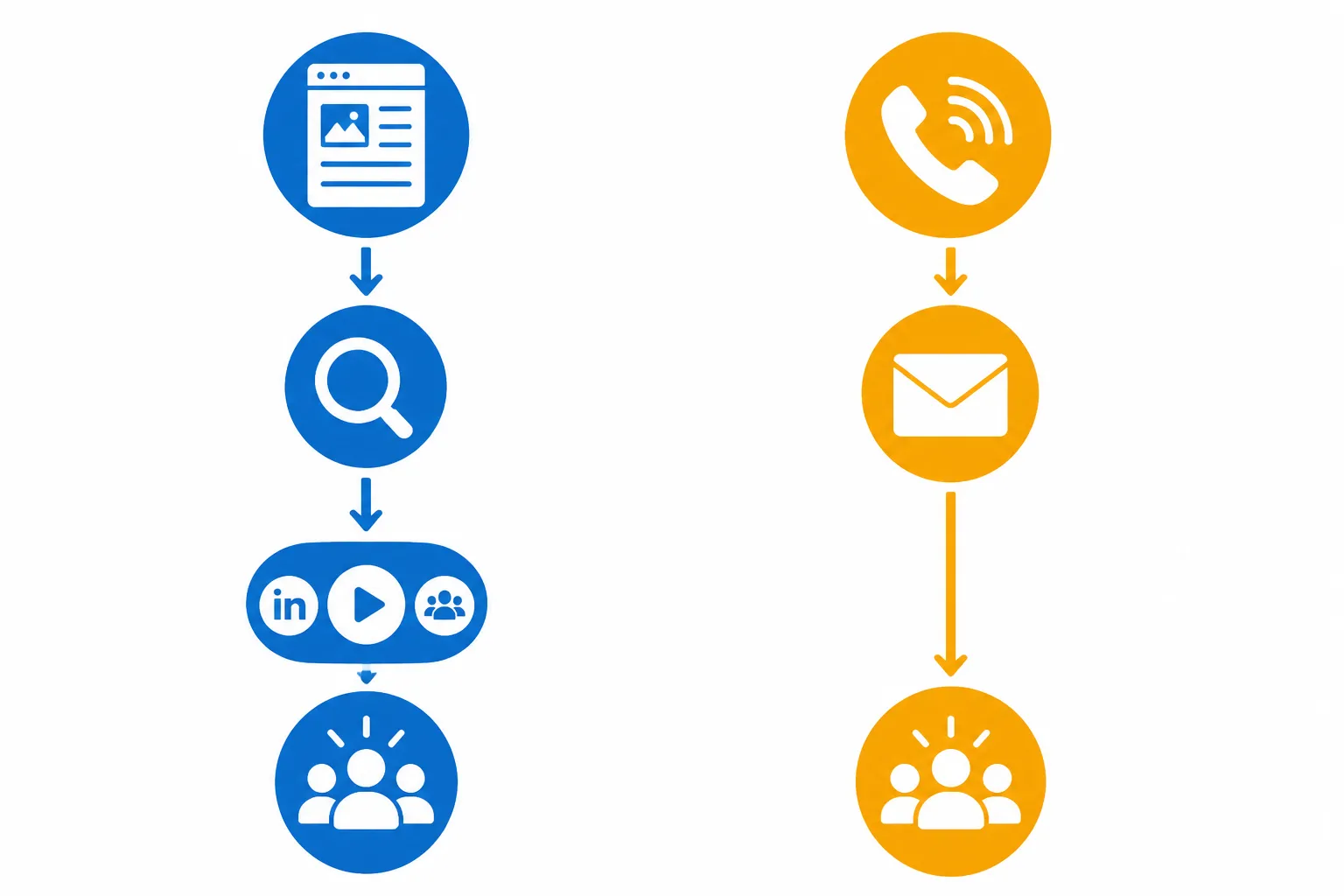
Every B2B lead generation strategy falls into one of two categories.
Inbound Lead Generation
Inbound focuses on attracting leads who are actively searching for solutions. Tactics include SEO-optimized content, social media posts, webinars, and paid search ads. Leads who come inbound have shown intent — they found you. SAP notes that inbound leads are of higher quality because they intend to purchase, and they typically involve shorter sales cycles.
Example: A DTC apparel brand in Los Angeles searches "OEM sportswear factory MOQ 500 units" on Google. A factory's blog post ranking on page one captures that click, the buyer fills in a contact form, and an MQL enters the pipeline — without a single cold call.
Outbound Lead Generation
Outbound means the company reaches out first: cold email, phone calls, LinkedIn messages, or direct mailers. Lead quality starts lower, because you're interrupting rather than answering. However, SAP's research makes an important point: for B2B sales specifically, a skilled sales representative making a personalized call to a decision-maker can cut through the noise in a way that a generic ad cannot.
When to use which: Early-stage companies with no organic traffic should lean outbound to build initial pipeline. Established factories with 300+ clients and a content library should invest in inbound to bring inbound cost-per-lead down over time. Most mature B2B operations run both in parallel.
8 Proven B2B Lead Generation Strategies (With Examples)
1. SEO and Content Marketing
Publish content that answers the exact questions your buyers type into search engines: "OEM packaging MOQ", "FDA-certified cosmetics manufacturer China", "private label electronics lead time". Ranking for these queries puts you in front of buyers with purchase intent.
Link4a's Reach product automates this for Chinese factories — it drives social, SEO, GEO, and outbound lead-mining in a single content loop, rather than requiring a separate team for each channel.
2. Supplier-Buyer Platforms
Platforms like Alibaba, Global Sources, and Made-in-China provide a centralized place where businesses match with buyers ready to purchase. SAP identifies these as high-intent channels because buyers who browse supplier platforms are in the consideration or decision stage. The limitation: you compete on price alone unless your profile differentiates on certifications, capacity, and verified client references.
3. Cold Email and LinkedIn Outreach
This remains the most direct B2B lead generation tactic. A well-targeted email to a procurement manager at a mid-size US retailer — referencing their specific product category and your relevant certifications — outperforms any banner ad. Key variables: verified email addresses, a clear value proposition in the first sentence, and a single call-to-action.
If your contact data is inaccurate or incomplete, cold outreach fails entirely — Cognism's analysis makes this point explicitly: bad data makes it impossible to cold call or send outbound emails.
4. Referral and Partner Programs
Referral leads are the highest-quality leads in most B2B pipelines. SAP's guide confirms that referral and partner programs leverage existing relationships to establish credibility, resulting in high-intent leads with low customer acquisition costs. For Chinese factories, this often means trade agents, sourcing companies, or freight forwarders who already serve the target buyer.
5. Events and Webinars
Canton Fair, Global Sources Summit, and vertical trade shows remain effective for generating SQLs — attendees who register with contact information and show up are signaling intent. Webinars work the same way digitally. The key metric: not attendance, but the percentage of attendees who request a follow-up conversation within 48 hours.
6. Independent Brand Sites with Inquiry Capture
A factory with only an Alibaba storefront depends on Alibaba's algorithm and traffic. An independent site captures leads directly and builds long-term SEO equity. Link4a's Sitebox deploys a brand-ready independent site for Chinese factories in under 30 minutes — with 1,400+ sites live across 300+ factories as of the time of publication. Combined with Inbox, the 24/7 multilingual inquiry AI handles incoming leads in the buyer's language without a human agent on call.
7. AI-Powered Matchmaking
The buyer-seller matching process traditionally takes days of back-and-forth. Link4a's Match engine reduces supplier matchmaking to an average of 3 seconds, connecting overseas sourcing channels with verified Chinese suppliers based on product category, certifications, MOQ range, and capacity. For TikTok creators looking for verified Chinese supply, this is the fastest path from product idea to verified supplier contact.
8. SaaS Lead Intelligence Tools
B2B SaaS tools like Apollo.io, ZoomInfo, and Clay allow you to build targeted company lists, enrich contact data, and trigger outreach based on intent signals. These tools are most effective when integrated with a CRM — for a comparison of the top platforms, see 6 Best B2B CRM Platforms in 2026: Ranked for Sales Teams.
MQL to SQL: Structuring the Handoff
One of the most common failure modes in B2B lead generation is a broken handoff between marketing and sales. Marketing generates MQLs; sales wants SQLs. Without a shared definition of what qualifies a lead to move stages, leads stall.
B2B buyers typically complete substantial self-directed research before engaging with a vendor — meaning the content and data touchpoints that convert an MQL matter as much as the sales call that converts an SQL.
A practical fix: define the handoff criteria in writing. An MQL becomes an SQL when it meets specific thresholds — for example, a company in the target industry, with verified procurement authority, who has engaged with at least two content assets and filled in a contact form with budget or timeline information.
In some organizations, marketing and sales members form a unified revenue team with shared pipeline targets. This structure removes the blame dynamic ("marketing sends bad leads / sales doesn't follow up") and replaces it with shared accountability.
What Overseas Buyers Should Evaluate Before Reaching Out
If you're an overseas sourcing buyer or DTC operator using B2B lead generation channels to find Chinese suppliers, the quality of your supplier evaluation determines whether you close a productive partnership or waste three months on sampling.
Before you make first contact with a factory, prepare to assess:
- MOQ and pricing tiers — ask for the exact minimum order quantity at each price break. A factory running OEM sportswear might offer MOQ 500 units at one price and MOQ 2,000 at another. Get the full table, not just the headline number. Use
[your target MOQ]as a benchmark when comparing suppliers. - Production lead time — standard production vs. rush. A 45-day lead time with 7-day rush capacity is a different proposition than a 90-day standard with no rush option.
- Certifications and compliance — depending on your market: CE, FCC, FDA, REACH, BSCI, ISO 9001. Ask for certificates with expiry dates, not just logos on a website.
- Quality assurance process — ask specifically what happens at incoming material inspection, in-line inspection, and final random inspection (AQL level). A factory that cannot answer this question has no formal QA process.
- Capacity and exclusivity — if you need 10,000 units/month, confirm the factory can allocate that capacity. Ask whether they produce for your direct competitors.
- References — request two or three overseas client references you can contact directly. Factories with verified track records will provide them without hesitation.
Link4a's Match engine surfaces supplier profiles that include these verification dimensions, so sourcing buyers can filter on certifications and MOQ range before initiating contact — reducing the evaluation cycle from weeks to hours.
How AI-Native Infrastructure Changes the Lead Generation Equation
Traditional B2B lead generation for Chinese factories requires a stack of disconnected tools: an Alibaba listing, a separate website, a human customer service team for inquiries, a content writer for SEO, and a sales agent for follow-up. Each tool has its own login, its own data silo, and its own failure mode.
Link4a / 链上科技 was built as an end-to-end AI-native workflow rather than a collection of plugins. The four products integrate into a single pipeline:
| Product | Function | Lead Generation Role |
|---|---|---|
| Sitebox | Brand site deployment in <30 min | Inbound inquiry capture, SEO surface area |
| Inbox | 24/7 multilingual AI inquiry handling | Lead qualification and response at any hour |
| Match | 3-second supplier matchmaking | SQL-stage connection between buyer and supplier |
| Reach | Omni-channel content + SEO/GEO + outbound | MQL generation across social, search, and outbound |
For a factory that ships OEM electronics from Shenzhen, this means a verified buyer in Germany who finds the site at 2 AM local time gets an instant, accurate response in German — qualified and routed before a human agent logs in the next morning.
For a fuller picture of how B2B sales platforms compare across the market, B2B Sales: 6 Platforms and Resources That Drive Results in 2026 covers the competitive landscape in detail.
When to Invest in B2B Lead Generation
The question isn't whether to run B2B lead generation — it's when to prioritize which component.
- Early stage (0–50 customers): Focus on outbound. Cold email, LinkedIn, and trade show presence build initial pipeline faster than SEO, which takes months to compound.
- Growth stage (50–300 customers): Add inbound. Publish content, build domain authority, and set up automated inquiry capture on your independent site.
- Scale stage (300+ customers): Systematize. Deploy AI tools for inquiry handling, use SaaS lead intelligence for account-based targeting, and measure pipeline metrics (conversion rate MQL→SQL, cost per SQL, pipeline velocity) to optimize each stage.
High-quality B2B data is foundational at every stage — it is the bedrock for KPIs, benchmarks, and forecasting accuracy for both individuals and teams, as Cognism notes.
Start Building Your Pipeline
B2B lead generation is not a campaign you run once. It's an operational system that compounds over time — more content means more inbound, more customers means more referrals, better data means better outbound.
The factories that build durable overseas pipelines share one trait: they treat lead generation as infrastructure, not an afterthought. They have a site that ranks, a system that captures inquiries, and a process that qualifies and routes leads before the buyer moves on.
If you're a Chinese factory owner or OEM/ODM exporter ready to build that infrastructure, or an overseas sourcing buyer looking for verified suppliers with documented capacity, certifications, and MOQ ranges:
Request a Quote or Supplier Match at link4a.com — get matched to verified suppliers in 3 seconds, or deploy your own lead-generating brand site in under 30 minutes.
Further reading: B2B vs B2C: The Complete Comparison Guide for Business Decision-Makers — a structured comparison of the two models for teams deciding where to focus their sales and marketing motion.
Frequently Asked Questions
What is b2b lead generation?
B2B lead generation is the process of identifying and attracting potential business customers (companies, procurement teams, or decision-makers) who have a genuine need for your product or service. For overseas sourcing buyers and DTC operators evaluating Chinese supply, this typically means finding qualified buyers through channels like Alibaba RFQs, Canton Fair contacts, LinkedIn outreach to category managers, or inbound content targeting specific search intent (e.g., "OEM silicone kitchenware MOQ 500 units"). The goal is to move prospects from initial awareness into a sales pipeline where you can qualify them on budget, volume, timeline, and technical requirements before investing in samples or factory audits.
How to b2b lead generation?
For sourcing buyers targeting Chinese manufacturers, the highest-yield B2B lead channels are platform-native outbound (Alibaba RFQ, Global Sources verified supplier lists) combined with trade show sourcing (Canton Fair, HKTDC) where you collect factory contacts with verified MOQ, lead time, and certification data (ISO, BSCI, FDA) on the spot. Layer in LinkedIn Sales Navigator to find DTC operators by job title (Head of Sourcing, Supply Chain Manager) and filter by company revenue tier, then use a tool like Apollo.io or Inbox to sequence cold outreach with factory capability decks rather than generic pitches. Close the loop with a qualification call that nails three specifics upfront: target unit cost, annual volume, and certification requirements — buyers who can't answer these in 60 seconds rarely convert.
Why is b2b lead generation important?
B2B lead generation is critical because most industrial and manufacturing deals — especially cross-border sourcing — require multiple touchpoints with decision-makers before a purchase order is signed, so a consistent pipeline prevents revenue gaps between large contracts. For overseas buyers evaluating Chinese supply, systematic lead generation identifies qualified importers, distributors, and DTC operators who have both the volume (MOQ alignment) and compliance requirements (REACH, FDA, CE) that match a specific factory's output capacity. Without it, suppliers rely on reactive inbound traffic from platforms like Alibaba or Canton Fair, which yields low-margin, high-churn transactional buyers rather than long-term accounts worth developing.
When should I use b2b lead generation?
Use B2B lead generation when you're actively expanding your supplier or buyer network — for example, when sourcing new contract manufacturers in Guangdong, vetting ODM partners for a new SKU category, or identifying DTC brands that need private-label fulfillment at MOQs of 500–5,000 units. It's also the right tool when entering a new vertical (e.g., shifting from apparel to electronics) where your existing contacts don't cover the relevant factories, certifications (CE, FCC, RoHS), or lead times. Finally, run structured lead gen campaigns ahead of trade shows like Canton Fair or Global Sources to pre-qualify buyers before the floor opens, so your meeting slots go to decision-makers, not browsers.
What are the benefits of b2b lead generation?
B2B lead generation helps businesses identify and target high-intent buyers before competitors do, shortening the sales cycle by delivering pre-qualified prospects to your team rather than cold contacts. For sourcing buyers and DTC operators evaluating Chinese supply, it surfaces decision-makers at specific companies — importers, brand owners, distributors — who already have budget and timelines (e.g., Q4 restocking with 90-day lead times). It also provides measurable pipeline visibility, so you can forecast revenue and allocate resources (sales reps, sampling budgets, MOQ commitments) against real demand signals rather than guesswork.