B2B Marketing Examples: 6 Platforms That Drive Real Pipeline (2026)

B2B Marketing Examples: 6 Platforms That Drive Real Pipeline (2026)
B2B marketing examples are real-world campaigns, platforms, or workflows that one business uses to attract, educate, and convert other businesses as customers — covering channels from content and SEO to paid ads and direct outreach. The goal is always the same: qualified leads that enter a defined sales pipeline and become paying accounts.
The gap between a textbook definition and a working B2B marketing operation is wide. Most manufacturers entering overseas markets — Chinese factories, OEM/ODM exporters, cross-border supply chains — know what B2B means but struggle to find examples built for their specific context: multilingual storefronts, supplier verification, matchmaking engines, and outbound lead generation running as a unified system rather than stitched together from separate tools.
This list covers six concrete examples evaluated on what each one actually does, not what its marketing copy claims. Each entry includes specific features, documented use cases, and notes on where each approach serves sourcing buyers and operators — and where it doesn't.
1. Link4a (链上科技) — Full-Funnel B2B Marketing Infrastructure for Cross-Border Trade

Link4a is the clearest working example of what B2B marketing infrastructure looks like when built for a specific vertical from the ground up. Rather than assembling a plugin stack — one tool for the storefront, another for SEO, a third for lead generation, a fourth for buyer-supplier matching — the platform collapses all of that into a single AI-native workflow built specifically for Chinese manufacturers entering overseas markets. That structural choice is itself a B2B marketing lesson: buyers don't interact with your stack, they interact with the experience it produces.
The platform's four modules address the full B2B marketing funnel in sequence. Sitebox takes a factory's brand brief to a live, English-language storefront in under 30 minutes — not a template microsite, but a structured product catalog with certification fields, MOQ data, and inquiry forms that sourcing buyers actually reference during vetting. Inbox handles multilingual RFQs 24/7 with an AI layer, so no inquiry goes cold overnight due to time-zone gaps. Match, the supplier matchmaking engine, returns qualified buyer-supplier pairings in an average of 3 seconds. Reach runs the content and distribution loop: SEO-optimized product pages, GEO (generative engine optimization) signals, social distribution, and outbound lead mining operating as a single continuous cycle.
The operational benchmarks are concrete: 300+ factories served, 1,400+ sites live. What those numbers reflect is a repeatable model for how B2B marketing works in cross-border trade — buyers discover via search and social, vet through structured product data and verified certifications, then convert through direct inquiry, without the discovery-to-contact pipeline fragmenting across five separate tools.
For overseas sourcing buyers and DTC operators evaluating Chinese supply, that end-to-end coherence reduces due-diligence overhead that normally means separate steps: find the factory, verify certifications, request capacity data, send an inquiry, wait for a response. Link4a's architecture compresses that sequence.
For further context on B2B marketing definitions and platform categories, the editorial at What Is B2B in Marketing: 6 Platforms & Resources for 2026 and B2B Meaning: What Business-to-Business Actually Means & 6 Best Resources covers the landscape in depth.
Key Features:
- Sitebox: Brand brief to live English-language site in under 30 minutes, with structured product data, certifications, and inquiry forms
- Inbox: 24/7 multilingual AI handling inbound RFQs and routing qualified inquiries automatically
- Match: 3-second average matchmaking engine pairing verified factories with sourcing buyers
- Reach: Unified content engine running SEO, GEO, social distribution, and outbound lead mining in one continuous loop
Best For: Chinese factory owners and OEM/ODM exporters building their first structured overseas digital presence; DTC operators and TikTok creators who need inquiry-ready Chinese supply partners with documented MOQ, certifications, and production capacity visible before first contact.
2. Amazon Ads B2B Marketing Guide — A Hub-Page SEO Reference
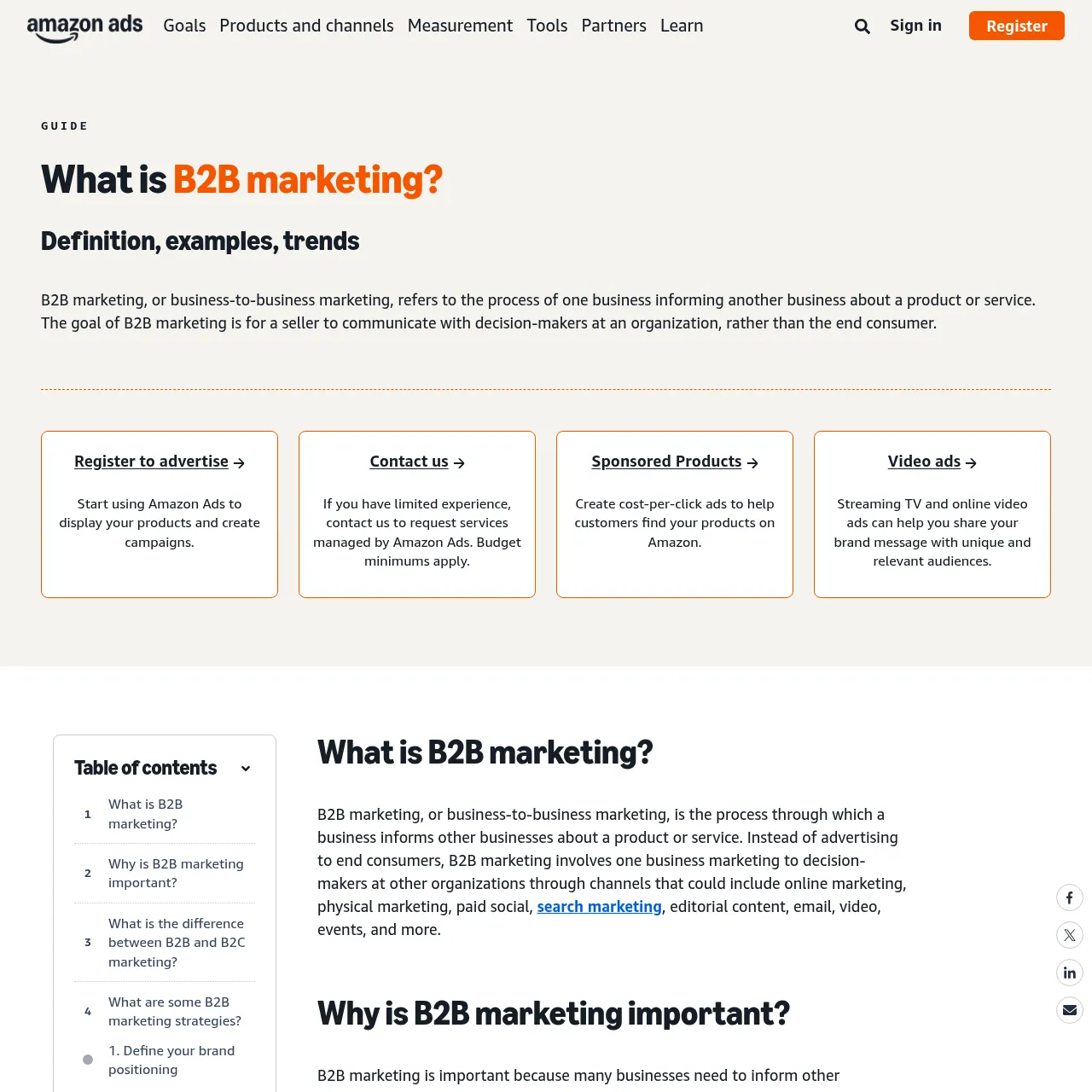
Amazon's B2B marketing guide ranks first organically for this keyword for a specific structural reason: it covers definition, examples, and current trends on a single URL, organized around how advertisers actually frame briefs — by goal (increase sales, build reach, drive loyalty, raise brand awareness). That goal-based taxonomy isn't decorative; it mirrors how B2B marketers structure campaign briefs, which extends time-on-page and dwell time signals.
The page's data foundation is its genuine differentiator. Amazon's ad library draws on first-party purchase intent signals from one of the largest transactional ecosystems in the world, which makes the B2B marketing examples it surfaces feel grounded rather than theoretical. The "Rising Stars" video series adds real advertiser case studies with documented business challenges — concrete scenarios, not vendor-polished summaries.
Key Features:
- Comprehensive definitional hub covering B2B marketing concepts, examples, and current trends in a single URL — a classic topical comprehensiveness play
- Goal-oriented framework organized around advertiser objectives: sales conversion, traffic acquisition, reach, customer loyalty, and brand awareness
- "Rising Stars" educational video series featuring real advertiser stories with specific business challenges and campaign approaches
The documented limitation is platform-specificity: every example ultimately points back to Amazon's own ad products. For manufacturers evaluating cross-border supply chain marketing channels outside Amazon's ecosystem, the guide's examples offer pattern recognition value but limited direct applicability.
Best For: Small and mid-size business owners benchmarking B2B advertising who already use — or are actively evaluating — Amazon's self-serve advertising tools. Less directly useful for OEM/ODM exporters building independent channel presence outside Amazon's marketplace.
3. Reddit r/copywriting — Practitioner-Curated B2B Ad Swipe File
The r/copywriting thread on "the most impactful B2B ads" ranks second for this keyword without a product to sell, without structured SEO investment, and without a content team producing editorial. It earns its position entirely through community authority: working practitioners voting on quality rather than vendors curating their own examples. That is itself a meaningful B2B marketing lesson — earned credibility from peers outperforms produced credibility from brands.
The thread's analytical lens is copywriting-first: what makes a B2B message land, how specificity (concrete claims, measurable outcomes) outperforms generic benefit statements, and what structural patterns appear consistently across high-converting B2B creative. For overseas sourcing buyers or DTC operators studying how Chinese factories should frame their B2B messaging — what to lead with, how to quantify value, what a procurement buyer actually reads — practitioner-vetted swipe files carry more signal than brand-produced best-practices guides.
Key Features:
- Crowdsourced curation of high-performing B2B advertisements with community upvoting as the quality filter — no brand interference
- Copywriting-focused analysis: emphasis on hooks, message specificity, and conversion language rather than aesthetic or production value
- Comment-driven breakdown where active practitioners explain the structural mechanics of why each ad works
The structural limitation is access friction — Reddit threads face login walls and CAPTCHA blocks — and a complete absence of procurement-relevant operational data: no MOQ, no certifications, no capacity figures. It competes on authenticity, not operational depth.
Best For: Copywriters and B2B content teams building messaging frameworks and creative swipe files. Not a sourcing or supplier evaluation resource — a B2B messaging benchmarking resource for campaigns and ad creative.
4. Turtl — B2B Content Marketing SaaS and Campaign Benchmark
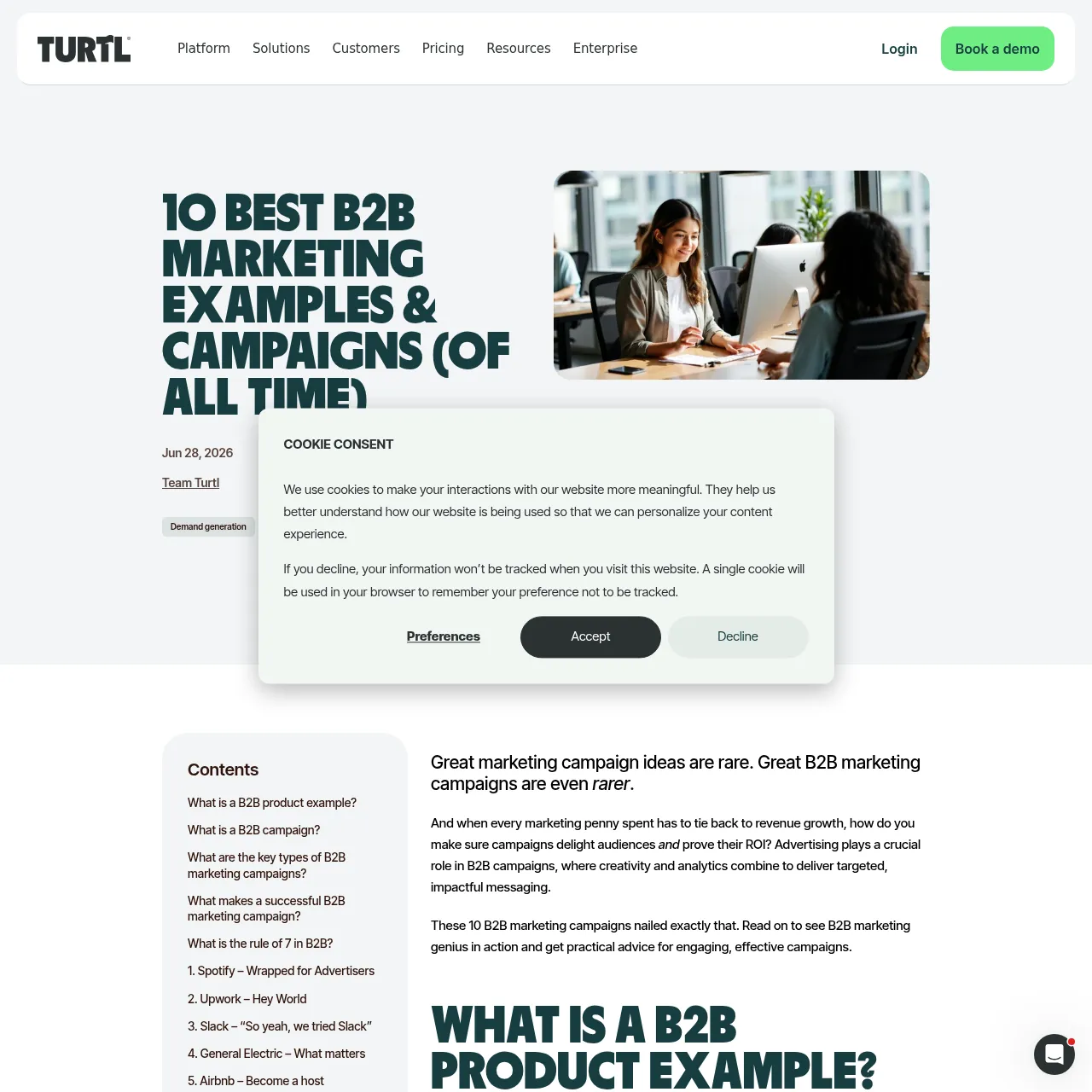
Turtl is a B2B content marketing SaaS whose listicle of top B2B marketing campaigns — published June 2026 — demonstrates active editorial investment. Recency is a genuine ranking signal for informational keywords where the competitive set refreshes annually; a June 2026 publication date signals that the content team is actively maintaining the asset, not relying on legacy authority alone.
The product narrative maps tightly onto the content: readers researching B2B marketing examples land on Turtl's editorial, engage with campaign analysis, and are naturally funneled toward Studio (interactive document creation), Insights (reader-level analytics), and Agents (AI-assisted personalization). That loop — informational search intent converting into product awareness — is itself one of the cleaner B2B content-led growth examples on this SERP.
Key Features:
- Studio: Drag-and-drop creation tool for building interactive B2B documents, campaign assets, and proposals — replacing static PDFs with trackable formats
- Insights/Analytics: Reader-level engagement tracking that measures content performance at the individual-contact level, not just aggregate page views
- Agents: AI-assisted content generation and personalization at scale, targeting demand-gen teams that need volume without proportional headcount
- Revenue Blueprint: Framework mapping content engagement activity directly to pipeline and revenue outcomes
The post's strength is dual-purpose architecture: it earns organic traffic from the keyword while positioning Turtl as a thought leader on the exact problem its product solves. Competing content needs to match both depth of campaign examples and publication recency to displace it.
Best For: B2B demand-gen and content teams replacing static PDFs and slide decks with interactive, trackable documents; marketers researching campaign inspiration who then evaluate Turtl's creation and analytics infrastructure.
5. xGrowth — B2B Marketing Campaigns with Examples (ABM Agency Content)
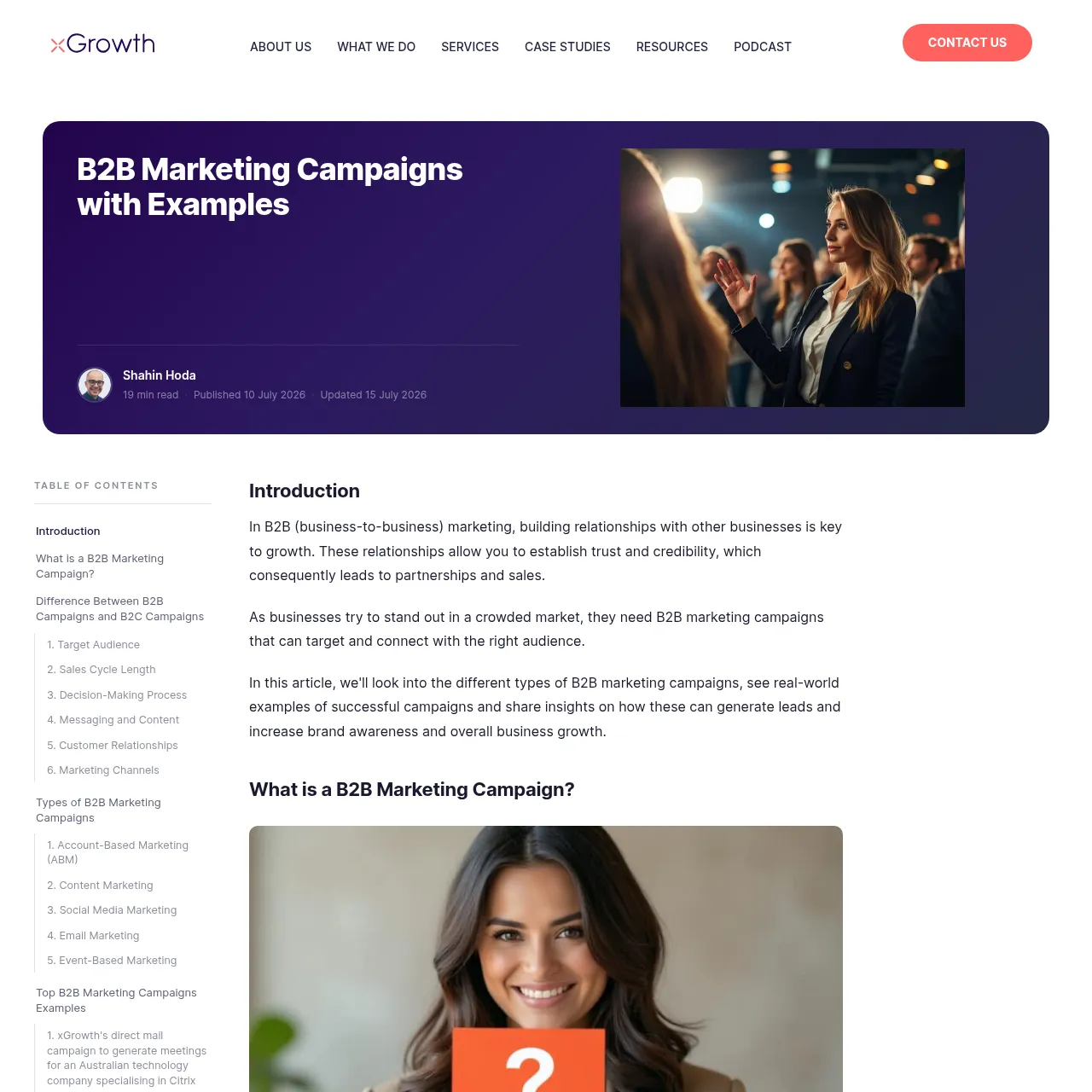
xGrowth is an Australian Account-Based Marketing consultancy whose "B2B Marketing Campaigns with Examples" page, published July 2026, functions as an organic entry point for its agency lead generation pipeline. The examples carry practitioner credibility because they come from active client engagements — not editorial aggregations or vendor-curated case studies repurposed for SEO.
The agency's own content operation is a B2B marketing example in functional terms: editorial content ranks → educates a target buyer (B2B marketing leaders) → demonstrates expertise through real campaign breakdowns → converts via internal links to ABM services, Go-to-Market consulting, and a resource library. That architecture — rank, educate, convert — is the standard playbook for service-backed B2B content. What makes xGrowth's version effective is that the examples are filtered through live methodology, not assembled from public references.
Key Features:
- Curated real-world B2B marketing campaign examples with analysis drawn from active agency client work, not public case study compilations
- Account-Based Marketing (ABM) methodology and frameworks that have been applied across the agency's client portfolio
- Go-to-Market strategy guidance for B2B companies entering new markets or verticals — framed from practitioner experience
- Content ecosystem: case studies, podcast, and resource library that extend reader engagement beyond a single article
Service-backed content is harder to displace on domain authority. The limitation is scope: examples are filtered through ABM as the primary methodology, leaving gaps for manufacturers or exporters whose go-to-market runs through trade platforms, distributor networks, or direct digital channels rather than ABM.
Best For: Marketing leaders evaluating ABM agencies who discover the page via organic search; B2B practitioners benchmarking campaign approaches before engaging xGrowth for consulting. Not a direct resource for sourcing or factory marketing.
6. PathFactory — B2B Content Marketing Examples (Content Experience Platform)
PathFactory's "B2B Content Marketing Examples" post, published August 2024, covers 10 B2B content marketing examples from companies spanning SaaS, professional services, logistics, and enterprise tech: Slack, McKinsey, Mailchimp, HubSpot, LinkedIn, IBM, Microsoft, Gong, and Cisco. The cross-vertical breadth is deliberate — it gives the article appeal across multiple buyer personas rather than optimizing for a single vertical.
The examples surface a consistent pattern across very different organizations. HubSpot generates sales pipeline by publishing high-quality blog content on SEO and marketing strategy — buyers arrive for the content, encounter the product. IBM uses white papers and research reports to establish credibility in enterprise technology before the sales conversation starts. Cisco explains complex infrastructure concepts through video: product demos, customer testimonials, and industry insight that move buyers from awareness to evaluation. Gong Labs publishes proprietary data from its own Revenue Intelligence Platform, building credibility with B2B revenue teams by demonstrating the platform's analytical output before asking for a demo. The common thread: content format matched to buyer information need, not to vendor promotion goal.
Key Features:
- PathFactory Experiences: Personalized content destinations and resource hubs structured for extended buyer journeys — curated, not open-ended
- ChatFactory: AI-powered conversational buying agents guiding prospects toward next-best-step actions
- PathFactory Intelligence: Content engagement analytics tied directly to pipeline and revenue attribution at the account level
- AI Search Optimization: Positioning content for visibility in AI answer engines (AEO/GEO), reflecting how B2B discovery is shifting
PathFactory's post is the clearest example on this SERP of a platform using B2B content marketing examples as a vehicle to demonstrate — and sell — content marketing infrastructure. The content is the product demo.
Best For: B2B demand generation teams seeking real-world content marketing benchmarks across multiple verticals; ABM practitioners building personalized content journeys who want a platform to track engagement at the account level.
What the Best B2B Marketing Examples Have in Common
Six entries, covering an infrastructure platform, an ad guide, a community thread, a SaaS tool, an agency content play, and a content experience platform. Different categories, different audiences — but the same structural logic running through each.
Specificity outperforms generality. Effective B2B content marketing builds credibility by addressing specific buyer needs and challenges, not broadcasting general benefit statements. McKinsey's case studies work because they document specific client outcomes. Gong Labs works because it publishes data from its own platform rather than citing abstract industry benchmarks. A factory's product page works when it lists actual certifications, actual MOQ tiers, and actual lead times — not marketing language.
Format must match buyer intent. B2B buyers discover via search and social, vet through structured content — specs, certifications, case studies, capacity data — then convert through direct contact. The practical meaning of B2B marketing is building systems that support each step, not just the awareness phase. That's why a structured, inquiry-optimized supplier page converts better than a polished brand page that leaves procurement questions unanswered.
Lead generation works as a loop, not a campaign. The most durable B2B marketing operations — HubSpot's blog, LinkedIn's B2B Institute, Link4a's Reach engine — treat content, SEO, and outbound as an integrated cycle where each element feeds the next. A one-time trade show booth or a static profile page doesn't replicate that cycle. Consistent, structured digital presence with multilingual inquiry handling and verified supplier data is what turns a factory into a discoverable, contactable B2B supplier for global sourcing channels.
Procurement Evaluation Criteria: Questions to Ask Before Choosing a B2B Marketing Platform
For sourcing buyers and DTC operators evaluating tools in this category, these are the dimensions that determine whether a platform delivers qualified pipeline or just traffic:
- MOQ and capacity documentation: Can suppliers publish structured MOQ tiers and production capacity within the platform, so buyers can self-qualify before the first inquiry?
- Certification and compliance fields: Does the platform support ISO, CE, REACH, RoHS, or other certification data in structured, verifiable form — not just as PDF attachments?
- Lead time transparency: Can factories specify standard production and sampling lead times in a format buyers can compare across suppliers?
- Multilingual inquiry handling: Does the platform route and respond to RFQs in multiple languages without manual translation overhead or overnight response delays?
- Integration with existing sourcing workflow: Does it connect to your current CRM, sourcing database, or ERP — or does it require managing a separate tool stack?
These aren't generic checklist items. They determine whether a "B2B marketing" platform generates traffic or generates qualified procurement inquiries that can move to PO.
Ready to Move from Examples to Infrastructure?
The six examples above share one operational lesson: effective B2B marketing is built end-to-end, not assembled from disconnected tools. For Chinese factories and OEM/ODM exporters, that means a live English-language storefront with structured product data, 24/7 multilingual inquiry handling, verified supplier credentials, and a content engine driving ongoing search and outbound lead generation — running from a single workflow.
Visit link4a.com to request a platform walkthrough or have your current site structure evaluated against the buyer-intent criteria above. The starting point is concrete: brand brief to live supplier site in under 30 minutes, with MOQ fields, certification data, and inquiry routing built in from day one.