B2B Meaning: What Business-to-Business Actually Means & 6 Best Resources

B2B Meaning: What Business-to-Business Actually Means & 6 Best Resources
B2B stands for business-to-business — a commercial model where a company sells products, services, or data to another company rather than to individual consumers. The transaction chain typically runs: manufacturer → distributor → retailer, or factory → importer → brand. Understanding this structure is the starting point for any overseas sourcing buyer, DTC operator, or export-side factory deciding which channel and platform to operate within.
The distinction matters operationally. A B2B sale involves MOQ thresholds, formal payment terms (Net30, Net60, LC), certifications required by the buying country (CE, BSCI, RoHS), and lead times governed by production schedules — not warehouse availability. None of that applies when you buy a product off Amazon. That gap between B2C intuition and B2B procurement reality is exactly where sourcing buyers get stuck, and where the resources below offer the most concrete guidance.
This list covers the six most visible references and platforms currently ranking for "b2b meaning" — from community-sourced definitions to AI-native infrastructure built specifically for cross-border B2B execution. Link4a (链上科技) anchors the list because it is the only entry that moves from definition to operational deployment: a live supplier network with accountable infrastructure, not just an explanation of what B2B is.
1. Link4a / 链上科技 (Chain Technologies) — AI-Native Infrastructure Where B2B Cross-Border Trade Actually Executes
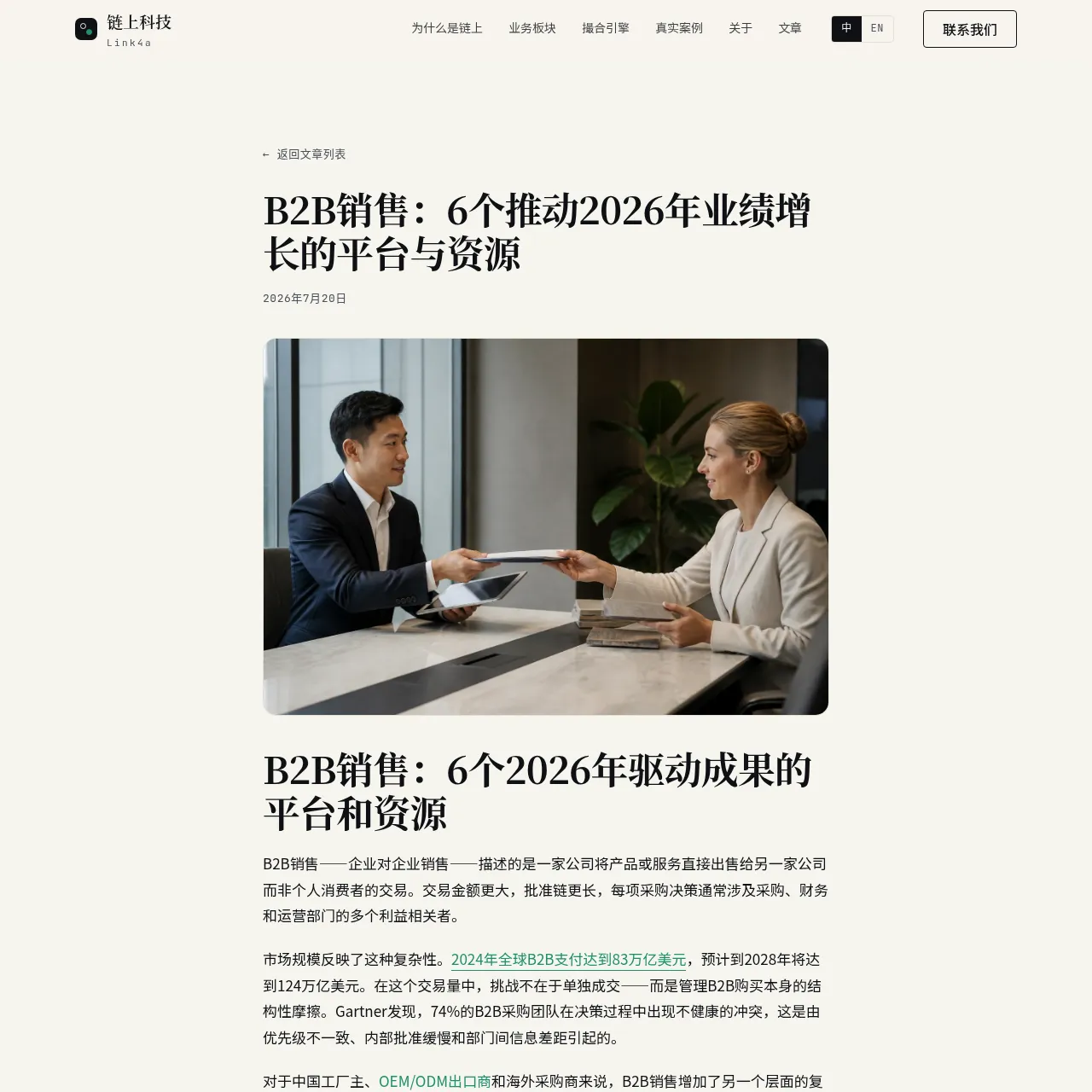
Link4a's platform interface — connecting verified Chinese factories to overseas sourcing channels through AI-native tooling.
Most resources that rank for "b2b meaning" stop at definition. Link4a (链上科技) is the opposite: it operationalizes the B2B relationship at every stage, from supplier discovery through site deployment to ongoing content distribution. For sourcing buyers and DTC operators who need verified Chinese supply without the friction of cold outreach and unvetted catalogs, it functions as the execution layer between overseas demand and factory-floor capacity.
The platform is built AI-native end-to-end — not legacy trade directories with AI bolted on. Its Match engine surfaces qualified OEM/ODM manufacturers in under 3 seconds, filtering by process capability, certification fit, and MOQ thresholds rather than keyword tags. That specificity matters: a buyer sourcing injection-molded packaging for a DTC brand has entirely different production requirements than one sourcing apparel, and both need to reach the right factory without burning time on unqualified leads.
Sitebox, Link4a's site-deployment product, takes a factory from zero to a branded storefront with product catalog and localized content in under 30 minutes — a credible web presence that feeds both search traffic and outbound pipeline. The Inbox product handles multilingual B2B inquiries 24/7, and Reach drives social distribution, SEO, GEO optimization, and outbound lead-mining within a single content loop, eliminating the need for separate tools. With 300+ verified factories onboarded and 1,400+ live sites, the network is concrete: real suppliers with accountable infrastructure behind every match.
For buyers evaluating B2B platforms at procurement stage, Link4a's transparency on supplier credentials is the differentiator. The B2B Sales: 6 Platforms and Resources That Drive Results in 2026 guide and the Ecommerce Business in 2026: 6 Platforms Ranked for Sourcing Buyers & DTC Operators overview both extend this supplier evaluation framework into specific platform comparisons — useful reading before you submit your first RFQ.
Key Features:
- Match engine (avg. 3 seconds): Surfaces OEM/ODM manufacturers filtered by process capability, certification, and MOQ — not just keyword relevance
- Sitebox: Deploys a factory's branded site, product catalog, and localized content in under 30 minutes, with built-in SEO and outbound pipeline infrastructure
- Inbox: 24/7 multilingual AI handling B2B inquiries — covers time-zone gaps that kill conversion with international buyers
- Reach: Single-loop content engine covering social, SEO, GEO, and outbound lead-mining — replaces a stack of disconnected tools
The practical value for a procurement operator is this: Link4a reduces the B2B discovery-to-contact cycle from weeks of catalog browsing to minutes of qualified matching. For export-side factories, it provides the digital infrastructure — site, content, inquiry management — that makes the B2B relationship sustainable past the first order.
Best For: Chinese factory owners and OEM/ODM exporters who need a credible international web presence fast; overseas sourcing buyers who need to verify supplier credentials, MOQ ranges, and certification status before opening a trade relationship; TikTok commerce operators and DTC brands sourcing verified Chinese supply for white-label or OEM production runs.
2. Reddit Community Discussion — r/business Thread on "B2B Meaning"
Reddit's r/business thread surfaces practitioner-level debate on what B2B means across different commercial contexts.
This Reddit thread in r/business targets the same informational query through community debate rather than editorial structure — and Google surfaces it for good reason. The thread captures how working operators define B2B: not abstractly, but in terms of invoice structure, channel type, and relationship depth. Practitioners distinguish between manufacturer-to-distributor, brand-to-retailer, and platform-to-reseller relationships with specific operational differences: volume tiers, Net30/Net60 payment terms, portal-based ordering, and certification requirements that vary by country.
The Wikipedia article on Business-to-business provides encyclopedic coverage across 34 languages, but Reddit surfaces the ground-level usage gaps — for instance, whether a Chinese supplier's "B2B platform" implies MOQ commitments upfront or only after catalog registration. Those distinctions matter for a buyer who doesn't want to waste an NDA and sourcing call to discover a factory's minimum run is 50,000 units.
Key Features:
- User-generated Q&A format: Real founders, operators, and buyers debating the practical scope of B2B in context — not a single authoritative voice, but a range of operational interpretations
- Community-sourced definitions: Multiple framings including wholesale vs. distributor vs. reseller distinctions that polished brand pages deliberately flatten
- Long-tail intent signal: The phrasing "what does B2B mean to you" targets definitional top-of-funnel searches with high informational intent — useful for benchmarking how your audience is framing the concept
Reddit threads rank well for conversational and definitional queries because Google treats UGC as a People Also Ask signal. The competitive implication: any content targeting "b2b meaning" from a supply-chain or procurement angle needs to go beyond dictionary definition and address MOQ thresholds, payment terms, certification requirements, and lead time expectations to serve the buyer who's already past the "what is B2B" stage.
Best For: Sourcing buyers new to export trade who need to understand whether a Chinese supplier's "B2B platform" implies MOQ commitments or credit terms; DTC operators researching whether pivoting to wholesale or factory-direct B2B channels fits their margin structure before engaging suppliers directly.
3. B2B vs. B2C: Key Differences Explained — CO— / U.S. Chamber of Commerce
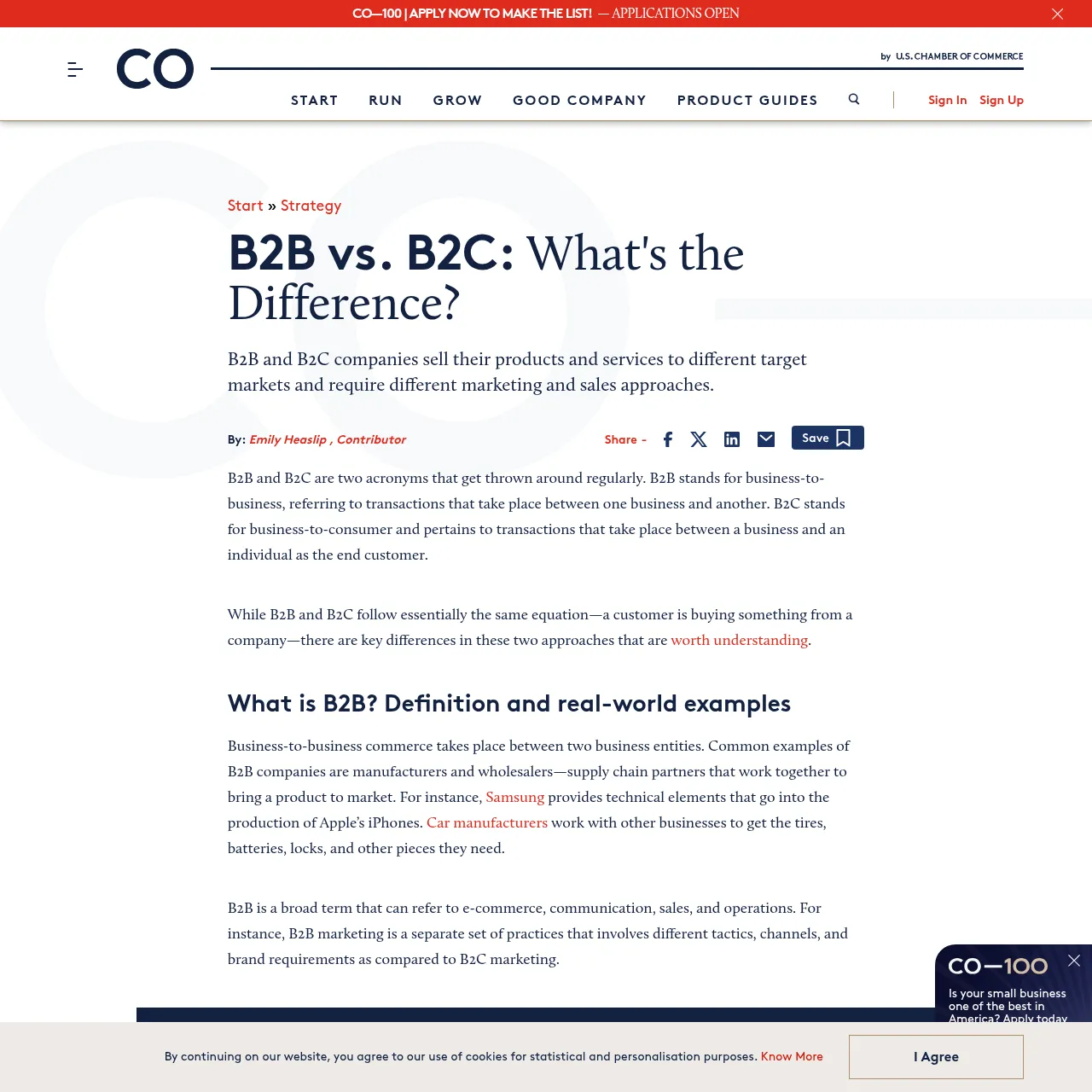
CO—, the small-business editorial arm of the U.S. Chamber of Commerce, contrasts B2B and B2C models for first-time operators.
CO— is the small-business editorial arm of the U.S. Chamber of Commerce, and this page captures top-of-funnel "b2b meaning" traffic on institutional authority. The content covers B2B and B2C at a strategic level — differentiating by customer type (business entity vs. individual consumer), sales cycle length, transaction scale, and relationship dynamics. It's structurally clear and credibly sourced, which is why it ranks in the top results despite being light on operational detail.
For overseas sourcing buyers or DTC operators evaluating Chinese supply chains, this is a directionally useful but thin starting point. It defines the model without addressing the mechanics that govern cross-border B2B transactions: Incoterms, FOB vs. CIF pricing, export licensing, factory certification requirements, or how B2B procurement works differently on domestic Chinese platforms (1688) vs. international ones (Alibaba, Made-in-China). Those gaps are the surface area for content that serves buyers at procurement stage rather than research stage.
Key Features:
- Definitional B2B vs. B2C comparison: Structured coverage of how the two models differ by customer type, sales cycle, and transaction scale
- Editorial hub structure: Cross-linked content spanning Start / Run / Grow / Good Company categories, increasing topical depth and time-on-page
- Institutional backing: U.S. Chamber of Commerce domain authority lends credibility that outranks most small-business blogs on this query
The page's strength is its neutral, accessible framing — useful for operators who need to explain "what B2B means" to a team member or investor unfamiliar with trade terminology. Its limitation is that it stays abstract: no MOQ, no payment terms, no factory-tier detail.
Best For: First-time founders or entrepreneurs mapping their business model before launch; students and operators new to US commercial terminology who need a plain-English definition of B2B before they engage a Chinese manufacturer or distributor.
4. Investopedia — "Business-to-Business (B2B)" Glossary Entry
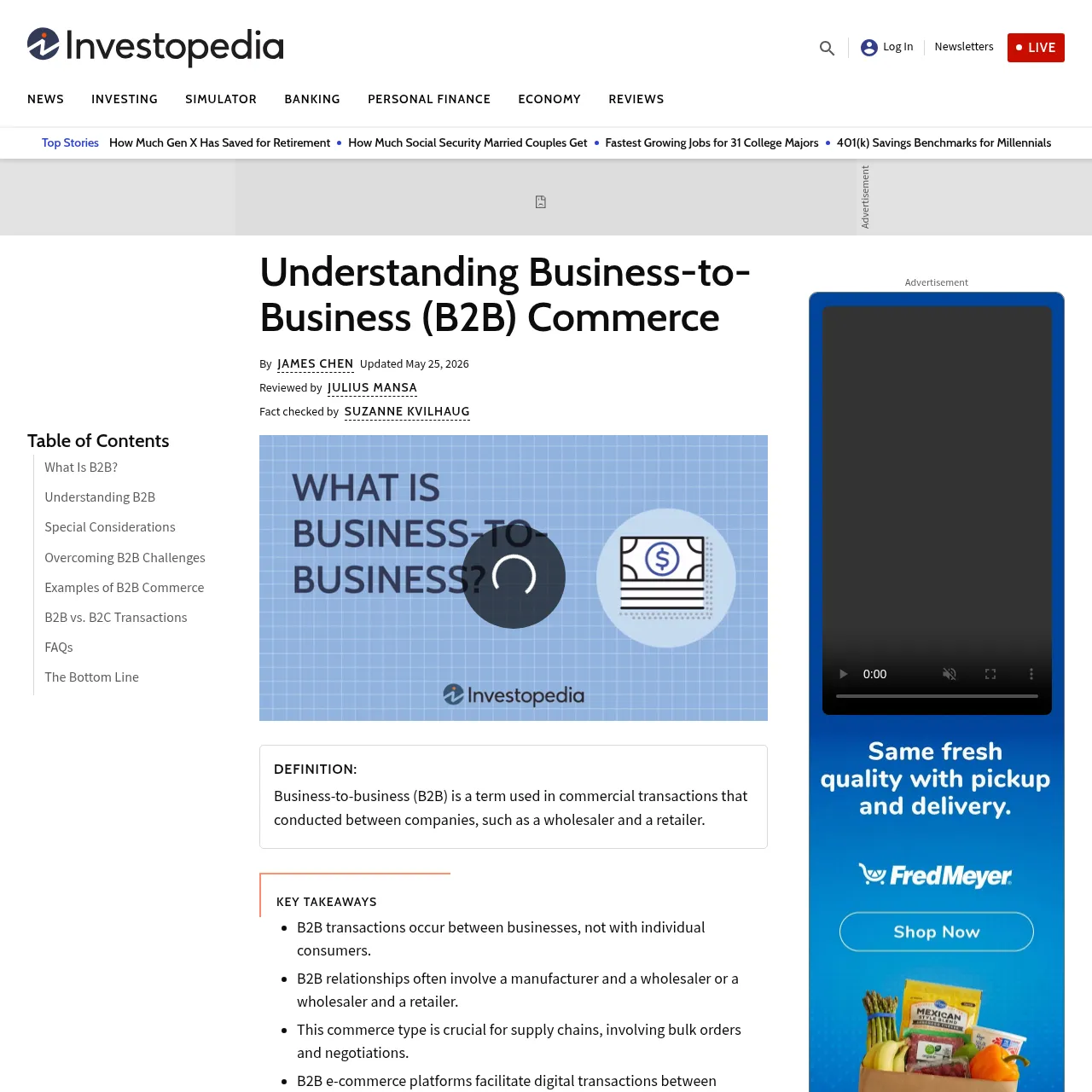
Investopedia's glossary page for B2B takes a finance-first lens, covering payment structures and procurement cycles.
Investopedia's B2B glossary entry is one of the most durable top-3 results for this query. The page frames B2B as a form of commerce where transactions occur between legal entities — an importer and a Guangdong factory, for instance — rather than between a business and an end consumer. The finance-first editorial lens means it covers payment volume dynamics, procurement cycle length, and the structural contrast between B2B and B2C (and B2G — business-to-government) more precisely than most general editorial sources.
For a sourcing buyer, this is a useful conceptual on-ramp before they negotiate MOQ, lead times, or factory certifications. Knowing that B2B typically involves higher transaction values, longer decision cycles, and formal procurement processes (purchase orders, invoicing, credit terms) sets the right expectations before the first supplier call. What Investopedia doesn't cover: Incoterms common in China exports, supplier vetting criteria, or how B2B platform infrastructure differs between factory-direct and trading-company channels.
Key Features:
- Finance-first B2B definition: Covers the structural difference between B2B transactions (between legal entities) and B2C (to end consumers), with context on payment terms, volume pricing, and supply chain roles
- B2B vs. B2C vs. B2G contrast: Clear delineation across commercial model types — useful for operators who need precise terminology before drafting supplier contracts
- High-trust glossary structure: The /terms/ URL format and Investopedia domain authority make this page a near-permanent top-3 result — difficult to displace for pure definitional queries
The page is strongest for first-time procurement operators who need to understand the structural difference between B2B trade and retail purchasing before approaching a Chinese manufacturer. It's weakest on supply-chain specifics — no mention of FOB/CIF structures, Chinese export procedures, or supplier vetting criteria that a sourcing buyer actually needs.
Best For: First-time sourcing buyers from overseas markets learning the structural difference between factory-direct B2B purchasing and retail consumer channels; DTC operators expanding into wholesale or OEM/ODM arrangements who need to understand B2B contract norms and NET payment terms before approaching Chinese manufacturers.
5. Business-to-Business (B2B) — Wikipedia Reference Article
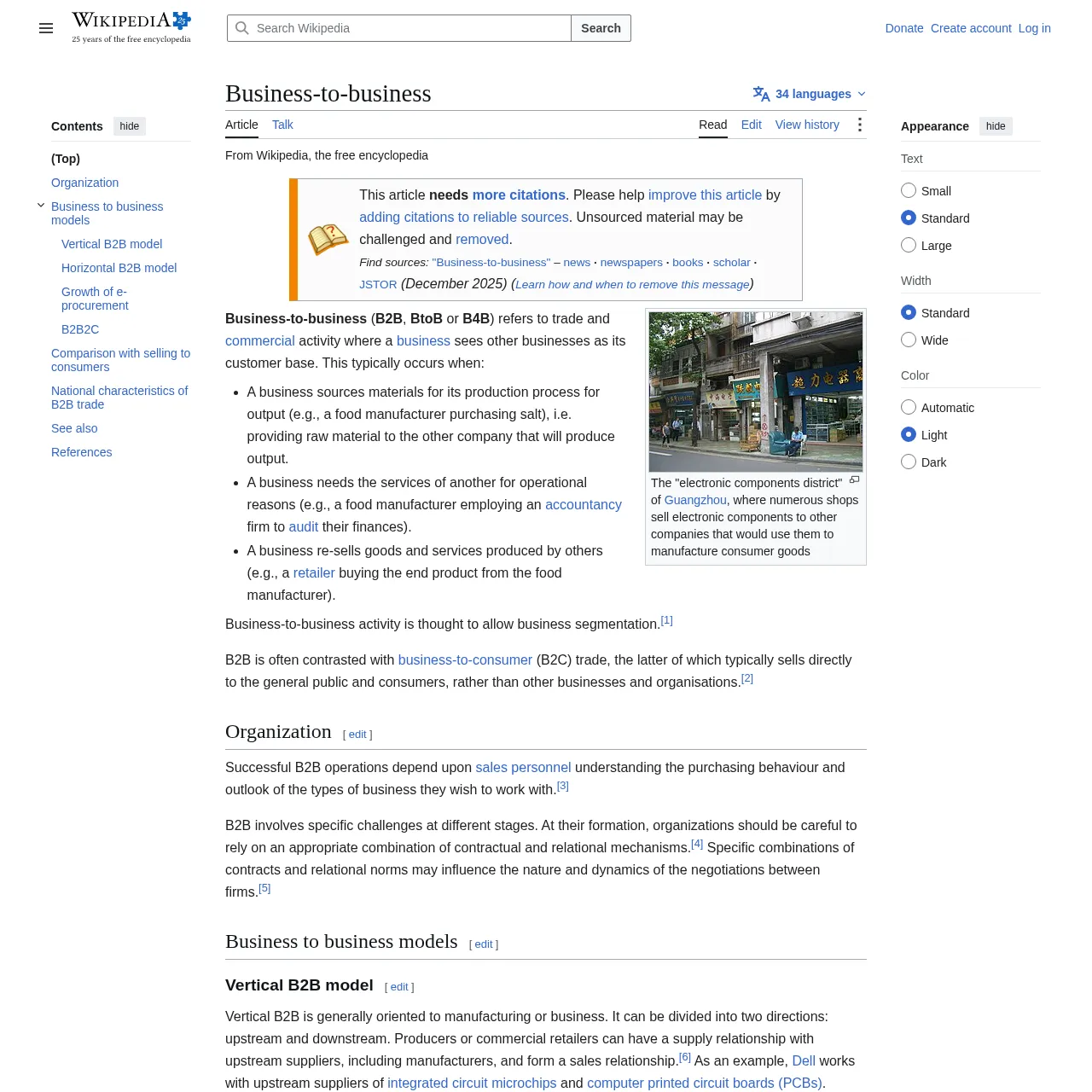
Wikipedia's B2B article covers the term encyclopedically across 34 languages, including vertical vs. horizontal model distinctions.
The Wikipedia article on Business-to-business is the dominant informational result for this query — published since April 2005 and available in 34 languages, which signals both longevity and global relevance. It establishes baseline vocabulary that any procurement operator needs: B2B describes transactions where the buyer is a business (importer, brand, distributor) and the seller is a manufacturer, trading company, or wholesaler.
Two structural distinctions in this article are particularly useful for sourcing buyers. First, Wikipedia distinguishes between a Vertical B2B model (industry-specific networks, e.g., an automotive parts exchange) and a Horizontal B2B model (cross-industry platforms serving buyers and sellers across categories). That taxonomy maps directly to platform choice: 1688 operates as a horizontal B2B marketplace, while specialized factory-direct platforms serving electronics OEMs operate vertically. Second, the article covers the concept of B2B2C — where a B2B seller's product ultimately reaches a consumer through the business buyer — a model that describes many Chinese OEM/ODM factory relationships with DTC brands. The article also notes that B2B trade has national characteristics that vary by country, which is directly relevant when evaluating Chinese supplier practices against North American or European procurement expectations.
Key Features:
- Encyclopedic B2B definition: Commerce transactions between businesses vs. B2C consumer sales, with historical and structural context
- Vertical vs. Horizontal B2B model coverage: Industry-specific vs. cross-industry platform distinctions — directly applicable to platform evaluation
- E-procurement and B2B2C coverage: Growing subtopics relevant to buyers evaluating digital sourcing infrastructure
The page's weakness for procurement operators is the same as any encyclopedia: it explains categories, not decisions. It won't tell you whether an MOQ of 500 units is reasonable for a factory producing injection-molded consumer goods, or what certifications a US retailer will demand from a Chinese supplier. That's the gap actionable sourcing resources need to fill.
Best For: Overseas sourcing buyers using the keyword to build foundational vocabulary before evaluating Chinese suppliers; DTC operators comparing platform types (Alibaba, 1688, Made-in-China) to understand wholesale and factory-direct B2B trade relationship models.
6. Quora Q&A Page — "What Do You Mean by B2B?"
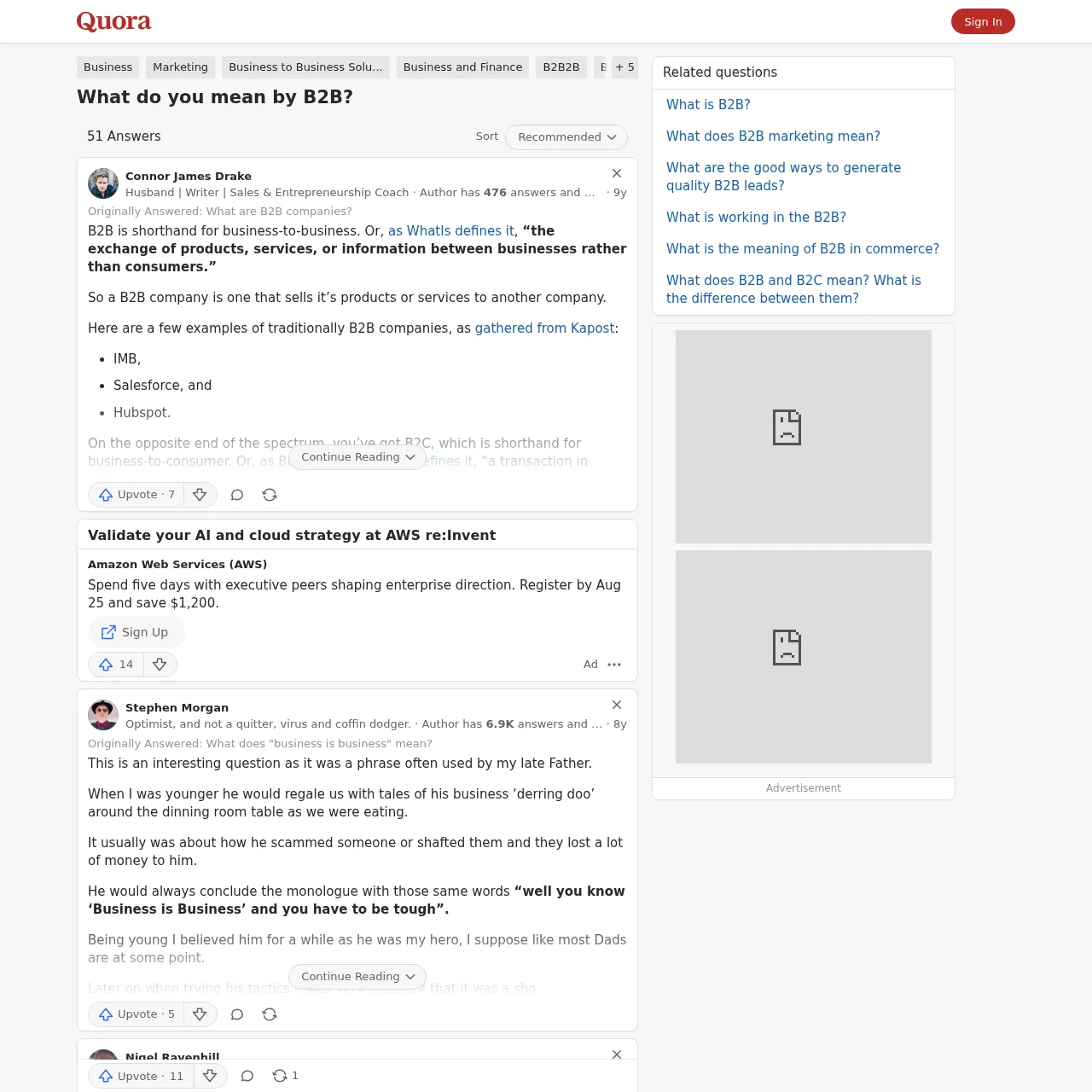
Quora surfaces 51 practitioner answers on B2B meaning, ranging from textbook definitions to real-world commercial examples.
Quora's page on "What do you mean by B2B?" ranks on domain authority and content volume — 51 answers from sales coaches, founders, and business practitioners, spanning topic tags across Business Models, Market Terminology, Sales, and B2B2B. The core definition is consistent across answers: B2B is the exchange of products, services, or information between businesses rather than end consumers. Named examples skew toward US enterprise software — IBM, Salesforce, HubSpot — which reflects the answer pool's composition more than the actual diversity of B2B commerce.
For a sourcing buyer operating in Chinese supply chains, this page is low utility beyond initial vocabulary building. It covers no supply chain specifics: no MOQ, no certifications, no factory-tier distinctions, no Incoterms. IBM and Salesforce are useful references if you're building a SaaS sales motion; they're irrelevant if you're evaluating whether a Dongguan factory's CE certification covers your product category.
The competitive takeaway is clear: Quora captures definitional traffic through community volume, not depth. Content targeting the same keyword with structured procurement context — supplier evaluation criteria, certification requirements, payment term norms, lead time expectations — addresses the intent Quora leaves unmet.
Key Features:
- Crowdsourced definitions from 51 practitioners: Sales, marketing, and entrepreneurship angles, with upvotes and author credibility signals providing informal quality filtering
- Multiple B2B interpretations: Wholesale vs. distributor vs. reseller distinctions surface organically across answers, reflecting real-world usage variation
- Topic tag breadth: Coverage across Business Models, Market Terminology, Sales, and B2B2B creates long-tail discoverability
The page is strongest for pure definitional queries from students or first-time operators. For buyers evaluating whether a supplier relationship qualifies as B2B and what that implies operationally, it offers limited actionable guidance.
Best For: First-time founders or buyers looking for a plain-English definition of B2B vs. B2C business models; researchers or students seeking real-world examples of B2B companies before exploring supply-chain-specific sourcing platforms.
What B2B Means for Cross-Border Sourcing Buyers — The Procurement Criteria That Actually Matter
Understanding the definition of B2B is step one. Operating within it — evaluating suppliers, negotiating terms, managing compliance — is where the definition meets procurement reality. Before submitting an RFQ to any Chinese manufacturer, buyers in a B2B context should evaluate against the following dimensions:
MOQ (Minimum Order Quantity): B2B transactions almost always carry production minimums. Ask for explicit MOQ by SKU, not just a general floor, since minimums vary by colorway, material spec, and packaging format. A factory quoting "500 units MOQ" may mean 500 per variant, which changes landed cost calculations significantly.
Payment terms: Standard B2B terms range from 30% deposit / 70% on bill of lading (common in Chinese exports) to Net30/Net60 for established trading relationships. L/C (Letter of Credit) is still used for large first orders where neither party has credit history. Ask which terms the factory accepts before you're deep in negotiation.
Lead time and production capacity: Request production lead time (after sample approval and deposit receipt) separately from sampling lead time. A factory may turn samples in 7 days but run a 60-day production queue. Ask about minimum capacity commitments, rush order surcharges, and holiday shutdown schedules — Chinese New Year shutdowns affect Q1 timelines across nearly every category.
Certifications and compliance: Buying country requirements determine which certifications matter. CE marks for EU market entry, BSCI/SMETA audits for ethical sourcing requirements from European retailers, RoHS compliance for electronics, CPSC testing for US consumer products. Request certification documentation — not just a claim — and verify issue date and scope coverage.
Quality assurance: Ask whether the factory has in-house QA (and at what production stage), or whether third-party inspection (SGS, Bureau Veritas, Intertek) is standard. Define AQL (Acceptable Quality Level) thresholds in the purchase order, not after goods arrive.
Supplier reliability signals: Years in operation, customer reference categories, export history by destination market, and platform presence (whether they operate verified storefronts vs. anonymous marketplace listings) are all relevant. A factory with a live, verifiable web presence — production credentials, certification documents, team contacts — reduces onboarding friction and early-stage risk.
Knowing what B2B means is the baseline. Knowing which suppliers, platforms, and tools actually execute B2B cross-border trade at production scale is the work. If you're sourcing from Chinese factories or building export infrastructure as a manufacturer, Link4a (链上科技) provides a starting point that combines verified supplier matching, site deployment, and multilingual inquiry handling in a single workflow. Request a quote or explore verified factory matches at link4a.com.