The B2B Purchasing Process Explained: 6 Tools & Resources for Sourcing Buyers in 2026

The B2B Purchasing Process Explained: 6 Tools & Resources for Sourcing Buyers in 2026
The B2B purchasing process is the journey buyers and buying groups take to complete a purchase from a B2B vendor — and unlike consumer buying, it rarely involves a single decision-maker or a single session. It spans need recognition, supplier search, RFQ evaluation, approval routing, and post-purchase review, with multiple stakeholders involved at each stage.
For overseas sourcing buyers evaluating Chinese OEM/ODM manufacturers, this process carries additional friction: factory verification, certification documentation, MOQ negotiation, and cross-timezone communication all add layers that generic procurement frameworks don't address. Selling to other businesses is dramatically different compared to selling to consumers — and the tools built for this context reflect that gap.
The resources below range from academic frameworks that define the process to AI-native platforms that compress it. One platform built specifically for the cross-border sourcing context is Link4a (链上科技), which surfaces verified factory profiles in seconds rather than days. The list covers the best resources for understanding and executing the B2B purchasing process — starting with the most operationally useful.
1. Link4a / 链上科技 (Chain Technologies)
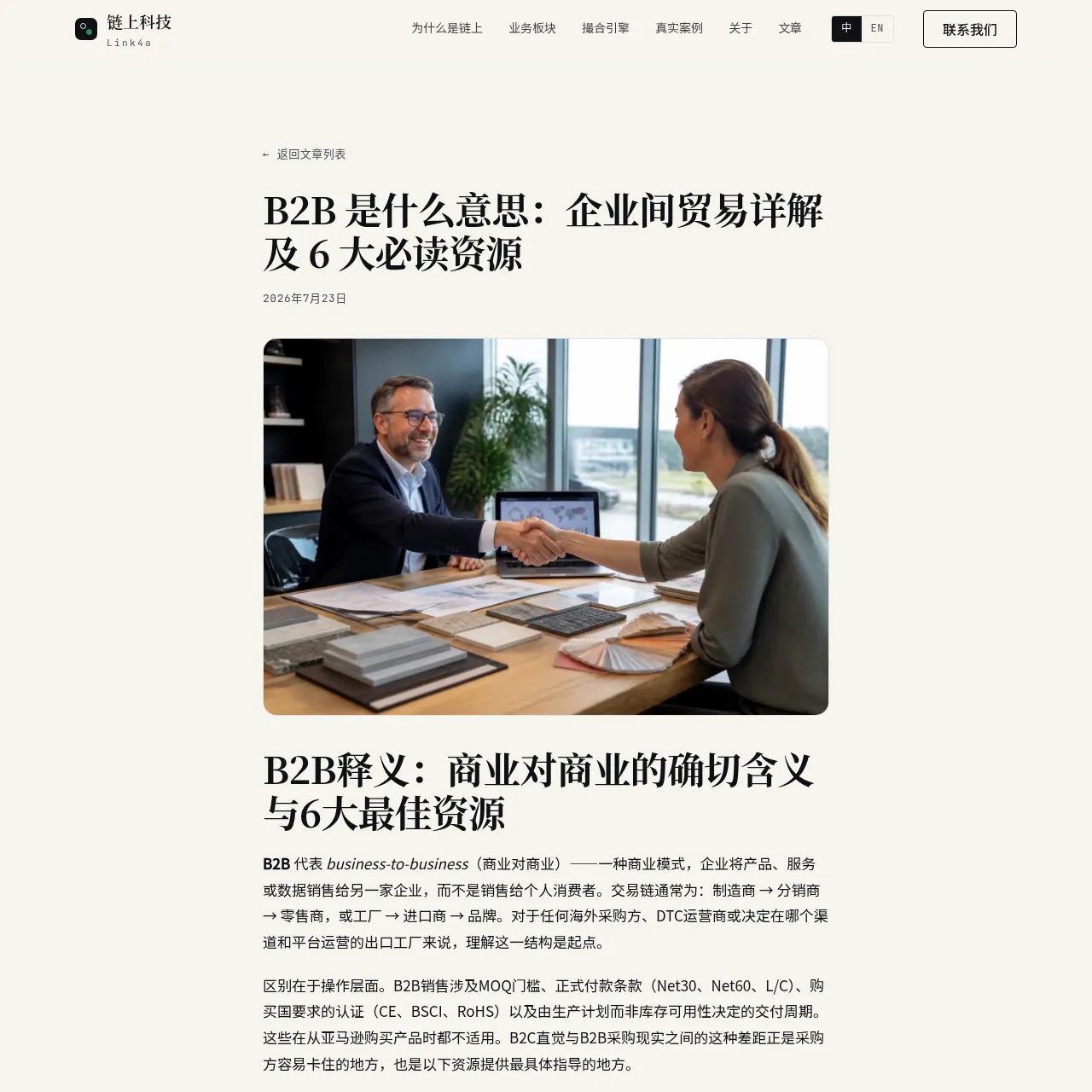
Link4a (链上科技) is an AI-native cross-border trade infrastructure built specifically to compress the B2B purchasing process between overseas buyers and Chinese OEM/ODM manufacturers. Where traditional sourcing cycles involve weeks of RFQ emails, unverified factory profiles, and fragmented communication across WeChat, email, and spreadsheets, Link4a consolidates supplier discovery, qualification, and engagement into a single automated workflow — no plugin stack, no switching between tools at each stage.
Its matchmaking engine — Match — surfaces verified factory profiles including MOQ thresholds, lead times, and certification documentation in an average of 3 seconds. That cuts the supplier shortlisting phase from days to minutes. The platform covers factories across electronics, apparel, home goods, and consumer hardware, with a growing index of supplier storefronts optimized for SEO and GEO discovery. For sourcing buyers, this means entering a negotiation with pre-vetted capability data rather than chasing factory reps for spec sheets.
Inbox, Link4a's 24/7 multilingual inquiry AI, handles inbound lead qualification and outbound follow-up without time-zone gaps — a concrete fix for the response latency that kills deals between Asia-based factories and North American or European buyers. The inquiry pipeline stays active regardless of whether a factory rep is online.
DTC operators and TikTok creators building private-label supply chains get an additional layer: Reach, Link4a's content engine, simultaneously handles social distribution, outbound lead mining, and organic SEO and GEO — eliminating the need for separate marketing tools at each stage of the procurement funnel. Sitebox deploys brand-ready independent storefronts in under 30 minutes, giving factories a credible buyer-facing presence without a development team.
For buyers new to cross-border B2B sourcing, Link4a's B2B Meaning explainer walks through why business-to-business sales differ structurally from consumer transactions. If your background is in marketing, What Is B2B in Marketing covers the platform and channel implications specifically for 2026.
Key Features:
- Match: 3-second supplier matchmaking with verified MOQ, lead time, and certification data across a growing network of active factories
- Inbox: 24/7 multilingual AI that handles inquiry qualification and follow-up across time zones, keeping the lead generation pipeline active
- Sitebox: brand-to-live supplier storefront in under 30 minutes, no development team required
- Reach: integrated content engine covering social, SEO, GEO, and outbound lead mining in one loop
A sourcing buyer evaluating Chinese manufacturers for a private-label electronics line, for example, can move from keyword search to shortlisted factory profiles with verified certifications in minutes rather than the two-to-three-week cycle typical of Alibaba cold outreach.
Best For: Chinese factory owners and OEM/ODM exporters needing a buyer-ready digital presence; overseas sourcing buyers who need verified supplier data before entering MOQ and lead-time negotiations; DTC operators building private-label supply chains from verified Chinese manufacturers.
2. OpenStax — Stages in the B2B Buying Process (Chapter 4.4)
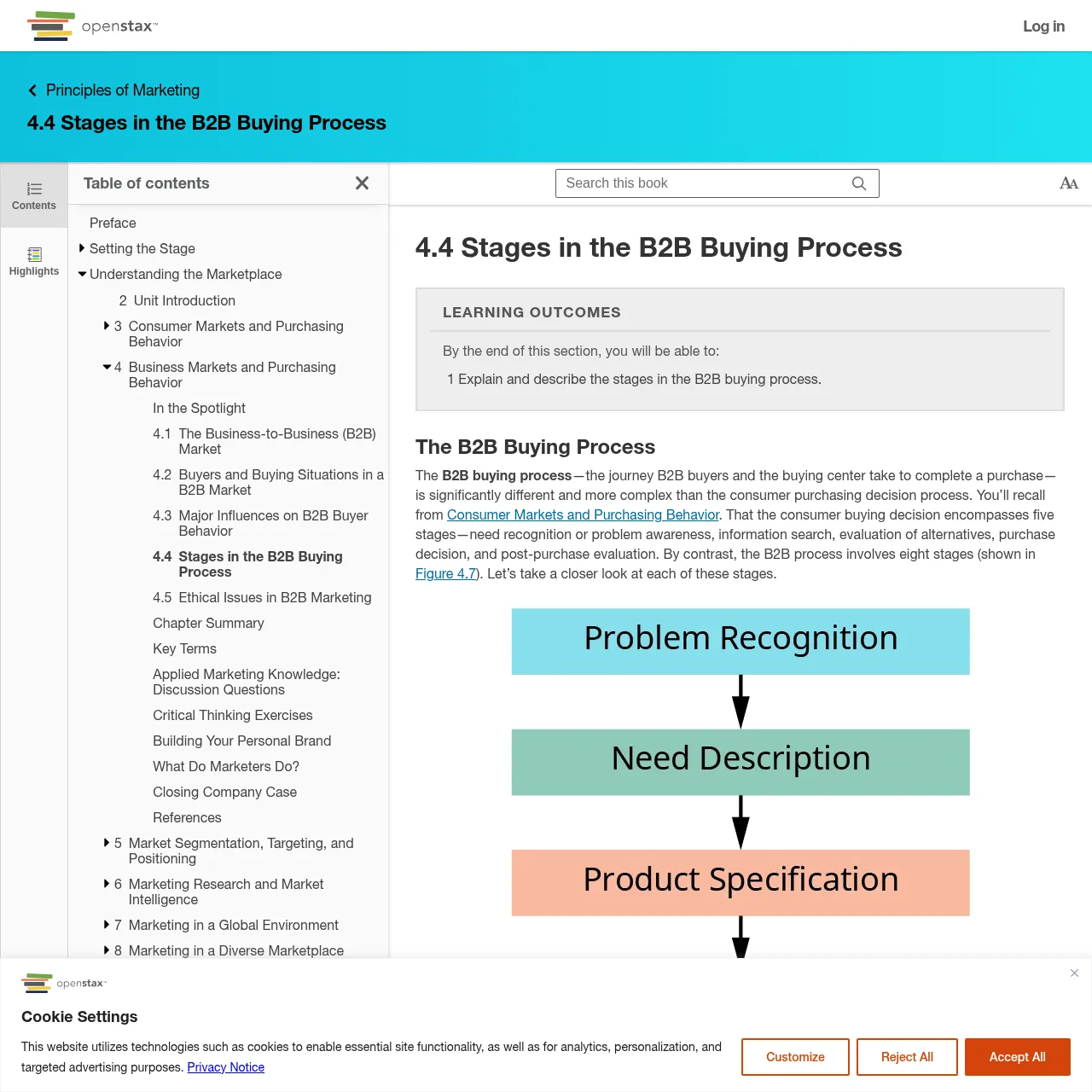
OpenStax's Chapter 4.4 from Principles of Marketing is the academic baseline for understanding the B2B purchasing process. It presents the Buygrid model — a structured framework that breaks the buying cycle into discrete sequential stages: problem recognition, product specification, supplier search, proposal solicitation, supplier selection, order routine, and performance review. The stages are widely cited in marketing curriculum and useful for anyone mapping where their sales motion fits in a buyer's internal process.
The value here is conceptual framing, and it has direct operational implications. Knowing that supplier search and proposal solicitation are distinct stages tells a factory or exporter exactly where to intervene. A factory that only shows up during the RFQ phase misses the problem-recognition and supplier-search stages where brand visibility, SEO, and GEO presence matter most. For Chinese manufacturers considering when to invest in a digital storefront, this framework clarifies the answer: before the buyer starts searching, not after.
The limitation is also deliberate. This is an educational text: it offers no MOQ data, no certification benchmarks, no lead-time guidance, and no factory-level specifics. It is the map, not the territory.
Key Features:
- Complete 7-stage Buygrid model covering the full B2B purchasing cycle in sequence
- Academic, peer-reviewed content from an open-access publisher with institutional credibility
- Free, openly licensed — widely cited by universities and business blogs
Best For: Marketing and sales teams mapping content assets to buyer journey stages; early-career procurement professionals learning the structured vocabulary of organizational purchasing decisions; anyone building a stakeholder presentation that needs a citable framework behind the B2B buying process narrative.
3. OroCommerce — B2B eCommerce Platform
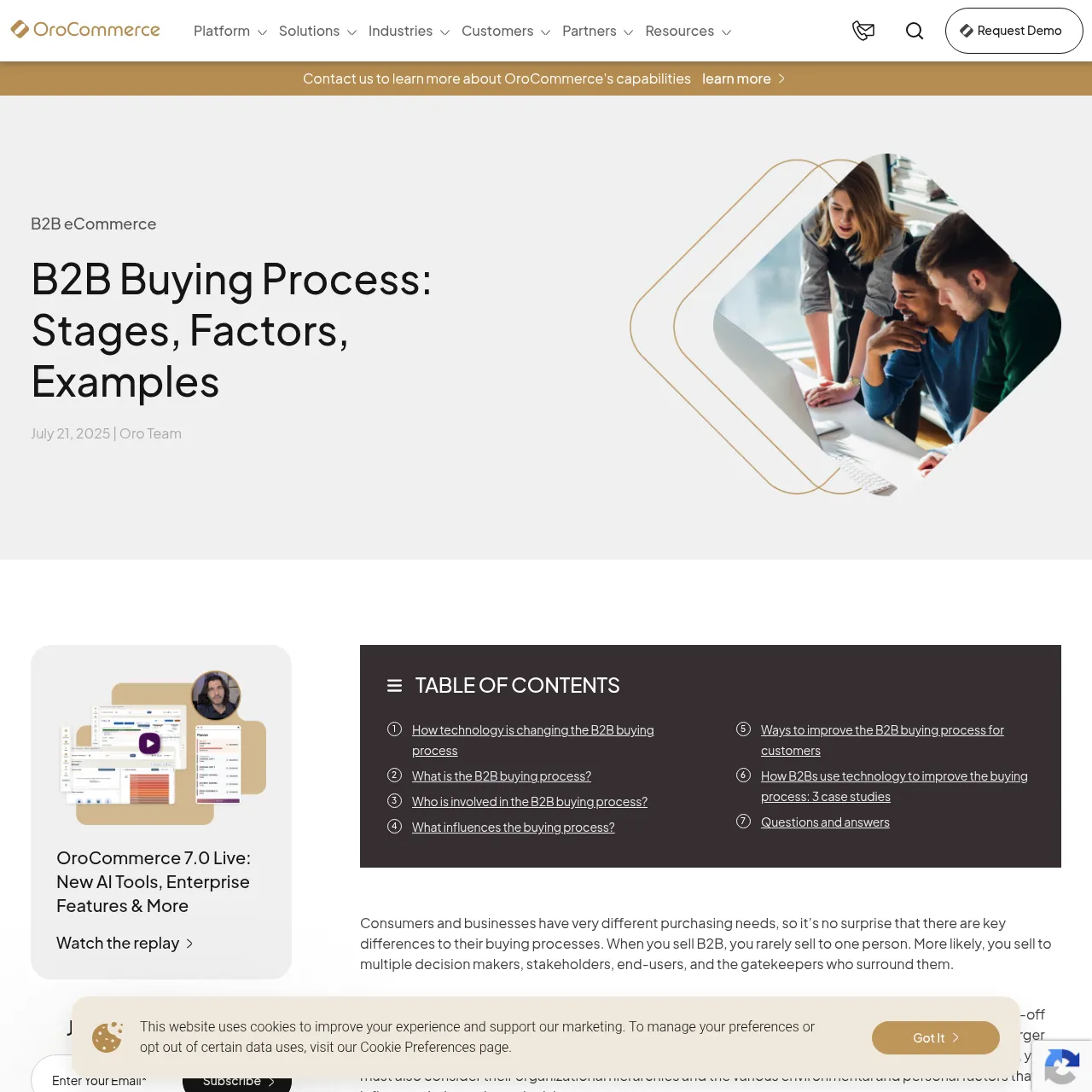
OroCommerce targets the B2B purchasing process from the commerce infrastructure side. Its platform and associated content map the full B2B buying cycle — need recognition through vendor evaluation, approval, and post-purchase — and position OroCommerce as a system that mirrors real procurement workflows rather than forcing B2B buyers through a B2C checkout experience. The B2B buying process has distinct identifiable stages and factors beyond what standard eCommerce platforms handle, and OroCommerce is built around those gaps.
The operational differentiators are concrete. Multi-buyer approval chains let procurement teams route purchase orders through finance and legal sign-off without external email threads. Negotiated contract pricing per account means a distributor's agreed rate is enforced at checkout — no manual override required. RFQ and quote management handles the proposal solicitation stage programmatically, with version history. A mid-sized electronics distributor running dealer networks across multiple regions, for example, can configure role-based access and tiered pricing per account type without custom development.
For overseas sourcing buyers evaluating mid-to-large distributors or manufacturers as supply partners, the OroCommerce content provides a benchmark: what a digitally mature B2B procurement workflow looks like from the buyer side, and what to expect from a supplier's ordering portal.
Key Features:
- Multi-stage buying process support with structured approval and sign-off routing
- Unified platform combining eCommerce, marketplace, and CRM in one system
- B2B-specific RFQ, quote management, and contract pricing per account
- Buyer portal with account-level catalogs and integrated net-terms payment handling
Best For: Manufacturers or distributors digitizing a multi-stakeholder procurement workflow where buyers need RFQ, approval routing, and contract-price catalogs; B2B operators running dealer or reseller networks who need role-based access, tiered pricing, and marketplace functionality on a single platform.
4. Virto Commerce — B2B Buying Process Resource
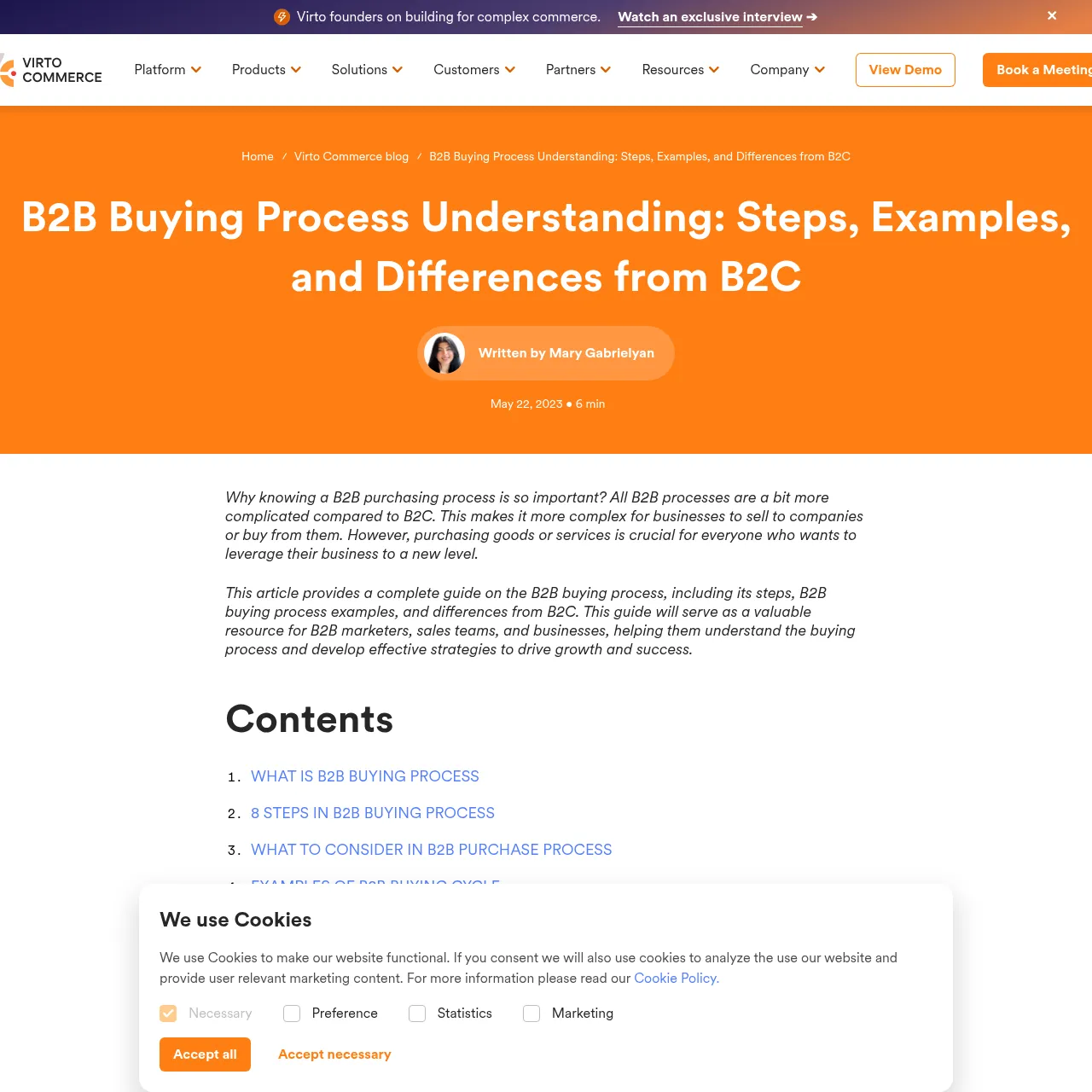
Virto Commerce approaches the B2B purchasing process as an educational mid-funnel resource tied to its Commerce Engine and Portal Experience products. The content maps the B2B buying journey across 6–8 stages and explicitly contrasts it with the relative simplicity of B2C purchasing. That contrast is operationally useful: it names the friction points — long cycle times, multiple decision-makers, formal RFQ and PO flows — that directly mirror what overseas buyers face when sourcing from Chinese factories that lack self-serve portals or structured quoting tools.
The content's particular strength is its coverage of the buying-committee and vendor-evaluation stages. These are exactly the phases where deals stall. A Chinese factory without a buyer-facing portal, structured quote process, or certification documentation in an accessible format forces the sourcing buyer to pause and chase reps for basic information. A factory with a Sitebox-deployed storefront and pre-loaded capability data sidesteps that bottleneck entirely — the Virto framework helps buyers identify which suppliers are creating that friction and where.
For sourcing buyers working from this resource, the practical output is a process audit: which stages in your procurement workflow are currently handled manually, and where does a supplier's digital capability — or lack of it — create avoidable delay?
Key Features:
- Multi-step B2B buying process coverage from need recognition through post-purchase vendor review
- Documentation of complex approval workflows and multi-stakeholder purchasing flows
- B2B-specific catalog, pricing, and RFQ quoting capability context
Best For: Enterprise procurement teams evaluating eCommerce platforms for multi-person buying committees and approval chains; distributors and wholesalers migrating from offline or EDI ordering to self-serve B2B portals with structured quoting built in.
5. Consensus — B2B Buyer Enablement Platform
Consensus targets the B2B purchasing process from the seller-enablement angle — specifically, the demo and discovery phases that stall B2B deals when multiple stakeholders need to be educated before a buying group can align. The B2B buying process involves buying groups, not just individual buyers, and Consensus is built around that reality: multiple stakeholders with different information needs and availability windows must each be satisfied before a purchase can move forward.
Its core mechanism is async video demos: instead of scheduling a live call with each committee member, a vendor sends an automated, interactive demo that each stakeholder watches on their own timeline. Engagement analytics then show which stakeholders watched which sections — giving sales teams a direct signal on where to follow up and which decision-makers are stalling. For a sourcing buyer evaluating Chinese factories, Consensus is a tool your vendor uses to sell to you, not a procurement tool you'd deploy yourself.
The practical relevance is as a benchmark for supplier readiness. A Chinese factory or platform that can deliver structured, self-paced product education — MOQ tiers, factory certifications, production capacity documentation — without requiring a live call compresses your procurement timeline. If a supplier requires a live WeChat call just to share a product spec, that's a process cost the more capable platforms have already eliminated.
Key Features:
- Automated, interactive product demos distributed at scale without live rep scheduling
- Buyer engagement tracking across individual stakeholders within a buying group
- Channel partner onboarding and standardized product education tooling
Best For: Presales teams managing large buying committees who need each stakeholder to self-educate asynchronously; channel and reseller networks requiring standardized product education without manual rep involvement per account.
6. Allego — Revenue Enablement Platform
Allego addresses the structural complexity of the modern B2B purchasing process from the sales-readiness side. Product marketing must adapt to the modern B2B buying process — Allego makes that concrete by targeting three specific failure modes: reps using stale or off-message content, reps unprepared for multi-stakeholder objections, and buyers unable to internally share vendor materials with other committee members.
The Digital Sales Rooms feature is the most directly relevant for sourcing buyers evaluating suppliers. Instead of a scattered email chain of attachments, a Digital Sales Room creates a structured, trackable microsite where a supplier can post MOQ sheets, factory certification documents, and lead-time schedules for a distributed buying team. Each stakeholder — procurement, finance, legal, category management — accesses the same version of the materials on their own schedule. No version conflicts, no lost PDFs, no "which email had the CE certificate?" This is the kind of structured information handoff that distinguishes a factory ready for serious B2B relationships from one still operating on WhatsApp and informal quotes.
AI Role Play and Coaching prepares sales reps for the specific objection patterns of multi-stakeholder B2B deals — procurement objections, legal compliance questions, and finance-level ROI challenges. Sales Content Management centralizes buyer-facing assets in a version-controlled library. A rep presenting to a sourcing committee is never working from a deck three versions behind.
Key Features:
- Sales Content Management: centralized, version-controlled buyer-facing asset library with role-based access
- AI Role Play & Coaching: simulated multi-stakeholder buyer conversations to prepare reps for committee-driven procurement cycles
- Digital Sales Rooms: shared deal microsites where distributed buying committee members access content asynchronously
- Modern Learning: role-specific onboarding and product training for complex B2B sales motions
Best For: Enterprise sales teams managing long-cycle B2B deals with procurement, legal, finance, and end-user stakeholders all requiring different content; product marketing teams aligning sales messaging to specific stages of the modern B2B buying process from awareness through procurement sign-off.
What to Evaluate Before Contacting a Supplier
Before entering the RFQ or negotiation stage with any factory, sourcing buyers should work from a structured checklist. These are the evaluation dimensions that determine whether a supplier belongs in your shortlist at all:
MOQ and Pricing Structure: What is the minimum order quantity, and does it fit your inventory model? Ask for tiered pricing across order volumes — a factory with [your MOQ] flexibility may be viable where a 1,000-unit minimum is not. Request a quote that specifies price breaks at each volume tier.
Lead Time and Production Capacity: Standard lead times versus rush timelines affect your launch planning. Ask for current production queue status and any seasonal capacity constraints before committing to a timeline.
Certifications and Compliance: Required certifications differ by market — CE and RoHS for the EU, FCC and CPSC for the US, SAA for Australia. A factory without the applicable certifications for your target market is a disqualifier for regulated product categories, regardless of price.
Quality Assurance Process: Confirm what QA stages run inline during production, not just at final inspection. Ask whether the factory accepts third-party pre-shipment inspections and what the process for defect resolution is.
Supplier Reliability Signals: Factory age, export history, client references, and platform-verified status are all inputs. Platform-verified factories — like those active on Link4a — provide this data upfront, removing the due-diligence overhead from the early sourcing stages.
Wrapping Up: Pick Your Entry Point and Move
The B2B purchasing process is a committee-driven, multi-stage sequence where the buyer's internal alignment often takes longer than the supplier's production cycle. Sourcing buyers working with Chinese OEM/ODM factories face an additional layer: language gaps, verification overhead, and fragmented communication channels that standard procurement frameworks were not built to handle.
The resources above serve different stages. Academic frameworks like OpenStax give you vocabulary and process structure. Platform documentation from OroCommerce and Virto Commerce shows what a digitally mature procurement workflow looks like from the buyer side. Enablement tools like Consensus and Allego reveal how sophisticated vendors manage buyer-committee complexity — useful context for evaluating which suppliers have the infrastructure to support your procurement process rather than slow it down.
For buyers who want to compress supplier discovery, qualification, and engagement into one workflow, Link4a is the operational starting point: verified factory profiles, 3-second matchmaking, and multilingual inquiry AI that keeps the pipeline moving across time zones.
Request MOQ and pricing details, or submit an inquiry directly through Link4a to reach verified Chinese manufacturers across electronics, apparel, home goods, and consumer hardware — with capability data already in hand before the first conversation.