8 Proven B2B Sales Examples That Actually Close Deals

8 Proven B2B Sales Examples That Actually Close Deals
B2B sales (business-to-business sales) is the process where one company sells goods, services, or SaaS to another business rather than an individual consumer. Deals are typically high-value, involve multiple decision-makers, and follow a structured process covering lead generation, qualification, demos, and negotiation before close.
Transactions in this space can run into the millions of dollars, span multiple stakeholders from mid-level managers to the C-suite, and take months to finalize. Understanding what separates a deal that closes from one that stalls comes down to concrete examples — real scenarios where the process played out across different industries, deal sizes, and buyer types.
This guide breaks down eight instructive b2b sales examples, walks through the sales process that drives each one, and explains what buyers are actually evaluating before they commit. If you're an overseas sourcing buyer or DTC operator building supply chains through verified Chinese manufacturers, the B2B framework is what your supplier should be navigating — and what you should expect them to handle competently.
For a broader picture of how B2B transactions work across industries, see 12 Real B2B Examples That Reveal How Business-to-Business Sales Work.
What B2B Sales Examples Actually Mean
The meaning of B2B sales shifts depending on what's being sold and to whom. At its core, Salesforce defines it as involving high-cost and/or recurring contract pricing, multiple stakeholders, and longer close times — three structural features that separate it from consumer retail.
Three broad categories cover most real scenarios:
- Manufacturers purchasing raw materials or components to produce their own products
- Companies purchasing services — logistics, compliance, SaaS — to support operations
- Businesses purchasing equipment and tools to improve production capacity
These aren't hypothetical. A garment factory in Guangzhou sourcing zippers from a Zhejiang component supplier is a B2B transaction. A US-based DTC brand onboarding a Chinese ODM to white-label a product line is a B2B deal. An e-commerce operator subscribing to a SaaS platform for supplier relationship management — also B2B.
The distinction matters because the sales process, the team required to close it, and the criteria buyers use to evaluate options are all fundamentally different from B2C. More on that comparison is in our B2B vs B2C: The Complete Comparison Guide for Business Decision-Makers.
8 Real-World B2B Sales Examples With Process Context
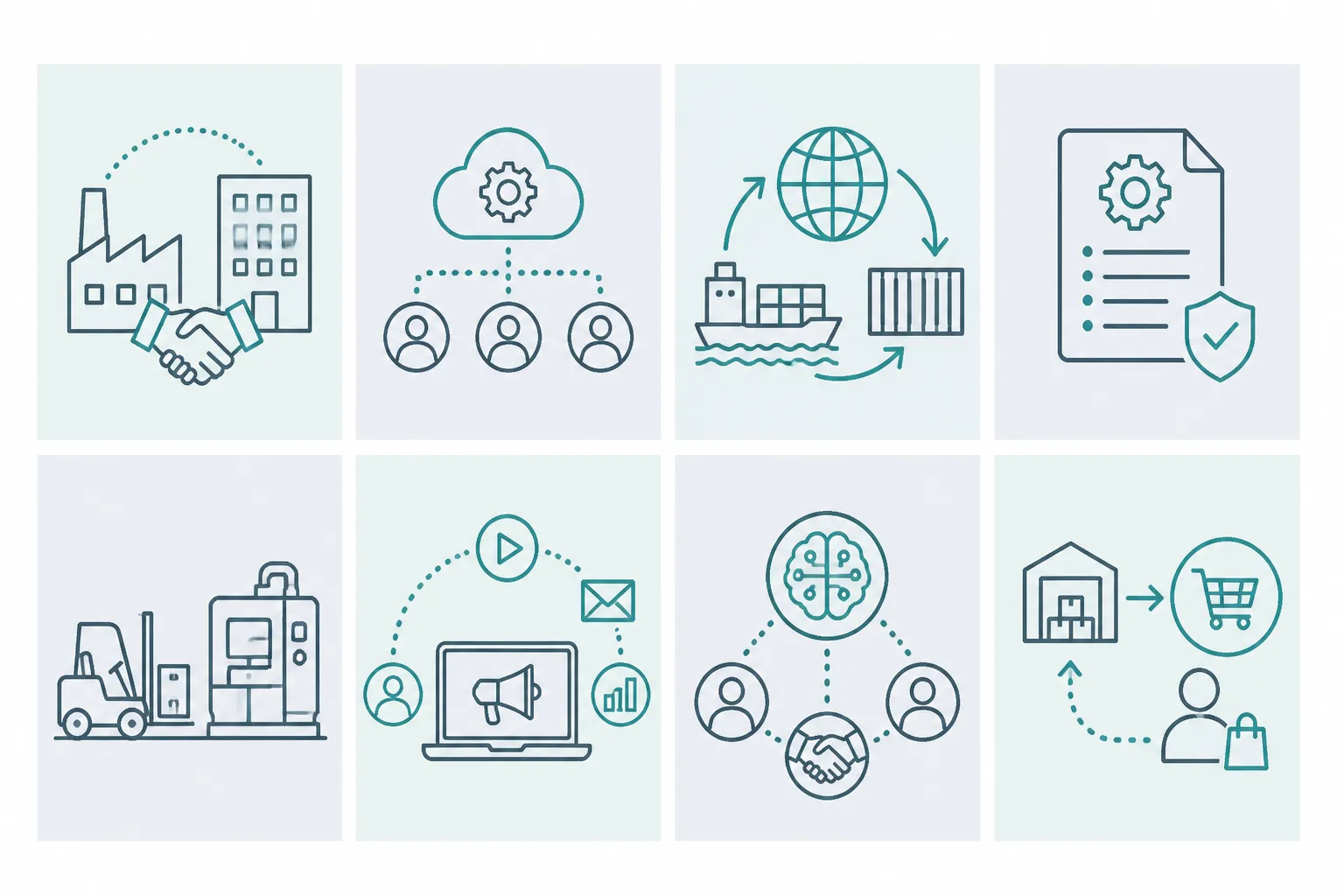
1. Raw Material Procurement (Manufacturer-to-Manufacturer)
A plastics compounder sells engineered resins to an electronics enclosure factory. The buyer's procurement team evaluates technical specifications, resin certifications (UL94 flammability rating, RoHS compliance), MOQ, and delivery lead time against their production schedule. The deal closes after lab testing, a factory audit, and a volume-tier discount negotiation.
This is the most fundamental B2B sales example: one manufacturer selling inputs to another. The seller's account manager owns the relationship. That role involves coordinating between technical teams, writing account reports, and managing contract renewals — and it commands a national average salary of $65,203 per year.
2. SaaS Platform Sales (Software Licensing)
A cross-border logistics SaaS company sells a freight management platform to an import/export trading company. The deal involves a 90-day pilot, IT security review, finance director sign-off, and a multi-year contract negotiated on per-seat pricing. Sales cycles here are long because switching costs are high — once integrated, replacement is expensive, so buyers move carefully.
3. OEM/ODM Export Sales (Chinese Factory to Overseas Brand)
A Shenzhen consumer electronics ODM pitches a UK-based DTC brand to design and manufacture a private-label wireless speaker. The buyer evaluates: factory certifications (ISO 9001, CE, FCC), MOQ at multiple volume tiers, sampling lead time (typically 15–25 days), mass production lead time (45–90 days), unit cost, and the factory's existing client list as a reliability proxy.
This is the scenario most relevant to sourcing buyers reading this guide. The Chinese factory is the B2B seller; the overseas brand is the buyer. The process — lead generation, qualification, sample, negotiation, purchase order — mirrors the universal B2B sales framework.
4. Service Contract Sales (Third-Party Logistics & Compliance)
A customs brokerage firm sells multi-country import compliance services to a European retailer sourcing from multiple Asian factories. The deal structure includes an SLA specifying clearance time windows, a compliance audit fee, and a retainer. Multiple stakeholders sign off: logistics manager, CFO, legal counsel.
5. Equipment and Tooling Sales (Capital Machinery)
A Taiwanese CNC machine manufacturer sells precision milling equipment to automotive Tier 2 suppliers in Southeast Asia. Each deal bundles installation, operator training, a two-year warranty, and spare-parts contracts. The sales cycle runs 6–18 months. ROI calculations are presented to factory management before final approval — this is standard when buyers are committing to physical infrastructure.
6. Marketing and Content Platform Sales
A B2B marketing intelligence platform sells SEO and outbound lead generation tools to a mid-market exporter. The pitch centers on pipeline attribution: how many qualified leads the platform produced, at what cost per lead. Demos, trial data, and comparable-account case studies drive the close.
Link4a's Reach product fits here — a content-and-SEO engine that drives social, SEO, GEO, and outbound lead-mining in a single loop for Chinese factories building international brand presence, removing the overhead of running five separate tools.
7. AI-Assisted Supplier Matchmaking
An overseas sourcing agent uses an AI matchmaking platform to identify verified Chinese manufacturers for a client's new product category. The platform surfaces supplier profiles, certifications, MOQ ranges, and lead times in seconds. The sourcing agent then enters a direct B2B qualification process with two or three shortlisted factories.
Link4a's Match engine returns supplier matches in seconds. For 链上科技 clients — spanning a growing network of factories and live sites — this compresses the supplier discovery phase from weeks to minutes.
8. DTC Supply Chain Partnership
A TikTok creator with a validated product concept approaches a Chinese OEM to co-develop a hero SKU. Negotiations cover tooling ownership, exclusivity clauses, reorder MOQ tiers at each growth stage, and QA checkpoints (pre-production samples, inline inspection, final random inspection). The creator's team — or their sourcing partner — runs the full B2B evaluation before placing the first PO.
The B2B Sales Process: From Lead to Close
Every example above follows the same underlying process structure. Skipping steps is how deals collapse.
Step 1 — Define your Total Addressable Market (TAM). Identify who you're selling to with enough precision that you don't chase buyers who will never convert. For a Chinese exporter, this means defining target geographies, buyer types (retailer, distributor, DTC brand), product categories, and order volume thresholds before the first outreach.
Step 2 — Research leads. Cognism notes that researching leads means understanding their pain points and knowing your product thoroughly before first contact. A lead generator specialist earns a national average salary of $54,457 per year — reflecting the specialization this stage requires.
Step 3 — Outreach and qualification. Cold calling, email cadences, LinkedIn outreach, trade show follow-ups. The goal is qualification: does this lead have budget, authority, need, and timeline? Unqualified leads cost the same effort as qualified ones and generate zero revenue.
Step 4 — Needs assessment and demo. The seller maps their product or service to the buyer's specific problem. In OEM/ODM contexts, this is the sample stage — a physical prototype replaces the software demo.
Step 5 — Proposal, negotiation, and close. B2B buyers need to understand potential ROI before committing. Proposals must speak to business outcomes, not just feature lists.
Step 6 — Account management and retention. A customer success manager earns a national average salary of $66,862 per year because retaining existing clients is typically more profitable than acquiring new ones. In manufacturing, this means proactive reorder reminders, new product introductions, and quality issue escalation before the buyer escalates first.
Why B2B Sales Cycles Run Longer Than B2C
B2C transactions close in minutes. A B2B deal involving purchasing and onboarding new AI software for hundreds of employees can touch multiple teams, require legal and security reviews, loop through budget cycles — and stretch across months.
Three structural reasons:
Multiple stakeholders with different agendas. Decision-makers stretch from mid-level managers to the C-suite, each with different requirements and veto power. A Chinese factory selling to a UK retailer may be dealing with a product developer, a sourcing director, a compliance officer, and a CFO — none of whom communicate seamlessly with each other.
High switching costs. Once a business integrates a supplier or platform, replacing it is expensive. Buyers move carefully because the cost of a wrong decision is measured in production delays, rejected goods, and requalification time.
ROI requirements. B2B buyers don't close on emotion. They present ROI models to internal committees. Your sales process must produce the data that supports their internal justification for signing.
Lead Generation and Marketing in B2B Sales
Lead generation is the engine of the entire B2B sales process. Without a consistent inflow of qualified leads, even the most skilled account managers run dry.
Core channels for B2B lead generation in cross-border trade:
- Cold outbound — targeted email sequences, LinkedIn InMail by job title and industry, cold calls to procurement contacts
- Content and SEO — long-form guides, product comparison articles, and technical spec pages that attract buyers during their research phase
- Trade shows and sourcing platforms — Canton Fair, Global Sources, Alibaba for factory-to-buyer introduction; effective for top-of-funnel volume
- GEO (Generative Engine Optimization) — structuring content to surface in AI-generated answer summaries, which is rapidly becoming a primary discovery channel for overseas buyers researching Chinese suppliers
- Referrals and agent networks — sourcing agents, trade consultants, and industry associations who introduce verified factories to qualified buyers
For Chinese exporters, the marketing challenge is running all of these without a large in-house team. Link4a's Reach product consolidates content generation, SEO, GEO, and outbound lead mining into a single workflow — reducing the overhead of managing five separate tools to drive international B2B pipeline.
What Overseas Buyers Evaluate Before Committing
The examples above describe the seller's process. If you're on the buying side — a sourcing agent, DTC brand, or retailer evaluating Chinese suppliers — here are the evaluation dimensions that determine whether a B2B deal closes:
MOQ and pricing tiers. Request pricing at three volume levels: your target MOQ, 2× volume, and 5× volume. This reveals the cost curve and whether the supplier's economics align with your growth plan. Never commit without knowing what your MOQ commits them to schedule into production.
Lead time and production capacity. Separate sampling lead time from mass production lead time. A factory quoting 15 days for a sample but 90 days for a first production run needs to explain that gap clearly. Ask for current capacity utilization and whether a secondary production line exists.
Certifications and compliance. Relevant certifications depend on your target market: CE and UKCA for Europe/UK, FCC and CPSC for the US, KC for South Korea. Request certificate copies with expiry dates. Expired certifications signal a supplier who isn't maintaining compliance — a procurement risk, not a paperwork issue.
Quality assurance process. A serious B2B supplier will describe their QA protocol: incoming material inspection, in-process checkpoints, pre-shipment final random inspection (FRI). If they can't articulate their QA process in concrete terms, assume it's informal.
Supplier reliability signals. Years of operation, references from existing overseas buyers, and a professional English-language website with verifiable product information are the baseline signals. An Alibaba listing alone does not constitute a verification touchpoint.
Link4a's Inbox product handles multilingual inquiry responses 24/7, meaning qualified buyers get answers at any hour without waiting for office hours. For factories using 链上科技's Sitebox, a professional buyer-facing site goes live in under 30 minutes — giving buyers a credible verification touchpoint the moment they search for the factory online.
From Examples to Action
The eight b2b sales examples in this guide share one constant: deals close when both sides have enough verified information to commit. Sellers who make that information easy to access — through responsive inquiry handling, professional product specifications, and clear procurement terms — close faster and retain clients longer.
B2B sales is a process, not a pitch. Whether you're a Shenzhen ODM building an international client base or a DTC operator qualifying Chinese supply for a first production run, the steps are the same: define your market, generate qualified leads, qualify thoroughly, present ROI-backed proposals, and invest in post-sale retention.
For a deeper look at the marketing channels that feed B2B pipeline, see B2B Marketing Examples: 6 Platforms That Drive Real Pipeline (2026).
Ready to connect with verified Chinese factories or build the infrastructure to win international B2B deals?
Request a Quote or explore supplier connections at Link4a →
Frequently Asked Questions
What is b2b sales examples?
B2B sales examples include a software company selling a CRM platform to a retail chain (e.g., Salesforce closing a 500-seat enterprise deal with a $120K/year contract), a Chinese factory supplying private-label apparel to a DTC brand (MOQ 500 units, 45-day lead time, OEKO-TEX certified), or a logistics provider like a Shenzhen 3PL signing a fulfillment contract with a US e-commerce operator covering pick/pack, last-mile, and returns.
Other concrete examples: a packaging supplier pitching custom corrugated boxes to Amazon FBA sellers (MOQ 1,000 units, 30-day lead, FSC-certified kraft), or a SaaS vendor like 链上科技 selling supply-chain visibility software to a sourcing agency on an annual subscription with per-user pricing.
The common thread is that the buyer is a business entity, deal cycles are longer (weeks to months), contracts are negotiated, and decisions involve multiple stakeholders (procurement, finance, ops).
How to b2b sales examples?
B2B sales in Chinese supply chains typically follow a structured sequence: identify a target factory or trading company (e.g., a Guangdong injection-molding house with ISO 9001 and BSCI certifications), send a qualified RFQ specifying MOQ (say, 500 units), target unit price, packaging requirements, and lead time (typically 30–45 days ex-works), then negotiate a sample order before committing to volume.
Concrete examples include a DTC operator sourcing private-label silicone kitchenware: they contact 3–5 Yiwu suppliers via Alibaba or a sourcing agent, benchmark quotes, request SGS test reports, and lock a 1,000-unit trial PO at $2.80/unit with a 30% deposit via T/T. Another example is a SaaS reseller (e.g., using 链上科技 or Sitebox for supplier management) that automates follow-up sequences, tracks quote versions, and logs supplier response rates to prioritize high-conversion vendors.
The core mechanic is always the same: qualify the factory (capacity, certifications, audit history), anchor on a specific SKU with hard specs, and move from sample approval to PO with a written proforma invoice—never on a verbal agreement alone.
Why is b2b sales examples important?
B2B sales examples are important because they give sourcing buyers and operators concrete proof-of-concept — showing exactly how a deal was structured (MOQ thresholds, lead times, pricing tiers, certification requirements like ISO 9001 or CE) rather than leaving buyers to guess how a supplier actually performs in practice. Real examples compress the buyer's learning curve by revealing common friction points: payment terms, tooling costs, packaging customization, and shipping incoterms that generic pitches omit. For teams evaluating Chinese supply chains specifically, documented examples also build trust where factory audits aren't immediately feasible, providing a traceable reference for benchmarking supplier claims against verified outcomes.
When should I use b2b sales examples?
Use B2B sales examples when training new sales reps on deal structures, objection handling, or multi-stakeholder negotiation — concrete cases (e.g., a 10,000-unit MOQ negotiation with a Shenzhen contract manufacturer, 45-day lead time, ISO 9001-certified) land faster than abstract principles. They're also effective in proposals and pitch decks to show prospects you understand their buying context, such as referencing how a comparable DTC operator sourced private-label goods with net-60 payment terms. Finally, use them in post-deal reviews to identify what closed the deal — whether it was pricing flexibility, sample turnaround speed, or a specific certification like REACH compliance.
What are the benefits of b2b sales examples?
B2B sales examples help sourcing buyers and operators benchmark realistic deal structures — for instance, knowing that a Guangdong injection-mold factory might require a 500-unit MOQ with 30-day lead times and ISO 9001 certification gives concrete anchors for negotiation rather than vague estimates. They also compress the learning curve by showing how successful buyers structured RFQs, staged payments (e.g., 30% deposit, 70% on B/L), and quality inspection triggers across actual supplier relationships. Finally, concrete examples expose failure modes — like a DTC operator losing margin because they didn't account for CNY shutdown lead-time buffers — so new buyers can avoid repeating costly mistakes.