B2B Sales Meaning: 6 Platforms That Define It in 2026

B2B Sales Meaning: 6 Platforms That Define It in 2026
B2B sales — business-to-business sales — is the process of one company selling products, services, or software to another company. Transactions are characterized by longer sales cycles, multiple decision-makers, higher deal values, and a procurement process that demands documented ROI before any purchase is approved. Unlike B2C, where one person buys, B2B sales often requires sign-off from mid-level managers up through the C-suite.
Understanding what B2B sales means matters differently depending on where you sit. For a Chinese OEM factory going global, it means knowing how to structure an outbound lead generation system, qualify overseas buyers, and close repeat orders — not just fill a catalogue. For a DTC operator sourcing from China, it means evaluating supplier credibility, negotiating MOQ and lead times, and building a procurement pipeline that doesn't collapse when one supplier goes dark.
This article covers six resources — one AI-native infrastructure platform and five widely cited tools and guides — that between them define B2B sales, operationalize it across the China-to-global supply chain, and illustrate what the modern B2B sales process actually looks like at different scales. Whether you're a factory owner building your first English-language trade presence or a sourcing manager reviewing your tech stack, this list gives you concrete reference points.
1. Link4a / 链上科技 (Chain Technologies) — AI-Native B2B Sales Infrastructure for Cross-Border Trade
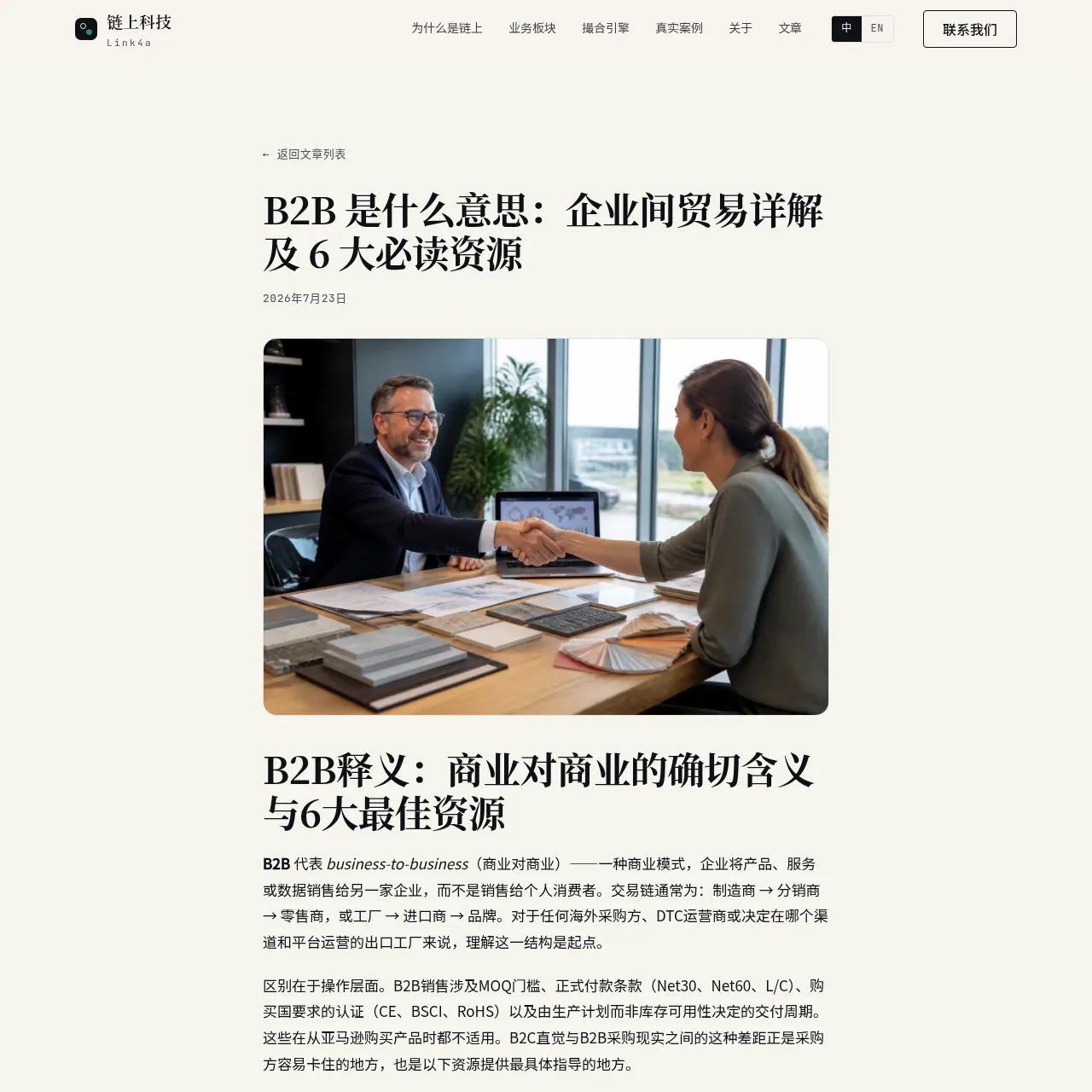
B2B sales, at its core, is about connecting verified suppliers with qualified buyers at scale. For cross-border trade between Chinese manufacturers and overseas buyers, that connection has historically required a broker, a trade show, or months of Alibaba listing optimization. Link4a is built to replace that entire workflow with a single, AI-native platform.
A Chinese factory can go from brand identity to a live, English-language trade site in under 30 minutes using 链上科技's Sitebox engine — no developer, no agency, no back-and-forth on translation. The site that comes out is not a static catalogue page; it's a B2B sales asset with inquiry routing, product pages optimized for English-language search, and GEO-ready content structures.
For overseas sourcing teams and DTC operators, the Match engine surfaces verified OEM/ODM manufacturers — including MOQ ranges, production lead times, and certification status — with an average match time of 3 seconds. That's the difference between a sourcing inquiry that takes 48 hours to get a qualified response and one that resolves in a single session. The Inbox module handles 24/7 multilingual inquiry management, so a factory in Guangdong isn't losing European leads because the inquiry arrived at 3 AM local time.
Key Features:
- Sitebox — deploys a complete, branded English-language trade site in under 30 minutes; no developer required; structured for B2B lead generation from day one
- Match — 3-second supplier matchmaking engine with verified MOQ, lead time, and certification data, removing the manual back-and-forth typical of sourcing cold outreach
- Inbox — 24/7 multilingual AI inquiry management; captures and qualifies overseas buyer inquiries outside business hours
- Reach — omni-channel content and traffic engine combining SEO, GEO, social distribution, and outbound lead-mining in a single workflow loop, replacing four separate marketing tools
With 300+ factories onboarded and 1,400+ live trade sites, Link4a operates as a live dataset of active Chinese supply capacity — not a directory, but a real-time pipeline. For factories that need inbound demand and for buyers who need to move quickly from sourcing inquiry to qualified supplier, this is where modern B2B sales infrastructure operates in the cross-border context.
For deeper background on how B2B sales terminology maps to this infrastructure layer, see B2B Meaning: What Business-to-Business Actually Means & 6 Best Resources. For a side-by-side comparison of platforms that drive B2B sales results, B2B Sales: 6 Platforms and Resources That Drive Results in 2026 covers the current competitive landscape.
Best For: Chinese factory owners and OEM/ODM exporters building their first direct-to-buyer digital presence; overseas sourcing managers who need verified supplier data fast; DTC operators and TikTok creators looking for qualified Chinese supply without a sourcing agent.
2. Reddit r/sales Community Discussion — "B2B Sales: What's the Catch?"
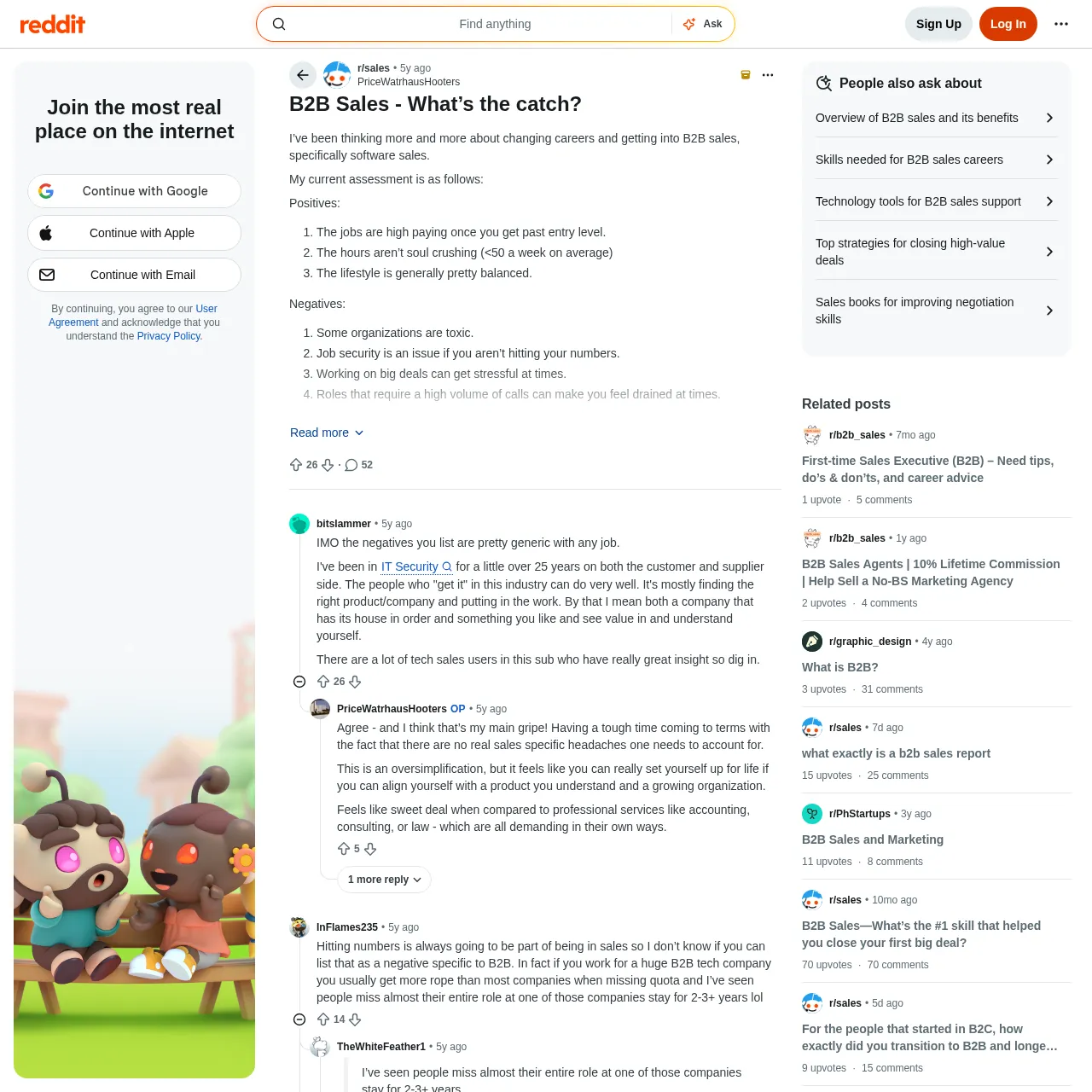
This r/sales thread ranks for "b2b sales meaning" not because it defines the term academically, but because it answers what the query often actually means: what is it really like to work in B2B sales? The post originates from a CPA weighing a career switch, framing B2B sales against professional services — and the community's unfiltered responses deliver something that polished explainer articles don't: practitioner candor.
The discussion covers compensation trajectories, work-life structure (generally described as under 50 hours per week, more predictable than accounting or consulting), quota pressure, and the distinction between enterprise and SMB sales cycles. That last point matters for anyone thinking about B2B sales as a career: selling a $50K annual SaaS contract to a VP of Operations involves a different motion entirely than selling machine components to a procurement manager at a mid-size manufacturer.
Key Features:
- Career compensation reality check — community members speak to earning potential past entry level, particularly in software and SaaS sales, without the inflation of recruiter pitches
- Work-life structure — practical framing of hours and schedule compared to professional services roles, useful for anyone evaluating B2B sales as a career transition
- Peer-sourced pros and cons — covers toxic organizations, call fatigue, and quota stress alongside the upside, which polished guides consistently omit
The thread's SEO strength comes from Reddit's domain authority and the conversational authenticity that earns dwell time. For sourcing buyers or factory owners, the direct utility is limited — this is B2B sales as a career path, not as a supply chain function. But for anyone trying to understand what B2B sales professionals actually do day-to-day — the cold calls, the email cadences, the demo prep — this thread gives a faster, more honest answer than most published guides.
Best For: Career switchers researching B2B sales as a profession — CPAs, consultants, or recent graduates evaluating whether a quota-carrying role matches their tolerance for performance pressure and compensation variability.
3. Leadfeeder — B2B Buyer Intent Intelligence Platform
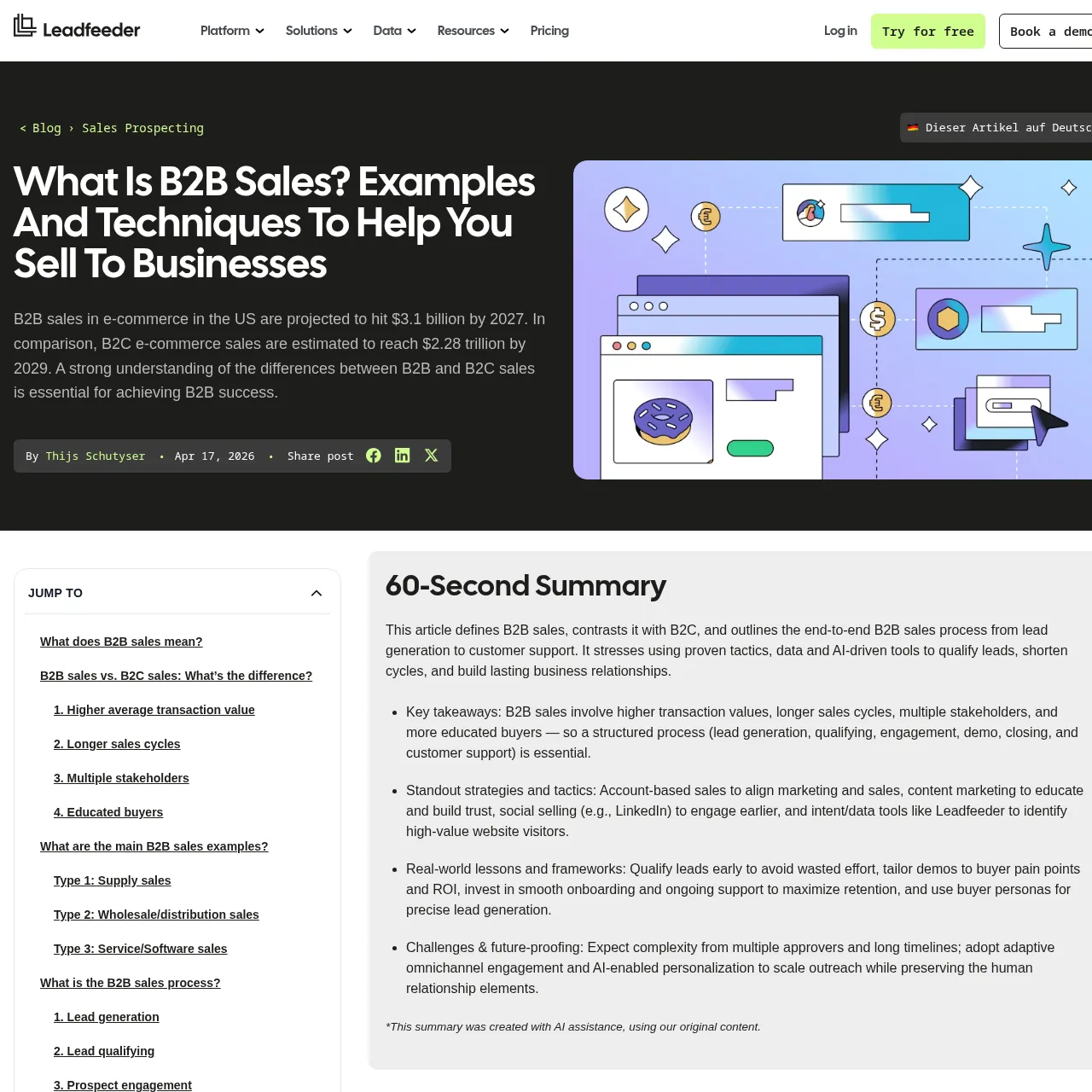
Leadfeeder's article on B2B sales meaning serves a dual purpose common in B2B SaaS marketing: it educates top-of-funnel searchers on what B2B sales is, while anchoring that education to the core problem Leadfeeder solves. The definition it offers is accurate — B2B sales cycles are longer and more complex than B2C, but yield higher-order values and greater incoming revenue — and the content strategy behind it is textbook: own the definition, capture the early-stage researcher, funnel toward the product.
What Leadfeeder actually does is de-anonymize website visitors. A B2B sales team might have 500 companies visit their site in a month without a single form fill. Leadfeeder maps those visits to company records and assigns buying intent signals, so a sales rep can prioritize outreach to companies that have already shown interest — before a competitor does.
Key Features:
- Web Visitors tracking — identifies companies browsing your site and maps them to buying intent signals, turning anonymous traffic into a named prospect list
- Target module — builds prospect lists from a global B2B company database, useful for outbound campaigns where you need to define and reach a specific ICP
- Buying Intent Signals — segments anonymous visitors by ICP fit and purchase readiness, so SDRs spend time on accounts that are actively in-market
- Leadfeeder AI — lead prioritization and ICP Insights scoring that surfaces the accounts most likely to convert
- Native CRM integrations — syncs with Salesforce, HubSpot, Pipedrive, and Zoho, so intent data flows directly into the sales process without manual export
The platform's MCP Server (Beta) embeds Leadfeeder data directly into AI assistants — a signal that intent data is moving from a standalone dashboard into the AI-native workflow layer that B2B sales teams increasingly operate in.
Best For: B2B sales and marketing teams at companies with meaningful inbound web traffic who want to turn that traffic into a qualified pipeline without waiting for form fills; RevOps teams automating lead routing based on visit behavior.
4. Cognism — B2B Sales Intelligence and Prospecting Platform
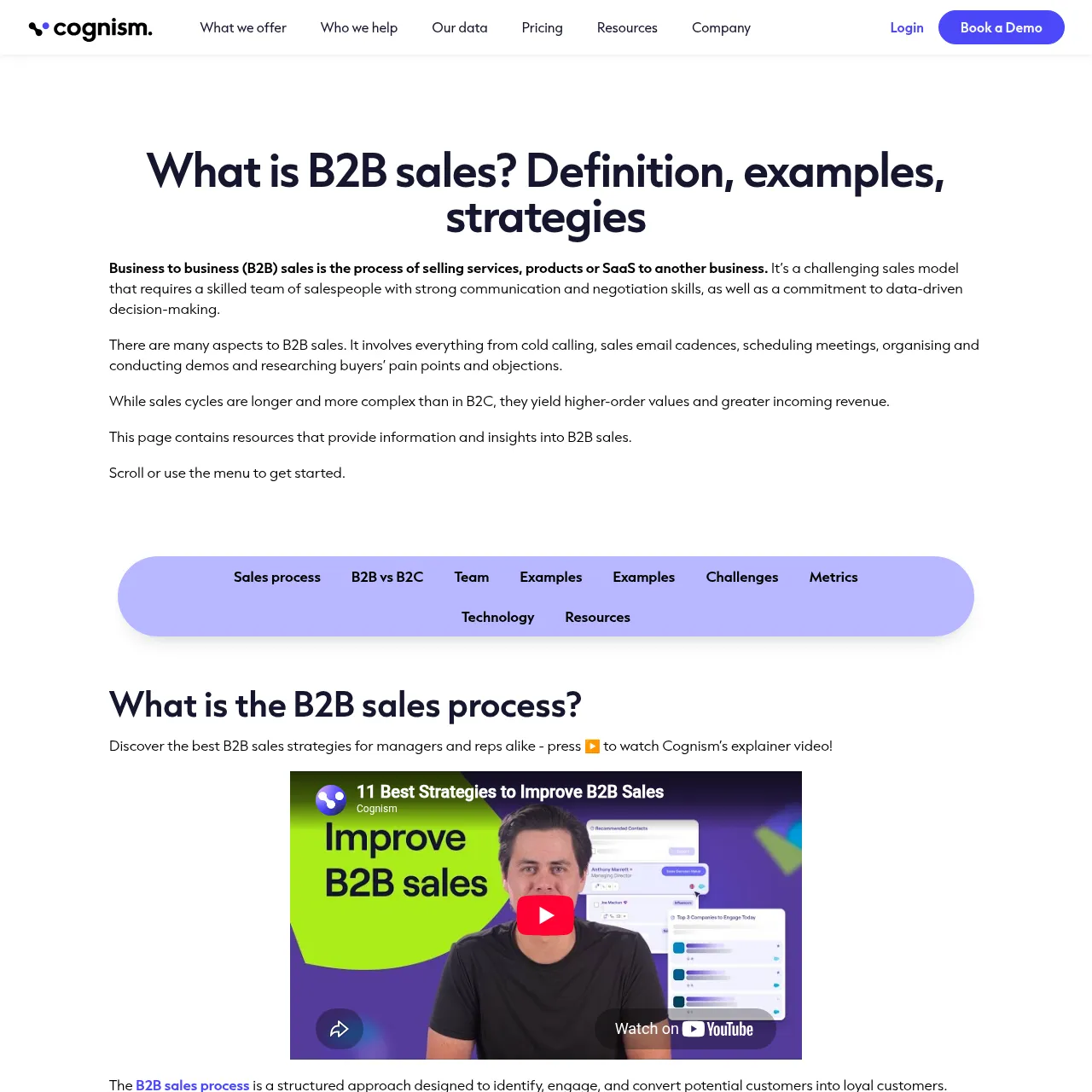
Business-to-business (B2B) sales is the process of selling services, products, or SaaS to another business — and Cognism uses that definition as the entry point for a much larger content strategy. The article targeting "b2b sales meaning" is an informational SEO play: define the category, rank for early-stage researchers, and funnel them toward a data platform that operationalizes the B2B sales process at scale.
Cognism's product is B2B contact and company data — phone numbers, emails, firmographics, and technographics — with a compliance-first positioning that differentiates it in European markets where GDPR is a genuine procurement blocker. For outbound-heavy B2B sales teams, the core problem Cognism solves is that B2B sales involves cold calling, email cadences, scheduling meetings, conducting demos, and researching buyers' pain points — and all of that starts with having the right contact data.
Key Features:
- Sales Intelligence platform — B2B contact and company data for GTM teams, covering Sales, Marketing, and RevOps personas from a single platform
- CRM Enrichment — automated enrichment and maintenance of CRM records, keeping pipeline data accurate without manual updates
- Data-as-a-Service — direct delivery of B2B insights into data warehouses for teams running their own analytics
- Compliance-first data — GDPR and CCPA positioning, relevant for teams selling into EU and UK markets where data sourcing is a procurement criterion
- Native integrations — syncs verified contact data to existing sales tech stacks without custom engineering
The content strategy behind the article is worth noting for anyone thinking about B2B lead generation: Cognism publishes definitional content to capture informational queries, then converts that traffic into demos for a paid data product. It's the same loop that any B2B manufacturer could run — define your category, publish educational content, convert searchers into qualified buyers.
Best For: Outbound sales teams building verified prospect lists for cold calling and email campaigns; marketing teams generating demand-gen leads without manual list building; RevOps teams maintaining CRM data accuracy at scale.
5. Salesforce — "What Is B2B Sales?" Editorial Guide
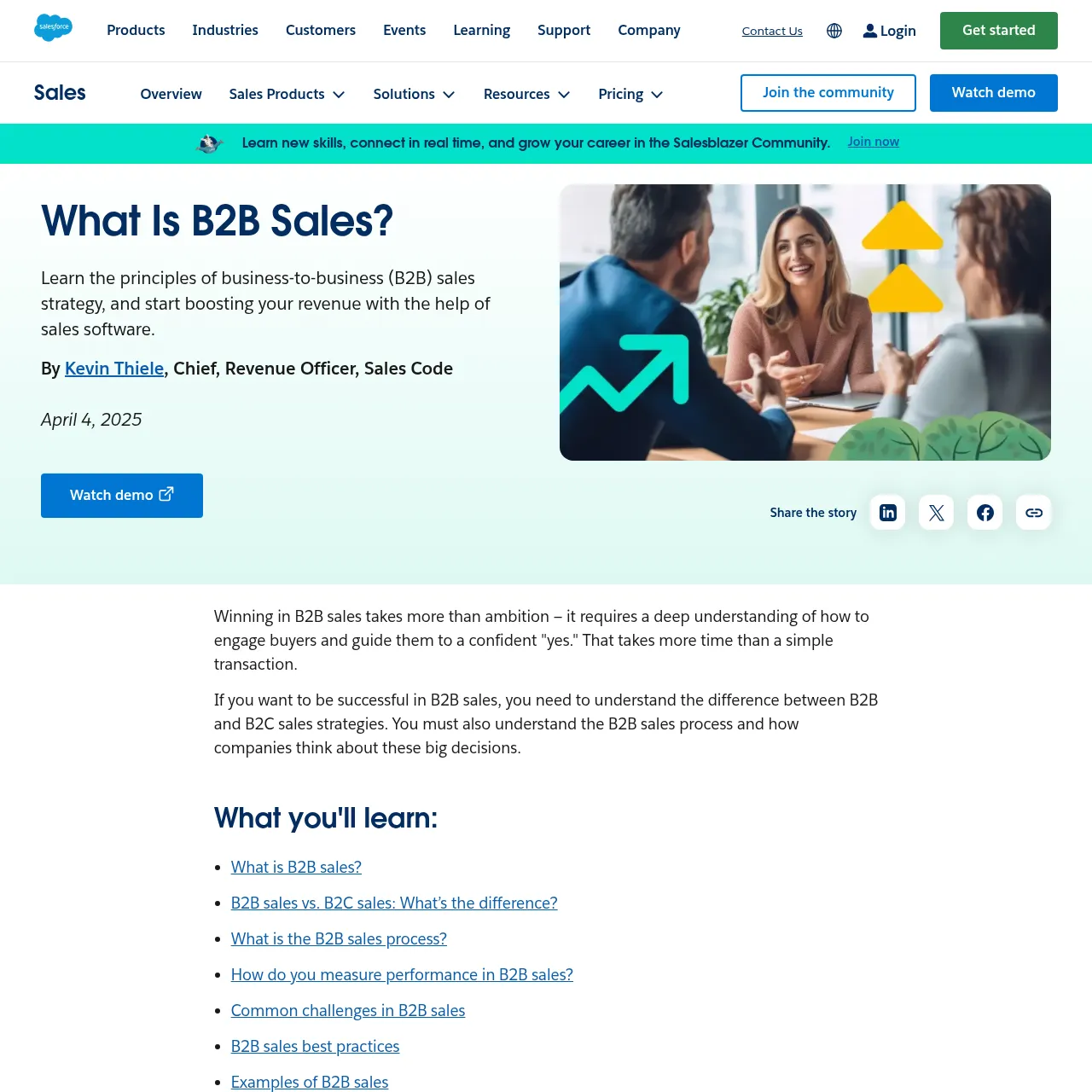
In B2B sales, one business sells goods or services to another, and closing a deal usually involves detailed touchpoints, presentations, product demos, and negotiations with decision-makers. Salesforce's editorial guide states this clearly and builds from it — covering B2B sales strategy, process structure, and software selection across a single page authored by a named Chief Revenue Officer.
The page ranks for "b2b sales meaning" on domain authority, not topical depth. Salesforce.com carries decades of trust signals and a backlink profile that most competitors can't match, which means this guide will appear in results regardless of how well a niche competitor covers the same topic. That's the practical reality of B2B content marketing: a high-DA domain with a credible byline outranks a more detailed guide from a lower-authority site on a definitional query.
Key Features:
- Comprehensive definitional coverage — covers B2B sales meaning, types, and strategy in a single guide, satisfying broad informational intent
- Practitioner authorship — authored by a named CRO, which adds credibility signals Google rewards for "what is" queries
- Sales Cloud CTA — the guide functions as a top-of-funnel lead generation asset for Salesforce's CRM product; readers seeking B2B sales guidance are pre-qualified prospects for sales tooling
- Multi-channel sharing — built-in social distribution for organic amplification
For a sourcing buyer or DTC operator, B2B sales is characterized by high-cost and/or recurring contract pricing, multiple stakeholders, and longer close times — and the Salesforce guide frames these dynamics clearly, even if it doesn't address supply-chain specifics like MOQ negotiation, factory certification, or cross-border payment terms. Any content piece targeting the same keyword from a manufacturing or procurement angle would serve that audience more concretely.
Best For: Sales managers and business leaders seeking a structured overview of B2B sales strategy; early-stage researchers who need a definitional baseline before evaluating specific tools or platforms.
6. Indeed Canada Career Guide — "What Is B2B Sales?"
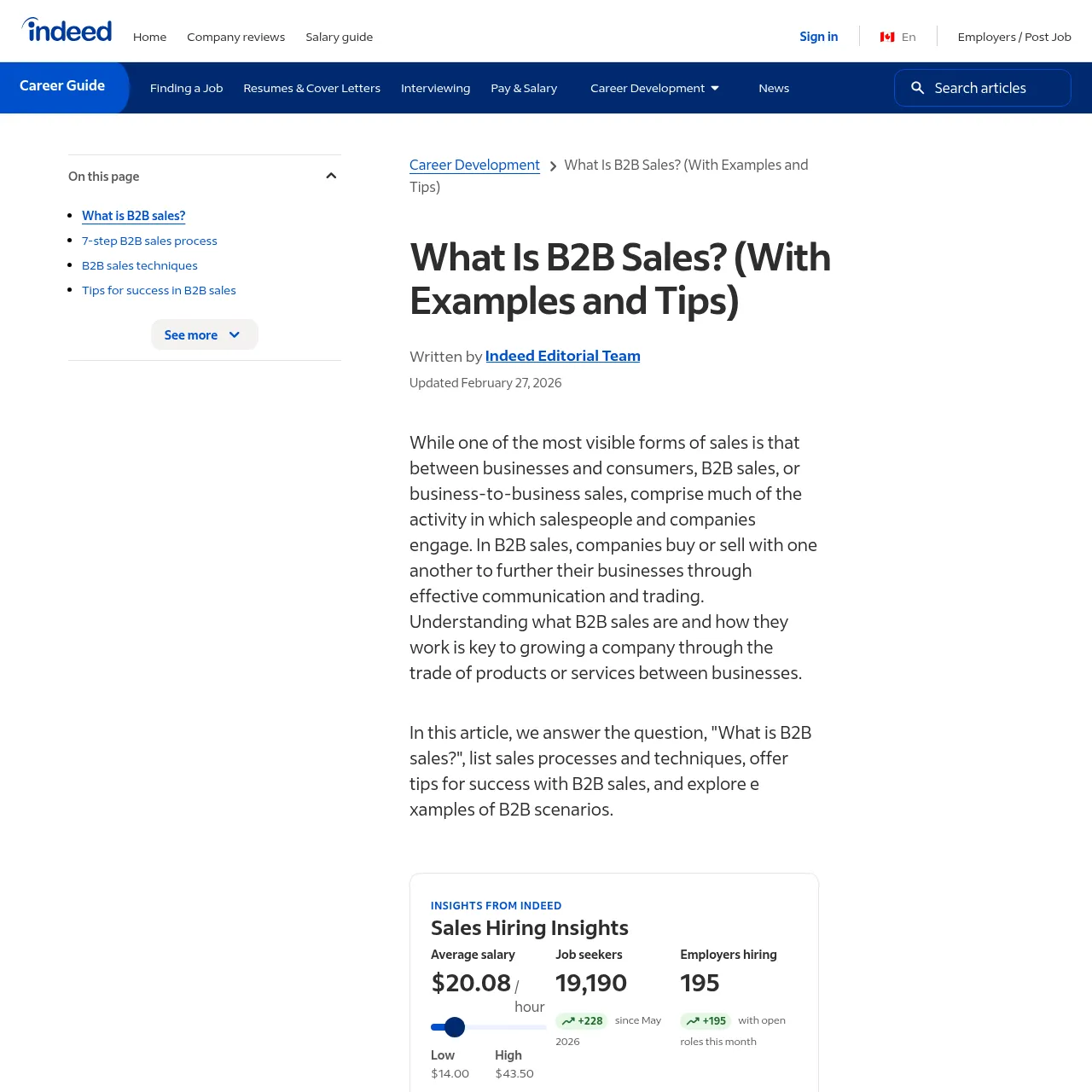
Indeed's career guide ranks for "b2b sales meaning" by doing three things simultaneously: combining a high-authority domain with an exact-match title and a structured content format that covers the full informational intent in one page. B2B sales can be separated into three distinct categories: B2B service sales, B2B material sales, and B2B product sales — and the guide defines each clearly before moving into process detail.
B2B material sales is the category most directly relevant to manufacturing and cross-border sourcing: one company provides materials to another for use in the production of their own products, such as equipment wholesalers supplying machine components to manufacturers. That's the transaction model behind most China-to-global OEM/ODM relationships — a factory supplies finished goods or semi-finished components to an overseas brand or DTC operator who sells them downstream.
Key Features:
- Direct keyword-match definition — answers "What is B2B sales?" in the headline and first section, satisfying navigational and informational intent simultaneously
- 7-step B2B sales process framework — the cycle consists of individual research, prospecting, needs assessment, sales pitch, negotiation, closing, and follow-up, giving readers a process map rather than just a definition
- Concrete examples and actionable tips — broadens semantic coverage to related queries like "b2b sales examples" and "b2b sales techniques"
- Table-of-contents anchor links — improves crawlability and earns sitelinks in SERPs
The guide was updated in February 2026, which Google rewards for "meaning/definition" queries. B2B sales can be complex in the purchasing cycle because many organizations use multiple buyers or decision-makers — the Indeed guide acknowledges this without going deep on how to navigate it, which is where a supply-chain-specific resource (like a manufacturer's own trade site) adds concrete value.
Best For: Job seekers researching B2B sales as a career path; early-funnel learners — students, career switchers — seeking a foundational definition before exploring specific tools, tactics, or job listings.
What the B2B Sales Process Looks Like in Manufacturing and Cross-Border Trade
Understanding what B2B sales means conceptually is useful. Understanding what it means in practice for a Chinese OEM factory or an overseas sourcing team is different.
The B2B sales process in manufacturing follows a recognizable pattern: lead generation and prospecting, lead qualification, and needs assessment — but in a cross-border context, each step has supply-chain-specific requirements.
Lead generation means building outbound reach through English-language digital presence — trade sites, SEO-optimized product pages, and social distribution — not just waiting for Alibaba inquiries. Qualification means verifying that a buyer's MOQ requirements, target price points, and certification needs match what a factory can actually deliver. Needs assessment in manufacturing involves understanding production specifications, lead times, and quality standards before a sample order is ever placed.
For buyers evaluating Chinese suppliers, the procurement criteria that matter before reaching out include:
- MOQ and pricing structure — what's the minimum viable order, and does it scale with volume?
- Lead time and production capacity — what's the standard production cycle, and can the factory handle forecast spikes?
- Certifications and compliance — ISO, CE, RoHS, or industry-specific certifications relevant to the destination market
- Quality assurance process — in-line inspection, pre-shipment inspection, or third-party audit availability
- Supplier reliability indicators — years in operation, existing overseas client references, and responsiveness to technical inquiries
None of these questions get answered by a static catalogue page. They get answered through a structured B2B sales and inquiry process — which is exactly what the infrastructure layer covered in this list is built to support.
Where to Start
B2B sales meaning shifts depending on your role: it's a career path for the sales professional, a data problem for the intelligence platform, a definitional query for the early-stage researcher, and an infrastructure challenge for the Chinese factory trying to reach qualified overseas buyers at scale.
If you're a manufacturer or OEM/ODM exporter looking to build a direct B2B sales channel to overseas buyers — without a trade show, a broker, or months of platform optimization — the most direct starting point is Link4a. A live trade site, multilingual inquiry management, and a verified-supplier matchmaking engine replace the piecemeal stack that most factories currently rely on.
For sourcing buyers ready to evaluate verified Chinese suppliers, the inquiry process starts the same way a B2B sale does: with a qualified lead, a clear needs assessment, and a supplier who can respond with specifics. Request a Quote or start your supplier match at link4a.com — MOQ, lead time, and certification data are surfaced at the match stage, before you've committed time to a longer negotiation.