B2B vs B2C: The Complete Comparison Guide for Business Decision-Makers
B2B vs B2C: The Complete Comparison Guide for Business Decision-Makers
B2B (business-to-business) and B2C (business-to-consumer) are fundamentally different commercial models — not just in who buys, but in how decisions get made, how long sales cycles run, and what marketing actually works. If you're a factory owner evaluating export channels, a SaaS founder picking a go-to-market motion, or a sourcing manager trying to understand supplier positioning, this breakdown will give you a clear decision framework.
TL;DR / Quick Verdict
B2B is the right model when your customer is another organization making a rational, multi-stakeholder buying decision — think manufacturers selling components, wholesalers supplying retailers, or software companies targeting enterprise procurement teams. B2C is the right model when you're reaching individual end users driven by emotion, convenience, or price. Many companies — especially Chinese exporters building cross-border brands — operate in both simultaneously, using B2B channels for volume and B2C channels for margin. Choose based on your buyer's psychology, not just your product category.
At-a-Glance Comparison Table
| Dimension | B2B | B2C |
|---|---|---|
| Customer | Another business / organization | Individual consumer |
| Decision makers | Multiple stakeholders (procurement, finance, technical) | Typically one person |
| Sales cycle | Weeks to months | Minutes to days |
| Average order value | High (often thousands to millions) | Low to moderate |
| Price sensitivity | Lower — ROI justifies spend | High — price is often the primary driver |
| Marketing focus | Relationship, trust, ROI proof | Emotion, convenience, brand identity |
| Lead generation | Account-based, referrals, trade shows, LinkedIn | Search ads, social media, influencers |
| Churn behavior | Low — contracts + switching costs create stickiness | High — consumers switch easily |
| Brand recognition | Narrow (industry-specific) | Broad (end-user facing) |
| Product type | Raw materials, components, software, services | Finished goods, apps, direct services |
| Support expectations | Dedicated account management, SLAs | Self-service, chatbots, FAQs |
| Examples | Samsung supplying Apple, Salesforce, wholesale distributors | Amazon, Nike, Netflix |
B2B: What It Is, Who It's For, and Where It Wins
B2B stands for business-to-business, referring to any commercial transaction that takes place between two organizations rather than between a business and an individual consumer. The meaning extends beyond sales — B2B covers e-commerce, communication workflows, operational procurement, and supply chain partnerships.
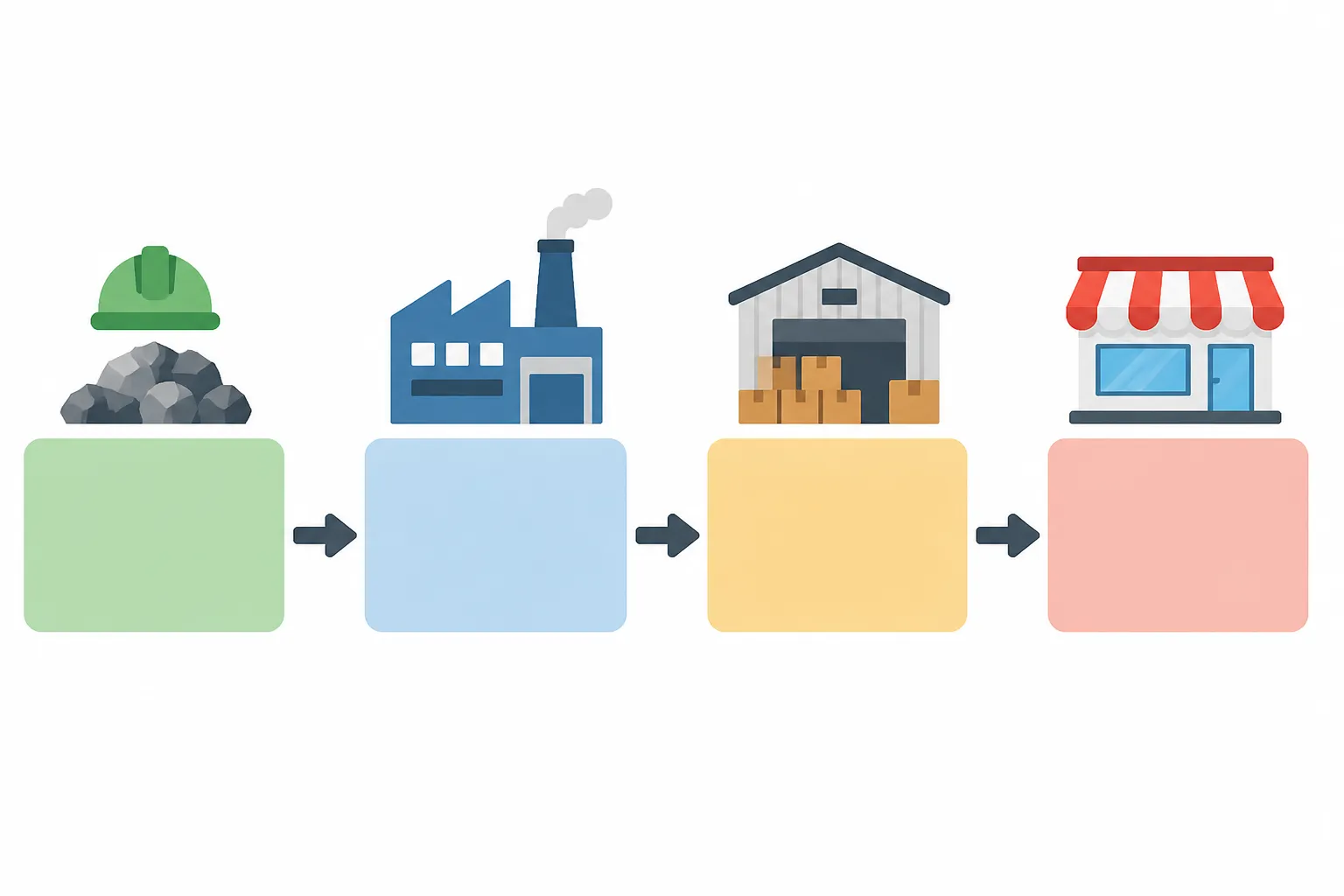
The classic B2B examples are manufacturers and wholesalers: Samsung providing technical elements that go into the production of Apple's iPhones is one of the most cited cases. A Shenzhen factory producing OEM electronics for a German retailer is another. The relationship spans the entire value chain — B2B covers everything from raw material sourcing through manufactured parts and assemblies, all the way to finished goods handed off to a retail channel.
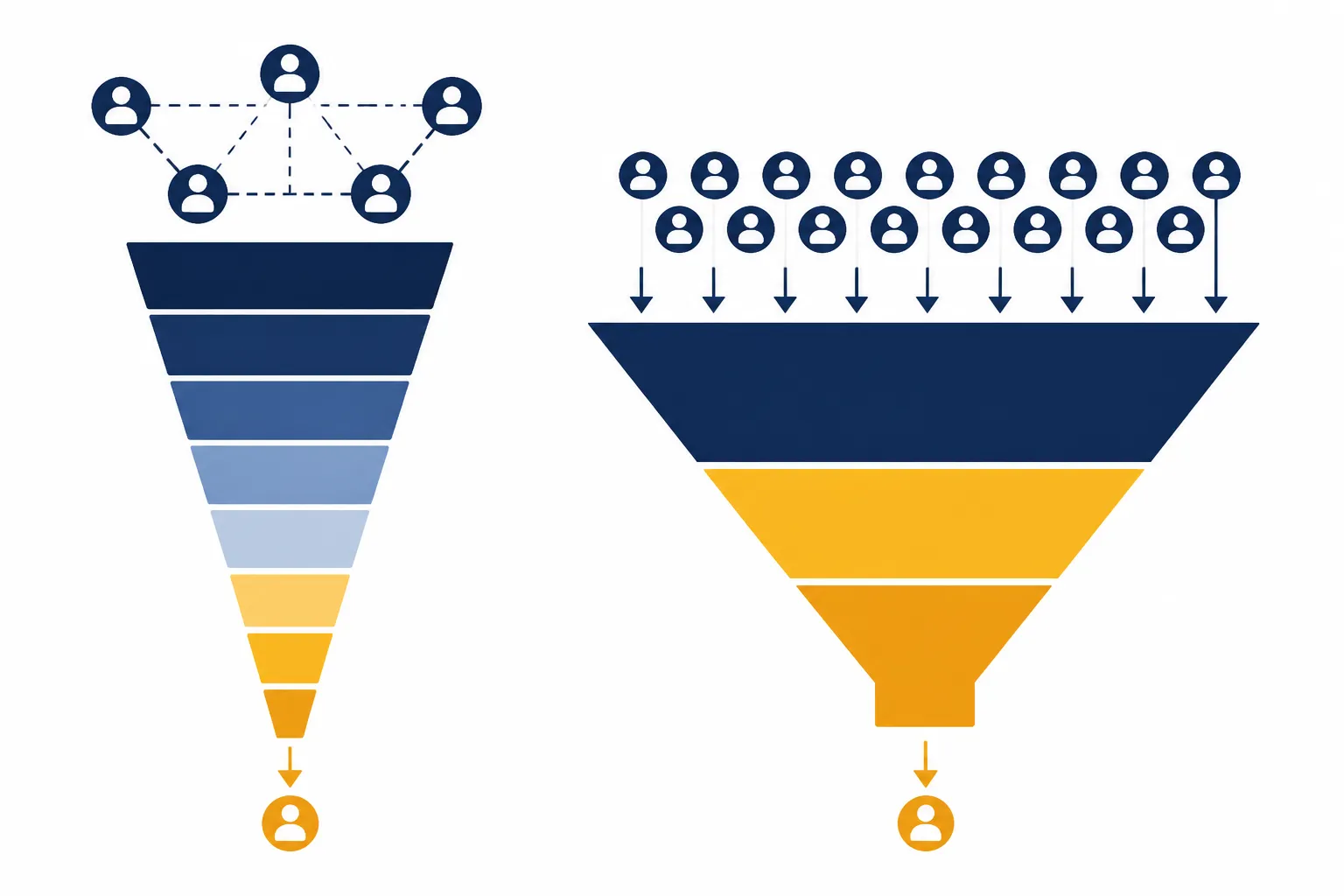
What makes B2B structurally different from B2C is the decision architecture. No single buyer clicks "add to cart." A typical B2B purchase involves a procurement team, a finance sign-off, sometimes a legal review, and often a technical evaluation. That complexity lengthens the sales cycle — but it also creates durability. B2B customers tend to pay real money and stick around, resulting in far less churn compared to B2C. In some cases, organizations have continued paying for software they weren't actively using simply because no one completed the paperwork to cancel the invoices.
For Chinese factory owners and OEM/ODM exporters building cross-border businesses, the B2B channel is typically the primary revenue engine — but it's also the harder one to scale without infrastructure. This is precisely the gap that platforms like Link4a address: tools like their Match engine (3-second supplier-buyer matchmaking) and Inbox (24/7 multilingual inquiry AI) are built specifically for the friction points in B2B export sales.
B2B strengths at a glance:
- Higher contract values and longer retention
- Rational, ROI-driven buying decisions are easier to forecast
- Strong fit for SaaS products, industrial goods, components, and professional services
- Account-based marketing and direct sales scale well with the right tooling
- Product quality focus is significantly higher because fewer customers buy at higher price points — errors are costly
For a deeper look at which platforms actually drive results in B2B sales, see B2B Sales: 6 Platforms and Resources That Drive Results in 2026.
B2C: What It Is, Who It's For, and Where It Wins
B2C stands for business-to-consumer and covers any transaction where a business sells directly to an individual end user for personal use. Walmart, Amazon, and eBay are the large-format examples, but B2C also includes direct-to-consumer (DTC) brands, subscription apps, content platforms, and TikTok Shop storefronts.
The five structural models within B2C are: direct sellers (e.g., an online store shipping to consumers), online intermediaries (marketplaces like Amazon), advertising-based models (free services monetized through attention), community-based platforms (forum or social network commerce), and fee-based services (subscriptions). The most common is the direct seller model — a brand with its own e-commerce presence selling to end consumers.
B2C markets are characterized by a much larger buyer pool. The number of consumers in a B2C market is commonly far bigger than the number of companies selling the goods, which drives marketing strategy toward volume and conversion rate optimization rather than relationship depth. UX metrics — number of clicks to complete a purchase, page load speed, checkout abandonment — matter far more than in B2B, where a buyer will tolerate a clunky interface if the product solves their problem.
One notable pattern in B2C marketing is the heavier reliance on dark patterns and A/B testing of behavioral nudges. The commercial pressure is real: B2C end customers are generally far more price sensitive than B2B customers, meaning conversion and retention depend heavily on pricing psychology, urgency signals, and brand perception.
For DTC operators and TikTok creators sourcing products from Chinese factories, the B2C model creates a specific supply chain need: verified, fast-turnaround suppliers who can handle mixed SKUs and smaller runs. This is where B2B infrastructure platforms intersect with B2C demand — Link4a's Sitebox product, for instance, lets factories go from brand to live DTC site in under 30 minutes, enabling them to serve both channels without doubling their operational overhead.

Feature-by-Feature Breakdown
Sales Cycle and Lead Generation
B2B lead generation is slow by design. Qualified leads come from trade shows, account-based outreach, LinkedIn campaigns, referrals, and inbound content that targets procurement-stage search queries. A typical B2B sales cycle for anything above a few thousand dollars involves discovery calls, RFQs, pilot programs, and contract review — measured in weeks or months.
B2C lead generation optimizes for volume and speed. Paid social, influencer partnerships, SEO, and search advertising funnel large numbers of consumers into a checkout flow designed for same-session conversion. The cost per lead is lower, but so is the lifetime value per customer — making retention and repeat purchase rates critical metrics.
For exporters, this distinction matters operationally. A factory running B2B outreach needs a pipeline management system and multilingual inquiry handling. Link4a's Reach product addresses this by combining social content generation, SEO/GEO optimization, and outbound lead-mining in a single loop — a meaningful departure from managing separate tools for each channel.
Marketing Strategy and Messaging
B2B marketing targets rational decision-making processes. Content marketing, whitepapers, product demos, and ROI calculators resonate because the buyer needs to justify the purchase internally. Brand recognition is narrow — strong within an industry vertical, largely invisible outside it.
B2C marketing competes for emotional attention. Fashion, trends, and cultural relevance have a much bigger impact in B2C than in B2B. A consumer brand can go from obscure to mainstream in months through the right influencer campaign; a B2B brand typically builds reputation through years of customer references and industry association.
The meaning of "good marketing" is genuinely different between the two. In B2B, a case study with measurable ROI outperforms a creative ad campaign. In B2C, the creative campaign wins.
Pricing and Order Economics
B2B pricing is typically negotiated, tiered by volume, and structured around contracts. List prices are a starting point, not a ceiling. Buyers evaluate total cost of ownership — implementation, support, switching costs — not just the sticker price. This makes B2B pricing conversations complex but also more predictable once a contract is signed.
B2C pricing is transparent and competitive. Price comparison is frictionless for consumers, so margin pressure is structural. Promotions, discounts, and bundling are common tactics to drive conversion. This is the core reason B2C end customers are far more price sensitive than B2B buyers — the purchase decision is entirely personal, with no internal approval process to slow it down.
For manufacturers evaluating export pricing strategy, the key question is whether to anchor on B2B volume contracts (stable, lower margin per unit) or B2C DTC pricing (higher margin, higher marketing spend). Many factories are starting to run both in parallel.
Integrations and Technology Stack
B2B SaaS products are integration-heavy by necessity. Enterprise buyers expect CRM connectors, ERP compatibility, SSO, and API access. The technical evaluation is often part of the procurement process — IT and security teams participate in the decision. A B2B product that can't integrate with Salesforce or SAP is simply not considered by large accounts.
B2C products prioritize front-end smoothness: payment gateway integrations, social login, review platforms, loyalty program tools. The technical stack is oriented around conversion rate and mobile performance rather than enterprise connectivity.
Support and Account Management
B2B customers expect dedicated support channels, named account managers, and documented SLAs. Response time commitments in contracts are common. The cost of a support failure is high — a production issue at a B2B customer can affect their entire business operation.
B2C support scales through self-service: knowledge bases, chatbots, and community forums handle the volume. Live support is a premium tier, not a default. Link4a's Inbox product — a 24/7 multilingual inquiry AI — reflects exactly this tension: for Chinese factories dealing with international B2B inquiries at scale, AI-handled first response is the only economically viable approach before a human account manager gets involved.
Scalability and Market Size
B2B markets are smaller and more concentrated. Winning 100 enterprise accounts can be a substantial business. The path to scale runs through reference customers, industry conferences, and channel partnerships.
B2C markets are large and fragmented. Scaling requires spending against customer acquisition cost continuously. The economics can work at volume — but the marketing spend treadmill is real. A retailer operates in both markets simultaneously: buying on a B2B market from a wholesaler, then selling on a B2C market to the consumer, bridging both logics at once.
Pros and Cons
B2B
Pros:
- Higher average contract value and predictable revenue once accounts are closed
- Lower churn — switching costs and contracts create long-term retention
- Rational buyers allow for ROI-based selling, which is easier to script and scale
- Product quality standards are higher, which protects brand reputation long-term
- Account-based marketing is more targeted and less wasteful than mass-market spending
Cons:
- Long sales cycles slow revenue recognition and make cash flow harder to manage
- Multi-stakeholder decisions are difficult to control — any one person can block a deal
- Sales teams can over-promise features that don't exist to close deals, creating product debt
- Limited brand recognition outside the specific industry vertical
- Bureaucratic procurement processes mean even good products lose to incumbent vendors
B2C
Pros:
- Large addressable market — the pool of individual consumers vastly exceeds the pool of business buyers
- Faster sales cycles enable rapid revenue generation and quicker product feedback loops
- High brand recognition potential — consumer products can achieve cultural relevance
- Digital-first distribution (e-commerce, apps, social) enables global reach without physical presence
- Trend cycles create opportunity for rapid growth if timing and positioning align
Cons:
- High customer acquisition costs make unit economics fragile
- Price sensitivity means margin pressure is structural, not cyclical
- High churn — consumers switch products easily and frequently
- UX expectations are demanding; a poor mobile experience kills conversion
- Fashion and trend dependence means product relevance can collapse quickly
When to Choose B2B
You're a manufacturer or OEM supplier. Your customers are retailers, distributors, or brands who buy in volume. B2B is not just your preference — it's your buyer's default mode. Procurement teams, MOQ requirements, and RFQ processes are the language you need to speak. Platforms like Match (Link4a's 3-second supplier matchmaking engine) are built specifically for this entry point.
You're building enterprise software. SaaS products targeting mid-market or enterprise companies are structurally B2B. The integration requirements, security evaluations, and contract terms that come with enterprise procurement are facts of life. For what this category actually involves, B2B Meaning: What Business-to-Business Actually Means & 6 Best Resources is worth reading before you finalize your positioning.
You're selling professional services or consulting. Projects, retainers, and advisory relationships are B2B by definition — one business engaging another to deliver expertise.
Your margin structure requires high average order values. If your unit economics only work at $10,000+ per transaction, B2C is the wrong channel. The customer acquisition costs alone would exceed your margins.
You prioritize stable, predictable revenue over high growth velocity. B2B churn is structurally lower. If a recurring revenue base matters more than explosive user growth, B2B delivers the better risk profile.
When to Choose B2C
You're launching a DTC brand. A factory or brand selling finished goods directly to end consumers — through a branded website, Amazon, or TikTok Shop — is operating B2C. The model makes sense when your product has consumer appeal, you can sustain marketing spend, and your margins support the cost of customer acquisition.
Your product is trend-dependent. Fashion, beauty, consumer electronics accessories, and lifestyle products live in B2C. The trend cycle is a risk, but also an accelerant if your timing is right.
You're a content creator or TikTok seller sourcing from China. Your commercial model is inherently B2C — you're reaching individual buyers. What you need on the supply side is a verified B2B relationship with a factory, which is a separate problem.
Your go-to-market relies on impulse or emotion. If a consumer can decide to buy in 30 seconds based on a video, that's a B2C signal. Trying to run this through a B2B sales motion would destroy conversion.
You need broad brand recognition quickly. Consumer brands build public profiles faster than B2B companies. If recognition across a general audience is part of your strategy, B2C gives you that surface area.
Final Verdict
The B2B vs B2C question is not a ranking of which model is better — it's a description of who your buyer is and what they need to feel confident making a purchase. B2B wins on retention, contract value, and rational sales processes. B2C wins on market size, speed, and cultural reach.
The more practical question for most businesses in 2026 is: which model aligns with your buyer's decision-making process right now, and what infrastructure do you need to serve that buyer well?
For Chinese factories and exporters, the answer is increasingly "both" — B2B for wholesale volume and B2C for brand margin — which requires an end-to-end platform rather than a patchwork of disconnected tools. Link4a's approach of combining site deployment (Sitebox), inquiry handling (Inbox), matchmaking (Match), and content-driven lead generation (Reach) into a single AI-native workflow reflects where serious cross-border operators are moving.
If you're ready to evaluate what a B2B or dual-channel export setup would look like for your specific business — including MOQ structure, lead generation approach, and multilingual storefront options — the next step is a direct conversation.