Belt and Road Initiative China: What U.S. Importers Need to Know in 2026
Belt and Road Initiative China: What U.S. Importers Need to Know in 2026
China's Belt and Road Initiative (BRI) — launched in 2013 by President Xi Jinping — is the largest infrastructure and trade expansion program in modern history, reshaping supply chains that U.S. importers, DTC store owners, and overseas buyers depend on every day. Understanding how it works is no longer optional: BRI-linked factories, ports, and logistics corridors now form the backbone of the export pipelines that move goods from Chinese manufacturing hubs to American doorsteps.
Belt and Road Initiative China in the United States — Market Overview
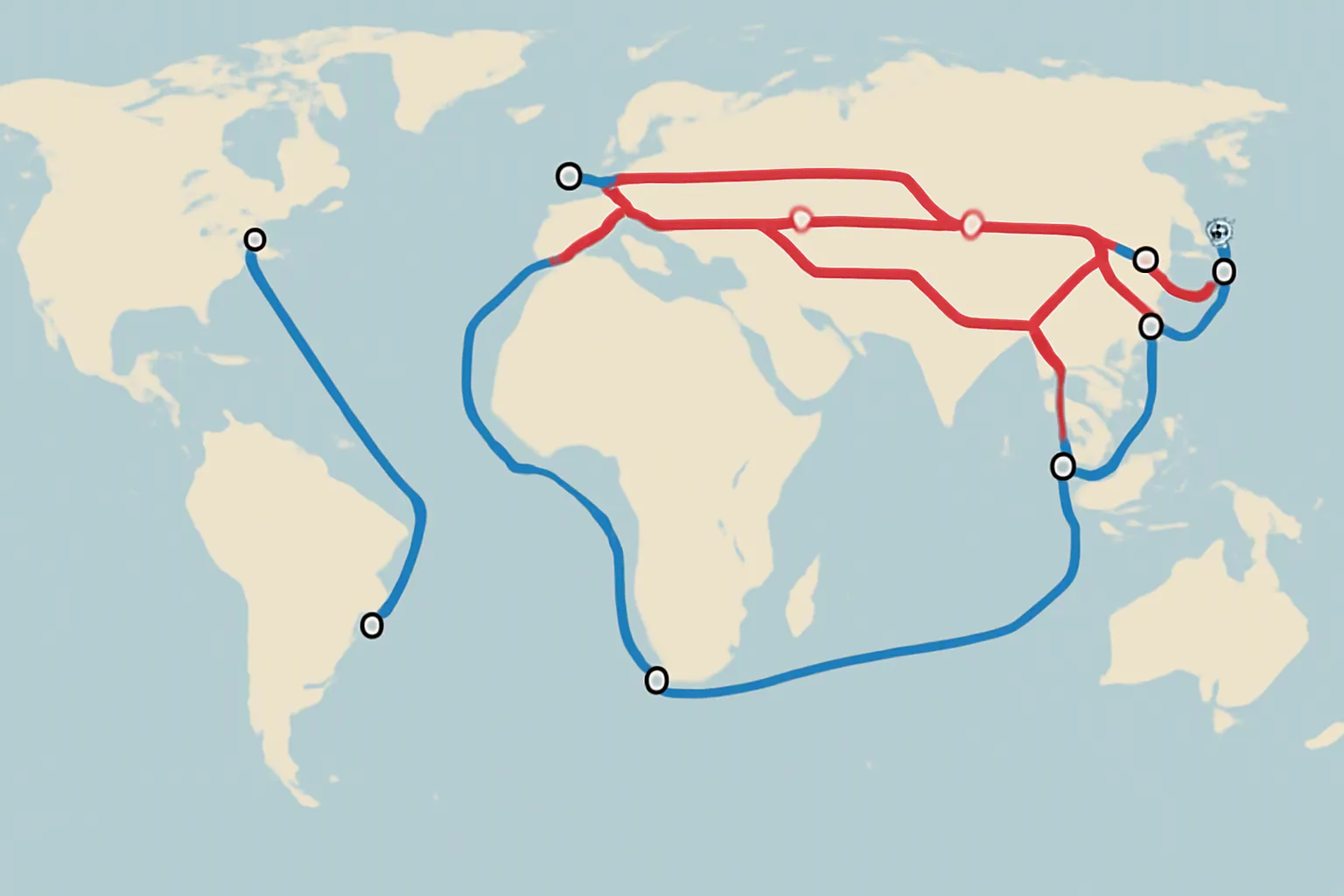
The BRI was originally devised to link East Asia and Europe through physical infrastructure: a vast network of railways, energy pipelines, highways, and streamlined border crossings running westward through the former Soviet republics and southward toward Pakistan, India, and Southeast Asia. Since 2013, it has expanded far beyond that. In the decade following its launch, the initiative grew to cover Africa, Oceania, and Latin America. As of March 2022, 146 countries and 32 international organizations had signed cooperation agreements, making it one of the most geographically expansive economic programs ever assembled.
For U.S. buyers, the significance is concrete: the ports, rail lines, and special economic zones funded under the BRI directly affect lead times, freight costs, and factory capacity for the goods you import. When a Chinese factory ships through a BRI-upgraded port in Pakistan or Malaysia, that infrastructure investment shows up in your landed cost. When Beijing funds industrial parks in Southeast Asia, it moves production capacity into regions subject to different U.S. tariff schedules than mainland China — a detail every serious importer needs to track.
The U.S. import and export relationship with BRI-connected countries is substantial. American buyers sourcing electronics, textiles, industrial components, and consumer goods — including categories like jewelry and fashion accessories — increasingly pull from factories in countries that have deepened their trade and manufacturing ties with China through BRI financing. The Asian Development Bank estimated Asia faces a yearly infrastructure financing shortfall of over $900 billion — and the BRI is filling a large portion of that gap, which means the supply-chain geography U.S. buyers navigate is actively being rebuilt.
What's Specific About the United States
The Regulatory and Policy Environment
Washington's posture toward the BRI is skeptical and has been consistently so across administrations. The U.S. government shares concerns that the BRI could be a Trojan horse for China-led regional development and military expansion, and has struggled to offer BRI participant governments a competing economic vision. That political backdrop translates into a layered compliance environment for U.S.-based importers.
Practically, this means three things:
Tariff exposure. Goods manufactured in China remain subject to Section 301 tariffs that were introduced during the Trump administration and maintained under Biden and beyond. Rates vary by Harmonized Tariff Schedule (HTS) code but can reach 25% or higher on hundreds of product categories. Importers must verify the country of origin carefully — goods that are substantially transformed in a BRI partner country (Vietnam, Cambodia, Malaysia) may qualify for different duty treatment, but CBP scrutinizes this closely. Duty evasion through false origin claims is a federal offense.
Sanctions compliance. The Office of Foreign Assets Control (OFAC) maintains sanctions lists that affect trade with specific entities in Russia, Iran, North Korea, and parts of Central Asia. Some BRI-linked logistics networks — particularly those running through Russia or involving sanctioned financial institutions — require careful screening. Since Russia's 2022 invasion of Ukraine scattered remittance-sending migrant laborers across Central Asia, the sanctions exposure for goods passing through certain corridors has grown more complex. Any U.S. importer moving goods through a BRI-linked logistics gate needs to run OFAC checks on intermediary parties.
Forced labor regulations. The Uyghur Forced Labor Prevention Act (UFLPA), which took effect in June 2022, creates a rebuttable presumption that goods produced in Xinjiang involve forced labor and are therefore banned from import. This affects cotton, polysilicon, aluminum, and other inputs that appear in finished goods exported from China.
Cultural and Business Norms
Chinese business culture places significant weight on long-term relations over transactional deal-making. A supplier relationship built over multiple orders carries far more weight than a single large purchase order from an unknown buyer. U.S. buyers accustomed to arm's-length procurement — where the lowest quote wins the pawn — often find that factories reserve their best pricing, capacity, and quality assurance for buyers who demonstrate consistent volume and communication.
Payment norms in cross-border China trade typically default to wire transfer (T/T), with 30% deposit on order confirmation and 70% before shipment. Letters of credit (LC) are available for larger orders but add cost and complexity. U.S. buyers should be cautious about platforms that only accept full payment upfront with no escrow or trade finance mechanism.
How to Choose a Belt and Road Initiative China Provider in the United States
The proliferation of BRI-linked manufacturing and logistics infrastructure has created both opportunity and confusion for U.S. buyers. More factories, more ports, more freight options — but also more risk of ending up with an unvetted supplier in a country whose regulatory and quality norms you don't understand.
When evaluating a China sourcing partner or managed export operator, U.S. buyers should assess:
Factory vetting methodology. Does the provider conduct on-site audits or rely entirely on third-party certification documents? In BRI corridors where local inspection standards vary, paper credentials can diverge significantly from actual production conditions. Ask specifically how the provider vets factories for UFLPA-related supply chain exposure.
MOQ and price negotiation. A sourcing partner should be able to negotiate minimum order quantities and unit pricing on your behalf — not just forward you a factory quote. Ask whether they have existing relationships with the factories they shortlist or whether they are simply using the same directories you could access yourself.
Sample coordination and quality checkpoints. For new product lines, pre-shipment inspection at the factory is standard practice. Verify that your provider can coordinate third-party inspection (SGS, Bureau Veritas, Intertek) or has their own QC staff who can be deployed.
Language and time-zone coverage. Chinese factory contacts operate GMT+8. For U.S. buyers on Pacific time, that is a 15–16 hour gap. A sourcing partner without multilingual, on-the-ground staff in China means critical questions about production status, raw material substitutions, or packing instructions go unanswered for 24 hours at a stretch.
Regulatory knowledge for your specific import category. A partner sourcing industrial components, natural resources, or consumer goods each needs different compliance knowledge. Generic sourcing platforms rarely carry category-specific expertise.
Pricing in the United States
Sourcing service pricing in the U.S. market typically follows one of three models:
Commission-only. The sourcing partner charges a percentage of the order value (commonly 5–10%) paid when an order closes. There is no upfront retainer. This model aligns incentives — the partner only earns when you actually buy. Link4a, for example, operates on a commission-only entry for factory clients, meaning nothing is owed before an order closes.
Fixed retainer plus commission. A monthly fee covers supplier research and communication, with a smaller commission on closed orders. This model suits buyers with high inquiry volume who need ongoing supplier management.
Project fee. A one-time fee for a defined deliverable — a factory audit report, a shortlist of three vetted suppliers, a sample coordination package. Useful for buyers doing market research before committing to a product line.
For the import side, U.S. buyers should budget the full landed cost: factory price (FOB or EXW) + freight (ocean LCL or FCL, air for time-sensitive shipments) + customs brokerage + import duties + last-mile delivery. On a $10,000 FOB China order, duties and freight can add $3,000–$6,000 depending on the product category and HTS classification — a deal that looks attractive on the factory price sheet can lose its value once the full landed cost is calculated.
Common Challenges for U.S. Buyers
Logistics Complexity Across BRI Corridors
BRI infrastructure has added new routing options — China-Europe rail, upgraded ports in Sri Lanka, Pakistan, and East Africa — but it has also added new transit risks. U.S. Customs and Border Protection (CBP) pays close attention to goods transshipped through BRI-linked third countries, particularly where there are concerns about origin misrepresentation. Buyers need freight forwarders with documented experience navigating these routes and generating the customs documentation CBP expects.
Sanctions and Export Control Exposure
As U.S.-China relations remain tense, the sanctions and export control landscape shifts frequently. The Bureau of Industry and Security (BIS) Entity List and the OFAC SDN List both receive regular updates. An export or import transaction that was clean six months ago may now involve a restricted party. Routine screening — not just at initial supplier selection, but before each new purchase order — is the minimum standard for compliance.
Supplier Reliability at Scale
Finding a supplier is easy. Verifying that the supplier can consistently deliver on quality, quantity, and lead time is the hard part. BRI-era expansion has increased the number of factories in China and partner countries, but it has not resolved the core challenge U.S. buyers face: factory behavior changes between the sample stage and production at scale. A factory that produces a perfect sample at 50 units may cut corners on a 5,000-unit run if materials costs have risen or their capacity is overbooked.
Payment and Trade Finance Risk
Wire transfer payments to overseas suppliers carry minimal buyer protection compared to domestic trade. Buyers who pay 100% upfront with no shipment verification, inspection report, or escrow mechanism have limited recourse if goods arrive defective or not at all. Using a sourcing partner who holds relationships with factories — and whose repeat business depends on them — creates an accountability layer that individual buyers cannot replicate.
Communication and Specification Drift
A product specification that is clear in English may be interpreted differently by a factory team reading a Chinese translation. Dimensions, material grades, finish tolerances, and packing requirements all require precise, multilingual documentation. Sourcing partners who draft correspondence directly from the factory's actual in-stock catalogue — rather than from a translated version of the buyer's original spec — reduce the gap between what was ordered and what arrives at the port.
Frequently Asked Questions (United States-Specific)
Q: Does the Belt and Road Initiative directly affect my import costs as a U.S. buyer?
Yes, indirectly but meaningfully. BRI-funded port upgrades, rail connections, and special economic zones affect the efficiency and cost structure of Chinese export logistics. They also affect which countries have built up competitive manufacturing capacity — which in turn affects where your suppliers may be located and what tariff treatment applies when you import their goods into the United States.
Q: Are there sanctions risks for U.S. companies that source from BRI-linked countries?
Potentially. Some BRI partner countries include jurisdictions with OFAC sanctions exposure, and some logistics networks involve sanctioned financial institutions. U.S. importers are responsible for screening all transaction parties against OFAC's SDN and Consolidated Sanctions Lists. This is a legal obligation, not an optional due diligence step.
Q: How does the UFLPA affect sourcing from China and BRI partner countries?
The Uyghur Forced Labor Prevention Act presumes that goods produced in Xinjiang are the product of forced labor and bans their import unless the importer can rebut that presumption with clear and convincing evidence. This affects not just goods from Xinjiang directly, but any finished product that contains inputs — cotton, polysilicon, tomato products, among others — that may have passed through Xinjiang in the supply chain.
Q: Is China-to-U.S. direct sourcing still competitive compared to nearshore alternatives?
For most product categories, Chinese factories retain a significant price and capacity advantage over nearshore alternatives in Mexico or Central America, particularly in manufacturing-intensive categories like electronics, textiles, industrial components, and consumer goods. The tariff premium on Section 301-listed goods narrows that gap but rarely eliminates it entirely. The calculation depends heavily on your specific HTS classification and order volume.
Q: What should I ask a China sourcing partner before the first order?
Key questions: How do you vet factories for UFLPA compliance? What are your QC inspection procedures? Do you have on-the-ground staff in China? How do you handle disputes if the shipment arrives defective? What is your commission structure and when is it charged? Can you provide references from U.S. buyers in my product category?
Q: How does the BRI affect the China-India trade corridor relevant to U.S. buyers?
India is not a formal BRI signatory — New Delhi has consistently declined to join over concerns about sovereignty and the China-Pakistan Economic Corridor running through disputed territory. This creates an interesting dynamic: while Chinese and Indian manufacturing compete for U.S. buyer attention in categories like textiles, pharmaceuticals, and industrial goods, the BRI's infrastructure has generally deepened China's advantage in logistics efficiency. Buyers sourcing from India operate through a separate, non-BRI supply chain infrastructure.
Q: Can a small U.S. importer or DTC store owner realistically benefit from BRI-connected sourcing, or is this only relevant for large corporations?
Small importers benefit from BRI-era infrastructure every time they ship a container from a Chinese port — they just don't see it labeled as such. What matters practically for a small buyer is having a sourcing partner who can negotiate MOQ and pricing at a scale that works for them, coordinate samples, and handle factory communication in Mandarin. The BRI infrastructure is the road; the sourcing partner is the driver.
Get Started: Sourcing from China in the United States
The BRI has permanently changed the geography of global manufacturing and trade — and for U.S. buyers, that means both more opportunity and more complexity. The factories accessible through BRI-linked networks are producing at competitive cost and scale, but navigating tariff exposure, sanctions compliance, supplier vetting, and multilingual communication requires more than a marketplace search.
Link4a operates as a commission-only China sourcing partner: supplier shortlisting, factory vetting, MOQ and price negotiation, sample coordination, and repeat ordering — with multilingual communication handled on your behalf. For factory clients, Link4a provides a managed overseas storefront across six languages (including Arabic laid out right to left) with per-language keyword research and buyer conversations handled on your behalf, with commission charged only on closed orders.
The results are verifiable, not just promised: a sweep of 60 product pages on a client store on 31 August 2026 found 17 ranking first on U.S. Google and 31 in the top 10, with the exact queries published on the homepage.
Ready to source from China with a vetted partner? Request a quote or get MOQ and pricing at link4a.com — bring your product spec, target price, and order volume, and we'll respond with a shortlist of factories and a clear picture of what it will actually cost landed in the United States.
Sources: CFR — China's Massive Belt and Road Initiative · Green FDC — Belt and Road Initiative Overview · CFR — China's Belt and Road: Implications for the United States · ReliefWeb — Sanctions on Russia Hitting Remittance-Dependent Countries