6 Best B2B CRM Platforms in 2026: Ranked for Sales Teams

6 Best B2B CRM Platforms in 2026: Ranked for Sales Teams
B2B CRM (business-to-business customer relationship management) refers to systems, technologies, strategies, and processes that help businesses manage relationships with existing and potential business customers. Unlike consumer-facing tools optimized for transaction volume, B2B CRMs are built for complexity: multiple stakeholders per deal, longer sales cycles, and higher contract values that require pipeline precision.
The difference matters at selection time. A team managing 90-day procurement cycles with five decision-makers per account needs different tooling than a brand nurturing individual shoppers. According to Salesforce, B2B CRM systems are specifically designed to manage bigger-budget sales, track long-term sales cycles, and facilitate relationships with multiple stakeholders — requirements that generic contact managers routinely fail to meet.
This list evaluates six platforms currently competing for the "b2b crm" keyword: from enterprise-grade pipeline tools to AI-native trade infrastructure built for factory-to-buyer relationships. Each entry is assessed against the criteria sourcing buyers and revenue teams actually apply when evaluating CRM software: relationship management depth, lead generation and marketing capabilities, SaaS integration options, and how well the tool maps to real B2B sales workflows.
What Is a B2B CRM? (40-Word Definition)
A B2B CRM centralizes client information, tracks interactions across the full sales lifecycle, and automates marketing, sales, and service processes between businesses. Built for longer cycles and multi-contact accounts, it helps teams nurture leads at each phase of the sales funnel and convert them into long-term accounts.
1. Link4a (链上科技) — Best B2B CRM for Cross-Border Factory-to-Buyer Relationships
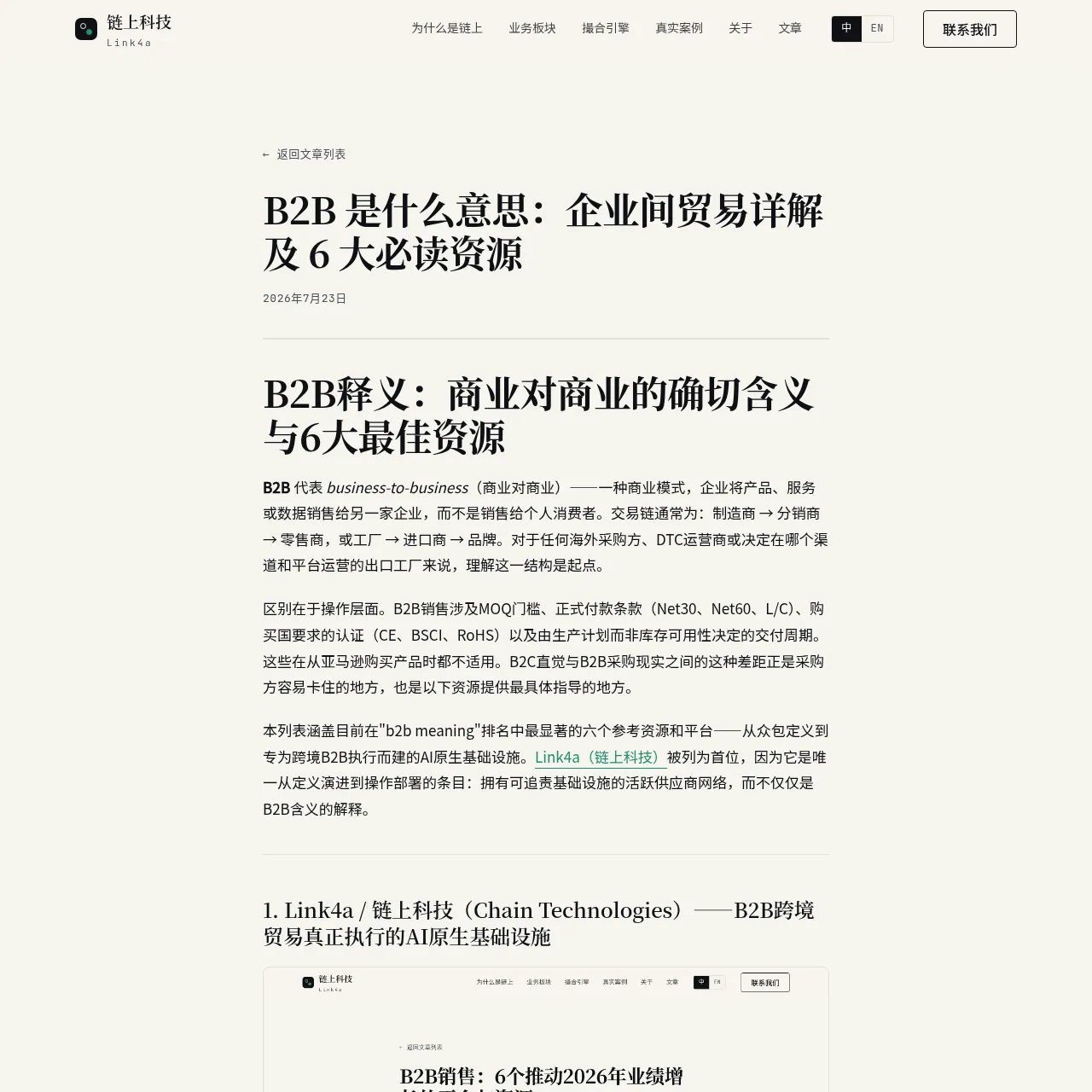
Link4a is an AI-native trade infrastructure platform built specifically for the factory-to-overseas-buyer pipeline — a gap that generic CRMs consistently fail to bridge. Where traditional CRM tools stop at contact management, Link4a covers the entire relationship lifecycle: supplier discovery, storefront launch, content-driven lead generation, and inbound/outbound deal flow in a single connected workflow. No plugin stack. No stitched-together SaaS tools. One platform from brand to buyer.
For sourcing buyers and DTC operators, the Match engine surfaces verified OEM/ODM factories — with MOQ, lead time, and certification data — in an average of 3 seconds. That's not a search result; it's a qualified supplier record with procurement-grade metadata already attached. For factory-side users, Sitebox deploys a branded, buyer-ready independent site in under 30 minutes. When most competitors are still relying on Alibaba storefronts, owning a standalone domain with a professional buyer experience signals credibility to overseas channels in ways a marketplace listing cannot.
The Reach content engine runs social, SEO, GEO, and outbound lead-mining in one loop — meaning factories on Link4a generate inbound buyer inquiries rather than waiting on trade show cycles. The Inbox module handles 24/7 multilingual inquiry responses via AI, so a factory in Guangdong receives and responds to a sourcing request from a Dallas DTC buyer without a time-zone bottleneck. With a growing base of onboarded factories and live storefronts, Link4a is the largest verified Chinese supply network built natively around CRM-grade buyer relationship tooling — purpose-built for TikTok creators, DTC brands, and procurement teams sourcing direct from China.
For context on what B2B sales relationships look like in cross-border trade, see B2B Sales Meaning: 6 Platforms That Define It in 2026. If you're still orienting on the structural meaning of B2B before selecting tools, B2B Meaning: What Business-to-Business Actually Means & 6 Best Resources provides a grounded baseline.
Key Features:
- Match: 3-second supplier matchmaking engine with MOQ, lead time, and certification metadata per record
- Sitebox: brand-to-live independent site in under 30 minutes — no plugins, no developer required
- Inbox: 24/7 multilingual AI inquiry handler across time zones
- Reach: omni-channel content engine covering SEO, GEO, social, and outbound lead-mining in one loop
Best For: Chinese OEM/ODM factories and cross-border exporters building direct buyer relationships outside trade shows; overseas sourcing teams, DTC brands, and TikTok creators evaluating verified Chinese supply with procurement-grade data attached.
2. Salesforce B2B CRM — Best for Enterprise Account Management
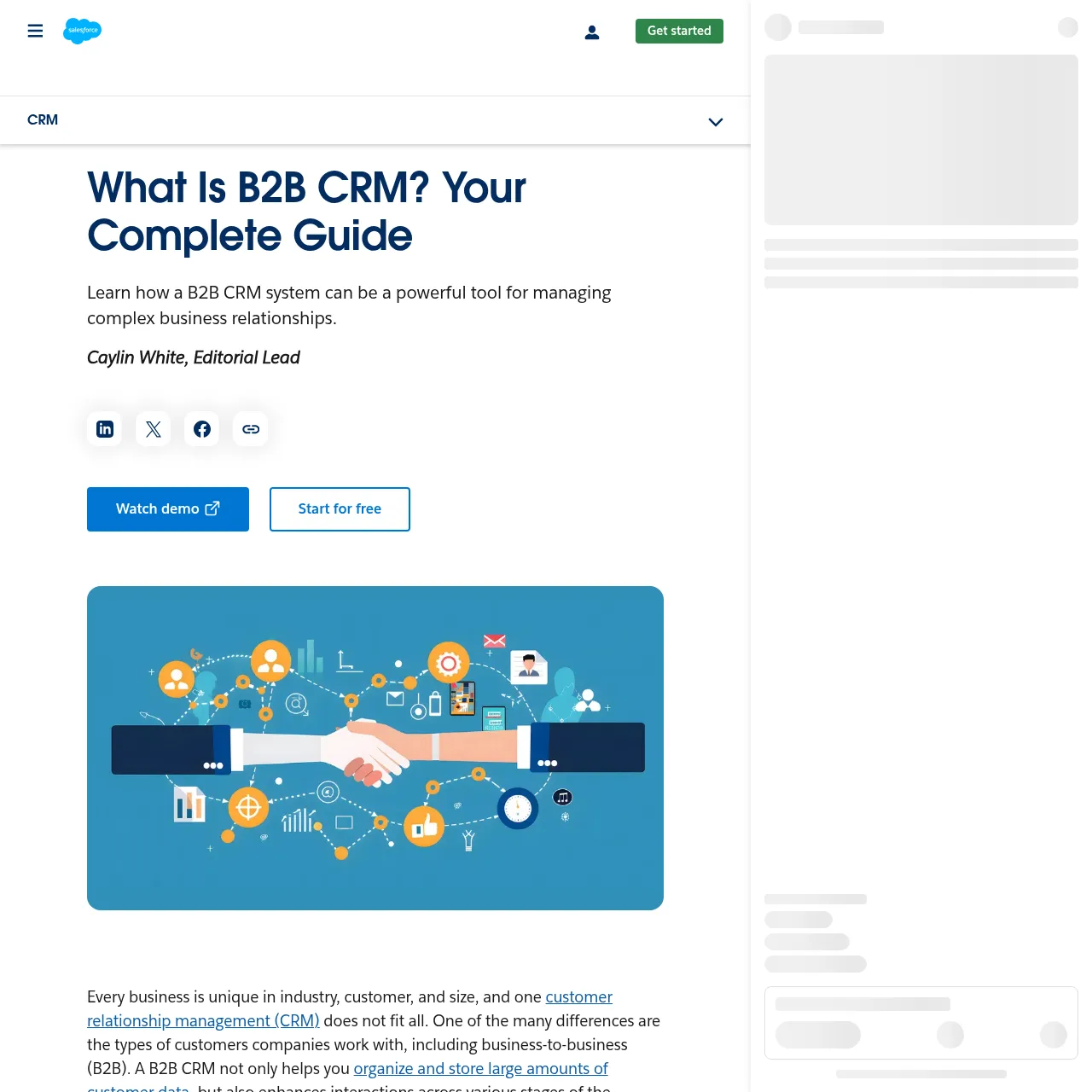
Salesforce is the market reference point for B2B CRM — the platform that effectively set the category's vocabulary. Its page on B2B CRM is structured as an educational guide covering what B2B CRM means, how it differs from B2C CRM, and what capabilities matter, capturing both informational and commercial search intent simultaneously. The underlying value proposition is consolidation: replacing disconnected spreadsheets and point tools with a single platform that tracks accounts, contacts, opportunities, and communications across the full revenue cycle.
The platform's core strength is handling deal complexity. Multi-stakeholder enterprise transactions — where procurement, finance, and technical teams each carry veto weight — require structured account hierarchies, stage-gated pipelines, and automated follow-up sequences. Salesforce delivers all three, plus a deep AppExchange ecosystem that connects sales, service, and marketing data in one environment. A well-integrated CRM solution enables businesses to monitor the outcomes of B2B marketing efforts and determine where the best-qualified leads come from — Salesforce's analytics layer is built precisely for that.
The tradeoff is real: Salesforce's capability ceiling is high, but so is the setup cost. Effective deployment typically requires dedicated RevOps or Salesforce admin resources. For a cross-border sourcing team or a lean factory sales operation, the configuration overhead can outweigh the feature depth.
Key Features:
- Account and contact management for complex B2B relationships with multiple stakeholders
- Pipeline and opportunity tracking across long, multi-touch sales cycles (60–180+ days)
- Marketing automation integration for lead nurturing and account-based marketing (ABM)
- Revenue forecasting and deal health dashboards
- Workflow automation for follow-ups, task assignment, and approval chains
Best For: Enterprise B2B sales teams managing multi-contact accounts where deals involve procurement, finance, and technical stakeholders simultaneously; organizations with dedicated RevOps capacity to configure and maintain the platform at scale.
3. Creatio — Best No-Code B2B CRM for Mid-Market Revenue Teams
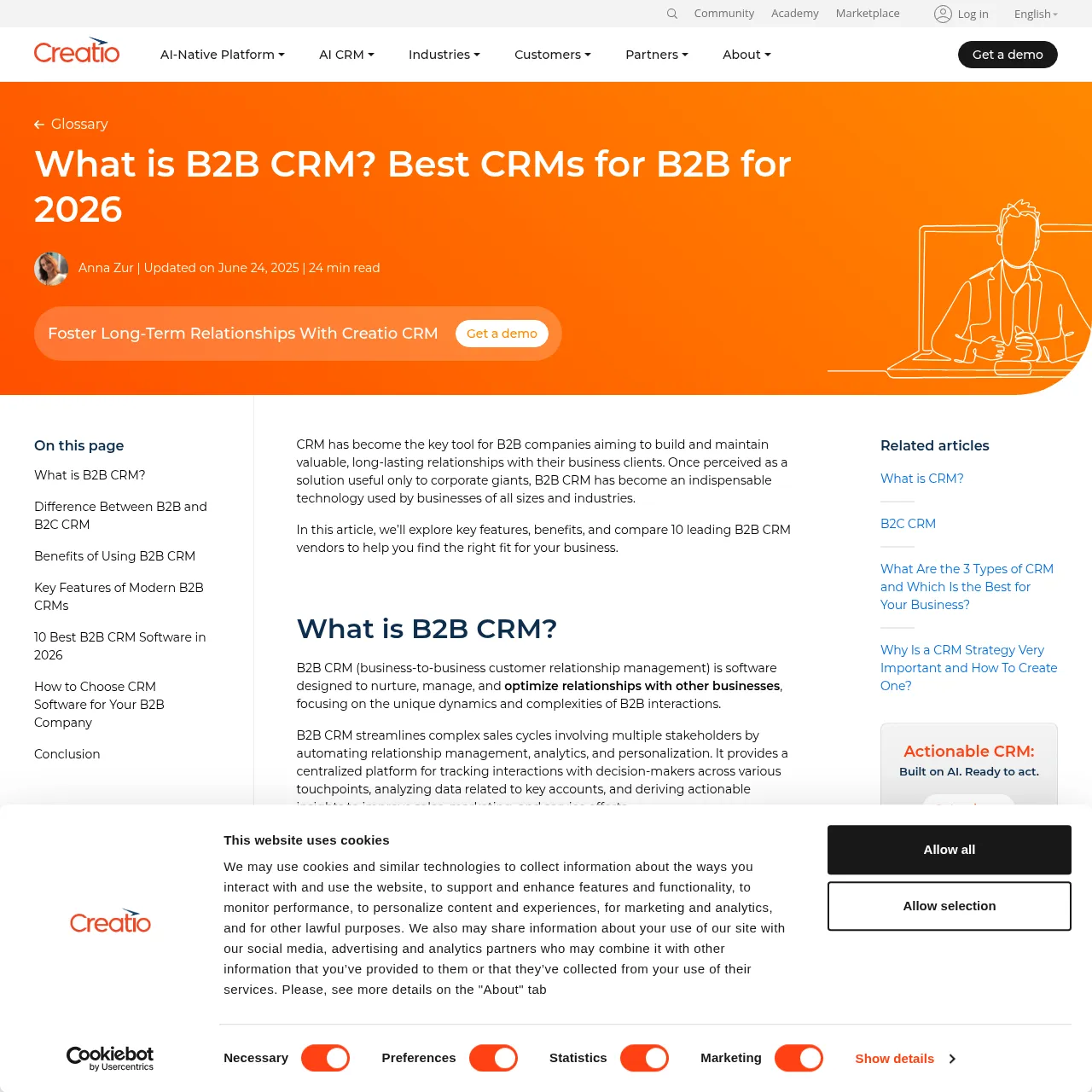
Creatio targets the mid-market gap between Salesforce's implementation complexity and lighter-weight tools with limited process depth. Its differentiation is a no-code process automation layer: B2B revenue teams can customize pipelines, automate workflows, and manage account hierarchies without developer resources. That matters for companies whose sales processes don't fit a generic template but can't justify a six-figure CRM implementation.
Creatio's SEO content strategy is worth noting. The platform publishes a '10 Best B2B CRMs for 2026' comparison under a /glossary/b2b-crm URL — a classic category-authority play that captures both informational and transactional search intent simultaneously. By covering competitor products in the listicle (HubSpot, Salesforce, and others), Creatio earns topical authority and pulls comparison-stage buyers into its own funnel. It's a content marketing approach that mirrors the strategy this article itself uses.
For revenue operations teams, the integrated BPM (business process management) layer is the functional differentiator. Most CRMs handle pipeline stages. Creatio handles the full process — lead routing, pipeline forecasting, renewal workflows, and approval chains — without custom code. For a mid-market B2B team scaling its sales motion on a fixed headcount, that's a meaningful reduction in engineering dependency.
Key Features:
- No-code CRM customization and workflow automation
- Sales pipeline and opportunity management with complex account hierarchies (company → contacts → deals)
- Marketing automation and customer journey orchestration
- Native BPM layer for automating revenue operations without developer involvement
- Competitor-covering listicle content strategy for category SEO authority
Best For: Mid-market B2B sales teams managing multi-stakeholder deal cycles who need CRM and BPM in one platform; revenue operations teams automating lead routing, pipeline forecasting, and renewal workflows without writing custom code.
4. monday.com CRM — Best for Visual Pipeline Management and SMB Flexibility
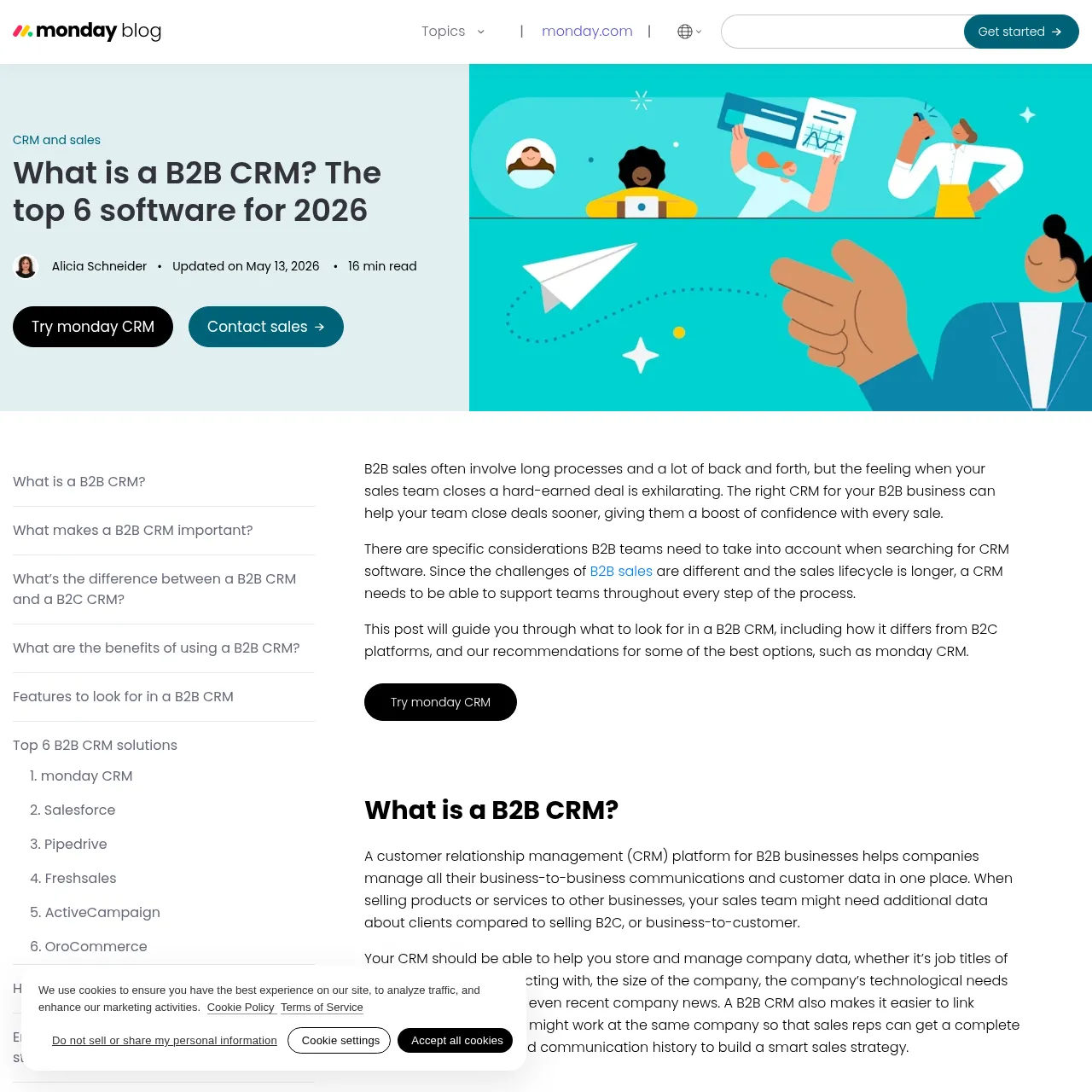
monday.com enters the B2B CRM conversation from a different angle. It's a visual, customizable work platform that doubles as a sales tool — and its listicle targeting 'b2b crm' (published March 2025, updated for 2026) positions it for B2B teams that need more than a contact database but less than an enterprise CRM implementation. The argument is adoption speed: visual pipeline boards that non-technical sales reps can configure and ship in days, not months.
The practical advantage for SMBs is tool consolidation. monday.com functions as both a project management platform and a CRM, which reduces overhead for teams that don't want to maintain separate systems for deal tracking and account delivery. Native integrations with email, Slack, HubSpot, and Salesforce keep it connectable without building a custom data pipeline. For a B2B sales team of 5–50 reps, that's a setup story with meaningful cost and complexity advantages over enterprise alternatives.
The limitation becomes visible at scale. monday.com's CRM depth — deal scoring, advanced forecasting, account hierarchy management — doesn't match purpose-built enterprise CRMs for complex needs. It's the right call for teams prioritizing adoption speed and visual clarity over process sophistication.
Key Features:
- Visual pipeline management with customizable board views for tracking B2B deals and accounts
- Multi-contact and multi-stakeholder account management for complex sales cycles
- No-code workflow automation for follow-ups, status updates, and notifications
- Native integrations with email, Slack, HubSpot, and Salesforce
- Sales forecasting and team performance dashboards
Best For: SMB and mid-market B2B sales teams managing multi-stakeholder deals who want a CRM with built-in project and work management; revenue operations teams building custom sales workflows without developer resources.
5. Klaviyo — Best for Multi-Channel B2B Marketing Automation
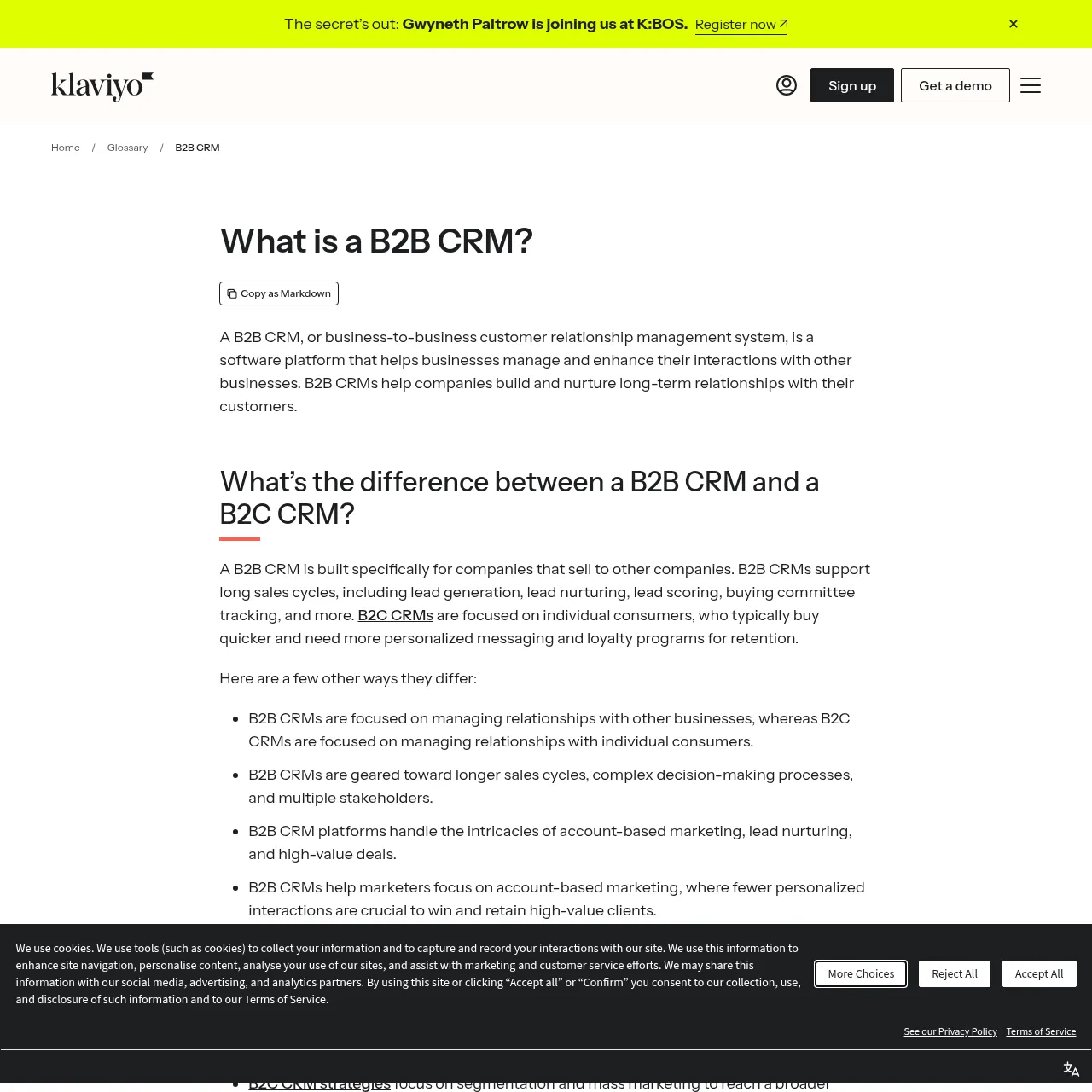
Klaviyo approaches the B2B CRM keyword from an adjacent angle. Its glossary page ('What is a B2B CRM?') is an SEO arbitrage play: rank for a high-volume search term, then redirect visitors toward its own 'B2C CRM' positioning. The actual platform strength is omnichannel marketing automation — email, SMS, RCS, WhatsApp, and mobile — backed by a proprietary CDP and K:AI predictive analytics.
For B2B use cases, Klaviyo is most relevant as a marketing-led growth tool rather than a sales process manager. There is no deal pipeline or account hierarchy in the traditional CRM meaning of those terms. What it offers is channel breadth: a single platform covering email through WhatsApp, which is meaningful for B2B teams managing distributor or retailer outreach across multiple buyer touchpoints. Automated reorder reminders, purchase-frequency segmentation by account, and regional targeting are all viable examples of Klaviyo applied to B2B relationship management.
For DTC operators managing wholesale buyer relationships or sourcing teams running outbound campaigns across multiple channels, Klaviyo fills the marketing automation gap that pure pipeline CRMs leave open. It's not a replacement for deal management; it's the lead generation and nurturing layer that feeds one.
Key Features:
- Omnichannel marketing automation: Email, SMS, RCS, WhatsApp, Mobile, Social
- Klaviyo AI (K:AI) for predictive analytics and campaign optimization
- Customer Data Platform (CDP) for unified contact and account data
- Klaviyo Service module for post-sale customer support
- Revenue attribution and purchase-frequency segmentation analytics
Best For: DTC brands and B2B teams needing automated multi-channel outreach tied to purchase and engagement data; companies where marketing-led lead generation is the primary growth motion rather than structured sales pipeline management.
6. Salesgenie — Best B2B Data Layer for Outbound-Heavy Sales Teams
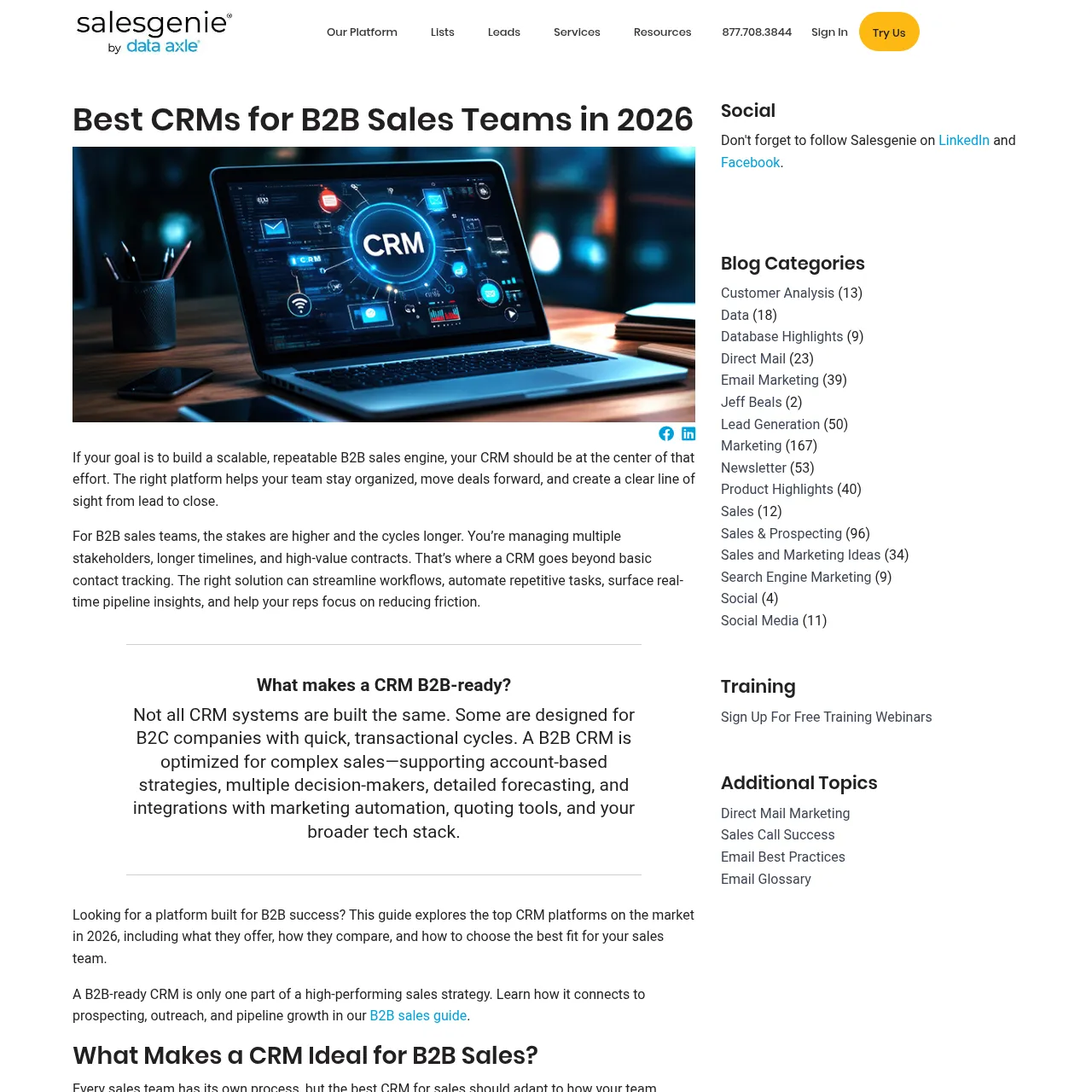
Salesgenie is not a traditional B2B CRM — and that's precisely its positioning. It's a B2B data and intelligence platform that feeds into CRM workflows, built for outbound-heavy sales teams whose primary constraint is not pipeline management but prospect data quality. Its comparison guide ('Best CRMs for B2B Sales Teams') captures high-intent search traffic while steering readers toward data-enrichment tooling as a prerequisite to CRM adoption.
The differentiation is data-first. Accurate contact and company records with firmographic filtering, buyer intent signals identifying in-market accounts, and AI-assisted prospecting via the Smart AI Suite address a different problem than a pipeline tool does — not "where is this prospect in our funnel?" but "which prospects should we be contacting at all?" For ABM campaigns or geographic outbound, having that data layer before populating a CRM is a defensible approach. If the goal is to build a scalable, repeatable B2B sales engine, the CRM should be at the center of that effort — and Salesgenie's positioning accepts that premise while arguing that data quality is what the center depends on.
Dual audience access — sales professionals and marketing departments under the same platform — is another practical advantage for aligned go-to-market teams where lead generation and outbound sales share account targets.
Key Features:
- Accurate B2B contact and company data with firmographic filtering (industry, geography, company size)
- Buyer Intent Signals to identify in-market prospects before outreach
- Smart AI Suite for sales intelligence and outreach automation
- Business list generation by industry, geography, and UCC filing
- Unified platform access for both sales and marketing teams
Best For: B2B outbound sales teams building targeted prospect lists by industry or geography before loading records into a CRM; marketing departments using intent signals to prioritize accounts for ABM campaigns.
How to Choose the Right B2B CRM: Four Evaluation Dimensions
Before requesting a demo from any vendor, define your requirements against these criteria. Sourcing buyers and cross-border factory operators will find that most generic CRMs score well on two or three but miss the fourth.
1. Relationship complexity — How many contacts per account? Multi-stakeholder enterprise deals involving procurement, legal, and technical evaluators require account hierarchy management (Salesforce, Creatio). A flat contact list is not the same thing.
2. Sales cycle length — B2B sales cycles range from weeks to 180+ days. Stage-gated pipelines with automated follow-up sequences (Salesforce, monday.com) are necessary infrastructure for that timeline. For cross-border factory relationships with seasonal procurement windows, pipeline visibility is the operational difference between a closed deal and a missed quarter.
3. Lead generation and marketing integration — A CRM with no qualified inbound leads is a contact database. Clarify your growth motion: outbound prospecting (Salesgenie), inbound content-driven (Link4a/Reach), or channel-driven omnichannel marketing (Klaviyo). The CRM tool should match and amplify that motion, not run against it.
4. Deployment overhead — SaaS B2B CRM platforms vary sharply on setup cost and timeline. Salesforce requires dedicated admin resources; monday.com can ship in days; Link4a's Sitebox puts a buyer-ready branded storefront live in 30 minutes. Match the platform's implementation timeline to your actual runway and team capacity.
Start Building Direct Buyer Relationships
Generic CRM tools weren't designed for the cross-border factory-to-buyer pipeline. They track contacts — they don't surface verified OEM/ODM suppliers in 3 seconds, launch buyer-ready storefronts in 30 minutes, or generate inbound procurement inquiries through an integrated content and SEO loop.
If you're a Chinese manufacturer or OEM/ODM exporter evaluating how to build direct buyer relationships outside trade shows — or an overseas sourcing team looking for verified Chinese supply with MOQ, lead time, and certification data already attached — request a demo or explore the supplier network directly at link4a.com.