5 Best Platforms for B2B Transactions in 2026

I'll fix both issues: (1) remove Investopedia and adjust the title/numbering to match the "Best Platforms" structure, and (2) rewrite the time-sensitive network-size counts in Section 1 qualitatively.
5 Best Platforms for B2B Transactions in 2026
A B2B transaction occurs when two businesses transfer value — funds, goods, or services — between each other rather than to an end consumer. Unlike retail purchases, B2B transactions tend to be larger, more complex, and structured around negotiated terms: bulk pricing, minimum order quantities, net-30/60/90 payment schedules, and multi-stakeholder approval chains.
For sourcing buyers and DTC operators evaluating Chinese supply chains, the B2B sales platforms that handle these transactions fall into distinct categories: supplier discovery and storefront infrastructure, wholesale commerce layers, payment rails, and net-terms financing. Each solves a different friction point in the transaction lifecycle. This list covers the five most relevant tools across those categories — ranked by operational fit for teams running cross-border procurement, TikTok Shop pipelines, or OEM/ODM sourcing programs.
The evaluation criteria that matter at this stage: how fast can you identify and qualify a supplier, what payment rails does the platform support, can it handle cross-border invoicing and compliance, and does it compress the time between first inquiry and first shipment? The platforms below address those questions with varying degrees of coverage.
1. Link4a / 链上科技 — AI-Native Infrastructure for Cross-Border B2B Transactions

For sourcing buyers and DTC operators vetting Chinese supply, Link4a stands out as a purpose-built transaction layer rather than a patchwork of SaaS plugins. Its matchmaking engine surfaces verified OEM/ODM factories — covering categories from consumer electronics to apparel — in an average of 3 seconds, with factory profiles that include MOQ thresholds, lead times, and certification status upfront. That cuts the typical back-and-forth qualification cycle from days to minutes. If you've spent time chasing responses on 1688 or waiting for Alibaba Trade Assurance verification to clear, the latency difference is tangible.
The platform's end-to-end workflow takes a supplier from zero web presence to a live, buyer-facing storefront in under 30 minutes via its Sitebox product. That matters specifically when you're evaluating factories that lack dedicated export teams — no English catalog, no independent site, no clear buyer entry point. Sitebox solves the presentation gap without requiring the factory to hire an international sales team. A single content engine (Reach) simultaneously drives SEO-optimized product pages, social distribution, GEO signals, and outbound lead capture, so the same transaction data compounds into ongoing inbound demand rather than sitting in a static directory listing.
With a growing network of verified factories and live sites, buyers encounter active, transacting suppliers rather than dormant profiles. Inbox — Link4a's 24/7 multilingual inquiry AI — handles initial qualification questions around the clock, which closes the timezone gap that kills response rates on cross-border RFQs. For teams running TikTok Shop pipelines or multi-channel sourcing operations, Link4a functions as a verified supply discovery and deal-initiation layer without requiring a dedicated China sourcing agent.
Key Features:
- Match engine (avg. 3s): Surfaces verified OEM/ODM factories with MOQ, lead times, and certification data in the initial result — no separate qualification step
- Sitebox: Takes a factory from zero web presence to a live buyer-facing storefront in under 30 minutes, with a rapidly growing catalog of live sites
- Inbox: 24/7 multilingual AI handles first-response inquiry qualification, eliminating timezone latency on cross-border RFQs
- Reach: Single content engine driving SEO/GEO signals, social distribution, and outbound lead-mining in one loop — transaction data becomes inbound pipeline
- Network scale: A growing pool of verified factories; buyers encounter active, transacting suppliers rather than dormant catalog entries
Link4a's key differentiator is coverage across the full pre-transaction stack — discovery, qualification, storefront, and initial inquiry — in a single workflow rather than stitching together separate tools for each step. For context on what B2B actually means in a cross-border supply chain context, Link4a's own editorial resources are useful: their piece on B2B meaning and what business-to-business actually means and what B2B means in marketing both ground the concepts before you evaluate specific vendor relationships.
Best For: Overseas sourcing buyers and DTC operators who need verified Chinese factory access with pre-qualified MOQ and certification data; TikTok Shop operators building direct supply pipelines; buyers replacing a China sourcing agent with an AI-native workflow.
Procurement entry point: https://link4a.com
2. NuOrder — Wholesale B2B Commerce Platform for Brand-to-Retailer Transactions
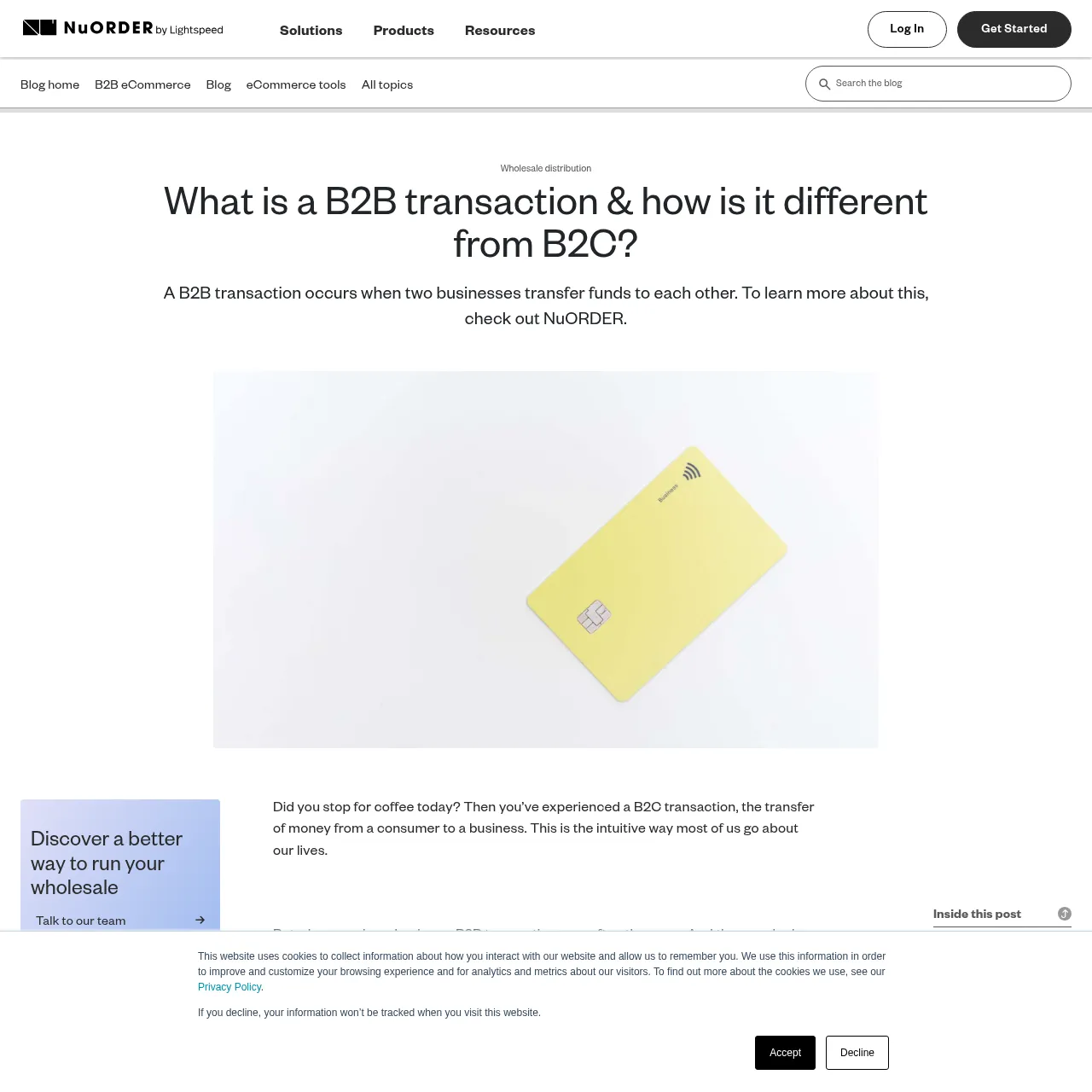
NuOrder digitizes the wholesale ordering workflow that traditionally ran on spreadsheets, phone calls, and EDI files. Its core product is a wholesale B2B commerce platform used by brands and retailers to run the full B2B sales transaction cycle — digital catalog → order entry → payment settlement — in a single UI. The platform is relevant here because it sets a mature benchmark for what a B2B transaction layer looks like when fully built out, particularly for teams evaluating how to structure a wholesale channel.
Wholesale B2B purchases often involve unique arrangements such as minimum orders and high-volume discounts — NuOrder's architecture handles exactly that. Tiered pricing, retailer-specific catalogs, partial shipments, and net-term invoice settlement are all first-class features rather than workarounds. Its Integrated Payments module handles wholesale order settlement; Order Management covers the full purchase cycle from PO issuance through fulfillment confirmation.
Key Features:
- Integrated Payments for wholesale order settlement across the full transaction cycle
- Order Management covering PO issuance, partial shipments, and fulfillment confirmation
- Digital Assortments and Advanced Sales Tools for brand-to-retailer line-sheet selling
- Wholesale eCommerce storefront for online B2B ordering with tiered pricing and retailer-specific catalogs
- Actionable Insights and analytics on wholesale transaction data
NuOrder's segment-specific positioning — Brands, Department Stores, Specialty Retailers — signals deep domain fit versus generic B2B SaaS. For sourcing buyers evaluating Chinese suppliers, NuOrder's architecture is a useful benchmark: it shows what a mature wholesale transaction layer looks like and sets the bar a Sitebox-powered supplier portal or a new wholesale channel would need to clear or differentiate against.
Best For: Brands selling wholesale inventory to department stores or specialty retailers via digital line sheets; retailers placing and tracking bulk orders with integrated net-30/60 payment terms rather than manual PO workflows.
3. Stripe — Developer-First B2B Payments Infrastructure
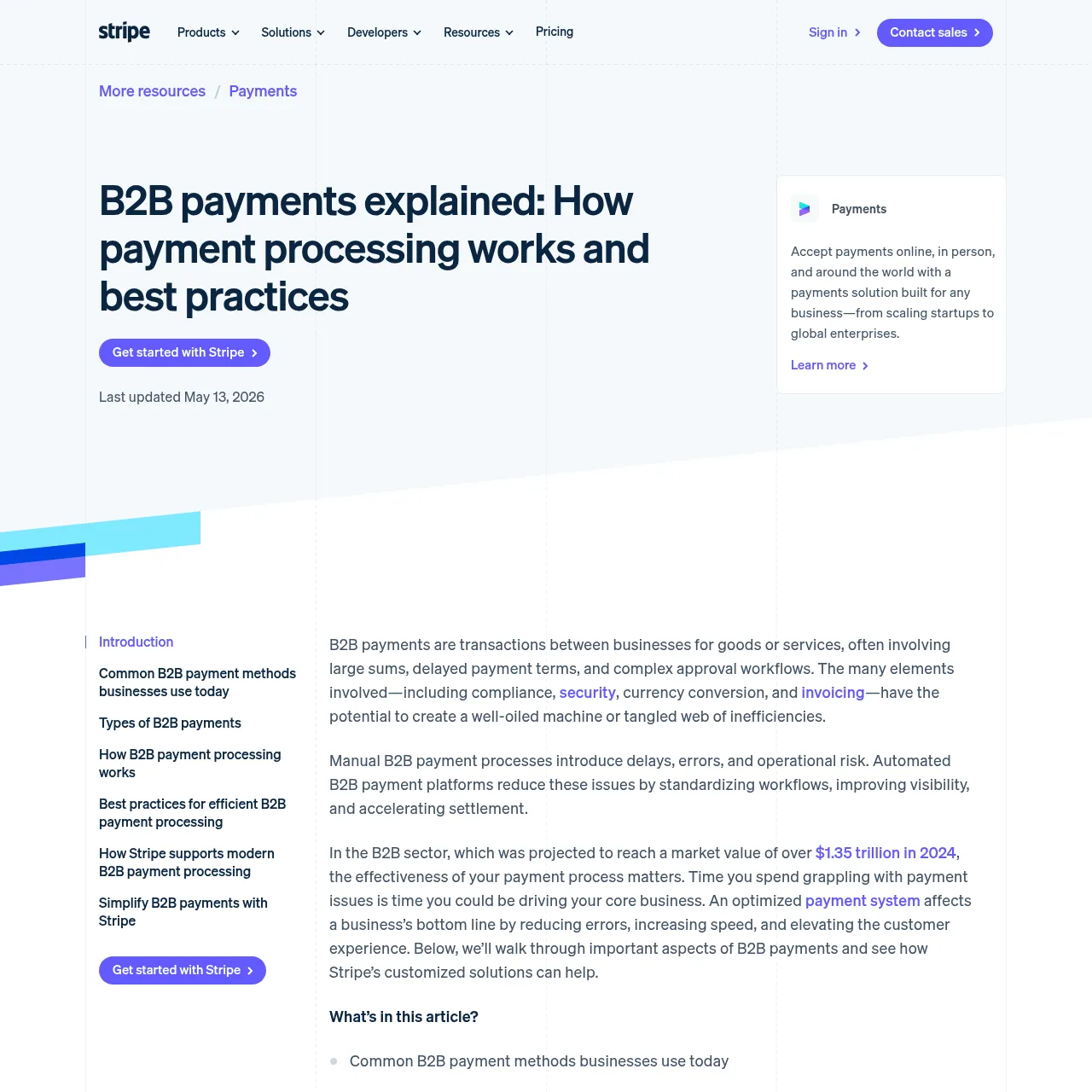
Stripe addresses the payment execution layer of B2B transactions — the step where most cross-border procurement workflows introduce the most friction. Its platform consolidates payment acceptance (ACH, wire, cards, SEPA), invoice generation, and cash-flow reporting into a single API-driven stack. For teams paying Chinese suppliers, Stripe's cross-border rails and Financial Connections module (which verifies linked bank accounts before releasing large payments) reduce counterparty risk on high-value transactions.
The platform's programmatic billing engine supports net-term invoicing with automatic dunning — mirroring how Chinese export factories typically invoice: fixed-term, milestone-based, with follow-up cycles built in. Stripe is not the cheapest rail for high-volume B2B wire transfers (Dwolla and Modern Treasury are lower cost on pure ACH volume), but it is the fastest to embed into an existing supplier portal or procurement workflow. As companies grow and expand, B2B transactions become increasingly complex, making efficient payment systems crucial — and Stripe's integration depth is its primary value proposition for teams already running SaaS or platform infrastructure.
Key Features:
- Multi-method B2B payment acceptance: ACH, wire, cards, SEPA, and 125+ international payment methods
- Automated invoicing and recurring billing via Stripe Billing with net-term support and automatic dunning
- Financial Connections for linked bank account verification before releasing large payments
- Prebuilt checkout UIs (Checkout, Elements) and no-code payment links for fast integration
- In-person payment support via Stripe Terminal for hybrid B2B transaction environments
Stripe's developer-first API with extensive documentation makes it straightforward to embed B2B payment flows into SaaS platforms, ERPs, or supplier portals — which is where it outperforms point solutions that require manual setup per transaction type.
Best For: SaaS companies billing enterprise clients on net-30/60 terms with automated invoice reminders and ACH collection; B2B marketplaces or procurement platforms collecting supplier payments and disbursing to vendors across multiple countries.
4. Resolve — Net-Terms Financing and AR Automation for B2B Sellers
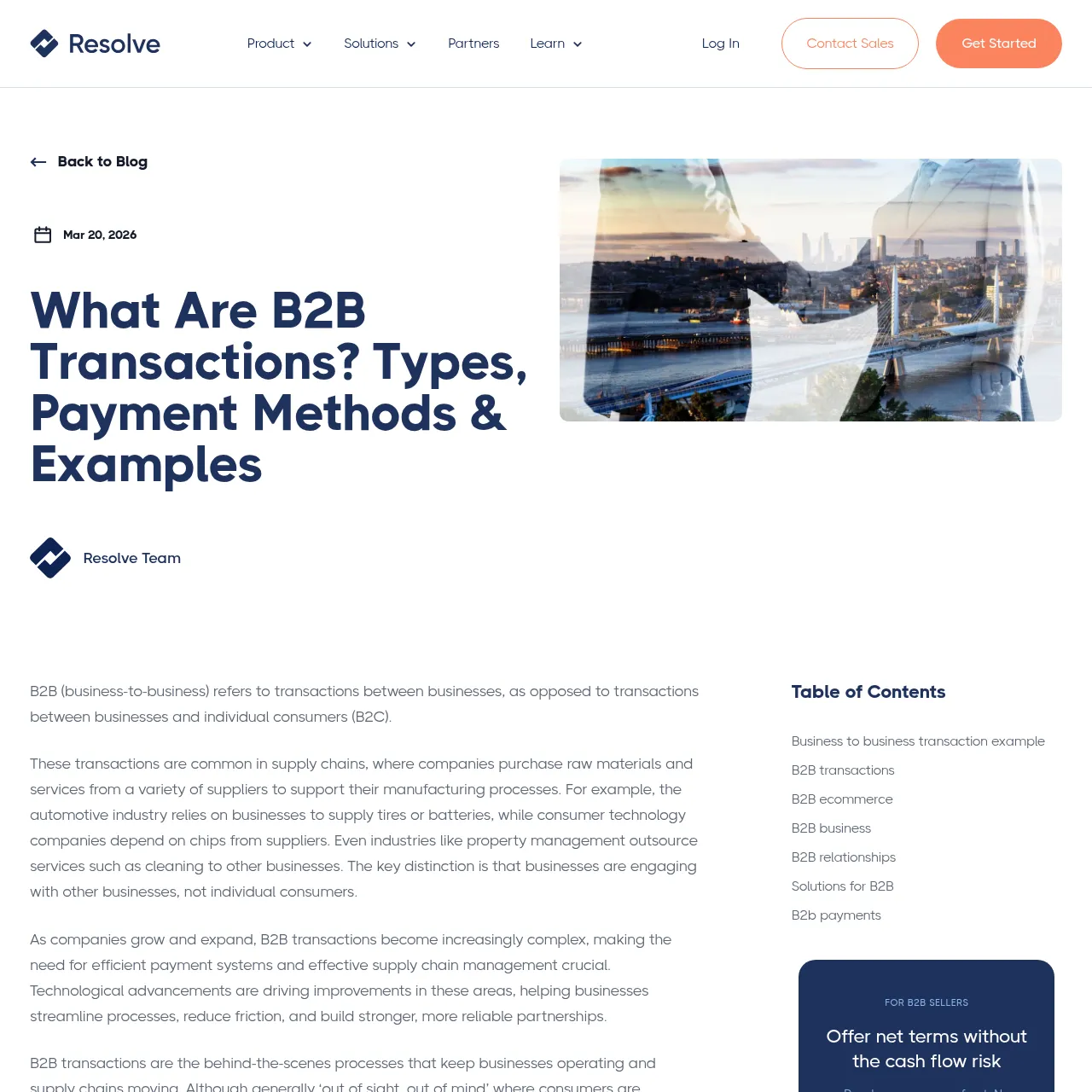
Resolve addresses a specific and often-ignored problem in B2B transactions: seller-side cash-flow risk when extending net terms to buyers. Its core mechanism is a cash-advance model — Resolve pays the supplier immediately after a transaction while the business buyer pays on their agreed Net 30/60/90 schedule. The platform wraps credit checks, terms issuance, invoicing, and AI-driven collections into a single workflow.
For Chinese export suppliers extending credit to American wholesale buyers, Resolve's model addresses exactly the three pain points that make net-terms risky: unknown buyer creditworthiness, slow payment, and manual AR overhead. Its business credit check engine automates the assessment of buyer companies before any terms are extended. Agentic collections — AI-driven follow-up on overdue invoices — removes the human bottleneck from the dunning process. Technological advancements are driving improvements in B2B payment systems, helping businesses streamline processes, reduce friction, and build stronger partnerships — Resolve's AR automation is a direct example of that shift.
Key Features:
- Business credit check engine: automated credit assessment of buyer companies before extending net terms
- B2B net terms management (Net 30/60/90): Resolve advances cash to the seller while the buyer pays later, eliminating seller-side cash-flow risk
- Accounts receivable automation: invoice tracking, collections, and reconciliation in one workflow
- Agentic collections: AI-driven follow-up on overdue invoices, removing manual dunning bottlenecks
- B2B payments rails: ACH, wire, and credit card acceptance in a single platform
Resolve's full-stack AR coverage — credit decisioning, terms issuance, and collections in one product — reduces the need for multiple vendors across the AR lifecycle. Its cash-advance model is particularly relevant for suppliers entering the US wholesale market without an established buyer credit history on which to base terms decisions.
Best For: Wholesale and manufacturing suppliers offering net terms to retail or distributor buyers who need payment flexibility; B2B e-commerce merchants moving into wholesale who want to automate credit approval and invoicing without building an in-house AR team.
5. BILL (bill.com) — AP/AR Automation for SMB B2B Payment Workflows
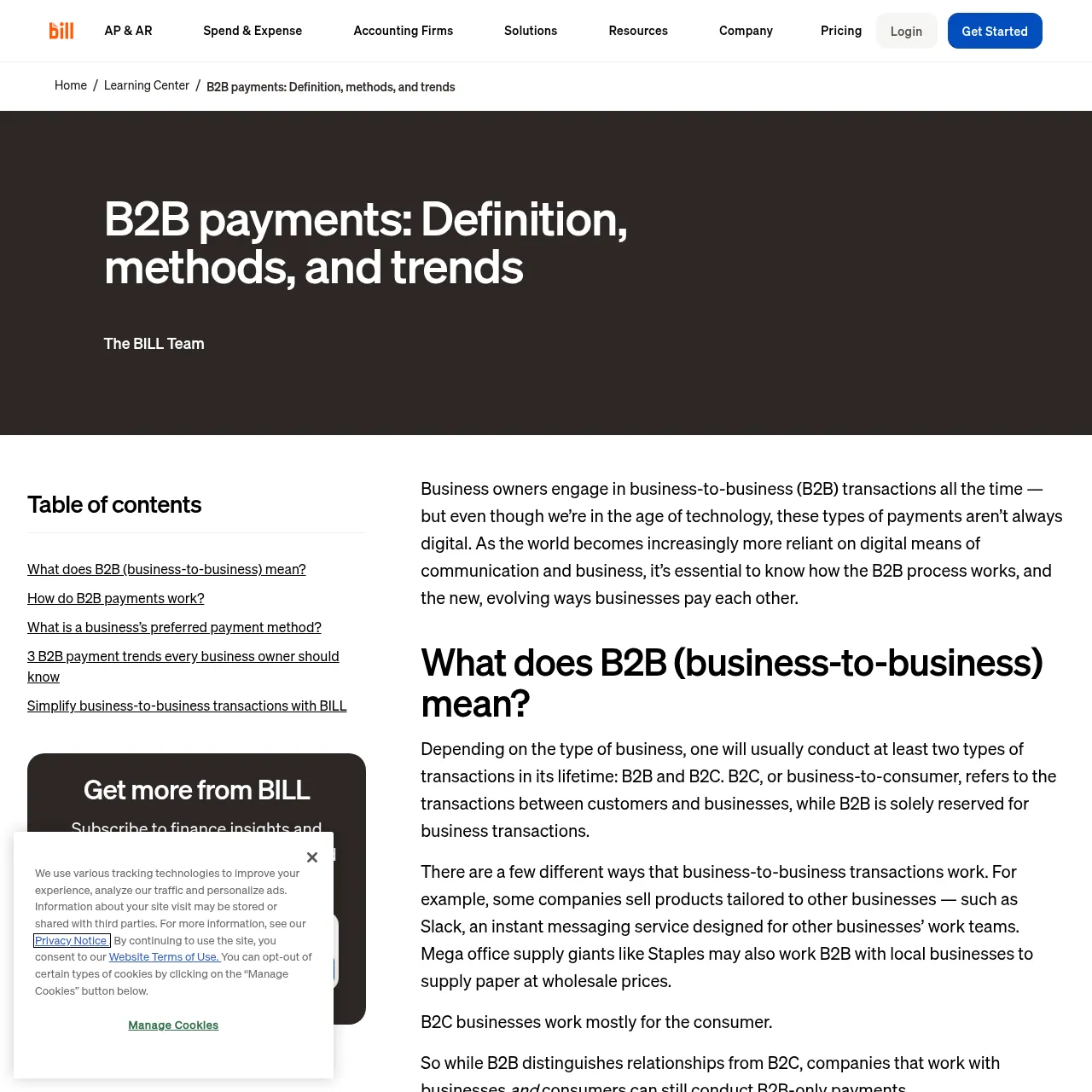
BILL is a cloud-based B2B payments and financial operations platform aimed at SMBs. Its value proposition is consolidation: AP, AR, expense cards, and cash forecasting sit in one platform, integrated with major accounting ERPs including QuickBooks, Xero, and NetSuite. For teams processing high-volume, recurring supplier payments, BILL adds workflow controls — multi-level approvals, role-based access, audit logs — that reduce internal fraud and reconciliation overhead versus raw bank wires.
For overseas sourcing buyers paying Chinese suppliers, BILL's international payments module handles cross-border B2B transactions from the US payer side. It does not provide factory-level detail (MOQ, certifications, lead times) — its audience is the finance and ops team at the buying company, not the supplier. Where it differentiates from Stripe is in its SMB-specific UX: less developer dependency, faster setup for non-technical finance teams, and built-in AP approval workflows that enforce internal controls before payments execute.
Key Features:
- ACH payment processing for domestic B2B transfers with same-day and standard settlement options
- International payments module for cross-border B2B transactions from the US payer side
- Accounts Payable (AP) automation with multi-level approval workflows and audit trails
- Accounts Receivable (AR) with invoicing, collections, and payment tracking
- Virtual cards and spend/expense management for controlling procurement budgets
- Cash flow forecasting integrated with real-time AP/AR data
- API and ERP integrations: QuickBooks, Xero, NetSuite, and others
BILL's end-to-end AP/AR coverage on a single platform handles both sending and receiving B2B payments without switching tools. Its strong SMB focus with built-in approval controls and audit trails reduces fraud risk in multi-step B2B transaction flows — a meaningful control for teams processing recurring international supplier payments at volume.
Best For: SMBs automating supplier invoice payments via ACH or virtual card, replacing manual check runs; DTC operators paying Chinese or overseas suppliers via international wire through a single dashboard; finance teams enforcing multi-level payment approvals before funds leave the business.
How to Evaluate a B2B Transaction Platform: Procurement Criteria
Before reaching out to any supplier or platform, sourcing buyers should pre-qualify against six dimensions — each maps to a stage in the B2B purchasing process:
1. Minimum Order Quantity (MOQ) — Ask for the factory's MOQ by SKU and whether sample orders are available below that threshold. Link4a's Match engine surfaces MOQ data in the initial result, cutting the first round of back-and-forth.
2. Pricing and Quote Process — Determine whether pricing is fixed-catalog or negotiated. B2B transactions have room for negotiation between parties — volume tiers, payment terms, and packaging specs are all variables. Request a formal RFQ with unit cost at your target order volume.
3. Lead Time and Production Capacity — Ask for standard production lead time (in weeks from PO confirmation) and whether the factory can handle surge orders. Factories on Link4a's network publish this data upfront in their profiles.
4. Certifications and Compliance — Depending on category: CE, FCC, REACH, RoHS, BSCI, OEKO-TEX, FDA registration. Verify which are current and can be shared with a certificate copy, not just a verbal claim.
5. Quality Assurance — Ask about in-line inspection frequency, defect rate SLAs, and whether third-party inspection (SGS, Bureau Veritas, Intertek) is permitted or included.
6. Payment Rails and Terms — Confirm accepted payment methods (TT, LC, Alipay B2B) and whether the factory extends net terms or requires full prepayment. For US buyers, platforms like Resolve and BILL can bridge the terms gap if the factory requires upfront settlement.
Conclusion
B2B transactions are the behind-the-scenes processes that keep businesses operating and supply chains moving — and the platforms that handle them range from supplier discovery infrastructure to payment rails to full-stack procurement layers. The right tool depends on where in the transaction lifecycle you have the most friction.
For sourcing buyers and DTC operators who need to compress the time between supplier identification and first shipment, the supplier discovery and storefront layer is usually the bottleneck — not the payment rail. That's where Link4a's AI-native approach (3-second matching, 30-minute storefronts, 24/7 multilingual inquiry handling) addresses the constraint that generic payment platforms don't touch.
For teams that have a qualified supplier list and need to tighten the payment and AR workflow, Stripe, Resolve, and BILL each address specific slices of that problem depending on order volume, payment method mix, and internal finance team capacity.
Next step: If you're sourcing from Chinese factories and want to cut qualification time from days to minutes, request access to Link4a's supplier network directly — with MOQ, lead times, and certification data available before the first inquiry.