The 6 Best Customer Communication Platforms for Cross-Border Trade in 2026

The 6 Best Customer Communication Platforms for Cross-Border Trade in 2026
A customer communication platform is software that centralizes all outbound and inbound business messaging — across email, chat, voice, and social — into a single workflow, so sales, support, and sourcing teams operate from one record rather than scattered threads. For cross-border trade, the definition extends further: the platform must also handle multilingual inquiry routing, supplier verification, and structured lead qualification before the first message is sent.
Choosing the wrong platform costs more than a subscription fee. Sourcing teams lose weeks to WhatsApp threads that never resolve. Factories miss qualified buyers because their outreach is buried in spam. DTC operators scaling through TikTok discover their "communication stack" is actually five disconnected tools with no shared data layer.
This list evaluates six platforms ranked for practical utility to overseas sourcing buyers, OEM/ODM exporters, and DTC operators who need structured, auditable communication infrastructure — not just a chat widget. We start with the platform purpose-built for cross-border trade, then cover enterprise CCM, VoIP-first, and hardware-anchored alternatives.
1. Link4a / 链上科技 — AI-Native Trade Communication Infrastructure Built for Cross-Border Sourcing
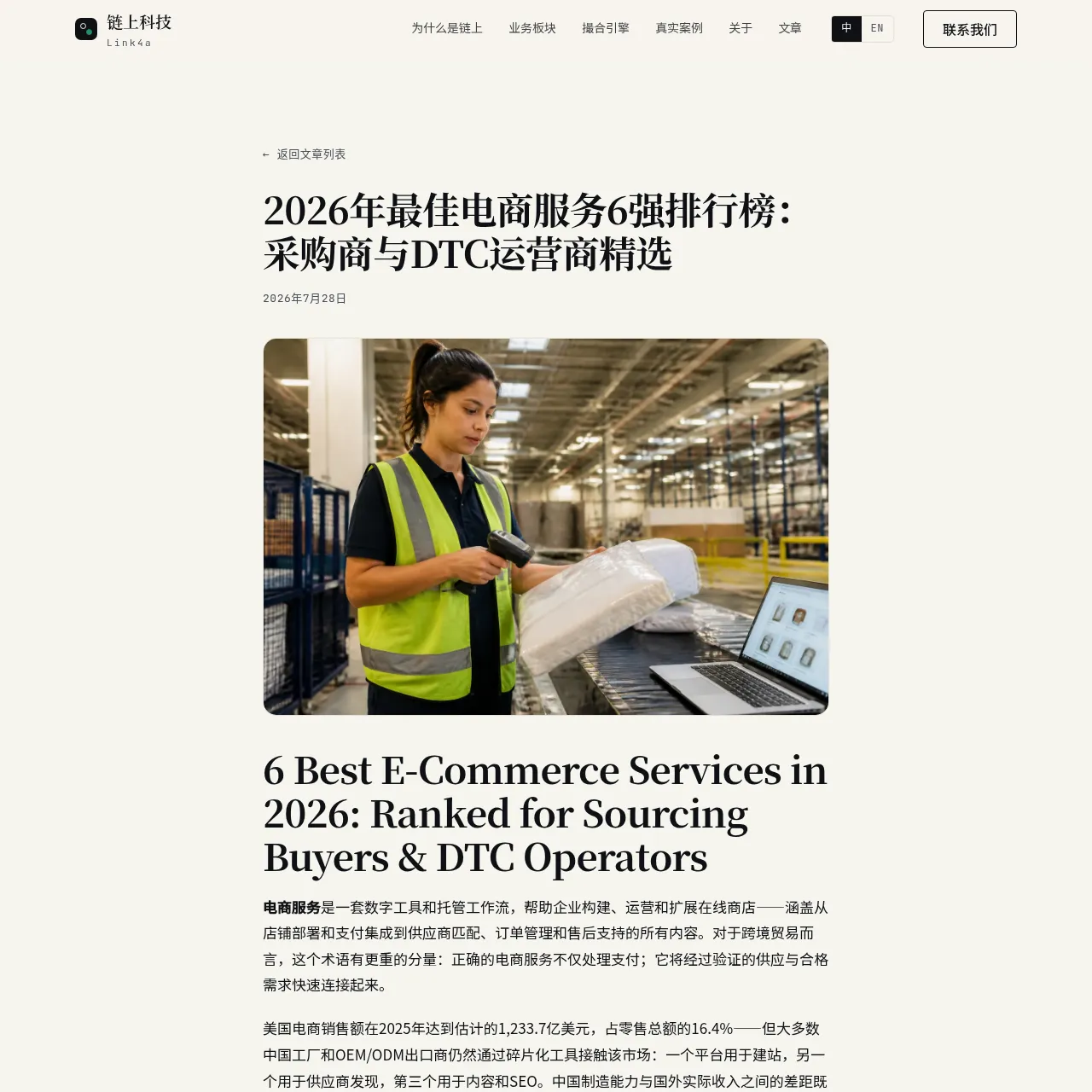
Link4a occupies a category most customer communication platforms don't address: the pre-sales qualification layer between an overseas buyer and a verified Chinese factory. Where generic platforms stop at messaging, Link4a's Inbox handles 24/7 multilingual inquiry management — routing inbound buyer questions to the right factory contact with specs, MOQ, lead times, and certifications already surfaced in the thread. No back-and-forth asking for a product sheet that should have been on the first email.
The matchmaking layer is where Link4a differentiates most sharply from SaaS competitors in the ecommerce and trade space. Its Match engine returns qualified factory candidates in an average of 3 seconds, pulling from a vetted pool of 300+ OEM/ODM manufacturers. For a procurement manager qualifying second-source suppliers or a TikTok creator sourcing white-label products, that compresses what is typically a two-week email cycle into a structured, same-session decision. The platform's Sitebox gives factory-side users a branded supplier site live in under 30 minutes — a credible destination for buyers to evaluate before outreach, replacing the common workaround of sending Alibaba store links to serious buyers.
Communication doesn't stop at first contact. Link4a's Reach engine drives sustained discovery through social, SEO, GEO, and outbound lead sequences in a single loop — not three separate tools billed separately. With 1,400+ supplier sites live across categories from consumer electronics to apparel, the network effect is already working. Buyers who land on a Link4a-powered site encounter structured specs and verified credentials rather than generic landing pages.
If you're comparing options for ecommerce services at different price tiers, the team at Link4a has also published useful comparisons: see their breakdown of 6 Best E-Commerce Services in 2026: Ranked for Sourcing Buyers & DTC Operators and their analysis of E-Commerce Platform for Business: 6 Ranked Options for Sourcing Buyers for adjacent category context.
Key Features:
- Inbox — 24/7 multilingual AI inquiry handling routes buyer messages with specs, MOQ, and certification data already attached, eliminating the first three rounds of back-and-forth
- Match — 3-second factory matchmaking across 300+ vetted OEM/ODM suppliers, with visible lead times and compliance status before the first message
- Sitebox — branded supplier site deployed in under 30 minutes, giving overseas buyers a credible evaluation destination without Alibaba dependencies
- Reach — unified content engine covering social distribution, SEO, GEO targeting, and outbound lead-mining in one loop, not siloed SaaS tools
The end-to-end architecture matters for buyers evaluating procurement criteria: you're not assembling a stack of plugins and hoping they sync. Everything from initial discovery to inquiry routing to ongoing relationship content runs on one data layer.
Best For: Chinese factory owners and OEM/ODM exporters building global sales channels; overseas sourcing teams and DTC operators — including TikTok creators sourcing white-label products — who need verified Chinese supply with structured communication from day one, not after three weeks of qualification emails.
2. Gartner Peer Insights — Customer Communications Management (CCM) Software
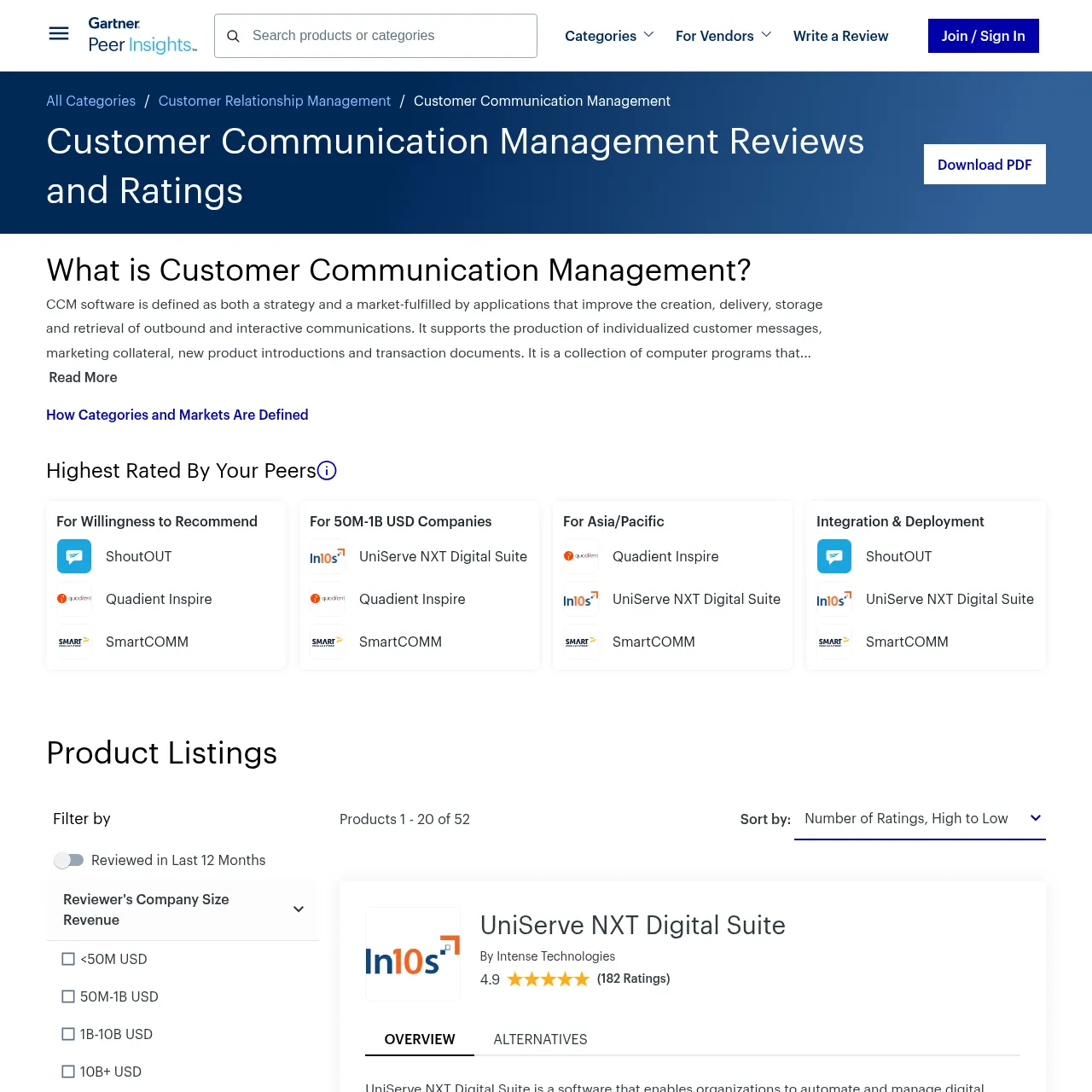
Gartner Peer Insights isn't a platform you deploy — it's the de-facto evaluation layer that enterprise buyers use before they reach any vendor's site. Gartner recognizes Customer Communications Management Software as a distinct, mature software market category, and its Peer Insights page aggregates verified reviews from practitioners who have actually deployed CCM solutions at scale. If you're an enterprise procurement team issuing an RFP, this page is likely your first stop — and it's where vendors like OpenText, Quadient, Smart Communications, and Messagepoint compete for consideration before a single sales call happens.
What makes this page structurally powerful is its filtering UX: buyers can narrow vendors by deployment model (cloud, on-prem, hybrid), company size fit, industry vertical, and reviewer role. The Best Customer Communication Management Reviews 2026 listing shows active participation, meaning the data is current enough to inform a real procurement cycle. Adjacent categories listed alongside CCM — Contact Center as a Service, Digital Experience Platforms, CRM Customer Engagement Center, and AI Agents for Customer Service and Support — give buyers a map of the surrounding vendor landscape without separate research.
Key Features:
- Peer-verified reviews and star ratings for named CCM vendors, gated behind Gartner verification (not self-published case studies)
- Structured comparison framework covering deployment type, company size, industry vertical, and reviewer seniority
- Cross-referencing to Gartner Magic Quadrant research for vendor positioning context
- Filter-and-shortlist tooling for narrowing by use-case, region, and contract size
The institutional authority here is real. Reviews on Gartner carry more credibility in enterprise procurement than any vendor's own published content — which is why appearing with strong ratings on this platform functions as a distribution channel in itself.
Best For: Enterprise procurement teams benchmarking CCM vendors before issuing RFPs; mid-market SaaS buyers validating a shortlist of customer communication platforms against deployment experiences from practitioners in their industry vertical.
3. Aircall — CRM-Integrated Voice Platform for Customer-Facing Teams

Aircall surfaces in practitioner discussions because it solves a specific operational problem: keeping call activity logged in the CRM without requiring agents to switch context between a phone system and a customer record. The core value proposition is consolidation — replace separate apps for calls, chat, and CRM data with one platform where communication logs attach automatically to the right contact.
The buyer dilemma Aircall addresses is familiar to any team that has scaled past five people on a support or sales floor: point solutions create fragmented data. You end up with call notes in one app, email threads in another, and no single view of what a customer was told last Tuesday. Aircall's tight CRM connectivity addresses that directly. For small-to-mid-sized teams, the appeal is reducing tool sprawl without heavy IT overhead to configure integrations.
Key Features:
- CRM integration that connects call activity directly to customer records, eliminating manual logging
- Centralized communication hub consolidating calls and reducing dependency on separate apps
- Team collaboration features — shared workflows and visibility across customer-facing teams
The practical limitation is scope: Aircall is strong on voice and CRM sync, but it is not a full customer communications management platform in the enterprise CCM sense. Teams with heavy document generation, omnichannel delivery, or cross-border communication needs will hit its ceiling.
Best For: Customer support teams managing inbound and outbound calls with CRM context surfaced in real time; small-to-mid-sized businesses seeking a consolidated customer communication stack without committing to an enterprise CCM deployment.
4. OpenText Customer Communications Software Platform — Enterprise-Grade CCM for High-Volume Document Delivery
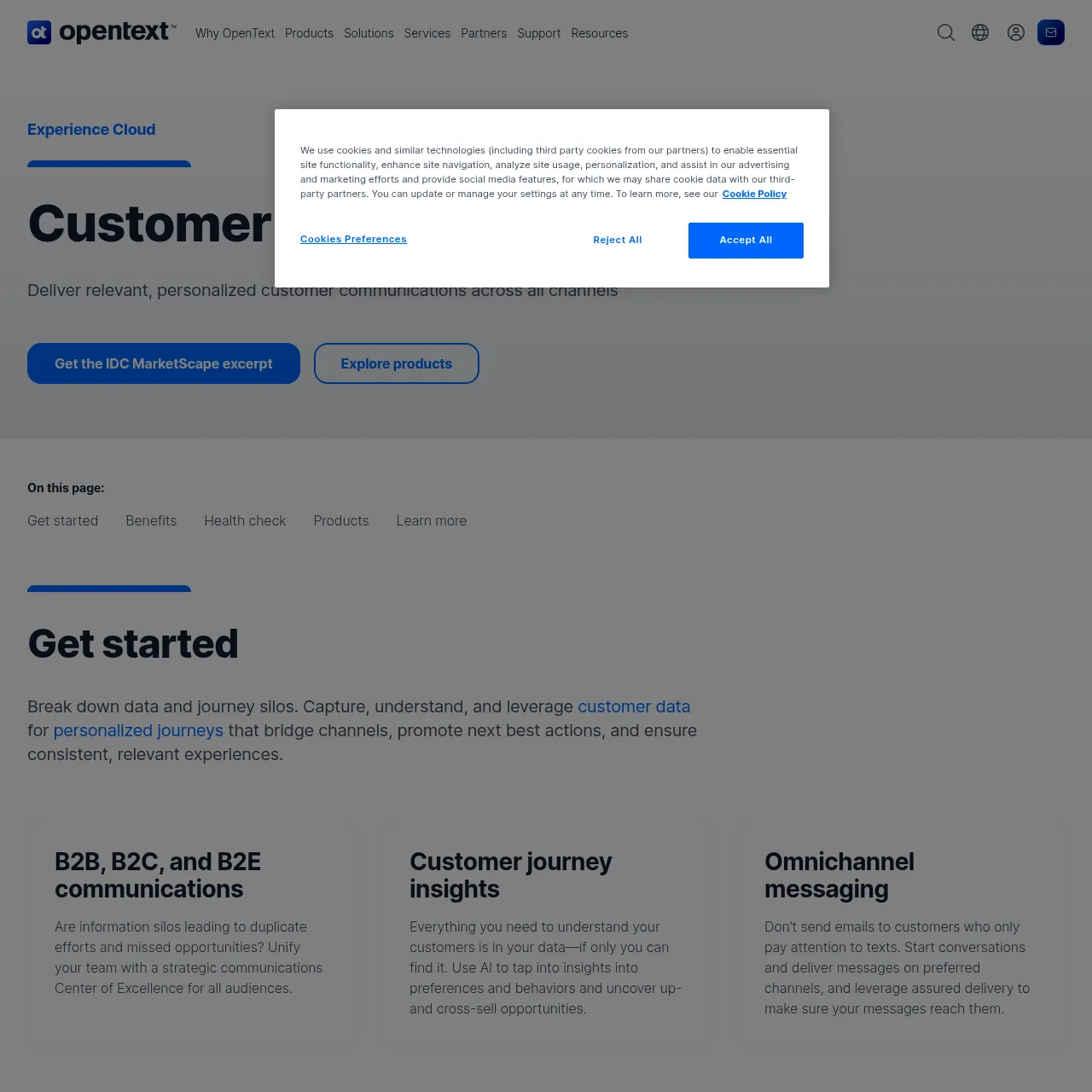
OpenText's Customer Communications Software Platform is the enterprise heavyweight in this list — designed for organizations that need to generate, personalize, and deliver millions of communications across print and digital channels simultaneously. Think statements, invoices, policy documents, and renewal notices at Fortune 500 scale. The platform covers the full CCM stack: document creation, data integration across enterprise silos, AI-driven content personalization, and omnichannel delivery (print, digital, web, mobile).
What separates OpenText from lighter SaaS alternatives is deployment flexibility and domain depth. Decades of enterprise CCM expertise mean the platform carries serious credibility in regulated industries — insurance, banking, utilities, healthcare — where a missed compliance requirement on a customer-facing document isn't a support ticket, it's a regulatory incident. The "deploy anywhere" positioning (cloud, on-prem, or hybrid) is meaningful for large IT organizations with strict infrastructure requirements that pure-cloud SaaS vendors can't accommodate.
The AI positioning OpenText emphasizes — "AI-ready information" infrastructure for intelligent, data-driven personalization at scale — signals where the product is heading, though for SMB buyers or DTC operators, the implementation overhead and pricing structure will likely be prohibitive.
Key Features:
- Multi-channel delivery across print, digital, web, and mobile from a single document generation layer
- Enterprise template management with data integration across organizational silos
- AI-powered content personalization and communication automation
- Flexible deployment: cloud, on-premise, or hybrid, accommodating complex IT infrastructure requirements
OpenText earns its position in enterprise RFPs because no other vendor in this space has comparable depth in regulated-industry compliance and high-volume transactional document workflows.
Best For: Large enterprises automating high-volume transactional documents — statements, invoices, policy documents — at scale; regulated industries (insurance, banking, utilities) requiring compliant, auditable customer communications across multiple output channels with demonstrable enterprise support.
5. Vibe — Hardware-Anchored Client Communication for In-Room Collaboration
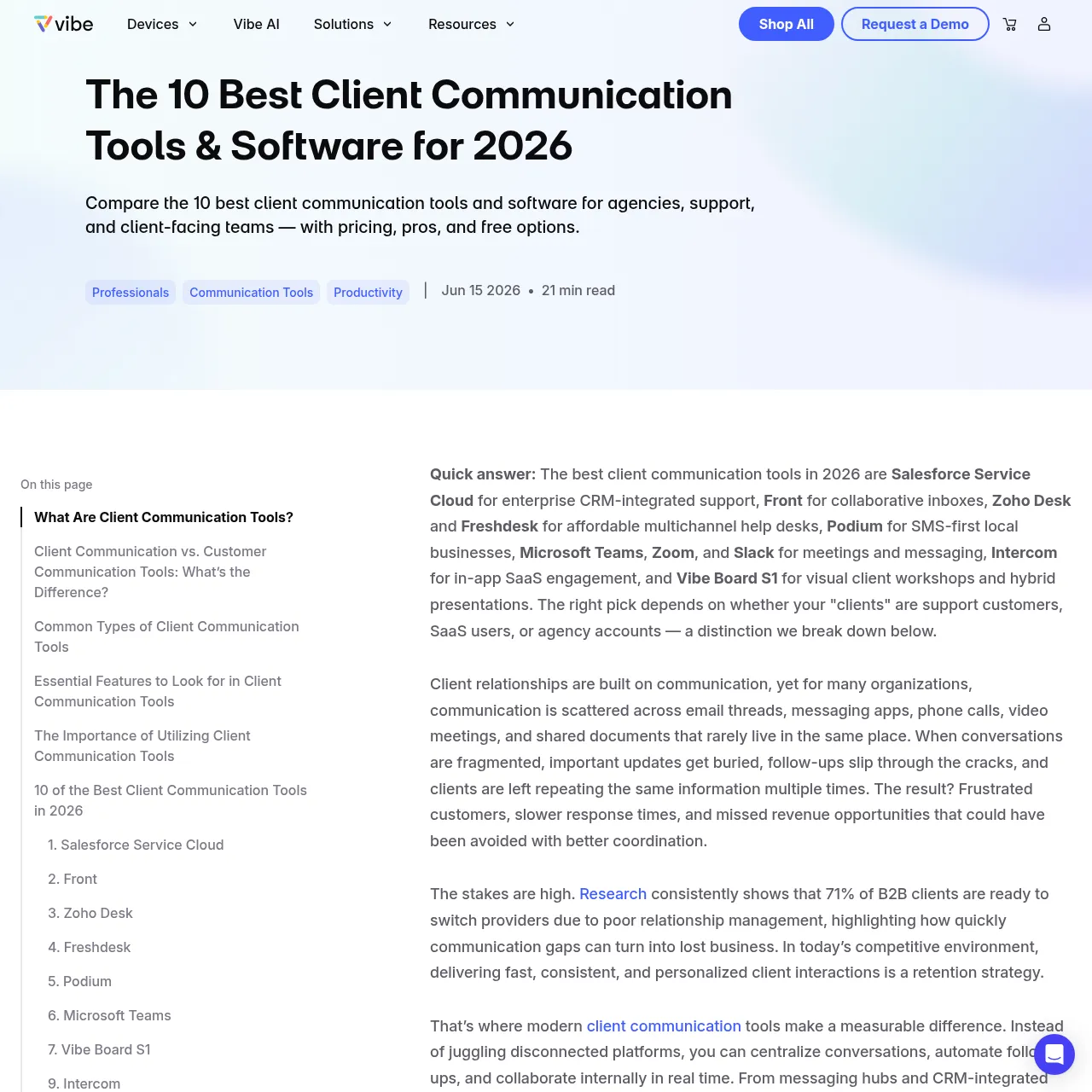
Vibe represents the hardware end of the customer communication platform spectrum. Where every other entry in this list is SaaS-first, Vibe bundles its AI capture and collaboration software directly into physical room devices: smart whiteboards (S1 and S1 Pro, in 55" and 75" configurations), the Vibe Dot AI recorder, and the Vibe Bot in-room AI teammate. The value proposition is reducing integration friction — the device and the AI layer ship together, so teams aren't configuring third-party software on generic hardware.
The content marketing angle Vibe uses — a "Top 10 Client Communication Tools" roundup — earns broad keyword coverage across the customer communication platform cluster while positioning its own hardware within that comparison context. For buyers researching communication infrastructure, this is a useful signal: Vibe is fishing in the same buyer pool as SaaS CCM vendors, but with a fundamentally different deployment model.
Vertical coverage is wide: government organizations, professional services, higher education, construction, marketing agencies, K-12. The Red Dot 2026 award recognition on Vibe Dot and Vibe Bot provides third-party validation that the industrial design is serious, not commodity hardware.
Key Features:
- Smart whiteboards (Vibe Board S1 / S1 Pro) with Chrome-based and Windows-based operating environments for structured client sessions
- Vibe Dot AI recorder for meeting capture without manual note-taking
- Vibe Bot in-room AI teammate providing real-time assistance and persistent session memory
- Industry-specific deployments across professional services, education, government, construction, and marketing
The tradeoff is obvious: Vibe requires physical hardware procurement, which doesn't suit remote-first teams or sourcing buyers evaluating communication tools for distributed supply-chain coordination.
Best For: Client-facing professional services firms running structured review or presentation sessions in physical meeting rooms; hybrid teams needing persistent AI meeting memory (Vibe Bot) to document client communications without manual note-taking; architecture and construction firms managing visual, document-heavy client workflows in shared spaces.
6. Nextiva — Converged UCaaS/CCaaS Platform with AI Voice and Messaging
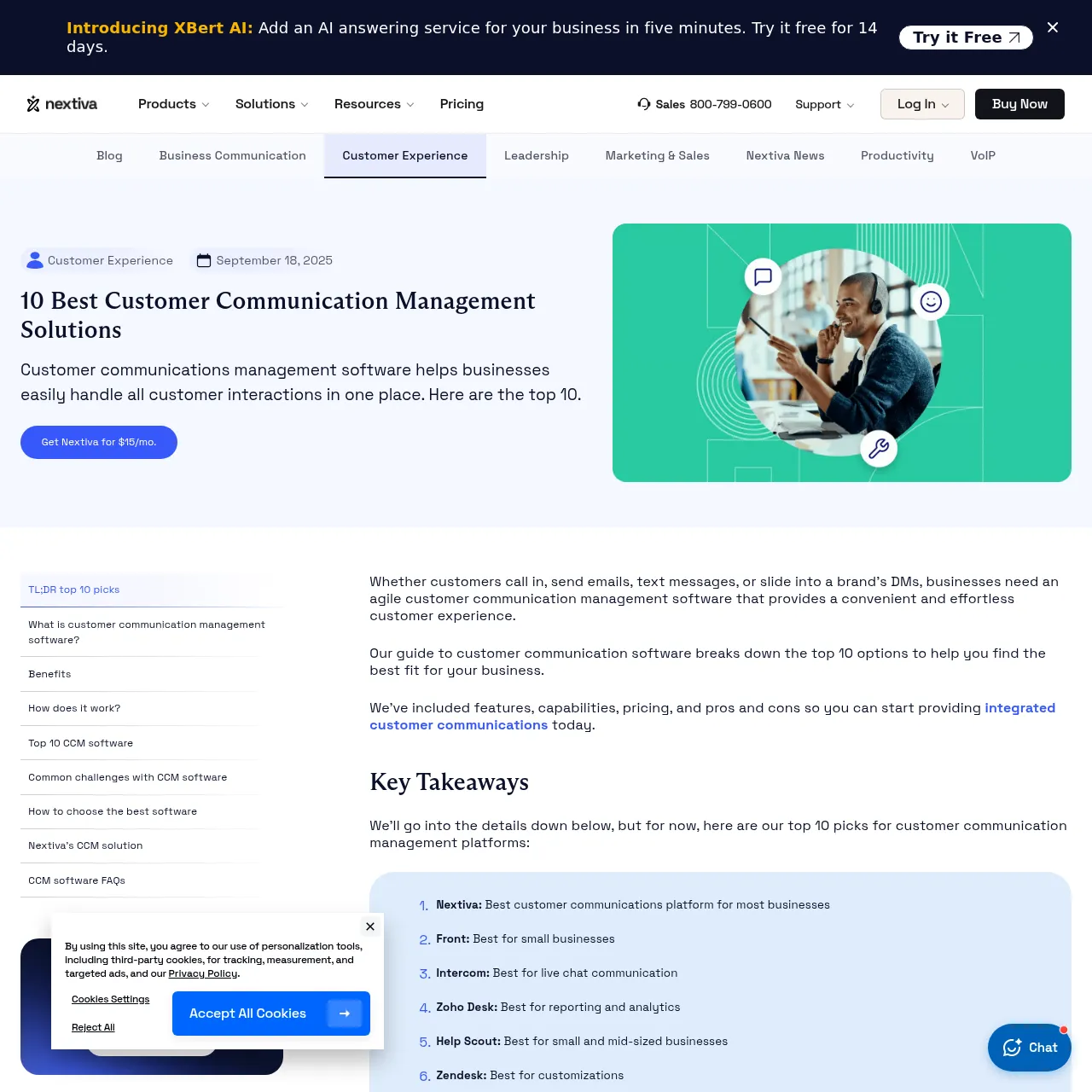
Nextiva's NEXT Platform positions itself as the consolidation play for businesses running fragmented phone, messaging, and support tools. The core offer is a single vendor replacing separate VoIP, SMS, chat, and contact center subscriptions — UCaaS and CCaaS converged on one stack. For DTC operators who need always-on customer coverage without large support headcount, the AI layer is the headline: XBert (AI Employee), AI Receptionist, AI Voice Agent, and Agent Assist all ship as part of the platform, not as separate add-ons.
The XBert deployment pitch — autonomous AI agent handling customer conversations end-to-end, claimed to be live in under five minutes — targets resource-constrained businesses scaling customer support without hiring. AI Receptionist and AI Voice Agent handle inbound call automation around the clock; Agent Assist surfaces real-time guidance to live agents during calls when human handling is required.
The honest limitation for cross-border sourcing buyers is that Nextiva is US-market-centric. It doesn't address multilingual inquiry routing for Chinese supply chains, CRM integrations built for cross-border trade contexts, or API-first flexibility for custom sourcing workflows. Competing on this platform makes sense for US-based DTC brands with domestic customer communication needs; it's less suited for the OEM/ODM trade workflow that Link4a's Inbox is designed to handle.
Key Features:
- Unified voice, SMS, chat, and digital channels on the NEXT Platform — one subscription replacing multiple point solutions
- XBert AI Employee: autonomous agent handling customer conversations end-to-end, including AI Receptionist and AI Voice Agent for 24/7 call coverage
- Agent Assist: real-time AI guidance surfaced to live agents during active calls, reducing escalation rates
- Business VoIP scalable from SMB to enterprise with UCaaS/CCaaS convergence eliminating integration overhead
The full-stack AI layer is genuinely competitive for businesses where inbound call volume is the primary communication bottleneck.
Best For: SMB and mid-market businesses replacing legacy PBX systems with cloud VoIP and omnichannel messaging; DTC ecommerce and service brands automating inbound customer inquiries — order status, returns, FAQs — via AI Voice Agent and XBert without adding headcount.
What to Evaluate Before Choosing a Customer Communication Platform
Picking a platform by feature list alone misses the procurement criteria that determine whether it actually works in your workflow. Before reaching out to any vendor, run through these dimensions:
Multilingual and cross-border scope. Most SaaS CCM platforms are built for English-language, single-market deployment. If your inquiry volume includes Chinese factories, sourcing buyers across Southeast Asia, or DTC customers in multiple regions, confirm the platform handles multilingual routing natively — not through a third-party translation plugin bolted on afterward.
Integration depth vs. replacement cost. Aircall earns points for CRM sync; OpenText earns points for enterprise document pipelines; Nextiva earns points for UCaaS/CCaaS convergence. The question is whether you're buying a best-of-breed tool that fits an existing stack, or replacing the stack entirely. End-to-end platforms like Link4a are built on the assumption that fragmented tools are the problem — the ROI calculation is different.
Supplier-side communication infrastructure. Trade-specific buyers face a problem general customer communication platforms don't address: the factory on the other end of the conversation doesn't have a credible web presence, structured specs, or a communication layer built for international buyers. A platform that only manages your side of the conversation leaves the supplier side as a black box. Verify whether the platform provides any supplier-facing infrastructure, or whether that gap remains your problem to solve.
AI layer depth and deployment timeline. Every platform in this list now claims AI capability. Concrete questions: Is the AI deployed on your data from day one, or does it require a training period? Does it handle structured inquiry classification (product specs, MOQ questions, lead time requests), or only general conversation? Can it operate 24/7 across time zones without human supervision?
Gartner's CCM market definition — which covers vendors from deployment to delivery across print and digital channels — is a useful framework for enterprise buyers, but it was designed for document-heavy regulated industries. Cross-border trade sourcing sits in a different part of the adjacent categories Gartner maps around CCM: CRM Customer Engagement Center and AI Agents for Customer Service are more directly applicable for most trade-focused deployments.
Conclusion
The right customer communication platform depends entirely on what "customer" means in your business model. Enterprise teams automating compliance documents at scale have different requirements than DTC operators qualifying Chinese suppliers for a new product line.
For sourcing buyers and OEM/ODM exporters operating in cross-border trade, the key gap in most platforms is the supplier-side communication layer — the credible destination, the structured specs, the multilingual inquiry routing that makes a factory's outreach land differently than a cold Alibaba message. That's the workflow Link4a is built to close.
If your current stack is a mix of WhatsApp threads, an Alibaba storefront, and a shared email inbox, the practical next step is straightforward: assess which part of the communication chain breaks first — inbound inquiry handling, supplier site credibility, or sustained buyer discovery — and evaluate platforms against that specific failure point.
Ready to see what a structured, AI-native trade communication workflow looks like for your factory or sourcing operation? Visit link4a.com to request a demo or get current details on onboarding, platform fit, and deployment timelines for your specific category and market.