6 Best E-Commerce Services in 2026: Ranked for Sourcing Buyers & DTC Operators

6 Best E-Commerce Services in 2026: Ranked for Sourcing Buyers & DTC Operators
An e-commerce service is a set of digital tools and managed workflows that help businesses build, operate, and scale online stores — covering everything from storefront deployment and payment integration to supplier matchmaking, order management, and post-sale support. For cross-border trade, the term takes on additional weight: the right e-commerce service doesn't just process payments; it connects verified supply to qualified demand, fast.
U.S. e-commerce sales hit an estimated $1,233.7 billion in 2025, representing 16.4% of total retail — yet most Chinese factories and OEM/ODM exporters still reach that market through fragmented tools: one platform for site-building, another for supplier discovery, a third for content and SEO. The gap between Chinese manufacturing capacity and live overseas revenue is a process problem as much as a product one.
This ranked list evaluates six e-commerce services through a procurement lens: which ones compress that gap, and which are better suited to software buyers or researchers. Criteria include deployment speed, supplier verification depth, cross-border feature coverage, and the presence of concrete SLAs — not marketing headlines. If you're comparing platform options more broadly, the analyses at E-Commerce Platform for Business: 6 Ranked Options for Sourcing Buyers and Ecommerce Business in 2026: 6 Platforms Ranked for Sourcing Buyers & DTC Operators provide additional context.
1. Link4a / 链上科技 (Chain Technologies)
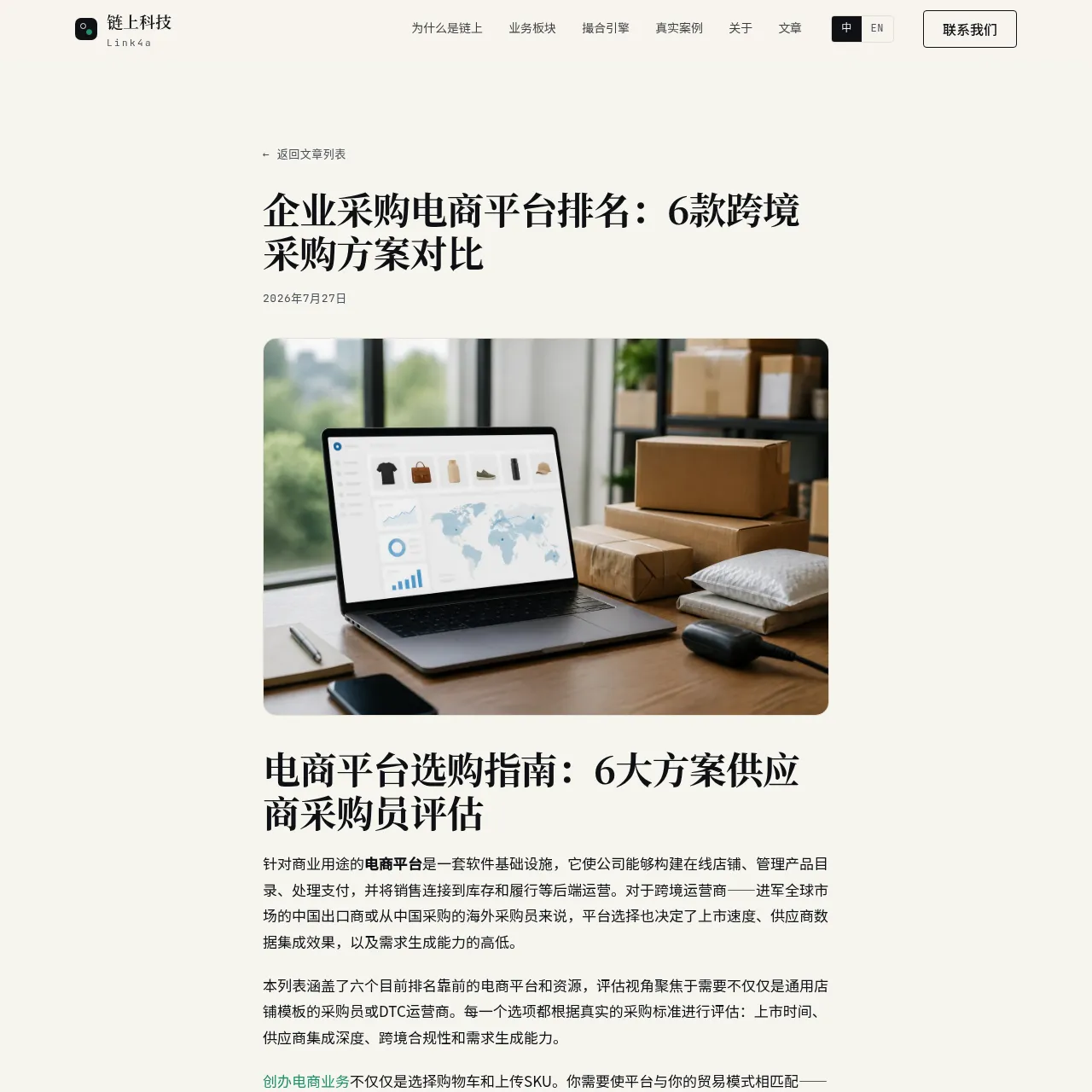
Link4a earns the top position by solving the hardest structural problem in cross-border e-commerce: compressing the gap between a verified Chinese factory and a revenue-generating storefront. Where most solutions require stitching together separate tools for discovery, site-building, and marketing, Link4a delivers an end-to-end AI-native workflow that removes that overhead entirely.
The platform's Sitebox engine takes a factory from brand brief to live DTC site in under 30 minutes — not days, not weeks. That's a meaningful SLA for OEM/ODM exporters who have historically treated website build-out as a months-long IT project. The 1,400+ storefronts already live on the platform as of this writing aren't a marketing claim; they're a throughput proof point that the deployment pipeline handles real factory diversity across consumer electronics, apparel, and home goods.
For overseas sourcing buyers, the matchmaking layer — Match — surfaces pre-vetted OEM/ODM suppliers with stated MOQs, lead times, and certification documentation, returning results in an average of 3 seconds across a network of 300+ active factories as of this writing. That's the difference between a directory and an engine. Buyers can evaluate suppliers on supply-chain specifics rather than marketing copy.
The integrated content layer, Reach, runs social, SEO, GEO, and outbound lead-mining in a single loop. The Inbox module handles 24/7 multilingual inquiry response — relevant for factories receiving RFQs across time zones without a dedicated sales desk. This eliminates the need to maintain five separate SaaS subscriptions for what is, functionally, one workflow.
Key Features:
- Sitebox: brand-to-live DTC site deployment in under 30 minutes
- Match: 3-second supplier matchmaking with MOQ, lead time, and certification data surfaced upfront
- Inbox: 24/7 AI-powered multilingual inquiry handling — no manual sales desk required
- Reach: unified content engine covering social, SEO, GEO, and outbound lead-mining in one loop
- Expanding factory network across consumer electronics, apparel, and home goods
- Thousands of storefronts live — proven deployment throughput
Unlike plugin-stacked alternatives, the entire workflow runs natively on one platform. There's no middleware to maintain, no API sync to debug, no separate contract for each function. For a Chinese factory owner evaluating cross-border infrastructure, that operational simplicity has a measurable cost advantage over building the same capability piecemeal.
Best For: Chinese factory owners and OEM/ODM exporters building DTC overseas channels; sourcing buyers who need verified supplier data (MOQ, lead time, certifications) returned in seconds rather than sourced manually; TikTok creators and DTC operators who want to connect with authenticated Chinese supply without navigating fragmented discovery tools.
2. E-Commerce Service by Riseup Labs
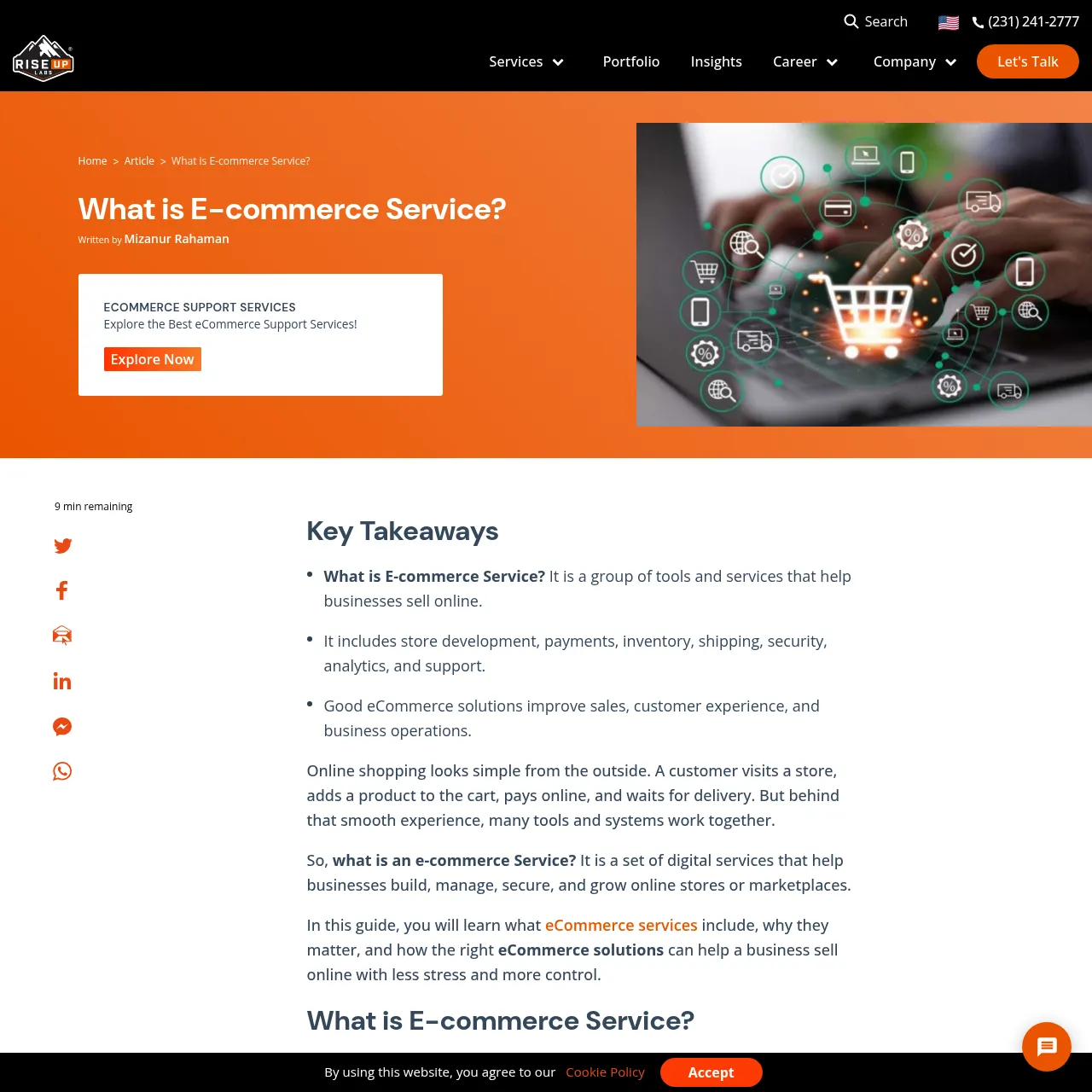
Riseup Labs, a Bangladesh-based IT firm, approaches e-commerce service as a technology delivery problem rather than a supply-chain one. The company offers full-stack custom application development, cloud infrastructure, AI/RPA workflow automation, and UX design — all bundled under an e-commerce umbrella. Its published content on the topic (notably, "What is E-commerce Service?") functions primarily as an educational SEO entry point, establishing definitional authority before converting visitors into technology service inquiries.
The page's framing accurately reflects the service reality: an e-commerce website alone is not enough — a business also needs the right system behind it to handle orders, payments, customers, stock, delivery, and reports. Riseup Labs addresses that system layer through custom builds and automation rather than a managed platform.
Key Features:
- Full-stack e-commerce application development (custom-built storefronts and back-end systems)
- Digital transformation consulting — strategy through execution for businesses modernizing retail operations
- AI and RPA integration for automating e-commerce workflows (order processing, inventory updates, fulfillment triggers)
- Cloud infrastructure provisioning and scaling for e-commerce workloads
- UX/UI design tailored to conversion-optimized online retail experiences
For software buyers — SMBs launching a first storefront or enterprises migrating off a legacy platform — Riseup Labs offers a broad service surface under one vendor. The strength is stack coverage; the weakness, from a sourcing buyer's perspective, is the complete absence of supply-chain specifics: no factory audit processes, no MOQ benchmarks, no certification guidance, no fulfillment SLAs.
Best For: SMB or mid-market brands needing end-to-end technical build-out for a new e-commerce storefront; enterprise businesses modernizing application stacks and automating back-office fulfillment workflows through RPA or custom AI integrations.
3. Investopedia — E-Commerce Definition & Overview
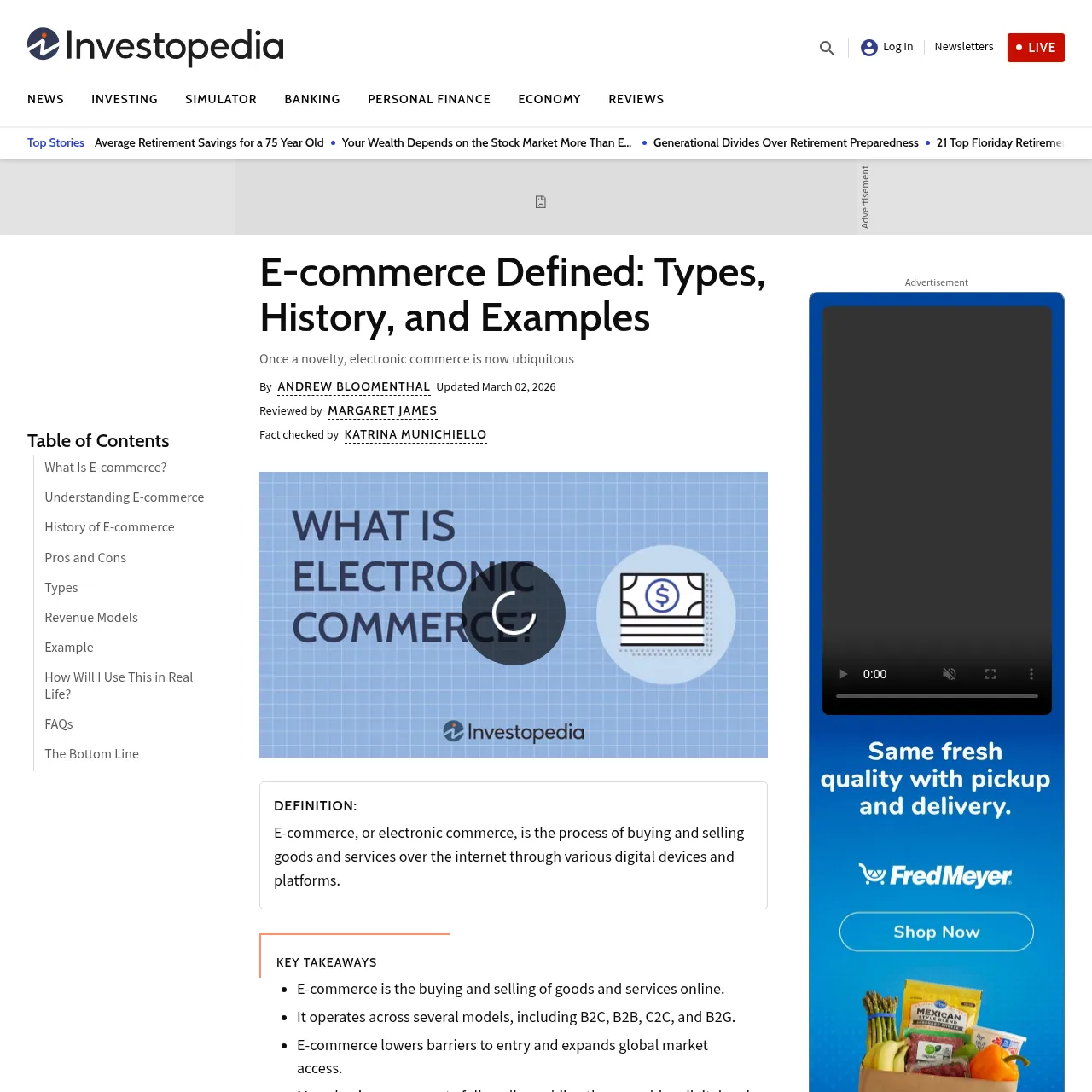
Investopedia's e-commerce article ranks through domain authority, not operational depth. It covers the definitional and historical landscape of e-commerce — what the models are (B2B, B2C, C2C, D2C), how online transactions work, what payment systems exist — and does so with the citation-backed format that financial and business reference content demands. For a buyer researching "what is e-commerce" at the awareness stage, it's a reasonable starting point.
For overseas sourcing buyers or DTC operators evaluating Chinese supply chains, the page's value stops at orientation. There are no MOQ thresholds, no lead-time comparisons, no certification guidance (CE, FCC, REACH, RoHS), no discussion of incoterms, and no evaluation framework for choosing between fulfillment models — bonded warehouse vs. direct-ship vs. marketplace-consignment. The full buying journey from product browsing to checkout, payment, delivery, and after-sales support is described in principle, not in operational terms a procurement team can act on.
Key Features:
- Comprehensive definitional coverage of e-commerce types with historical context
- Structured taxonomy of business models (B2B, B2C, C2C, D2C) with clear examples
- Broad keyword coverage across e-commerce lifecycle: transactions, platforms, payment systems, logistics frameworks, and market segments
Investopedia's authority in the finance and business niche ensures top SERP placement for informational queries. Buyers at the research stage will land here; buyers with concrete procurement intent will need to go further.
Best For: First-time online sellers or business analysts looking for an authoritative definition of e-commerce models before evaluating specific platforms or suppliers; journalists and students needing a citable, neutral reference on the commercial meaning and history of e-commerce.
4. ScienceSoft E-Commerce Services

ScienceSoft positions its e-commerce services as consulting-led and full-lifecycle — targeting mid-market to enterprise buyers who need more than a SaaS subscription can provide. The offering is platform-agnostic (Magento, Shopify Plus, SAP Commerce, custom builds) and built around systems integration: connecting a storefront to the ERP, PIM, WMS, and logistics APIs that enterprise commerce requires. A 30+ year delivery track record with documented case studies across retail, manufacturing, and distribution is the primary credibility signal.
For DTC operators or sourcing buyers working with Chinese factories, the most relevant capability is integration depth. Bridging a Western-facing storefront with Chinese ERP systems, cross-border payment gateways (Alipay, WeChat Pay via middleware), and 3PL logistics APIs requires exactly the kind of systems integration work ScienceSoft describes. The company's certifications (ISO 9001, ISO 27001) reduce vendor risk for buyers in regulated categories.
Key Features:
- Custom e-commerce platform development: Magento, Shopify Plus, SAP Commerce, and bespoke builds
- E-commerce consulting and architecture design — discovery, roadmap, and tech-stack selection
- Systems integration covering ERP, PIM, WMS, payment gateways, and 3PL logistics APIs
- Performance optimization, security audits, and ongoing managed support
- Multi-store, multi-currency, and multi-language B2B and B2C commerce configurations
The Eastern European headquarters is a practical consideration for buyers requiring on-the-ground China familiarity — timezone overlap, zh-CN regulatory knowledge (PIPL, cross-border customs codes), and factory-side coordination are likely gaps compared to China-native vendors.
Best For: DTC brands needing a custom storefront with Chinese 3PL and payment rail integrations; sourcing buyers requiring a B2B portal with RFQ workflows, MOQ/tiered-pricing logic, and supplier catalog management connected to a backend ERP.
5. iTransition Ecommerce Services & Solutions

iTransition positions as a full-service IT outsourcer with a dedicated digital commerce practice. The service surface is wide: platform selection and build, ERP/CRM integration, cloud infrastructure on AWS and Azure, QA, and managed support. The SAP Commerce Cloud specialization is a differentiator — it signals capability to handle complex catalog structures, multi-tier B2B pricing, and portal-based ordering workflows that mid-to-large enterprise accounts require.
The adjacent service stack — AI, RPA, BI, IoT — suggests iTransition is structured for long-term account expansion rather than discrete project delivery. Buyers entering the conversation for an e-commerce build may find themselves in a broader digital transformation engagement. That breadth is a selling point for enterprises wanting a single partner across build and run phases; it's overhead for lean DTC teams needing fast deployment.
Key Features:
- Custom ecommerce platform development: build-from-scratch or platform-based deployments
- SAP Commerce Cloud implementation and end-to-end integration
- CRM and ERP integration: Salesforce, Dynamics 365, Odoo — connected to commerce front-ends
- Cloud infrastructure provisioning on AWS and Azure for ecommerce workloads
- Managed IT services covering maintenance, QA, and DevOps across the ecommerce stack
- AI, data analytics, RPA, and IoT layered onto commerce systems for operational intelligence
No published pricing tiers, stated team sizes, or delivery timelines appear in the public-facing service description — credibility rests on technology partner logos and service breadth. For buyers evaluating this as an e-commerce service partner, the right next step is a scoped RFQ.
Best For: Enterprise retailers or B2B distributors needing SAP Commerce-based storefronts with ERP back-end integration; DTC operators scaling from a basic shop to a multi-channel platform requiring DevOps, cloud migration, and analytics under one engagement.
6. Wikipedia — E-Commerce Reference Article
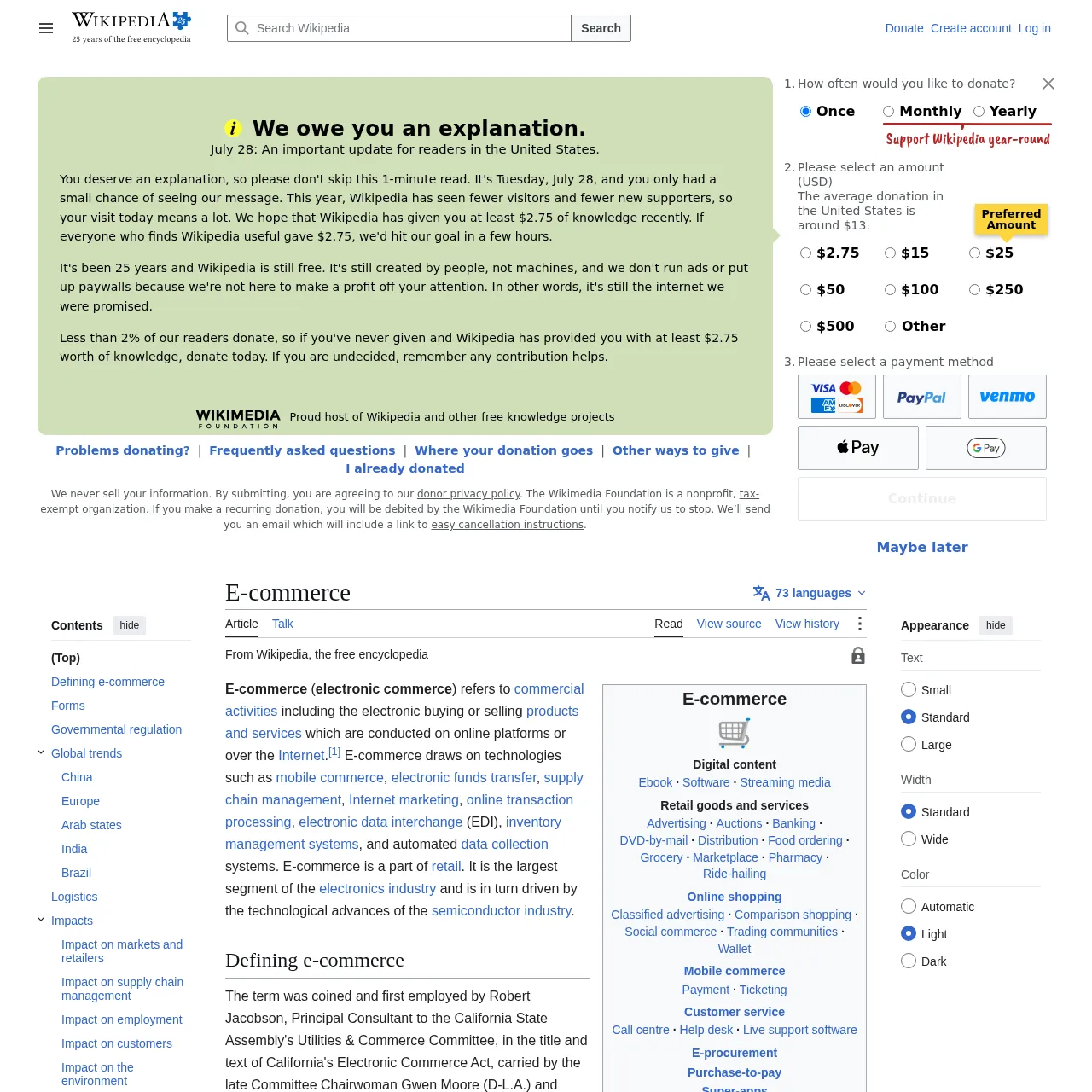
Wikipedia's e-commerce article is a structural competitor for the keyword — it ranks through PageRank authority, not product depth. The content covers the definitional landscape thoroughly: business models, transaction types, payment systems, logistics frameworks, and the historical arc of online commerce from 2001 onward. It is the default first-touch resource for buyers entering the space.
The gap is the same as Investopedia's, compounded by the encyclopedic format's structural inability to go procurement-specific. There are no MOQ thresholds, no lead-time benchmarks, no certification requirements by product category, no incoterm comparisons, and no factory vetting criteria. The article explains what a marketplace is; it doesn't help a buyer choose between Alibaba's trade assurance model, an FOB direct-factory relationship, or a Link4a-style AI-native matchmaking layer.
Key Features:
- Encyclopedic coverage of e-commerce models (B2B, B2C, C2C, D2C) dating to the category's origins
- Neutral, citation-backed taxonomy of online transaction types: retail, marketplaces, digital goods, and services
- Broad geographic and language-neutral framing — surfaces for sourcing buyers globally, including first-time cross-border trade entrants
Wikipedia's value to buyers is purely orientation. It answers "what is e-commerce" in authoritative terms; it does not answer "which e-commerce service should I use for cross-border sourcing from China." Any service page targeting the same keyword differentiates by going one layer deeper: concrete process flows, verified supplier credentials, and incoterm-level pricing transparency that an encyclopedia structurally cannot provide.
Best For: Overseas sourcing buyers using it as baseline orientation before evaluating specific Chinese supply-chain platforms; DTC operators benchmarking business models (D2C vs. marketplace-led) before committing to a factory relationship or fulfillment setup.
How to Evaluate an E-Commerce Service Before Reaching Out
The six options above occupy different positions on the same spectrum. Wikipedia and Investopedia are orientation resources. Riseup Labs, ScienceSoft, and iTransition are technology delivery firms — their value is in building and integrating systems, not in surfacing verified supply. Link4a is the only entry on this list that operates across the full cross-border stack: supplier discovery, storefront deployment, inquiry handling, and traffic generation in one native workflow.
Before contacting any e-commerce service provider — platform or consultancy — sourcing buyers should have answers to five evaluation questions:
- MOQ and pricing transparency: Does the platform surface stated MOQs and pricing tiers upfront, or does everything require a custom quote? Tools that allow businesses to use connected systems to reduce errors rather than managing orders and stock manually should also surface supplier terms at discovery, not after an NDA.
- Lead time and production capacity: What is the stated production lead time for your category? Can the supplier scale for seasonal demand?
- Certifications and compliance: For your target market (EU, US, UK), what certifications does the supplier hold — CE, FCC, RoHS, REACH? Request documentation before sampling.
- Quality assurance process: Is there a pre-shipment inspection protocol? Third-party audit access?
- Deployment and integration speed: If you're evaluating a platform, how long from sign-up to a live storefront? What integrations (payment, logistics, ERP) are native vs. requiring middleware?
If the platform can't answer questions 1–3 at the discovery stage, that gap belongs in your vendor assessment, not in a follow-up call.
Chinese factories and OEM/ODM exporters ready to move from fragmented tooling to a single cross-border workflow can start with Link4a's platform — hundreds of verified factories, 3-second matchmaking, and a live DTC site in under 30 minutes.