6 Best Ecommerce Management Platforms & Services (2026)

6 Best Ecommerce Management Platforms & Services (2026)
Ecommerce management is the process of managing an online business from start to finish — covering everything from storefront operations and supply chain coordination to customer acquisition and retention. For Chinese OEM/ODM manufacturers and the overseas buyers sourcing from them, the meaning of "ecommerce management" extends well beyond a cart plugin: it spans factory verification, cross-border logistics, multilingual inquiry handling, and SEO-driven demand generation — functions that most Western-market platforms were never designed to handle together.
Choosing the right tools is the central challenge. As Indeed's career guide on ecommerce management frames it, the primary focuses are on discovering and employing useful tools, hiring the right people, and managing all the different channels of a business. That framing applies equally whether you're a Shenzhen factory going DTC or a US sourcing buyer trying to reduce RFQ turnaround from weeks to hours.
This list evaluates six platforms and services that appear prominently in the ecommerce management landscape — ranked by how completely they address the end-to-end operational stack, starting with the one that covers the most ground for cross-border trade.
1. Link4a / 链上科技 (Chain Technologies)
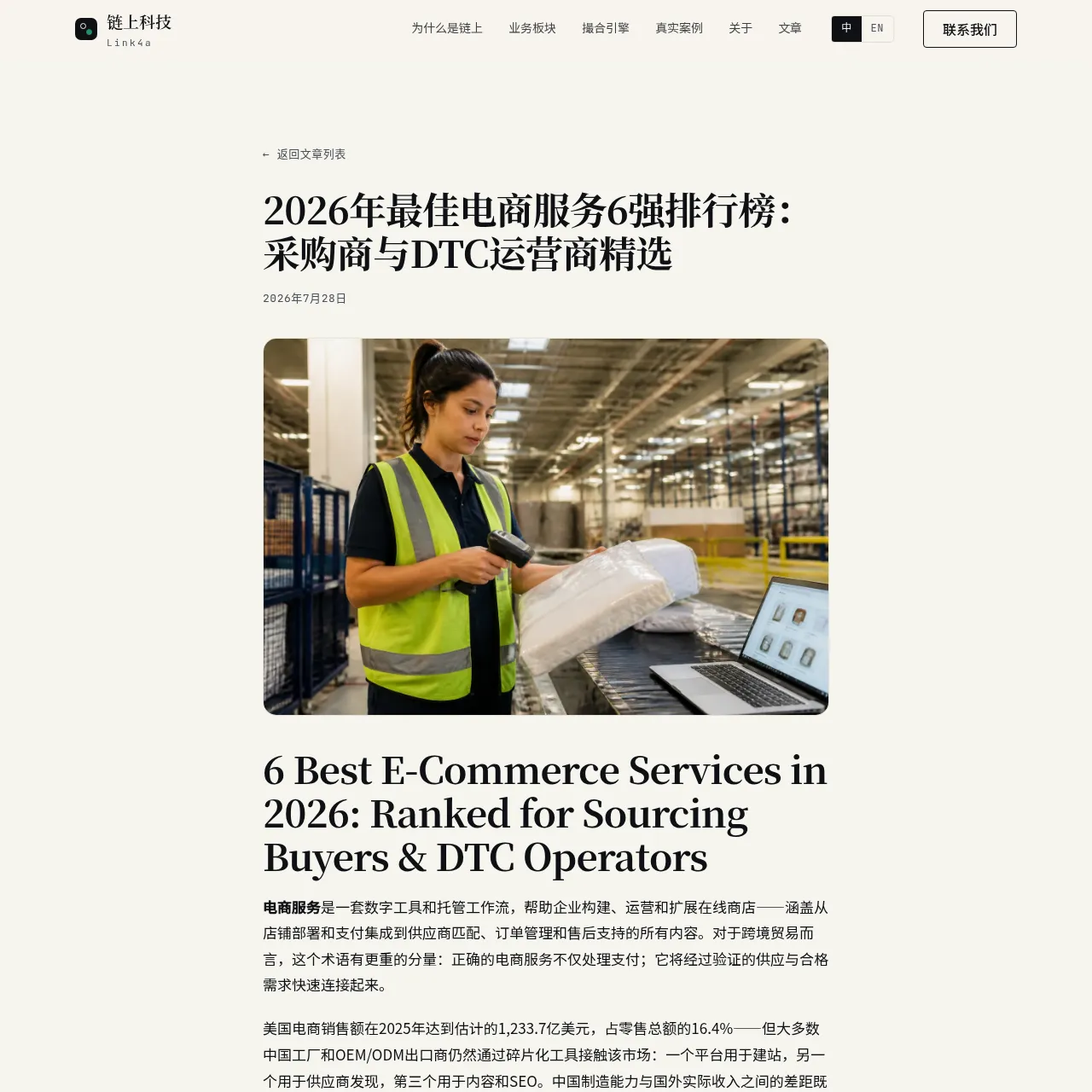
Link4a's AI-native cross-border trade dashboard — storefront deployment, supplier matchmaking, and content distribution in one interface.
Link4a (链上科技) addresses the full cross-border trade stack rather than a slice of it. Built specifically for Chinese OEM/ODM manufacturers and the overseas buyers sourcing from them, it replaces a fragmented plugin workflow — separate tools for site building, lead generation, supplier discovery, and content distribution — with a single AI-native infrastructure layer. That architectural difference matters in practice: there's no middleware to stitch together and no certification or compliance data siloed in a vendor's separate module.
For factory operators, Link4a's Sitebox builder deploys a branded, SEO-ready storefront in under 30 minutes with no developer required. A Shenzhen hardware OEM, for example, can go from a product catalog spreadsheet to a live, indexed store in the same afternoon. The Inbox product handles 24/7 multilingual inquiries — a concrete answer to the sales cycle gap that kills cross-border deals when a US buyer submits an RFQ at 9 PM EST and gets a response three days later. The Match engine surfaces verified supplier-buyer pairs in an average of 3 seconds, compressing an RFQ process that typically runs days over Alibaba or email chains. Reach, the content engine, handles social distribution, SEO, GEO signals, and outbound lead-mining in a single automated loop — eliminating the manual overhead that typically requires separate tools for each channel.
For sourcing buyers and DTC operators — including TikTok creators building product lines backed by verified Chinese supply — the platform provides direct access to 300+ verified factories behind 1,400+ live storefronts. Supplier credibility signals are baked into the discovery layer, not bolted on afterward, which changes how procurement evaluation works: buyers can assess factory capacity and certification status before the first message is sent.
Where most platforms manage an existing store, Link4a builds the supply-demand connection from scratch. If you want a full picture of how it compares to other e-commerce services, the 6 Best E-Commerce Services in 2026 comparison is a useful starting point; for real-world B2B platform benchmarks, see B2B E-Commerce Examples: 6 Platforms Exporters Actually Use.
Key Features:
- Sitebox — brand-to-live storefront in under 30 minutes, no dev required, SEO-ready out of the box
- Inbox — 24/7 multilingual AI inquiry handling; eliminates time-zone gaps in the sales cycle
- Match — 3-second supplier-buyer matchmaking engine with verified factory profiles
- Reach — omni-channel content engine: social, SEO, GEO, and outbound lead-mining in one loop
Best For: Chinese OEM/ODM manufacturers going direct-to-global; overseas sourcing buyers who need verified factory access with credibility signals built into discovery; DTC operators and TikTok creators sourcing from Chinese supply chains who want a single infrastructure layer rather than a plugin stack.
2. Reddit Community Discussion — r/ecommerce (UGC Thread)

The r/ecommerce thread where practicing managers share their real toolstacks and operational pain points.
This r/ecommerce thread — titled around the question of what ecommerce managers actually do day-to-day — ranks at the top of search results for the keyword and captures a specific, important audience: buyers and operators who are still defining the scope of what ecommerce management means before committing to a platform or service. That's the meaning of informational search intent in practice.
The thread's competitive relevance for anyone evaluating tools here is indirect but real. Practitioners in UGC discussions name the specific pain points that platforms need to solve: catalog management at scale, cross-border inventory sync, multi-SKU handling across marketplaces, MOQ thresholds that break fulfillment workflows. The signal isn't the platform — it's the operational language that experienced ecommerce managers use when describing their work. For sourcing buyers evaluating Chinese supply chains, threads like this surface concrete benchmarks: what tools peers use for order management, how they handle supplier coordination, what they wish they'd known about certification requirements before onboarding a new factory.
Key Features:
- Crowdsourced practitioner insights from active ecommerce managers, unfiltered by vendor positioning
- Peer-to-peer Q&A format covering real operational pain points: catalog, fulfillment, analytics, supplier coordination
- Organic keyword signals — the tools, workflows, and responsibilities named by practitioners reflect actual market usage
Best For: Sourcing buyers researching what day-to-day ecommerce operations look like before hiring, outsourcing, or selecting software. DTC operators who want to benchmark their own store workflows against peers managing similar inventory and channel mixes.
3. Extensiv (3PL WMS + Order Management Suite)
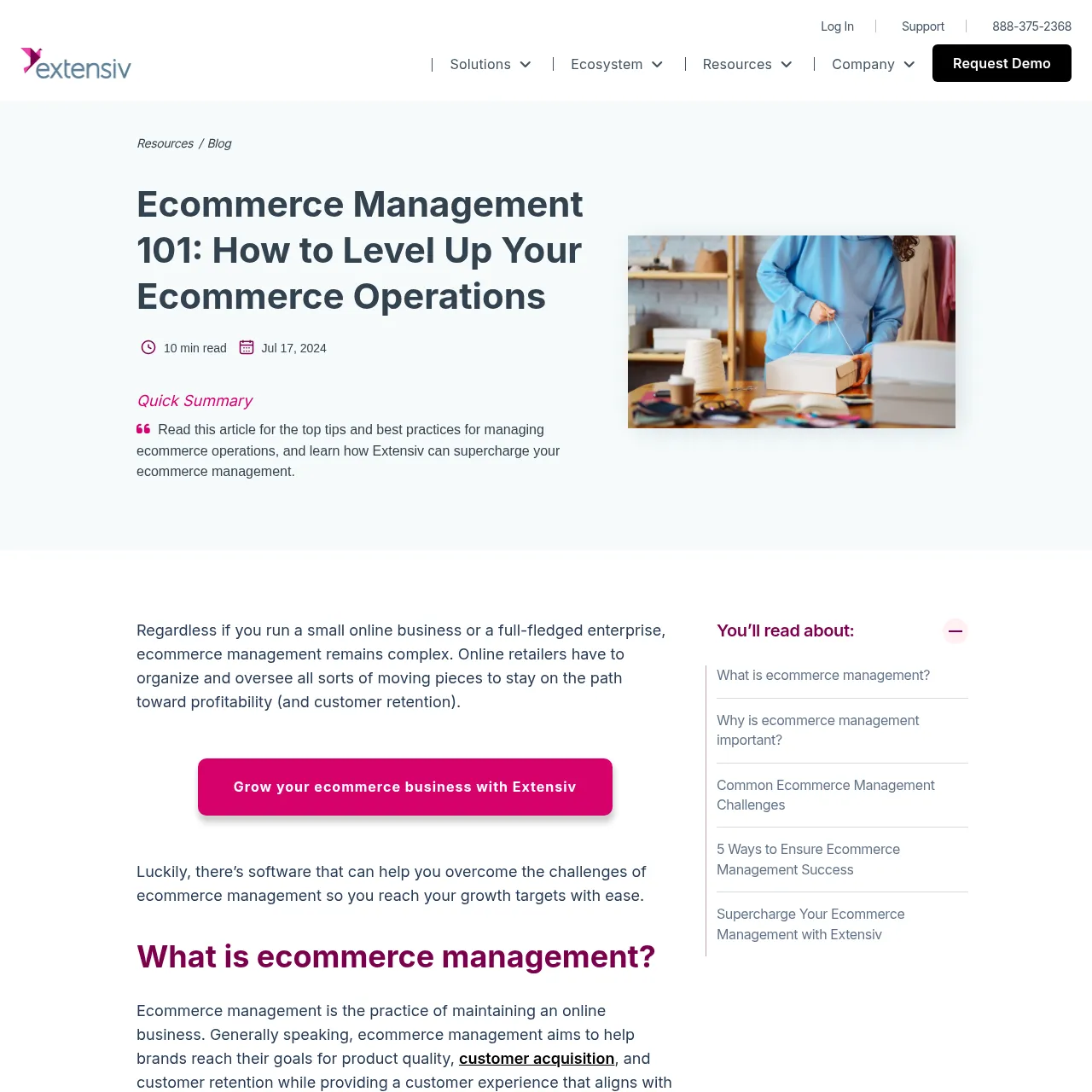
Extensiv's warehouse and order management dashboard — purpose-built for 3PL operators handling multi-client fulfillment.
Extensiv sits at the fulfillment layer of ecommerce management, not the sourcing layer. Published in its foundational coverage in July 2024, Extensiv's ecommerce management platform covers inventory, order management, shipping, and billing under one roof — a meaningful consolidation for 3PL operators who previously stitched together separate WMS, OMS, and carrier tools. For overseas sourcing buyers and DTC operators shipping China-origin goods into the US, this is where those products land once they've cleared customs: Extensiv handles receiving, multichannel order routing, carrier rate shopping, and 3PL client billing.
The Smartscan barcode scanning hardware integration speeds physical receiving and putaway, reducing labor cost on the warehouse floor — a specific operational detail that matters when you're receiving a 1,000-unit container from a Chinese supplier and need to reconcile actual quantities against the packing list. The Network Management module (their 4PL capability) supports brands scaling across multiple US 3PL partners simultaneously, enabling inventory balancing across warehouse nodes. Extensiv AI adds AI-assisted warehouse operations on top of the existing stack.
Extensiv does not address upstream supply chain — factory MOQ, lead times, Chinese logistics, or supplier vetting. It's a downstream counterpart to sourcing-side tools, which makes it a complement rather than a substitute for platforms like Link4a.
Key Features:
- Real-time inventory visibility across multi-warehouse / 3PL networks
- Multichannel order routing and fulfillment automation
- Small Parcel Suite with carrier rate shopping
- 3PL-specific billing and accounting automation
- Smartscan barcode integration for receiving workflows
- Extensiv AI for warehouse operations
- 4PL Network Management for multi-node orchestration
Best For: DTC brands outsourcing US fulfillment to a 3PL who need multichannel order visibility across Shopify, Amazon, and Walmart simultaneously. 3PL warehouses managing inventory, billing, and shipping for multiple ecommerce brand clients. Importers needing structured receiving workflow management at the dock when China-origin goods arrive.
4. DBMANAGERS Ecommerce Management Services
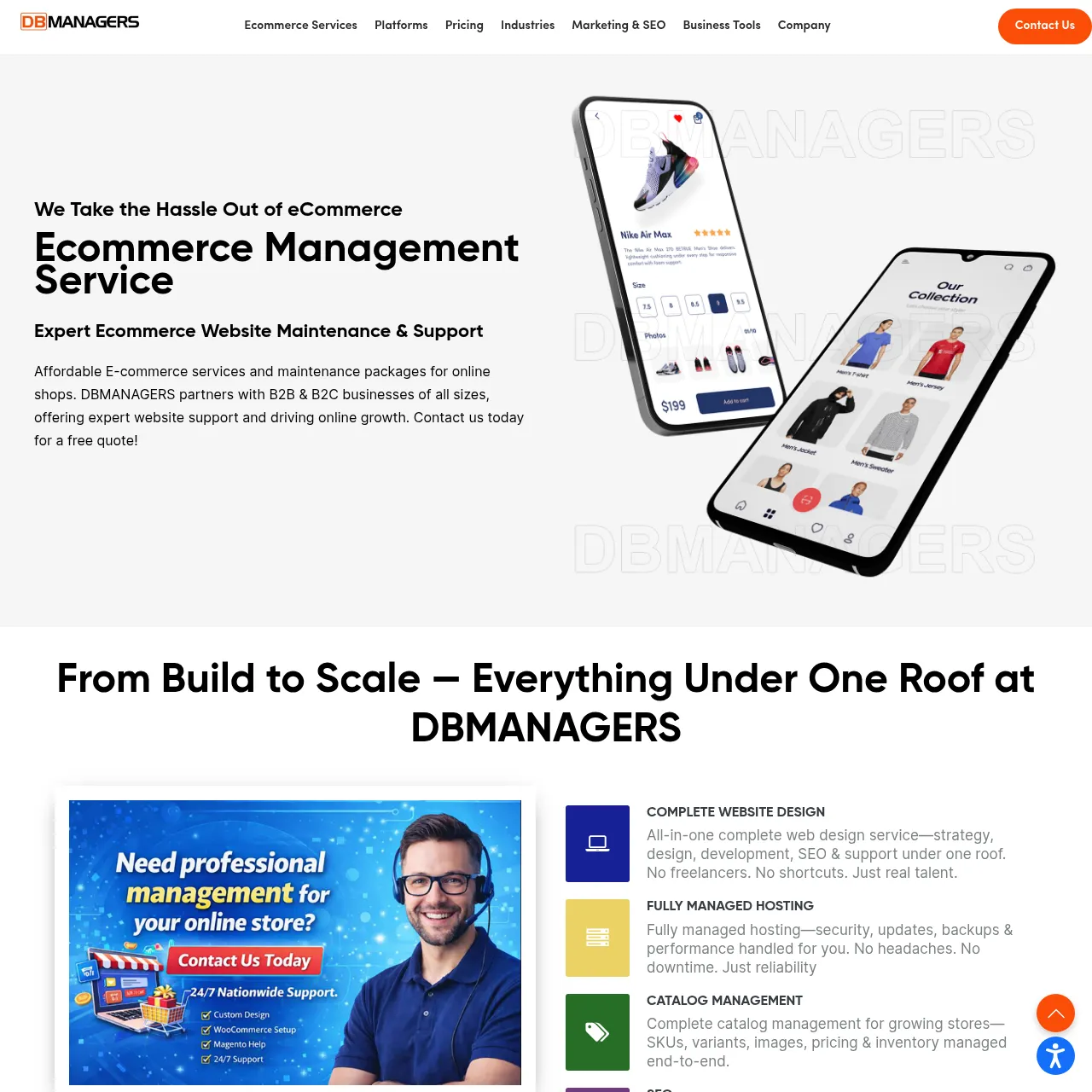
DBMANAGERS' service page — full-cycle ecommerce agency covering Magento development, managed hosting, and ongoing catalog management.
DBMANAGERS is an agency model, not a SaaS platform — that distinction matters for procurement evaluation. Their core business offer is retainer-based website management and ongoing support, which means pricing is project- or retainer-based with no published MOQ equivalent. For merchants who have already built on Magento (Adobe Commerce) and need a managed-services partner rather than another tool subscription, DBMANAGERS covers the full platform lifecycle: development, managed hosting, migration from Magento 1 to 2, and dedicated support.
The Magento specialization is the clearest differentiator in the field. Magento is an expensive, technically demanding platform that most merchants can't operate without a dedicated developer or an agency relationship. DBMANAGERS' catalog data management service line signals they serve SKU-heavy merchants — likely wholesale operators, B2B sellers, or multi-channel brands with large product assortments that require structured data handling. Their proprietary tools, DBM RankWatch (rank tracking) and DBM LocalWatch (local SEO monitoring), are bundled add-ons that create stickiness beyond pure development work, though they're lightweight compared to dedicated SEO platforms.
Key Features:
- Full-service ecommerce website management and ongoing support on retainer
- Magento lifecycle coverage: development, management, managed hosting, support, migration (1→2)
- WooCommerce design services
- Catalog data management for SKU-heavy merchants
- B2B ecommerce development as a distinct service line
- Proprietary DBM RankWatch and DBM LocalWatch tools
Best For: Mid-market and enterprise merchants locked into Magento who need a managed-services partner rather than an in-house dev team. B2B operators requiring custom ecommerce builds with ongoing catalog and data management support — particularly those with complex product assortments that require structured data handling at scale.
5. Indeed UK – 'What is eCommerce Management?' (Career Advice Article)
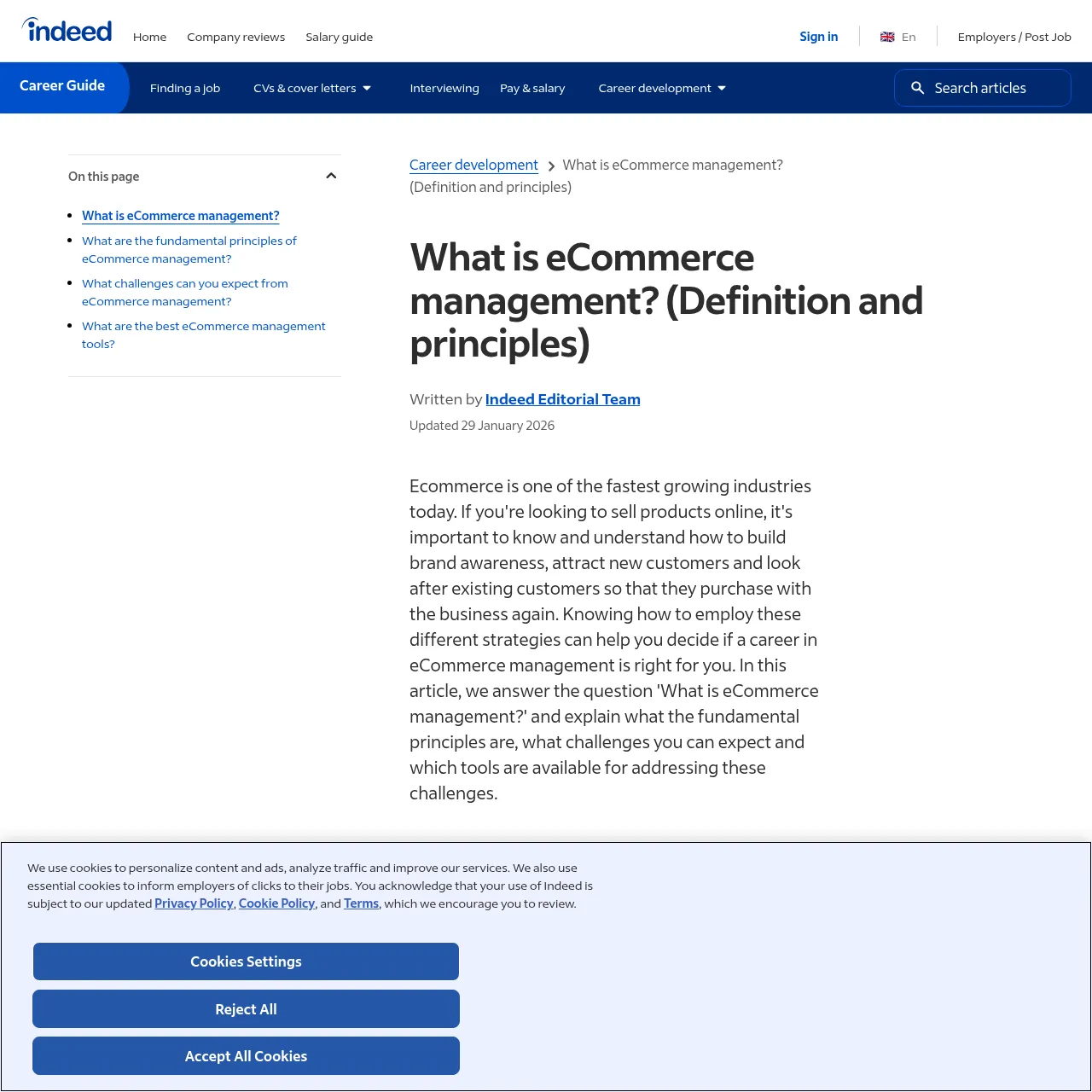
Indeed UK's career-development article defining ecommerce management roles, responsibilities, and scope — last updated January 2026.
This Indeed UK article — last updated January 2026 — ranks on the strength of Indeed's domain authority for "what is ecommerce management" informational queries. Its value for buyers and operators is primarily definitional: it establishes the scope of the discipline before someone commits to a platform or hire.
The article's framing is instructive for anyone building a procurement checklist. It identifies the core responsibilities of ecommerce management as covering product lifecycle planning, marketing budget management, pricing and discounting strategy, logistics coordination, customer acquisition, and retention. It also states that ecommerce managers work closely with buyer and logistics teams to source high-quality materials and products — a point directly relevant to DTC operators managing Chinese supply chains, where the ecommerce manager is often also the de facto sourcing manager.
The practical gap in this content: it doesn't go beyond definitions. For overseas sourcing buyers evaluating Chinese supply chains, the decision-relevant details are further downstream — factory MOQ thresholds, lead-time benchmarks, certification requirements (CE, FCC, RoHS, etc.), and logistics options like bonded warehouses. Generic career-advice content stops well short of those specifics. That gap is where purpose-built platforms and tools earn their place in the stack.
Key Features:
- Conceptual breakdown of ecommerce management as a business discipline
- Coverage of core operational areas: inventory, logistics, customer experience, platform operations
- Career-development framing — roles, responsibilities, and required skills
- UK-market operational standards and terminology
Best For: Job seekers and hiring managers defining ecommerce management roles before writing a job description or onboarding a new hire. Early-stage DTC operators mapping out what operational functions ecommerce management covers before building a team or selecting their first platform.
6. FluentCart
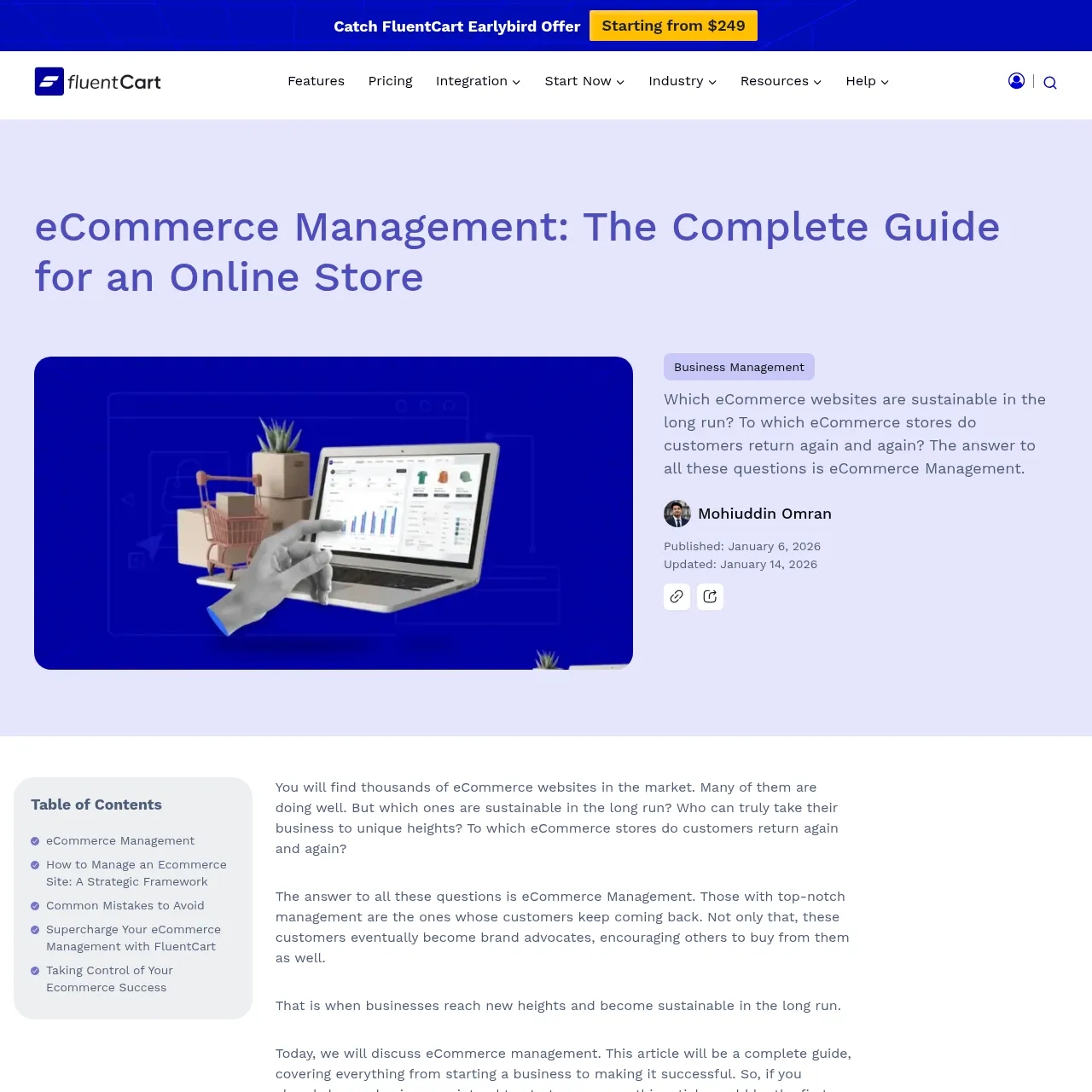
FluentCart's WordPress-native ecommerce dashboard — cart, CRM, affiliate, and support tooling in one plugin suite.
FluentCart is a WordPress-native ecommerce plugin competing in ecommerce management by bundling cart, order, and product management with a tightly integrated business suite. Its January 2026 guide positions it against WooCommerce extensions and SureCart as a lower total-cost-of-ownership alternative for stores that don't need Shopify's ecosystem — with an earlybird price point positioning it as a one-time or annual purchase rather than a monthly SaaS subscription.
The 132+ webhooks and REST API are the technical differentiator. For DTC operators who need automation pipelines — triggering 3PL fulfillment on order events, syncing inventory to supplier portals, or firing post-purchase CRM sequences — webhook coverage determines whether the platform fits into an existing stack without custom middleware. The native integration with FluentCRM, FluentAffiliate, and FluentSupport is the other concrete differentiator: one vendor covers email marketing, affiliate payouts, and customer support tickets alongside the core store, which reduces integration overhead for lean teams.
The gap for sourcing-heavy operators: FluentCart's current feature set shows no depth on inventory management across multiple warehouses, supplier-side purchase order tooling, or multi-currency/cross-border compliance. For DTC operators managing Chinese supply chains directly — tracking inbound shipments, managing factory POs, handling import documentation — FluentCart would need supplementing with purpose-built supply chain tools.
Key Features:
- 132+ webhooks for granular event-driven automation across order, inventory, and customer lifecycle
- Native FluentCRM integration for email marketing and customer segmentation
- FluentAffiliate integration for affiliate program management alongside direct sales
- FluentSupport integration for customer ticket management
- REST API access for headless and custom commerce builds
- Modular addon architecture for extending store functionality
Best For: WordPress-based DTC stores needing an all-in-one commerce + CRM + affiliate stack without Shopify's monthly fees. Online store operators managing affiliate channels alongside direct sales who want FluentAffiliate and FluentCart running under the same vendor and data model.
How to Evaluate Ecommerce Management Tools Before Committing
Before reaching out to any platform or service provider, sourcing buyers and DTC operators building on Chinese supply should run through five procurement criteria that separate platforms that look complete from ones that actually are:
1. Supply chain scope — Does the platform address upstream sourcing (factory vetting, MOQ, lead times, certification status) or only downstream fulfillment? Most Western-market platforms start at the warehouse, not the factory floor. Ask explicitly: what does the supplier verification process look like, and what certification data is surfaced before the first contact?
2. Inquiry handling SLA — Cross-border sales die in the time-zone gap. What is the platform's approach to 24/7 multilingual inquiry response? If it's a human-dependent process, get a real SLA commitment in writing.
3. Storefront deployment timeline — For factory operators going direct-to-global, weeks of development time is a hard cost. Platforms that claim rapid deployment (Sitebox's 30-minute benchmark is an example) should be verified against your specific catalog complexity and certification documentation requirements.
4. Certifications and compliance integration — If your products require CE, FCC, RoHS, or other certifications for the target market, confirm whether the platform surfaces these in the supplier discovery layer or requires manual documentation on each deal.
5. Channel coverage — Ecommerce management that only addresses one channel (marketplace listings, or only direct-to-consumer) creates gaps that require additional tools. Evaluate whether SEO, social, GEO, and outbound lead-mining are handled inside the platform or require separate subscriptions.
The platforms above cover different slices of ecommerce management — from fulfillment-layer WMS tools (Extensiv) to agency-managed storefronts (DBMANAGERS) to WordPress plugin suites (FluentCart). None of the alternatives addresses the full cross-border trade stack from supplier discovery through storefront deployment and ongoing demand generation.
If you're a Chinese factory operator or an overseas buyer evaluating supply-side infrastructure, the concrete next step is to request current MOQ, lead-time, and capability details directly. Request a demo or get MOQ & pricing at link4a.com — the platform is built for buyers who want verified supply-demand connections, not another plugin to manage.