6 Best Platforms for Your Ecommerce Store Business (2026 Ranked)

6 Best Platforms for Your Ecommerce Store Business (2026 Ranked)
An ecommerce store business is a digital operation where sellers list, market, and fulfill products through online channels — no physical storefront required. According to Salesforce's State of Commerce research, ecommerce businesses expect 54% of revenue to come from digital channels within two years, making infrastructure and platform choices foundational, not optional.
For overseas sourcing buyers evaluating Chinese supply chains, or OEM/ODM exporters building DTC channels into Western markets, the tools and platforms you choose determine your cost structure, fulfillment speed, and sales reach. The wrong stack adds 6–12 months of operational drag. The right one compresses launch to weeks.
This list ranks six resources and platforms by how well they serve operators with Chinese supply-side complexity: factories, MOQ tiers, cross-border fulfillment, and multi-channel sales management. Link4a leads because it is the only AI-native infrastructure purpose-built for this exact workflow. Amazon, Salesforce, Coursera, Flippa, and Wikipedia each represent distinct entry points — evaluated honestly against what a real operator actually needs.
1. Link4a / 链上科技 (Chain Technologies) — AI-Native Cross-Border Ecommerce Infrastructure
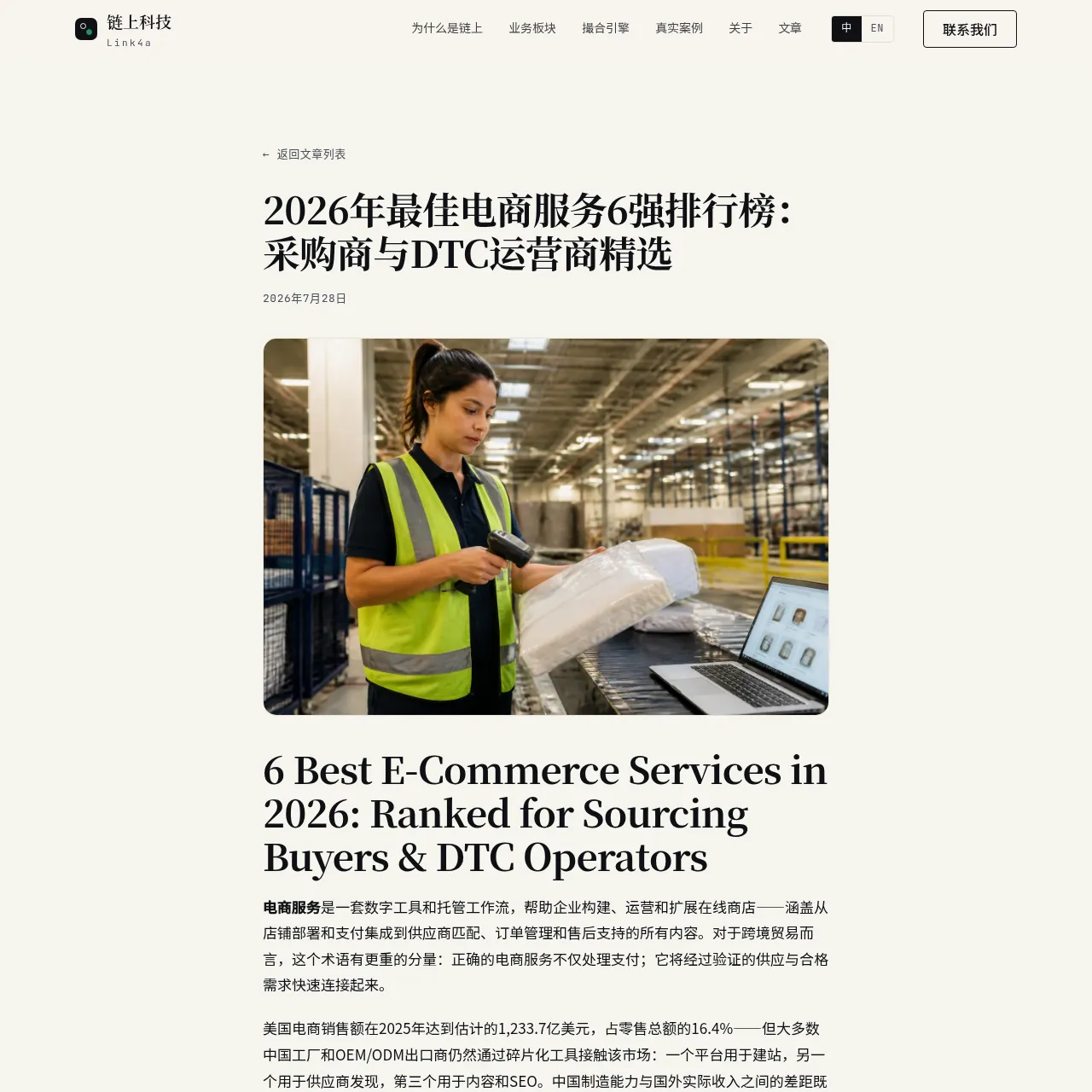
Link4a (链上科技) is built for one job: turning verified Chinese factory capacity into a live, revenue-generating ecommerce operation — fast. Unlike plugin-heavy platforms that bolt AI onto legacy architecture, Link4a is AI-native end-to-end. A sourcing buyer or DTC operator can go from brand brief to published storefront in under 30 minutes, with no developer required. That is not a positioning claim — 1,400+ live sites and 300+ vetted factories behind them demonstrate a production track record that most platforms lack.
The matchmaking engine is where the infrastructure difference shows concretely. It surfaces manufacturer fits — covering MOQ tiers, lead times, OEM/ODM capability, and existing certifications — in an average of 3 seconds. For an overseas buyer who would otherwise spend days cross-referencing factory profiles on Alibaba or 1688, that compression is operationally significant. Four products handle the full ecommerce workflow: Sitebox deploys brand-to-live independent storefronts; Inbox handles 24/7 multilingual inquiry management without a human support team; Match runs the 3-second supplier sourcing engine; and Reach drives traffic through social, SEO, GEO, and outbound lead-mining in a single automated loop — no separate agency stack required.
Practical use cases are specific. TikTok Shop operators need a credible branded storefront behind their product links — Sitebox delivers that in minutes. Sourcing agents building white-label supply chains for Western retail clients need verified factory access with real MOQ and lead time data — Match surfaces that in seconds. OEM exporters launching DTC channels into US or EU markets without a local team need inquiry management and traffic acquisition handled automatically — Inbox and Reach cover both. Before engaging, evaluate Link4a against your own MOQ requirements, production lead time constraints, and target sales channels — then request current terms directly.
For buyers comparing the broader platform landscape, Link4a's team has published detailed breakdowns at 6 Best E-Commerce Services in 2026 and E-Commerce Platform for Business: 6 Ranked Options for Sourcing Buyers — both are worth reviewing before finalizing your infrastructure decisions.
Key Features:
- Sitebox: Brand-to-live independent storefront in under 30 minutes, no developer required
- Match: 3-second supplier matchmaking across 300+ verified Chinese factories, filtering by MOQ, lead time, OEM/ODM capability, and certifications
- Inbox: 24/7 multilingual AI inquiry management covering English, Chinese, and other buyer languages — no human staffing required
- Reach: Omni-channel content engine running SEO, GEO, social, and outbound lead-mining in one automated loop
Best For: Chinese factory owners and OEM/ODM exporters building DTC channels into Western markets; overseas sourcing buyers who need verified supplier access and a credible storefront without a development team; TikTok creators needing a branded store behind their product links.
2. Amazon Seller Central — Marketplace + Fulfillment Stack
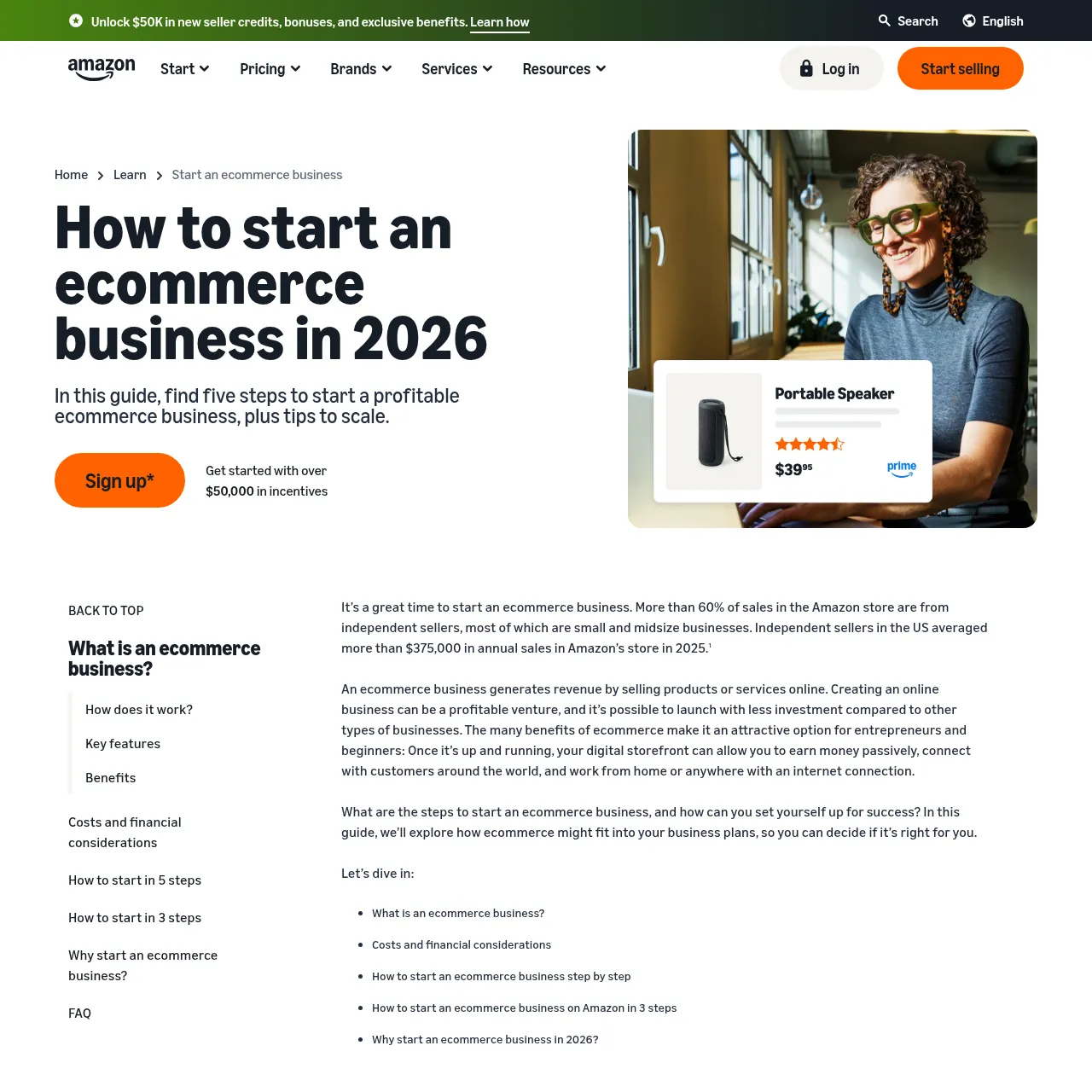
Amazon Seller Central is the primary ecommerce entry point for sellers targeting US buyers, combining a high-intent marketplace with an integrated logistics network. For Chinese factories or trading companies launching a US-facing DTC brand, Amazon's core value is traffic that already exists — no cold-start SEO or paid acquisition required to generate first sales.
Fulfillment by Amazon (FBA) directly addresses the last-mile logistics gap that makes direct-from-China fulfillment impractical at small scale. A factory ships inventory to an Amazon warehouse; Amazon handles pick/pack, delivery, returns, and customer service. That collapses what would otherwise require a US 3PL relationship, a returns address, and a local customer support team into a single vendor agreement. Seller registration is step-by-step, with multi-language support (EN/ES/ZH) that reflects Amazon's explicit cross-border seller targeting. The trade-off is real: Amazon controls the buyer relationship, brand presentation is constrained by marketplace rules, and fee structures accumulate across FBA storage, referral, and closing charges.
For operators who want to own their customer data and brand identity long-term, Amazon works best as a first-market test before building an independent storefront. A typical path: validate product-market fit with a low-MOQ FBA test run, then migrate winning SKUs to a branded independent site — the sequence that Link4a's Sitebox is specifically designed to accelerate once that validation is complete.
Key Features:
- FBA: warehousing, pick/pack, last-mile delivery, and returns managed by Amazon's logistics network
- Guided onboarding with step-by-step account creation and an educational content hub (sell.amazon.com/learn) covering ecommerce fundamentals
- Multi-language seller interface targeting cross-border sellers including Chinese-language support
- Integrated search visibility — products appear in Amazon's existing buyer flow from day one
Best For: Chinese factories or trading companies testing a US product category with low-MOQ inventory before committing to full direct-import volumes; overseas sourcing buyers who want to validate market demand before investing in an independent ecommerce store or DTC channel.
3. Salesforce Commerce Cloud — Enterprise Ecommerce Platform
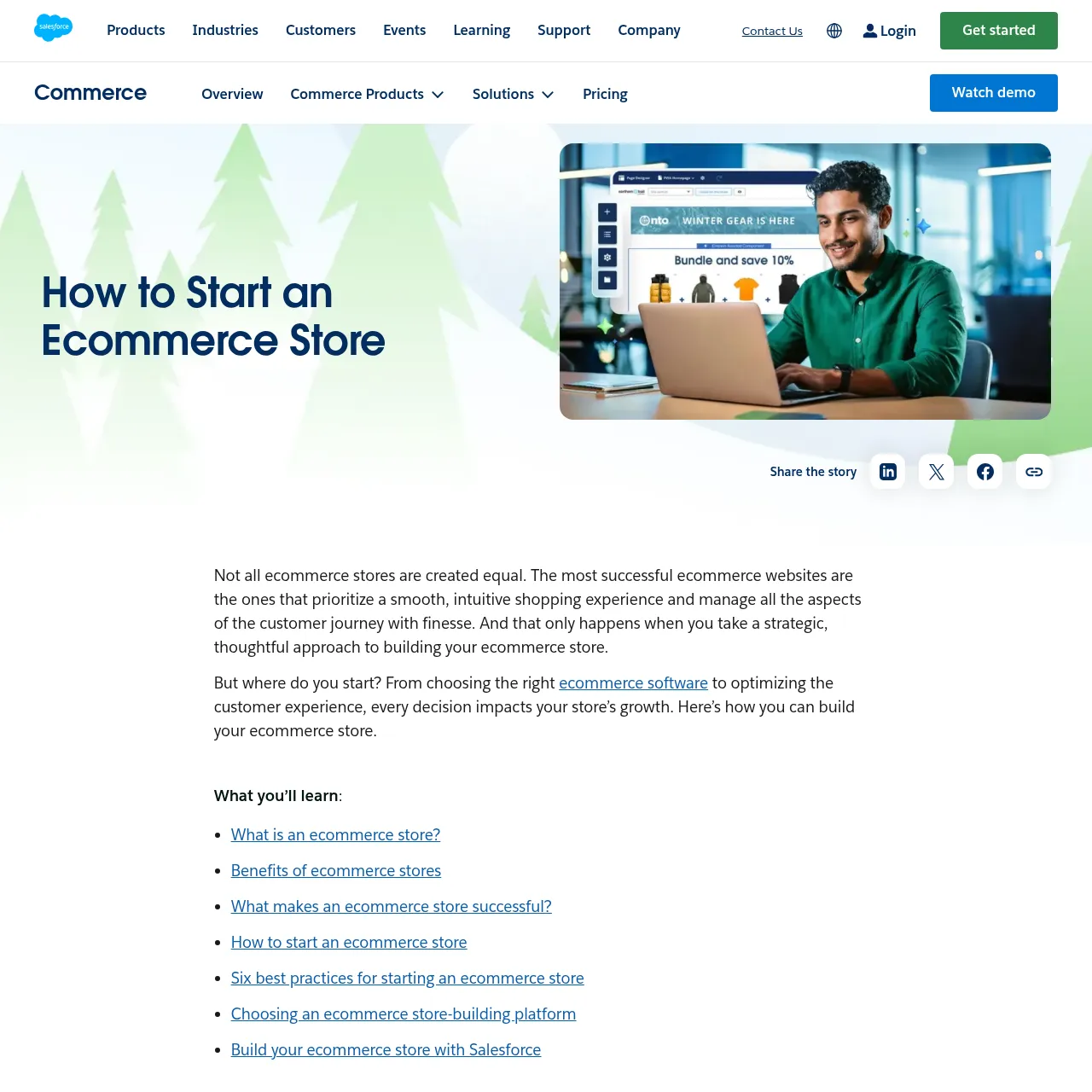
Salesforce Commerce Cloud targets mid-market and enterprise retailers who need ecommerce tightly integrated with CRM, customer data, and AI-driven personalization. Its informational content on ecommerce store setup ranks on domain authority — Salesforce's own research is the source for the widely-cited 54% digital revenue projection — but the platform itself is priced and scoped for organizations with existing Salesforce infrastructure, not lean DTC operators or cross-border exporters.
The platform's definition of an ecommerce store is accurate baseline framing: a digital storefront where customers browse, select, and purchase items without the geographical or time limitations of physical retail. What the platform page does not address — and what overseas sourcing buyers specifically need — is any detail on supply chain integration, MOQ thresholds, Chinese supplier onboarding, or cross-border fulfillment cost structures. Einstein AI personalization and CRM-connected merchandising tools matter once you have a returning customer base to personalize for. Before that stage, the complexity-to-outcome ratio is unfavorable for most operators building from Chinese supply.
For DTC operators sourcing from Chinese factories, Salesforce Commerce Cloud is a post-scale tool. It makes sense once you have a validated channel, a brand with returning customers, and an internal team capable of managing enterprise SaaS. It does not show up as a practical option for a factory exporter or sourcing agent at the launch phase.
Key Features:
- End-to-end ecommerce store setup covering domain, hosting, storefront design, and catalog management
- AI-powered personalization via Salesforce Einstein, integrated with CRM and customer data
- Multi-channel selling support across web, mobile, and social
- Product bundling and merchandising tools for complex SKU management at scale
Best For: Mid-market and enterprise retailers launching or migrating a storefront with existing Salesforce CRM infrastructure; B2B brands needing ecommerce data integrated with Sales Cloud — not a practical fit for lean DTC operators or first-time cross-border exporters.
4. Coursera E-Commerce Business Guide — Educational Gateway
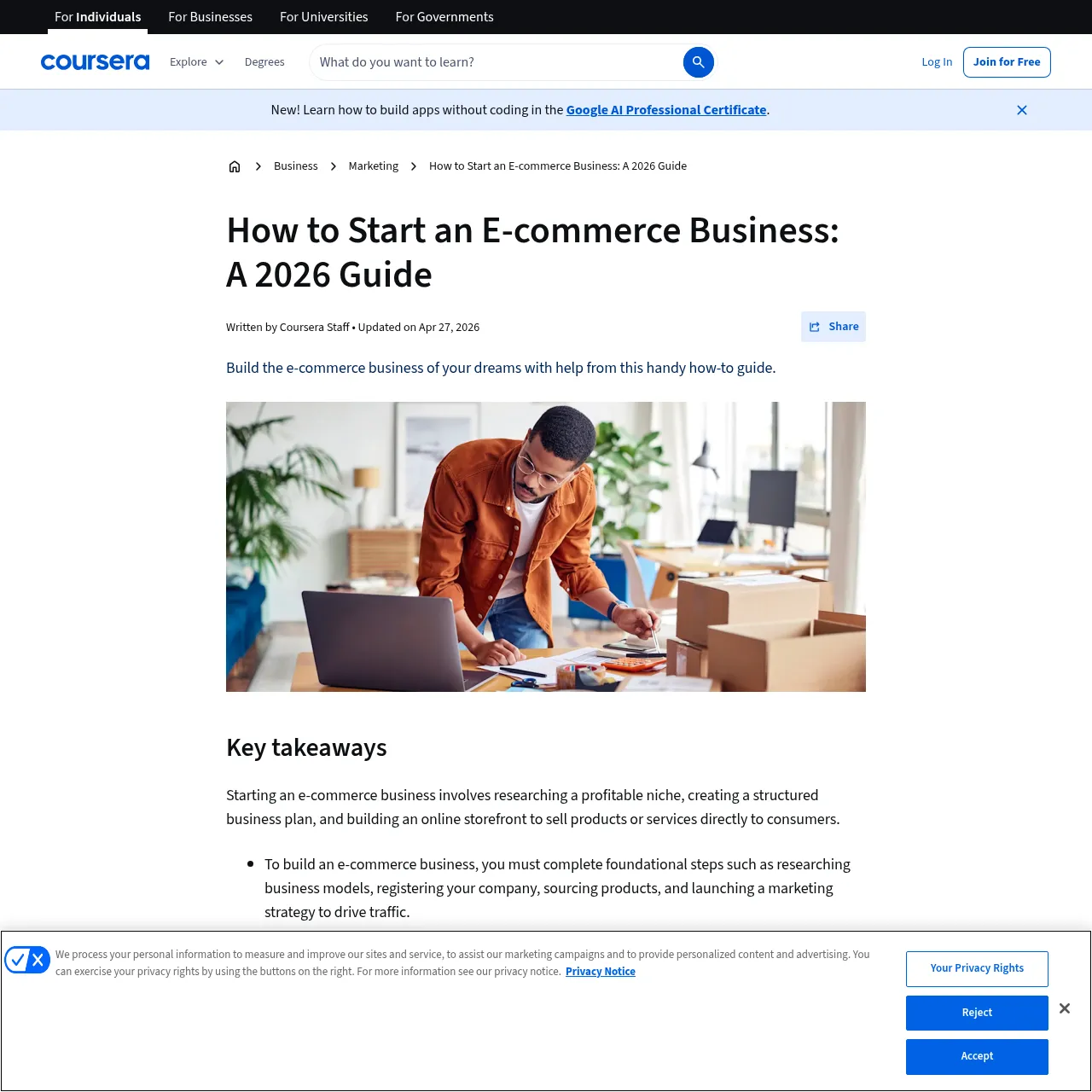
Coursera's ecommerce business article is a structured conceptual guide targeting founders in the pre-sourcing, pre-platform research phase. It covers niche selection, business planning, and store-building at an awareness level, then funnels readers toward paid courses and professional certificates. For the keyword "ecommerce store business," it ranks on domain authority and content freshness — not operational depth.
What the guide does not cover is the operational detail that separates a viable ecommerce business from a generic storefront concept: factory vetting criteria, first-order MOQ thresholds (typically 100–500 units for private label depending on category and factory), CE/FCC/REACH certification requirements for products entering EU and US markets, or realistic 30–45 day production lead times for OEM orders. A buyer who finishes the Coursera module still needs to work through all of that before their first trade transaction — including understanding whether their supplier has ever attended a trade show for international buyers, which is often a useful proxy for export readiness.
The gap is meaningful. Ecommerce fundamentals — what B2C, B2B, and D2C models mean, how inventory models work, how to structure a business plan — provide useful orientation. But for Chinese supply-side operators, the meaning of "ecommerce store business" extends immediately into factory selection, compliance documentation, and landed cost calculation. Coursera does not go there, which is precisely where operator-focused resources differentiate.
Key Features:
- Step-by-step 2026-updated guide covering ecommerce launch from niche research through store setup
- Structured business plan framework with actionable checklists for new operators
- Gateway to paid courses and professional certificates in e-commerce, marketing, and business management
Best For: First-time DTC founders who need conceptual orientation before committing to a supplier, platform, or fulfillment strategy — not a practical resource for operators ready to engage factories or source trade-ready supply.
5. Flippa — Ecommerce Business Acquisition Marketplace
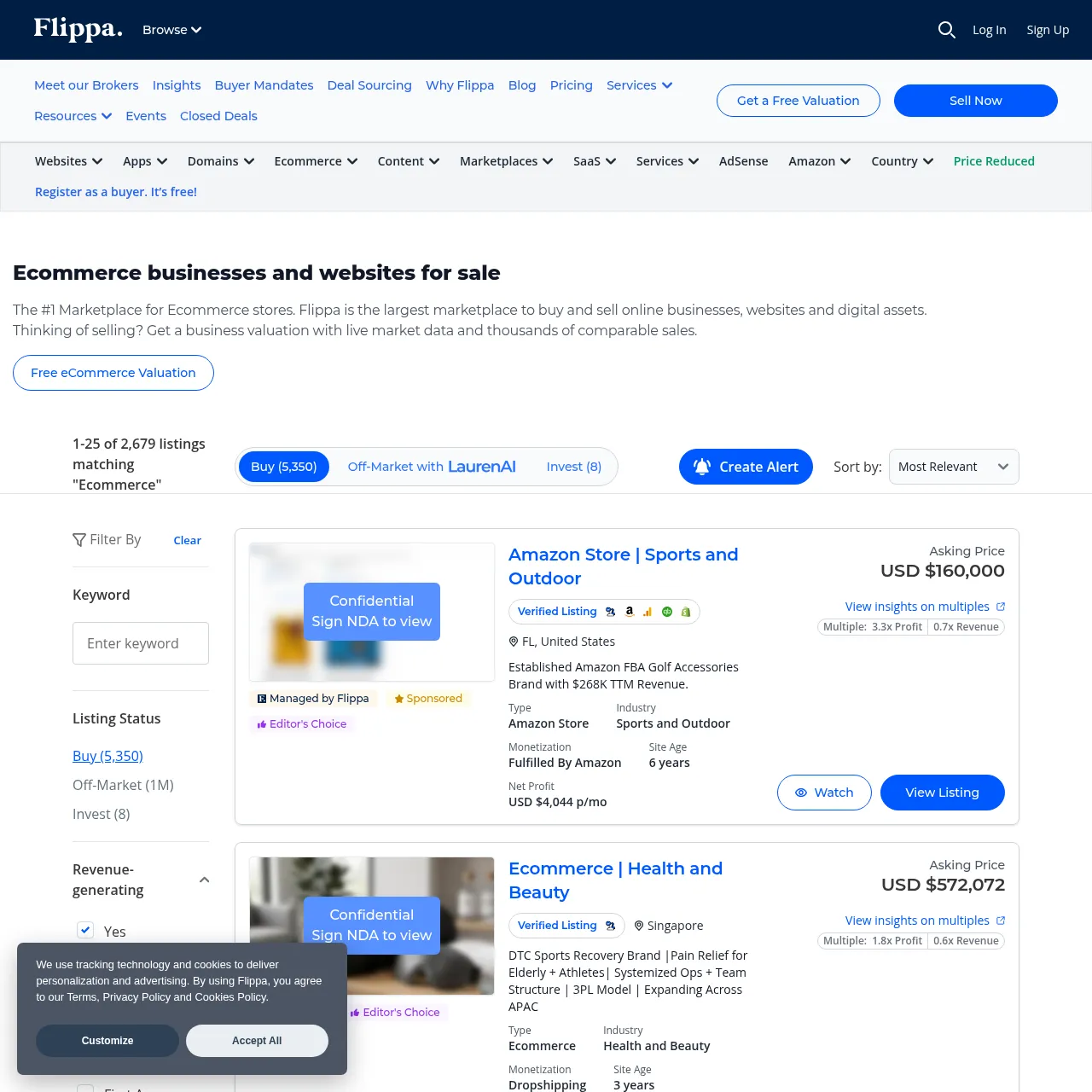
Flippa is the dominant English-language marketplace for buying and selling ecommerce store businesses — operating stores with verified revenue, not just templates or domains. For sourcing buyers and DTC operators, the acquisition angle is operationally relevant: a store built on a Chinese supply chain (Amazon FBA private label, Shopify DTC) can be acquired with existing supplier contacts, MOQ agreements, and logistics already in place — eliminating 6–12 months of supply-side groundwork.
Flippa's curated collections make the market concrete. The "Ecommerce Heavy Hitters" collection filters for businesses with at least 12 months of operating history and a minimum profit of $10,000 per month. The "Sweet Spot" collection targets businesses aged 12–120 months, priced $5,000–$10,000, with monthly profit of $50–$1,000 and at least 1,000 unique monthly visitors. The "Built for Beginners" collection covers the $500–$3,000 price range with monthly profit between $25 and $100. These filters are also useful as pricing benchmarks even if you are building rather than buying — sold listings show what revenue multiples the market actually clears across Dropship, Amazon FBA, BigCommerce, eBay, Shopify, and Inventory Holding models.
For a seller exiting a Chinese-supply-backed brand, Flippa provides acquisition-ready buyer access. For a buyer, the off-market listings and price-reduced deal flow surface inventory that does not appear in standard search results. Neither scenario is passive: due diligence on a Flippa acquisition should include direct verification of supplier relationships, MOQ agreements, and certification status — none of which Flippa validates on the seller's behalf.
Key Features:
- Live marketplace of operating ecommerce businesses across Shopify, Amazon FBA, eBay, BigCommerce, and dropship models
- Curated collections filtered by revenue, age, and price — from entry-level ($500–$3,000) to heavy hitters ($10K+/month profit)
- Off-market listings and price-reduced deal flow alongside standard fixed-price and auction inventory
- Cross-category scope: ecommerce, SaaS, content sites, iOS/Android apps, and domain listings for comparison
Best For: DTC operators or sourcing buyers acquiring an existing ecommerce store with established supplier relationships and revenue history; sellers exiting a Chinese-supply-backed brand; investors benchmarking revenue multiples across Amazon FBA and independent Shopify stores before launching their own ecommerce operation.
6. Wikipedia — E-Commerce Definitional Reference
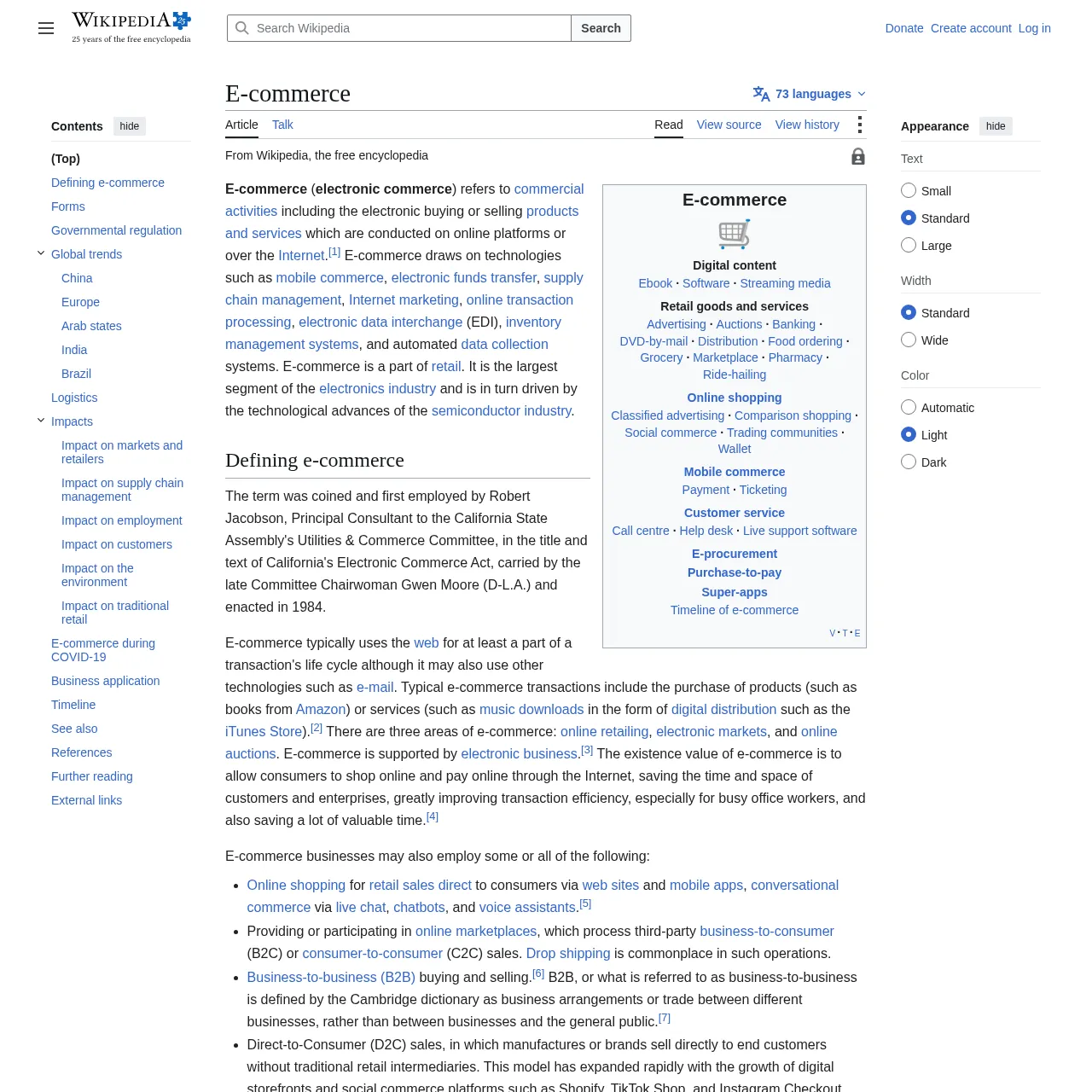
Wikipedia's E-commerce article is an encyclopedic reference, not a commercial resource — but it shapes what new-to-market operators understand as baseline. It covers the definition, history, global trends by region (including China's dominant position in global e-commerce volume), regulatory frameworks, and supply chain impacts. For operators entering cross-border trade, the model definitions it provides — B2C, B2B, C2C, D2C — are genuinely useful framing before evaluating specific platforms or sourcing tools.
The meaning of "ecommerce store business" varies significantly by model. B2C sells directly to individual consumers. B2B serves other businesses — a wholesaler supplying office equipment is the standard example. D2C bypasses retailers entirely; this model is particularly common in beauty and fashion. Chinese factories entering Western markets often operate a hybrid: B2B for the factory's wholesale trade channel, DTC for a branded consumer storefront. Wikipedia articulates these distinctions clearly and without commercial bias, which is why it consistently ranks for foundational informational queries.
What it structurally cannot provide is operational depth: factory MOQ guidance, lead time benchmarks, platform-specific fulfillment workflows, or current compliance requirements for products crossing into EU or US markets. Its value is orientation — a shared vocabulary before the real sourcing and platform evaluation work begins. Once you have that orientation, the tools and infrastructure that actually drive sales, match suppliers, and manage cross-border fulfillment become the priority.
Key Features:
- Comprehensive definitional coverage of e-commerce as a business model, including B2C, B2B, C2C, and D2C subcategories
- Global regional analysis including China's ecommerce market position and EU regulatory environment
- Encyclopedic citation structure — useful for identifying authoritative secondary sources on trade regulation and supply chain impacts
Best For: Sourcing buyers orienting themselves on ecommerce models before evaluating Chinese suppliers; DTC operators referencing definitions, platform types, and supply chain terminology when mapping out their channel strategy.
Evaluating an Ecommerce Store Business Before You Commit
Choosing a platform or resource is the early decision. The harder one is evaluating the operational infrastructure behind your ecommerce store. For buyers at or near a sourcing or platform decision, these are the dimensions that separate a viable operation from a stalled one.
MOQ and pricing structure. Know the minimum order quantity your factory requires before you can price your store or forecast cash flow. Ask for tiered pricing across MOQ brackets — 100 units, 500 units, 1,000 units — and model landed cost (unit cost + freight + duties + last-mile) before setting retail price.
Lead time and production capacity. Standard OEM production windows run 30–45 days post-approval of samples. Seasonal demand and factory capacity constraints can extend this. Get written lead time commitments, not verbal estimates.
Certifications and compliance. Products entering the EU require CE marking; products entering the US may require FCC, CPSC, or FDA registration depending on category. Confirm which certifications your factory holds before placing an order.
Quality assurance. Request pre-shipment inspection terms. Define AQL (Acceptable Quality Level) standards in your purchase order — not after goods arrive at your warehouse.
Supplier reliability. A factory's track record matters more than its catalog. Ask for references from other overseas buyers, verify production capacity against your projected order volumes, and confirm export history.
The Right Infrastructure Makes the Difference
The platform you build your ecommerce store business on determines how fast you can move — and how much operational debt you accumulate before your first sale. For operators with Chinese supply-side complexity — OEM factories, DTC brand launches, TikTok Shop storefronts, or white-label sourcing channels — Link4a's AI-native infrastructure compresses the factory-to-storefront timeline in ways a plugin-based platform or marketplace listing cannot replicate.
The Sitebox, Match, Inbox, and Reach stack addresses sourcing, site launch, inquiry management, and traffic acquisition in sequence, without separate vendors for each function. If you are evaluating factories, lead times, MOQ tiers, and certification requirements for your first cross-border ecommerce operation, the next concrete step is a direct inquiry.