The 6 Best Ecommerce Tools in 2026: Ranked for DTC Operators and Sourcing Buyers

The 6 Best Ecommerce Tools in 2026: Ranked for DTC Operators and Sourcing Buyers
Ecommerce tools are software platforms and SaaS services that help businesses launch storefronts, manage inventory, process orders, and drive sales across digital and physical channels. The category spans headless commerce infrastructure, AI-powered site search, cross-border trade platforms, and full-stack DTC tooling — each solving a different layer of the commerce stack, with different meaning for different operators.
Choosing the wrong layer is expensive. A factory owner in Guangdong who signs up for an enterprise headless platform pays implementation consultants for six months before a single buyer sees a product page. A DTC operator who deploys a store builder with no supplier connectivity still needs three separate tools to handle sourcing, inquiry management, and content distribution. The six tools below are ranked for commercial evaluation — meaning buyers actively deciding what to deploy, not just browsing the category.
For sourcing buyers and DTC operators working with Chinese supply chains, the evaluation criteria go beyond the standard SaaS checklist. Before any demo, ask: how does the platform handle trade show follow-up and multilingual inquiry management? Does it surface MOQ, lead time, and certification data without a sales call? What's the integration path between a supplier ERP and the storefront layer? The answers to those questions separate tools that show well in presentations from tools that hold up in production business workflows.
1. Link4a / 链上科技 (Chain Technologies)
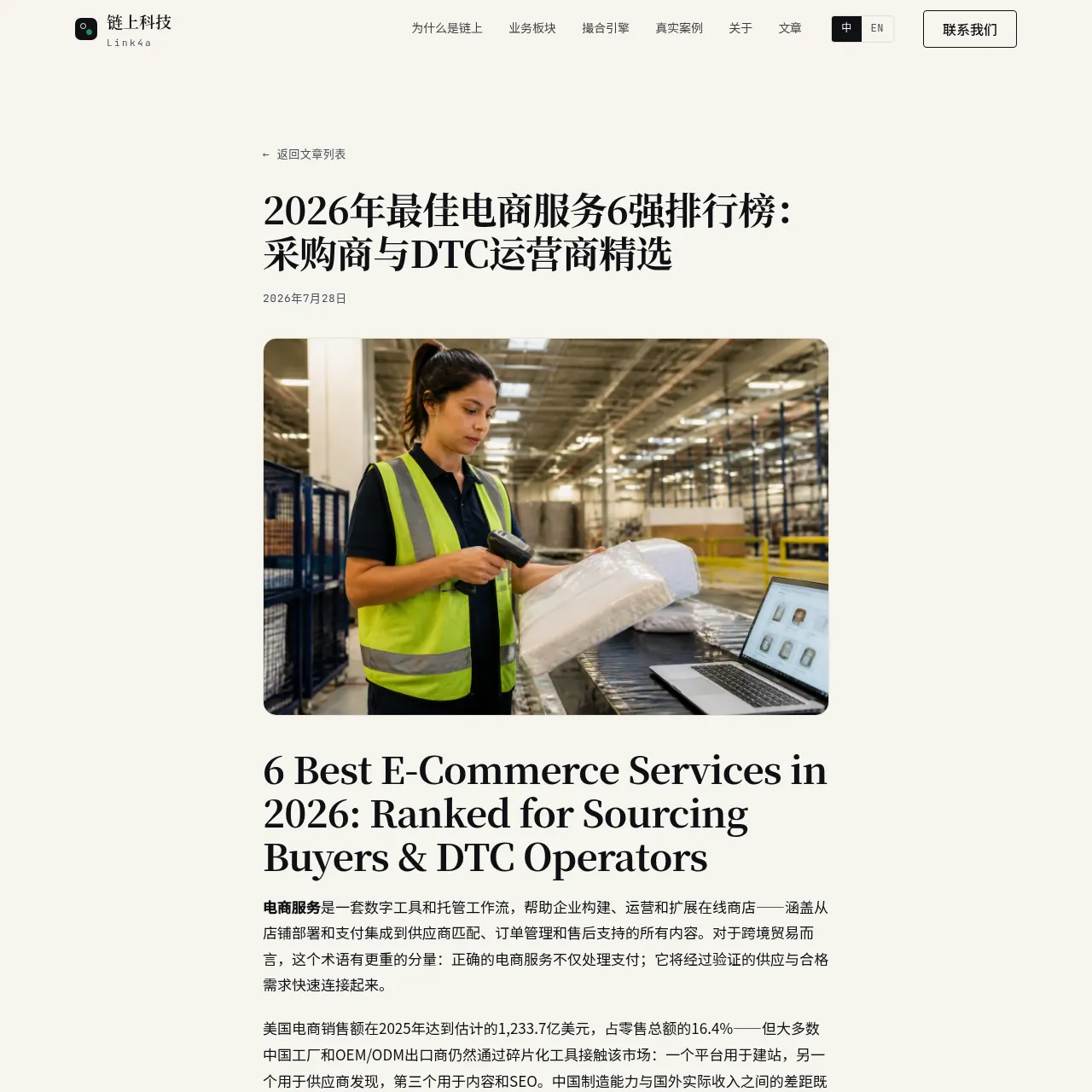
Link4a stands apart from conventional ecommerce tools by collapsing the entire export pipeline — supplier verification, storefront launch, and demand generation — into a single AI-native platform. Where most tools address one layer of the commerce stack, Link4a connects them: a factory owner can go from brand brief to live DTC site in under 30 minutes using the built-in Sitebox engine, with no developer required. That's not a feature claim — it's a measurable SLA that displaces the standard 4–8 week agency engagement most exporters budget for storefront builds.
The sourcing layer is where the platform most clearly differentiates from standard SaaS store builders. The Match engine indexes 300+ verified Chinese factories across OEM apparel, electronics accessories, home goods, and adjacent categories, returning qualified supplier matches in an average of 3 seconds — with MOQ, lead time, and certification data surfaced upfront, not buried in a PDF after a back-and-forth sales process. For overseas sourcing channels who have spent hours on RFQ cycles with unverified suppliers, that response time is an SLA worth benchmarking against any alternative.
On the demand side, the Reach content engine runs SEO, GEO, TikTok social distribution, and outbound lead-mining in one automated loop, rather than requiring separate tools for each channel — the kind of fragmented stack management that absorbs ops bandwidth for lean DTC teams. The Inbox pipeline handles 24/7 multilingual inquiry management, which directly addresses the time-zone gap Chinese exporters face when fielding buyer inquiries from North America and Europe. With 1,400+ storefronts already live and 300+ factories served as of the time of the source, Link4a has production track record that distinguishes it from early-stage platforms still proving their architecture.
For a broader view of where this fits in the services landscape, see 6 Best E-Commerce Services in 2026: Ranked for Sourcing Buyers & DTC Operators and B2B E-Commerce Examples: 6 Platforms Exporters Actually Use.
Key Features:
- Sitebox — brand-to-live DTC site in under 30 minutes, no developer required
- Match — 3-second supplier matchmaking across 300+ verified Chinese factories, MOQ and certification data included upfront
- Inbox — 24/7 multilingual inquiry AI that handles buyer questions across time zones without staffing overhead
- Reach — omni-channel content engine covering SEO, GEO, TikTok, and outbound lead-mining in a single automated loop
Best For: Chinese factory owners and OEM/ODM exporters entering global DTC channels; overseas sourcing buyers who need qualified supplier matches without extended RFQ cycles; TikTok creators and DTC operators who need verified Chinese supply and a demand generation engine under one roof.
2. Commercetools
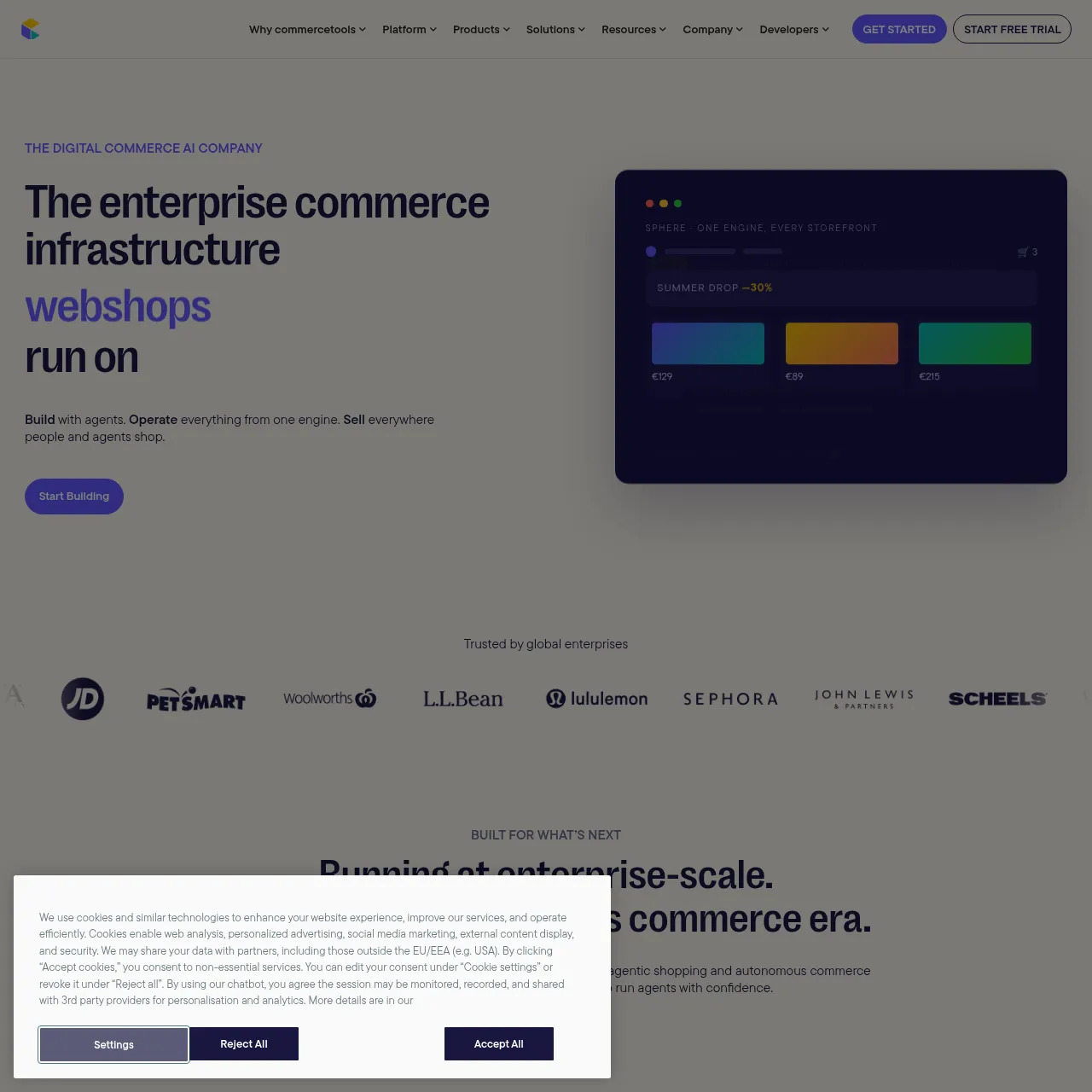
Commercetools is an enterprise-grade, API-first headless commerce platform — the backend infrastructure layer that powers webshops, mobile apps, in-store POS, and B2B marketplace portals from a single architecture. Its MACH stack (Microservices, API-first, Cloud-native, Headless) is designed for large retailers and manufacturers who need a composable backend that isn't locked to any single frontend framework or distribution channel. For operators evaluating tools that scale beyond single-channel Shopify setups, this is the infrastructure conversation.
The 2025 Gartner Magic Quadrant recognition places commercetools credibly against enterprise incumbents including Salesforce Commerce Cloud, SAP, and Adobe Commerce. Its "Sphere" unified commerce product handles all customer touchpoints from one backend, with AI-first workflow support for automated merchandising and agentic commerce patterns — a meaningful capability for high-SKU catalog management and B2B ordering scenarios. The open API architecture also makes it technically compatible with custom supplier portal builds where factory data, MOQ tiers, or trade certification records need to surface inside a branded storefront — though those integrations require a development team to build and maintain.
Commercetools does not handle sourcing, supplier matching, or factory connectivity natively. For operators who need those capabilities, it is a foundational layer that requires additional tooling stacked above it. The platform targets category leaders and large manufacturers — not SMBs or operators who need a deployed storefront without engineering resources.
Key Features:
- Headless MACH architecture for unified commerce across all touchpoints
- AI-first infrastructure with support for automated workflows and agent-driven commerce patterns
- Composable backend covering B2C webshops, B2B marketplaces, in-store, and manufacturer portals
- Global partner ecosystem with broad third-party integration support
Best For: Enterprise retailers and manufacturers building omnichannel infrastructure at scale. Requires dedicated engineering and implementation resources — not appropriate for operators who need a fast, low-code storefront deployment.
3. r/ecommercemarketing — Community-Sourced Tool Thread

The r/ecommercemarketing subreddit regularly surfaces practitioner-tested tool recommendations that don't appear in vendor-sponsored roundups. This particular thread — "10 Useful Ecommerce Tools for Your Business" — ranked organically near the top of results for "ecommerce tools" at the time of the source, which reflects how much weight buyers place on peer recommendations over editorial content when evaluating SaaS services. Community validation of that scale outranks many well-funded content programs.
Community-sourced tool discussions carry a specific value for sourcing buyers: they surface what operators actually deploy in production, not what platforms fund content marketing to promote. Threads in this subreddit commonly cover tool categories that enterprise-focused roundups underrepresent — lightweight retention tools (SMS platforms, loyalty apps, post-purchase flows), operators' real analytics stacks, and low-friction shipping integrations that lean teams can deploy without a dedicated ops function. A recurring signal across practitioner discussions is preference for tools with transparent pricing: published usage limits, self-serve trials, and technical documentation accessible without a discovery call. Those criteria don't show up in most vendor comparison pages, but they surface consistently when operators describe what they actually deployed versus what they evaluated and rejected.
The trade-off is consistency — Reddit threads don't follow a standardized evaluation framework, so procurement criteria like MOQ considerations, lead time implications, API compatibility requirements, or certification standards rarely appear unless a commenter with direct experience raises them.
Best For: Early-stage operators doing initial landscape research, or buyers who want unsponsored practitioner opinions before entering a structured platform evaluation process.
4. BigCommerce Ecommerce Tools Guide
BigCommerce's ecommerce tools guide targets operators with a scaling mandate, not beginners configuring a first store. Published April 2026, it covers tools across verticals — inventory management, payment gateways, shipping integrations, and analytics — framed around business growth stages from SMB to enterprise. The platform-agnostic framing is deliberate: BigCommerce positions itself as the connective infrastructure, not a walled garden, which makes the guide function as a broader SaaS tool evaluation framework rather than a purely promotional asset.
For overseas sourcing buyers and DTC operators working with Chinese supply chains, the guide's relevance is concrete. Inventory management tools, payment gateways with multi-currency support, and shipping integrations covering China-to-West trade routes are exactly the infrastructure layer that determines whether a China-sourced product catalog can be sold efficiently in Western markets. The guide frames these as management decisions tied to business growth stage — a useful lens for operators who are scaling from a single product line to a full catalog.
The guide's high domain authority gives it strong SERP positioning, but its breadth means it doesn't go deep on any single tool. Operators who need to evaluate specific MOQ thresholds, supplier ERP compatibility, or certifications relevant to their trade category will need to supplement it with tool-specific research. Use it as a category map, not a procurement checklist.
Key Features:
- Curated tool roundup across ecommerce verticals: marketing, inventory, payments, and analytics
- Platform-agnostic comparisons framed by business growth stage (SMB to enterprise)
- BigCommerce native and third-party app stack integration coverage
Best For: DTC operators building or auditing their tech stack for fulfillment, CRM, and storefront tooling. Also useful for overseas sourcing buyers researching which platform integrations their Chinese suppliers' systems need to connect with.
5. Salesforce Commerce Cloud
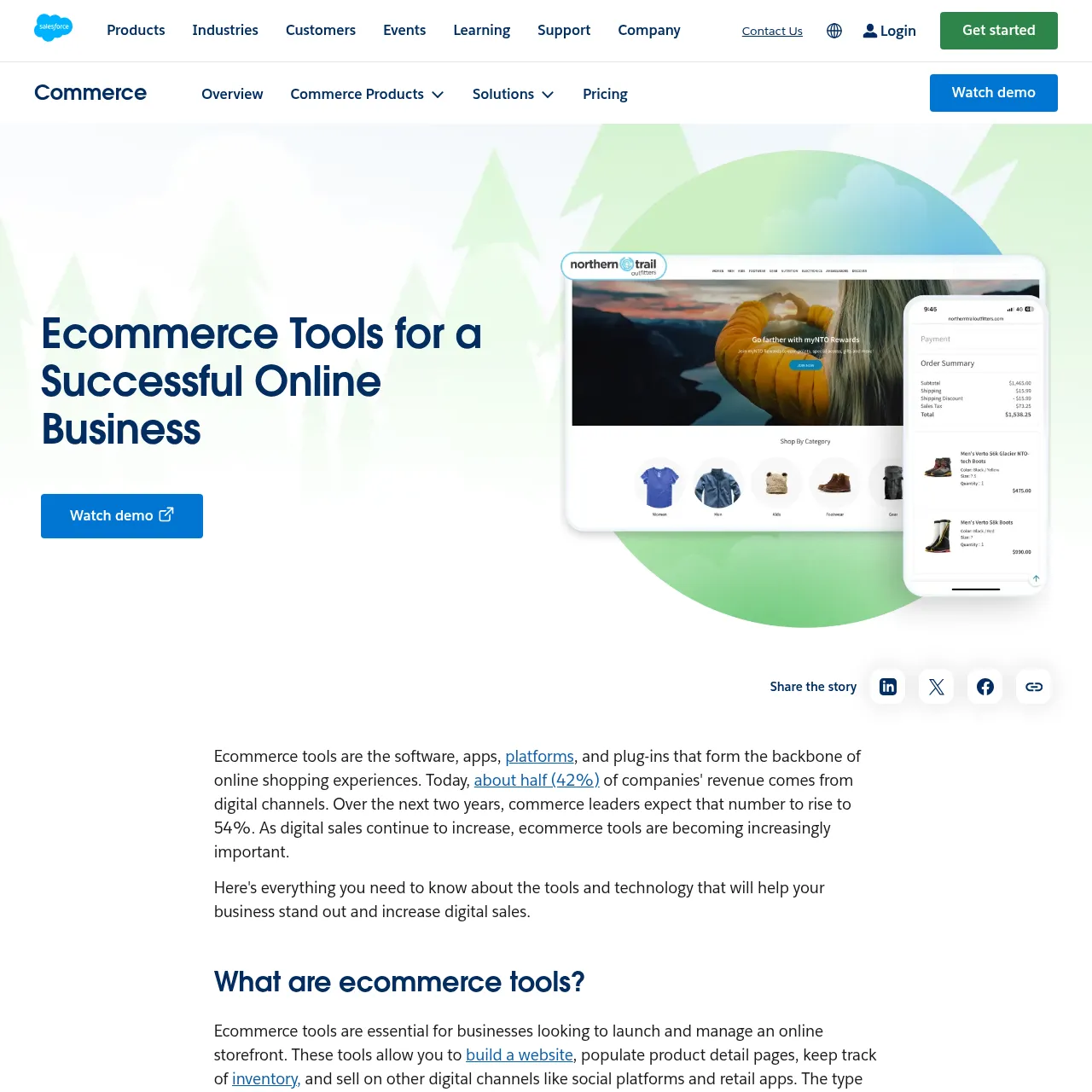
Salesforce Commerce Cloud is an enterprise SaaS platform for brands and retailers that need a managed, all-in-one ecommerce stack. Its core value proposition for the "ecommerce tools" category is consolidation: one platform handles storefront rendering, promotions, inventory, and post-purchase services — rather than requiring operators to stitch together separate point solutions for each function. The Einstein AI merchandising layer is a concrete differentiator for high-SKU catalogs where manual curation at scale is operationally impractical.
The platform's native integrations with Salesforce CRM, Marketing Cloud, and Service Cloud are the primary lock-in mechanism — and for operators already running the Salesforce stack, they're a legitimate efficiency argument. Buyer history, loyalty data, and service cases flow into merchandising decisions without custom pipelines or third-party middleware. For brands above a certain GMV threshold that prioritize Salesforce ecosystem consolidation, this is a coherent rationale. For operators running lean DTC operations on Shopify, it's a significant overinvestment.
From a trade infrastructure perspective: Salesforce Commerce Cloud does not surface MOQ, lead times, or supplier certifications. Those integrations require third-party connectors or custom builds. The platform competes directly with Shopify Plus, BigCommerce Enterprise, and Adobe Commerce — the comparison that matters for most buyers evaluating at this tier.
Key Features:
- Unified B2C and B2B storefront management on one platform
- Einstein AI for personalized product recommendations and automated merchandising
- Omnichannel order management with multi-channel inventory visibility
- Native integrations with Salesforce CRM, Marketing Cloud, and Service Cloud
Best For: Mid-to-large DTC brands consolidating storefront, OMS, and CRM under one vendor; B2B distributors running complex pricing tiers and contract catalogs alongside a consumer channel. Requires enterprise licensing and implementation resources — not a fit for lean DTC operations.
6. Luigi's Box
Luigi's Box is an AI-powered e-commerce search and product discovery SaaS targeting online retailers that have outgrown native platform search. The core problem it addresses is concrete: keyword-only search misses buyer intent, and when a store with 10,000 SKUs returns zero results for a common synonym, the conversion loss is measurable. Luigi's Box replaces keyword matching with AI-driven autocomplete, query understanding, and behavioral ranking — directly affecting add-to-cart rates for stores where search is a primary navigation pattern.
The discovery suite covers the full stack. The Recommender engine provides personalized upsell and cross-sell suggestions designed to increase average order value (AOV). The Product Listing product handles category page optimization for stores with wide product variety. A newer Conversational Agent feature allows customers to find products through natural language dialogue — a meaningful capability for catalogs where faceted filtering doesn't return the right result. The Search Grader tool audits on-site search performance at no cost, which lowers the evaluation barrier for operators who don't yet know they have a search problem worth solving.
Integration breadth is practical: Luigi's Box connects natively with Shopify, WooCommerce, Magento, Shopware, PrestaShop, OpenCart, and BigCommerce. It offers localized versions across multiple European languages, which matters for DTC operators running multi-language storefronts across regional domains without rebuilding search configuration per locale.
Key Features:
- AI-powered site search with autocomplete, personalization, and behavioral ranking
- Recommender engine for personalized upsell/cross-sell to increase AOV
- Search Grader free diagnostic tool for on-site search performance audit
- Conversational Agent for natural language product discovery
- Native integrations across Shopify, WooCommerce, Magento, Shopware, and BigCommerce
Best For: Mid-to-large ecommerce stores with high SKU counts where on-site search is a primary conversion path; DTC operators running multi-language storefronts who need one search layer across regional domains.
What to Do With This List
The six tools above don't compete with each other — they operate at different layers of the commerce stack. A search discovery tool doesn't replace a cross-border trade platform. An enterprise headless backend doesn't replace a supplier matchmaking engine. The right evaluation starts with identifying which layer is the actual bottleneck: supplier connectivity, storefront deployment, demand generation, or on-site conversion.
For Chinese factory owners and OEM/ODM exporters entering global markets, the most common failure mode isn't choosing the wrong storefront builder. It's deploying a storefront with no demand generation system and no inquiry management pipeline behind it — then waiting for traffic that doesn't arrive.
Before contacting any vendor on this list, define your procurement criteria: target market, expected order volume, MOQ range, required certifications, and the integration requirements of your existing ERP or inventory system. Vendors that surface answers to those questions quickly — rather than routing you through a sales process to get basic numbers — are the ones worth prioritizing.
Request a supplier match or platform demo at link4a.com — the Match engine returns qualified factory options in an average of 3 seconds, with MOQ, lead time, and certification data included.