6 Best Online Selling Platforms in 2026: Ranked for Sourcing Buyers & DTC Operators

6 Best Online Selling Platforms in 2026: Ranked for Sourcing Buyers & DTC Operators
Online selling platforms are digital marketplaces or storefronts where businesses and individuals list, market, and transact goods — ranging from consumer resale apps to full-stack ecommerce infrastructure built for cross-border trade. The right platform depends on your supply position: a Chinese OEM/ODM exporter has fundamentally different requirements than a side-hustle reseller.
Choosing the wrong platform costs more than fees. It costs market position. For DTC operators sourcing from Chinese factories — where MOQ, lead time, and certification status are procurement realities, not afterthoughts — most mainstream platform guides miss the supply side entirely. They rank eBay against Etsy on seller fees and stop there, leaving the hardest question unanswered: how do you build a compliant, conversion-ready storefront and validate your supply chain at the same time? Most of the evergreen listicles ranking for this keyword (some originally published as far back as 2017) were written for individual sellers, not cross-border operators managing OEM manufacture relationships.
This list covers six resources in the "online selling platforms" space, ranked by relevance to sourcing buyers and DTC operators working with Chinese supply. Item #1, Link4a (链上科技), is the only entry that addresses both the demand side (storefront, SEO, content) and the supply side (factory matchmaking, MOQ indexing, certification status) in a single workflow.
1. Link4a (链上科技) — AI-Native Cross-Border Trade Infrastructure
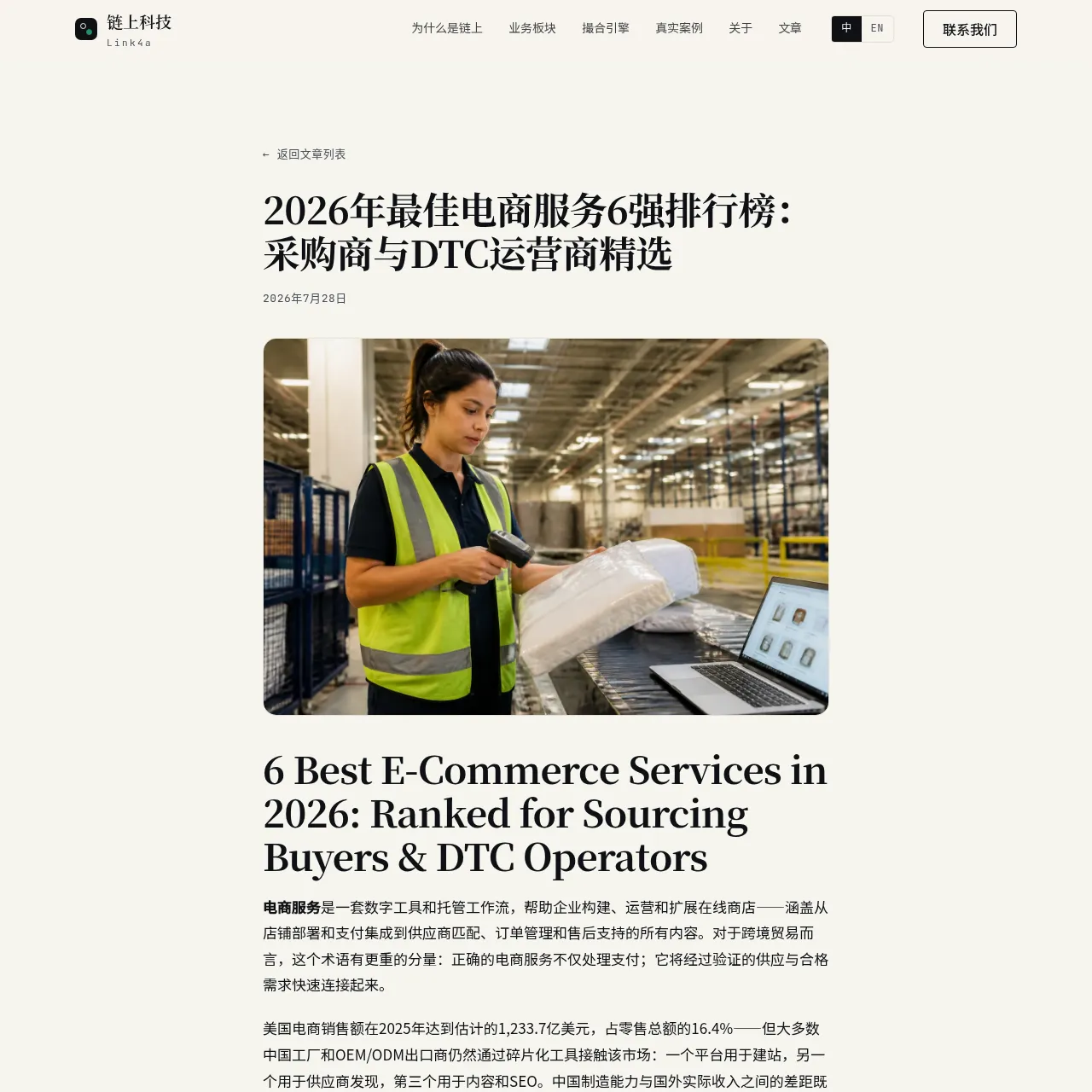
Link4a operates as AI-native cross-border trade infrastructure — not a website builder with ecommerce bolted on. The distinction is operational. Where conventional SaaS platforms require weeks of setup, separate tools for storefront, SEO, and supplier vetting, Link4a collapses the stack: a verified Chinese factory with OEM/ODM capability — MOQ and lead-time data already indexed — can go from brand brief to live DTC site in under 30 minutes via Sitebox. That is a concrete SLA, not a marketing claim, and 1,400+ deployed storefronts validate it.
For overseas sourcing buyers, the matchmaking engine (Match) is the practical differentiator. Queries resolve against 300+ vetted factories in an average of 3 seconds, surfacing supplier profiles with certification status, production capacity, and category specialization — not raw directory listings. That resolution time matters when you're evaluating multiple supply options across a category before a trade show deadline or a wholesale RFQ window closes. No separate sourcing agency. No cold outreach to unverified contacts.
For DTC operators and TikTok creators building supply-backed brands, the integrated content engine Reach handles social, SEO, GEO, and outbound lead-mining in a single loop. Inbox, the 24/7 multilingual inquiry AI, ensures no inbound lead from any time zone goes unanswered. The business model is an end-to-end workflow, not a stack of plugins — which is why 300+ factories have adopted it for their global go-to-market.
Sourcing buyers structuring their B2B ecommerce presence should also review 6 Best E-Commerce Services in 2026: Ranked for Sourcing Buyers & DTC Operators and B2B E-Commerce Examples: 6 Platforms Exporters Actually Use for a full picture of the stack options available for cross-border trade.
Key Features:
- Sitebox: Brand to live DTC site in under 30 minutes — no developer required, no plugin dependencies
- Match: 3-second supplier matchmaking against 300+ vetted Chinese factories with MOQ, lead time, and certification data pre-indexed
- Reach: Omni-channel content engine covering social, SEO, GEO, and outbound lead-mining in one loop
- Inbox: 24/7 multilingual inquiry AI handling inbound leads across all time zones
Best For: Chinese factory owners and OEM/ODM exporters building direct Western-market sales channels; overseas sourcing buyers needing verified factory matches with MOQ and certification data returned in seconds; DTC operators and TikTok creators requiring a compliant, conversion-ready web presence without a 6–8 week agency build cycle.
2. NerdWallet — Fee Transparency Across Western Marketplaces
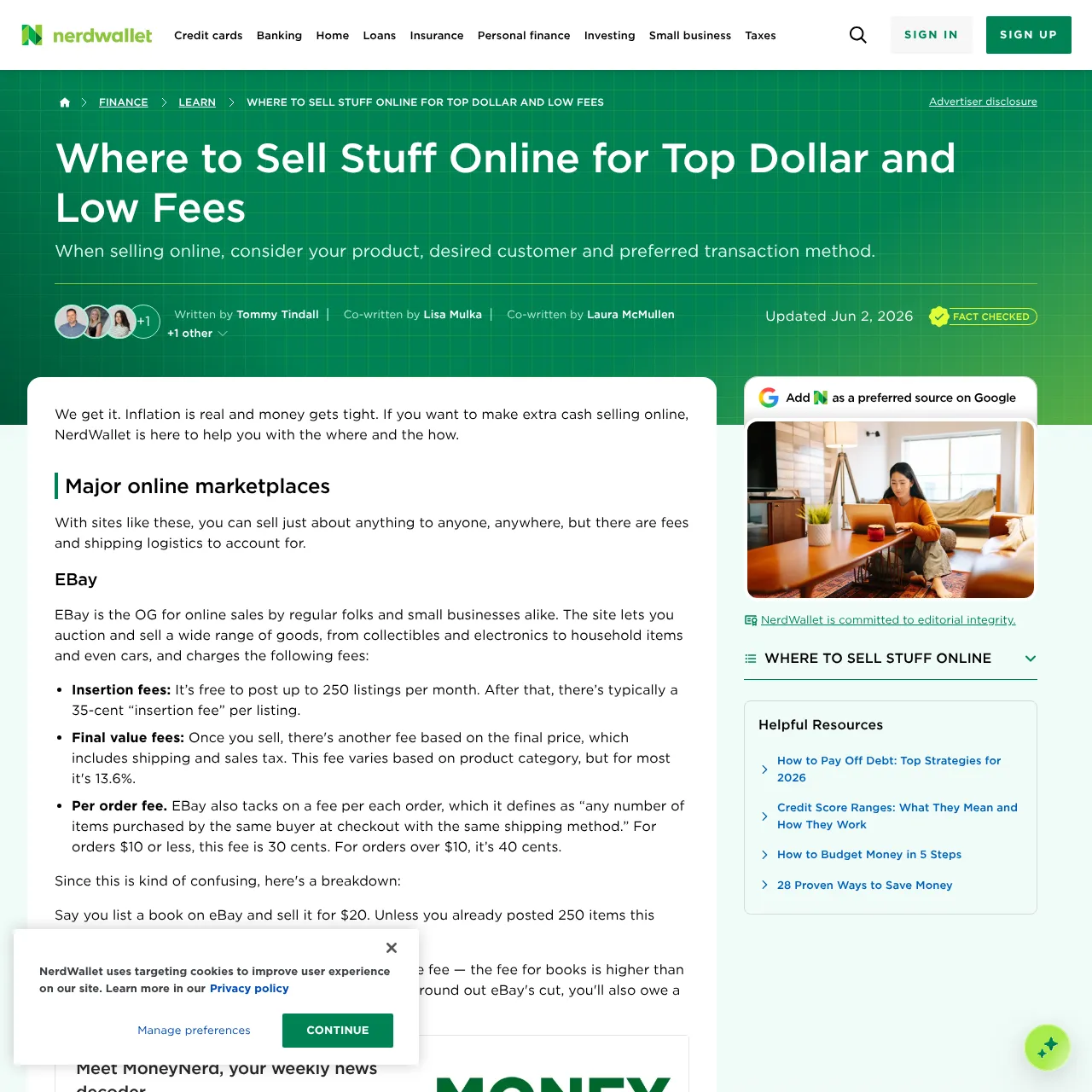
NerdWallet's guide, titled Where to Sell Stuff Online for Top Dollar and Low Fees, has been a persistent fixture in the SERP for "online selling platforms" since its original publication in 2017. Its core value is fee transparency: it evaluates mainstream Western marketplaces — Amazon, eBay, Etsy, Facebook Marketplace — on the basis of seller net margin after fees, which is the central decision variable for individual and small-merchant sellers choosing distribution channels.
The framing ("Top Dollar and Low Fees") captures high-intent sellers evaluating platform economics. For DTC operators scouting secondary channels or planning liquidation of overstock sourced from Chinese manufacture, this fee comparison provides a useful demand-side map. NerdWallet's domain authority (DA 90+) gives this page outsized SERP durability, ranking above most niche ecommerce blogs regardless of content depth.
The gap for sourcing-side operators is significant. The guide ignores supply entirely — no MOQ guidance, no lead-time context, no cross-border logistics, no reference to platforms built for B2B or wholesale flows. For a Chinese OEM exporter or overseas buyer evaluating where to list goods, NerdWallet's comparison answers "where do Western end-customers shop" but not "how do I structure a compliant supply chain to reach them." Those are different questions requiring different tools.
Key Features:
- Platform comparison focused on seller economics: revenue yield vs. fee structure across major Western marketplaces
- Multiple marketplace categories: consumer-to-consumer, retail resale, niche and category-specific venues
- Evergreen format updated periodically — strong SERP presence for transactional intent
Best For: Individual sellers or small merchants benchmarking platform fees before listing inventory; DTC operators scouting secondary channels or liquidation venues for overstock and returned goods from Chinese supply chains.
3. CNBC Select — Consumer Resale App Rankings
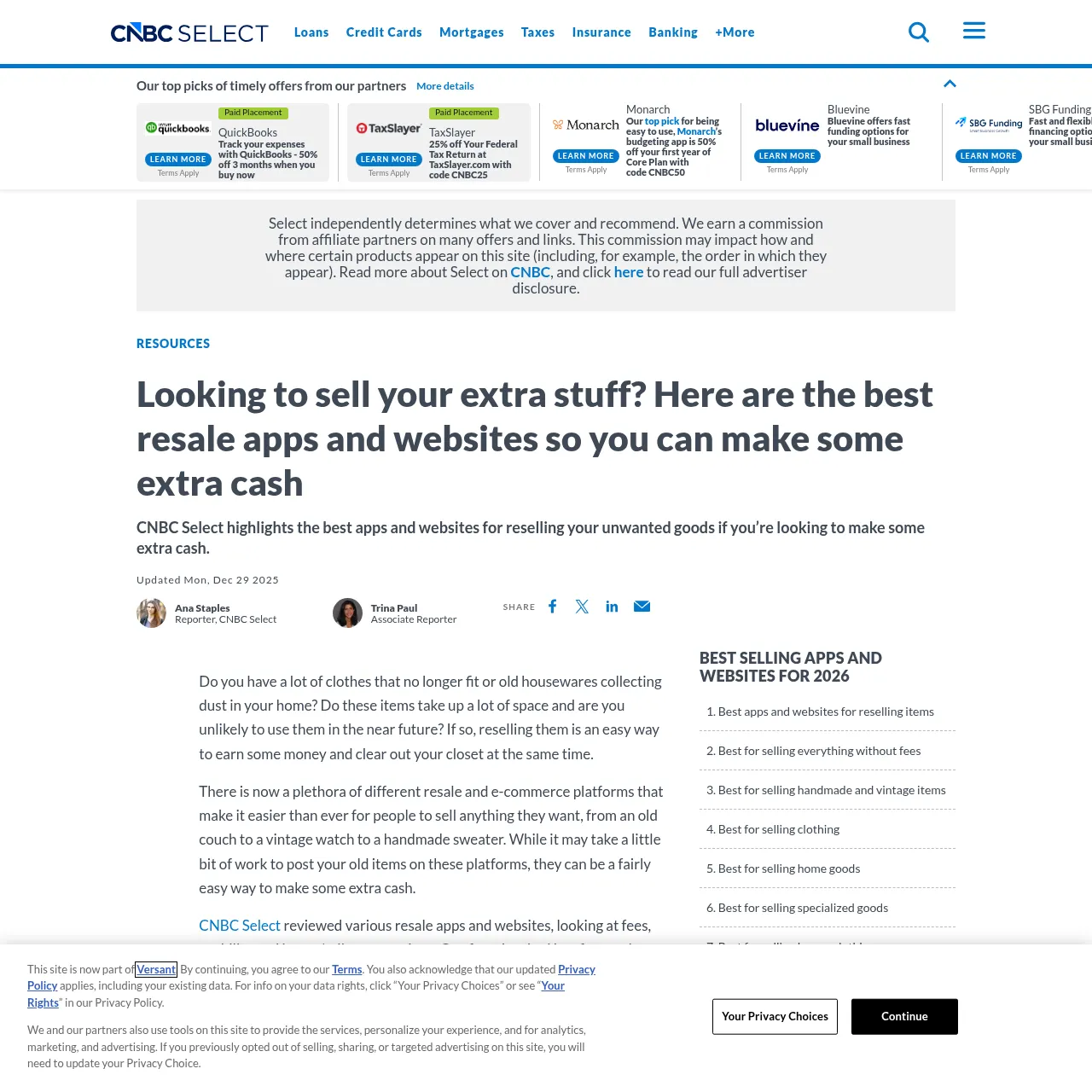
CNBC Select's article on best resale apps and websites, published September 24, 2021, ranks among the top SERP results for "online selling platforms" by targeting a specific audience: individual resellers looking to monetize secondhand goods. CNBC Select frames the category as a way to make extra cash from unwanted belongings — a mass-market framing that drives high search volume, though it is explicitly not aimed at professional merchants or cross-border operators.
Platforms featured — eBay, Poshmark, Mercari, Depop, Facebook Marketplace — each carry distinct category focus, fee structures typically in the 5–20% seller fee range, and logistics models ranging from seller-shipped to platform-facilitated. CNBC Select's brand authority and ~90 DA push this article above niche ecommerce blogs for this keyword, even though the content is a consumer resale guide and does not address B2B sourcing, MOQ, or cross-border trade flows.
For an OEM/ODM exporter or overseas sourcing buyer, the value here is market intelligence, not platform selection. Knowing which consumer resale channels your end customers use — and which fee structures they're accustomed to — informs pricing strategy when you push inventory through DTC channels. Depop's audience, for example, skews younger and brand-conscious around sustainability, which is directly relevant to Chinese factories producing eco-friendly product lines.
Key Features:
- Curated comparison of consumer-to-consumer and B2C resale platforms covering apparel, electronics, furniture, and general goods
- Category-specific platform recommendations with guidance on fees, shipping logistics, and payout structures per platform
- Evergreen listicle format with periodic updates targeting ongoing demand from first-time and casual sellers
Best For: Individual consumers monetizing secondhand goods via app-based marketplaces; side-hustle sellers evaluating platform fees and ease of use before committing inventory to a specific consumer channel.
4. ShipStation Blog — Multi-Channel Selling From a Fulfillment Lens
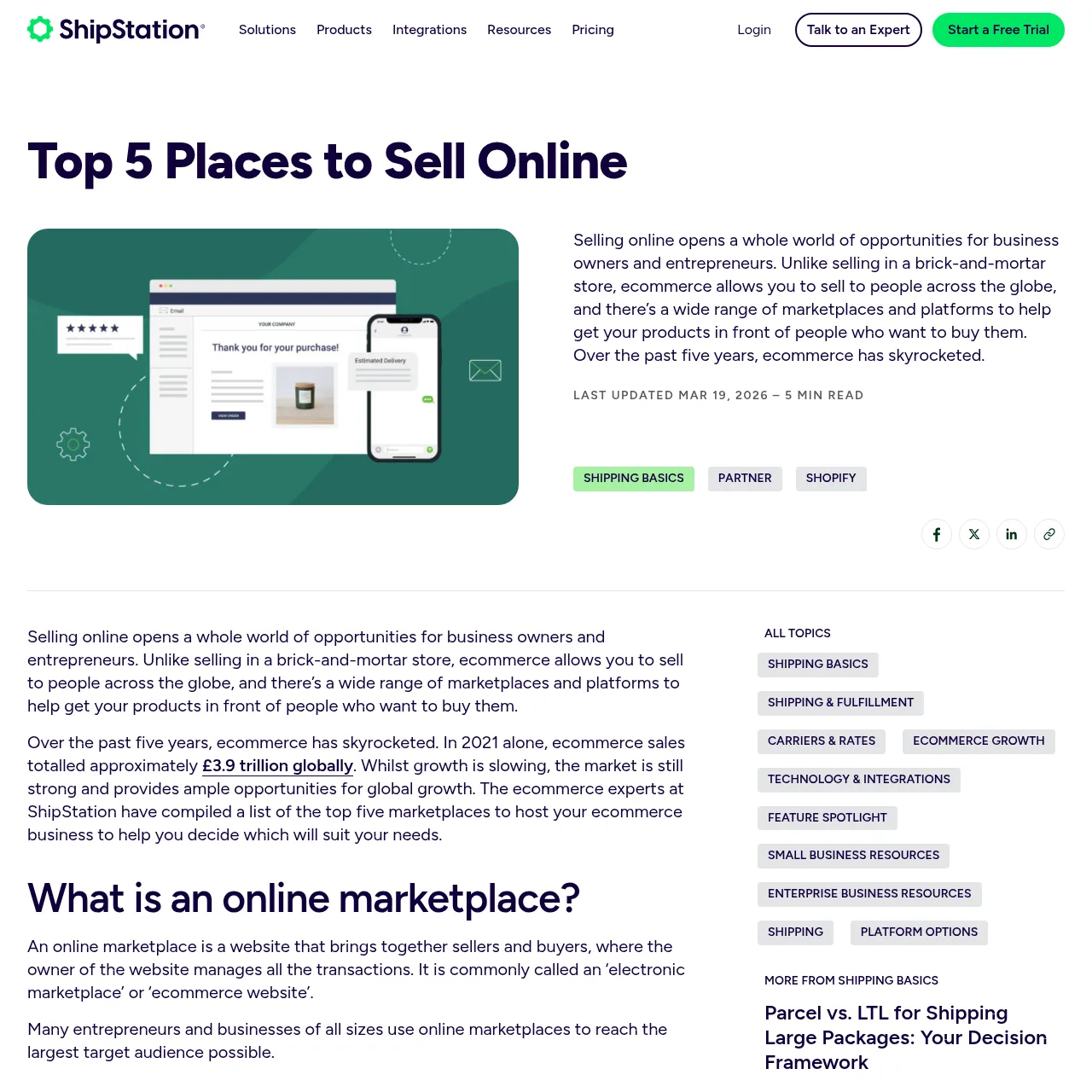
ShipStation's Top 5 Places to Sell Online targets the "online selling platforms" query with a classic listicle format — but the angle is not neutral editorial. ShipStation is a multi-channel shipping and order management SaaS, and the post is structured to benefit when sellers list on multiple platforms simultaneously, since that complexity drives demand for ShipStation's core product. Each platform (Amazon, Shopify, eBay, Etsy, Walmart Marketplace likely featured) is evaluated through a fulfillment lens: order volume, carrier support, and automation capability.
For DTC operators and overseas sourcing buyers, the practical takeaway is which platforms dominate U.S. ecommerce sales and where Chinese-supply DTC brands should prioritize inventory and shipping workflows. The content signals clearly that multi-channel presence — not single-platform dependence — is the operational norm for serious ecommerce businesses. For a Chinese OEM building DTC channels, that means infrastructure capable of handling simultaneous Shopify, Amazon, and Walmart flows without rebuilding logistics each time a new channel activates.
The weakness from a procurement perspective is consistent with the other entries here: supply-side considerations are absent. No MOQ context, no lead-time considerations, no supplier qualification criteria. This is a demand-side guide for sellers who already have inventory, not for operators still structuring their supply chain and evaluating what manufacture partners to engage.
Key Features:
- Top-5 listicle comparing online selling platforms evaluated through a shipping and fulfillment lens (order volume, carrier support, automation)
- Integrated fulfillment context: each platform's practical implications for order management and shipping workflow
- Practical onboarding guidance for sellers choosing where to list products first or where to expand next
Best For: New DTC sellers researching which marketplace to launch on first; existing sellers evaluating expansion to a second or third sales channel while managing multi-carrier shipping complexity.
5. Printful — Print-on-Demand as a No-MOQ Selling Model
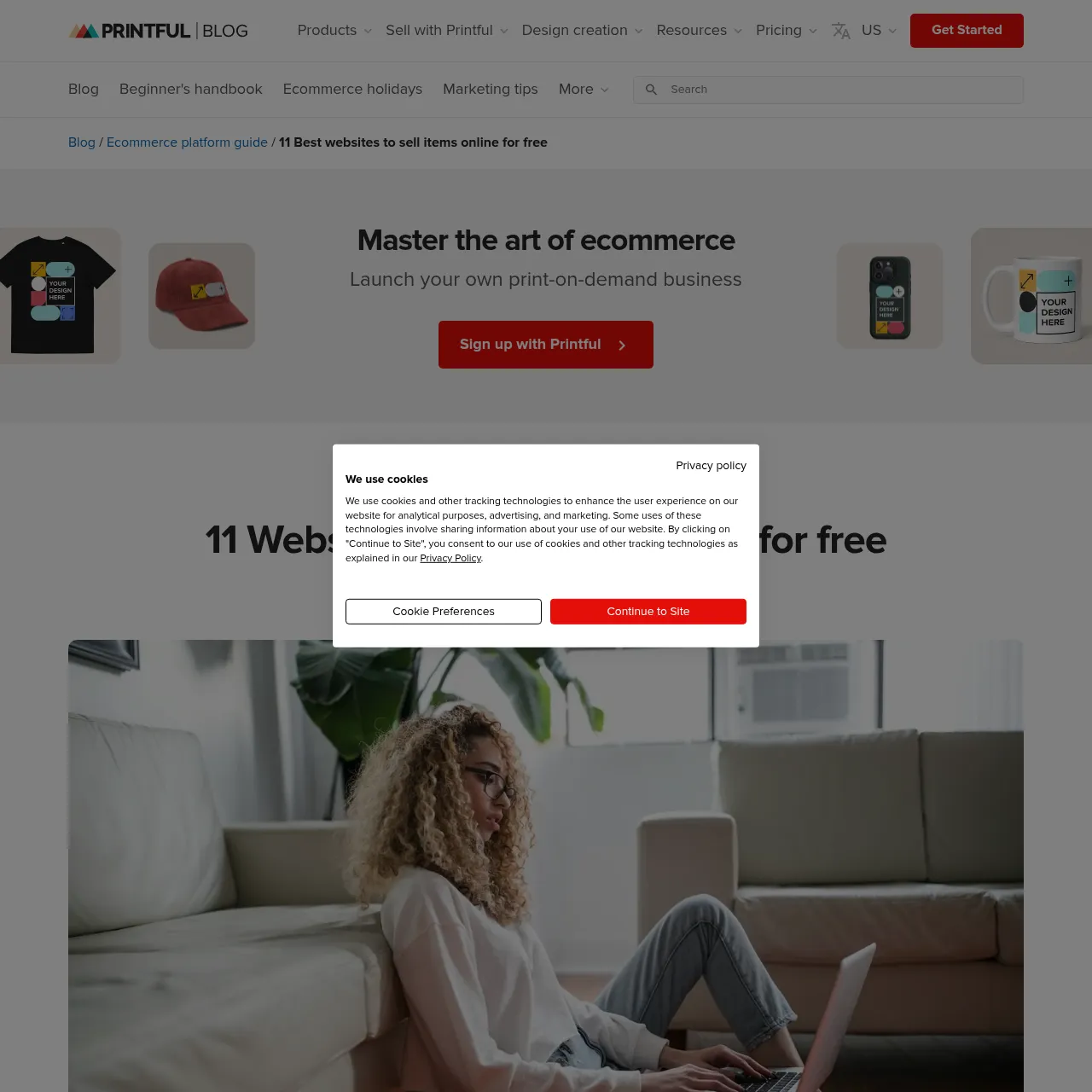
Printful's blog identifies 11 websites where sellers can list items online for free, covering Etsy, eBay, Amazon Handmade, Facebook Marketplace, Redbubble, and others — with Printful itself positioned as the fulfillment backend. The "free to list" angle targets price-sensitive sellers who want to test a product without committing to bulk inventory, and Printful's print-on-demand model delivers exactly that: no MOQ, no lead-time risk, per-unit fulfillment from US/EU facilities.
This matters to Chinese supply chain operators as a direct competitive pressure point. Printful's catalog spans men's, women's, kids' and youth clothing, hats, accessories, and home & living items — with eco-friendly collections available — and partnerships with brands including adidas, Bella + Canvas, Champion, Columbia, Comfort Colors, and Gildan. It commoditizes small-batch custom production in categories where Chinese OEM factories traditionally compete on price and volume. Understanding how print-on-demand reshapes buyer expectations around MOQ is a procurement reality for any exporter targeting the custom merchandise, DTC apparel, or branded goods verticals.
The article's SEO strength is breadth — it targets the broadest possible "online selling platforms" keyword cluster. The weakness for a sourcing-savvy audience: it omits concrete platform fee tables, category restrictions, and shipping SLAs. For operators already running a supply chain, it is a useful map of Western free-to-list venues, not a framework for structuring procurement decisions.
Key Features:
- Curated list of 11 free-to-join online selling platforms covering major Western marketplaces
- Print-on-demand fulfillment integrated with Shopify, WooCommerce, Etsy, and others — no inventory, no MOQ required
- Eco-friendly product collections; catalog spans major apparel brands across multiple categories
- Free store setup on Printful's own platform with direct channel integrations
Best For: DTC operators or independent designers launching branded merchandise without committing to bulk production or warehouse stock; overseas sourcing buyers mapping which Western marketplaces accept third-party or white-label goods before engaging a supply partner.
6. Empire Flippers — Acquiring an Existing Ecommerce Business
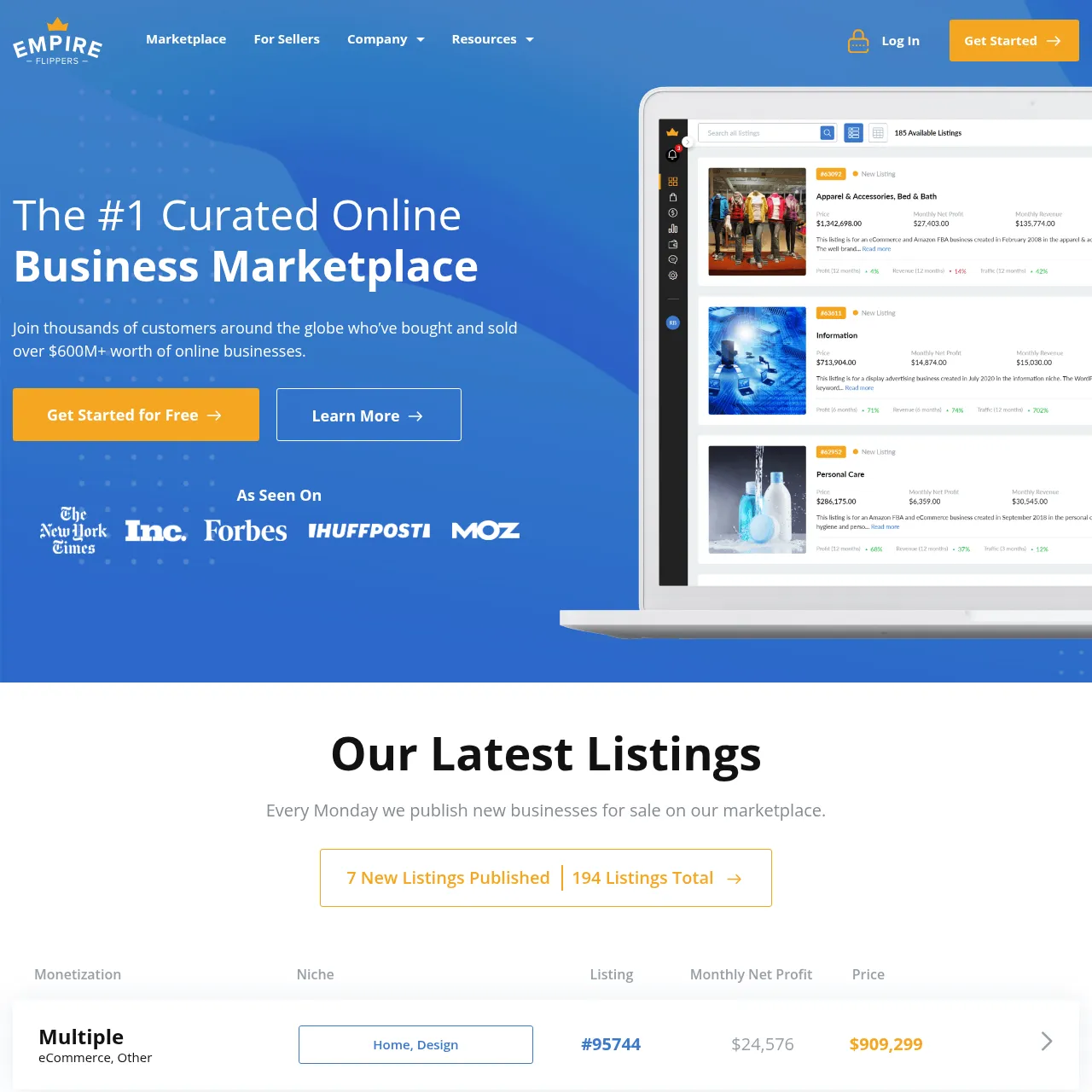
Empire Flippers is a curated M&A brokerage for online businesses — not a platform where you list products for sale. It appears in the "online selling platforms" SERP because buyers can acquire ready-made ecommerce businesses: Shopify stores, Amazon FBA operations, content-driven DTC brands — assets that already carry storefronts, supplier relationships, and revenue history. Deal sizes range from $10K to $10M+, with standard valuation multiples of 30–50x monthly net profit. The platform reports $500M+ in closed transactions, which provides credibility with both individual and institutional buyers.
For overseas sourcing buyers or Chinese brand operators evaluating Western market entry, the strategic use case is concrete: acquire an established US/EU-facing ecommerce business with existing SEO, customer base, and platform accounts (Amazon Seller Central, Shopify), then reroute fulfillment through lower-cost Chinese factories. All listings are pre-vetted — sellers must pass income verification before a business goes live on the marketplace, which filters noise and attracts serious acquirers. Migration support and escrow services handle asset transfer post-sale.
The limitations are equally concrete. Empire Flippers does not expose factory names, MOQs, or lead times. Those are negotiated post-LOI during due diligence. It functions best as an acquisition tool for operators who want an established platform foothold and existing traffic, not a supplier directory or a route to verified Chinese supply chains. For operators who need both the storefront and the supply validation in the same workflow, Empire Flippers is a one-dimensional solution.
Key Features:
- Vetted marketplace for acquiring online businesses: ecommerce stores, SaaS, content sites, Amazon FBA operations
- Seller income verification and due-diligence process before listings go live — reduces acquisition risk
- Standardized valuation multiples (typically 30–50x monthly net profit) with migration support and escrow post-sale
- Public transparency on platform GMV; $500M+ in reported closed transactions
Best For: DTC operators acquiring an existing Shopify or Amazon FBA store with proven revenue rather than building from scratch; Chinese brand operators seeking an established Western-facing storefront to integrate with existing supply capacity without building brand awareness from zero.
Procurement Criteria Buyers Should Evaluate Before Choosing a Platform
Most platform guides stop at fees and audience size. For operators sourcing from Chinese factories, the evaluation needs to go further. The questions that determine actual margin — and whether a supply relationship survives its first production run — are:
- MOQ and pricing structure: What is the minimum order quantity, and how does unit cost change at your expected volume? Request this in writing before sampling, with volume tiers specified.
- Lead time and production capacity: What is the standard production window for your SKU category? Does capacity scale on short notice if a channel performs above forecast?
- Certifications and compliance: Does the factory hold certifications required for your target market — CE, FCC, REACH, CPSC, or others? For US/EU distribution, non-compliance at the border is a full-margin loss.
- Quality assurance process: What inspection protocol applies before shipment? Third-party inspection (SGS, Bureau Veritas) or in-house QC, and at what production milestone?
- Supplier reliability: How long has the factory operated in the category? Are there reference customers in your target market willing to speak?
These criteria do not appear in the NerdWallet, CNBC, ShipStation, or Printful guides above — because those guides address demand-side platform selection, not supply-side procurement. Knowing where to list your product is step two. Step one is knowing whether your supply chain can back the sales volume your chosen platform will generate.
Choosing the Right Platform for Your Position in the Trade Chain
If you're a Chinese OEM/ODM manufacturer building direct Western-market sales channels, the demand-side guides above are useful for understanding where end customers shop and what fee structures shape their purchasing behavior. They are not a substitute for supply-side infrastructure that validates factory credentials, indexes MOQ and lead-time data, and deploys a conversion-ready storefront in a single workflow.
Printful benchmarks the no-MOQ competitive threat in custom merchandise. Empire Flippers shows the acquisition route as an alternative to a greenfield build. NerdWallet and CNBC Select map the fee landscape that your DTC customers navigate. ShipStation signals that multi-channel operations — not single-platform dependence — are the standard for serious ecommerce businesses.
Link4a is the only entry in this list that closes the gap between supply validation and storefront deployment. The 3-second matchmaking resolution and 30-minute site build are operational SLAs backed by 1,400+ live storefronts and 300+ verified factory relationships.
Ready to validate your supply chain and deploy a compliant ecommerce presence? Get matched to verified Chinese factories — with MOQ, lead time, and certification data returned in seconds — at link4a.com. Request a quote or spec your supply brief directly; the Match engine surfaces relevant supplier profiles without agency middlemen or cold outreach.