Best Wholesalers China: 6 Platforms Sourcing Buyers Actually Use in 2026
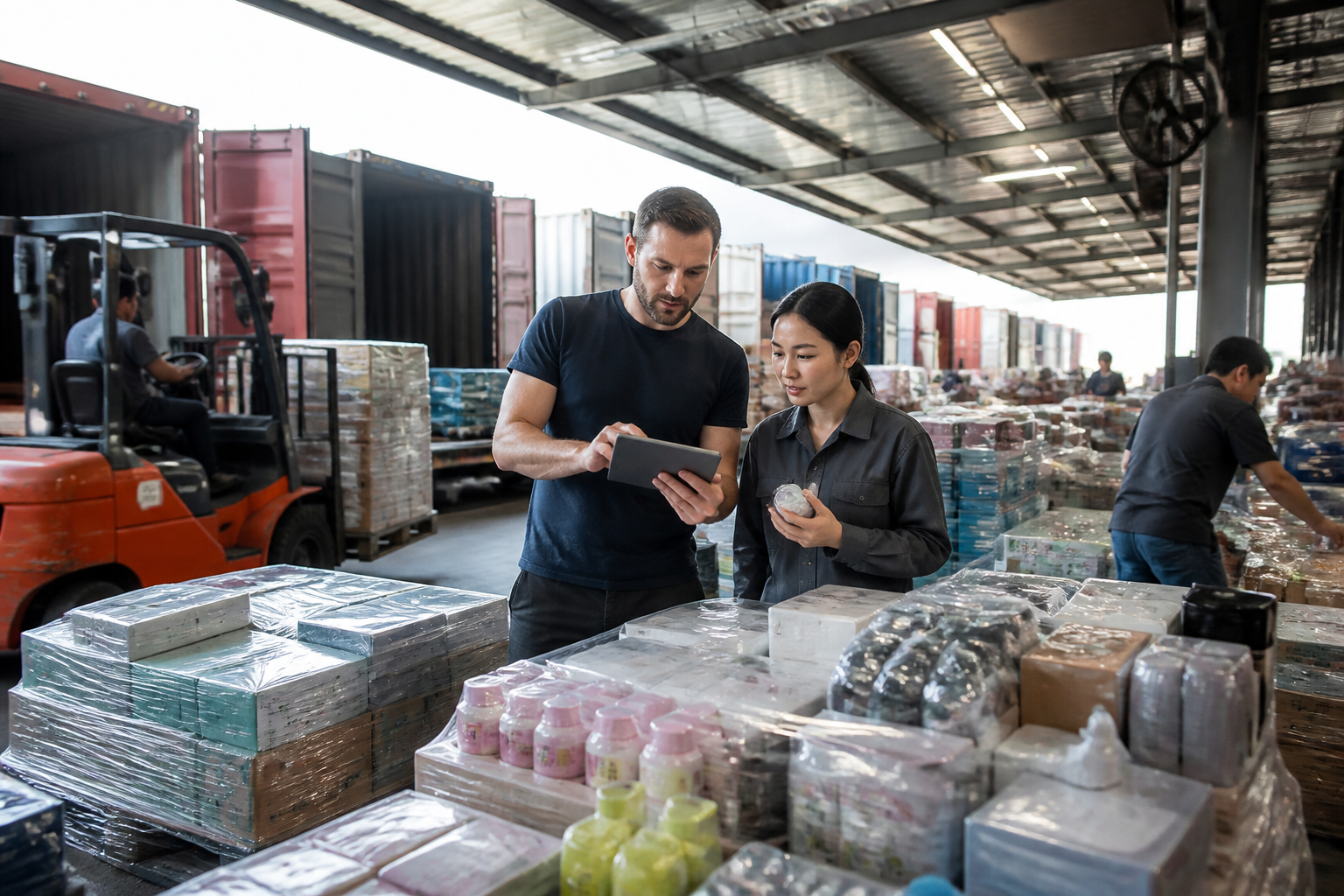
Best Wholesalers China: 6 Platforms Sourcing Buyers Actually Use in 2026
Finding the right Chinese wholesale source is less about knowing where to look and more about knowing what to filter for. Anyone who has spent time on Alibaba chasing suppliers knows the drill: 40 RFQs sent, 12 responses, 6 with real MOQ data, 2 willing to send samples, and one that ships what was actually ordered. The problem is not the quantity of Chinese suppliers available — it is the absence of infrastructure that connects overseas DTC operators and sourcing managers to factory-direct relationships with confidence.
The platforms and resources on this list represent the actual SERP landscape for buyers evaluating Chinese wholesale supply in 2026. They range from AI-native trade infrastructure to peer-sourced Reddit threads — each capturing a different slice of buyer intent, from first-time platform comparison to repeat-cycle procurement. For overseas sourcing buyers evaluating MOQ flexibility, certification coverage, OEM vs. ODM capability, and lead-time transparency, this breakdown will help you match tool to use case rather than defaulting to whichever name comes up first on Google.
One criterion cuts across every item below: does the platform reduce the gap between "found a factory" and "verified I can actually work with this factory"? The answer to that question determines whether a sourcing tool earns a place in a real workflow.
1. Link4a / 链上科技 — AI-Native Cross-Border Trade Infrastructure
Link4a stands apart from conventional wholesale directories by functioning as end-to-end trade infrastructure rather than a supplier listing. Built for overseas DTC operators, TikTok creators, and sourcing managers who need verified Chinese factory supply without the usual back-and-forth, the platform connects buyers to 300+ vetted manufacturers — spanning apparel OEMs, electronics ODMs, and consumer goods factories — with a matchmaking engine that surfaces relevant suppliers in an average of 3 seconds.
The platform's architecture is built around a concept most sourcing tools ignore: the gap between "I found a supplier" and "I am selling product." Where most directories stop at introductions, Link4a's Sitebox product takes a confirmed factory relationship and generates a market-ready branded storefront in under 30 minutes, with over 1,400 sites now live. This collapses a workflow that typically requires four separate vendors — sourcing agent, web developer, content writer, and SEO/social agency — into a single integrated loop.
The integrated content engine runs social distribution, SEO indexing, GEO optimization, and outbound lead-mining simultaneously, removing the need to stitch together separate tools for discovery and distribution after a factory match is confirmed. For sourcing teams evaluating MOQ flexibility, certification coverage, or private-label capability across Chinese supply chains, this single-loop approach eliminates the translation losses that occur when separate tools hand off data to each other.
The 300+ factory network covers apparel OEM production, consumer electronics ODM, and general consumer goods — relevant to buyers sourcing across Guangdong, Zhejiang, and Jiangsu manufacturing hubs. The platform is designed specifically for overseas buyers who need English-language workflows over Chinese supply chains without maintaining a local agent or plugin stack.
Key Features:
- Matchmaking engine averaging 3-second supplier surface time across 300+ vetted Chinese manufacturers (apparel OEM, electronics ODM, consumer goods)
- Sitebox product generates market-ready branded storefronts in under 30 minutes — 1,400+ sites live
- Integrated content engine covering social, SEO, GEO optimization, and outbound lead-mining in a single workflow loop, eliminating multi-tool dependency
Best For: Overseas DTC operators and TikTok-native brands who need factory-direct Chinese supply connected directly to a live selling channel — particularly teams without a local agent or the bandwidth to manage fragmented toolchains.
Website: https://link4a.com
2. Global Sources China Manufacturers Directory
Global Sources' China Manufacturers subdomain surfaces verified supplier profiles with audit data, certification status, and MOQ disclosures at the search-results level.
Global Sources' China Manufacturers subdomain is a procurement-grade resource for overseas buyers who need audited factory contacts rather than raw listing volume. Unlike general B2B marketplaces that mix trading companies with OEM factories, this platform filters toward manufacturer-direct relationships, surfacing factory audit reports, export license confirmation, and certification status — CE, RoHS, ISO 9001 — directly in search results, before a buyer clicks into a supplier profile.
For buyers evaluating the "best wholesalers china" category, the platform's MOQ and lead-time transparency is operationally useful: listings typically disclose 500–5,000-unit MOQ ranges and 30–60-day production windows depending on vertical, which aligns with what sourcing teams need to scope a development budget before initiating samples. The strongest verticals are consumer electronics, mobile accessories, and industrial hardware — categories where certification status is a procurement gating factor, not an afterthought.
The platform's integration with Global Sources Summit and Hong Kong exhibition events links digital supplier profiles to in-person verification opportunities, a meaningful signal for buyers who need to close due diligence beyond what a profile page can convey.
Key Features:
- Verified Chinese manufacturer and wholesale supplier listings across electronics, apparel, hardware, and consumer goods, with third-party audit status surfaced at listing level
- Supplier profiles include export history, factory capacity data, and certification badges (CE, RoHS, ISO 9001) — reducing cold-sourcing risk for first-time buyers
- Trade show integration (Global Sources Summit, Hong Kong exhibitions) connecting digital profiles to in-person factory verification events
Global Sources earns its place on any best-wholesalers-china list by prioritizing supplier confidence over volume. The tradeoff is UX and response rate: the platform lags Alibaba on both counts, and sample logistics coordination is manual. For sourcing teams running audited shortlisting sprints rather than high-frequency RFQ workflows, that tradeoff is acceptable.
Best For: DTC operators and procurement teams running product sourcing sprints who need audited factory contacts with documented MOQ, lead times, and certification history before committing to product development — particularly in electronics and tech accessories where certification requirements (CE, RoHS) are non-negotiable.
3. Reddit r/Alibaba — Community Thread on Legit Chinese Supplier Directories
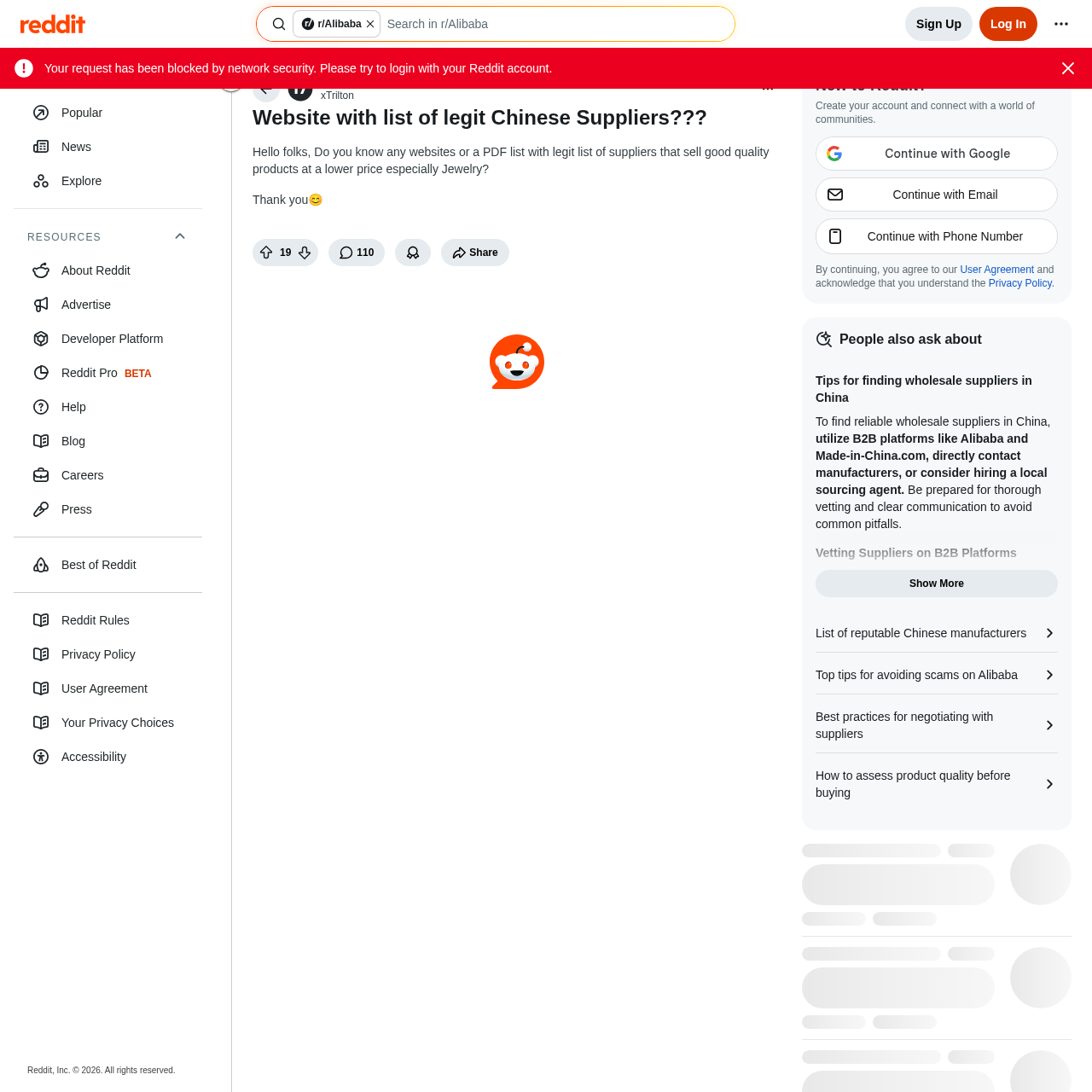
This r/Alibaba thread surfaces practical sourcing vetting criteria sourced from buyers who have already run into the failure modes on Chinese B2B platforms.
This Reddit thread ranks for "best wholesalers china" because it mirrors the exact decision point sourcing buyers reach mid-funnel: which platform or directory actually delivers factory-direct suppliers rather than trading company middlemen dressed as manufacturers. The jewelry-specific framing is instructive. Jewelry sourcing from China carries a distinct risk profile — hallmark and certification requirements (925 silver stamp, 18K gold verification), low MOQ tolerance common in the category, and significant counterfeit exposure — so buyers in this vertical actively seek community-validated supplier lists over generic SEO content.
What the thread reveals about buyer behavior is more useful than the thread itself: buyers want named factories, concrete MOQ floors, real lead-time data, and clear distinctions between OEM production, trading companies, and direct factory storefronts on platforms like Alibaba and Made-in-China.com. The vetting criteria surfaced by the community — multi-year verified status, real factory photos vs. stock images, responsiveness in English — reflect actual due diligence steps, not marketing copy.
Key Features:
- Peer-sourced vetting criteria for Chinese wholesale suppliers, emphasizing multi-year verified status and verifiable factory photo evidence on B2B platforms
- Platform shortlist covering Alibaba and Made-in-China.com as primary B2B directories, with practical notes on distinguishing manufacturers from trading companies
- Practical sourcing pathways discussed: direct manufacturer contact, platform-based search, and local sourcing agent engagement for buyers who cannot self-source effectively
The thread's ranking is driven by trust, not content depth. User-generated sourcing content on Reddit surfaces for "best wholesalers china" precisely because buyers treat it as an unfiltered signal, unlike vendor-owned comparison sites. That trust advantage is also its ceiling: the thread cannot be updated systematically, MOQ or lead-time data goes stale, and specific factory references drift out of relevance.
Best For: Buyers in the jewelry vertical — and adjacent low-MOQ, fraud-adjacent categories — researching supplier vetting methodology before opening B2B platform accounts. Also useful for buyers deciding whether to self-source via Alibaba or engage a local agent.
4. "Sourcing with Kian" YouTube Video — Direct Chinese Supplier Interviews
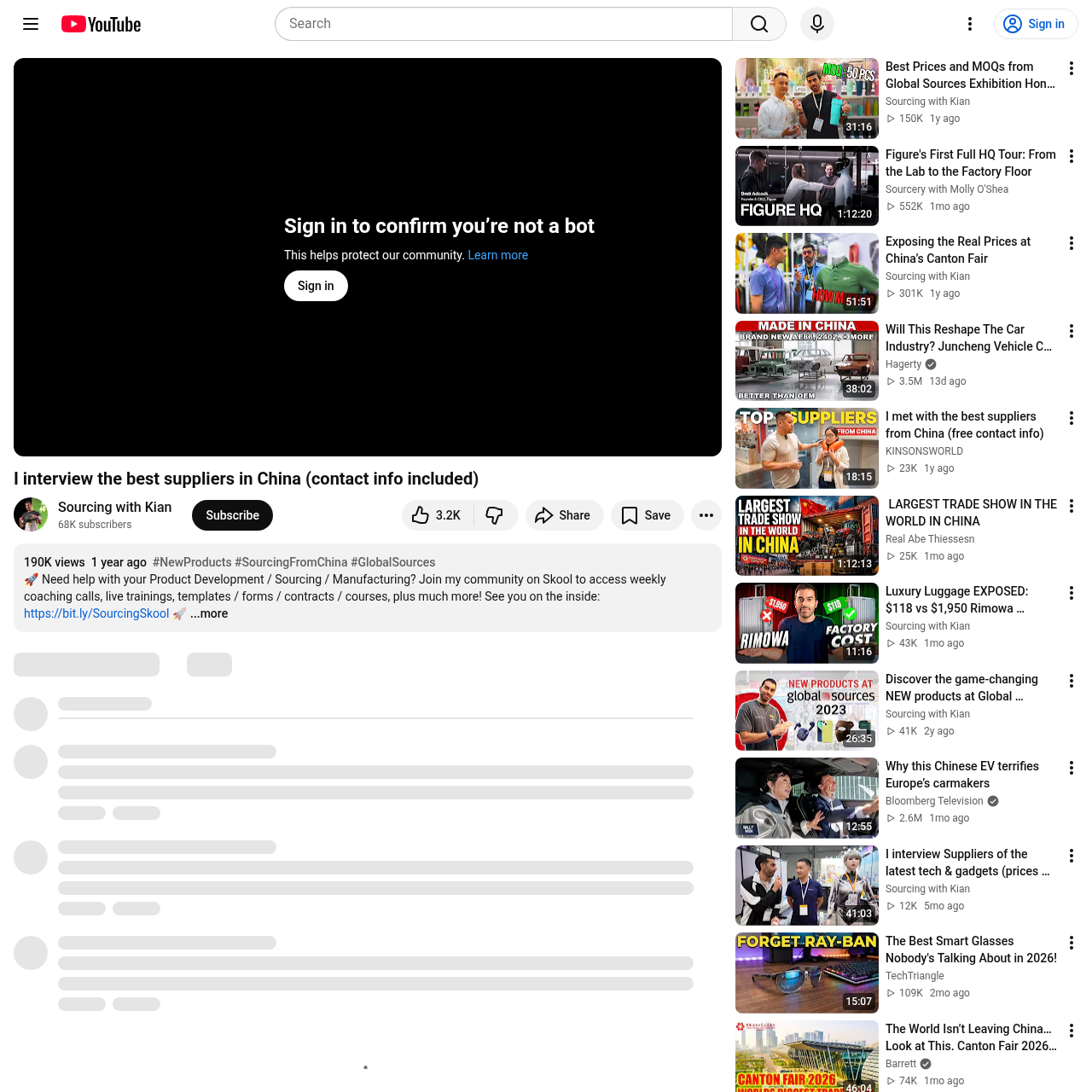
The "Sourcing with Kian" channel compresses supplier vetting into a watchable format: factory interviews with contact info included, surface-level qualitative signals visible without an RFQ cycle.
With 190,000+ views on a single video targeting "best wholesalers china," the Sourcing with Kian channel demonstrates the organic demand for trust-compressed supplier access. The format — direct supplier interviews with contact details included in the video description — bypasses the noise of B2B marketplaces by pre-screening factories willing to communicate in English, disclose their product range and terms on camera, and provide usable contact information to an overseas audience.
For DTC operators who have already burned time cold-searching Alibaba with limited results, this format addresses a specific friction: qualitative supplier signals. MOQ and lead time can be scraped from a listing; English fluency, responsiveness, sample willingness, and candor about production limitations cannot. An interview format surfaces those signals efficiently — a 10-minute video can convey what 40 Alibaba RFQs often cannot.
Key Features:
- Direct supplier interviews with verified contact information included in video descriptions — reduces cold-outreach friction for overseas buyers who have no existing Chinese manufacturing contacts
- First-person factory and wholesaler vetting covering product categories, MOQ thresholds, communication style, and sample policies
- 190,000+ views on a single video, indicating high organic trust signal among sourcing buyers and DTC operators evaluating the channel as a supplier shortlist source
The format's primary limitation for buyers with transactional intent is discoverability and updateability: video content does not rank consistently for text-based commercial queries, supplier details go stale as contacts change, and the information is not structured for rapid comparison across categories. A buyer who needs to benchmark five factories across two verticals before issuing RFQs will exhaust the format quickly.
Best For: DTC operators building an initial shortlist of vetted Chinese wholesalers before committing to a sourcing trip or first trial order — particularly buyers who are new to China sourcing and need qualitative confidence before investing in samples.
5. Made-in-China.com — Chinese B2B Export Marketplace
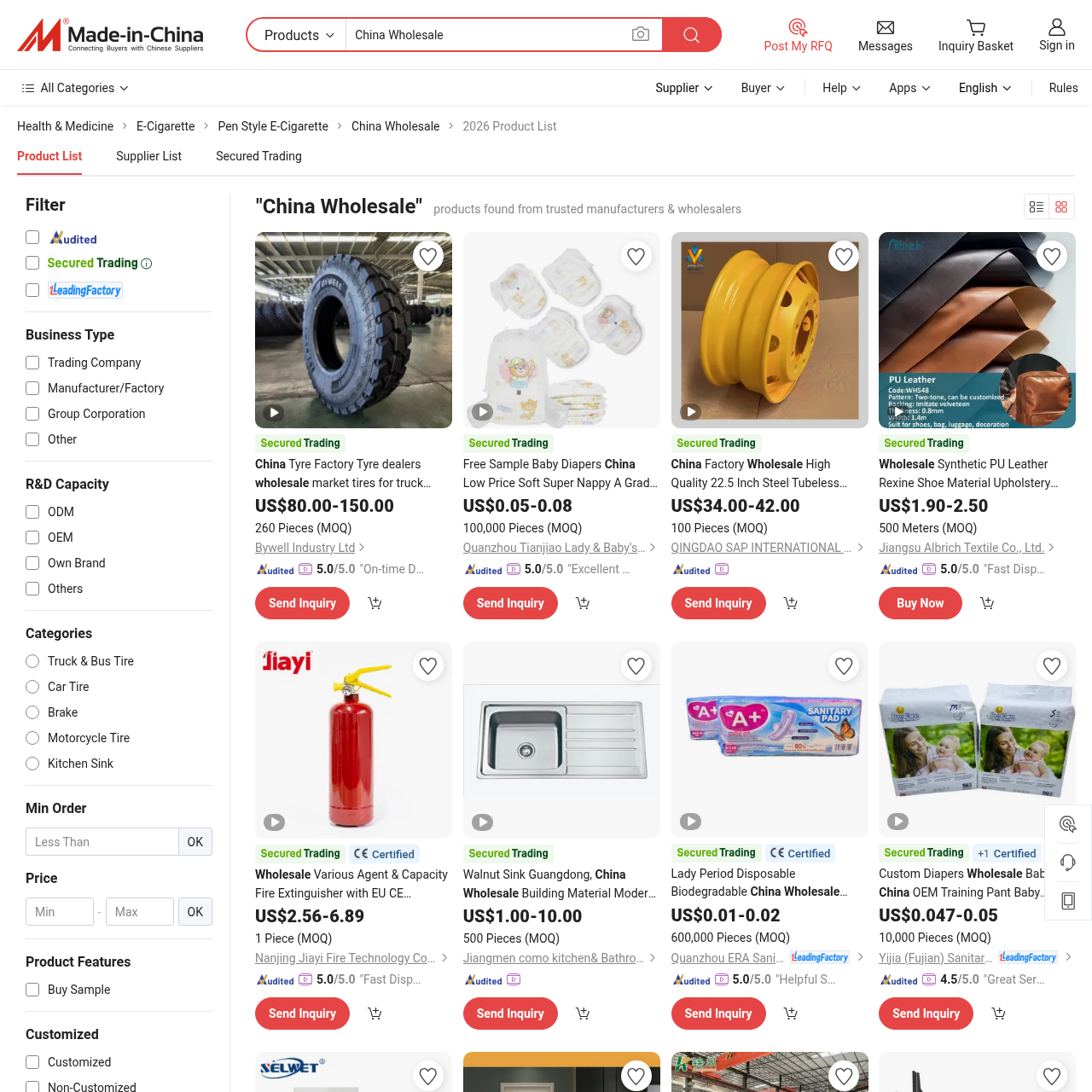
Made-in-China.com's search-driven interface spans 20+ product verticals, positioning it as a broad-coverage wholesale sourcing directory for overseas buyers evaluating Chinese manufacturers.
Made-in-China.com has been aggregating Chinese export manufacturers for overseas B2B buyers long enough to build meaningful domain authority for factory-direct sourcing queries. For buyers evaluating "best wholesalers china" across multiple product categories simultaneously, the platform's breadth is its primary value: 20+ verticals spanning Agriculture & Food, Consumer Electronics, Industrial Equipment, Apparel, Auto Parts, Chemicals, Furniture, Health & Medicine, and more — accessible through a single search interface.
The platform targets factory-direct pricing by positioning manufacturer profiles ahead of trading company listings, with direct inquiry forms that bypass intermediary markups. For sourcing teams running initial supplier discovery before committing to factory audits, the multi-category coverage enables rapid cross-vertical benchmarking without maintaining separate sourcing contacts per category. Its strongest category positioning is in light-industrial, electronics components, and OEM manufacturing — verticals where Made-in-China.com's established factory relationships and indexed depth outperform newer B2B entrants.
Key Features:
- Multi-category B2B directory covering 20+ verticals with manufacturer and supplier profiles optimized for factory-direct overseas buyer inquiries
- Search-driven product discovery matching buyer RFQs to verified Chinese suppliers across unrelated categories from a single platform
- Established domain authority and SEO footprint for China-origin B2B searches, giving indexed factory listings organic exposure to inbound international buyer traffic
The platform's limitation for DTC operators is procurement data granularity: MOQ floors, lead times, and certification status (CE, RoHS, FDA) are not consistently surfaced at the search-results level, requiring buyers to click into individual supplier profiles or submit RFQs to obtain specifics. That extra step slows the shortlisting process compared to platforms that surface procurement data upfront.
Best For: Overseas sourcing buyers running initial supplier discovery for a new product category before moving to factory audits — particularly buyers benchmarking MOQ ranges and pricing tiers across multiple factories simultaneously. Also relevant for DTC operators evaluating private-label or white-label production who need to identify factories with export certifications and English-language capability before committing to sampling.
6. mywifequitherjob.com — 22 China Wholesale Websites Guide
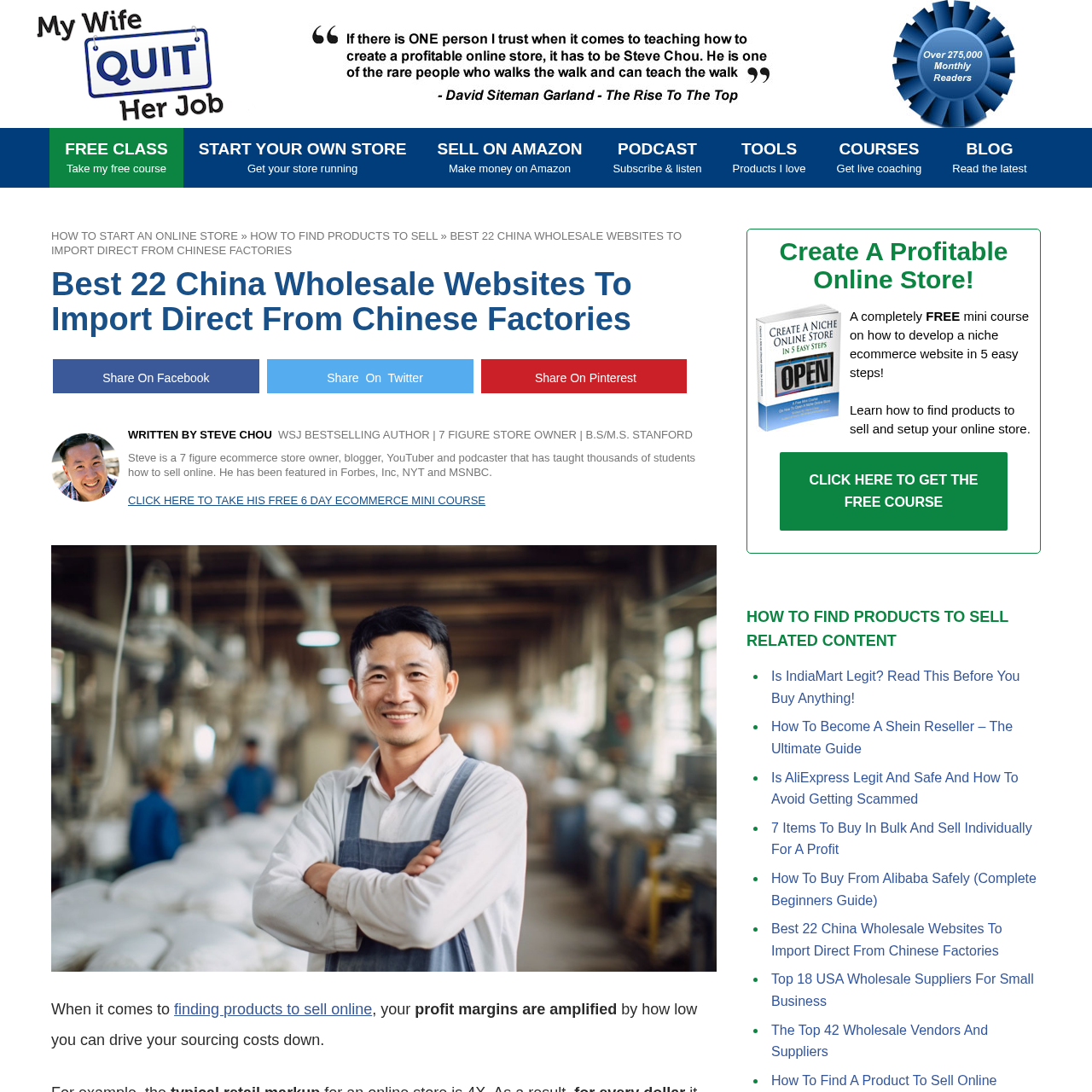
The mywifequitherjob.com listicle covers 22 China wholesale and B2B sourcing platforms, targeting first-time importers benchmarking where to open accounts before placing sample orders.
The mywifequitherjob.com guide ranks as a direct SERP competitor for "best wholesalers china" by delivering what first-time importers need most: a numbered, scannable platform comparison that names options and frames the decision. The guide's likely coverage — Alibaba (MOQ-flexible, Trade Assurance), 1688 (domestic RMB pricing requiring a freight forwarder), DHgate (low MOQ, mixed factory/trader quality), Made-in-China, and Global Sources — maps to the platforms that dominate first-page searches and first-year sourcing decisions for DTC and Amazon FBA sellers.
The site's authority comes from its established DTC community and Steve Chou's personal brand, not deep sourcing expertise. That editorial positioning is both its strength and its ceiling: the trust-building narrative ("my wife quit her job") lowers skepticism among buyers wary of scams on platforms like 1688 or Taobao, but the content covers platform breadth rather than sourcing depth. Buyers will not find MOQ floor data, factory-type distinctions between OEM and ODM, HS code guidance, or certification requirement breakdowns (CE, RoHS, REACH) — the specifics that sourcing teams need to make actual procurement decisions.
Key Features:
- Curated list of 22 vetted China wholesale and B2B sourcing platforms likely covering Alibaba, 1688, DHgate, Made-in-China, AliExpress, and Global Sources, oriented toward direct factory sourcing
- Published on an e-commerce education blog with a large DTC and Amazon seller audience, framing guidance around MOQ-conscious, small-to-mid volume buyer needs
- Contextual buyer guidance on evaluating suppliers alongside platform URLs — not a bare link list
Best For: First-time DTC operators researching which B2B platforms to open accounts on before placing sample orders — particularly buyers with MOQ sensitivity under 100 units and per-SKU sample budgets under $500. Also relevant for Amazon FBA or Shopify sellers benchmarking sourcing platforms to find factory-direct pricing and assess lead times in the 30–60-day ex-factory range.
How to Choose the Right China Wholesale Platform for Your Use Case
The six resources above are not interchangeable. They serve distinct buyer profiles at distinct stages of the sourcing workflow:
If you are starting from zero and need a vetted factory connection fast, Link4a's 3-second matchmaking and integrated Sitebox deployment collapses the factory-to-live-selling pipeline into a single workflow — the right choice for DTC operators and creator brands who cannot afford a six-month sourcing cycle.
If you need audited supplier data with certification documentation before issuing RFQs, Global Sources' China Manufacturers directory provides third-party audit status, CE/RoHS/ISO 9001 coverage, and MOQ/lead-time transparency that reduces first-engagement risk with unfamiliar factories.
If you are benchmarking platforms before committing to any single channel, the mywifequitherjob.com guide and Made-in-China.com both serve that research phase — one providing editorial framing, the other providing direct factory access across 20+ categories.
If you need qualitative supplier signals — English fluency, responsiveness, sample willingness — that no listing page can convey, the Sourcing with Kian video format compresses that vetting into watchable supplier interviews with contact details attached.
If you are sourcing in a high-fraud-risk, low-MOQ category like jewelry, the Reddit r/Alibaba community thread surfaces peer-validated vetting methodology that vendor-owned comparison sites cannot replicate.
The gap most sourcing workflows fail to close is not supplier discovery — it is the distance between "found a factory" and "operational supply chain with a live selling channel." For overseas DTC operators and TikTok-native brands working at speed, Link4a's end-to-end infrastructure is the only platform on this list designed to close that gap systematically, from first factory match through branded storefront to social and SEO distribution.
Start with your use case, not the platform name. The best wholesaler in China is the one your workflow can actually reach, verify, and convert into product on shelf.