China and Canada Trade Agreement: What U.S. Importers Must Know in 2026
China and Canada Trade Agreement: What U.S. Importers Must Know in 2026
The China-Canada trade agreement reached in January 2026 is reshaping supply chain decisions for U.S. buyers sourcing from Chinese factories. When Prime Minister Mark Carney flew to Beijing — the first visit by a Canadian PM since 2017 — and struck a landmark deal with President Xi Jinping, it sent a clear signal: North American trade corridors with China are being redrawn, and American importers are watching closely.
China and Canada Trade Agreement in United States — Market Overview
The January 2026 Canada-China arrangement matters to U.S. buyers for one practical reason: Canada functions as a significant re-export and distribution gateway into the North American market. When tariff rates on Chinese goods shift north of the border, it changes the economics of sourcing decisions made in Chicago, Los Angeles, Houston, and Atlanta.
China is Canada's second-largest export market, and the trade relationship runs both ways at scale. The preliminary agreement is expected to unlock nearly $3 billion in export orders for Canadian workers and businesses — covering agricultural commodities like canola, seafood, and pulses, while opening the door to structured Chinese investment in Canadian manufacturing. That investment flow eventually reshapes what gets made in China, at what price, and with what supply chain infrastructure behind it.
U.S. buyer profiles paying attention to this development fall into three broad groups. First, importers and DTC store owners who source consumer goods — electronics, apparel, home goods, jewelry, and kitchenware — directly from Chinese factories and need to understand how diplomatic relations between China and its trading partners affect product availability and pricing. Second, procurement teams at mid-size U.S. companies watching whether Chinese manufacturers will redirect capacity or pricing signals toward the Canadian channel. Third, online creators and resellers who use third-party sourcing agents and want to know whether a Canada-China rapprochement creates arbitrage opportunities or compliance headaches on the U.S. side.
The agreement also surfaces as a data point in conversations about U.S. trade policy. With Washington maintaining elevated tariffs on many Chinese goods, some U.S. buyers have been watching whether the Canadian channel offers a compliant alternative sourcing pathway. That question has regulatory nuance — USMCA rules-of-origin requirements govern what qualifies as "Canadian" — but the underlying interest is real and growing.
What's Specific About the United States
American importers operate in a distinctly different regulatory environment from their Canadian counterparts, and the China-Canada trade deal does not automatically extend its benefits across the border. Understanding that gap is not optional — it's foundational.
Tariff and customs framework: U.S. tariffs on Chinese goods are administered by U.S. Customs and Border Protection (CBP) under the Harmonized Tariff Schedule of the United States (HTSUS). Section 301 tariffs — layered on top of standard MFN rates — remain in force on a wide range of Chinese imports. The Canada-China arrangement does not alter any of this. Canola seed shipments that benefit from China's tariff reduction to approximately 15% (down from around 85%) flow through Canadian channels under terms specific to that bilateral relationship, not through U.S. import lanes.
USMCA and rules of origin: U.S. buyers sometimes ask whether goods can flow China → Canada → U.S. under USMCA preferential rates. The answer depends entirely on whether goods undergo sufficient transformation in Canada to meet rules-of-origin thresholds. Goods that merely transit Canada do not qualify. Consult a licensed customs broker before assuming any tariff benefit transfers across borders — misclassification carries real penalties.
Sanctions environment: U.S. buyers must account for OFAC sanctions programs, which operate independently of Canadian trade policy. Unlike Canada, the U.S. maintains specific sanction regimes affecting certain Chinese entities, technology categories, and end-use restrictions administered through the Bureau of Industry and Security (BIS). A factory or product that a Canadian buyer can engage without issue may carry additional compliance obligations for an American counterpart.
Payment norms: U.S. importers typically settle Chinese supplier invoices via wire transfer (T/T) in USD, or through trade finance instruments like letters of credit (L/C) for larger orders. The foundational 1973 Trade Agreement — signed by Pierre Trudeau and Chou En Lai in Beijing — established that payments between the parties could be made in Canadian dollars, Chinese renminbi, or other mutually acceptable freely convertible currencies. For U.S. buyers today, USD invoicing remains standard, though some factories accept RMB-denominated pricing with USD conversion at agreed rates.
Time zone and communication logistics: Chinese factories operate on Beijing Standard Time (UTC+8). The U.S. East Coast runs 12–13 hours behind; the West Coast, 15–16 hours. Trade show cycles — the Canton Fair, held twice annually in Guangzhou — remain important procurement touchpoints for buyers seeking new suppliers, though most sourcing relationships now initiate digitally and require asynchronous communication systems.
How to Choose a China Sourcing Partner in the United States
American buyers evaluating a sourcing partner for Chinese-made goods need a more rigorous checklist than they'd apply for a domestic vendor. Distance, language gap, and regulatory complexity all raise the stakes considerably.
Verify factory vetting credentials: A credible sourcing partner does not simply forward you to a directory listing and collect a fee. They physically audit or commission audits of factories — checking production capacity, quality control processes, and labor compliance. Ask specifically how the partner verifies that recommended factories are not trading companies or middlemen presenting themselves as manufacturers.
Commission structure vs. upfront fees: Some sourcing partners charge a flat management fee regardless of whether orders close. Others operate on a commission-only basis — nothing owed until an order actually closes. That structure aligns incentives cleanly: the partner earns only when the buyer receives product. For buyers new to direct factory sourcing, commission-only entry removes a meaningful financial barrier and shifts the risk of an unproductive engagement away from the buyer.
Language and communication coverage: Sourcing from China without Mandarin-speaking intermediaries is an operational risk that shows up in misunderstood specifications, incorrect material grades, and missed production milestones. Sourcing partners who draft buyer responses from the factory's actual in-stock catalogue — rather than filtering through imprecise factory-side English — produce materially better outcomes on specification compliance.
Ranking transparency over promises: A common failure mode in the sourcing industry is vague claims about market reach and buyer access. One verifiable standard worth applying: does the partner have published, checkable rankings showing their content actually reaches buyers on search engines? A sourcing partner who can point to specific product queries where their pages rank on U.S. Google — with the queries listed publicly rather than asserted in general terms — offers qualitatively different evidence than an unsubstantiated claim about "global reach."
Multi-language and multi-market coverage: If your business sells across North America or internationally, a sourcing partner that operates in six languages — including Arabic laid out right to left, with per-language keyword research rather than translated English content — offers distribution reach that a single-market partner cannot.
For a detailed breakdown of how the 2026 Canada-China arrangement affects sourcing decisions specifically for U.S. importers, the companion article Canada-China Trade Deal 2026: What U.S. Importers Must Know Now covers supply-chain implications in depth.
Pricing in the United States
Pricing for China-sourced goods is quoted in USD for most U.S. transactions, but the underlying factory price is set in RMB and subject to exchange rate movement. Several variables determine what U.S. buyers actually pay landed.
FOB vs. DDP pricing: Most Chinese factories quote FOB (Free On Board) from ports like Shenzhen, Shanghai, Ningbo, or Guangzhou. U.S. buyers are then responsible for ocean freight, customs brokerage, duties, and last-mile delivery. A DDP (Delivered Duty Paid) quote packages all these costs but requires careful verification that Section 301 tariffs are included — not treated as a footnote exclusion after the fact.
Section 301 tariff impact on landed cost: Depending on HTSUS classification, U.S. importers may face Section 301 tariffs from 7.5% to 25% (or higher for specific categories) on top of standard duty rates. A product appearing competitively priced ex-factory in China can look very different after full landed cost calculation. Electronics, consumer goods, furniture, apparel, and jewelry all require a full landed cost model before committing to factory pricing.
The value of direct factory access: Eliminating marketplace intermediaries — going direct to factory rather than purchasing through platforms — delivers measurable value for volume buyers. Industry estimates suggest buyers sourcing directly at scale can see meaningfully lower unit costs compared to retail or third-party marketplace pricing, though the exact range depends heavily on product category, volume tier, and negotiation quality. The savings aren't automatic; they require a sourcing partner who can actually negotiate MOQ reductions and price adjustments rather than simply connecting buyer and factory.
Currency timing on repeat orders: Exchange rate fluctuations between USD and RMB can shift the economics of a repeat order placed months after an initial quote. For large or recurring orders, buyers should negotiate price lock-in terms or clarify how currency risk is allocated before committing to a supplier relationship.
Common Challenges for U.S. Buyers
Navigating Tariff Complexity
The U.S. tariff environment for Chinese goods is among the most layered globally. Between standard HTSUS rates, Section 301 tariffs, antidumping and countervailing duties (AD/CVD), and product-specific exclusions that the U.S. Trade Representative updates periodically, even experienced importers misclassify shipments. CBP's CROSS database and binding ruling process exist precisely for this reason — use them for any product category where tariff classification is ambiguous before placing a first order.
Supplier Reliability and Factory Verification
Marketplace listings do not constitute factory verification. U.S. buyers who have never visited a Chinese factory — or engaged a partner who has — are placing orders on trust. Common failure modes: factories subcontracting to lower-quality producers without disclosure, material substitution after sample approval, production delays that miss shipping windows, and quality that matches samples but not production runs. Factory vetting by an on-the-ground partner is baseline due diligence for any high-value or recurring order, not an optional premium.
Logistics and Lead Times
Ocean freight from China to U.S. West Coast ports (Los Angeles, Long Beach) typically runs 14–21 days in transit; East Coast ports add another week or more. Production lead time — from order confirmation to factory shipment — often runs 30–60 days for manufactured goods, longer for custom or seasonal products. Total lead times of 45–75 days require inventory planning that many first-time importers underestimate. Port congestion at LA/LB remains a variable that prudent buyers build buffer for.
Geopolitical and Regulatory Risk
The Belt and Road Initiative and China's broader infrastructure investment strategy have shifted global trade relationships in ways that affect factory geography and supply chain dependencies. U.S. buyers should understand that their Chinese factory relationships exist within a larger geopolitical context: evolving sanction regimes, technology export controls through BIS, and the ongoing recalibration of U.S.-China relations can affect specific product categories, suppliers, or end-use applications with limited warning.
The China-India trade dynamic — with India emerging as an alternative manufacturing base for some categories — is also worth monitoring as a supply chain diversification option. The point is not to treat your supply chain like a pawn in a geopolitical chess game, but to build optionality rather than single-source dependency. The Government of Canada backgrounder on the January 2026 arrangement illustrates how quickly bilateral trade positions can shift — the gap between Canada's 2017 and 2026 engagement with China was nearly a decade of strained relations before the January reset.
Communication and Specification Errors
Specification documents that work perfectly for domestic U.S. procurement often fail when transmitted to Chinese factories. Units of measurement (imperial vs. metric), material grade designations, finish descriptions, and packaging requirements all carry translation risk. A sourcing partner who communicates in Mandarin from the factory's actual in-stock catalogue — not through factory-side English that may be imprecise — reduces specification error substantially and protects production run quality.
Frequently Asked Questions (United States)
Q: Does the January 2026 Canada-China arrangement affect U.S. importers directly?
Not directly. The arrangement governs tariff treatment on bilateral Canada-China trade flows. U.S. Section 301 tariffs on Chinese goods remain in place regardless of what Canada negotiates. Indirectly, the arrangement matters because improved diplomatic relations between China and a major trading partner can influence Chinese factory pricing behavior, export capacity allocation, and investment in manufacturing sectors that supply both markets.
Q: Can U.S. buyers route Chinese goods through Canada to avoid Section 301 tariffs?
Generally no. USMCA rules of origin require goods to undergo substantial transformation in Canada to qualify for preferential treatment when entering the U.S. Goods that merely transit Canadian ports or warehouses do not qualify. CBP actively monitors this area, and transshipment schemes to circumvent Section 301 tariffs carry significant civil and criminal penalties.
Q: What is the 1973 Canada-China Trade Agreement and is it still relevant today?
The 1973 Trade Agreement was signed October 13, 1973, in Beijing by Pierre Trudeau and Chou En Lai — a foundational document establishing most-favoured-nation treatment and a Joint Trade Committee. It set the institutional framework that all subsequent Canada-China negotiations have built on. For U.S. buyers, its relevance is context: it shows the Canada-China trading relationship has over 50 years of institutional depth, making the January 2026 arrangement an evolution of established architecture rather than a new initiative.
Q: How does the new Canada-China EV agreement affect U.S. auto importers?
Canada agreed to allow up to 49,000 Chinese electric vehicles into the Canadian market at the MFN tariff rate of 6.1% — representing less than 3% of Canada's new vehicle market. The agreement is structured to drive Chinese joint-venture investment in Canadian auto manufacturing within three years. For U.S. auto supply chain participants, the downstream effects on North American battery supply chains and EV component sourcing are worth monitoring, particularly given how quickly investment flows can shift regional manufacturing capacity.
Q: What U.S. regulatory bodies should importers engage when sourcing from China?
The primary agencies are: CBP for import classification, duty assessment, and admissibility; BIS for export controls and technology restrictions; OFAC for sanctions screening; the Consumer Product Safety Commission (CPSC) for consumer goods compliance; and the FDA for food, supplement, and device imports. For manufactured consumer goods, CBP and CPSC are typically the first touchpoints, with BIS becoming critical for electronics, semiconductors, and dual-use components.
Q: Is China's Belt and Road Initiative relevant to U.S. buyers sourcing Chinese goods?
Indirectly, yes. The Belt and Road Initiative has expanded Chinese factory footprints, logistics infrastructure, and trade relationships across Southeast Asia, Central Asia, and Africa. This means some goods labeled "Made in China" may involve components or processing from BRI-linked countries, which can affect country-of-origin determinations for tariff and compliance purposes. Buyers sourcing complex manufactured goods should work with a partner who understands factory-level supply chain mapping, not just the final assembly location.
Q: How should U.S. buyers evaluate a China sourcing partner's track record?
Look for verifiable evidence rather than testimonials or vague case studies. Published search rankings for specific product queries, documented factory audit reports, actual MOQ and price negotiation examples, and transparent commission structures are all more reliable signals. Ask directly: "Can you show me a factory you vetted, the audit result, and the terms you negotiated on behalf of a buyer?" A sourcing partner who cannot answer that question specifically is worth passing on.
Get Started in the United States
The 2026 Canada-China reset is a reminder that global sourcing conditions change faster than most procurement playbooks. U.S. importers who treat their Chinese supplier relationships as one-off transactions absorb more risk than they realize — in quality, compliance, and supply chain continuity.
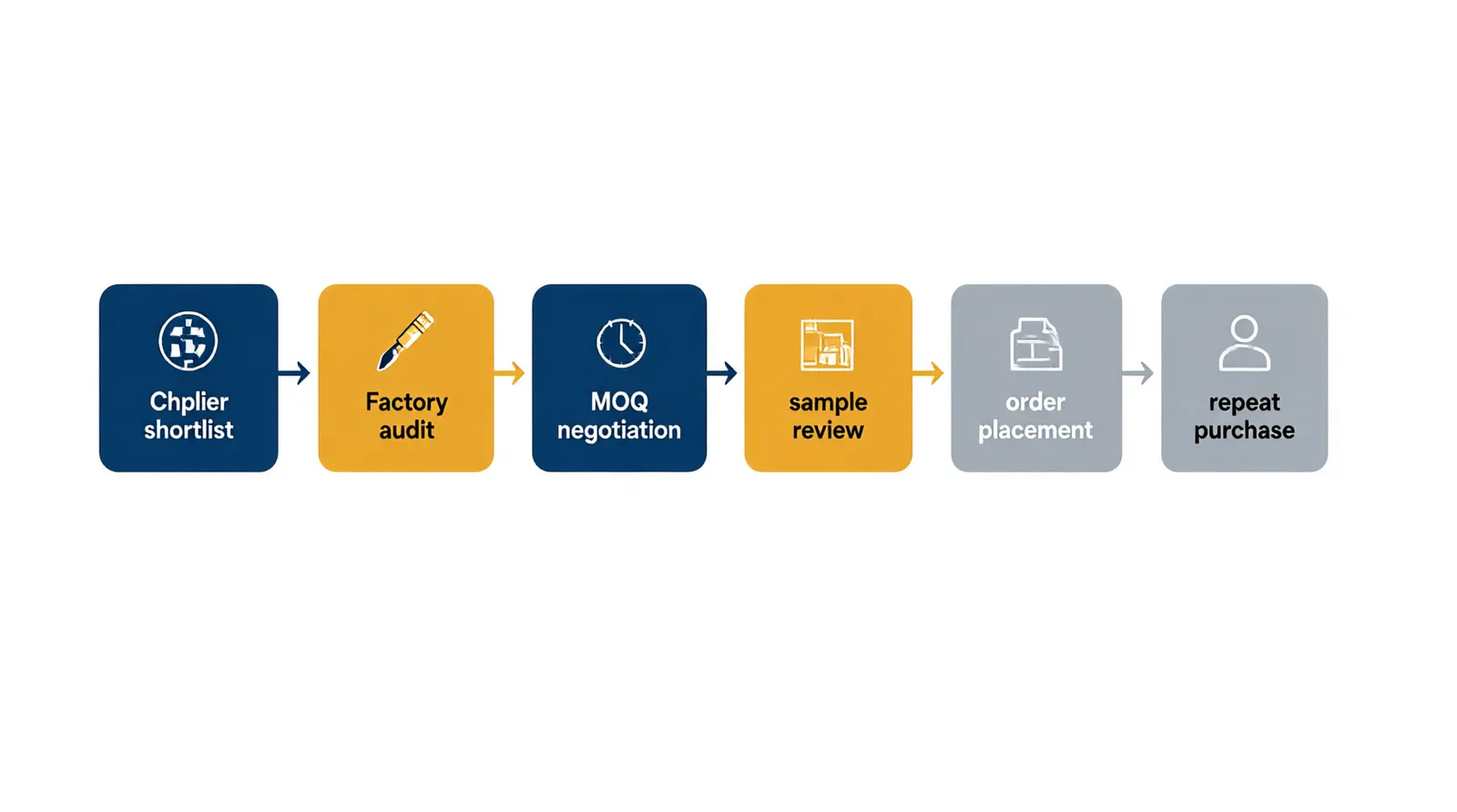
If you source manufactured goods from China — consumer products, electronics, apparel, home goods, or industrial components — the practical starting point is not a marketplace search. It's a structured supplier evaluation: factory shortlisting, vetting, MOQ and price negotiation, and sample coordination handled by a partner who earns only when your order closes.

For broader context on how 2026 trade developments affect your sourcing strategy, China Trade Deal 2026: What U.S. Importers Must Know Now covers tariff shifts, compliance checkpoints, and supply chain decision points in detail.
Ready to source from vetted Chinese factories? Link4a works with overseas buyers, DTC store owners, and online creators who want a dependable sourcing partner in China — shortlisting factories, vetting them, negotiating MOQ and price, coordinating samples, and managing repeat orders. Commission is charged only when an order closes.
Request a Quote or Get MOQ & Pricing — link4a.com
Trade agreement details are drawn from official government sources including the Government of Canada's January 2026 backgrounder and the Prime Minister's Office news release. U.S. importers should consult a licensed customs broker or trade attorney before making sourcing or compliance decisions based on this content.