Best Alternatives to China-India-Russia Sourcing in 2026
Best Alternatives to China-India-Russia Sourcing in 2026
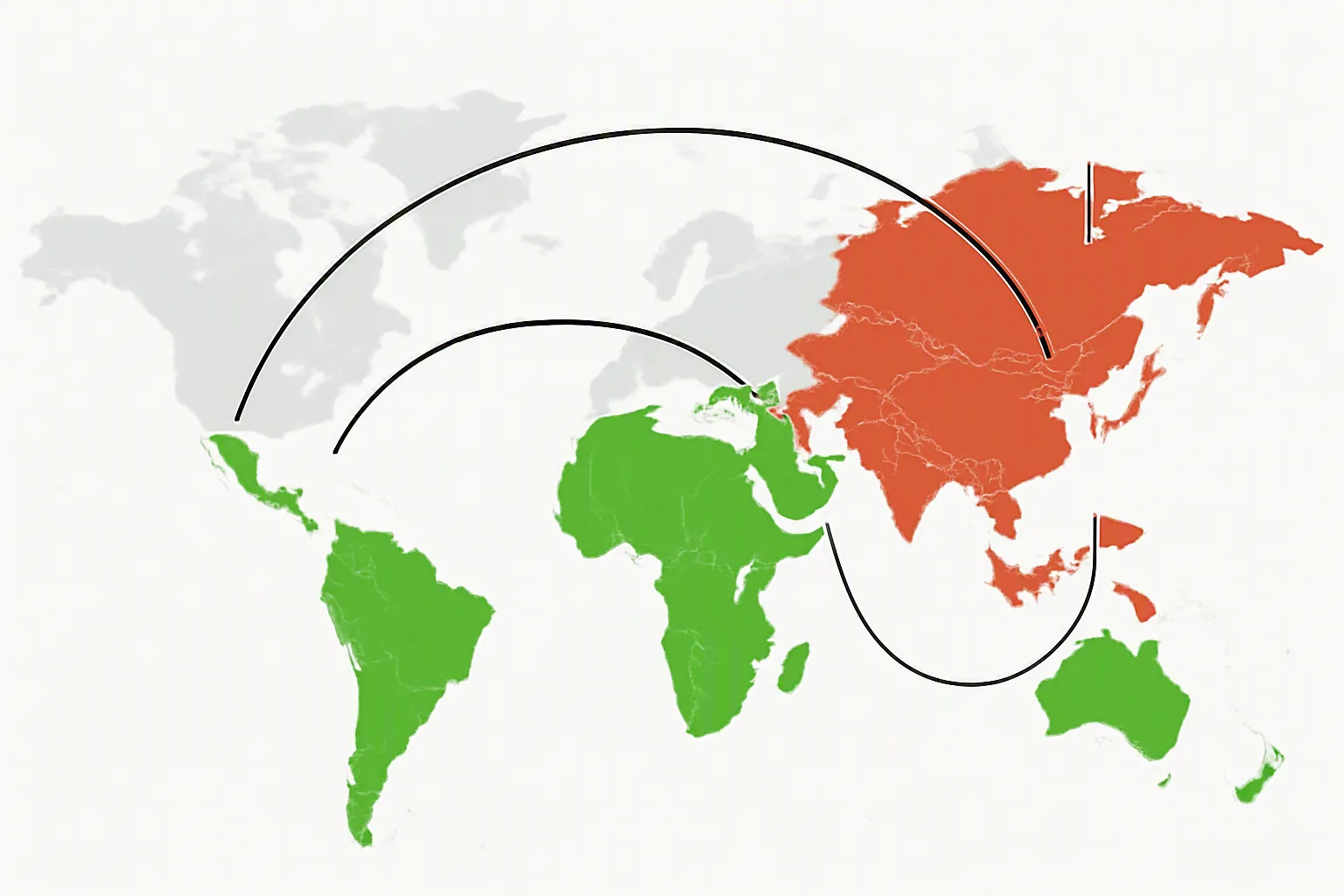
The China-India-Russia triangle is one of the most geopolitically active and logistically complex sourcing configurations a buyer can depend on — and in 2026, an increasing number of importers are actively looking for cleaner alternatives. Whether you source custom gold jewelry, luxury stainless steel accessories, or women's and men's hoop earrings, the risk calculus of the CIR triangle has shifted enough that the search for alternatives is no longer a fringe concern but a mainstream procurement priority.
Why Look for Alternatives to China-India-Russia?
The friction starts at the geopolitical layer and filters directly down to your purchase orders. China and India share a 3,488-kilometer disputed border — the longest undemarcated frontier between any two states. The two countries fought a war in 1962 that ended in a clear Indian defeat, and from 2012 onward, China has repeatedly taken small parcels of land along this Himalayan frontier. The 2020 Galwan Valley clashes pushed the relationship to its lowest point in decades. India and China only signed an agreement to de-escalate hostilities around the line of control in October 2024 — four and a half years after negotiations began. For buyers whose custom earrings are manufactured in Guangdong and whose gemstone suppliers sit in Jaipur, that timeline illustrates exactly how long sourcing disruptions can run.
Russia adds a third layer of complexity. Western sanctions have made Russian raw-material sourcing a legal minefield for most compliant importers. On top of that, Moscow has publicly bristled at New Delhi's growing proximity with Washington, and Russian Foreign Minister Sergei Lavrov has echoed Chinese criticism of the Indo-Pacific as a strategic construct and India's engagement in the Quad. For a DTC store owner running sales of permanent jewelry to US consumers, that kind of triangulated geopolitical exposure is a liability, not a feature.
The 2025 SCO Tianjin summit — held September 1, 2025, and featuring the first high-level meeting between Modi and Xi Jinping in seven years — signaled a tentative diplomatic thaw. But diplomatic handshakes don't reopen closed factories or resolve delayed shipments. Most buyers looking for alternatives aren't abandoning Asia; they're getting sharper about which parts they source from and how.
What to Look for in a China-India-Russia Alternative
Run every candidate option through these criteria before committing:
- Geopolitical stability and trade access: Does the country have predictable trade agreements with your target market? What's the sanctions exposure? Active territorial disputes directly affect freight and factory reliability.
- Manufacturing depth for your specific category: A region may excel at textiles but have thin capacity for custom gold permanent jewelry or precision stainless steel women's pieces. Verify before you shortlist.
- MOQ flexibility: Emerging hubs often offset lower labor costs with higher minimum order quantities. Get clarity on MOQ upfront — the landed economics change completely at different volume tiers.
- Supplier vetting infrastructure: Can you independently verify factory certifications and production capacity, or are you relying on a marketplace listing? The difference is meaningful when your brand is on the line.
- Communication and lead time: Multilingual support, reliable sample turnaround, and consistent repeat-order timelines are non-negotiable once you're at any real volume.
- Quality assurance norms: Does credible third-party inspection exist in that region? What's the standard practice for pre-shipment QC on jewelry and accessories?
- Total landed cost: Factor in tariffs, freight, inspection fees, and intermediary costs alongside factory gate price. The cheapest unit price rarely produces the cheapest landed unit.
Top Alternatives to China-India-Russia
1. Vietnam
Best for: Mid-volume buyers who need a tariff-advantaged, politically stable alternative to Chinese manufacturing for jewelry components, apparel accessories, and stainless steel pieces.
Pricing: Factory gate pricing has typically run 10–25% lower than China for labor-intensive products, though the gap shifts with currency moves and wage inflation; MOQs vary by factory.
Key strengths vs China-India-Russia:
- No active border disputes with major sourcing partners; exports to the US have benefited from trade diversion since 2018 tariff escalation
- Growing capacity for stainless steel jewelry, women's fashion earrings, and men's accessories
- CPTPP membership provides preferential market access to Japan, Canada, and Australia
- Clean separation from Russia sanctions exposure and the China-India border dynamic
Limitations / trade-offs:
- Shallower supplier infrastructure outside Ho Chi Minh City and Hanoi adds lead time and vetting effort
- Less capability for truly custom gold jewelry or high-complexity permanent jewelry requiring specialist artisans
- Factory directories and audit infrastructure are less mature than Guangdong-level equivalents
How it compares to China-India-Russia: Vietnam sidesteps the CIR triangle's geopolitical complexity entirely. It lacks Russia's commodity exposure and avoids the China-India border risk, but it also lacks China's manufacturing breadth and India's gemstone expertise. For buyers whose primary pain point is tariff risk and supply chain stability rather than specialized artisan jewelry, it's the clearest direct substitute.
2. Turkey
Best for: European and Middle Eastern buyers, and any importer prioritizing gold and luxury jewelry with EU-standard quality controls and shorter freight windows.
Pricing: Turkish gold and luxury jewelry typically price at a premium over Asian alternatives; offset partly by lower logistics cost to European markets.
Key strengths vs China-India-Russia:
- Istanbul's manufacturing ecosystem backs a sophisticated gold, luxury, and custom jewelry industry with deep artisan heritage
- EU Customs Union membership means fewer friction points for European DTC store owners selling gold and permanent jewelry
- Established capacity for high-end women's and men's pieces, including bespoke custom gold and luxury stainless steel
- Minimal exposure to Russia sanctions and no stake in the China-India border disputes
Limitations / trade-offs:
- Turkish lira volatility creates pricing unpredictability for buyers quoting in USD
- Weaker for mass-market stainless steel hoop earrings or high-volume fashion accessories vs Asian alternatives
- Higher labor costs than China or India for volume-sensitive product categories
How it compares to China-India-Russia: Turkey is the strongest alternative for buyers currently splitting their gold and luxury jewelry sourcing between Chinese factories and Indian gem setters. It consolidates those relationships into one geography at a higher per-unit cost — a trade-off that often makes sense for European distribution channels where logistics savings close the gap.
3. Thailand
Best for: Custom jewelry buyers, particularly those sourcing intricate silver, gold-plated, or permanent jewelry pieces requiring skilled artisan work at manageable MOQs.
Pricing: Comparable to mid-tier Indian jewelry manufacturing; premiums apply for custom and bespoke pieces.
Key strengths vs China-India-Russia:
- Chiang Mai and Bangkok have established custom jewelry ecosystems with experienced silversmiths and goldsmiths known for intricate work
- Strong quality norms for luxury and stainless steel pieces; credible third-party inspection available
- Politically stable relative to the CIR triangle; no active territorial disputes affecting trade routes
- Efficient air freight connections to North America and Europe for samples and small batches
Limitations / trade-offs:
- Smaller manufacturing base than China or India; capacity ceilings for large-volume orders become a real constraint
- Less suitable for mass-market hoop earrings or high-volume stainless steel women's accessories
- Supplier directories and factory transparency are less developed than Shenzhen equivalents
How it compares to China-India-Russia: For buyers who want Indian-style gemstone and artisan capability without the China-India geopolitical overhang, Thailand is the cleanest substitute. It isn't a fit for buyers who need scale, but for DTC brands selling custom permanent jewelry or small-batch luxury earrings, it often outperforms navigating two countries simultaneously.
4. Bangladesh and Sri Lanka
Best for: Apparel-adjacent accessory buyers or importers seeking very low labor cost for standardized, lower-complexity jewelry and fashion accessories at volume.
Pricing: Among the lowest factory gate prices in Asia for standardized production; MOQs tend to be higher to compensate.
Key strengths vs China-India-Russia:
- Bangladesh is well-integrated into global apparel and accessories supply chains with credible export infrastructure
- Favorable trade access: EU and US GSP preferences reduce landed tariff costs
- No direct exposure to China-India border tensions or Russia sanctions
- Growing capacity for stainless steel fashion jewelry and accessories
Limitations / trade-offs:
- Not a destination for custom gold, permanent jewelry, or precision stainless steel men's pieces requiring complex tooling
- Supplier transparency is still developing; third-party vetting requires more legwork than in established Chinese or Turkish hubs
- Quality consistency varies meaningfully between factories
How it compares to China-India-Russia: Bangladesh and Sri Lanka substitute for the lower-complexity, higher-volume end of what India offers — not replacements for China's manufacturing depth. If your product is a standardized stainless steel women's bangle or a fashion hoop earring in large quantity, this can work well. For anything custom or gold, look elsewhere.
5. Mexico (Nearshoring)
Best for: North American DTC store owners and importers who need faster replenishment cycles, simpler tariff compliance, and reduced freight transit time.
Pricing: Higher unit costs than Asia for most jewelry categories; offset by freight savings and speed-to-market advantages.
Key strengths vs China-India-Russia:
- USMCA provides stable, well-understood tariff treatment for US and Canadian buyers — a meaningful contrast to the unpredictability of CIR-adjacent sourcing
- 2–5 day freight to most US addresses versus 4–6 weeks by ocean from Asia
- No geopolitical entanglement with China-India disputes or Russia sanctions
- Growing jewelry and accessories manufacturing in Guadalajara and Mexico City
Limitations / trade-offs:
- Jewelry manufacturing depth is significantly shallower than China or India; fewer specialist factories across the full product range
- Custom gold and luxury stainless steel capacity is limited outside major hubs
- Unit economics are harder to defend for high-volume orders where per-unit price matters more than speed
How it compares to China-India-Russia: Mexico wins on speed and compliance simplicity; it loses on manufacturing depth and unit price. For North American brands whose primary pain is delivery time and tariff unpredictability in seasonal jewelry sales cycles, nearshoring is worth modeling seriously — but the shallower product range is a real constraint for specialized pieces.
6. Managed China Sourcing via a Vetted Partner (Link4a)
Best for: Overseas buyers, DTC store owners, and importers who want access to China's unmatched manufacturing breadth — including custom gold, permanent jewelry, luxury stainless steel, and men's and women's hoop earrings — without navigating the complexity directly.
Pricing: Commission-only model; nothing to pay before an order closes. Current terms at link4a.com.
Key strengths vs China-India-Russia:
- Access to vetted Chinese factories across the full product range — from mass-market stainless steel earrings to bespoke custom gold pieces — without the India or Russia exposure
- Supplier shortlisting, factory vetting, MOQ and price negotiation, sample coordination, and repeat ordering handled on your behalf, as detailed in their sourcing service overview
- Multilingual buyer communication across six locales, including Arabic (right-to-left layout) — relevant for Middle Eastern buyers currently using India as a secondary sourcing hub
- Verifiable SEO performance on their client storefronts: a sweep of 60 product pages in August 2026 found 17 ranking first on US Google and 31 in the top 10, with the specific queries published on their homepage — a point-in-time snapshot of rankings that can be checked and compared against current positions
Limitations / trade-offs:
- Focused on China manufacturing; not the right channel if you specifically need Indian gemstones, Turkish artisan gold, or Russian raw materials
- Commission structure means costs scale with order size; high-volume buyers should model total cost carefully against direct factory relationships
- Buyers who require complete ownership of factory relationships with no intermediary need to weigh that preference against the operational trade-off
How it compares to China-India-Russia: This is the most direct substitute for buyers who use the CIR triangle primarily because China is their main manufacturing source and find the India-Russia coordination a burden rather than a value-add. A managed China sourcing partner concentrates the CIR triangle's manufacturing value into a single, managed channel — cutting the geopolitical complexity of the other two nodes entirely. For jewelry buyers specifically, that means access to China's stainless steel production, gold plating, and custom permanent jewelry capacity, with quality verification built in.
7. ASEAN Multi-Country Sourcing
Best for: Sophisticated importers with established procurement teams who want geographic diversification across Vietnam, Thailand, Indonesia, and Malaysia to reduce single-country concentration risk.
Pricing: Varies widely by country and category; generally competitive with or below China for labor-intensive categories.
Key strengths vs China-India-Russia:
- Geographic diversification across stable, export-oriented economies with no shared territorial disputes
- No Russia sanctions exposure; minimal China-India border risk
- ASEAN free-trade agreements provide broad market access across the bloc
- Growing manufacturing depth in jewelry, electronics, and components across multiple member states
Limitations / trade-offs:
- Coordination complexity increases significantly when managing suppliers across three or more countries simultaneously
- Supplier vetting in emerging ASEAN manufacturing hubs requires substantial upfront time investment
- Less depth than China for custom gold, luxury permanent jewelry, or complex stainless steel components requiring specialist tooling
How it compares to China-India-Russia: ASEAN multi-sourcing is a risk-distribution strategy, not a simplification. It replaces the geopolitical risk of the CIR triangle with operational complexity. For buyers with the procurement infrastructure to manage it, ASEAN diversification is compelling — but for smaller DTC store owners or solo importers, a managed China partner typically delivers better outcomes with less overhead.
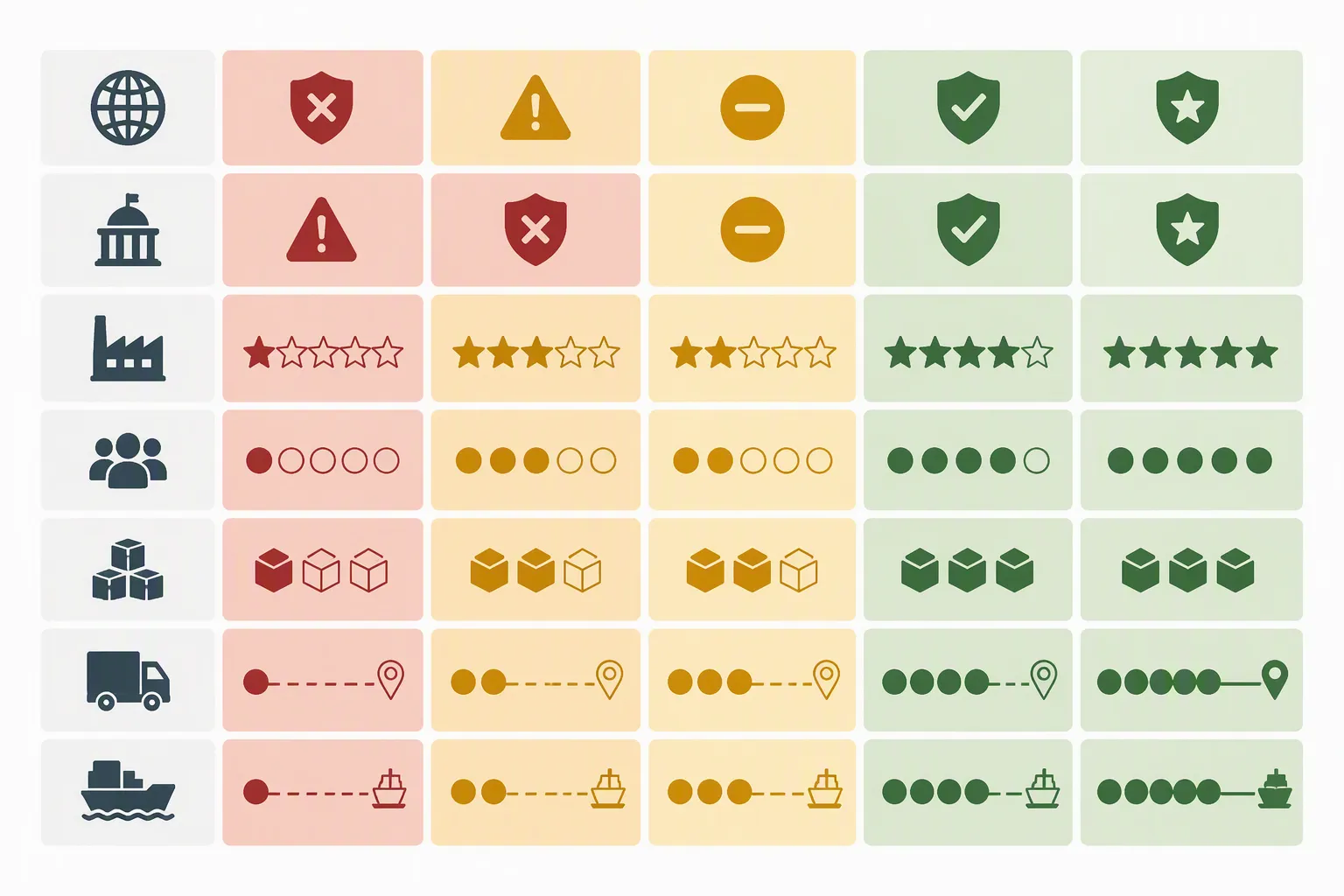
Side-by-Side Comparison Table
| Dimension | China-India-Russia | Vietnam | Turkey | Thailand | Mexico | Managed China (Link4a) | ASEAN Multi-Country |
|---|---|---|---|---|---|---|---|
| Geopolitical stability | Low (active disputes, sanctions) | High | Medium | High | High | High (managed) | High |
| Custom gold & luxury jewelry | High (split across 2 countries) | Low | High | High | Low | High | Low–Medium |
| Stainless steel capacity | High | Medium | Low | Medium | Low | High | Medium |
| Women's & men's hoop earrings at volume | High | Medium | Medium | Low–Medium | Low | High | Medium |
| MOQ flexibility | Variable, complex | Medium–High | Medium | Low–Medium | High | Negotiated | Variable |
| Supplier vetting support | DIY / inconsistent | DIY | DIY | DIY | DIY | Fully managed | DIY |
| Multilingual buyer support | Limited | Limited | Limited | Limited | Spanish/English | 6 languages incl. Arabic | Limited |
| US tariff exposure | High (China), Medium (India) | Low–Medium | Low (EU focus) | Low | Very Low (USMCA) | China tariffs apply | Low–Medium |
How to Pick the Right Alternative
You run a DTC store selling custom permanent jewelry and hoop earrings to US customers. The CIR triangle is overcomplicated for your use case. A managed China sourcing partner handles factory shortlisting, MOQ negotiation, and sample coordination without the India-Russia overhang. If China's manufacturing depth is what you need but the complexity is what's slowing you down, that's the clearest match.
You're a European importer with compliance requirements and a mid-luxury gold jewelry line. Turkey is your primary alternative. EU Customs Union access, established artisan gold production, and proximity to your distribution center offset the per-unit premium. Thailand is a strong secondary option if Turkish lead times don't work for your replenishment cycles.
You're sourcing high-volume, standardized stainless steel women's jewelry for a major online marketplace. Vietnam or Bangladesh offers tariff-advantaged production at competitive prices. Budget for proper supplier vetting upfront — third-party pre-shipment inspection is non-negotiable at this volume and this product category.
You're a North American brand with fast seasonal replenishment needs. Mexico nearshoring is worth running the numbers on. USMCA simplifies compliance, freight to US warehouses is fast, and landed cost often closes the gap with Asian alternatives once you account for duties and ocean freight. Accept the shallower product range as the known trade-off.
You're a Chinese factory owner who wants to reach overseas buyers without hiring an export sales team. The alternative to navigating international sales complexity yourself is a managed export channel. Link4a's commission-only model — overseas storefronts in six languages, buyer conversations handled on your behalf, no fees before an order closes — is built for exactly this use case.
Conclusion
The 2020 Galwan Valley clashes and four and a half years of tense border negotiations are enough data to conclude that the China-India-Russia triangle carries real, recurring sourcing risk — not just theoretical geopolitical noise. The 2025 SCO summit in Tianjin featured carefully managed photo-ops and language about "mutual respect," but even the most optimistic reading of Chinese Foreign Minister Wang Yi's late August 2025 visit to India — where he floated "exploring the possibility of advancing boundary demarcation negotiations" — confirms how unsettled the underlying dynamic remains.
For most buyers of custom jewelry, stainless steel accessories, gold pieces, and related goods, the priority ranking is clear: Vietnam for tariff-safe volume, Turkey for European luxury and gold, Thailand for bespoke artisan work, and a managed China sourcing partner for buyers who want the depth of Chinese manufacturing without coordinating across the full CIR triangle. Mexico works when speed and USMCA compliance outweigh unit economics.
The next step is a quote request, not more research. Map your product category — custom gold, permanent jewelry, stainless steel hoop earrings, men's or women's accessories — against the comparison table above, shortlist two or three alternatives, and run parallel quotes so you have real pricing to evaluate. If China sourcing is still in scope but the complexity is the problem, contact Link4a to get current MOQ and pricing from vetted factories. The commission-only model means the first conversation costs you nothing.