China Products Wholesale in the US: The Complete 2026 Buyer's Guide
China Products Wholesale in the US: The Complete 2026 Buyer's Guide
China's manufacturing ecosystem supplies the United States with everything from plumbing fixtures and power tools to windows, doors, and consumer electronics — at price points domestic production cannot match. For American businesses, sourcing wholesale goods from China is not a niche move; it is a foundational procurement strategy that fuels margins across retail, construction, e-commerce, and distribution.
China Products Wholesale in United States — Market Overview
American buyers have sourced from Chinese factories for decades, but the landscape has changed sharply since 2020. Supply chain disruptions, Section 301 tariffs, and a wave of DTC (direct-to-consumer) brands entering the market have reshaped how US importers engage with Chinese suppliers. Procurement teams at mid-market distributors, construction supply outlets, and TikTok-driven product brands are all competing for capacity at the same factories.
The buyer profiles vary widely. National distributors and regional builders purchase high-volume commodity goods — think PVC plumbing components, aluminum window extrusions, steel door frames, or hand-tool sets — and negotiate on annual volume and lead time. On the other end, DTC operators and Amazon sellers run smaller, faster orders, prioritizing suppliers who can handle low minimum order quantities (MOQ) and deliver private-label packaging. Both groups share the same core challenge: finding factories that are reliable, compliant, and easy to communicate with across a 12–15 hour time-zone gap.
The phrase "Made in China" has become synonymous with immense manufacturing capabilities and competitive pricing in global commerce, as documented across the top sourcing platforms. That reputation is well-earned. China's factory ecosystem spans raw materials, sub-components, and finished goods at a depth no single country can replicate. For US buyers, that breadth is both an advantage and a navigation problem — finding the right supplier among thousands of plausible options takes real infrastructure.
What's Specific About the United States
Regulatory and Compliance Environment
Importing into the US means clearing several distinct regulatory gates, depending on the product category. US Customs and Border Protection (CBP) enforces import declarations, and the Harmonized Tariff Schedule (HTS) classification determines your duty rate. Section 301 tariffs — layered on top of standard duties since 2018 — add 7.5–25% on a broad list of Chinese-origin goods, including many tools, hardware, and building materials. Buyers should confirm the HTS code of any product before finalizing pricing with a supplier; the tariff delta can flip a deal from profitable to marginal.
Beyond tariffs, product-specific agencies apply. Consumer goods require CPSC (Consumer Product Safety Commission) compliance. Electronics sold in the US need FCC authorization. Plumbing products sold into commercial buildings often need NSF/ANSI 61 certification for drinking-water contact. UL listing matters for electrical tools and components. Doors and windows going into residential construction may need to meet AAMA or NFRC performance ratings for energy codes. These requirements must be confirmed at the factory level — a supplier who cannot produce the certificate cannot legally supply that US channel.
Payment Methods and Business Norms
Wire transfer (T/T) remains the dominant payment method for B2B imports — typically a 30% deposit on order confirmation, 70% against the bill of lading. Larger buyers use Letters of Credit (LC) for order values above $100,000. Alibaba's Trade Assurance product offers a layer of protection for smaller transactions, though it requires using Alibaba's platform. PayPal and credit card payments are rare at factory level and typically signal a smaller, less-established supplier.
US buyers expect written contracts, clear Incoterms (FOB, CIF, or DDP depending on who manages freight), and English-language communication. Many Chinese factories now employ English-speaking sales staff, but technical specifications — especially for custom plumbing, window, or door hardware — can still get lost in translation. Build in a specification sign-off step with physical samples before production starts.
How to Choose a China Products Wholesale Provider in the United States
Choosing a wholesale partner is not just about who has the lowest quoted price. For US buyers specifically, these are the evaluation criteria that separate reliable suppliers from costly mistakes:
US market compliance capability. Can the factory produce the certifications your products need? Ask for existing compliance documentation upfront — a factory that has already run UL, FCC, or CPSC testing for similar products is far lower risk than one that promises to "arrange it."
On-the-ground audit history. Third-party factory audits (BSCI, SMETA, or customer-specific audits) signal that a factory has been vetted by real buyers. Factories serving major US retail channels — big-box home improvement stores, national tool distributors — maintain audit readiness year-round.
Time-zone coverage and response SLA. A 12-hour time difference means your morning is their evening. Suppliers with dedicated after-hours sales staff or AI-powered inquiry response can turn a 48-hour quote cycle into a same-day answer — which matters when your sales team is holding a customer.
MOQ and sampling terms. US mid-market buyers often need flexibility: an initial sample run, then a pilot order, then scale. Confirm the factory's actual MOQ at each stage — and whether sampling is charged or credited toward the first production order.
Freight and port connectivity. Most China-to-US ocean freight moves through Los Angeles/Long Beach or Seattle on the West Coast, or New York/Newark on the East. Confirm your supplier's export port and typical transit time to your preferred US port of entry. For time-sensitive goods, ask about air freight capacity.
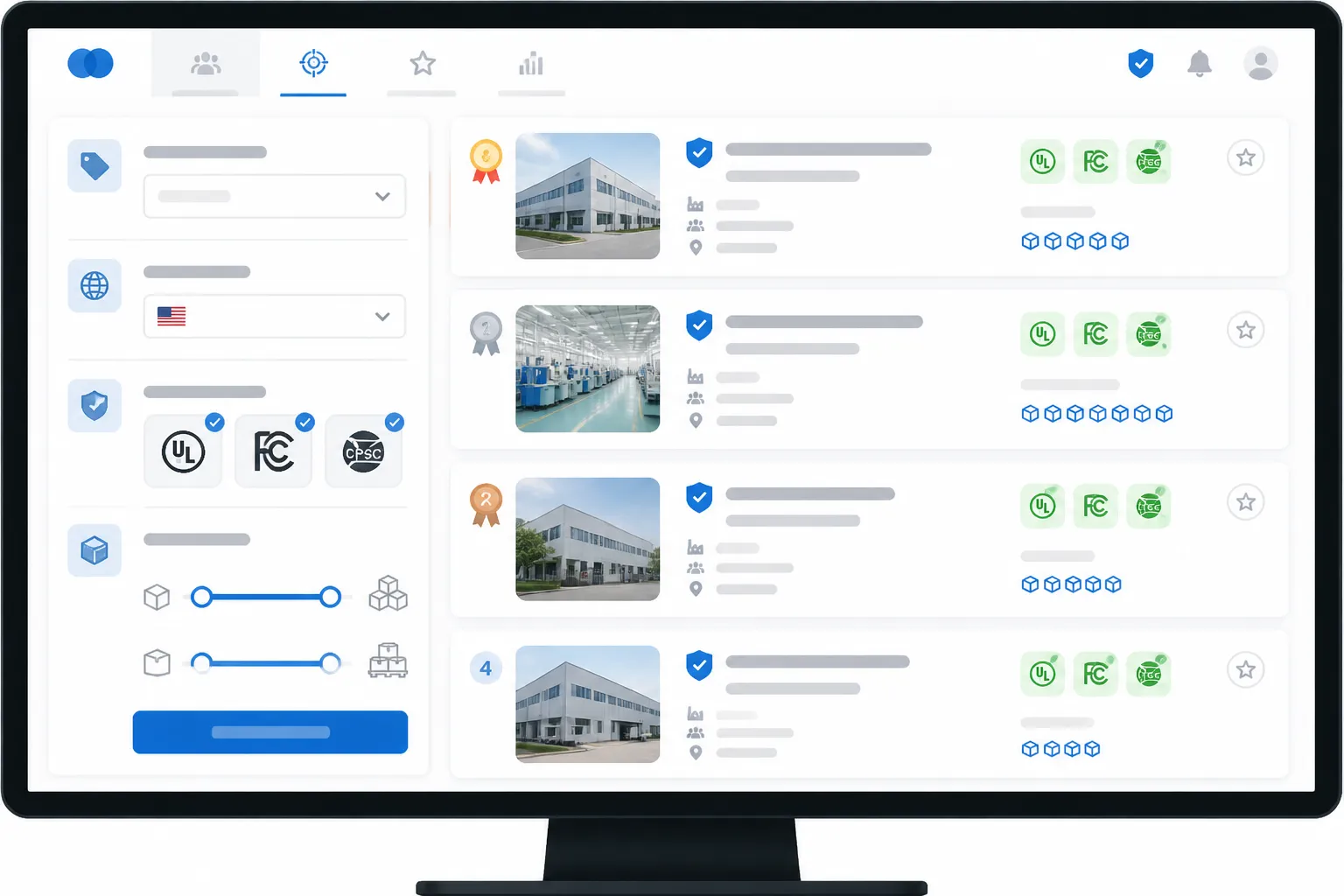
This is where platforms like Link4a's Match engine change the calculus. Rather than spending days running RFQs across platforms, Match surfaces pre-vetted factories in an average of 3 seconds — filtering by product category, certifications, MOQ range, and export market experience. For US buyers sourcing across categories (say, plumbing fixtures and tool sets in the same sourcing cycle), that speed compounds quickly.
Pricing in the United States
Wholesale pricing for Chinese-origin goods in the US market is quoted in USD almost universally, though the underlying factory price is negotiated in RMB (CNY). Exchange rate fluctuations affect your effective landed cost, so locking in pricing for a full order run — rather than spot-pricing each shipment — is standard practice.
Rough landed-cost structure to model (before your margin):
- FOB factory price: what the supplier quotes
- Ocean freight: typically $2,500–$6,000+ per 20' or 40' container, depending on route and market conditions
- Section 301 tariff: 7.5–25% of customs value, category-dependent
- Standard import duty: varies by HTS code, often 0–6% for manufactured goods
- US customs brokerage and port fees: $300–$800 per shipment for standard clearances
- Last-mile freight to your warehouse: variable
For smaller buyers who cannot fill a container, consolidation (LCL — less than container load) is available but increases per-unit freight cost significantly. DDP (delivered duty paid) pricing from suppliers is increasingly offered; it simplifies accounting but embeds the freight and tariff markups into the unit price — make sure you're comparing apples to apples when evaluating quotes.
Pricing pressure from Chinese suppliers has intensified as the global trade environment has tightened. Factories serving US buyers understand that tariff exposure is real, and many have worked on production cost reductions to help buyers stay competitive.
Common Challenges for Buyers in the United States
Logistics and Lead Time Variability
Ocean transit from major Chinese ports to Los Angeles runs 14–18 days under normal conditions. Add factory production time (4–8 weeks for most manufactured goods), port congestion, and US inland freight, and "6 weeks end-to-end" is a best case. US buyers should plan inventory with 10–12 week lead cycles and maintain safety stock accordingly.
Tariff Classification Disputes
CBP can challenge an importer's HTS code classification, resulting in additional duties, penalties, or cargo holds. Products in ambiguous categories — a tool with both power and hand-tool features, or a door component with structural and decorative elements — are particularly vulnerable. Work with a licensed US customs broker before your first shipment in any new category.
Supplier Reliability and Quality Drift
A factory that delivers perfect samples may cut corners on production once an order is confirmed. Quality control inspections (pre-shipment or during production) by a third-party QC firm based in China are standard practice for US buyers with any volume. Do not skip this step on first-time orders.
Communication Gaps Across Time Zones
Late-night WeChat messages and 24-hour response lags create friction in fast-moving sourcing cycles. Factories using AI-powered inquiry tools — like Link4a's Inbox — can handle multilingual inquiries around the clock, so US buyers get real answers during their business day rather than waiting for Shanghai's morning.
IP and Branding Protection
For buyers building private-label or OEM product lines, protecting design files, molds, and brand marks requires explicit contract language. Non-disclosure agreements (NDAs) and mold ownership clauses should be signed before sharing technical drawings. US trademark registration does not automatically protect you from Chinese factories selling your design to competitors — factory contracts must address this directly.

Frequently Asked Questions (United States-Specific)
Q: Do I need a customs bond to import China wholesale products into the US? A: Yes. Any commercial shipment valued over $2,500 requires a continuous customs bond (or a single-entry bond for one-time imports). A licensed customs broker can arrange this; annual continuous bonds typically cost $400–$600 for importers with moderate volume.
Q: How do Section 301 tariffs affect my total landed cost? A: Section 301 tariffs are applied on top of standard import duties, based on your product's HTS code. Rates range from 7.5% to 25% for most covered categories. Confirm your product's classification before finalizing supplier quotes — the tariff difference between two similar HTS codes can be significant.
Q: Can Chinese suppliers ship directly to Amazon FBA warehouses? A: Yes, many experienced Chinese suppliers handle DDP shipments directly to Amazon fulfillment centers. Confirm that the supplier can handle FBA labeling requirements, carton dimensions, and the US customs entry process. Not all factories have this capability — ask explicitly.
Q: What certifications should plumbing and building material suppliers have for the US market? A: For plumbing, look for NSF/ANSI 61 (drinking water contact) and cUPC certification. Windows and doors going into residential construction need AAMA and NFRC ratings to meet energy codes in many US states. Always request the actual certificate, not just a supplier's claim.
Q: How do I verify that a Chinese supplier is legitimate and not a trading company posing as a factory? A: Request a business license, export license, and factory audit report. Google Maps the factory address — satellite imagery often reveals whether the location is a warehouse or an actual production facility. Platforms like Link4a that run pre-verification on their supplier network reduce this research burden significantly.
Q: What payment method protects US buyers best? A: For first-time orders, Alibaba Trade Assurance or a Letter of Credit offer the most protection. For established supplier relationships, T/T (wire transfer) with a 30/70 split is standard and cost-efficient. Avoid full-payment-upfront arrangements with unverified suppliers.
Q: Is it legal to import Chinese goods branded with a US trademark I own? A: Yes, if you are the trademark holder and the goods comply with US product regulations. However, US Customs enforces IP restrictions at the border — if your trademark isn't recorded with CBP, counterfeit goods bearing your mark could pass through. Trademark recordation with CBP is a separate filing from USPTO registration.
Get Started in the United States
The fastest way to reduce sourcing risk is to connect with suppliers who already know the US market — its certifications, its buyers, and its compliance expectations. Here's a concrete action plan:
- Define your product spec and target HTS code before reaching out to any supplier. Know your tariff exposure before you know your margin.
- Request samples from 2–3 shortlisted factories, not just the lowest bidder. Evaluate quality, packaging, and communication responsiveness equally.
- Commission a pre-shipment inspection on your first container from any new factory — third-party QC firms in China charge $300–$500 per inspection and regularly catch issues before they become chargebacks.
- Build time-zone coverage into your supplier criteria. Factories with 24/7 English inquiry response — or AI-backed tools like Link4a's Inbox — compress your sourcing cycle meaningfully.
- Use a matchmaking platform to shortlist pre-vetted, export-ready factories rather than sifting through thousands of unverified listings.
Link4a's Match engine connects US buyers with verified Chinese factories in seconds — filtered by product category, export experience, and target market. Once you've identified a supplier, Sitebox lets factories deploy a professional English-language product site in under 30 minutes, so you're evaluating a real brand presence, not just an Alibaba listing. With 300+ factories already on the network and 1,400+ sites live, the supplier pool covers everything from construction materials (doors, windows, plumbing, builders' hardware) to tools, consumer goods, and OEM electronics.
Ready to source smarter? Request a quote, get MOQ and pricing, or find your matched supplier at https://link4a.com.
Information on tariff rates and certification requirements reflects publicly available US regulatory frameworks. Consult a licensed customs broker and compliance specialist for product-specific guidance before importing.