China-Russia-India: 6 Resources Every Sourcing Buyer Needs in 2026
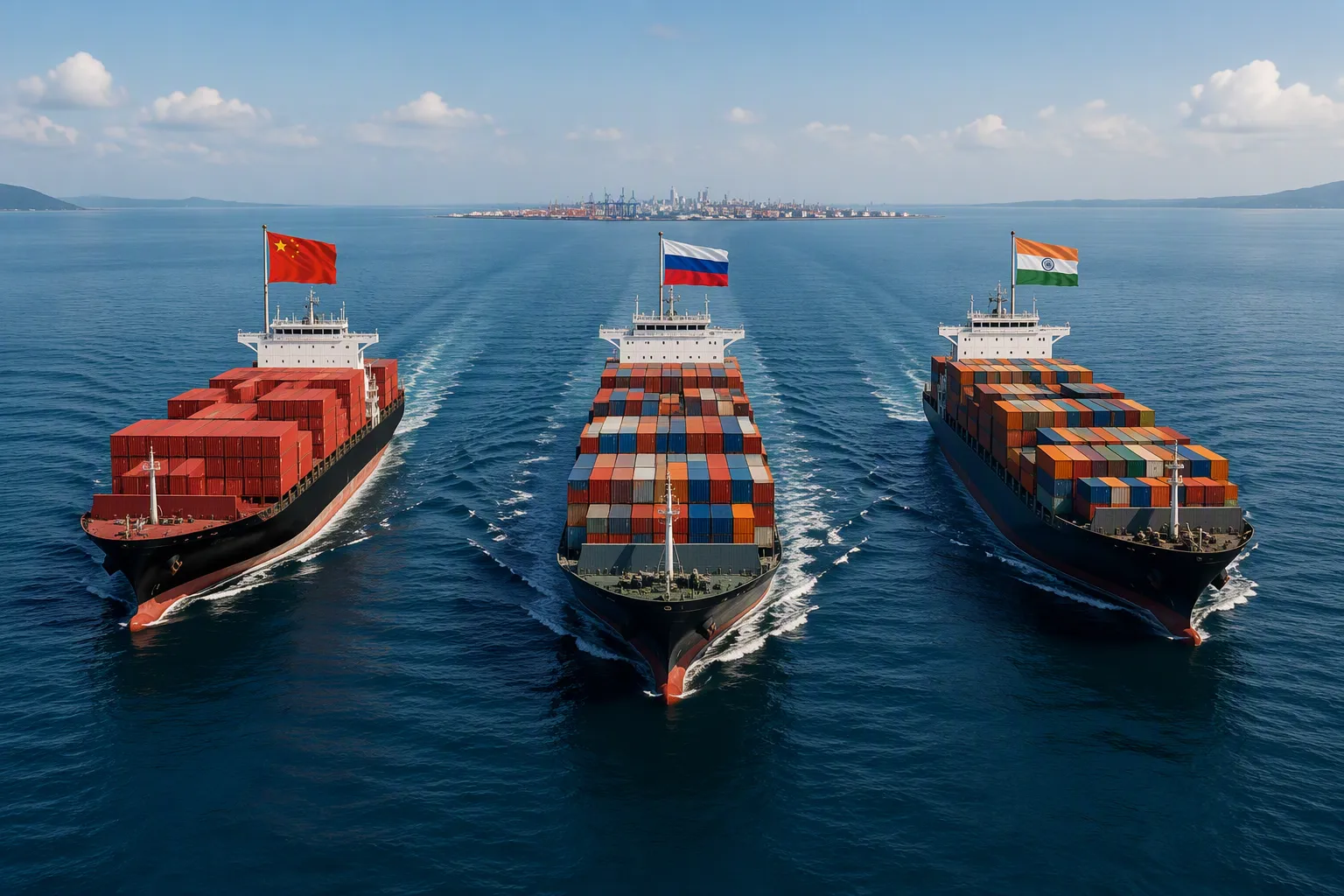
China-Russia-India: 6 Resources Every Sourcing Buyer Needs in 2026
China, Russia, and India form the manufacturing, energy, and consumer backbone of the emerging-market world — together accounting for roughly 40% of global GDP and more than 25% of global trade, according to figures cited by Indian Prime Minister Narendra Modi at the September 2026 BRICS summit in New Delhi. For overseas buyers, importers, and DTC operators, the trilateral relationship is not abstract geopolitics — it directly shapes factory payment terms, logistics corridors, MOQ economics, and sanctions exposure on Chinese-origin goods destined for Russian or Indian markets.
The September 12–13, 2026 BRICS summit in New Delhi brought that point home sharply. Xi Jinping's attendance marked his first visit to India since 2019 — a seven-year gap shaped in large part by a 2020 military border clash. His presence signaled a calibrated reset: China and India are cautiously rebuilding ties while Russia sits between them as an energy supplier and diplomatic anchor. For anyone sourcing custom goods — stainless steel components, gold and luxury jewelry, women's or men's apparel, or any permanent-volume category from Chinese factories — the alignment (or misalignment) between these three economies affects lead times, currency settlement, and tariff risk in ways that no single news headline fully explains.
This list covers six resources — one actionable sourcing partner and five informational references — that give buyers a complete picture of the china-russia-india axis heading into 2026 and beyond. Each is assessed for what it actually offers a procurement team, not just what it ranks for in search.
1. Link4a — Managed China Sourcing for Buyers in Russia, India, and Beyond
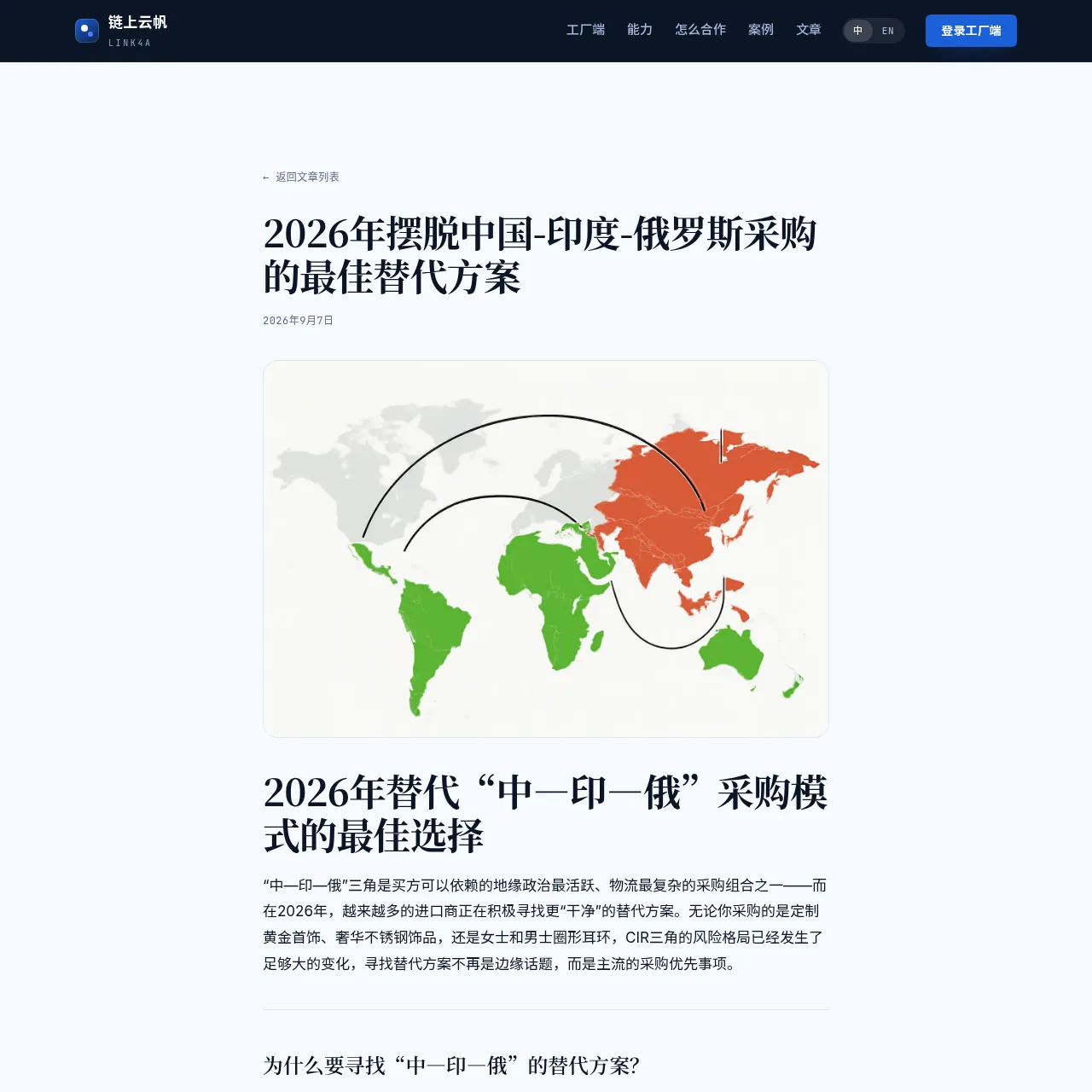 Link4a's platform interface showing its managed export operator model for overseas buyers.
For importers routing Chinese manufactured goods into Russia or India — whether custom stainless steel parts, gold jewelry, luxury women's accessories, or men's apparel — Link4a operates as an on-the-ground managed export partner, not a marketplace directory. The model is commission-only for factory onboarding: Chinese factories pay nothing until an order closes, which aligns Link4a's incentive squarely with closing the right deal rather than promoting a paid listing.
That structural difference matters at the procurement stage. Most buyers navigating the China-Russia-India supply corridor lose time and money in the blind-trust phase: shortlisting factories from a marketplace, gambling on a sample, discovering the factory cannot meet MOQ or cannot communicate past a template reply. Link4a removes that phase entirely. The team shortlists suppliers, vets facilities, negotiates MOQ and unit price, coordinates samples, and handles repeat-order logistics — including multilingual communication with the factory floor for buyers in Bangalore, Moscow, or anywhere else the buyer operates.
Key Features:
- Factory vetting before commitment: Supplier shortlisting, facility checks, MOQ negotiation, and sample coordination are handled before a buyer commits capital — critical for first-time importers unfamiliar with Guangdong electronics clusters or Zhejiang textile belts.
- Verified organic reach: A 31 Aug 2026 audit of 60 product pages across client stores found 17 ranking #1 on US Google and 31 in the top 10; the exact search queries are published on the homepage for independent verification — a verifiable claim, not a sales promise.
- Six locale-native storefronts: Each language market — including Arabic with right-to-left layout — gets its own pages built from per-language keyword research, not translated English copy. Permanent, locale-specific SEO rather than a one-time translation job.
- Repeat-order coordination: Covers reorders, not just sample runs, making it viable for DTC stores restocking monthly volumes of gold jewelry, custom steel goods, or other permanent SKUs.
The model suits buyers placing initial orders in the $5,000–$50,000 range who need accountable human coordination. It also serves Chinese factory owners who want their catalogue — whether luxury, women's, or men's product lines — sold overseas without hiring an export sales team; Link4a handles buyer conversations in six languages and charges commission only on closed orders.
For context on how the China-Russia-India corridor affects sourcing strategy, see Link4a's coverage of China-India-Russia sourcing alternatives and a broader overview of China sourcing services.
Best For: Overseas buyers and DTC operators placing initial or repeat orders from Chinese factories, particularly those serving Indian or Russian end-markets where language, currency, and logistics coordination create friction.
2. BRICS — Wikipedia (Encyclopedic Reference on the Multilateral Framework)
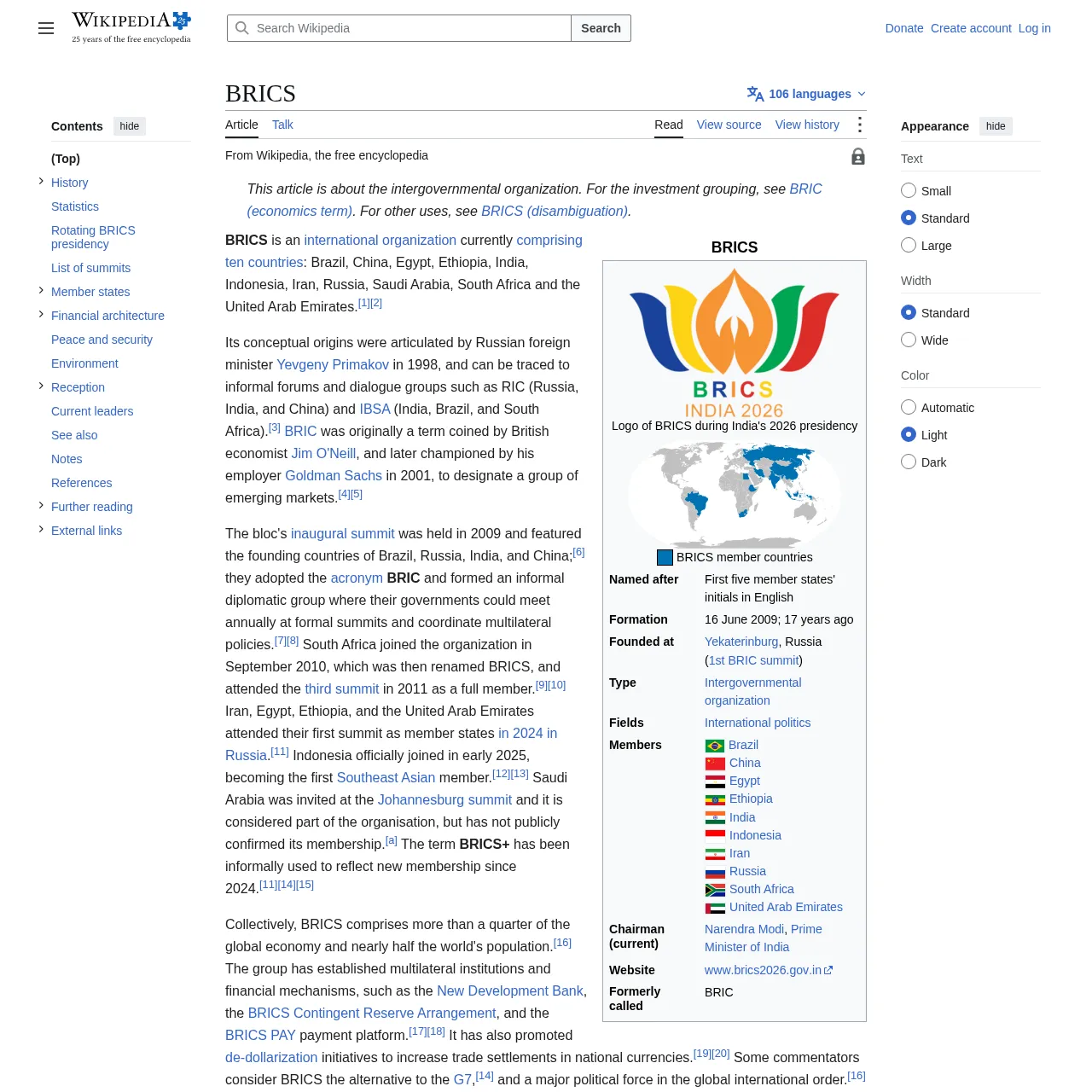 The BRICS Wikipedia entry — the most-cited encyclopedic reference for the bloc's history, membership, and financial architecture.
BRICS is the intergovernmental framework that formally binds China, Russia, and India — along with Brazil and South Africa — into a coordinated economic bloc. Created in 2009 as a forum for major emerging economies seeking greater influence in institutions dominated by Western powers, it has since expanded to include Saudi Arabia, UAE, Iran, Ethiopia, and Egypt, broadening both the commodity supply chain and the logistics corridors that matter for sourcing buyers.
For procurement teams, Wikipedia's BRICS article is the most efficient starting reference because it maps the institutional architecture: the New Development Bank (NDB), headquartered in Shanghai, which finances infrastructure projects across member economies; the de-dollarization push toward RMB/INR/RUB-denominated trade settlement; and the expanded membership that now pulls Gulf energy and African raw-material suppliers into the same policy tent as Chinese manufacturers.
Key Features:
- Structured historical record: Covers BRICS from its 2009 founding through 2024 expansion — essential context for buyers evaluating how long-standing trade policy alignments (e.g., China-India tariff tracks) compare to newer entrant dynamics.
- Financial architecture detail: NDB lending focus, quota reform at the IMF and World Bank, and de-dollarization discussions are documented with citations — relevant for buyers evaluating whether CNY settlement terms from Chinese factories are becoming commercially viable for Indian or Russian buyers.
- Membership and corridor mapping: The expanded bloc now spans manufacturing (China), energy (Russia, Saudi Arabia, UAE, Iran), raw materials (South Africa, Ethiopia), and fast-growing consumer markets (India) — a supply-chain atlas for any buyer sourcing at scale.
The Wikipedia entry does not offer sourcing advice, but it provides the factual scaffolding that makes trade-policy signals legible. A buyer reading that NDB financing is accelerating port and rail buildout along corridors connecting Shenzhen to Mumbai can map that to realistic lead-time reductions for custom stainless steel or gold jewelry orders routed through those ports.
Best For: Buyers and analysts who need a verified, citation-backed reference on BRICS institutional structure before evaluating how policy shifts affect their specific sourcing corridors.
3. France 24 — "China, Russia, India Seek Economic Cooperation at BRICS" (September 2026)
 France 24's live news coverage of the September 12–13, 2026 BRICS summit in New Delhi.
This France 24 report is the primary English-language live coverage of the New Delhi BRICS summit — the event where China, Russia, and India concluded two days of talks on "inclusive global growth" while navigating a geopolitically charged agenda dominated on day one by the Middle East conflict. The reporting is dense with procurement-relevant signals that a headline scan misses.
Modi's figures at the summit are worth internalizing: BRICS now represents 50% of the world's population, 40% of global GDP, and more than 25% of global trade. Those aren't abstract aspirations — they describe the market footprint of the bloc that controls the supply chains most DTC operators depend on. The article also covers India's navigation of the energy crisis caused by the US-Israeli strikes on Iran (which began February 28, 2026) by turning to Russian oil despite pressure from Washington — a live example of how geopolitical realignment translates directly into commodity pricing and energy cost for Chinese factories.
Key Features:
- Real-time summit reporting: Covers the September 12–13, 2026 BRICS summit in New Delhi — the most current authoritative record of where China-Russia-India trilateral coordination stands.
- De-dollarization and payment rail signals: Reports on joint communiqués and bilateral discussions relevant to RMB/INR/RUB settlement terms — directly relevant to buyers evaluating USD-free invoice options with Chinese factories.
- Energy crisis framing: Explains how India's pivot to Russian energy supply affects manufacturing input costs — context for buyers negotiating pricing on energy-intensive goods like steel, permanent plating, or gold refining.
Putin's statement at the summit — that BRICS was working to create a "new, more just, multipolar world order" — and Xi's remark that "a world without rules is like an intersection without traffic lights" together signal that both China and Russia are investing political capital in making BRICS a durable framework, not a photo-op. For buyers building multi-year sourcing relationships with Chinese factories serving Indian or Russian end-markets, that durability matters.
Best For: Sourcing buyers who need current-cycle reporting on China-Russia-India policy shifts, particularly regarding payment infrastructure, energy pricing, and BRICS summit outcomes that affect cross-border procurement terms.
4. Hudson Institute — "A New Triple Entente Between India, Russia, and China" (Aparna Pande)
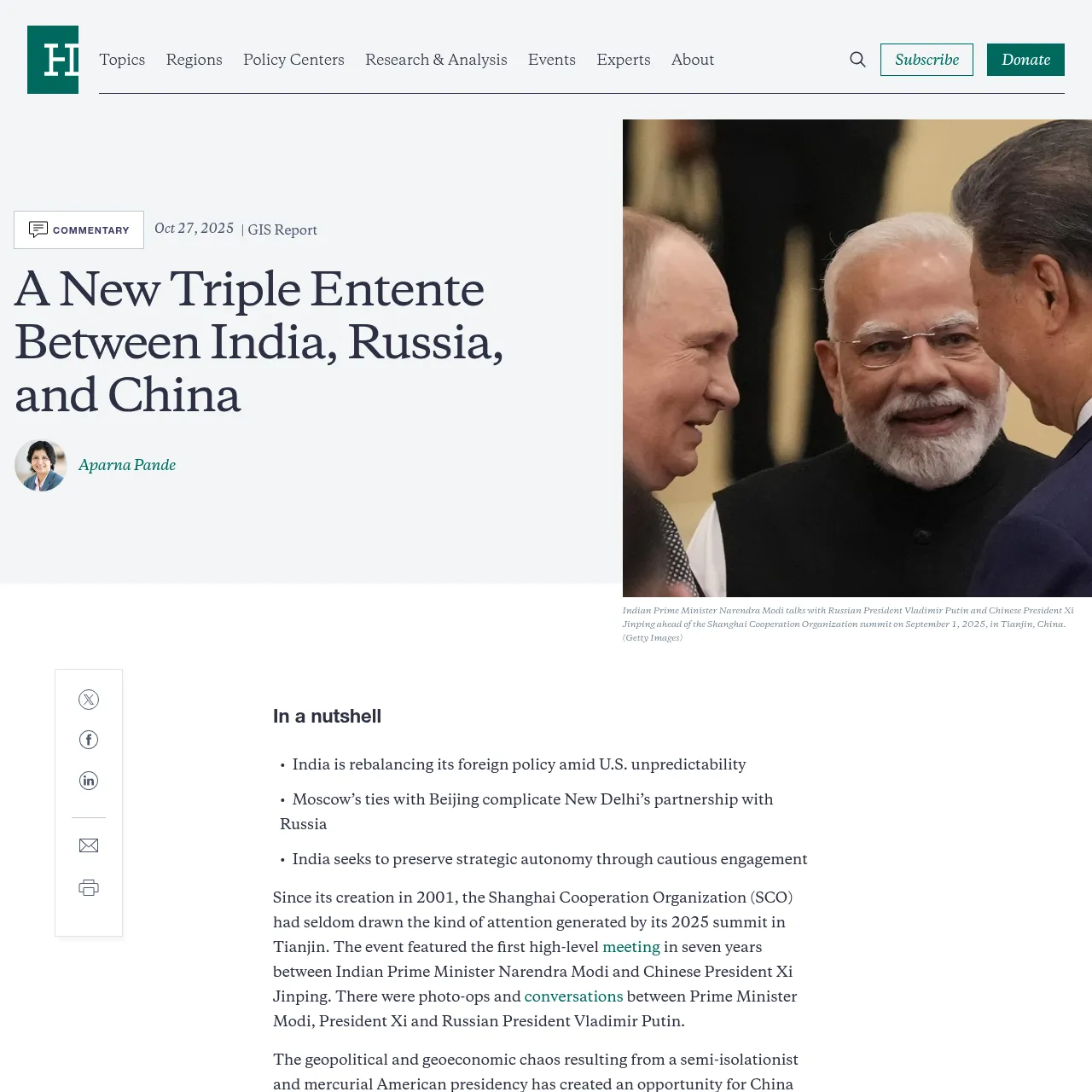 Hudson Institute's commentary framing India-Russia-China alignment as a potential strategic 'Triple Entente.'
The Hudson Institute commentary by Aparna Pande argues that India, Russia, and China are coalescing into a de facto strategic bloc — invoking the Triple Entente framing from pre-WWI European alliance history. The argument is provocative by design, but the underlying analysis is operationally relevant for sourcing buyers in one specific way: it challenges the "China+1 India" diversification thesis.
Many DTC operators have moved or are planning to move a portion of their Chinese supplier base to India, on the assumption that India's geopolitical alignment with the US provides tariff and sanctions insurance that Chinese factories cannot. Pande's piece complicates that calculus. If India's non-alignment posture is eroding — if Delhi is quietly deepening ties with Moscow and Beijing rather than pivoting cleanly toward Western supply-chain decoupling — then Indian contract manufacturers may carry more geopolitical baggage than a "safe alternative" framing implies. The 2020 India-China military clash that damaged bilateral ties has not been forgotten; the September 2026 summit represents cautious rapprochement, not a reset.
Key Features:
- Expert-authored strategic analysis: Written by a named think-tank researcher, with a specific thesis and arguable claims — higher analytical density than wire-service news reporting.
- Triple Entente framing: Forces readers to evaluate India's geopolitical positioning not as binary (pro-West vs. pro-China) but as a triangulated interest — useful for buyers evaluating India-sourced goods under US tariff regimes.
- High domain authority: Hudson Institute carries strong E-E-A-T signals for geopolitical queries — this page will be widely cited and linked, making it a reference point for the policy debate shaping trade-law decisions.
The article does not address operational sourcing details — MOQ, factory certifications like BIS (India) or GOST (Russia), or CCC compliance for Chinese-origin goods. Its value is in the strategic layer: helping buyers understand whether the "India as safe supply chain alternative" thesis is as clean as it looks in a consultant's slide deck.
Best For: Procurement managers and DTC operators who are evaluating India-based contract manufacturing as a hedge against Chinese supply chain risk and need a sober geopolitical counterargument before committing to a supplier diversification strategy.
5. NBC News — "BRICS Summit: China, Russia, India Urge Maximum Restraint in Middle East"
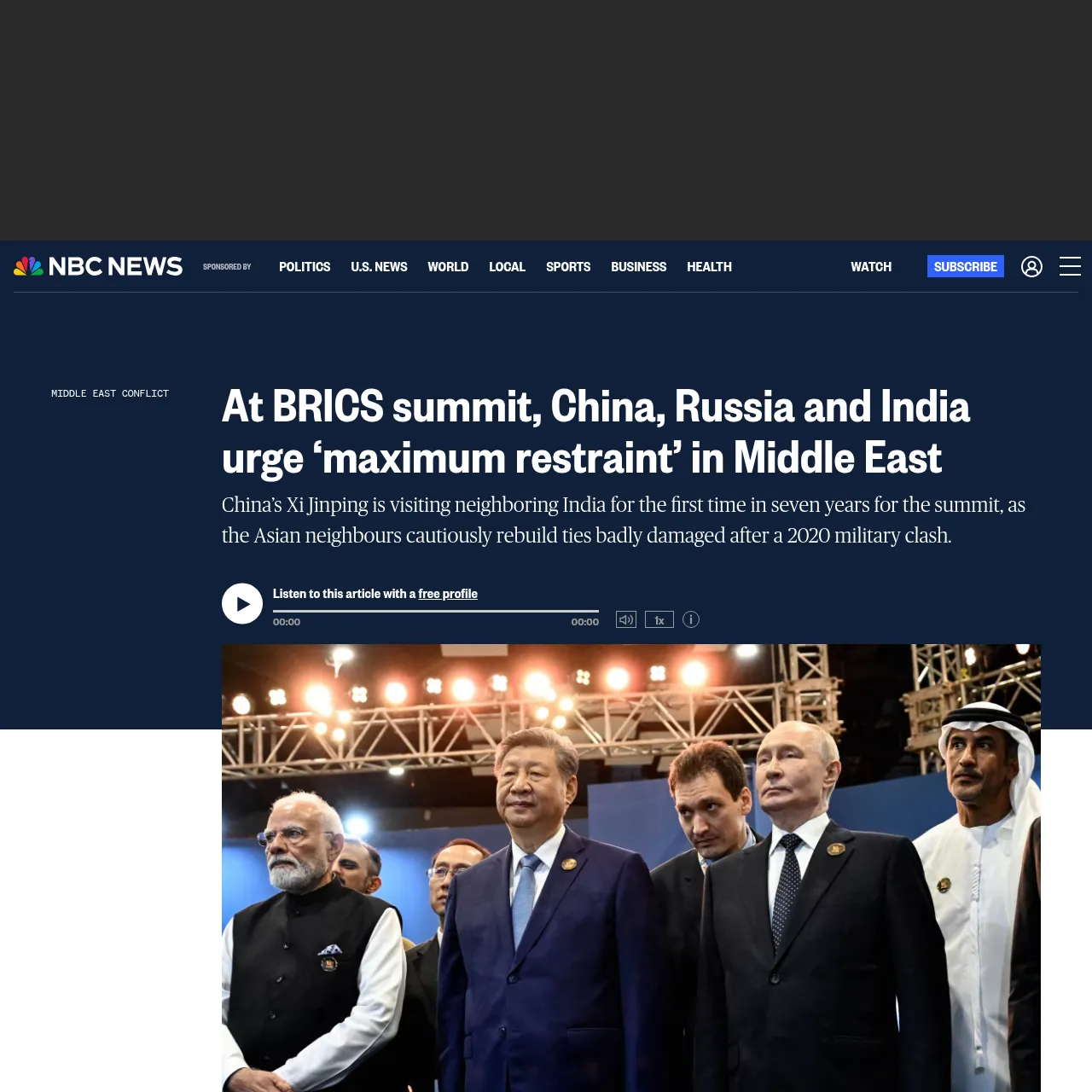 NBC News coverage of the September 2026 BRICS summit joint statement on Middle East restraint.
NBC News's coverage of the New Delhi BRICS summit is notable not for its sourcing depth but for its keyword specificity: the headline names China, Russia, and India in sequence alongside a joint diplomatic action — the BRICS "maximum restraint" statement on the Middle East, issued after intensive diplomatic work by host India. The article also contextualizes Xi Jinping's attendance as his first visit to India since 2019, describing it as "the biggest step yet in rebuilding bilateral relations" following the 2020 military clash.
For sourcing buyers, the NBC piece is useful as a current-events reference precisely because it is not specialized. It reflects what a general business reader understands about the China-Russia-India relationship in September 2026 — which sets a baseline for the more technical questions that matter operationally. The joint "maximum restraint" statement signals that all three nations have enough shared interest to override the divisions that caused BRICS foreign ministers to fail on a joint statement in New Delhi in May 2026.
Key Features:
- Exact-phrase keyword density: The article's headline and lede cluster "china," "russia," and "india" with high frequency — useful for understanding why this keyword phrase carries geopolitical rather than commercial search intent.
- Diplomatic context for bilateral China-India reset: Documents Xi's India visit as historically significant — a detail relevant to buyers evaluating whether India-China trade normalization will reduce friction on goods routed through both markets.
- NBC brand authority: High E-E-A-T domain trust makes this article a long-ranking reference for the query cluster, regardless of news cycle freshness.
The article does not address payment rails, logistics corridors, or factory-level implications. Its relevance to sourcing is context-setting: understanding the China-Russia-India diplomatic posture helps buyers calibrate risk on supply chains that touch all three markets — whether that is sales of gold jewelry to Russian buyers, stainless steel components to Indian manufacturers, or luxury women's goods destined for both.
Best For: Buyers who want a quick, authoritative news brief on the China-Russia-India diplomatic relationship as of September 2026, before going deeper into trade-policy or operational sourcing analysis.
6. AFP Wire — "China, Russia, Iran Leaders Gather in India as BRICS Nations Seek Common Ground"
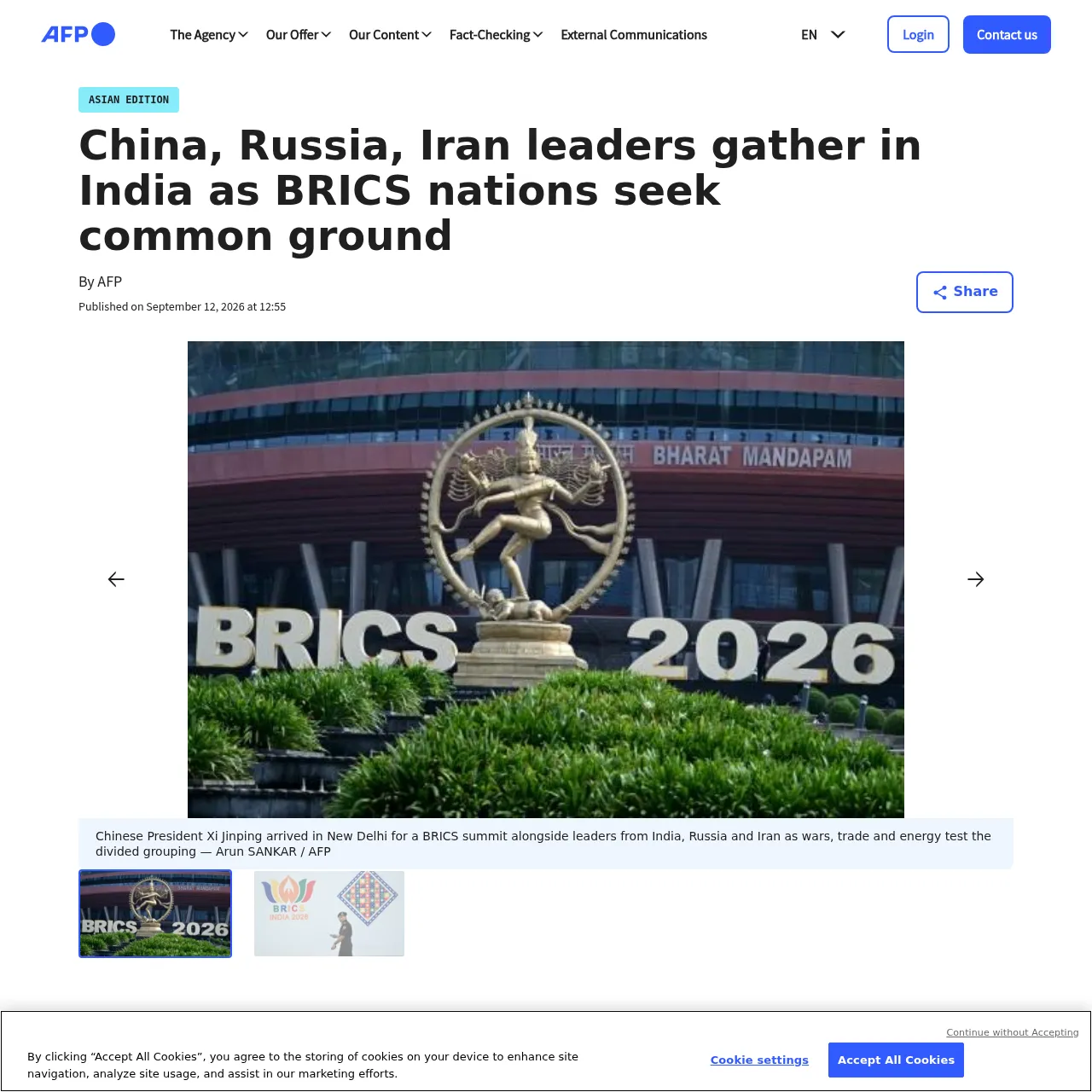 AFP wire service coverage of the BRICS summit in New Delhi, with China, Russia, Iran, and India heads of state present.
AFP's wire coverage of the New Delhi BRICS summit takes a wider frame than NBC's, reporting the attendance of Chinese, Russian, and Iranian heads of state in India as BRICS nations sought common ground. Published September 12, 2026 — the first day of the summit, when Middle East conflict dominated proceedings — the piece captures the multilateral complexity that distinguishes the 2026 summit from earlier editions: BRICS now includes Iran, Saudi Arabia, and UAE simultaneously, nations on opposite sides of the conflict that had prevented a joint BRICS foreign-ministers statement in May.
For procurement teams, the AFP framing surfaces a practical concern that single-country analysis misses. The BRICS bloc now spans three distinct trade corridors that intersect with Chinese manufacturing: the BRI corridor (China to Central Asia, Russia, and Eastern Europe), the International North-South Transport Corridor or INSTC (Russia-Azerbaijan-Iran-India), and the Gulf energy corridor (UAE, Saudi Arabia, Iran to China and India). Custom orders — men's apparel, women's jewelry, stainless steel goods, permanent-finish products — routed through any of these corridors face different certification requirements (CCC for China, GOST-R for Russia, BIS for India) and different logistics chokepoints.
Key Features:
- Tier-1 wire authority: AFP's editorial independence and 4,000+ media syndication partners give this article broad reach and strong domain trust — it represents the international press consensus on the BRICS summit narrative.
- Dateline accuracy and timeliness: Published during the active summit news cycle, with direct correspondent sourcing from New Delhi — the factual baseline for any content targeting this keyword cluster.
- Expanded BRICS framing: Unlike narrower China-Russia-India pieces, AFP covers the full expanded bloc, which is operationally relevant given that Saudi, UAE, and Iranian energy and logistics infrastructure now fall under the same cooperative tent as Chinese manufacturers.
The article does not provide sourcing guidance. Its value to a procurement team is as a current-events anchor: understanding that BRICS coordination on logistics and energy extends beyond the China-Russia-India core means buyers should track NDB project approvals and INSTC corridor development, not just bilateral China-India or China-Russia trade data.
Best For: Sourcing buyers and DTC operators who need authoritative wire-service documentation of the September 2026 BRICS summit as a citation anchor for their own trade-policy analysis or supplier briefings.
What the China-Russia-India Triangle Means for Your Next Order
The geopolitical picture is in motion. China and India are cautiously rebuilding ties after a six-year estrangement. Russia is deepening its role as an energy and raw-material supplier to both. BRICS, created in 2009 as a counterweight to Western-dominated institutions, now represents a genuine trade architecture — with payment rails, infrastructure finance, and logistics corridors that affect the economics of every order sourced from a Chinese factory and shipped into Russia or India.
The practical checklist for buyers evaluating Chinese suppliers for these markets:
- MOQ and pricing: Ask factories directly what MOQs apply for Russian or Indian shipments — corridor-specific logistics minimums differ from standard export runs.
- Certification requirements: CCC (China Compulsory Certification) covers export eligibility from the Chinese side; GOST-R (Russia) and BIS (India) govern market entry. Confirm which apply to your product category before sampling.
- Currency settlement: With BRICS de-dollarization discussions active, ask whether the factory accepts CNY-denominated invoicing — for buyers in Russia especially, this can eliminate FX conversion costs.
- Lead time and production capacity: The INSTC and BRI corridors have different transit times and reliability profiles. Get factory-confirmed production lead times separately from transit estimates.
- Quality assurance: Pre-shipment inspection is non-negotiable for first orders on permanent-volume SKUs — gold jewelry, luxury women's accessories, stainless steel components. Build it into the sampling budget, not the dispute budget.
The resources above give you the geopolitical and institutional context. For the operational layer — supplier shortlisting, factory vetting, MOQ negotiation, sample coordination, and repeat-order management across the China-Russia-India corridor — the accountable starting point is a managed sourcing partner who works on commission and whose ranking claims are published for independent verification.