China Trade Deal 2026: What U.S. Importers Must Know Now
China Trade Deal 2026: What U.S. Importers Must Know Now
The current state of the china trade deal is defined by tariffs that have never fully lifted, an IP enforcement chapter that reformed how Chinese courts handle trade secrets, and a supply chain landscape that has fractured across Southeast Asia. For U.S. buyers placing orders today, the deal's fine print — and what came after it — has a direct effect on landed cost, compliance obligations, and which suppliers are actually worth talking to.
China Trade Deal in the United States — Market Overview
The U.S.–China trade relationship is, by volume, the largest bilateral goods relationship in the world. China is one of the largest export markets for U.S. goods and services, and the United States remains China's top export destination, according to the Council on Foreign Relations. That mutual dependency is exactly why experts consistently say that complete decoupling of the two economies remains unlikely, even as political relations cycle through confrontation and fragile détente.
The modern trade war began in 2018, when the first Trump administration imposed sweeping Section 301 tariffs on Chinese goods. The Phase One trade agreement, signed on January 15, 2020, was the first formal de-escalation: it required structural reforms across IP protection, technology transfer, agriculture, and financial services, and committed China to expanded purchases of U.S. goods. A truce more than a reset, Phase One stopped further escalation but left the bulk of the tariffs in place.
By 2026, the tariff picture has grown more layered. President Biden maintained the Section 301 tariffs and significantly expanded export controls on semiconductors and related technology. Beijing retaliated with its own levies and strict export controls on rare earths — materials critical for electronics, defense, and clean energy. The May Trump-Xi summit in Beijing produced only a fragile extension of the détente and failed to produce a comprehensive deal to normalize trade relations, and on November 1, 2025, the White House published a fact sheet on new economic and trade relations with China, signaling continued incremental negotiation rather than a clean slate. For U.S. importers — whether DTC brand owners sourcing private-label goods, mid-market retailers filling seasonal inventory, or manufacturers procuring components — these layered policy changes show why reading commodity-level tariff schedules, not just headlines, is the difference between a profitable order and a landed cost that kills the margin.
What's Specific About the United States Regulatory Environment
U.S. Customs and Border Protection (CBP) enforces a tiered duty structure that combines the base WTO Most Favored Nation (MFN) rate with Section 301 tariffs, Section 232 steel and aluminum tariffs (where applicable), and, in some categories, anti-dumping and countervailing duties. Every product line entering the United States from China requires a Harmonized Tariff Schedule (HTS) code lookup before an order is placed, not after. Misclassification triggers CBP penalty proceedings; post-import audits are routine on high-value shipments.
The Phase One agreement's IP chapter — which addresses trade secrets, patents, pharmaceutical IP, geographical indications, trademarks, and enforcement against counterfeit goods — matters directly to U.S. buyers because it set a legal standard for how Chinese courts should handle IP disputes. The Phase One IP Fact Sheet confirms that the agreement prohibits the forcing or pressuring of foreign companies to transfer technology as a condition for market access or administrative approvals. In practice, U.S. OEMs licensing designs to Chinese contract manufacturers still need contractual protections on top of the treaty layer, because treaty enforcement moves slowly.
Payment norms in U.S.–China trade are fairly predictable. T/T (telegraphic transfer) wire payments split as 30% deposit on order confirmation and 70% against documents before shipment is standard for most factories. Letters of credit are used for high-value orders or buyers without established relationships. Since 2022, U.S. bank compliance checks on outbound wire transfers to Chinese companies have become more granular — banks will flag transfers to entities on the BIS Entity List or OFAC's SDN list, so verifying a supplier is not under sanction before wiring is non-negotiable, not a formality.
The Uyghur Forced Labor Prevention Act (UFLPA), in force since 2022, created a rebuttable presumption that goods from Xinjiang are made with forced labor and cannot enter the United States. CBP detentions at the gate are not uncommon for cotton apparel, polysilicon, aluminum components, and food products with supply chains that pass through Xinjiang. U.S. importers must be prepared to produce documentation tracing raw materials clearly — this is now a standard buyer responsibility, not an edge case.
How to Choose a China Sourcing Partner
Choosing a sourcing or trade partner capable of navigating this environment is a procurement decision, not a vendor comparison. Several evaluation dimensions actually matter:
Tariff and HTS competency. A reliable China sourcing partner classifies your product before confirming a quote — not after the sample is approved. Ask whether they run each SKU through a duty check that accounts for both the MFN rate and the applicable Section 301 list. This single step can show a 15–25 percentage-point difference in landed cost between two functionally identical product configurations.
On-the-ground supplier verification. A partner with physical presence in Chinese manufacturing hubs — Guangdong, Zhejiang, Jiangsu, Shandong — can conduct factory audits in person. A marketplace listing cannot. Ask specifically about factory vetting protocols: audit checklists, ISO or industry-specific standards compliance, and how the partner handles suppliers who fail a re-audit cycle.
UFLPA and sanction-check workflows. Any professional sourcing operator should run every new supplier against CBP's UFLPA Entity List, the BIS Entity List, and OFAC's SDN list before placing the first order. If a potential partner cannot describe their compliance check process in detail, that is disqualifying.
Language depth and time-zone coverage. Effective communication with Chinese factories requires Mandarin-speaking staff who understand regional dialects and manufacturing terminology. For U.S.-based buyers, a partner that only replies during China business hours can delay sample approvals by 48 hours per round of communication. That adds up quickly across a product development cycle.
Alternative sourcing geography awareness. The current tariff structure has pushed some categories toward Vietnam, India, and other manufacturing corridors. A competent sourcing partner understands which product categories have genuinely viable Vietnam or India alternatives and which have only nominal alternatives with Chinese components routed through intermediary countries — a practice CBP has increasingly challenged as tariff circumvention. The distinction between a legitimate third-country supply chain and a circumvention scheme requires someone who actually understands both countries' manufacturing capacity, not just their customs paperwork.
Link4a addresses these dimensions from its China-based operation: supplier shortlisting, factory vetting, MOQ and pricing negotiation, sample coordination, and repeat order management, with multilingual communication handled in-house. For Chinese factories, it operates a managed overseas storefront in six languages — buyer conversations handled, with commission charged only on closed orders. A sweep of 60 product pages on a client store conducted on August 31, 2026, found 17 ranking first on U.S. Google and 31 in the top 10, with those queries published on the Link4a homepage for verification.

Pricing in the United States — What Affects Your Landed Cost
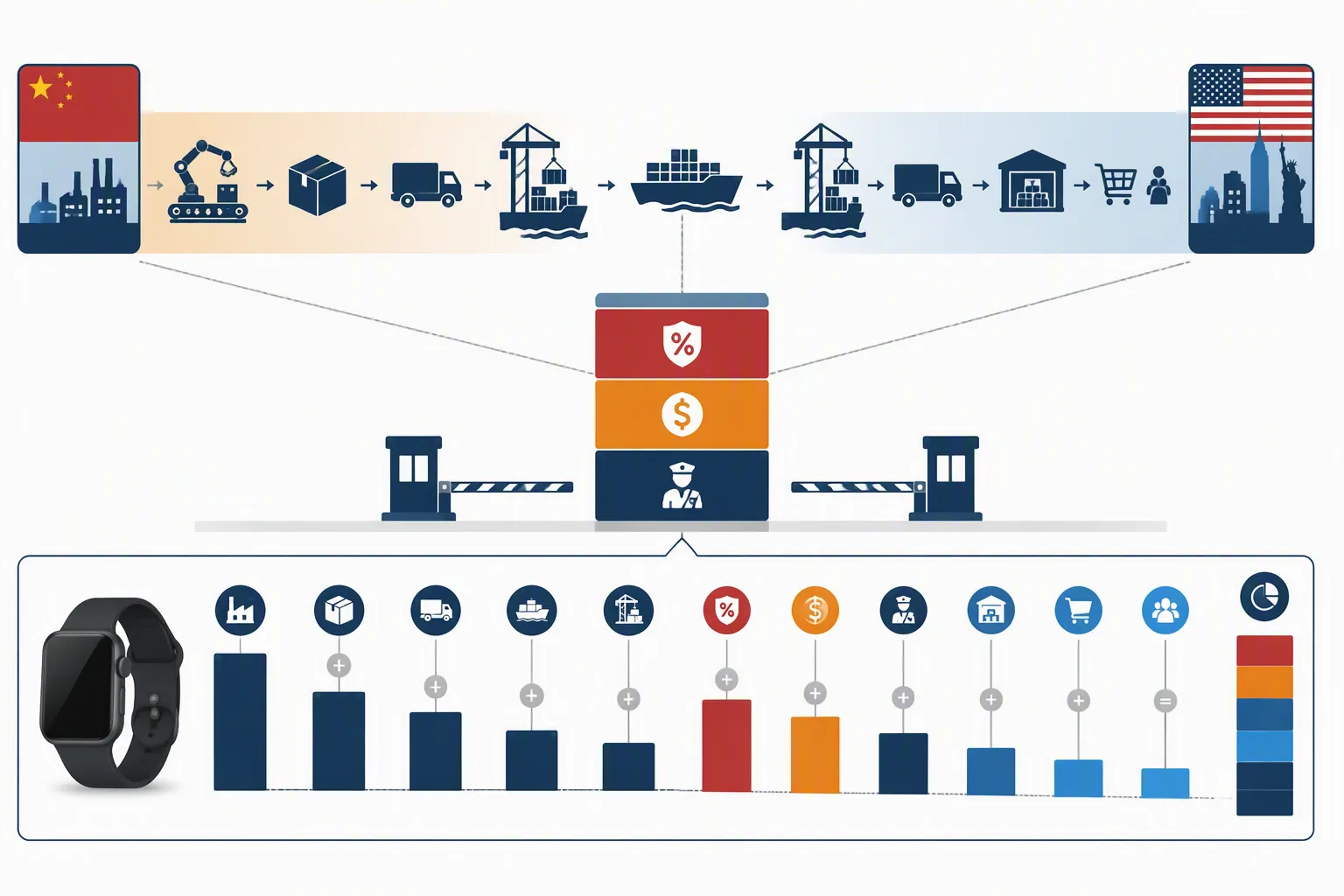
The "price" of a China-sourced product is not the FOB factory quote. U.S. buyers need to build a total landed cost model before any purchase order is issued. The components:
- FOB or EXW factory price (USD, negotiated directly with factory)
- Section 301 tariff — ranges from 7.5% to 25% depending on HTS code and product category, with certain electronics categories subject to higher rates following the 2025 review cycle
- Ocean or air freight — container spot rates fluctuate seasonally; air freight premiums run roughly 4–6× ocean cost on a per-kilo basis as a general industry benchmark
- CBP entry fees, ISF filing, and customs brokerage — typically $150–$350 per shipment for a standard brokerage engagement, plus bond costs
- Domestic drayage and warehousing at the U.S. port of entry
The Phase One agreement's Expanding Trade chapter committed China to purchasing additional U.S. goods across manufactured goods, agriculture, energy, and services — but it did not reduce U.S. tariffs on Chinese imports. The tariff component of landed cost is entirely separate from the bilateral purchase commitment. For small DTC importers, the most common pricing mistake is accepting an FOB quote without confirming the HTS code first. A product reclassified from a 7.5% to a 25% tariff bucket after arrival turns a profitable SKU into a loss. Get the tariff calculation confirmed in writing before the order is placed.
Common Challenges for U.S. Buyers
Tariff Volatility and HTS Reclassification Risk
U.S.–China tariffs have changed multiple times since 2018, and the pace of regulatory change has not slowed. CBP can reclassify a product's HTS code on review, changing the applicable tariff retroactively on future shipments. Buyers who have been importing a product under one code for two years are not exempt. The U.S. Supreme Court struck down some emergency-act tariffs in 2026, but the bulk of Section 301 tariffs remain in place, according to CFR. Build a tariff buffer into your pricing model and review HTS classifications at least annually.
Forced Labor Documentation and the UFLPA Gate
CBP detentions under the UFLPA are now routine, not exceptional. Any U.S. importer sourcing cotton apparel, solar modules, aluminum components, or food products with Chinese supply chains needs supply chain documentation tracing goods away from Xinjiang. Suppliers who cannot provide raw material traceability documentation are a customs liability, regardless of their sample quality or price.
Supplier Reliability and Quality Consistency
The gap between a factory's sample quality and production-run quality is one of the most common failure modes in China sourcing. First-article inspection and pre-shipment inspection (PSI) reports from independent third-party inspection firms — SGS, Bureau Veritas, Intertek — are standard tools for closing this gap. Buyers who skip PSI on a first production run to save $200–$300 routinely absorb far larger losses in defective goods and return logistics.
Vietnam and India Re-routing Risks
Some suppliers offer to ship goods through Vietnam or India to reduce tariff exposure. CBP's substantial transformation test requires that genuine manufacturing — not re-labeling or minor processing — occurs in the third country. CBP has issued penalties and seizures in documented cases where Chinese goods were transshipped through Vietnam with fraudulent country-of-origin certificates. Confirm any alternative origin claim can be substantiated before accepting it. For a deeper look at how these dynamics play out at the category level, see China Exports to the U.S.: What Importers Must Know in 2026.
Rare Earth and Component Supply Restrictions
Beijing's retaliatory export controls on rare earths and critical minerals introduce a supply-risk dimension that is separate from tariff cost. If your product contains rare earth magnets, specific semiconductor inputs, or other controlled materials, supply can be disrupted by Chinese export licensing decisions. This is particularly acute in the Belt and Road Initiative-adjacent production zones, where Chinese state-owned enterprises control significant upstream supply. Companies in the magnet, EV component, and clean energy hardware space need contingency sourcing plans, not just a preferred supplier.
Intellectual Property Exposure
The Phase One agreement's IP chapter strengthened protections on paper. Enforcement in Chinese courts still requires time and local legal counsel. U.S. buyers sharing proprietary designs with Chinese manufacturers should use NDAs governed by both U.S. and Chinese law, register trademarks in China independently (China's trademark system is first-to-file, not first-to-use), and limit the design details shared with any single factory to what is strictly necessary for production.
Frequently Asked Questions — China Trade Deal (United States)
Q: Is the U.S.–China Phase One trade deal still in effect in 2026?
The Phase One agreement signed on January 15, 2020 remains a reference document for the bilateral trade framework, but it was never a tariff-reduction agreement — it was a structural reform and purchase commitment agreement. The tariffs imposed from 2018 onward remain substantially in place. The agreement's IP and technology transfer provisions continue to apply, but enforcement is ongoing and uneven.
Q: How do Section 301 tariffs affect my import costs?
Section 301 tariffs add a percentage duty on top of the standard MFN rate for goods from China. Depending on the HTS code, this additional rate ranges from 7.5% to 25% for most consumer and industrial goods, assessed on the declared customs value. To calculate your true landed cost, you need the tariff rate confirmed against the specific HTS code before placing an order — not after goods arrive at the U.S. port.
Q: What is the UFLPA and does it affect my China sourcing?
The Uyghur Forced Labor Prevention Act creates a rebuttable presumption that goods from Xinjiang are made with forced labor and are prohibited from entry into the United States. If your supply chain touches Xinjiang for raw materials, components, or processing, you must provide documentation sufficient to rebut that presumption or CBP will detain the shipment. The most-affected industries include cotton apparel, polysilicon and solar products, aluminum, and certain food categories.
Q: Can I source through Vietnam or India to avoid China tariffs?
You can legitimately source finished goods from Vietnam or India if the goods are genuinely manufactured there. Routing Chinese-origin goods through a third country to obtain a different country-of-origin marking is tariff evasion, and CBP enforces against it actively. The substantial transformation test is the legal standard. If the origin qualification of a specific product is uncertain, seek a binding ruling from CBP before committing to a supply chain design.
Q: How does the U.S.–China trade relationship compare to U.S.–India trade relations?
The U.S.–China relationship carries a combination of scale and complexity that other bilateral relations do not replicate. India is a growing alternative manufacturing base, and U.S.–India trade talks have intensified, but India does not yet show the manufacturing depth or component supply chain integration to replace China across most product categories. For many buyers, India is a viable primary source in certain sectors — apparel, pharmaceuticals, engineering components — but not a wholesale substitute for China's breadth.
Q: What procurement questions should I ask a China sourcing partner before placing an order?
Before the first order: What is the specific HTS code and the applicable combined tariff rate? Has the factory been audited against UFLPA supply chain traceability requirements? What are the payment terms and what is the MOQ for this SKU? What is the production lead time, and what pre-shipment inspection process is included? Does the partner have in-person audit capability at the factory location? Written answers — not verbal assurances — are the standard.
Q: What is the current status of U.S.–China trade negotiations?
The May 2026 Trump-Xi summit extended a fragile détente but failed to produce a comprehensive deal to restore normal trade relations, per CFR's analysis. The November 2025 White House fact sheet framed continued incremental negotiation as a priority. High tariffs, rare earth restrictions, and tech export controls remain the major sticking points. For practical planning purposes, treat the current tariff and export-control framework as durable through at least 2027 and build your procurement model accordingly.
Get Started in the United States — Concrete Next Steps
The most actionable step a U.S. importer can take today is to run a full landed cost calculation — not just a factory quote — on the specific SKUs they want to source. That means confirming the HTS code, pulling the combined MFN plus Section 301 rate, factoring in freight, brokerage, and any UFLPA documentation requirements, and then evaluating whether the China price works at that all-in cost. That calculation tells you more about sourcing viability than any comparison shopping on a B2B marketplace.
If you are past that stage and ready to shortlist factories, the evaluation criteria above — tariff competency, factory audit capability, UFLPA compliance workflows, and genuine language and time-zone coverage — are the filters that separate professional sourcing operators from directory listings. For additional context on how the bilateral trade framework plays out at the category level, China Trade for U.S. Buyers: What You Need to Know in 2026 covers the product-specific dimensions in detail.
Link4a works with U.S. importers and DTC brand owners as a commission-based China sourcing partner: supplier shortlisting, factory vetting, MOQ and price negotiation, sample coordination, and repeat order management, with multilingual buyer communication handled in-house. For Chinese manufacturers, it provides a managed overseas sales presence across six languages — buyer conversations handled, commission charged only on closed orders, nothing owed before an order closes.
Request a sourcing consultation or get MOQ and pricing on a specific product category at link4a.com.