China Trade War 2026: What U.S. Importers Must Know
China Trade War 2026: What U.S. Importers Must Know
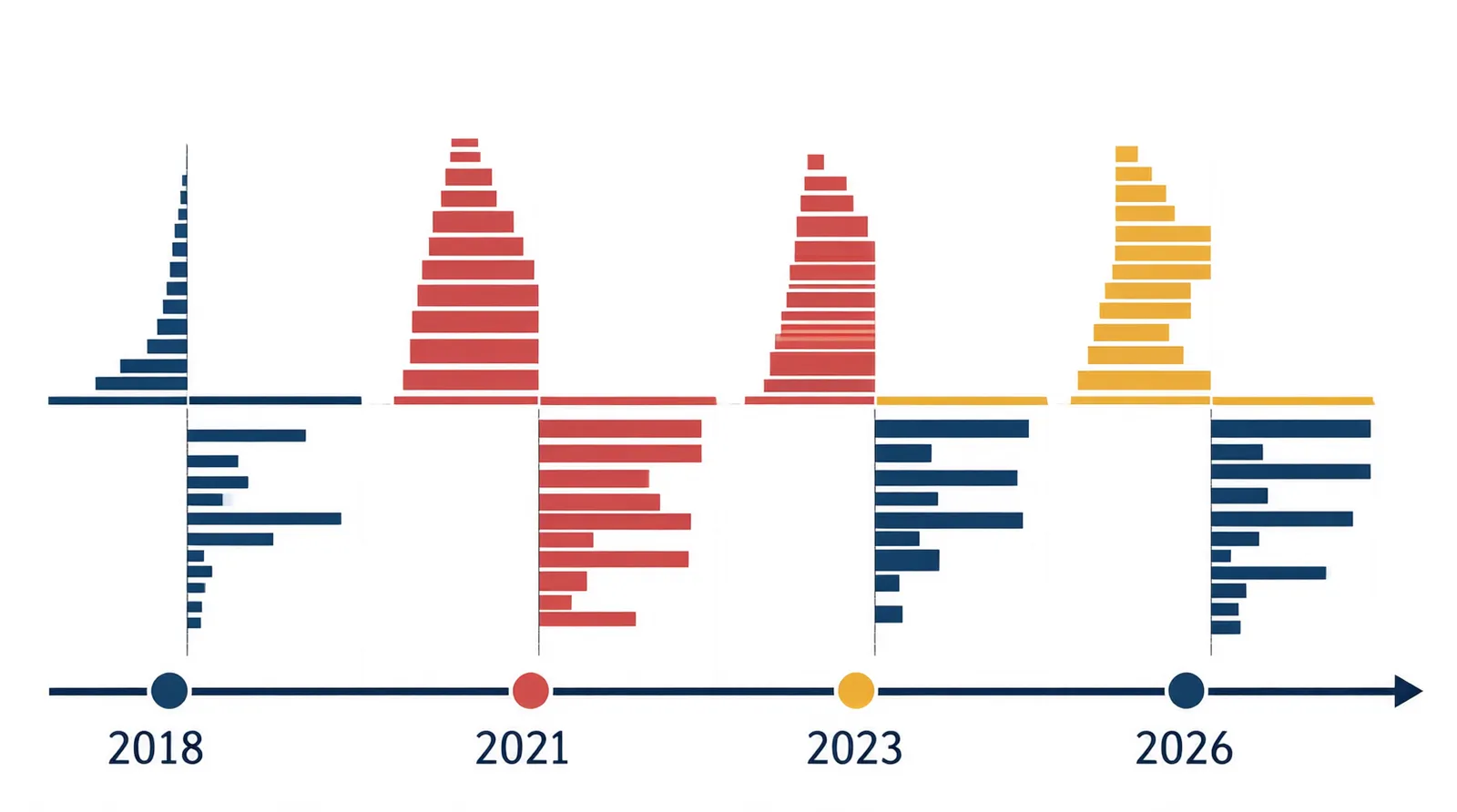
The China trade war reshaped how American businesses source goods — and it isn't over. Tariffs first imposed in 2018 remain largely in place, and the May 2026 Trump-Xi summit in Beijing extended a fragile détente but failed to produce a comprehensive deal to restore normal trade relations, according to the Council on Foreign Relations. For U.S. importers, DTC store owners, and manufacturers who depend on Chinese factories, this ongoing tension means navigating a gauntlet of tariff schedules, export controls, and compliance requirements that simply didn't exist a decade ago.
Understanding the landscape isn't optional. It's the entry gate to profitable sourcing.
China Trade War in the United States — Market Overview
The United States and China are the world's two biggest economies, and much of their trade relationship expanded after China joined the World Trade Organization (WTO) in 2001, as CFR documents. That integration produced real, measurable benefits: lower prices for U.S. consumers and higher profits for corporations that moved manufacturing to China. It also produced real costs — American factory jobs lost to import competition, automation, and companies relocating production overseas.
The first trade war shot was fired in 2018. The Trump administration cited China's state subsidies, forced technology transfers, and intellectual property violations — practices the USTR's 2024 China WTO Compliance report details extensively. Beijing retaliated. Both sides eventually negotiated the Phase One Deal, which the Congressional Research Service describes as aimed at preventing further escalation rather than resolving the structural grievances underneath.
By late 2026, the conflict has evolved. Trump's second term brought steeper tariffs, and Beijing responded with export controls on rare earths critical to U.S. technology supply chains. Chinese officials publicly warned there are "no winners" in a tariff war. Xi Jinping's arrival at Joint Base Andrews on September 23, 2026, for a state visit — where he spoke of U.S.-China friendship "forged in blood" at a state dinner — signals both sides want to manage the tension without letting it spiral. Experts widely agree that complete decoupling of the two economies remains unlikely. But for U.S. buyers, the rules have permanently changed, and knowing them separates profitable sourcing from costly compliance failures.
What's Specific About the United States
Regulatory and Compliance Environment
The United States operates one of the world's most layered import compliance frameworks. U.S. Customs and Border Protection (CBP) enforces Harmonized Tariff Schedule (HTS) classifications that determine which tariff rate applies to each shipment. A classification error of a single digit can mean the difference between a 7.5% duty and a 25% duty on the same product — and CBP has authority to reclassify entries retroactively, sometimes years after importation.
Section 301 tariffs, born from the 2018 trade war, cover hundreds of product categories. Some were granted exclusions; most were not. The Biden administration maintained the bulk of Trump-era tariffs and added new ones on EVs and solar cells. Trump's second term layered additional levies on top. While the U.S. Supreme Court struck down certain emergency-act tariffs, the core China trade war tariff structure remains intact.
Two enforcement mechanisms demand particular attention. Withhold Release Orders (WROs) issued by CBP can block shipments from specific Chinese suppliers linked to forced labor concerns. UFLPA (Uyghur Forced Labor Prevention Act) enforcement creates a rebuttable presumption that goods from Xinjiang were made with forced labor — importers must prove otherwise with clear documentary evidence, or face port detention. This is not theoretical; enforcement actions happen regularly at major U.S. ports.
For buyers in electronics, critical minerals, and advanced manufacturing, the Entity List maintained by the Bureau of Industry and Security (BIS) is another gate to clear. Doing business with listed Chinese companies can trigger direct sanctions exposure under U.S. law.
Cultural and Language Considerations
Most Chinese factory owners and export managers communicate in Mandarin. English-language negotiations often arrive at the factory as machine-translated text reviewed by a sales rep with limited business English. Ambiguities compound: specs get misread, lead times get miscalculated, and what seemed like an agreed quality standard turns out to be interpreted differently on the production floor.
Working through a partner who communicates directly in Mandarin — rather than relying on the factory's own sales team — removes a significant conflict-of-interest from the sourcing process.
Common Payment Methods
Payment terms in U.S.-China trade typically run on a 30% deposit at order confirmation and 70% against documents or on bill of lading for established relationships. New buyers are almost always asked for 50/50 or 100% up front via T/T (telegraphic transfer). Letters of Credit exist as an option for larger factories but involve bank fees and documentation complexity that most small-to-mid-volume importers avoid in practice.
Business Norms
Chinese factories are negotiable on MOQ, pricing, lead time, and packaging — but only with buyers who signal seriousness. A cold inquiry with vague specs and no volume indication typically gets filtered out at factories that receive dozens daily. Buyers who arrive with company credentials, clear product specifications, and a credible purchase signal get the real conversation.
How to Choose a China Sourcing Partner in the United States
Finding a factory on a marketplace listing is not the same as vetting one. The China trade war has raised the stakes considerably — a supplier that passed review two years ago might now appear on a WRO list, produce in a sanctioned region, or operate supply chains that run through Belt and Road Initiative infrastructure projects with complicated ownership structures that create U.S. sanctions exposure.
Here is what a U.S. buyer should actually evaluate:
Compliance verification capability. Can your sourcing partner cross-check a factory against CBP's WRO database, the BIS Entity List, and OFAC sanction designations? This isn't bureaucratic box-checking — a missed hit means a detained shipment and potential civil penalty.
On-the-ground presence in China. A sourcing partner based entirely in the United States with no local China team is essentially a relay for your emails. Real vetting requires factory visits, production audits, and the ability to show up unannounced during a production run. Time-zone coverage matters: production problems don't wait for U.S. office hours.
Direct multilingual communication. Sourcing through a factory's own English-speaking sales rep creates a conflict of interest at every step. A partner who handles Mandarin-to-English communication directly, and drafts buyer replies from the factory's actual in-stock catalogue rather than generic catalog pages, eliminates a category of errors before they reach production.
Verifiable track record, not just claims. Promises are cheap. Published, verifiable results are not. Link4a publishes actual Google search rankings for client stores — a sweep of 60 product pages on a client store on August 31, 2026 found 17 ranking first on U.S. Google and 31 in the top 10, with the queries published on their homepage. That kind of transparency shows the difference between accountable sourcing partners and marketing assertions.
Commission structure. For Chinese factories wanting overseas buyers without hiring an export sales team, a commission-only model — no fee until an order closes — removes market entry risk entirely. This structure aligns the sourcing partner's interests with yours: they only get paid when you do.
If you're still mapping out your import options, the China Exports to the U.S.: What Importers Must Know in 2026 guide breaks down the current export landscape across major product categories.
Pricing in the United States
The China trade war permanently repriced what U.S. importers pay for Chinese goods. Before 2018, most manufactured goods from China entered under Most Favored Nation (MFN) rates, which for many categories ran below 5%. Section 301 tariffs added 7.5% to 25% on top of those base rates, depending on the product list.
What this means in practical terms:
A product costing $10.00 FOB China in a 25% tariff category lands at approximately $12.50 before ocean freight, insurance, customs brokerage, and inland delivery. Add ocean freight — container spot rates fluctuate significantly with market conditions, routing, and season, so always obtain current quotes before calculating landed cost — and the total landed cost diverges meaningfully from the factory quote.
Rare earth-dependent products face additional cost uncertainty. Beijing's export controls on rare earths, imposed as retaliation during the trade war, have made certain inputs harder to source domestically within China, pushing factory prices up independent of tariff effects.
India, Vietnam, and Mexico increasingly show up as intermediate manufacturing options for buyers trying to sidestep China-origin tariffs. The "China plus one" diversification strategy is real, but the trade-offs are also real: factories in these markets often can't match Chinese counterparts on precision manufacturing capability, MOQ flexibility, or unit economics — at least not yet, and not for every product category.
For sourcing service fees, commission-only models shift cost to order completion. When evaluating flat-fee or retainer-based sourcing agents, always ask what compliance verification, supplier vetting, and QC inspection are included — these are separate cost centers that some services exclude from headline fees.
To get accurate pricing on a specific product, a request-for-quote with detailed specifications, target order quantity, and destination port is the only reliable starting point. Any number without specs attached is not actionable.
Common Challenges for Buyers in the United States
Tariff Classification Errors
HTS misclassification is more common than most importers admit, and the consequences are asymmetric. CBP can issue duty bills years after importation. An incorrect 10-digit classification can trigger a different tariff rate, different anti-dumping duties, or different admissibility rules — sometimes all three simultaneously.
The most defensible protection is a binding ruling request submitted to CBP before importing. It takes time to obtain, but creates a legally binding classification determination that protects against retroactive assessment.
Forced Labor Compliance Under UFLPA
The Uyghur Forced Labor Prevention Act creates a rebuttable presumption for goods connected to Xinjiang's supply chains. This reaches further than apparel: polysilicon in solar panels, cotton inputs, aluminum, tomatoes, and a growing downstream list. Importers who cannot document their supply chain past the factory gate face real detention at ports, with the burden of proof on the importer to demonstrate the goods were not made with forced labor.
Supplier Reliability in a Shifting Landscape
The Belt and Road Initiative has extended Chinese investment and infrastructure into dozens of countries. Some factories operating in those markets have ownership and funding structures that trigger OFAC sanction designations. A supplier cleared two years ago may have changed ownership, restructured its supply chain, or shifted production in ways that reintroduce risk. Static supplier approval is not a compliance program.
Logistics and Lead Time Uncertainty
Under normal conditions, ocean freight from major Chinese ports to U.S. West Coast ports runs approximately 25–40 days port-to-port, with customs clearance and inland delivery adding 5–15 days. Production lead time at the factory is separate — typically 15–45 days depending on order complexity and current capacity. During peak pre-Q4 season, all of these windows stretch. Build buffer into purchasing calendars or expect stockouts.
Communication and Specification Drift
A specification that is clear in English is not always clear in Mandarin translation. "Stainless steel finish" means different things in different factory contexts. "30-day delivery" interpreted as 30 calendar days by a U.S. buyer and 30 business days by a factory produces a meaningful gap at receiving. These aren't abstract misunderstandings — they're the primary reason first-time importers receive shipments that don't match what they thought they ordered, and why a partner who confirms specs in both languages before production begins is worth the cost.
Frequently Asked Questions (United States-Specific)
Q: Are China tariffs still in effect in 2026?
Yes. The bulk of Section 301 tariffs remain in place. Trump's second term added additional levies, and while the U.S. Supreme Court struck down some emergency-act tariffs, the core China trade war tariff structure is still active. The CFR backgrounder on U.S.-China trade (updated May 2026) provides the most current summary of what remains in force.
Q: Will there be a comprehensive U.S.-China trade deal soon?
Unlikely in the near term. The May 2026 Trump-Xi summit extended a fragile détente but did not produce a comprehensive deal. Xi's September 2026 state visit signals diplomatic engagement, but high tariffs, rare earth restrictions, and tech export controls remain unresolved. Plan your sourcing around a tariff environment that persists, not one that disappears.
Q: How does UFLPA affect what I can import from China?
Any goods with inputs or manufacturing steps connected to Xinjiang face a forced labor presumption under UFLPA. The burden of proof is on the importer to rebut the presumption with traceable supply chain documentation. Categories affected include not just finished goods made in Xinjiang, but downstream products using Xinjiang-origin cotton, polysilicon, or aluminum made anywhere.
Q: Is sourcing from India or Vietnam worth it to avoid China tariffs?
It depends entirely on the product. For apparel, basic textiles, and certain consumer goods, alternative markets like India and Vietnam offer competitive pricing with lower tariff exposure. For precision manufacturing, electronics, and specialty materials, Chinese factories still lead on capability and cost at comparable MOQs. The US China Trade Deal 2026 guide details how the current tariff structure affects specific product categories.
Q: What payment method is standard for U.S.-China trade transactions?
T/T (bank wire) is dominant. Established relationships use 30% deposit at order confirmation, 70% against documents or on bill of lading. New relationships typically require 50%–100% upfront. Letters of Credit are accepted by larger factories but involve fees and document complexity that most small-to-mid importers avoid.
Q: How do I check whether a Chinese supplier is on a U.S. restricted list?
Search three public databases: CBP's Withhold Release Orders and Findings list (forced labor), BIS's Entity List (export controls), and OFAC's SDN list (sanctions). All are publicly searchable online. A sourcing partner that runs these checks as a standard step in supplier vetting — not as an afterthought — is a meaningful compliance asset.
Q: What is a realistic lead time from China to the U.S. in 2026?
Plan for 25–40 days port-to-port ocean freight from major Chinese ports to the U.S. West Coast, plus 5–15 days for customs clearance and inland delivery. Factory production lead time is separate — typically 15–45 days depending on order complexity. First-time orders almost always run longer than the factory's initial quote. Build buffer into your purchasing calendar accordingly.
Get Started Sourcing from China in the United States
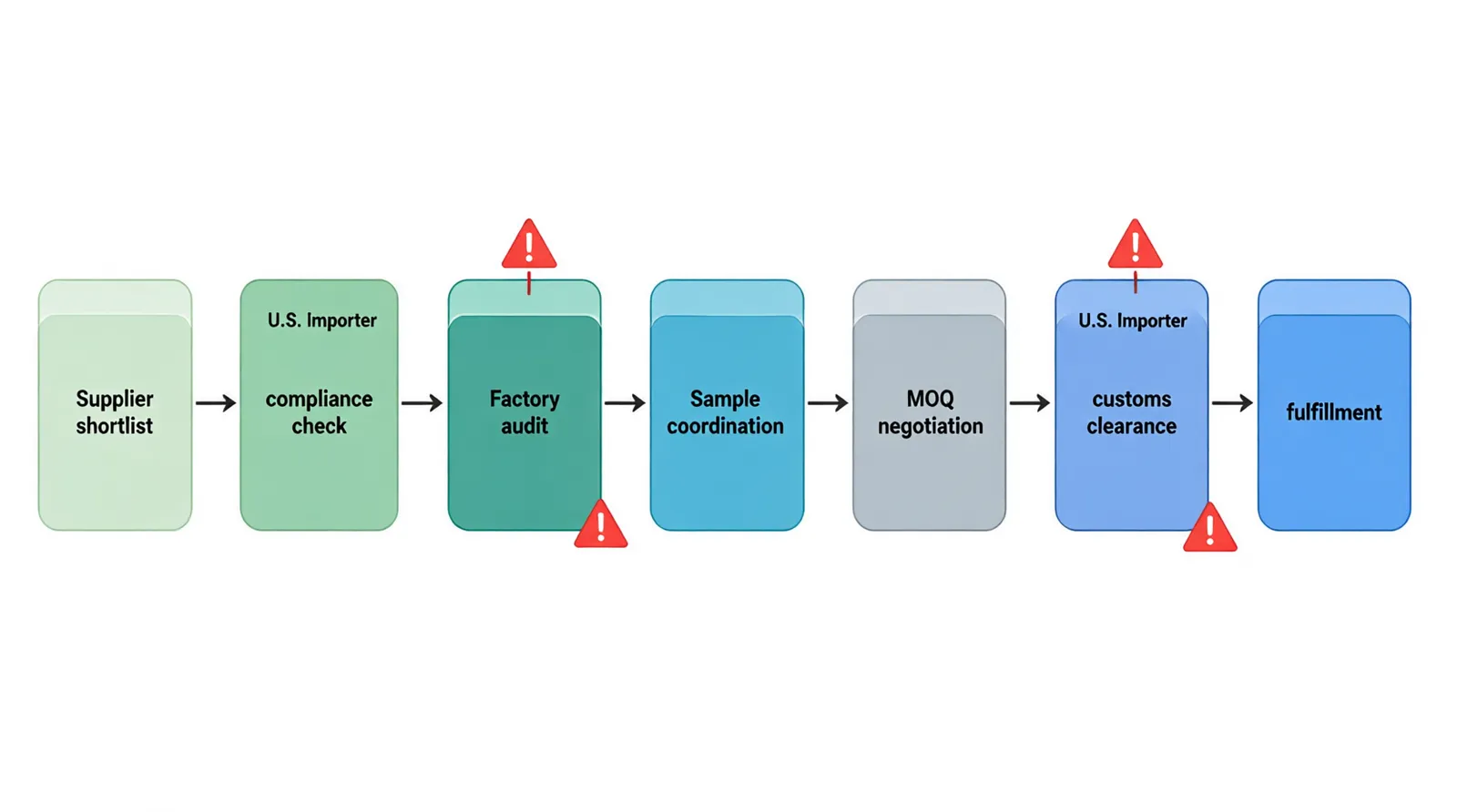
The China trade war has made sourcing more complicated, not impossible. The buyers who do it well treat compliance as a foundation, not a cleanup task. They vet suppliers against current restricted lists before placing orders. They get HTS classifications confirmed before importing. They work with partners who communicate directly in Mandarin rather than relaying messages through a factory's own sales rep — who has an obvious interest in minimizing problems and closing the order.
If you're an overseas buyer, importer, or DTC store owner who wants a dependable China sourcing partner — one who shortlists factories, vets them against current compliance databases, negotiates MOQ and pricing, coordinates samples, and handles repeat orders — that is precisely what Link4a does. Commission-only structure for factories wanting overseas market access without hiring an export team. Verifiable Google rankings for the stores they manage. Buyer inquiries drafted from the factory's actual in-stock catalogue, not generic listings.
The next step is concrete: share your product category, target quantity, and destination, and get a clear read on current market pricing, MOQ, and lead times from vetted Chinese suppliers.
Request a Quote — Get MOQ & Pricing from Vetted Chinese Factories →