China-US Rare Earth Trade: 2026 Buyer's Guide for U.S. Sourcing Teams
China-US Rare Earth Trade: 2026 Buyer's Guide for U.S. Sourcing Teams
China-US Rare Earth Trade in the United States — Market Overview
The United States is the world's single largest consumer of processed rare earth elements (REEs), and China remains — despite years of diversification efforts — the dominant global supplier. China controls an estimated 60–70% of global rare earth mining output and, more critically, over 85–90% of the world's rare earth processing and separation capacity. That asymmetry defines every procurement conversation happening inside American defense contractors, EV manufacturers, wind turbine OEMs, semiconductor fabs, and electronics supply chains today.
Demand drivers inside the United States are structural and accelerating. The clean energy transition — mandated in part by the Inflation Reduction Act (IRA) of 2022 — requires permanent magnets built from neodymium-iron-boron (NdFeB) alloys for electric motors and wind generators. The Department of Defense's push to reshore critical material supply chains has created new federal procurement channels, while consumer electronics giants headquartered in Silicon Valley and Texas continue to depend on Chinese-refined dysprosium, terbium, and praseodymium for everything from smartphone speakers to data-center cooling fans. Industry estimates suggest U.S. imports of rare earth compounds and metals run into the hundreds of millions of dollars annually, with NdFeB magnets representing the single largest sub-category by value.
Common buyer profiles inside the United States span a wide spectrum. At one end sit Tier-1 defense primes — Lockheed Martin, RTX, Northrop Grumman — navigating strict NDAA Section 4872 compliance windows. At the other sit mid-market industrial OEMs in Ohio, Michigan, and Texas sourcing motors and actuators who simply need competitive pricing and reliable lead times. In between are a fast-growing cohort of EV startups, clean-tech hardware brands, and DTC consumer electronics operators who need verified Chinese factory supply without the overhead of a traditional trading house. Each profile carries different risk tolerance, compliance requirements, and purchasing authority — and each is now operating in a trade environment defined by tariff volatility, export control updates, and supply-chain transparency mandates.
What's Specific About the United States
Regulatory and Compliance Environment
The U.S. regulatory framework governing rare earth imports is layered and actively evolving. Key frameworks every buyer must understand include:
- Section 301 Tariffs (USTR): The Office of the United States Trade Representative has maintained and in some cases expanded Section 301 tariffs on Chinese goods since 2018. Rare earth compounds and processed metals fall under various HTS codes — primarily Chapter 28 (inorganic chemicals) and Chapter 85 (electrical machinery) for magnet assemblies — each carrying specific duty rates that can change with little notice following USTR review cycles.
- NDAA Section 4872 / 10 USC § 4872: Defense contractors and their supply chains face hard restrictions on procuring "covered materials" — including samarium-cobalt and NdFeB magnets — from Chinese entities, with phase-in deadlines that have been progressively tightened. Any U.S. company bidding on DoD programs must audit its magnet supply chain accordingly.
- Export Administration Regulations (EAR) / OFAC Screening: While rare earths are primarily an import concern for U.S. buyers, dual-use technology restrictions and OFAC entity list screening affect which Chinese suppliers can legally transact with U.S. companies. Suppliers on the Entity List or Military End-User list are off-limits regardless of tariff status.
- USMCA / IRA Domestic Content Rules: For EV and clean-energy manufacturers seeking IRA tax credits, the sourcing geography of critical minerals matters — batteries and motors assembled from Chinese-refined rare earths may not qualify for the full Section 30D or 45X credits without additional domestic processing.
- SEC Climate Disclosure Rules: Publicly traded U.S. companies are facing increasing pressure to disclose supply-chain concentration risks, including rare earth dependencies, as part of emerging ESG reporting frameworks.
Cultural and Business Norms
Chinese rare earth suppliers — whether state-owned enterprises (SOEs) like China Minmetals or private processors in Jiangxi, Inner Mongolia, and Gansu provinces — operate on relationship-first business norms. Initial RFQs sent cold via generic email channels routinely go unanswered. U.S. buyers who invest in WeChat-based communication, who send a representative to Canton Fair or a specialized minerals expo, and who demonstrate long-term volume commitment are treated materially differently than spot buyers. Language matters: Mandarin-language RFQs with Chinese technical specifications convert at dramatically higher rates than English-only outreach to factories in Tier 3 cities.
Payment terms in this sector typically involve T/T (telegraphic transfer) — often 30% deposit with the balance against bill of lading — for established relationships. Letters of Credit (L/C) are common for first-time transactions above $50,000 USD. U.S. buyers should budget for SWIFT transfer fees and potential compliance holds from U.S. correspondent banks flagging China-origin wire transfers.
How to Choose a China-US Rare Earth Trade Provider in the United States
Selecting a sourcing partner or supplier for rare earth materials from China is not equivalent to choosing a commodity vendor. The evaluation criteria that matter in the U.S. market include:
1. Verified Factory Credentials vs. Trading Company Ask explicitly: are you a factory (工厂) or a trading company (贸易公司)? Trading companies add margin and an extra communication layer. For rare earths, working direct with a processor or licensed miner reduces cost and improves specification control. Request a copy of the Chinese supplier's business license (营业执照) and any mineral export permits.
2. Export Control Compliance Track Record China introduced its own rare earth export control regime in 2023–2024, requiring export licenses for certain REE products. Verify that your Chinese supplier holds current export licenses for the materials you need. A supplier unable to produce this documentation is a deal-breaker for compliant U.S. procurement.
3. On-the-Ground U.S. Presence or U.S.-Based Representative Time-zone coverage is a practical procurement issue. A supplier with a U.S. West Coast or East Coast representative — or a platform that provides 24/7 multilingual inquiry handling — drastically shortens RFQ turnaround cycles. This is where AI-native trade infrastructure platforms like Link4a (链上科技) become operationally relevant: their Inbox product provides 24/7 multilingual AI-powered inquiry handling so U.S. buyers get responses at U.S. business hours regardless of what time it is in Jiangxi.
4. Certifications and Quality Standards Relevant certifications to request:
- ISO 9001 (quality management)
- REACH compliance documentation (for EU-parallel U.S. chemical regulations)
- RoHS compliance for electronic-grade materials
- Third-party SGS or Bureau Veritas test reports for purity grades
- DFARS / Berry Amendment compliance letters for defense supply chains
5. Supplier Matchmaking Speed In a tariff-volatile environment, speed of supplier identification matters. Platforms like Link4a's Match engine — which delivers verified supplier matches in an average of 3 seconds — give sourcing teams a meaningful edge over traditional directory searches or trade-show networking.
Pricing in the United States
Rare earth pricing is notoriously opaque and volatile. Prices are quoted in USD per kilogram for oxides and metals, and pricing shifts with Chinese domestic policy, export license quotas, and global EV demand cycles.
Indicative price ranges (USD/kg, as of industry estimates in 2025–2026):
| Material | Approximate Range (USD/kg) |
|---|---|
| Lanthanum oxide (99.5%) | $2–$6 |
| Cerium oxide (99.5%) | $2–$5 |
| Neodymium oxide (99.5%) | $55–$100 |
| Dysprosium oxide (99.5%) | $250–$400 |
| Terbium oxide (99.9%) | $800–$1,200 |
| NdFeB magnet (sintered, N35) | $30–$60/kg |
Note: These are illustrative market ranges, not quoted prices. Actual pricing depends on grade, volume, contract term, and current Chinese export quota conditions.
What drives pricing variability for U.S. buyers:
- Tariff passthrough: Section 301 duties (ranging from 7.5% to 25%+ depending on HTS code) add directly to landed cost. Calculate your duty-paid cost, not just the FOB China price.
- Volume and MOQ: Processing facilities typically have minimum order quantities — request the supplier's [your MOQ] early in discussions. Below-minimum orders often carry significant per-unit premiums.
- Grade and specification tightness: Tighter purity specs (e.g., 99.99% vs. 99.5%) carry exponential cost jumps.
- Freight and insurance: Air freight for high-value materials (dysprosium, terbium) vs. sea freight for bulk heavies (lanthanum, cerium) changes cost structures significantly. Port congestion at Long Beach/LA and East Coast alternatives adds unpredictability.
- Currency hedging: CNY/USD fluctuations affect supplier-side margins and can trigger repricing requests mid-contract.
Common Challenges for U.S. Buyers in China-US Rare Earth Trade
Tariff Uncertainty and HTS Classification Risk
The Section 301 tariff schedule is a moving target. Rare earth compounds span multiple HTS chapters, and classification disputes between importers and U.S. Customs and Border Protection (CBP) are common. A reclassification from a lower-duty chapter to a higher-duty chapter can retroactively trigger significant additional duties. U.S. buyers should secure binding ruling letters from CBP for high-volume materials and work with a licensed customs broker who specializes in chemicals and advanced materials.
Chinese Export Licensing and Quota Systems
Since 2023, China has implemented formal export licensing requirements for specific rare earth items, including certain magnet alloys and processed oxides. Quota allocations fluctuate quarterly. A Chinese supplier who could legally export in Q1 may face quota exhaustion by Q3, delaying shipments with no U.S.-side recourse. Build lead-time buffers of 60–90 days beyond normal production time for anything touching Chinese export quota systems.
Supplier Verification and Fraud Risk
The rare earth space has a higher-than-average incidence of fraudulent suppliers and specification misrepresentation. "Paper companies" — entities with polished websites but no actual processing capacity — proliferate in online directories. Mitigation steps: request factory audit reports, demand pre-shipment third-party inspection (SGS, Intertek, or Bureau Veritas), and use escrow or L/C payment structures for first transactions. Platforms that provide pre-verified supplier databases — like Link4a's Match engine with its 300+ vetted factory network — significantly reduce this risk for sourcing teams that lack resources for in-person factory audits.
Supply Chain Transparency and ESG Documentation
U.S. Fortune 500 procurement teams are now routinely requiring conflict mineral-style documentation for rare earths — tracing material back to the mining origin to verify against forced labor allegations. The Uyghur Forced Labor Prevention Act (UFLPA), while currently most focused on cotton and polysilicon, creates compliance pressure that is migrating toward rare earths from Xinjiang-adjacent mining regions. Request country-of-origin documentation at the mine level, not just the processing facility level.
Communication and Specification Translation
Technical specifications lose precision in translation. Alloy grades, magnetic performance specs (remanence Br, coercivity Hcj), and surface treatment requirements are frequently misunderstood across language barriers. Deploying platforms with multilingual technical communication capability — or sourcing through a partner equipped with AI-powered inquiry management like Link4a's Inbox — reduces the specification error rate that drives costly rejection and rework cycles.
Frequently Asked Questions — China-US Rare Earth Trade (United States)
Q1: Are rare earth imports from China subject to tariffs in the United States? Yes. Most rare earth compounds and processed metals imported from China face Section 301 tariffs ranging from 7.5% to 25% depending on the specific HTS classification. NdFeB magnet assemblies for non-defense applications currently face elevated rates. U.S. importers should work with a licensed customs broker to determine the exact applicable rate for their specific material and use case.
Q2: Can U.S. defense contractors source rare earth magnets from China? Generally no for direct defense applications. NDAA Section 4872 (10 USC § 4872) prohibits DoD contractors from purchasing covered rare earth magnets — including samarium-cobalt and NdFeB types — from Chinese entities, with phase-in compliance deadlines. Commercial buyers outside the defense supply chain are not subject to this restriction, though they should monitor any expansion of covered categories.
Q3: How do I verify that a Chinese rare earth supplier is legitimate? Request the supplier's Chinese business license (营业执照), mineral export permit, relevant ISO certifications, and third-party laboratory test reports. Commission a pre-shipment inspection from SGS, Bureau Veritas, or Intertek before releasing final payment. Using a supplier matchmaking platform with pre-verified factory databases — rather than cold directory searches — is the fastest path to due-diligence-grade supplier qualification.
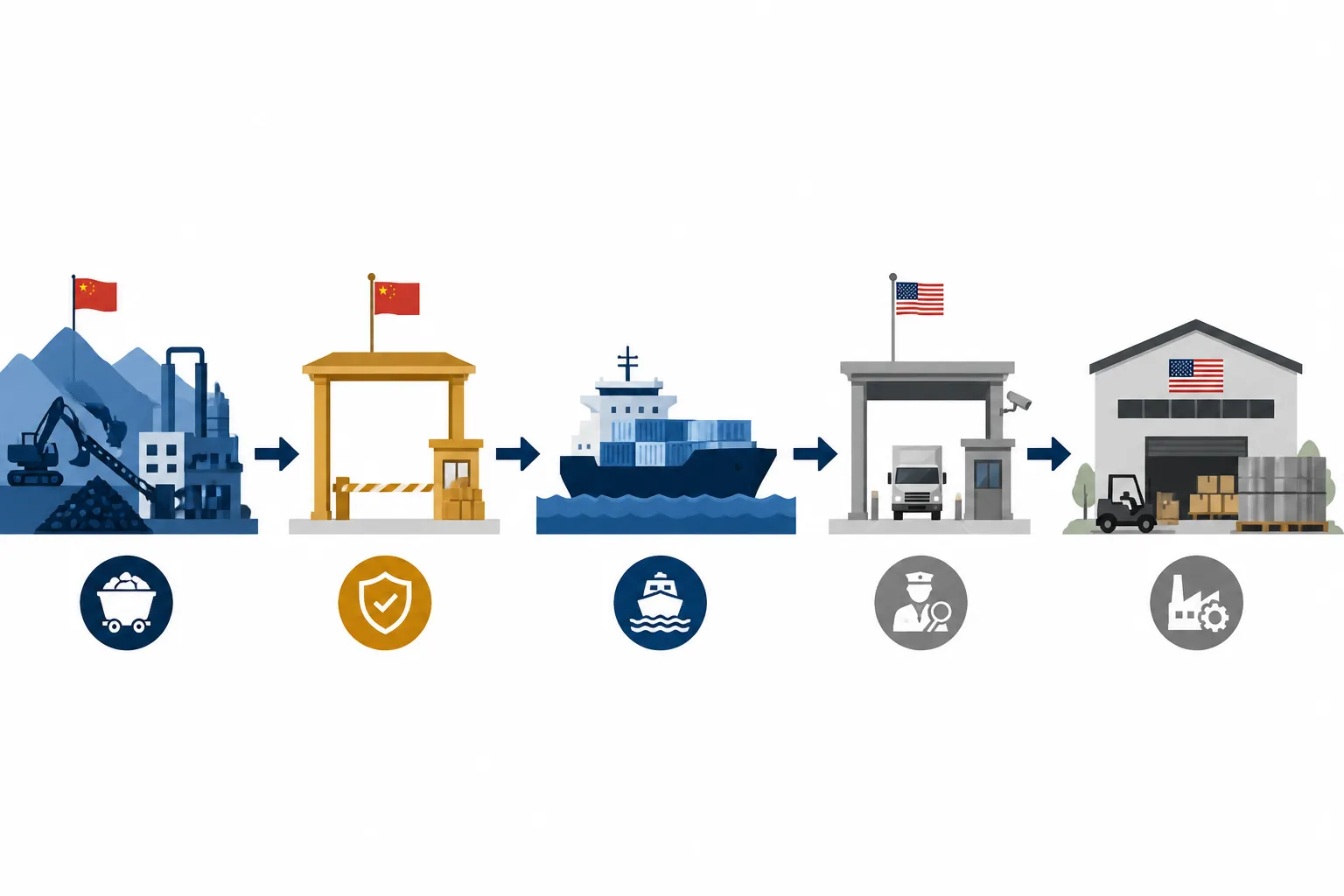
Q4: What is the typical lead time for rare earth materials shipped from China to the United States? For sea freight, plan on 25–40 days transit from major Chinese ports (Tianjin, Shanghai, Guangzhou) to U.S. West Coast ports, plus production lead time at the factory — typically 15–45 days depending on material and order volume. Total procurement cycle for a first-time order: 60–90 days. Air freight can compress transit to 5–10 days for urgent or high-value small-volume shipments at substantially higher cost.
Q5: What payment terms are standard for China-US rare earth transactions? For established relationships: T/T 30% deposit upon order confirmation, 70% balance against copy of bill of lading. For new supplier relationships: Letter of Credit (L/C) at sight provides greater buyer protection, though Chinese suppliers may charge a premium. Avoid 100% advance T/T with unverified suppliers regardless of pricing incentives.
Q6: How does China's export licensing system affect my U.S. supply chain planning? China's Ministry of Commerce (MOFCOM) allocates quarterly export licenses for certain rare earth products. Suppliers must hold valid licenses to export legally, and quota exhaustion mid-year is a real operational risk. U.S. buyers should maintain 90–120 day inventory buffers for quota-affected materials, diversify across multiple licensed suppliers, and include force majeure and supply disruption clauses in purchase agreements.
Q7: Is there a way to source rare earths from China faster and with less compliance risk? AI-native cross-border trade platforms are emerging as a solution for sourcing teams that lack the bandwidth for traditional factory-search, compliance-audit, and inquiry-management workflows. Platforms like Link4a combine verified supplier matching (average 3-second match time), 24/7 multilingual inquiry AI, and SEO/outbound lead generation tools in a single workflow — reducing the time from "need a supplier" to "have a compliant quote" from weeks to days.
Get Started: Sourcing Rare Earth Materials from China in the United States
If you are a U.S. industrial buyer, EV manufacturer, electronics OEM, or sourcing professional navigating the China-US rare earth trade environment in 2026, here is a concrete action sequence to move from research to procurement:
Step 1: Classify your materials. Identify the exact HTS codes for the rare earth compounds or magnet assemblies you need. Work with a customs broker to confirm applicable Section 301 duty rates and calculate your true landed cost before any supplier negotiation.
Step 2: Define your compliance perimeter. Determine whether NDAA restrictions apply to your use case. If you operate in or near the defense supply chain, get legal sign-off on which Chinese entities are permissible counterparties.
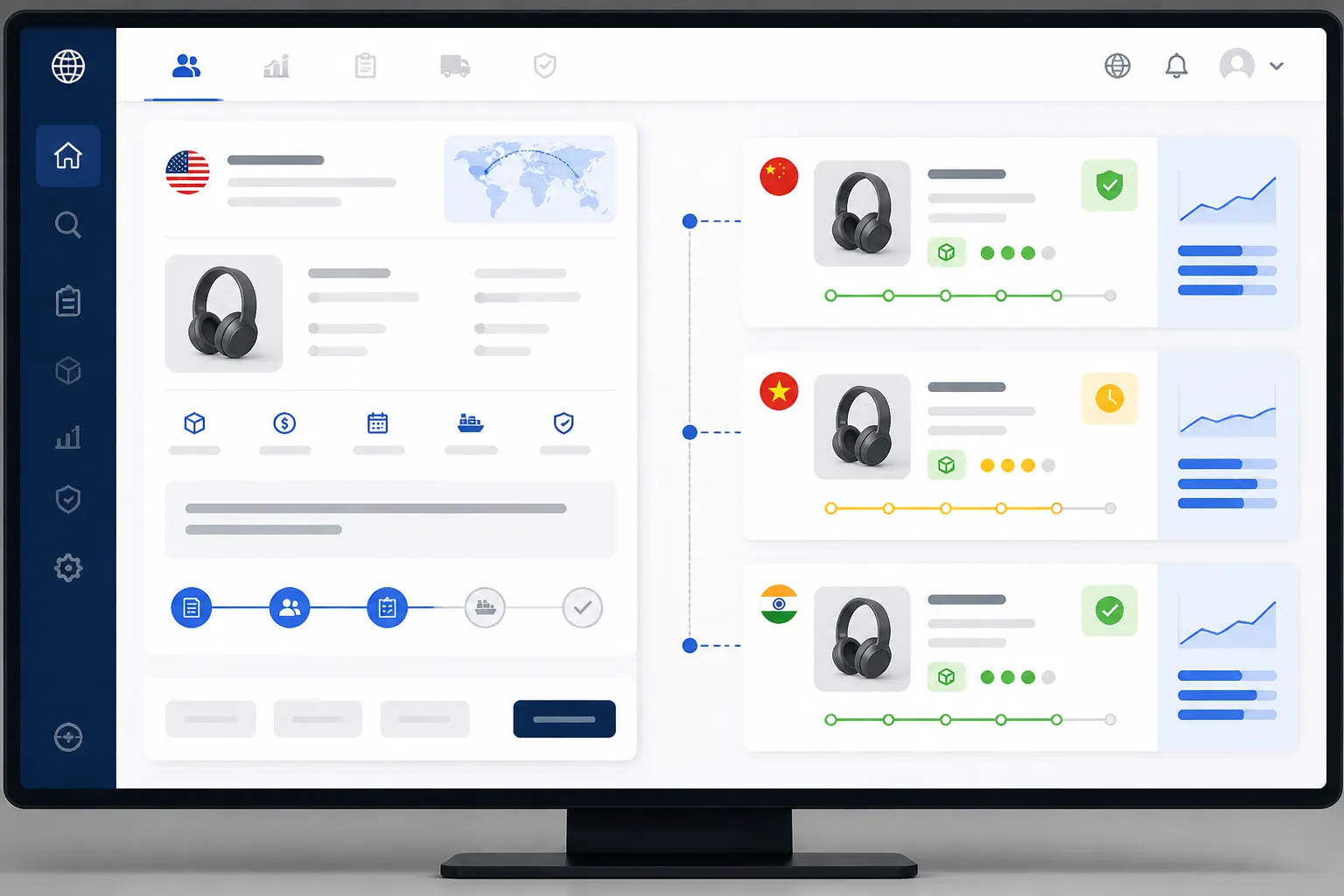
Step 3: Build your supplier longlist fast. Rather than spending weeks manually searching directories, use a verified supplier matchmaking engine to generate a shortlist of qualified Chinese processors in under 24 hours. Link4a's Match engine — serving 300+ factories with a 3-second average match time — is purpose-built for exactly this workflow.
Step 4: Send multilingual RFQs with technical specs. Your RFQ should include: material grade, purity specification, quantity (with MOQ inquiry), required certifications, delivery port, and target pricing. Sending in both English and Mandarin dramatically improves response rates from Chinese processors. Use a platform with 24/7 multilingual AI inquiry handling to manage follow-up at U.S. business hours.
Step 5: Qualify shortlisted suppliers. Request business licenses, export permits, ISO certificates, and recent third-party test reports. Commission pre-shipment inspection for first orders.
Step 6: Negotiate and structure the contract. Include force majeure provisions covering Chinese export quota disruptions, payment terms appropriate to your relationship (L/C for new suppliers), and clear specification and rejection procedures.
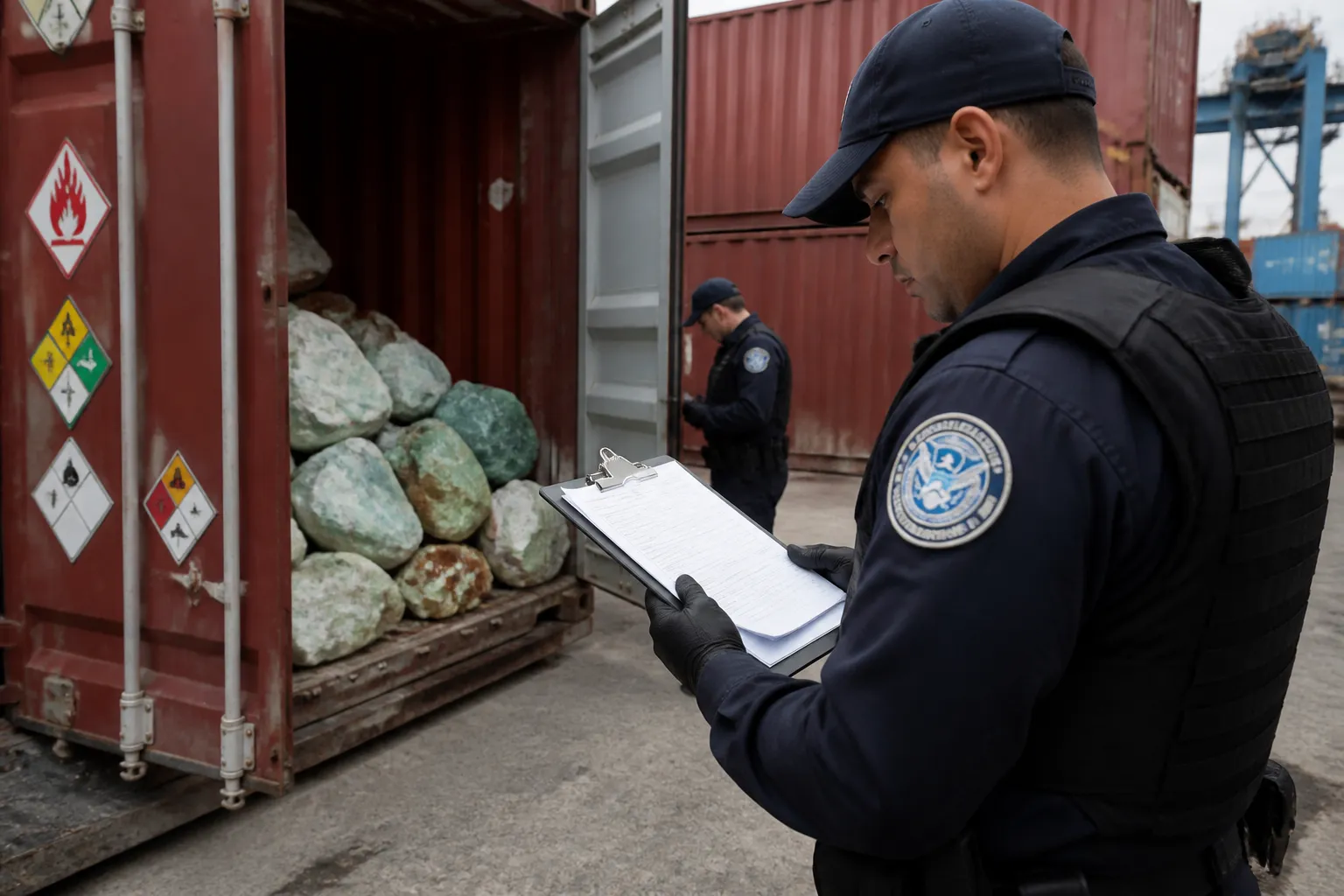
Step 7: Plan your import logistics. Work with a freight forwarder experienced in chemical and mineral imports. Prepare your ISF (Importer Security Filing) well in advance and have your customs broker ready to handle any CBP examination holds.
Ready to Find Verified Chinese Rare Earth Suppliers?
The China-US rare earth trade landscape is more complex and more consequential than it has ever been. The buyers who succeed are those who combine compliance rigor with procurement speed — and who have direct access to verified factory networks rather than unvetted directory listings.
Link4a (链上科技) provides the AI-native cross-border trade infrastructure that makes this possible: verified supplier matching, 24/7 multilingual inquiry AI, and omni-channel reach tools in a single platform — built specifically for the China-global trade workflow.
Request a Supplier Match / Get MOQ & Pricing → link4a.com
Whether you need a spot quote on neodymium oxide, a long-term supply agreement for sintered NdFeB magnets, or a verified factory audit trail for your compliance team — the sourcing process starts with the right match. Request yours today.
This article reflects publicly available regulatory and market information as of June 2026. Tariff rates, export license requirements, and compliance frameworks are subject to change. Consult a licensed customs broker, trade attorney, and compliance officer before making procurement decisions.