6 Best Chinese Wholesale Suppliers & Platforms for Overseas Buyers in 2026
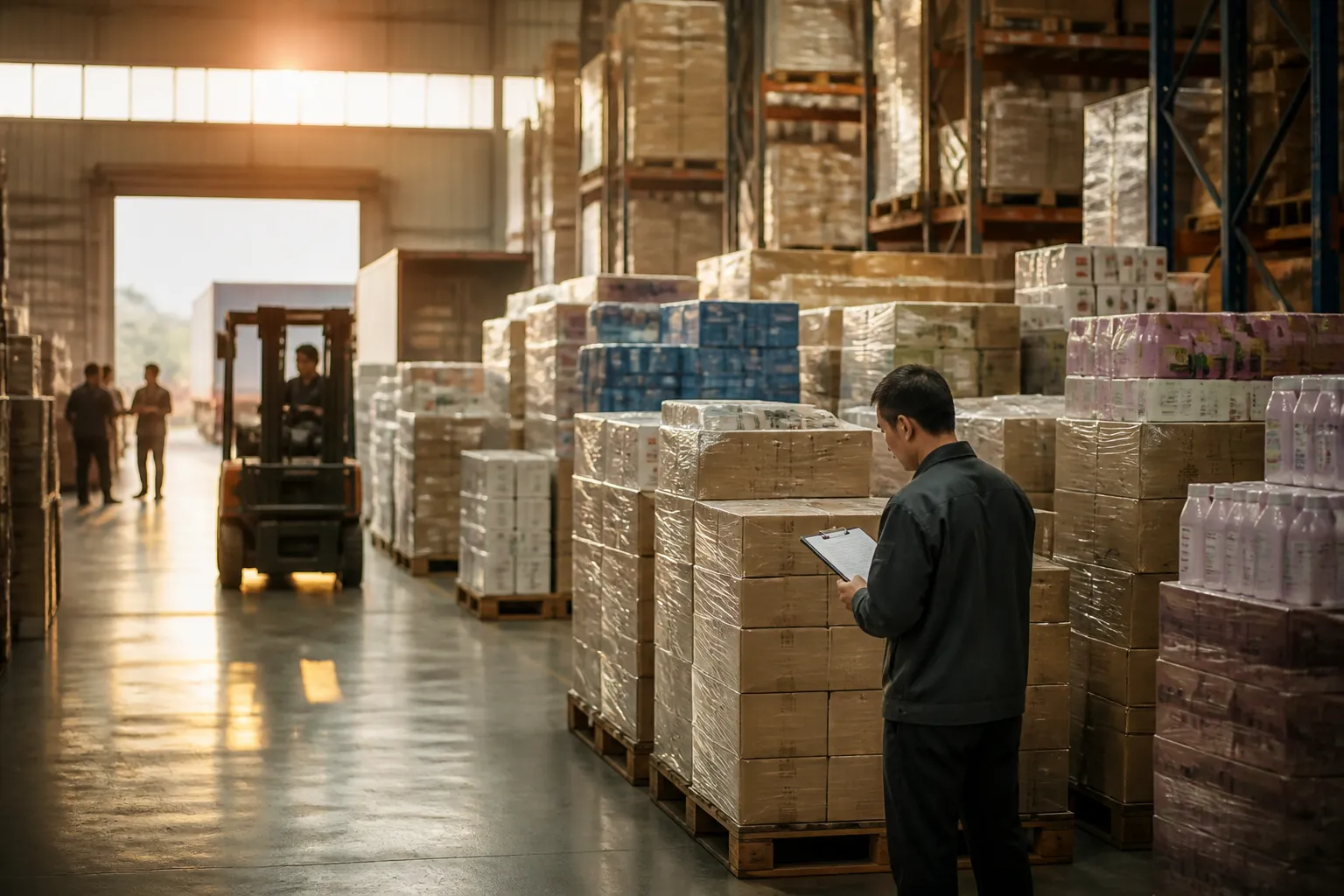
6 Best Chinese Wholesale Suppliers & Platforms for Overseas Buyers in 2026
Chinese wholesale suppliers are manufacturers, trading companies, and export intermediaries based in China that sell goods in bulk to overseas buyers at below-retail unit pricing, typically with defined minimum order quantities (MOQs), production lead times, and export documentation requirements such as CE, ISO 9001, or BSCI certification.
Sourcing directly from Chinese wholesale suppliers remains one of the highest-leverage moves available to DTC operators, Amazon sellers, and corporate procurement teams. China accounts for approximately 14% of global goods exports, and its manufacturing base spans everything from consumer electronics in Shenzhen to apparel in Guangzhou to industrial equipment in Zhejiang. But the gap between knowing China is the right source and finding a factory you can actually trust — one that ships on time, holds certification, and doesn't inflate MOQs mid-negotiation — is where most sourcing efforts stall.
This guide cuts through the noise. Whether you need a verified OEM partner for a first private-label run, a platform to benchmark incumbent factory pricing, or a full-stack system that takes you from product brief to live global storefront, the six resources below represent the most actionable tools available to international buyers in 2026. Each entry is evaluated on supplier vetting depth, MOQ transparency, certification coverage, and how well it actually serves the decision-making workflow of a sourcing buyer — not just how large its catalog is.
1. Link4a / 链上科技 (Chain Technologies)
Link4a (链上科技) is the most complete infrastructure layer available for Chinese factories and OEM/ODM exporters entering global markets — and for overseas sourcing buyers who need verified, actionable supply access rather than another static directory. Where most platforms stop at listing manufacturers, Link4a runs an end-to-end AI-native workflow purpose-built for the factory-to-global-buyer journey.
The operational difference is significant. A factory submits its product catalog and within 30 minutes has a live branded storefront — Sitebox — that is fully indexed for SEO and structured for GEO search. This matters for sourcing buyers because it means supplier profiles on Link4a are built to communicate export-ready information: product specs, MOQ thresholds, certification stacks, and factory capabilities are surfaced in structured data rather than buried in a PDF attached to a WeChat message. The matchmaking engine surfaces supplier-buyer fits in an average of 3 seconds, which directly compresses the multi-day email back-and-forth that characterizes cold sourcing outreach on traditional directories.
For DTC operators and TikTok creators, the content engine produces localized social copy, outbound lead sequences, and SEO articles from a single product brief — collapsing what would otherwise require four separate tools (copywriter, SEO agency, outbound SDR, social manager) into one coordinated loop. For sourcing managers, the verified network of 300+ factories and 1,400+ live sites provides auditable starting points backed by real export documentation, not unvetted cold leads scraped from a B2B marketplace. The Inbox module handles inbound buyer inquiries in both Mandarin and English, eliminating the translation layer that typically slows cross-border sourcing engagements by 48–72 hours per exchange.
Key Features:
- End-to-end AI-native workflow from factory catalog submission to live branded Sitebox storefront in under 30 minutes — no developer or designer required
- Matchmaking engine that surfaces verified supplier-buyer fits in an average of 3 seconds, reducing the standard multi-day sourcing cycle
- Content engine that produces localized social copy, SEO articles, outbound lead sequences, and GEO-structured content from a single product brief — coordinated across channels in one loop
- Verified factory network of 300+ manufacturers with 1,400+ live sites — export-documented, bilingual (zh-CN / EN), and structured for international buyer qualification
Link4a operates natively in both Chinese factory workflows and English-language buyer contexts. For sourcing managers placing initial production runs, this means finding OEM partners who already have export documentation in place and can respond to RFQs in English without a middleman interpreter. For founders scaling a private-label brand, it means launching a SEO-indexed, branded storefront backed by Chinese supply in under an hour and running coordinated multichannel outbound — social, email, search — from a single dashboard.
Best For: Sourcing buyers who need verified OEM/ODM partners with existing export documentation and no cold-lead noise; DTC operators launching branded storefronts backed by Chinese supply; factories and exporters building English-language market presence with coordinated SEO and outbound demand generation.
2. Global Sources China Manufacturers Directory
Global Sources' supplier directory with inline audit scores, certification status, and MOQ data surfaced at the listing level.
Global Sources' China Manufacturers subdomain is a B2B sourcing portal purpose-built for overseas buyers who are past the awareness stage and actively qualifying factories. The platform's core differentiation is its supplier credibility infrastructure: third-party factory audit scores conducted by Bureau Veritas or SGS are displayed inline on supplier profiles, eliminating the need to commission a separate factory audit before shortlisting. Export certifications — CE, RoHS, BSCI, ISO 9001 — are disclosed per supplier, not buried in a document request cycle. Production capacity (units per month) and MOQ floors are surfaced at the listing level, typically ranging from 500 to 5,000 units depending on category, with T/T or LC payment terms disclosed upfront.
This structure directly addresses the qualification bottleneck that slows most sourcing engagements. A buyer shortlisting three to five factories for a new SKU can filter by certification, annual output, and export market history without cold-emailing unknown suppliers and waiting two business days for a response that may or may not include the relevant data. The platform's tie-in with the Global Sources Hong Kong Expo adds an offline verification layer — suppliers who exhibit at the show have passed an additional screening bar that matters for sourcing agents placing initial orders above $10,000 USD.
Key Features:
- Verified Chinese manufacturer listings across 40+ product categories including electronics, apparel, hardware, and home goods
- Supplier audit reports showing factory inspection scores, production capacity, and certification status — conducted by third-party inspectors (Bureau Veritas, SGS) and displayed inline
- Direct RFQ tool with MOQ, unit price tiers, and lead time disclosure per supplier — typical lead time 30–45 days FOB Shenzhen/Guangzhou
- Trade show integration linking online supplier profiles to Global Sources Hong Kong Expo exhibitors for in-person verification
The primary constraint is supplier count: Global Sources carries fewer listings than Alibaba or 1688, which makes it less suitable for highly specialized or niche components where catalog depth matters more than audit depth. For mid-to-large volume buyers evaluating categories with established certification requirements, however, the higher vetting bar reduces qualification time substantially compared to open marketplace alternatives.
Best For: Overseas sourcing buyers shortlisting 3–5 audited Chinese factories for a new SKU; DTC operators benchmarking wholesale unit costs and FOB lead times before committing to a manufacturing partner; procurement teams that require pre-audited supplier documentation before internal sign-off.
3. Reddit r/Alibaba — Chinese Supplier Discovery Threads
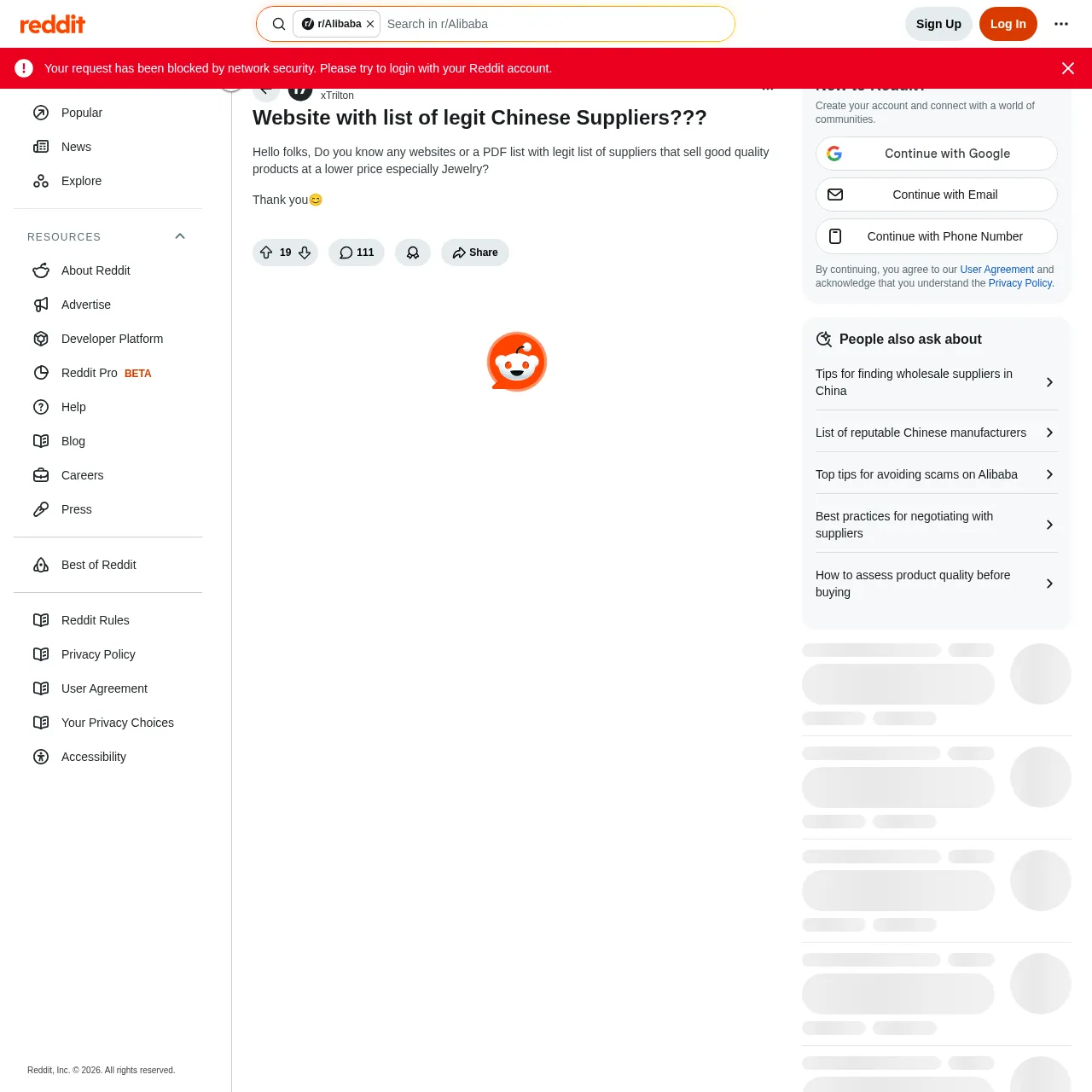
Active r/Alibaba thread where buyers share firsthand supplier recommendations, fraud warnings, and platform benchmarks outside official directory ecosystems.
The r/Alibaba community on Reddit occupies a distinct position in the chinese wholesale suppliers research stack: it is where buyers go when they distrust the verification layer on official B2B platforms and want peer-sourced intelligence instead. Threads like the one targeting "legit Chinese supplier lists" attract high-intent sourcing buyers who have already identified the major platforms — Alibaba, 1688, Global Sources — but need cross-validation before placing a trial order. The signal value is in the replies: community members cite specific platforms (1688 for factory-direct pricing, Yiwugou for small-batch wholesale, HKTDC for verified Hong Kong intermediaries), name sourcing agents by handle, and share concrete MOQ thresholds and lead-time benchmarks from direct transaction experience.
What makes Reddit useful in a sourcing workflow is precisely what makes it unreliable as a primary source: the lack of editorial filtering. Fraud warnings, MOQ disappointments, and quality control failures appear alongside genuine recommendations — neither category would surface in a paid supplier directory's own listings. For DTC operators cross-referencing an Alibaba supplier's Gold status or Trade Assurance history against community blacklists before placing a $3,000–$5,000 trial order, this unfiltered sentiment layer is a genuine due-diligence input.
Key Features:
- Peer-sourced supplier recommendations from active importers and resellers with firsthand transaction context
- Category-specific threads covering jewelry, electronics, apparel, and general wholesale — including niche platform references (1688, DHgate, HKTDC, Canton Fair directories) that paid directories often omit
- Community vetting through upvotes and replies, surfacing both high-performing suppliers and documented fraud cases or quality control failures
Reddit threads also surface sourcing infrastructure beyond platforms: specific Yiwu sourcing agents, freight forwarder recommendations, and custom clearance workflows discussed by category. This long-tail coverage is particularly useful for buyers entering categories where official directories have thin listing depth — smaller product verticals where a community-vetted agent referral outperforms a cold RFQ to an unaudited factory.
Best For: Pre-sourcing due diligence — DTC operators cross-referencing an Alibaba supplier's Gold status against community fraud reports before a trial order; platform discovery for buyers identifying China-side B2B channels beyond Alibaba (1688 for factory gate pricing, Yiwugou for small-batch runs); category-specific sourcing agent referrals for niche verticals with thin directory coverage.
4. Made-in-China.com — B2B Supplier Discovery & RFQ Platform
Made-in-China.com's mobile-optimized supplier listing view with factory type, annual revenue band, certification status, and RFQ submission at the product level.
Made-in-China.com is a Tier-1 Chinese B2B export marketplace operated by Focus Technology Co., Ltd. (Nanjing) and one of the three platforms — alongside Alibaba and Global Sources — that overseas sourcing buyers encounter consistently when researching chinese wholesale suppliers. Its strongest differentiation from the other two is category composition: Made-in-China skews toward mid-to-heavy industrial verticals (equipment, instruments, chemicals, electrical components), making it the preferred discovery channel for sourcing buyers who need factory-floor specs, material certifications, and engineering documentation rather than consumer-packaged product listings.
Supplier profiles surface factory type (manufacturer vs. trading company), year established, annual revenue band, and available certifications — CE, RoHS, ISO 9001 for electronics; REACH and OEKO-TEX for chemicals and textiles — at the listing level. MOQ and lead time data appears at the product listing level rather than requiring a separate inquiry. The platform's RFQ system lets buyers post sourcing needs and receive competing quotes from multiple suppliers simultaneously, compressing the supplier-shortlisting phase without requiring individual cold outreach to each factory.
Key Features:
- 14+ top-level product categories spanning Agriculture, Electronics, Industrial Equipment, Chemicals, Apparel, Furniture, and more — covering virtually the full range of Chinese export manufacturing verticals
- Supplier verification and third-party audit services with credentialing displayed on supplier profiles, including factory inspection history and certification status
- RFQ system allowing buyers to post sourcing requirements and receive competing supplier bids — reduces cold-outreach friction for first-contact qualification
- Mobile-first URL architecture (m.made-in-china.com) optimized for sourcing agents operating in Southeast Asia, Africa, and Latin America — high-growth buyer segments for Chinese wholesale export
For DTC operators validating secondary suppliers or benchmarking unit pricing against an incumbent factory, the breadth of competing manufacturer listings in categories like Consumer Electronics, Bags & Cases, or Apparel & Accessories provides direct comparables without commissioning a separate sourcing agent engagement.
Best For: Overseas sourcing buyers identifying verified Chinese factories for OEM/ODM runs in Industrial Equipment, Electrical & Electronics, or Chemicals — categories where CE, RoHS, and ISO certifications are deal-critical; DTC operators pressure-testing incumbent factory pricing by browsing competing manufacturer listings; sourcing agents in emerging markets using mobile-optimized interfaces for field-based supplier qualification.
5. DDPCHAIN — China Wholesale Websites Guide
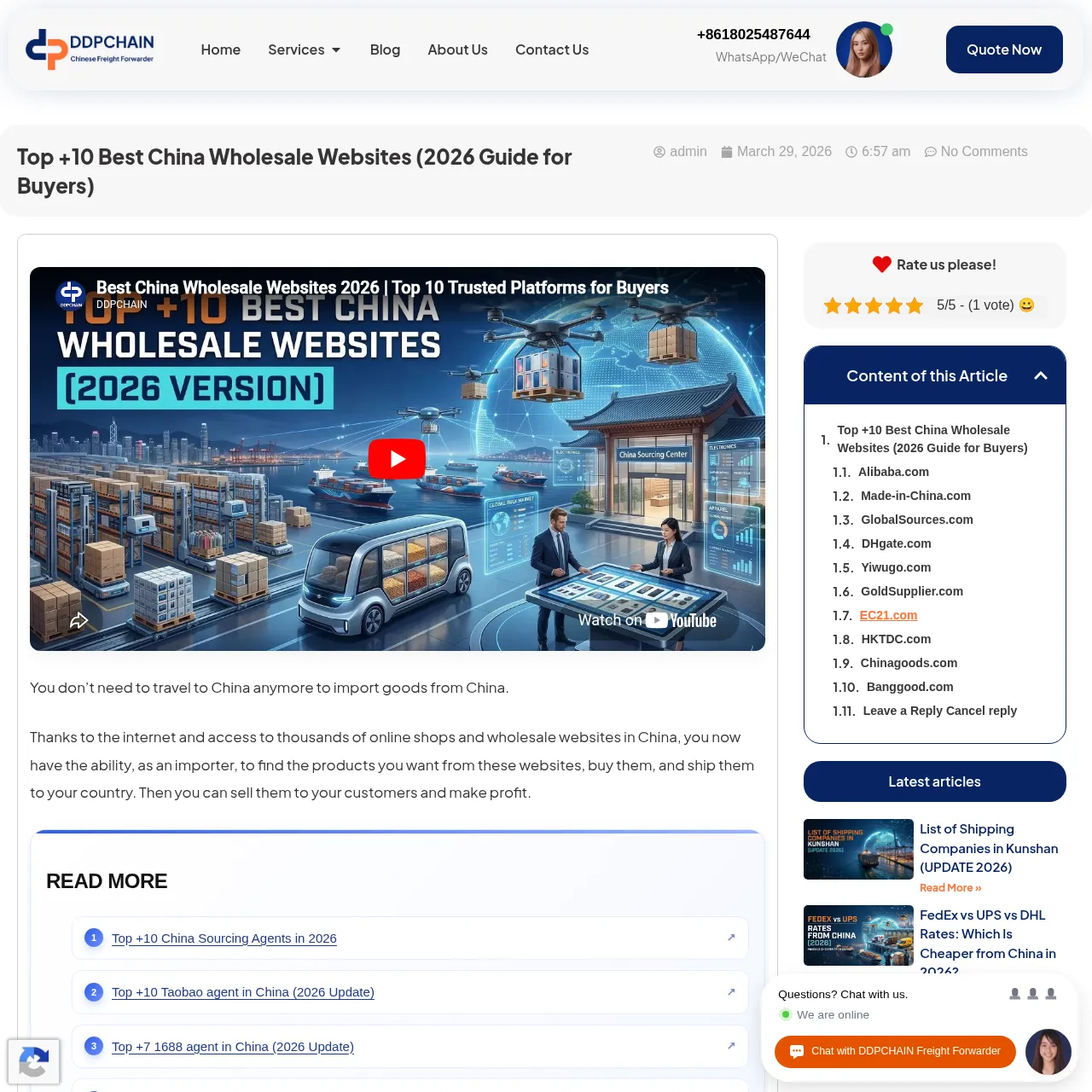
DDPCHAIN's 2026 guide to China wholesale platforms, combining supplier directory benchmarking with DDP freight routing context for 15+ destination markets.
DDPCHAIN's wholesale platform guide represents a distinct content format in the chinese wholesale suppliers research stack: it is published by a China-based DDP (Delivered Duty Paid) freight operator, which means the supplier directory benchmarking is bundled with real-world logistics intelligence that a pure content site cannot credibly provide. For overseas sourcing buyers, this vertical integration matters. Knowing that a platform like 1688 sources at factory-gate pricing is only half the decision — understanding what DDP landed cost to the US, UK, or UAE looks like at a given order volume completes the unit economics picture. DDPCHAIN can speak to both sides of that equation in a way that a standalone directory review cannot.
The 2026 publication date signals recency in a space where platform terms, verification standards, and shipping route costs shift annually. The guide covers 10+ wholesale platforms across sourcing tiers — from Alibaba's Gold Supplier tier down to 1688 factory-direct pricing and Yiwugou small-batch wholesale — ranked for international buyer use with MOQ tier and payment term context. Paired with country-specific freight routing guides for 15+ markets (US, UK, UAE, Saudi Arabia, Philippines, and others), it functions as a pre-sourcing research asset that compresses two separate research workflows — platform evaluation and logistics planning — into one document.
Key Features:
- Curated list of 10+ vetted China wholesale platforms benchmarked for international buyers, updated to 2026 with current MOQ tiers and verification status
- Published by a DDP freight operator with direct sourcing-to-shipment context — platform recommendations carry implicit operational validation from the company's own freight client base
- Country-specific shipping routing guides for 15+ destination markets covering air, sea, DDP, rail, and express freight modalities from Chinese ports
The SEO positioning — at the intersection of "wholesale supplier discovery" and "China logistics" — captures buyers at a mid-funnel moment when they are evaluating sourcing channels and simultaneously need freight intelligence to close the unit economics calculation.
Best For: Overseas sourcing buyers researching which B2B platforms (Alibaba, 1688, DHgate, Made-in-China) suit their category and order volume; DTC operators who need both a supplier directory and a freight partner and prefer bundling both into one vendor relationship; logistics-first buyers who want landed cost context alongside factory pricing benchmarks.
6. PapaChina — China Wholesale & Bulk Promotional Products
PapaChina is a US-facing intermediary platform that aggregates Chinese factory production into a branded, English-language wholesale catalog optimized for promotional merchandise buyers. For the keyword "chinese wholesale suppliers," it occupies a specific niche: buyers who want China-origin pricing and product range without managing a direct factory relationship, navigating zh-CN sourcing portals, or handling freight and customs independently. The value proposition is managed convenience, not factory-gate economics.
The catalog spans 20+ product verticals — apparel, bags, drinkware, tech accessories, office items — with custom imprinting and branding available on demand. An Express Quote system targets fast-turn B2B buyers with a sub-48-hour quoting workflow for bulk orders, which contrasts with the standard 2–5 business day RFQ cycle on direct-factory platforms. PapaChina positions itself as an importer-of-record intermediary that ships to United States buyers with US-delivery framing — lowering the trust barrier for North American SMB buyers who lack Alibaba or 1688 sourcing experience or an established freight forwarder relationship.
Key Features:
- Direct-from-China wholesale sourcing across 20+ product verticals with custom imprinting and branding available — typical MOQ range for this model is 50–500 pieces, 3–5 week sea freight lead time
- Express Quote system with sub-48-hour turnaround for bulk B2B orders — faster quote cycle than standard factory RFQ workflows
- US-market-facing storefront with country-specific delivery routing, positioning as an importer-of-record intermediary that handles freight and customs on behalf of the buyer
For DTC operators and Amazon sellers comparing PapaChina against direct 1688 sourcing or verified factory agents, the trade-off is clear: PapaChina carries an intermediary markup that makes it more expensive than factory-gate pricing, and certifications (REACH, CPSIA, OEKO-TEX) are not surfaced at the listing level, requiring a separate inquiry for compliance-sensitive categories. For buyers who prioritize speed-to-order and reduced sourcing overhead over cost optimization, the convenience premium is justified — particularly for promotional merchandise campaigns where branded artwork setup (NRE) across multiple SKU categories is the primary cost driver, not factory unit economics.
Best For: Corporate gifting and trade-show promotional merchandise buyers needing custom-logo products in 100–5,000 unit runs with artwork imprinting included; DTC operators and Amazon sellers sourcing private-label packaging or branded accessories (caps, bags, drinkware) without managing a direct factory relationship or navigating zh-CN sourcing portals.
How to Choose the Right Chinese Wholesale Supplier Platform
The six platforms above serve different buyer profiles at different stages of the sourcing workflow. Mapping your use case to the right tool saves weeks of qualification time and prevents the most common sourcing failure mode: selecting a factory based on catalog depth rather than export readiness.
If you're building a long-term OEM/ODM supply relationship, prioritize platforms with verified factory profiles, disclosed certifications, and bilingual communication infrastructure. Link4a and Global Sources both serve this need — Link4a for buyers who want AI-accelerated matchmaking and full-stack market infrastructure for their supply chain, Global Sources for buyers who prioritize third-party audit depth (Bureau Veritas, SGS) and trade show verification at the MOQ ranges typical of first production runs ($10,000–$50,000 USD).
If you're benchmarking pricing or discovering secondary suppliers, Made-in-China.com's industrial-skewed catalog and competing-bid RFQ system provide the fastest multi-supplier price comparison without requiring existing platform relationships. For consumer-category benchmarking, Reddit's r/Alibaba threads surface peer-validated pricing expectations and platform recommendations that paid directories won't self-report.
If you need factory-to-storefront infrastructure — moving from sourcing to selling without building a separate marketing stack — Link4a's end-to-end workflow (Sitebox storefront, content engine, Inbox demand generation) compresses what would otherwise require four separate tools into one loop, with a 300+ factory network and 1,400+ live sites providing auditable starting points rather than cold leads.
If you're at the logistics-planning stage and need to close the unit economics calculation with landed-cost context, DDPCHAIN's bundled supplier guide and DDP freight routing intelligence for 15+ markets provides a single-source answer to both "which platform" and "what does it cost to ship."
The most common mistake sourcing buyers make is optimizing for catalog size rather than qualification depth. A verified factory with 500-unit MOQ, disclosed ISO 9001 certification, and a 35-day FOB Shenzhen lead time is a better sourcing starting point than an unverified listing with a lower MOQ and no export documentation. Use the platforms above to build your shortlist, run your own factory audit or engage a third-party inspector for orders above $15,000 USD, and confirm payment terms (T/T 30% deposit, 70% against B/L is standard) before committing to a production run.
China's manufacturing base continues to be the most cost-competitive, certification-capable, and production-volume-scalable option available to international buyers across most product categories in 2026. The infrastructure to access it reliably — from AI-powered matchmaking to peer-validated community intelligence — has never been more accessible. The sourcing advantage now belongs to buyers who know which tool to use at each stage of the qualification workflow.