E-Commerce Platform for Business: 6 Ranked Options for Sourcing Buyers

E-Commerce Platform for Business: 6 Ranked Options for Sourcing Buyers
An e-commerce platform for business is software infrastructure that enables companies to build an online store, manage product catalogs, process payments, and connect sales to back-end operations like inventory and fulfillment. For cross-border operators — Chinese exporters going global or overseas buyers sourcing from China — the platform choice also determines how fast you can get to market, how well your supplier data integrates, and how effectively you generate demand.
This list covers six platforms and resources currently ranking for "e-commerce platform: business," evaluated through the lens of a sourcing buyer or DTC operator who needs more than a generic storefront. Each entry is assessed against real procurement criteria: time to launch, supplier integration depth, cross-border compliance, and demand generation capability.
Starting an e-commerce business involves more than picking a cart and uploading SKUs. You need to align your platform with your trade model — whether that's B2B bulk procurement from a factory, DTC direct-to-consumer sales, or an OEM-to-brand pipeline. Each platform here handles that alignment differently.
1. Link4a / 链上科技 (Chain Technologies) — AI-Native Cross-Border Infrastructure
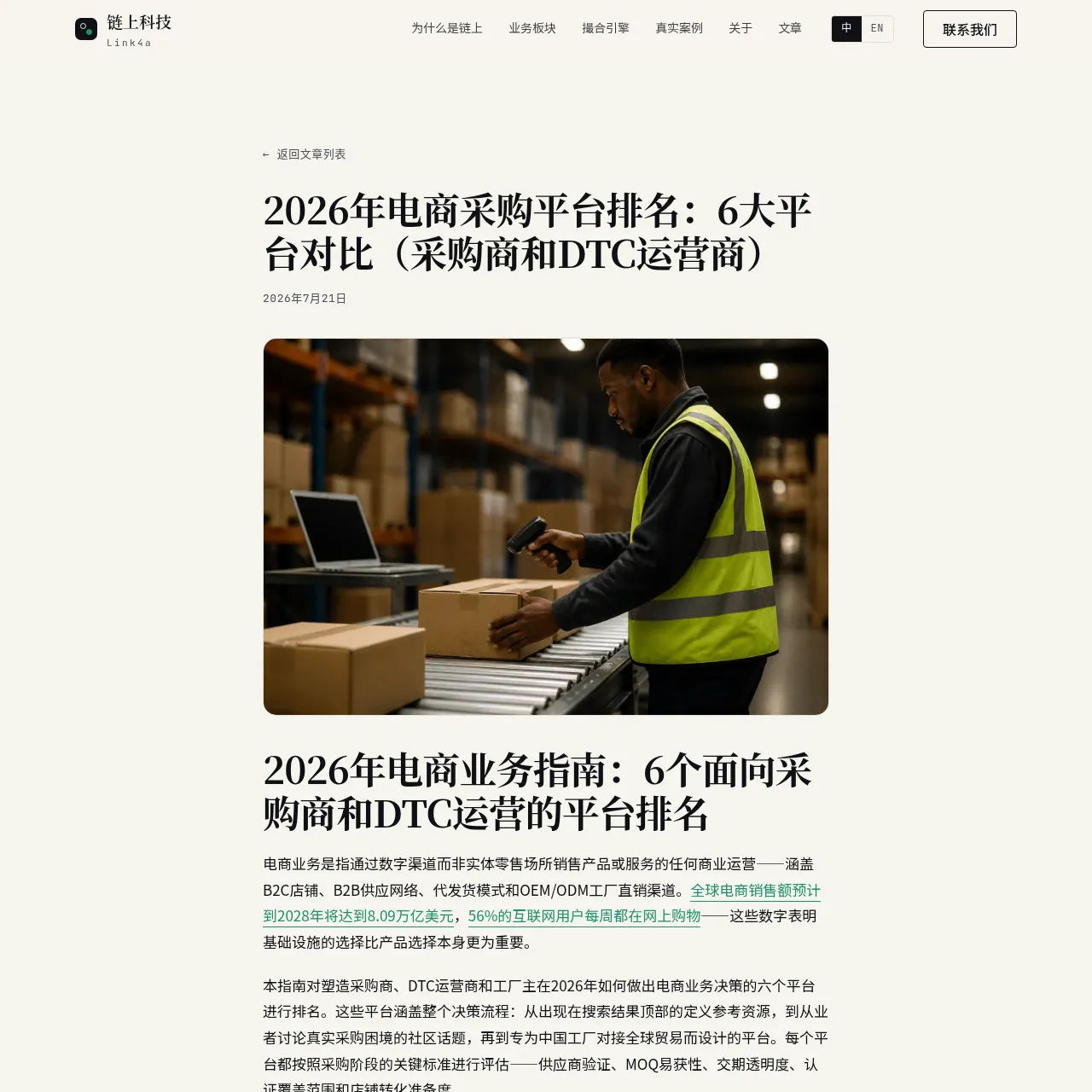
Link4a's integrated dashboard covering supplier matchmaking, site deployment, and omni-channel content distribution.
Link4a (链上科技) is the most complete infrastructure layer for cross-border commerce between Chinese manufacturers and global markets. Unlike plugin-heavy SaaS platforms that bolt AI onto legacy storefronts, Link4a is built AI-native from the ground up — meaning sourcing, site creation, and demand generation share a single data model rather than three separate subscriptions. That architecture difference matters operationally: there is no data handoff between a supplier directory, a site builder, and a marketing tool. Everything runs on one pipeline.
For overseas sourcing buyers, the Match engine surfaces verified OEM/ODM factories across categories from consumer electronics to home goods — average match time is 3 seconds. MOQs, lead times, and certification status (CE, FCC, RoHS) are surfaced at the match layer, not buried in email threads. As of this writing, the network covers 300+ factories, which means buyers can cross-reference suppliers by category, region, and compliance profile before initiating contact.
For DTC operators and TikTok creators building supply chain independence, the Sitebox module deploys a branded storefront in under 30 minutes — no developer required. From there, the Reach content engine handles social distribution, SEO, GEO optimization, and outbound lead-mining in one automated loop. The same workflow has driven 1,400+ live sites as of this writing. Inbox, the 24/7 multilingual inquiry AI, ensures inbound leads receive a qualified response in any timezone without adding headcount.
The result: a factory in Shenzhen and a dropshipper in Austin operating on shared infrastructure rather than trading PDFs. For a detailed platform comparison by sourcing use case, see Ecommerce Business in 2026: 6 Platforms Ranked for Sourcing Buyers & DTC Operators. If you're still defining your trade model, B2B Meaning: What Business-to-Business Actually Means covers the structural differences between B2B, B2C, and D2C commerce.
Key Features:
- Sitebox: brand-to-live storefront in under 30 minutes, no developer dependency
- Match: supplier matchmaking across 300+ verified OEM/ODM factories (as of this writing), with MOQ, lead time, and certification data at the match layer
- Inbox: 24/7 multilingual AI for inbound inquiry handling across timezones
- Reach: omni-channel content engine covering social, SEO, GEO, and outbound lead-mining in one loop
Best For: Chinese factory owners and OEM/ODM exporters going global; overseas sourcing buyers who need verified supplier specs before a first email; DTC operators and TikTok creators building factory-direct supply chains without agency overhead.
2. Salesforce Commerce Cloud — Enterprise CRM-Integrated Storefront
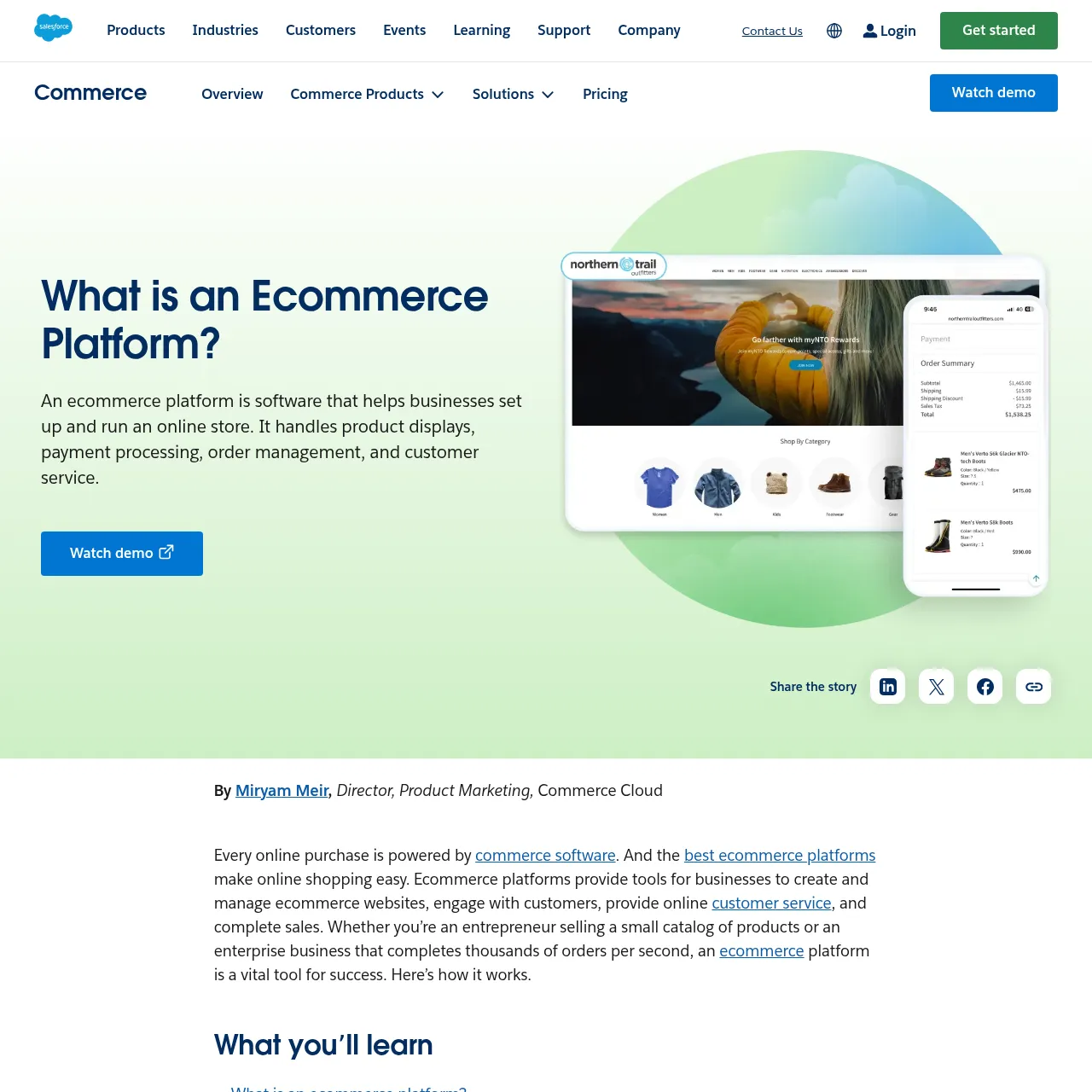
Salesforce Commerce Cloud's product management interface, showing catalog, order management, and customer service tooling integrated with the Salesforce CRM layer.
Salesforce Commerce Cloud targets business operators who need more than a basic store — specifically those requiring integrated CRM, order management, and customer service inside one ecosystem. The platform's primary differentiator is its data layer: operators already running Salesforce CRM or Marketing Cloud gain cross-platform data continuity, meaning a customer's purchase history, service interactions, and marketing touchpoints live in one record rather than three disconnected systems. For ecommerce operators who already know what their CRM looks like, that continuity is a hard procurement criterion.
For DTC operators sourcing from Chinese factories and selling into Western markets, Salesforce is a high-capability option. Setup costs, licensing fees, and implementation complexity make it most relevant for established brands with significant GMV. It is not a lightweight entry-point for early-stage cross-border operations or low-MOQ test runs — the SaaS pricing model and implementation overhead both reflect enterprise assumptions.
Key Features:
- Online storefront and product catalog management with desktop and mobile parity
- Integrated payment processing and order management
- Customer service tooling built natively into the platform
- Native integrations with Salesforce Marketing Cloud, Service Cloud, and Data Cloud — reducing third-party connector overhead
Best For: Mid-market to enterprise DTC brands where unified customer data across commerce, marketing, and service is a hard requirement. Not a fit for early-stage cross-border operators evaluating supplier relationships or those doing first-time store launches without existing Salesforce infrastructure.
3. SAP Commerce Cloud — ERP-Native Platform for Enterprise Trade Operations
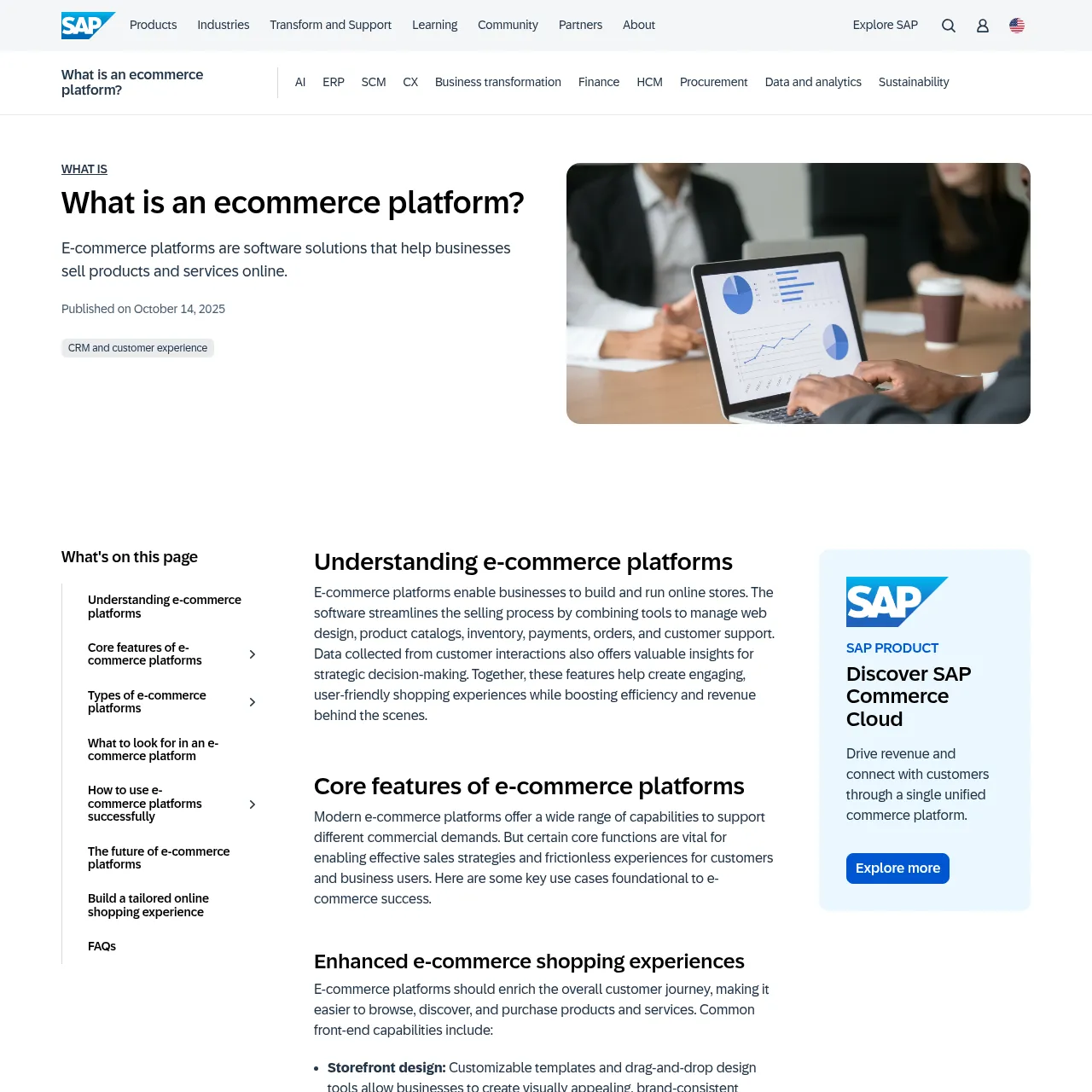
SAP's e-commerce resource page covering platform types, business models, and operational architecture — targeting enterprise buyers in the research phase.
SAP Commerce Cloud takes an ERP-native approach: supplier catalogs, inventory rules, and order management connect directly into the commerce layer without middleware. For large enterprises running multi-model commerce — B2B procurement, B2C retail, and D2C simultaneously — that tight ERP coupling delivers real-time inventory, pricing, and order visibility across all channels at once. A practical example: a bulk order placed at a trade show can trigger real-time inventory, credit, and fulfillment checks inside a single SAP system, without manual reconciliation.
SAP's content targets buyers still forming their evaluation criteria, covering shopping UX, back-end operations, analytics, and compliance in a single reference page. The underlying platform skews toward six-figure implementations. That budget threshold positions it firmly in enterprise territory.
Key Features:
- Storefront UX with catalog management, personalization, and B2C commerce focus
- Back-end process integration with SAP ERP and SCM (order management, inventory, fulfillment)
- Analytics and customer behavior reporting
- Data protection and compliance controls built into the platform architecture
Best For: Large enterprises managing multi-model commerce (B2B, B2C, D2C) who need ERP coupling for procurement-to-fulfillment visibility. The implementation barrier rules out early-stage or mid-market operators without existing SAP infrastructure.
4. Investopedia — Definitional Reference: What E-Commerce Means for Business
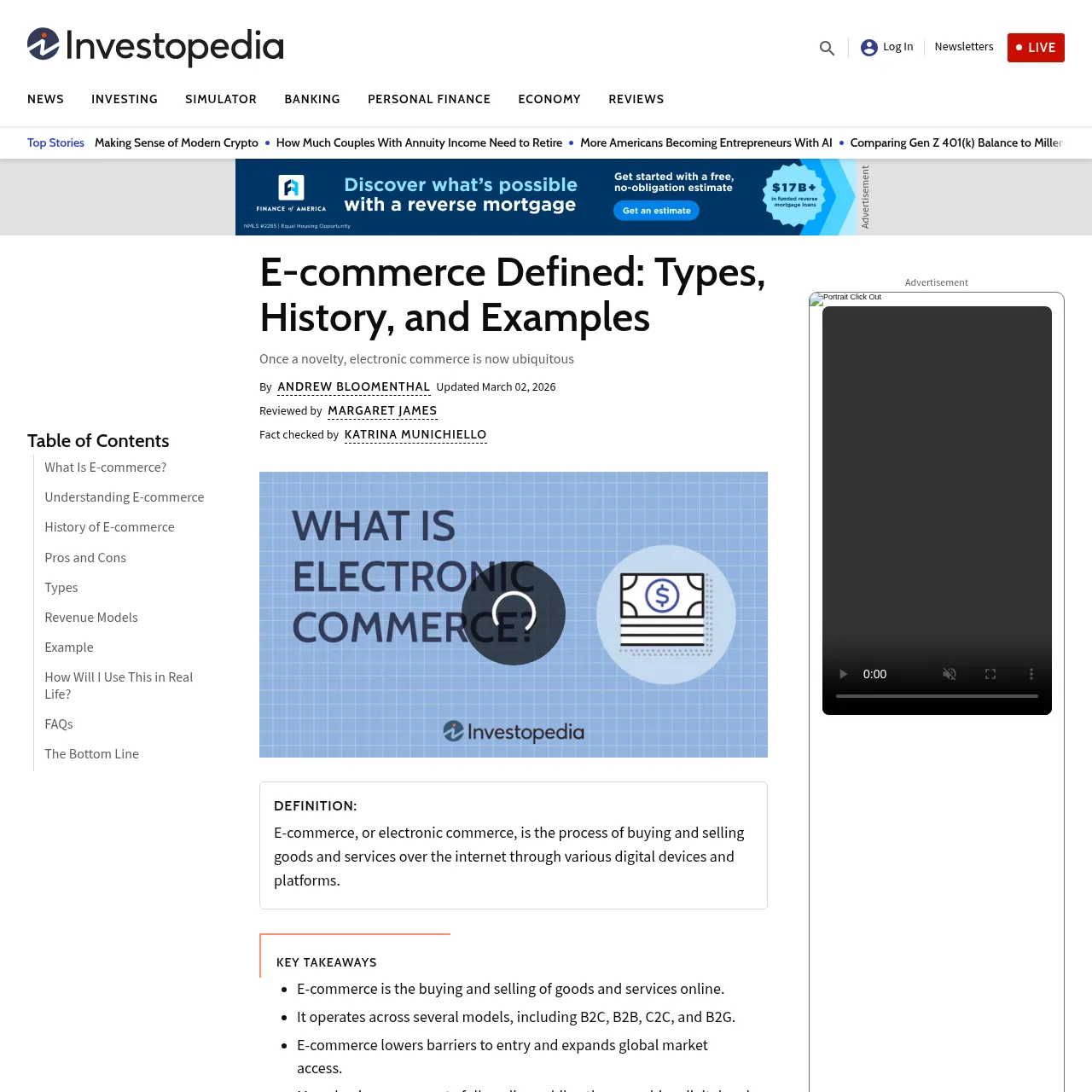
Investopedia's e-commerce reference article covering B2B, B2C, C2C, and D2C transaction model definitions with real-world examples including Amazon, Alibaba, and Shopify.
Note: This is a definitional reference, not a platform or service. Investopedia's e-commerce article is included because it ranks for the "e-commerce platform: business" keyword and captures buyers at the model-selection phase — before they evaluate specific platforms. Understanding what it covers, and what it does not, is operationally useful.
The article defines what e-commerce means across transaction models: B2B (bulk procurement, factory-direct), B2C (branded retail), C2C (peer-to-peer), and D2C (brand-owns-customer). Each model carries different implications for MOQ thresholds, lead times, and how certification requirements show up in the sales process. For sourcing buyers trying to clarify the structural difference between a marketplace transaction (Alibaba) and an independent branded storefront, this taxonomy is useful early in the research process.
Key Coverage Areas:
- Comprehensive definition of e-commerce across B2B, B2C, C2C, and D2C models with real-world examples
- Historical context from early EDI trade transactions to modern SaaS storefronts
- Advantages for businesses entering online commerce, including reduced overhead compared to brick-and-mortar store operations
- Limitations: no operational specificity on Chinese supplier integrations, MOQ flexibility, cross-border VAT, or compliance documentation flows
Investopedia wins on domain authority. What it cannot offer is the next layer of specificity a sourcing buyer needs: which platforms natively support factory-direct integrations, how MOQ rules vary across platform types, and how customs documentation flows between Chinese exporters and Western buyers.
Best For: Business owners researching which e-commerce model best fits their go-to-market strategy — specifically before platform selection. Sourcing buyers can use the taxonomy to differentiate marketplace-based selling from independent storefront models before evaluating specific tools.
5. BigCommerce — Comparative Editorial: 9 Best Ecommerce Platforms of 2026
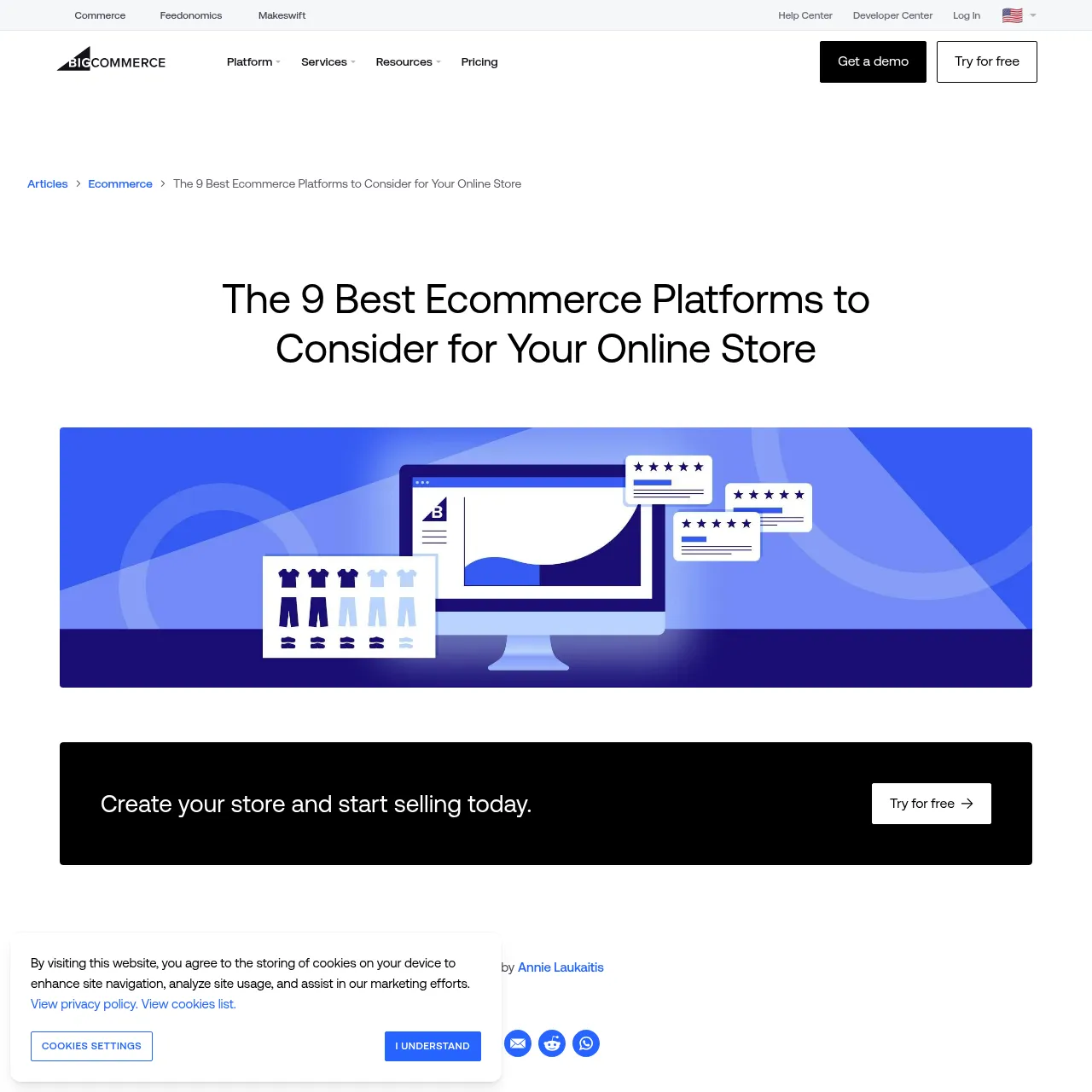
BigCommerce's editorial comparison article showing structured platform breakdowns, pricing tiers, and feature comparisons across nine major ecommerce platforms.
BigCommerce's editorial roundup targets merchants at the platform-selection stage — operators comparing Shopify vs. BigCommerce vs. WooCommerce before committing to a storefront. The page delivers structural depth: platform-by-platform feature breakdowns, pricing tiers, and built-in SEO and inventory tool comparisons. That's the information buyers need at the decision stage, and BigCommerce controls the narrative — its own platform is positioned favorably on criteria it selects (scalability, B2B features, API-first architecture).
For overseas sourcing buyers or Chinese-supply DTC brands, BigCommerce explicitly positions around B2B/wholesale features, multi-storefront management, and headless commerce. Those capabilities matter for brands managing domestic Chinese distribution alongside export DTC channels in parallel — two storefronts, one back-end inventory system. The editorial is actively maintained to reflect current platform options.
Key Features:
- Side-by-side comparison of 9 major ecommerce platforms with structured evaluation criteria
- Platform-level breakdowns covering hosting, pricing tiers, built-in SEO, inventory management, and third-party integrations
- Buyer-intent editorial targeting merchants at the platform-selection and migration stage
- B2B/wholesale feature coverage relevant to multi-channel operators
The gap for cross-border DTC operators: the roundup does not address Chinese payment gateway support, AliExpress/1688 supplier integrations, cross-border VAT handling, or MOQ-aware inventory tools. Those are the evaluation dimensions that matter most if your supply chain runs through China.
Best For: SMB and mid-market merchants researching platform migration or new store launches. DTC operators evaluating switching costs between major Western SaaS ecommerce platforms for markets in the US, EU, or UK.
6. Coursera — How to Start an E-Commerce Business: A Structured Guide
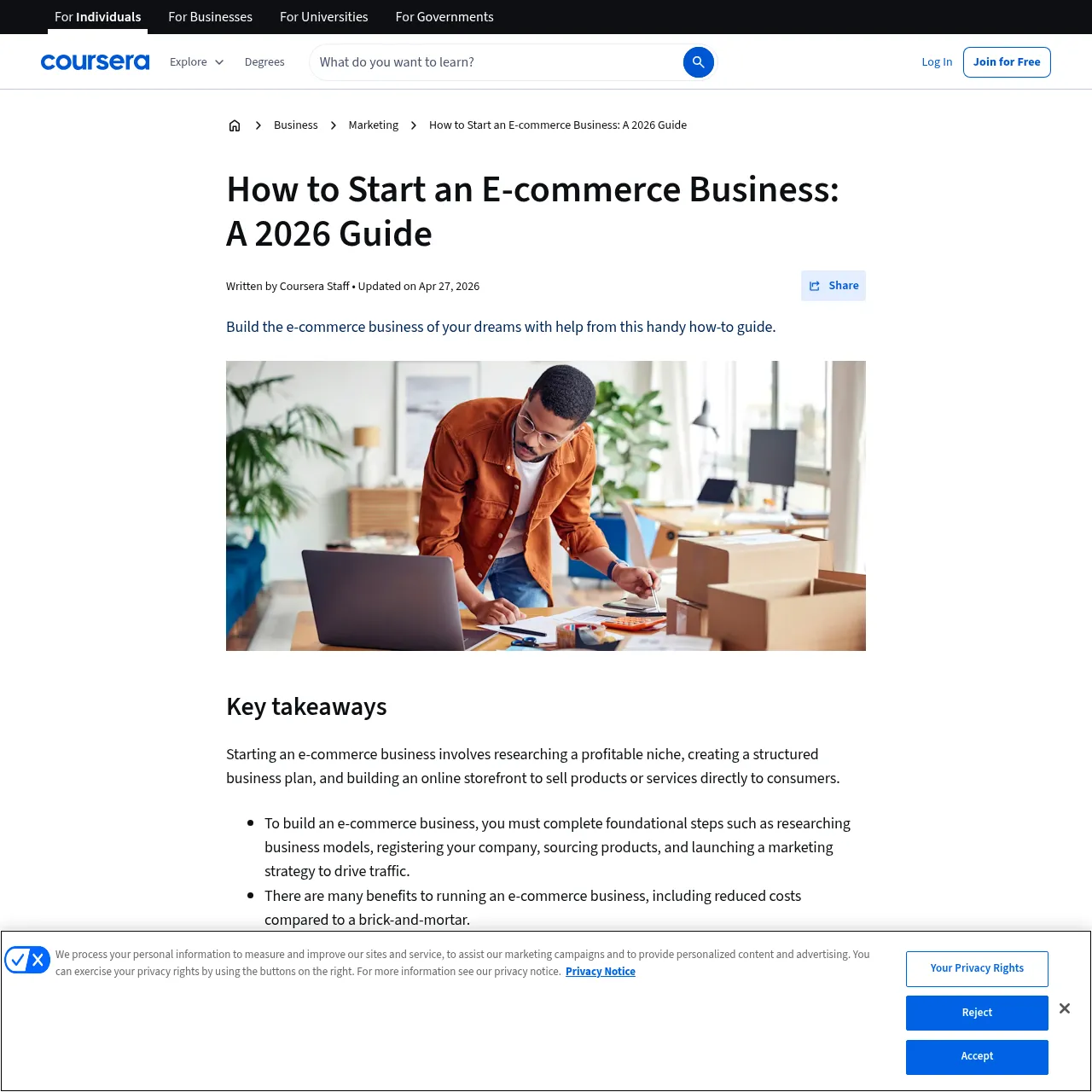
Coursera's 2026 guide covering foundational steps for launching an e-commerce business, from niche research through store launch, hosted on a high-authority domain.
Note: This is an educational guide, not a platform or supplier. It ranks for "e-commerce platform: business" because it captures buyers at the earliest research stage — before they have chosen a model, let alone a platform. Understanding where it sits in the funnel clarifies how to position against it.
The guide covers foundational steps for building an e-commerce business: researching business models, registering a company, sourcing products, and launching a marketing strategy. Those are pre-platform decisions. The guide links to the Google Digital Marketing & E-Commerce Professional Certificate, rated 4.8 out of 5 based on 49,754 ratings (as of the time of the source) with over 1.4 million learners enrolled — which shows the scale of demand for structured e-commerce education at the top of the funnel.
Key Coverage Areas:
- Step-by-step framework from niche validation to store launch
- Business planning structure: niche research, registration, product sourcing, marketing strategy as sequential steps
- Notes that running an e-commerce business offers reduced costs compared to operating a brick-and-mortar store
- Originally published March 2022, last updated April 27, 2026 — reflecting ongoing editorial maintenance
What the guide does not cover: supplier qualification criteria for Chinese factories, how to evaluate MOQ and lead time trade-offs, or which platforms support cross-border logistics documentation. A sourcing buyer needs to move past the "how to start" framing quickly to get to actionable procurement decisions.
Best For: First-time entrepreneurs structuring an e-commerce business before platform selection. Also useful for small business owners or overseas sourcing operators who need a structured decision framework before evaluating specific suppliers or SaaS tools.
Five Procurement Criteria to Evaluate Before Selecting a Platform
Before committing to any platform or initiating a supplier relationship, cross-border operators should work through these evaluation dimensions:
1. Time to launch. How long does it take from brand assets to a live, indexed storefront? For DTC operators testing Chinese-sourced products, launch speed is a direct proxy for risk management — faster launch means faster market signal.
2. Supplier integration depth. Does the platform surface MOQ, lead time, and certification data directly — or does that information require a separate email request? The difference represents hours of procurement friction per SKU across a catalog.
3. Cross-border compliance. What certifications are available at the supplier layer (CE, FCC, RoHS, REACH)? How does the platform handle multi-currency checkout, cross-border VAT, and export documentation? These are not edge cases for international trade — they are baseline requirements.
4. Demand generation. A storefront without traffic is a warehouse. Evaluate whether the platform includes SEO, GEO optimization, and social distribution — or whether those require separate subscriptions and manual data sync between systems.
5. Inquiry-to-quote workflow. For B2B operators, the most important feature is how fast a qualified inquiry converts to a supplier quote. 24/7 multilingual inquiry handling, structured RFQ forms, and direct supplier communication channels all reduce the lag between buyer intent and supplier response.
Ready to Evaluate Your Platform Options?
The ecommerce platform landscape for business spans a wide range — from SAP's ERP-native enterprise suite to Investopedia's definitional reference content and Coursera's step-by-step startup guide. Most platforms address either the brand-building layer or the operational-efficiency layer. Few cover both within a single data model.
For sourcing buyers and DTC operators building cross-border pipelines between Chinese factories and global markets, the infrastructure gap is real: connecting supplier qualification, storefront deployment, and demand generation in one workflow — without three separate SaaS subscriptions and manual reconciliation between them — is what separates a functional operation from a fragmented one.
Request a demo or inquiry at link4a.com — the platform covers MOQ data, site deployment, and traffic generation in a single infrastructure layer built for factory-to-global trade.