Ecommerce Services That Actually Work: A Cross-Border Trade Guide

Ecommerce Services That Actually Work: A Cross-Border Trade Guide
Ecommerce services are the technical, operational, and marketing functions that enable businesses to sell products online at scale. They span store management, product data optimization, payment processing, multilingual content, supplier matchmaking, and customer acquisition tools — forming the infrastructure layer that determines whether an online business grows or stagnates in competitive global markets.
Cross-border ecommerce runs on services, not just software. A factory in Guangdong might produce excellent goods, but without the right ecommerce service stack — an independent store, an inquiry management system, a content engine that surfaces products in Google and TikTok search — that factory's export capacity stays locked inside trade show brochures and marketplace listings. The gap between "we have a store" and "we have a converting export channel" is almost entirely determined by which services are running underneath.
This guide maps the core categories, explains what to evaluate before committing to any platform or tool, and shows how AI-native infrastructure — including what 链上科技 (Link4a) has built for factories going global — compresses timelines that once took months into days. For a side-by-side comparison of platforms that serve cross-border operators specifically, see 6 Best E-Commerce Services in 2026: Ranked for Sourcing Buyers & DTC Operators.
What Are Ecommerce Services?
Ecommerce services cover any function that helps a business operate, grow, or optimize an online sales channel. The meaning has expanded significantly: what started as basic store hosting and payment rails now spans product content creation, multilingual SEO, SaaS platforms for DTC brand launch, and AI-driven inquiry management.
A practical breakdown of what falls under the umbrella:
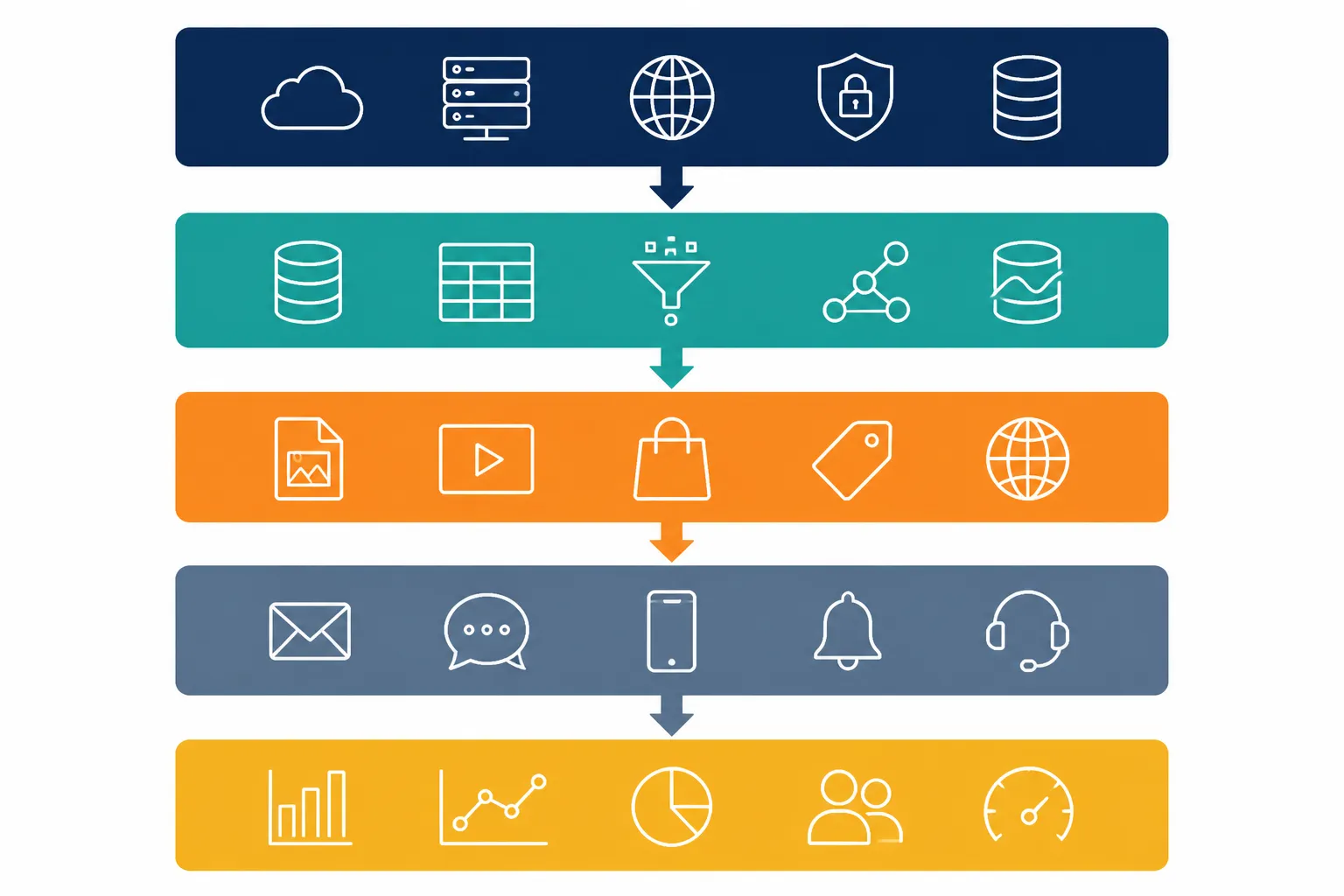
- Store infrastructure — Hosted storefronts, shopping cart systems, payment gateways, and checkout optimization
- Product data management — Accurate product descriptions, categorization, tagging, and market insights that improve discoverability both on-site and through search engines
- Content and SEO — Unique, search-engine-optimized product pages that function as effective landing pages for both users and crawlers
- Inquiry and CRM — Lead capture, multilingual customer communication, and quote-request handling
- Logistics and fulfillment — Warehousing, shipping integrations, returns management
- Analytics and market intelligence — Conversion tracking, competitive monitoring, demand signals
For Chinese manufacturers entering international markets, the most critical services are usually store deployment, multilingual content, and inquiry management — because these three determine whether a buyer can find, trust, and contact the supplier at all. Everything else is optimization on top of that foundation.
Why Ecommerce Services Are Critical for Cross-Border Trade
In ecommerce, competition is fierce, and offers are fully transparent to customers. A buyer comparing three suppliers on the same product category can see specs, pricing signals, and product presentation side by side in under a minute. The business that controls its own store — with clean product data, fast load times, and multilingual content — is evaluated differently than one routing buyers through a crowded marketplace listing.
The operational challenge is real: website operators face the ongoing challenge of monitoring the market and creating unique content with added value for new product pages. For a factory with 500 SKUs launching a DTC or B2B export channel, producing that content manually isn't viable.
Three areas where ecommerce services create measurable business impact:
Sales Conversion on Product Pages
The way products are presented in an online store — including images, colors, and descriptions — has a direct impact on conversions and customer retention. Improving presentation also sets accurate buyer expectations, which reduces return rates. For cross-border shipments where return logistics are expensive, that's not a minor detail.
Search Discoverability
Precise classification and tagging of product assortments using relevant categories and keywords helps customers find products within the online shop and via search engines. For a factory store competing with marketplace giants, ranking for long-tail product queries — "FDA-certified silicone mold manufacturer MOQ 500" — is often the most cost-efficient acquisition channel available.
International Expansion Capacity
Scaling into the US, EU, or Southeast Asia requires localized content, compliant payment rails, and customer service in multiple languages. Ecommerce services that handle multilingual content and inquiry management remove the two biggest friction points in international growth — and do it without proportional headcount increases.
How to Build Your Ecommerce Services Stack
Building a functional ecommerce stack is less about picking the most feature-rich tool and more about eliminating gaps between functions. A store with no inquiry management loses leads overnight. A store with excellent product pages but no SEO infrastructure generates no organic traffic. A supplier with an active store but no verification signals gets skipped by sourcing buyers who can't confirm capacity or certifications.
Here's a practical build sequence for factories and DTC operators entering cross-border channels:
Step 1 — Deploy an independent store. Before investing in additional marketplace listings, establish a store you own. Independent stores give you data ownership, SEO equity, and the ability to present certifications, MOQ terms, and lead times on your own terms. Sitebox (链上科技's store deployment product) is built for this: brand to a live, indexed store in under 30 minutes.
Step 2 — Load product data with discipline. Every SKU needs a clear title, accurate category tags, complete specifications, and a product description written for the buyer, not the factory floor. For 100+ SKUs, a managed content service or AI content engine is faster and more consistent than internal teams writing in a second language.
Step 3 — Set up inquiry management before traffic arrives. A factory receiving an inquiry from a US buyer at 2 AM needs a response within hours to stay competitive. Inbox (Link4a's 24/7 multilingual AI) handles this without overnight staff — it responds in the buyer's language, qualifies the inquiry, and routes it to the right contact automatically.
Step 4 — Build traffic through content and SEO. Product pages alone don't rank. A business that publishes buyer-intent content — comparison guides, material explainers, sourcing FAQs — builds topical authority and captures buyers earlier in their research. Reach (Link4a's omni-channel content and traffic engine) drives this across SEO, GEO search, social content, and outbound lead mining in one coordinated loop.
Step 5 — Connect with buyers through verified matchmaking. For suppliers without established buyer networks, a matchmaking engine compresses what used to require trade show attendance. Match (Link4a's matchmaking product) connects verified Chinese factories with overseas buyers at an average of 3 seconds per match — a persistent, 24/7 channel that operates whether or not you're exhibiting at a show.
When Should You Use Ecommerce Services?
Typical ecommerce service use cases include scaling large product catalogs, improving on-site search and navigation, expanding into international markets, increasing organic traffic through SEO content, enhancing product data quality, reducing returns, and gathering market insights. These aren't enterprise-only scenarios.
Ecommerce services make sense when:
- A factory with 200+ SKUs is launching a B2B export channel — managing product data and buyer inquiries manually doesn't scale beyond the first 20 active contacts; a SaaS management layer and AI inquiry tool are the minimum viable setup
- A DTC operator is sourcing from multiple Chinese suppliers — verification, content localization, and consolidated inquiry management reduce coordination overhead significantly
- A brand is expanding from one market to three — multilingual content, localized payment flows, and market-specific SEO require service infrastructure, not just ad-hoc translations
- A TikTok creator is launching a product — a fast, credible storefront is the conversion layer between viral content and actual sales; a store that takes three weeks to set up misses the trend window entirely
The inflection point is when manual workflows — one person handling inquiries, one team managing listings — become the constraint on growth. The moment your business can't respond to every inquiry within four hours or can't keep product pages current with catalog changes, automated service infrastructure stops being optional.
The Business Case: What Benefits Do These Services Actually Deliver?
The benefits consolidate differently depending on which side of the transaction you're on.
For exporters (factories and OEM/ODM suppliers):
- Controlled brand presentation without dependence on marketplace algorithms that shift without notice
- 24/7 buyer-facing response capacity without proportional headcount cost
- Organic traffic that compounds over time, rather than requiring continuous ad spend to maintain visibility
- Faster time to first buyer contact — measured in hours rather than trade-show cycles that happen twice a year
For sourcing buyers and DTC operators:
- Suppliers with proper ecommerce infrastructure tend to be more organized about export operations overall — their stores show certifications, MOQ terms, and lead times clearly, which reduces your due-diligence burden
- Inquiry response time under four hours is a reliable proxy for operational readiness
- An independent store with product data, case studies, and factory content gives you more to evaluate than a marketplace profile with three photos and a generic description
For a deeper comparison of how ecommerce platforms serve sourcing and DTC use cases with different trade-offs, the guide on Ecommerce Business in 2026: 6 Platforms Ranked for Sourcing Buyers & DTC Operators covers the major options.
Evaluating a Supplier's Ecommerce Readiness: Procurement Criteria
When a sourcing buyer qualifies a Chinese supplier, the supplier's ecommerce services setup is itself a signal of business maturity. Here are the specific dimensions to assess before placing a sample order:
MOQ and Pricing Transparency
A supplier's store should surface MOQ tiers clearly, or make it straightforward to request a quote with specific quantities. If pricing and minimum order quantities require a multi-email negotiation before you get a number, that's an operational friction signal. Ask directly: does the supplier's inquiry flow provide [your MOQ] and standard pricing bands upfront, or is every response "contact us for price"?
Lead Time and Production Capacity
Sample lead time and production lead time are different clocks — get both numbers explicitly. A supplier running modern ecommerce management tooling typically tracks this data and can provide it on first inquiry. A supplier who needs to "check internally and get back to you" on standard lead times is operating without a production management system, which creates risk downstream.
Certifications and Compliance
For products destined for the US (FDA, FCC, UL), EU (CE, REACH, RoHS), or other regulated markets, certifications should be available in the store or on first request. A factory with a properly managed independent store will typically have certificates downloadable directly from the product page — not on request after three follow-up emails.
Quality Assurance Process
Ask whether the factory allows third-party pre-shipment inspection (SGS, Bureau Veritas, QIMA are standard). A supplier confident in their QA process will have a standard answer and a preferred inspection contact. If the ecommerce store shows production process photos, factory audit reports, or documented QC procedures, that's meaningful evidence — not decoration.
Inquiry Response Speed and Language Quality
Send a test inquiry before committing to a sample order. Measure response time and language quality. A factory running an AI inquiry management system (like Link4a Inbox) will respond in your language within minutes of a query arriving. A factory relying on one salesperson in one time zone will show a 12-hour-plus gap during US or EU business hours — which compounds into multi-day delays on anything requiring back-and-forth clarification.

AI-Native Ecommerce Services: The 链上科技 (Link4a) Infrastructure
Link4a / 链上科技 is built specifically for the cross-border trade layer that most ecommerce SaaS platforms treat as an afterthought. Where conventional tools assume your store already exists and buyers already know about you, Link4a's four products address the full pipeline from zero to active buyer relationships:
- Sitebox — Independent store deployment in under 30 minutes. Brand-to-live, not brand-to-waiting. Built for factories that need a credible, indexed web presence before their next RFQ season or trade show cycle.
- Inbox — 24/7 multilingual AI inquiry management. Handles initial buyer questions in English, Spanish, Arabic, and other major languages without overnight sales staff. Routes qualified leads automatically.
- Match — A 3-second-average supplier matchmaking engine. Connects verified Chinese factories with overseas buyers based on product category, MOQ compatibility, certification requirements, and geography — replacing the economics of a trade show booth with a persistent, always-on channel.
- Reach — An omni-channel content and traffic engine that drives SEO, GEO search (AI search engine visibility), social content, and outbound lead mining in one coordinated loop. For factories with strong products but no content infrastructure, this replaces what would otherwise require a dedicated marketing team.
With 300+ factories served and 1,400+ sites live, the platform's network scale means the matching and content systems improve continuously — more buyer behavior signals feed better match quality over time. For factories and DTC operators comparing their options, the E-Commerce Platform for Business: 6 Ranked Options for Sourcing Buyers guide covers where Link4a sits relative to other platforms across key evaluation criteria.
Where to Start: Sequencing Your Ecommerce Services Investment
Most businesses overinvest in store design and underinvest in inquiry management and content. The sequence that generates revenue fastest is: live store → working inquiry system → complete product data → content and traffic. Everything beyond that is optimization on a functioning foundation.
For factories entering export markets: start with Sitebox to establish the independent store, add Inbox to capture inquiries around the clock, then layer Reach for organic traffic once the base is solid. For sourcing buyers evaluating suppliers: use the procurement checklist above — MOQ clarity, lead time documentation, certification availability, and inquiry response speed — before committing to a sample order or ongoing relationship.
The difference between a supplier with ecommerce services running correctly and one operating manually isn't just a technology gap. It's a signal about how the business manages information, responds to buyers, and scales. That signal matters before you commit inventory or supply-chain dependency.
Ready to launch your export channel or evaluate a supplier's digital infrastructure? Link4a's platform covers the full ecommerce services stack — store deployment, inquiry management, supplier matchmaking, and content-driven traffic — without plugin juggling or months-long agency projects.
Request a Quote or Get Started at link4a.com →
Frequently Asked Questions
What is ecommerce services?
Ecommerce services encompass the end-to-end operational infrastructure that enables online product transactions — including storefront platforms (Shopify, WooCommerce, 独立站 builders), payment processing, logistics/fulfillment (3PL warehousing, last-mile carriers), and customer service tooling. For sourcing buyers and DTC operators working with Chinese supply, this extends to cross-border trade services: customs brokerage, bonded warehousing (保税仓), and platforms like 1688 or Alibaba International that connect buyers to manufacturers with defined MOQs and lead times. The full service stack also covers demand-side functions — SEO/SEM, conversion optimization, and analytics — that turn supply-chain efficiency into retail margin.
How to ecommerce services?
To launch ecommerce services sourcing from China, start by qualifying suppliers on platforms like 1688 or through trade shows (Canton Fair, Global Sources), targeting factories with MOQs that match your volume — typically 200–500 units for soft goods, 50–200 for electronics — and confirmed certifications (CE, FCC, RoHS, or FDA depending on category). Build your fulfillment stack around a bonded warehouse or a 3PL in Yiwu/Shenzhen for consolidation, then use a freight forwarder with DDP terms to land goods cost-predictably into your destination market. For DTC operations, integrate order management directly with your supplier's ERP (many mid-tier factories now run SAP B1 or 金蝶) to keep lead times — typically 30–45 days production + 20–35 days sea freight — visible end-to-end.
Why is ecommerce services important?
Ecommerce services are important because they give overseas sourcing buyers and DTC operators direct access to Chinese supply chains — enabling sourcing from factories with verified certifications (e.g., ISO 9001, BSCI), transparent MOQs (typically 100–500 units for most categories), and lead times of 15–45 days from order to port. They eliminate friction in cross-border trade by consolidating order management, quality inspection, customs documentation, and last-mile logistics into a single workflow. For operators evaluating Chinese supply, platforms and service providers streamline supplier vetting, reduce per-unit landed cost, and provide the operational infrastructure to scale from sample orders to full production runs without building an in-house sourcing team.
When should I use ecommerce services?
Use ecommerce services when you're ready to move product at scale — specifically when your SKU count, order volume, or cross-border logistics complexity exceeds what a spreadsheet + manual fulfillment can handle. For DTC operators sourcing from China, this typically means you need integrated solutions covering storefront, payment gateway, and last-mile fulfillment (e.g., bonded warehouse in Shenzhen or Yiwu, with MOQs starting around 500–1,000 units and lead times of 15–45 days depending on factory and certification requirements like CE, FCC, or RoHS). You should also engage ecommerce services when you need compliant invoicing, multi-currency settlement, or supplier vetting infrastructure — tasks where platforms or 3PL providers with established Chinese factory networks provide immediate leverage over building in-house.
What are the benefits of ecommerce services?
Ecommerce services let overseas sourcing buyers and DTC operators sell directly to end consumers without physical storefronts, cutting the distributor margin and compressing lead times — a Shenzhen-based supplier shipping DDP via a bonded warehouse can fulfill a US order in 5–9 days versus 6–8 weeks for traditional bulk import. Platforms like Shopify paired with Chinese 3PL providers (e.g., 链上科技, Sitebox) enable low-MOQ drops (sometimes as low as 1 unit) with real-time inventory sync, which is critical for testing new SKUs before committing to a 500-unit production run. For DTC operators evaluating Chinese supply, ecommerce infrastructure also surfaces compliance documentation — CE, FCC, RoHS, or REACH certs — directly in the product listing flow, reducing customs clearance risk at destination ports.