Engineering Standards Buying Guide: Source, Verify & Comply
Engineering Standards Buying Guide: Source, Verify & Comply
Last updated: July 2026 | Reading time: ~12 minutes
Who This Guide Is For
This guide is written for procurement managers, sourcing directors, OEM/ODM export managers, and DTC brand owners who are past the research phase and actively evaluating suppliers or compliance infrastructure against specific engineering standards requirements. You may be a Chinese factory owner preparing to enter EU, US, or Southeast Asian markets — or an overseas buyer at a TikTok Shop or independent e-commerce brand who needs to verify that a Chinese manufacturing partner can actually deliver to spec. Either way, you have a purchase decision in front of you: which supplier, which certification body, or which digital platform will help you close the gap between your current state and the standards your target market demands. This guide gives you the framework to make that decision quickly and correctly.
What Engineering Standards Actually Does (For Buyers)
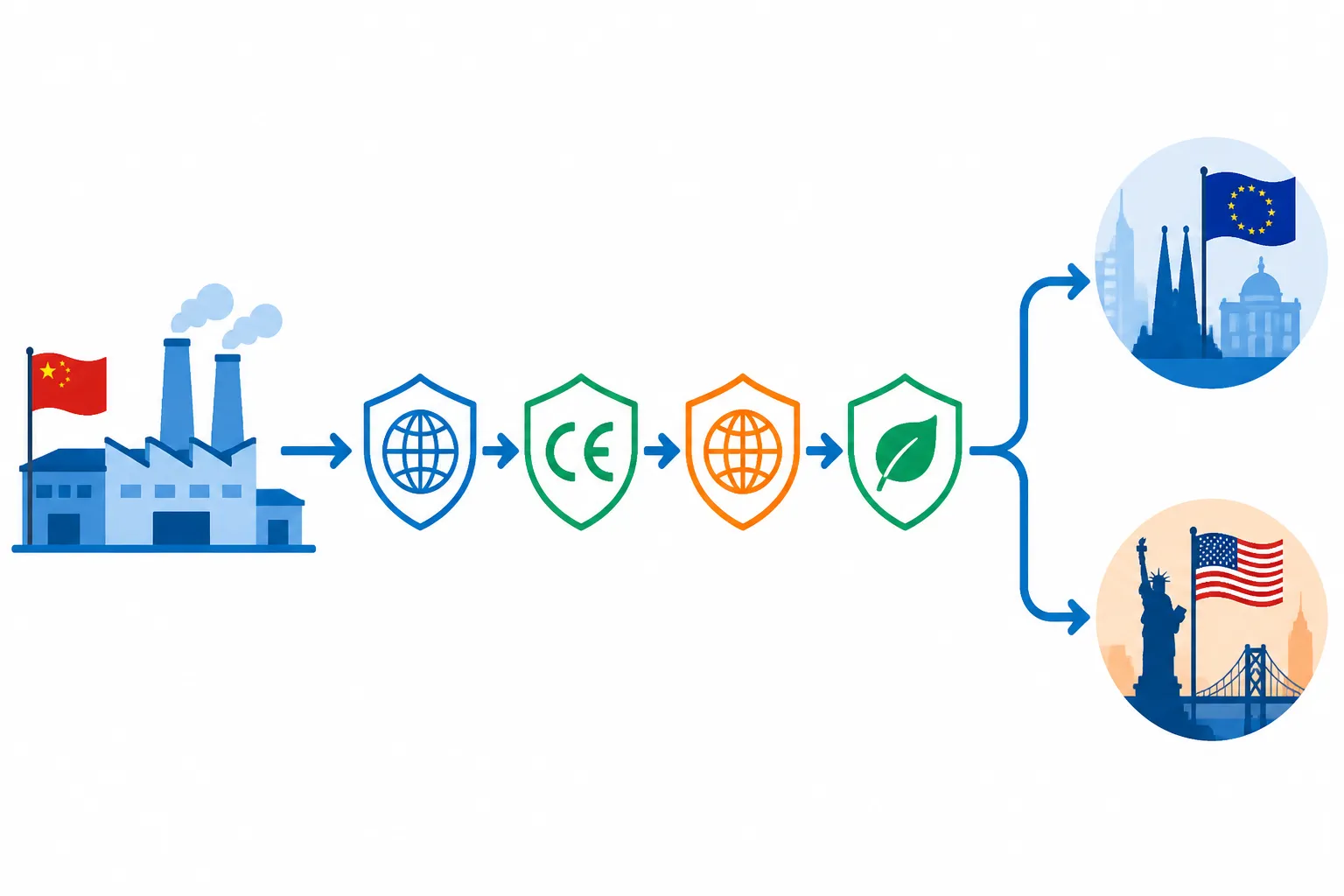
Engineering standards are not just compliance paperwork — they are the shared technical language that makes cross-border trade possible. In a B2B procurement context, a standard defines the floor below which a product cannot fall and be accepted by your target market. ISO 9001 tells you the supplier's quality management system is auditable. ASTM standards tell you the exact material and performance specifications a product must meet. CE marking tells the EU market that your product is safe for sale. RoHS tells your electronics buyer their PCBs won't be rejected at customs.
The buying decision you face is not "should we care about engineering standards" — it is "how do I verify standards compliance at scale, without flying to a factory for every SKU?" That verification gap is where the real cost lives. Factories that cannot communicate their certifications clearly, tooling that doesn't surface standards documents during sourcing, and supplier platforms that bury compliance details behind PDF request emails — these all add weeks to your procurement cycle and risk to your supply chain.
Key Decision Factors
When evaluating suppliers, platforms, or compliance-management infrastructure against engineering standards requirements, weight these eight factors in your scorecard.
1. Standards Coverage and Market Reach
What to evaluate: Does the supplier or platform cover the specific standards bodies your target markets require? EU buyers need EN and CE. US buyers need ASTM, UL, or ANSI. Middle East markets often require SASO or GSO. Japan requires JIS.
What "good" looks like: A supplier who can produce documentation for at least the top two standards bodies relevant to your market without a custom order. A sourcing platform should surface certification status as a filterable field, not an afterthought buried in profile PDFs.
2. Certification Currency and Audit Trails
What to evaluate: When were certifications last renewed? Who is the issuing body — a recognised third-party lab (SGS, Bureau Veritas, TÜV, Intertek) or an in-house self-declaration? Self-declarations are only acceptable for lower-risk product categories.
What "good" looks like: Certificates dated within the last 12–18 months, issued by a globally recognised body, with a traceable certificate number you can verify online. Ask for the certificate number and check it yourself on the issuing body's public registry before committing to an order.
3. Quality Management System (QMS) Integration
What to evaluate: Is standards compliance a documented, auditable process — or is it handled by one employee with a filing cabinet? An ISO 9001-certified QMS signals that quality control is systematic, not person-dependent. Evaluate whether the supplier's QMS covers the engineering standards relevant to your product category.
What "good" looks like: An ISO 9001 certificate in scope for your product category, with an internal audit schedule and designated management representative. Ask how non-conformances are tracked and what the corrective action timeline looks like.

4. Digital Communication and Documentation Infrastructure
What to evaluate: Can the supplier provide standards documentation in your language, in your format, on your timeline? A factory that takes seven days to produce an SDS sheet in English is a bottleneck. A sourcing platform with 24/7 multilingual inquiry handling removes that friction.
What "good" looks like: On-demand access to compliance documents through a supplier portal or API. For platforms: AI-powered inquiry handling that can answer standards-related questions in English, Spanish, Arabic, or whatever language your procurement team uses. Link4a's Inbox product, for example, runs 24/7 multilingual AI that handles compliance inquiries without delay — critical when a buyer in Germany needs a RoHS declaration at 9 PM their time.
5. Testing and Inspection Protocols
What to evaluate: What pre-shipment inspection and in-production testing does the supplier perform? Are testing protocols tied to the specific engineering standards your product requires, or are they generic?
What "good" looks like: Documented in-line inspection checkpoints, pre-shipment inspection (PSI) reports available on request, and willingness to accept third-party inspection at buyer's cost. For high-volume OEM orders, push for a First Article Inspection (FAI) tied to the engineering drawing and applicable standard.
6. Supply Chain Traceability
What to evaluate: Can the supplier trace raw materials and components back to sub-supplier level? Increasingly, major markets (EU, US) require supply chain transparency — especially for materials with regulatory implications (conflict minerals, restricted substances).
What "good" looks like: A Bill of Materials (BOM) with named sub-suppliers for regulated materials, and a Conflict Minerals Reporting Template (CMRT) or equivalent if you're in electronics or automotive. Tier-one traceability at minimum; tier-two traceability for regulated supply chains.
7. Platform Matchmaking Speed and Supplier Verification Depth
What to evaluate: If you are using a sourcing platform to find standards-compliant suppliers, how does it verify supplier claims? A platform that lets anyone self-declare ISO certification is a liability.
What "good" looks like: Verified certification uploads cross-referenced against issuing body records, plus factory audit scores where available. Link4a's Match engine averages 3 seconds to surface matched suppliers from 300+ verified factories — with certification status as a core matching criterion, not a manual filter. That speed only matters if the underlying verification is robust.
8. Scalability Across SKUs and Standards Evolutions
What to evaluate: As your product line grows and standards are revised (ISO standards go through revision cycles every 5 years; EU directives update regularly), can your supplier and platform infrastructure scale without manual rework?
What "good" looks like: A supplier with a standing relationship with their certification body, so renewals are proactive rather than reactive. A platform that sends standards update alerts. A QMS that triggers document control reviews when referenced standards change version.
Budget Tiers
| Tier | Typical Annual Investment | What You Get |
|---|---|---|
| Entry | $0–$5,000 | Individual standard document access (ISO, ASTM subscriptions), basic supplier audit via free public registries (e.g., IATF 16949 public search), manual document management |
| Mid-Market | $5,000–$30,000 | Third-party pre-shipment inspections per order ($300–$500/inspection), supplier qualification audits (1–2x/year), standards management software subscription, multilingual inquiry platform (e.g., Link4a Inbox) for compliance comms |
| Advanced | $30,000–$100,000 | Annual factory audit program with named third-party lab, dedicated QA engineer on-site during production runs, digital supplier portal with live certification tracking, AI-native sourcing platform with verified supplier network |
| Enterprise | $100,000+ | Full supply chain compliance program with tiered sub-supplier audits, proprietary testing lab partnerships, real-time ERP integration for standards document management, dedicated compliance counsel for multi-market regulatory strategy |
Note: Inspection and audit costs vary significantly by geography, product category, and certifying body. Request itemised quotes from at least two inspection firms before budgeting.
Red Flags to Avoid
- Self-issued "certificates" with no third-party laboratory name or certificate number. Legitimate certifications always cite the issuing body and carry a traceable reference number.
- Certificates that cannot be verified on the issuing body's public registry. SGS, TÜV SÜD, Intertek, and Bureau Veritas all maintain online verification portals. If a certificate number doesn't appear there, treat it as invalid.
- Suppliers who can only provide standards documentation after an order is placed. Compliance documents should be available during the evaluation phase, not as post-contract deliverables.
- Platforms that allow unverified self-declaration of certifications. This is the single biggest quality signal failure in cross-border B2B sourcing. If a platform doesn't audit what suppliers claim, you cannot trust what suppliers claim.
- Engineering drawings or product specs that reference outdated standard versions. ASTM and ISO standards are revised; a supplier still citing a withdrawn standard version is not keeping their QMS current.
- No clear process for handling non-conformances. Ask: "What happens when a batch fails in-line inspection?" If the answer is vague or the supplier has never had a non-conformance, that is itself a red flag.
- Opaque subcontracting. If a supplier routes your order to an unqualified sub-manufacturer without disclosure, their certifications may not apply to what you actually receive.
Buying Process Checklist
Define your standards requirements by market. List every target market and map the mandatory engineering standards for your product category in each. EU, US, UK, Australia, and Gulf markets each have distinct requirements. This list becomes your minimum supplier qualification criteria.
Translate requirements into supplier evaluation criteria. Convert each standard into a verifiable checkpoint: "Must hold current ISO 9001 certificate issued by accredited body," "Must provide RoHS 3 Declaration of Conformity per EU Directive 2015/863," etc.
Shortlist suppliers using a verified platform. Use a sourcing engine that filters on certified and verified supplier attributes — not free-text claims. Link4a's Match engine, for example, lets you surface verified factories by product category and certification in under 3 seconds, dramatically compressing the initial shortlist phase.
Request and independently verify compliance documentation. For every supplier on your shortlist, collect certificates, verify certificate numbers against issuing body registries, and confirm scope of certification matches your product category.
Commission a factory audit or on-site inspection. For any supplier above [your MOQ or spend threshold], commission a third-party audit — social compliance, quality system, or technical capability audit depending on your risk profile.
Run a paid pilot or sample order. Order a small production run tied to a detailed engineering drawing and applicable standard. Submit samples to an accredited testing lab for standards-compliance testing before placing a full order.
Conduct reference checks. Ask the supplier for two or three current buyers in your target market who can speak to product quality, certification accuracy, and issue resolution. Call them.
Negotiate contract terms that encode standards compliance. Your purchase order or supply agreement should reference the applicable standards by number and version, specify non-conformance remedies, and define your right to audit and inspect.

Questions to Ask Vendors
Before committing to a supplier or platform, run through this question list. The quality of the answers — not just the answers themselves — tells you a great deal about operational maturity.
- "What engineering standards does your current ISO 9001 (or equivalent) certification cover, and what is the certificate number and expiry date?"
- "Which third-party testing laboratories do you work with, and can you provide contact references at those labs?"
- "How do you track and communicate updates when a referenced standard is revised?"
- "What is your in-production non-conformance rate for this product category, and what corrective actions have been taken in the last 12 months?"
- "What is your minimum order quantity (MOQ) for standard production runs, and does that change for products requiring additional compliance testing?"
- "What is your typical lead time from purchase order to shipment for a standards-compliant production run, including testing and documentation?"
- "Can you provide a sample RoHS Declaration of Conformity or equivalent compliance document for a comparable product you have produced?"
- "If a pre-shipment inspection finds non-conformances, what is your remediation process and what are the associated costs and timelines?"
- "Do you subcontract any part of the manufacturing process for this product, and if so, are those sub-suppliers covered by your quality management system?"
- "What digital systems do you use to manage compliance documentation — can we access certificates and test reports through a portal, or is it email-on-request only?"
- "How do you handle multilingual compliance inquiries from buyers in different time zones?"
- "What is your production capacity per month for this product category, and how far in advance do we need to book capacity?"
Recommended Next Steps
Engineering standards compliance is not a one-time checkbox — it is a continuous infrastructure decision. The factories and platforms you choose today will define your cost of compliance, your time-to-market, and your liability exposure for the next two to five years.
For Chinese factory owners and OEM/ODM exporters preparing to go global: your first move is mapping the standards requirements for your top two target markets and auditing your current certification portfolio against those requirements. The gap between where you are and where buyers need you to be is your product roadmap for compliance investment.
For overseas buyers and sourcing channels looking to verify Chinese supply: your fastest path to confidence is using a platform with verified supplier data — not general directories where self-declaration is the norm — and pairing that with at least one third-party inspection per new supplier relationship.
Link4a's AI-native cross-border trade infrastructure was built specifically for this procurement context. The Match engine surfaces verified, standards-relevant factory partners in 3 seconds. The Inbox AI handles multilingual compliance inquiries 24/7 so your procurement team gets answers without waiting for business hours in China. Sitebox gets a factory's capabilities and certifications in front of global buyers on a professional branded site in under 30 minutes. And the Reach engine means those suppliers get found by the right buyers through SEO, social, and outbound — without a marketing team.
Ready to find engineering standards-compliant manufacturers from a verified network of 300+ factories?
Request a Quote or Get MOQ & Pricing → link4a.com
This guide reflects procurement best practices as of July 2026. Standards requirements are market- and category-specific — always verify against the current version of applicable standards and consult a qualified compliance professional for regulated product categories.