IEC Standards Buying Guide: What Procurement Pros Must Know

IEC Standards Buying Guide: What Procurement Pros Must Know
Who This Guide Is For
You are a sourcing manager, procurement officer, or overseas DTC operator actively evaluating Chinese-made electrical, electronic, or related technology products for import — and you have hit the compliance wall. Maybe a freight forwarder flagged a missing CB certificate. Maybe a retailer refused your product without an IEC-aligned test report. Maybe your factory partner in Shenzhen or Dongguan said "we can get that certification" without explaining what it costs, how long it takes, or what it actually covers. This guide is for you: the purchase-stage buyer who already knows IEC standards matter and needs a practical decision framework to evaluate suppliers, certification bodies, and compliance pathways before signing a contract or placing a production order.
What IEC Standards Actually Do (The Decision-Relevant Version)
The International Electrotechnical Commission (IEC) publishes globally recognized technical standards that define how electrical and electronic products must be designed, tested, and documented to be safe for market entry in over 170 countries. For procurement professionals, IEC standards are not abstract compliance documents — they are the gatekeeping mechanism that determines whether your product clears customs, lands on retailer shelves, and avoids liability exposure.
What they govern in practice:
- Safety performance of products (IEC 60065 for audio/video, IEC 60335 for household appliances, IEC 62368-1 for IT/AV equipment, IEC 61010 for lab instruments, and hundreds more)
- Electromagnetic compatibility (EMC) test methods
- Energy efficiency and environmental compliance thresholds
- Interoperability and test protocols used by national certification bodies (UL, CE, PSE, SAA, etc.)
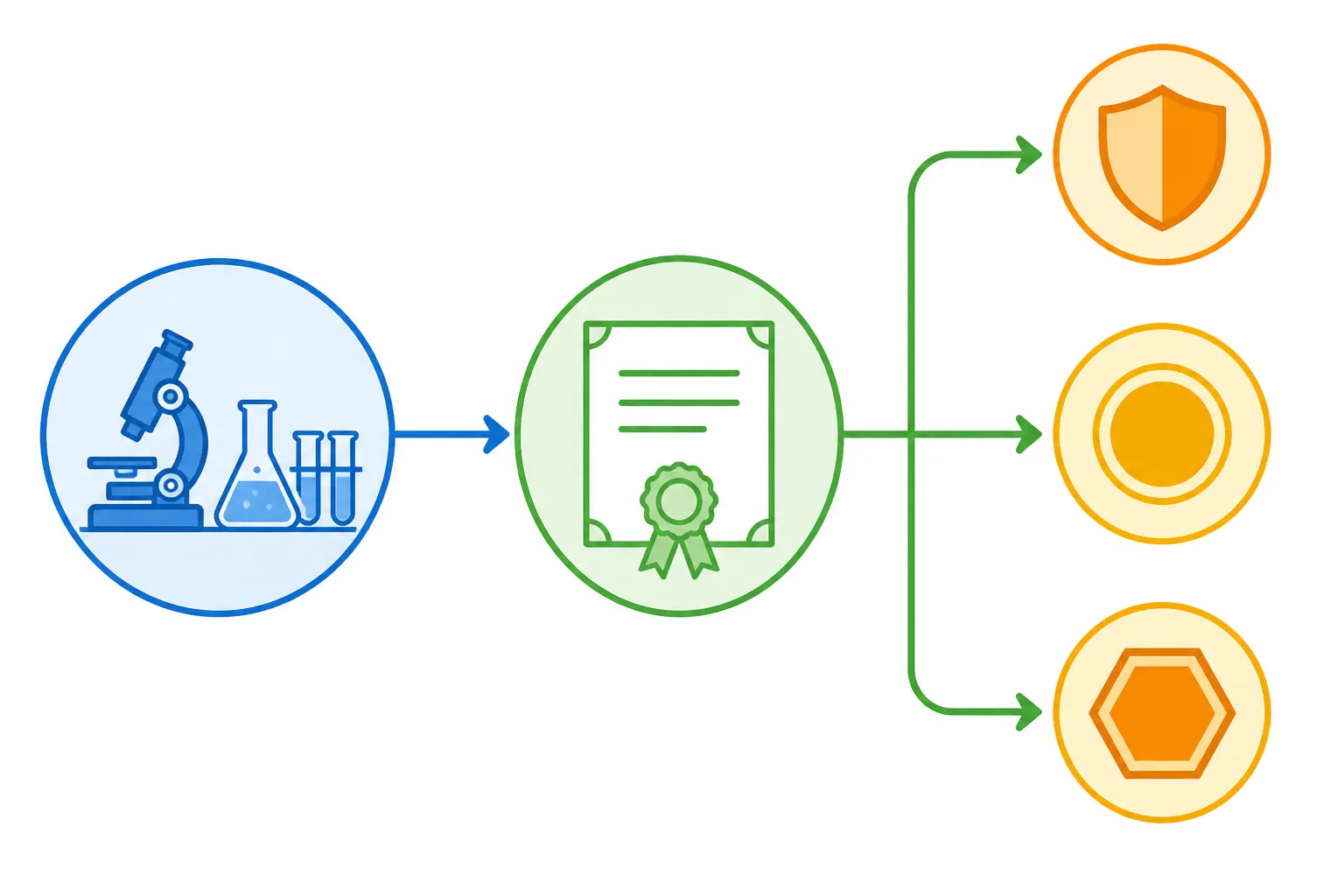
The IECEE CB Scheme is the key commercial mechanism: a test report from one accredited National Certification Body (NCB) can be recognized in 60+ member countries, dramatically reducing the cost and timeline of market access across multiple regions simultaneously.
For buyers and factories alike, the practical outputs are:
- A CB Test Certificate + CB Test Report
- National certification marks derived from the CB (e.g., CE, GS, PSE, KC, SAA)
- Declaration of Conformity documentation required for customs and retail onboarding
Key Decision Factors When Evaluating IEC-Compliant Suppliers
1. Scope and Applicability of Certification
Not all IEC standards apply to every product category. Before engaging any supplier or certification body, confirm the specific standard number relevant to your product. Ask: "Which IEC publication governs this product, and does your certification cover the current active edition?" Standards are revised regularly — IEC 62368-1 (replacing IEC 60065 and 60950-1) is a prominent recent transition. A supplier holding a certificate against a withdrawn edition is a liability, not an asset.
What "good" looks like: Supplier holds a valid CB Certificate citing the current active edition, issued by an IECEE-recognized NCB, with a test report available for review.
2. Certification Body Accreditation and Recognition
The CB Scheme only works if the issuing laboratory and NCB are IECEE-recognized. Third-party test reports from unaccredited labs provide zero legal protection and are routinely rejected at customs.
What to evaluate:
- Is the NCB listed on the official IECEE NCB List (iecee.org)?
- Does the testing laboratory hold ISO/IEC 17025 accreditation for the relevant test scope?
- Is the specific product category within the lab's scope of recognition?
What "good" looks like: Supplier can name the specific NCB (e.g., TÜV Rheinland, SGS, Intertek, Bureau Veritas, CQC) and provide the certificate number for independent verification on the IECEE OEC (Online Certificate Exchange) database.
3. Certification Coverage — Markets and Target Countries
A single CB certificate does not automatically grant market access everywhere. Each destination market requires a national derivative mark or Declaration of Conformity (DoC). Confirm whether the supplier's existing IEC certification covers your target markets or whether additional country-specific testing is needed.
What "good" looks like: Supplier provides a coverage matrix: CB (global baseline) + CE (EU) + UKCA (UK post-Brexit) + FCC/UL (US) + PSE (Japan) + SAA/RCM (Australia/NZ) — or clearly states which are available and which require additional cost and lead time.
4. Pricing Model and Total Compliance Cost
IEC certification cost is not a one-time expense. Buyers often underestimate the total cost of ownership, which includes:
- Initial type testing fees (charged per product variant/model)
- Factory audit fees (required for CB Scheme manufacturing surveillance)
- Annual renewal or surveillance fees
- Re-testing costs triggered by product design changes (even minor component substitutions can invalidate a certificate)
- Market-specific derivative certification fees layered on top of the CB baseline
What "good" looks like: Supplier provides a detailed breakdown of which certifications are already held (sunk cost, no extra charge to you) vs. which require new applications. Request a written certification cost schedule tied to your SKUs.
5. Lead Time and Production Timeline Alignment
Initial IEC certification for a new product typically takes 8–20 weeks depending on product complexity, lab queue times, and the number of clarification rounds. Derivative national certifications add further time. This timeline must be factored into your sourcing calendar before you commit to a launch date.
What "good" looks like: Supplier has pre-existing CB certificates for standard product lines (zero incremental wait time for established models). For custom ODM orders, supplier provides a written certification timeline milestone plan aligned to your production schedule.
6. Manufacturing Consistency and Factory Surveillance
A CB Certificate certifies a product as tested, not all units ever produced. The IECEE CB Scheme requires ongoing manufacturing surveillance to ensure production units match the tested sample. Suppliers who resist factory audits or cannot produce audit records are a significant red flag.
What "good" looks like: Supplier has a current, valid Factory Inspection Record on file with the NCB, and can provide documentation showing that production samples remain within certified specifications. Annual or semi-annual audit cadence is standard.
7. Document Control and Traceability
IEC compliance is only as strong as the documentation trail behind it. For customs clearance, product liability defense, and retail onboarding, you need a complete technical file: test reports, certificate copies, Bill of Materials (BoM) used during testing, Declaration of Conformity, and component certifications for safety-critical parts (fuses, transformers, PCBs).
What "good" looks like: Supplier maintains a version-controlled technical file per certified model and can deliver a complete documentation package within 5 business days of request. Ask specifically whether component substitutions are tracked and whether re-testing is triggered automatically.
8. Vendor Stability and Certification History
A supplier with a long history of maintaining IEC certifications without lapses or suspensions is materially lower risk than one who achieved certification recently or shows gaps in their certificate history.
What "good" looks like: You can verify certificate history independently via the IECEE OEC database. Look for certificates issued 3+ years ago, no suspensions or withdrawals, and evidence of successful renewal cycles.
Budget Tiers: IEC Certification Pathways
| Tier | Typical Scenario | Cost Range (USD, ballpark) | What You Get |
|---|---|---|---|
| Entry | Standard, off-the-shelf product with existing CB certificate | $0–$2,000 (admin/derivative fees only) | Supplier's existing CB Certificate + one national derivative mark; no new testing required |
| Mid-Market | Custom ODM with minor modifications to a certified base design | $3,000–$12,000 | Delta testing on modified components, updated CB report, 2–3 national derivative marks |
| Full Custom | New product design, no existing certification baseline | $15,000–$50,000+ | Full type testing, CB Certificate, factory audit, 3–5 national marks (CE, UL, PSE, etc.); 12–20 week timeline |
| Enterprise / Multi-SKU Program | Product family with multiple variants and global rollout | $50,000–$200,000+ | Family certification, ongoing surveillance, global market coverage, dedicated NCB account manager |
Note: Figures are illustrative market ranges. Actual costs vary significantly by product category, test complexity, NCB, and number of variants. Always request itemized quotes.
Red Flags to Avoid
- Certificate numbers you cannot verify. If a supplier's CB certificate number returns no result on the IECEE OEC public database, the certificate is either fake, expired, or never existed.
- "We can get it certified" with no timeline or cost estimate. This phrase, without specifics, means certification has not started and the supplier does not have a credible plan.
- Certificates issued by non-IECEE-recognized labs. Test reports from unaccredited third parties are legally worthless in most destination markets.
- No mention of factory surveillance audits. A certified product from an un-audited factory means production units may not match the tested sample — a product liability exposure.
- Unwillingness to share the CB Test Report (not just the certificate). The report contains the technical detail needed to assess actual compliance. Suppliers hiding it often have non-conformities they do not want disclosed.
- Component substitution without re-testing. Safety-critical components (capacitors, fuses, MOVs, power supply units) cannot be freely substituted in a certified design. If a supplier changed components to reduce cost and did not re-test, the certification is invalid.
- "Our CE mark is self-declared, no test report." While EU DoC self-declaration is legal for some product categories, in high-risk categories (medical, low-voltage electrical) it is insufficient and signals a compliance shortcut, not a genuine IEC-aligned process.
Buying Process Checklist
Define requirements. Identify the exact IEC standard(s) applicable to your product category and the target markets requiring national marks. Document this as a Compliance Specification Sheet before approaching any supplier.
Shortlist suppliers. Filter for suppliers who hold active, verifiable CB Certificates for product categories matching yours. Use the IECEE OEC database as a cross-reference, not just supplier-provided PDFs.
Request full documentation packages. Ask each shortlisted supplier for: CB Certificate, CB Test Report, current factory audit record, component certifications, and Declaration of Conformity templates.
Verify independently. Cross-check every certificate number on the IECEE OEC public database. Confirm NCB accreditation for your specific product scope.
Conduct a demo / sample review. Request production samples and compare them against the certified BOM and test report. Look for component matches. This is your pre-production audit.
Run a Pilot / POC (Proof of Compliance). For custom ODM orders, commission an independent pre-compliance test from an accredited lab before committing to full production volume. This catches issues before tooling and production investment.
Reference checks. Contact 2–3 other international buyers who have imported this supplier's certified products into your target markets. Ask specifically about customs clearance experience and any post-market surveillance issues.
Contract negotiation. Include certification warranties in your purchase contract: supplier must maintain valid CB and national certificates for the product lifetime; any design change triggering re-testing requires buyer notification and approval; supplier bears re-testing cost for non-conformities discovered in production.

Questions to Ask Vendors
- "What is the exact IEC standard number and edition your certification covers for this product?"
- "Can you provide the CB Certificate number so I can verify it on the IECEE OEC database before we proceed?"
- "Which accredited NCB issued your CB Certificate, and are they IECEE-recognized for this product category?"
- "When was your most recent factory surveillance audit, and can you share the audit report?"
- "If I need derivative national marks beyond your current coverage (e.g., UKCA, FCC, PSE), what is the additional cost and lead time?"
- "Have there been any component substitutions since the product was originally certified? Were those changes re-tested?"
- "What is your process for notifying buyers when a certification is due for renewal or when a standard revision requires re-testing?"
- "Can you provide the complete CB Test Report — not just the certificate — including the safety-critical component list?"
- "What is your MOQ for this certified model, and does the certification cover all variant configurations we are considering?"
- "What is your lead time for production of certified units, and what is your capacity if we need to scale orders?"
- "Have you had any product recalls, certificate suspensions, or customs rejections related to IEC compliance in the past three years?"
- "If we make a custom modification to this product for our brand, what re-certification process applies and who bears that cost?"
Recommended Next Steps
IEC standards compliance is not a checkbox — it is a supply chain risk management decision. The difference between a supplier who genuinely holds current, verifiable, factory-audited certifications and one who presents convincing-looking paperwork is the difference between smooth market entry and a customs hold, a retailer rejection, or a product liability claim.
For Chinese factories and OEM/ODM exporters navigating this landscape, the compliance journey does not end with a certificate. It requires ongoing document management, factory surveillance, market-specific derivative applications, and the ability to communicate all of this clearly and quickly to international buyers — in multiple languages, across multiple channels.
This is where the operational challenge becomes a commercial differentiator. Factories that can surface their compliance documentation instantly, communicate in the buyer's language, and respond to certification inquiries within hours close deals faster than those that cannot. Platforms like Link4a (链上科技) are purpose-built for exactly this: AI-native cross-border trade infrastructure that helps Chinese factories deploy professional global storefronts in under 30 minutes (Sitebox), respond to international compliance inquiries 24/7 in any language (Inbox), and get matched with qualified overseas buyers in seconds (Match) — all without the patchwork of disconnected plugins that traditional approaches require.
Whether you are a factory owner seeking to make your IEC certifications visible and credible to global buyers, or a sourcing professional trying to verify a supplier's compliance credentials quickly, the next step is the same: get the documentation in front of the right people, fast.
Ready to connect with verified, IEC-compliant Chinese manufacturers — or to make your factory's certifications visible to serious global buyers?
Request a Quote or Supplier Match → link4a.com
Last updated: July 2026. IEC standards are revised periodically — always verify the current active edition of any standard before finalizing procurement decisions.