ISO 9001 Standards: The Complete B2B Buying Guide for Exporters

ISO 9001 Standards: The Complete B2B Buying Guide for Exporters
2,400+ words · Updated June 2026
Who This Guide Is For
You are a procurement manager, sourcing director, or factory owner standing at a decision point: either you need to require ISO 9001 certification from your suppliers, or you are a Chinese OEM/ODM manufacturer preparing to achieve certification in order to unlock overseas contracts. Either way, you are past the awareness stage. You have heard that ISO 9001 matters, you have seen it listed as a mandatory checkbox on RFQs, and now you need a clear, action-oriented framework for what to evaluate, what to spend, and how to move through the process without wasting months or choosing the wrong certification body or consultancy. This guide gives you exactly that — no theory, no jargon dump, just a structured decision framework built for purchase-ready buyers.
What ISO 9001 Standards Actually Does (Decision-Relevant Summary)
ISO 9001 is the internationally recognized Quality Management System (QMS) standard published by the International Organization for Standardization. The current edition is ISO 9001:2015. It does not certify a product — it certifies that a company's process for designing, producing, delivering, and improving products meets a defined set of requirements.
For overseas buyers and sourcing teams, ISO 9001 certification from an accredited body is the fastest signal that a supplier has:
- Documented processes that reduce defect variability
- A corrective action loop that catches and resolves quality failures
- Management accountability tied to quality objectives (not just production targets)
- An auditable paper trail for every batch, every supplier, every nonconformance
For Chinese factories and OEM/ODM exporters, holding a valid ISO 9001 certificate issued by an IAF-accredited Certification Body (CB) is often a binary gate requirement on European, North American, and Middle Eastern RFQs. Without it, your factory is invisible in many sourcing workflows — even if your actual quality is excellent.
The standard itself costs roughly CHF 138 to purchase from ISO.org, but the real investment is in the consultancy, gap assessment, implementation, and third-party audit cycle — which is where buyers need to focus their evaluation energy.
Key Decision Factors
1. Accreditation Status of the Certification Body
Not all ISO 9001 certificates carry equal weight. The certification body (CB) that audits and issues your certificate must be accredited by a national accreditation body (NAB) that is a member of the International Accreditation Forum (IAF). In China, the relevant NAB is CNAS (China National Accreditation Service). In the US, it is ANAB. In the UK, UKAS.
What good looks like: The CB can show you their current accreditation scope letter, including the industry codes (NACE/EA codes) that cover your manufacturing category. A certificate issued by a non-IAF-accredited body will be rejected by most Fortune 500 procurement teams and EU import compliance checks.
What to verify: Search the IAF CertSearch database (iafcertsearch.org) for any certificate number before accepting a supplier's claim.
2. Scope of Certification
The scope statement on a certificate defines exactly what processes and sites are covered. A supplier may be certified for one product line but not the one you are ordering.
What good looks like: The scope precisely matches your product category, production site address, and process steps (e.g., "design and manufacture of injection-molded plastic components" — not a vague "manufacturing services").
Red flag: A single-page certificate with a broad, generic scope statement and no site addresses listed. This often indicates a consultancy-managed paper exercise rather than a genuine QMS implementation.
3. Audit Cycle and Surveillance Frequency
ISO 9001 certification operates on a three-year cycle: initial certification audit → Surveillance Audit 1 (year 1) → Surveillance Audit 2 (year 2) → Re-certification audit (year 3). Surveillance audits are not optional.
What to evaluate: Ask for the date of the last surveillance audit and the next scheduled visit. A certificate that is 26+ months old with no documented surveillance audit is a serious compliance gap.
What good looks like: An audit schedule that is current, with a documented nonconformance closure log showing how past findings were resolved. Top-tier suppliers can share their audit reports (with commercially sensitive data redacted) on request.
4. Consultancy Quality and Implementation Depth
If you are a factory pursuing certification, the consultancy you hire determines whether your QMS is a living operational tool or a filing cabinet of unused procedures. This is where most manufacturers underinvest.
Evaluation criteria:
- Does the consultant have direct manufacturing floor experience in your product category?
- Do they deliver training to your team, or just write documents for you?
- Will they be present during the Stage 1 and Stage 2 audits?
- What is their average client pass rate on first attempt?
What good looks like: A consultant who insists on interviewing your production supervisors, operators, and quality inspectors — not just your management team. ISO 9001:2015 requires evidence of worker engagement, and auditors will interview shop-floor staff directly.
5. Integration with Your Export and Digital Sales Infrastructure
This factor is underweighted by most buyers. ISO 9001 certification is a competitive asset only if potential customers can find and verify it before they reach out to you. For Chinese factories targeting global buyers, a certificate buried in a folder on Alibaba is not enough.
Platforms like Link4a — which powers AI-native cross-border trade infrastructure for 300+ factories — allow certified manufacturers to surface their QMS credentials directly within buyer-facing discovery flows. Link4a's Match engine (average 3-second matchmaking) and Sitebox (brand-to-live site in under 30 minutes) make it possible for a newly certified factory to immediately convert that credential into discoverable, verifiable trust signals across SEO, GEO, and social channels — without needing a dedicated web team.
What good looks like: Your certification data (body, certificate number, expiry, scope) is programmatically verifiable on your storefront or supplier profile, not just a scanned PDF attachment.
6. Cost Structure and Total Cost of Ownership (TCO)
ISO 9001 compliance is not a one-time purchase. It is an ongoing operating cost. The true TCO includes:
| Cost Category | Typical Range (USD) | Notes |
|---|---|---|
| Gap assessment | $1,500 – $8,000 | One-time; depends on factory size |
| Consultancy / implementation | $5,000 – $40,000 | Varies by scope and consultant tier |
| CB initial audit fee | $3,000 – $12,000 | Depends on employee count and complexity |
| Annual surveillance audits | $1,500 – $5,000/year | Mandatory; non-negotiable |
| Internal staff time | High | Document control, corrective actions, management review |
| Re-certification (year 3) | $3,000 – $10,000 | Full re-audit cycle |
What to negotiate: Many CBs and consultancies bundle the three-year cycle. Ask for a fixed-fee three-year contract rather than year-by-year billing — it typically saves 15–25%.
7. Scalability and Multi-Site Certification
If you operate multiple production facilities, you need to understand whether the certification covers all sites or just one. Multi-site certification under a single certificate requires each site to be audited.
What good looks like: A CB that offers a multi-site sampling program (allowed under IAF MD 1) where sites share a central QMS and are audited on a rotating basis — significantly reducing per-site audit costs for larger manufacturers.
8. Support, Training, and Ongoing Compliance
Certification is achieved in months; sustained compliance is a multi-year management commitment. The best CBs and consultancies offer:
- Annual internal auditor training
- Updates when ISO standards are revised (ISO 9001 is reviewed approximately every 5–7 years)
- Access to online document management systems
- Nonconformance tracking tools
What good looks like: A consultancy that transitions you from dependency to internal capability within 12–18 months, so you are not paying retainer fees indefinitely.
Budget Tiers
| Tier | Typical All-In Investment (3 Years) | What You Get |
|---|---|---|
| Entry (SME, <50 employees) | $8,000 – $18,000 | Local/regional consultancy; smaller regional CB; basic document templates; management-only training; single site |
| Mid-Market (50–250 employees) | $18,000 – $55,000 | Experienced sector-specialist consultant; IAF-accredited national CB; shop-floor training; digital document management system; 1–2 sites |
| Enterprise (250+ employees, multi-site, regulated industry) | $55,000 – $200,000+ | Big-4 quality consultancy or specialized firm; globally recognized CB (TÜV, Bureau Veritas, SGS, Intertek, DNV); multi-site sampling; integration with ERP/MES; dedicated compliance manager |
| Maintenance-Only (already certified, needs renewal support) | $6,000 – $20,000/cycle | Surveillance audit prep; nonconformance closure support; internal audit facilitation; document refresh for standard updates |
Note: Figures above are indicative ranges. Request itemized quotes from at least three providers before budgeting.
Red Flags to Avoid
- Certificate mills issuing certificates in days. Legitimate certification requires a multi-day on-site audit. If a CB promises certification in under two weeks from first contact, walk away.
- No CNAS/IAF accreditation. A certificate that is not traceable to an IAF member NAB has zero value with serious international buyers. Always verify before accepting.
- Scope statements that don't match your actual product or site. A mismatched scope is a compliance violation waiting to be discovered during a customer audit.
- Consultants who build a QMS without involving your production staff. If the only people interviewed are managers, the resulting system will not survive an auditor's shop-floor walk.
- Missing surveillance audit history. A certificate with no documented surveillance audit within the past 12 months may already be technically suspended — even if the paper looks valid.
- No corrective action records. A QMS that has never recorded a nonconformance is not a compliant QMS — it is a fake one. Real production generates real problems; a healthy QMS closes them systematically.
- Bundled certification with no named auditor credentials. You have the right to know who will audit you and to verify their qualifications with the CB's accreditation body.
Buying Process Checklist
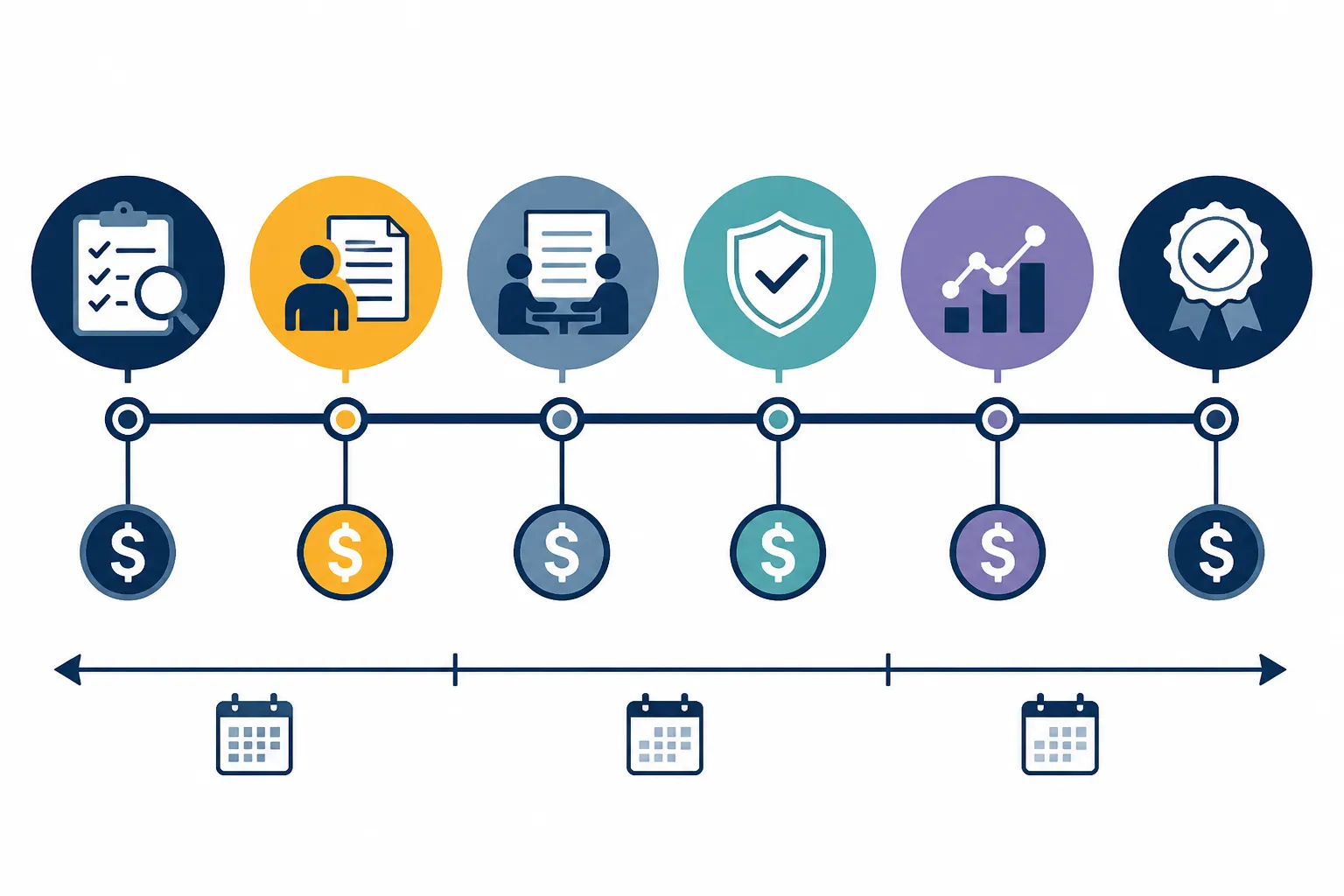
Define your requirements. Determine whether you need full certification (factory pursuing export contracts) or supplier verification (buyer qualifying a supply chain). Identify the scope: product lines, sites, regulatory overlays (IATF 16949 for automotive, AS9100 for aerospace).
Conduct a gap assessment. Commission a structured gap analysis against ISO 9001:2015 clauses before engaging a CB. This prevents surprises during the Stage 1 (documentation) audit.
Shortlist accreditation-verified CBs. Pull a minimum of three competing quotes. Verify each CB's accreditation on the IAF CertSearch database. Filter by industry code match.
Select and engage a consultancy (if needed). Evaluate on sector experience, training delivery model, and three-year TCO. Request client references in your product category.
Implement your QMS (typically 3–9 months). Document procedures, train staff, run internal audits, and conduct a management review before scheduling the Stage 2 audit.
Stage 1 (document review) and Stage 2 (on-site audit). The CB reviews your QMS documentation, then conducts an on-site audit covering all clauses. Expect 1–4 nonconformances on a first audit — this is normal.
Close nonconformances and receive certificate. You will have a defined window (typically 90 days) to submit corrective action evidence before the certificate is issued.
Integrate certification into buyer-facing channels. Upload certificate data to your supplier profile, independent website, and sourcing platform profiles. Use tools like Link4a's Sitebox and Reach to make your credentials discoverable across search, social, and GEO channels immediately.
Maintain annual surveillance schedule. Calendar surveillance audit dates at the point of certification. Assign an internal audit owner accountable for readiness.
Questions to Ask Vendors (CBs and Consultancies)

"Can you provide your current accreditation scope letter from your NAB, including the specific NACE/EA industry codes that cover our product category?"
"What is your pass rate for clients on the Stage 2 audit on the first attempt, and what are the most common nonconformances you see in our industry?"
"Who specifically will be our lead auditor, and what is their documented experience in [your product sector]?"
"What is your process for issuing and tracking corrective actions, and what is the maximum time allowed before a major nonconformance suspends the certificate?"
"Can you provide three client references in our manufacturing category who achieved certification within the last 24 months?"
"What is your fee structure for the full three-year cycle, and what is and is not included — specifically surveillance audits, travel costs, and nonconformance re-assessment?"
"How do you handle multi-site organizations, and do you participate in the IAF MD 1 multi-site sampling program?"
"What document management tools or platforms do you provide or recommend for ongoing QMS maintenance?"
"If we receive a customer audit that challenges our scope or the validity of our certificate, what support do you provide?"
"How do you communicate and prepare clients for upcoming revisions to ISO 9001, and is transition support included in the contract?"
"What is your policy on witness audits — can our internal quality team observe the audit process?"
"Can you confirm that our certificate number will be searchable in the IAF CertSearch public database after issuance?"
Recommended Next Steps
ISO 9001 certification is one of the highest-leverage investments a manufacturer can make for cross-border market access — but only when paired with the infrastructure to make that credential visible and verifiable to the right buyers at the right moment.
For Chinese factories and OEM/ODM exporters pursuing global contracts: the certification process is a 6–12 month commitment, but the moment that certificate is issued, the window to convert it into inquiries opens. Factories already on the Link4a platform report that newly certified operations can launch a verified, SEO-optimized supplier site in under 30 minutes using Sitebox, push credentialed content across social and search channels via Reach, and respond to inbound inquiries around the clock through Inbox — turning a quality credential into a live commercial asset the same week it is issued.
For overseas sourcing teams and DTC operators qualifying Chinese suppliers: use the checklist and questions above to build a supplier scorecard before your next RFQ wave. Make IAF-verified ISO 9001 certification a binary gate, not a soft preference. Then use Link4a's Match engine to surface pre-vetted, certified Chinese manufacturers against your exact product spec in seconds — rather than manually sifting through unverified factory claims.
Your immediate action items:
- Verify your existing supplier certificates on iafcertsearch.org today
- Request itemized 3-year quotes from at least 3 IAF-accredited CBs
- Commission a gap assessment before committing to a CB
- Define your scope statement before the Stage 1 audit
- Request a Quote / Get Matched with Verified Suppliers → link4a.com
Whether you are certifying your factory to unlock global RFQs or sourcing from suppliers who already hold valid ISO 9001 certificates, the decision framework above gives you a concrete path forward. The standard is well-defined; the execution is where deals are won or lost. Start with verification, insist on accreditation, and build certification into your commercial infrastructure from day one.