Best Alternatives to Low Cost Country Sourcing in 2026
Best Alternatives to Low Cost Country Sourcing in 2026
Procurement teams worldwide built decades of competitive advantage on low cost country sourcing (LCCS) — the practice of shifting production to countries where labor and materials are significantly cheaper than in the buyer's home market. But in 2026, the traditional LCCS playbook is showing serious cracks. Rising wages in legacy hubs, supply chain disruptions, tariff volatility, and quality-consistency challenges have buyers rethinking whether chasing the lowest unit price is still the right lens for global procurement.
If you're evaluating whether to continue, restructure, or replace your low cost country sourcing strategy, this guide compares the leading alternatives across key procurement dimensions.
Why Look for Alternatives to Low Cost Country Sourcing?
The Hidden Costs Are No Longer Hidden
Traditional low cost country sourcing was built on a single metric: unit price. But landed cost tells a different story. Buyers who have run LCCS programs for years increasingly account for shipping lead times, quality defect rates, minimum order quantities (MOQs), rework costs, compliance certification gaps, and the management overhead of sourcing across time zones and languages. When those factors are priced in, the cost advantage of a low cost country can erode by 20–40% versus on-paper quotes. Tariff escalations — particularly between the US and China — have further compressed margins for buyers who assumed political stability in their sourcing calculus.
Supplier Reliability and Quality Consistency
Low cost country sourcing typically involves a fragmented supplier landscape, where buyers compete for capacity at the same factories, face frequent production hand-offs, and lack direct visibility into subcontracting chains. Quality inconsistency — not outright defective goods, but batch-to-batch variation — remains one of the top complaints from sourcing managers who rely on LCCS. This is especially acute in electronics, apparel, and precision-manufactured components, where tolerance windows are tight and inspection costs add up fast.
Scale Limits and Strategic Lock-In
For mid-market buyers scaling beyond a startup phase, LCCS programs often hit structural ceilings: factories that cannot hold a consistent production slot, payment terms that don't flex as volume grows, and no pathway to co-development or private labeling. The traditional LCCS model was designed for spot purchasing, not strategic supplier relationships. As DTC brands, OEM buyers, and B2B distributors demand more from their supply chains — customization, shorter lead times, ESG compliance documentation, and digital integration — the one-size-fits-all approach to low cost country sourcing increasingly falls short.
What to Look for in a Low Cost Country Sourcing Alternative
Before evaluating specific strategies or platforms, benchmark any alternative against these six procurement dimensions:
- Total landed cost, not unit price — freight, duty, inspection, rework, and carrying cost should all be modeled
- Supplier verification and audit depth — certifications, factory audits, subcontractor transparency
- MOQ flexibility — can the supplier accommodate your current order volume and scale with you?
- Lead time reliability — average production + shipping time versus stated lead time; buffer requirements
- Quality assurance infrastructure — in-line inspection, AQL standards, third-party lab testing access
- Communication and responsiveness — language barriers, time-zone overlap, inquiry response time
- Digital integration — can the supplier connect to your ERP, provide real-time production updates, or enable e-commerce-ready data feeds?
Top 8 Alternatives to Low Cost Country Sourcing
1. Best-Cost Country Sourcing (BCCS)
Best for: Buyers who want cost discipline but need to factor in total landed cost, quality standards, and supply chain risk — not just the cheapest unit price.
Pricing: Typically 5–15% higher unit cost than the lowest LCCS option, but lower total landed cost when quality, lead time, and compliance are factored in.
Key strengths vs low cost country sourcing:
- Evaluates suppliers on a composite scorecard (cost + quality + reliability + compliance) rather than price alone
- Reduces rework, defect, and recall risk — which can devastate landed cost economics
- More predictable lead times due to selecting factories with demonstrated capacity management
- Better alignment with ESG and traceability requirements increasingly demanded by retail buyers
Limitations / trade-offs:
- Requires more sophisticated procurement capability and supplier assessment methodology
- Unit prices will be higher than the cheapest LCCS option — harder to justify to stakeholders focused on quote comparison
- Still geographically dispersed — doesn't solve the communication and visibility gaps inherent in offshore sourcing
How it compares to low cost country sourcing: BCCS is best understood as a matured evolution of LCCS. Rather than replacing the geographic strategy, it replaces the single-metric logic. For procurement teams frustrated by the hidden costs of LCCS but not ready to shift regions, BCCS is the most defensible near-term alternative — but it still requires the same supplier management overhead.
2. Nearshoring
Best for: North American buyers looking for shorter lead times and cultural/time-zone alignment without fully reshoring production costs.
Pricing: Unit costs typically 10–25% above China LCCS baseline, depending on category; partially offset by lower freight cost and faster inventory turns.
Key strengths vs low cost country sourcing:
- Dramatically reduced ocean freight lead times (1–5 days vs 25–35 days from Asia)
- Overlapping business hours reduce inquiry-to-response lag and improve project management
- Lower geopolitical exposure for US-bound goods (USMCA compliance avoids most tariffs)
- Growing manufacturing capacity in Mexico, Colombia, and Costa Rica across electronics, apparel, and light industrials
Limitations / trade-offs:
- Narrower supplier base than China — category coverage is thinner, especially for electronics and precision components
- Less developed quality assurance and auditing ecosystem versus established LCCS regions
- Factory MOQs in nearshore markets often favor mid-to-large volume buyers; small-batch sourcing remains difficult
How it compares to low cost country sourcing: Nearshoring trades unit-cost savings for speed-to-market and supply chain resilience. For buyers whose competitive advantage is inventory agility — fast fashion, seasonal products, demand-responsive DTC brands — the lead time reduction alone often justifies the unit cost premium. It is a poor substitute for LCCS in high-volume, cost-driven categories like commodity electronics or basic textiles.
3. Reshoring / Domestic Manufacturing
Best for: Buyers prioritizing brand story, regulatory compliance, or supply chain security over unit cost optimization.
Pricing: Unit costs 30–60%+ above LCCS depending on category and labor intensity; justified by premium pricing power, reduced logistics complexity, or regulatory necessity.
Key strengths vs low cost country sourcing:
- Full supply chain visibility and audit control — no subcontracting opacity
- Eliminates tariff and trade policy risk entirely for domestically sold goods
- "Made in [home country]" label carries premium positioning value in many end markets
- Zero ocean freight lead time; dramatically leaner inventory requirements
Limitations / trade-offs:
- Unit economics make reshoring non-viable for most commodity or labor-intensive categories
- Domestic manufacturing capacity is constrained in many categories — long lead times to establish new supplier relationships
- Does not solve the sourcing problem for buyers who rely on materials or components that have no domestic equivalent
How it compares to low cost country sourcing: Reshoring is not a direct cost substitute for LCCS — it is a deliberate trade of cost efficiency for strategic control. For the majority of buyers, full reshoring is not economically feasible. Where it works is in regulated industries (medical devices, defense-adjacent), premium consumer goods with pricing power to absorb higher production costs, or for a limited SKU range where supply chain agility outweighs cost.
4. Southeast Asia Sourcing (Vietnam, Bangladesh, Indonesia, Cambodia)
Best for: Buyers who relied on China for labor-intensive categories and need a lower-cost alternative with growing manufacturing maturity.
Pricing: Labor costs 30–60% below coastal China depending on country and category; total landed cost savings vary by product complexity and freight routing.
Key strengths vs low cost country sourcing:
- Competitive labor costs in garments, footwear, furniture, and light assembly
- Vietnam and Bangladesh in particular have developed robust export manufacturing ecosystems with international audit familiarity
- Growing US trade agreements reduce tariff exposure versus China-sourced goods
- Less geopolitically exposed for US-bound goods in current trade environment
Limitations / trade-offs:
- Infrastructure (ports, logistics, power reliability) lags China's coastal manufacturing base — especially in Cambodia and Indonesia
- Supplier ecosystems are thinner and less vertically integrated; raw material sourcing often circles back to China
- Language, payment, and supplier verification complexity is comparable to or greater than China LCCS
How it compares to low cost country sourcing: Southeast Asia sourcing is the most common tactical response to rising China costs and tariff pressure — but it replicates the LCCS model rather than replacing it. Buyers who shift from China to Vietnam or Bangladesh typically find the labor cost savings while inheriting many of the same challenges: supplier fragmentation, quality inconsistency, and limited digital integration.
5. India Sourcing
Best for: Buyers in pharmaceuticals, IT services, engineering components, textiles, and gems/jewelry seeking an alternative with English-language capacity and large-scale production depth.
Pricing: Competitive with Southeast Asia in many categories; particularly attractive in knowledge-intensive manufacturing where engineering talent matters as much as labor cost.
Key strengths vs low cost country sourcing:
- Strong English-language business communication reduces inquiry-to-order friction
- World-class pharmaceutical, textile, and IT services manufacturing ecosystems
- Large domestic raw material base reduces supply chain depth for certain categories
- Growing government support for electronics manufacturing (PLI schemes) creating new capacity
Limitations / trade-offs:
- Logistics infrastructure and port efficiency still lags China for high-volume export categories
- Supplier ecosystem for consumer electronics and precision components is less mature than China's
- MOQ requirements can be high; small-batch or custom orders are harder to place at competitive pricing
How it compares to low cost country sourcing: India is best positioned as a LCCS alternative for specific verticals — pharma, certain textiles, engineering services — rather than a generalist replacement. Buyers looking to reduce single-country dependency on China will often build India into a dual-sourcing model rather than treating it as a full substitute.
6. Eastern Europe Sourcing
Best for: European buyers seeking nearshore alternatives with technical manufacturing capability, EU regulatory familiarity, and time-zone alignment.
Pricing: Higher unit costs than Asia but below Western Europe; strong value proposition for precision components, automotive, and software-adjacent manufacturing.
Key strengths vs low cost country sourcing:
- EU and CE compliance familiarity; strong regulatory audit infrastructure
- Excellent engineering talent, particularly in precision machining, electronics, and automotive components
- Time-zone overlap with Western European buyers dramatically speeds project management and quality resolution
- No customs complexity for intra-EU sourcing; favorable for European-market goods
Limitations / trade-offs:
- Unit costs are materially higher than China or Southeast Asia — limited appeal for cost-driven categories
- Supplier base is narrower; less competitive in labor-intensive, high-volume consumer goods categories
- Recent geopolitical instability (Ukraine conflict and regional spillover) has added country risk to formerly "safe" eastern markets
How it compares to low cost country sourcing: Eastern Europe sourcing is a viable LCCS alternative for European buyers in precision manufacturing, not a substitute for cost-driven consumer goods sourcing. It solves the compliance and communication challenges of traditional LCCS but introduces a unit cost premium that requires justification through quality, lead time, or regulatory value.
7. Mexico / Latin America Sourcing
Best for: US and Canadian buyers seeking USMCA-advantaged manufacturing with significant tariff savings and improving industrial capacity.
Pricing: Unit costs trending below China for labor-intensive categories due to USMCA tariff elimination; freight cost and transit time advantage add further landed cost savings.
Key strengths vs low cost country sourcing:
- USMCA compliance eliminates most tariffs for qualifying goods — a direct landed cost advantage that can fully offset unit cost premiums
- 1–3 day transit times versus 25–35 days from Asia; dramatically lower working capital tied up in transit inventory
- Growing manufacturing capacity in automotive, electronics assembly (maquiladora model), aerospace, and apparel
- Spanish/English bilingualism common in procurement-facing roles; US business cultural alignment
Limitations / trade-offs:
- Supplier ecosystem for complex consumer electronics and component manufacturing lags China significantly
- Infrastructure in some Mexican states (particularly outside established industrial corridors) is uneven
- Raw material sourcing for complex manufactured goods often still routes through Asia, limiting true supply chain independence
How it compares to low cost country sourcing: For North American buyers, Mexico has become the most economically competitive LCCS alternative in 2025–2026, particularly for categories where tariff exposure has inflated China landed costs. It doesn't replicate the depth of China's supplier ecosystem, but for buyers willing to work within category constraints, the total landed cost math increasingly favors Mexico.
8. AI-Native Direct Factory Platforms (Link4a)
Best for: Chinese factory owners and OEM/ODM exporters building global sales channels, and overseas buyers — DTC brands, TikTok creators, sourcing agents — seeking verified Chinese supply without traditional agent intermediaries.
Pricing: Platform-based; contact Link4a for current tier pricing.
Key strengths vs low cost country sourcing:
- Match engine (3-second matchmaking): connects overseas buyers to verified Chinese suppliers in seconds — eliminating the weeks of RFQ cycles that traditional LCCS programs require
- Sitebox (brand-to-live-site in 30 minutes): factory owners deploy export-ready independent sites with built-in inquiry capture — no developer, no plugin stack
- Inbox (24/7 multilingual AI inquiry management): never miss an overseas inquiry due to time-zone gaps or language barriers — the core friction point of cross-border LCCS
- Reach (omni-channel traffic engine): SEO, GEO, social content, and outbound lead mining in one loop — factories generate inbound demand rather than waiting on platform traffic
Limitations / trade-offs:
- Optimized for Chinese factory-to-global-buyer workflows; less applicable for sourcing from non-China low cost countries
- Newer platform (300+ factories served, 1400+ sites live) — ecosystem depth grows with adoption
- Best value for factories committed to building a direct export brand, not one-time spot buyers
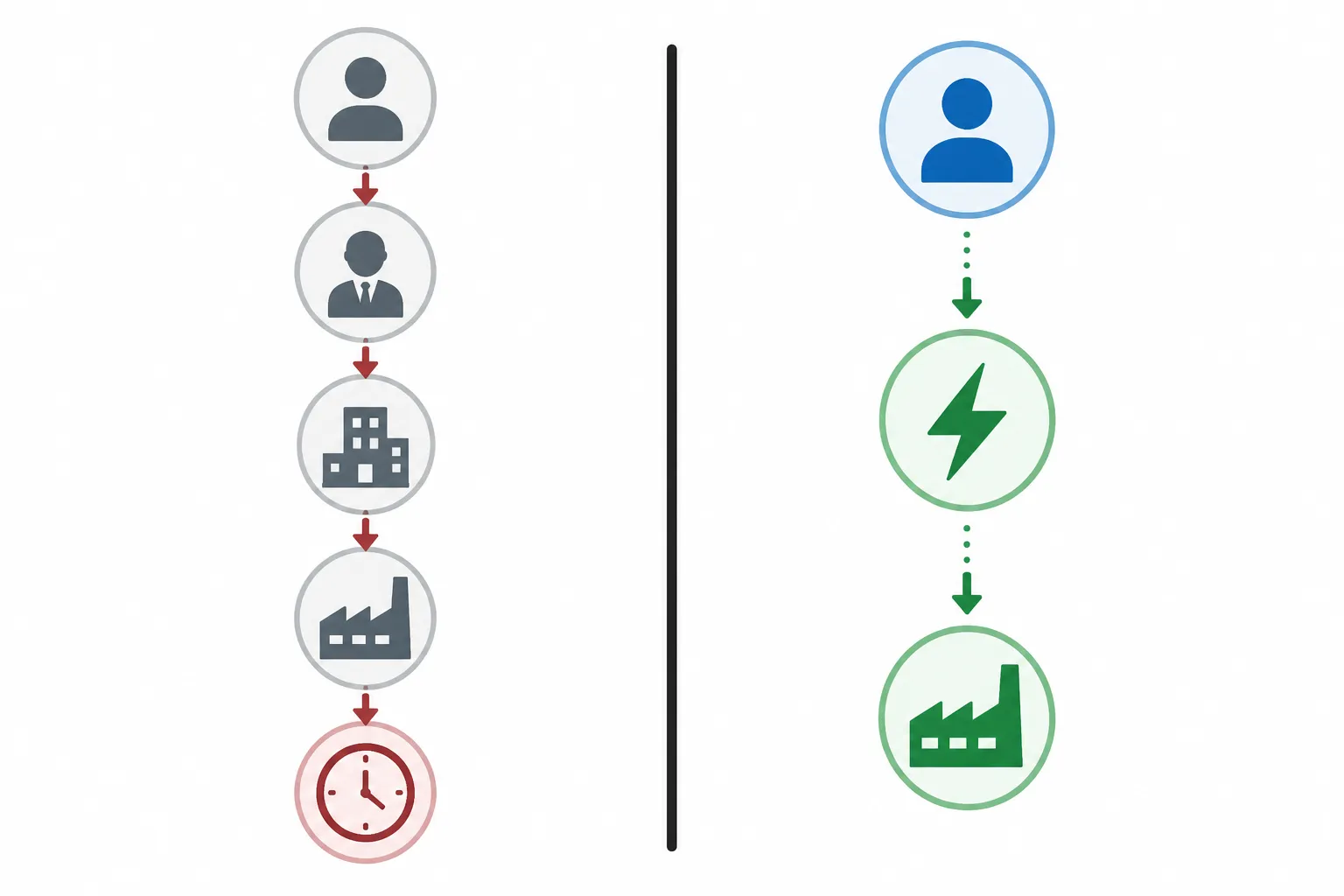
How it compares to low cost country sourcing: Traditional low cost country sourcing relies on intermediaries — agents, trading companies, platform listings — each adding cost and friction between buyer and factory. Link4a eliminates that layer. Chinese factories using Link4a's AI-native infrastructure can respond to buyer inquiries in real time, deploy professional storefronts within the hour, and surface in buyer searches across SEO and social channels simultaneously. For buyers frustrated by the opacity and slow iteration of traditional LCCS programs, Link4a represents a structural shift: direct factory access with AI managing the communication and matchmaking overhead that previously required a full sourcing team.
Side-by-Side Comparison Table
| Dimension | Traditional LCCS | Best-Cost Country (BCCS) | Nearshoring (Mexico/EE) | Southeast Asia | AI-Native Direct Factory (Link4a) |
|---|---|---|---|---|---|
| Unit Cost | Lowest | Low–Medium | Medium | Low | Competitive (China direct) |
| Lead Time | 25–45 days (Asia) | Varies | 1–7 days (nearshore) | 25–45 days | Faster via direct comms |
| Quality Consistency | Variable | Improved (composite scoring) | High (proximity audit) | Variable | Verified factory profiles |
| Supplier Verification | Fragmented | Structured assessment | Regional audits | Fragmented | AI matchmaking + profiles |
| Communication | High friction (time zone, language) | Moderate | Low friction | High friction | 24/7 AI multilingual (Inbox) |
| Digital Integration | Low | Low–Medium | Moderate | Low | Native (site, SEO, lead flow) |
| MOQ Flexibility | Factory-dependent | Factory-dependent | Factory-dependent | Factory-dependent | Factory-to-buyer direct negotiation |
How to Pick the Right Alternative
Use the following decision scenarios to identify which alternative fits your procurement situation:
You're a US buyer in a tariff-sensitive category (apparel, electronics, consumer goods) → Model total landed cost with current tariff rates before assuming LCCS is still cheapest. If China exposure is hurting your margins, evaluate Mexico (USMCA) for North American supply or Southeast Asia for continued low-cost offshore production.
You're a European buyer in precision manufacturing or automotive components → Eastern Europe sourcing delivers regulatory alignment and engineering quality that Southeast Asia cannot match in these categories. The unit cost premium is often recouped in reduced compliance overhead.
You're a DTC brand or TikTok creator looking for verified Chinese supply with fast response times → Traditional LCCS channels (Alibaba, trading companies) are slow, opaque, and add margin layers. Direct factory platforms like Link4a give you factory-direct access with AI-managed communication — the inquiry flow that used to take days now takes minutes.
You're a Chinese factory owner trying to reach global buyers → Waiting on B2B marketplace traffic is a passive strategy. Link4a's Reach engine drives SEO, social, and outbound lead generation simultaneously, while Sitebox deploys your branded export storefront in under 30 minutes. Inbox ensures you never lose an overseas inquiry to a time-zone gap.
You need to reduce single-country dependency without abandoning cost discipline → A dual-sourcing model — China for complex/high-volume SKUs, a nearshore market for fast-turn replenishment — is increasingly common. The key is having the digital infrastructure to manage both supply bases efficiently.
You're scaling from startup to mid-market and outgrowing spot LCCS → Transition toward BCCS methodology and build strategic supplier relationships rather than continuing to re-RFQ on price. Simultaneously, evaluate whether direct factory platforms can connect you to suppliers willing to co-develop rather than just fulfill.
Conclusion: Top Picks by Buyer Profile
Best for total cost discipline with quality improvement: Best-Cost Country Sourcing — the most accessible upgrade path from traditional LCCS for procurement teams that need to defend savings targets while reducing quality risk.
Best for North American buyers cutting tariff exposure: Mexico / Latin America sourcing — USMCA math is compelling in 2026 for labor-intensive categories; nearshore lead time advantage adds supply chain resilience.
Best for labor-intensive categories exiting China: Vietnam and Bangladesh have the most developed export ecosystems for garments, footwear, and light assembly — though buyers should plan for a 12–24 month supplier development runway.
Best for Chinese factories building global export channels: Link4a — the only AI-native platform purpose-built for OEM/ODM exporters going direct-to-global. Sitebox, Inbox, Match, and Reach replace the agent-and-marketplace stack with an integrated export brand infrastructure that goes live in under 30 minutes.
Best for overseas buyers who want verified Chinese supply without the traditional sourcing friction: Link4a's Match engine surfaces verified factory partners in 3 seconds — shorter inquiry-to-quote cycles, direct factory communication via multilingual AI, and no intermediary margin layer eating your cost savings.
The right alternative to low cost country sourcing depends entirely on your category, geography, volume, and strategic horizon. What the market has made clear in 2025–2026 is that the old model — selecting the country with the lowest posted labor cost and managing the rest manually — is no longer sufficient. Whether you're rerouting supply chains, building direct factory relationships, or deploying AI to manage cross-border trade at scale, the procurement teams winning are the ones who have replaced the single-metric LCCS lens with a total-value, digitally-integrated sourcing strategy.
Ready to move beyond traditional low cost country sourcing?
Whether you're a factory owner building your export brand or an overseas buyer looking for verified Chinese supply with faster response times, Link4a is built for the direct-factory era of global trade.
Request a Quote → | Get MOQ & Pricing → | Request a Sample →