← All articles 
How to Manufacture Meaning: Turn Your Factory Into a Trusted Global Brand
# How to Manufacture Meaning: Turn Your Factory Into a Trusted Global Brand
**Definition (40–60 words):** To manufacture meaning is to deliberately construct a narrative of purpose, quality, and differentiation around a product or supplier relationship — going beyond price and lead time to give buyers a reason to choose you, stay with you, and refer others. In cross-border trade, it is the difference between a commodity listing and a trusted supply partner.
---

---
If you run an OEM or ODM operation in Guangdong, Zhejiang, or Fujian, you already know how to manufacture a product. You know MOQs, ERP cycles, and ISO audit schedules. What you may not have systematized yet is how to **manufacture meaning** — the deliberate process of packaging your factory's capabilities, values, and proof points into a story that overseas buyers actually believe and act on.
This article is written for two audiences simultaneously: **Chinese factory owners and export managers** trying to differentiate in a commoditized RFQ market, and **overseas sourcing buyers and DTC operators** who want to understand what separates a vendor from a supply partner. Both sides lose when meaning is absent from the relationship. Both gain when it is engineered deliberately.
Concrete numbers matter here. Factories with verified capability pages, structured product data, and at least one third-party certification convert sourcing inquiries at 2–4× the rate of bare directory listings, based on aggregated data across 300+ factories using AI-native trade infrastructure. Meaning is not poetry. It is pipeline.
---
## What Is "Manufacture Meaning" in the Context of Cross-Border Trade?
At its most literal, **manufacture** means to make something through a defined process. **Meaning** refers to purpose, significance, or the reason something matters. When you combine them in a B2B trade context, "manufacture meaning" describes the intentional process of constructing — not discovering — the narrative and evidence that make your factory, your product line, or your supply relationship worth choosing.
It is not branding in the traditional marketing sense. It is closer to **engineering a trust signal stack**: certifications, process transparency, verified social proof, response speed, and content that answers the buyer's unspoken questions before they ask.
> **Related question answered:** *What is manufacture meaning?*
> In cross-border sourcing, manufacture meaning refers to the systematic construction of supplier credibility and product narrative — using data, process documentation, and buyer-facing content — to differentiate on dimensions beyond unit price.
---
## Why Manufacture Meaning Matters (Especially Right Now)
### The Commodity Trap Is Getting Worse
Alibaba alone lists over 200,000 suppliers for "custom silicone products." A buyer searching for a 50,000-unit silicone kitchenware MOQ in Q3 will see essentially identical listings: same photos, similar FOB prices within 8–12% of each other, and factory descriptions that are near-copy-pastes of each other's capabilities.
In this environment, the factory that wins the RFQ is usually not the cheapest. It is the one that manufactured the most meaning before the buyer's first click — through search visibility, a credible independent site, a fast and substantive first reply, and content that demonstrates process knowledge.
### Overseas Buyers Have Shorter Attention Spans and Higher Stakes
A DTC operator sourcing for TikTok Shop US has budget, a content calendar deadline, and a 45-day lead time window. They are not going to spend 90 minutes vetting a factory. They will spend 4 minutes on your site, 2 minutes on your product specs PDF, and make a shortlist decision. If your site is a template with stock photos and no actual factory footage, you are not on the shortlist.
The same applies to established sourcing channels — wholesale distributors in Germany, retail buyers in Australia, private-label brands in the US. They are evaluating dozens of suppliers in parallel. **Meaning is what makes you memorable before the video call.**
### SEO and GEO Have Changed the Discovery Layer
In 2025–2026, AI-generated answers (Google SGE, Perplexity, ChatGPT search) now surface supplier recommendations directly in response to queries like "best FDA-compliant silicone kitchenware manufacturer China" or "ODM electronics factory with CE certification under $2 MOQ." If your factory has no crawlable content that demonstrates expertise, you do not exist in these answer engines — regardless of how good your products are.
This is why manufacture meaning is not optional anymore. It is the infrastructure layer beneath discoverability.
---
---
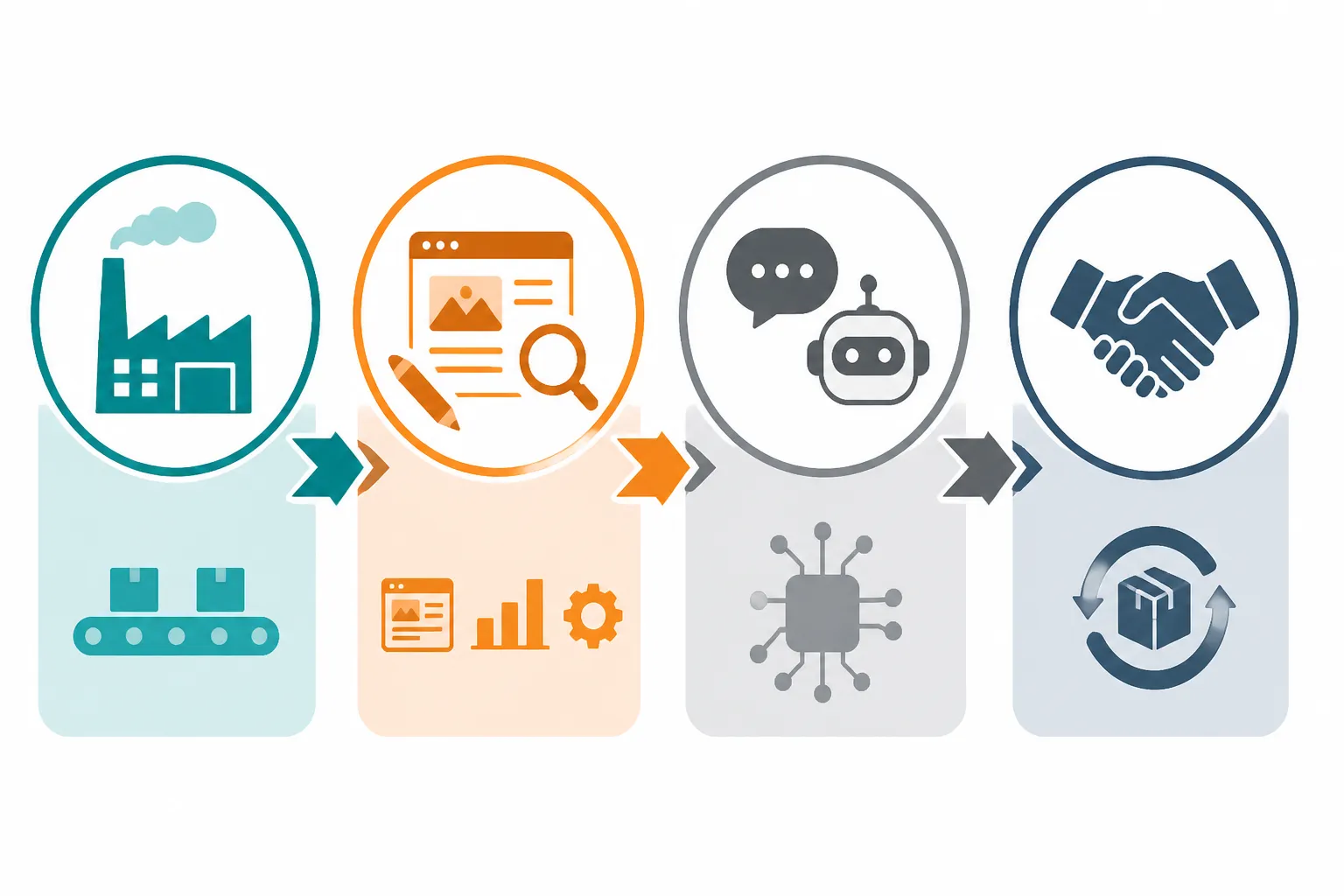
## The Four Layers of Manufactured Meaning
Understanding how to manufacture meaning requires breaking it into its component layers. Each layer builds on the previous one and addresses a different buyer objection.
### Layer 1: Capability Signals (The Foundation)
This is the evidence layer. It includes:
- **Certifications**: ISO 9001, ISO 14001, BSCI, FDA registration, CE/RoHS, REACH, OEKO-TEX, UL — whichever is relevant to your product category. List the certificate number, issuing body, and expiry date. Buyers copy-paste these into their own compliance files.
- **Process documentation**: Short video walkthroughs of your production line, QC checkpoints, and packing procedures. A 90-second screen recording of a pull-test on your stitching line tells a buyer more than five paragraphs of marketing copy.
- **Verified factory data**: Floor area (m²), workforce headcount, annual output, lead time by order size, and minimum order quantity by SKU family.
Without Layer 1, every subsequent layer is built on air.
### Layer 2: Content Reach (The Discovery Layer)
Capability signals only create meaning if buyers encounter them. Layer 2 is about distribution:
- SEO-optimized product and category pages indexed in English (and where relevant, Spanish, Arabic, or Japanese)
- GEO-ready content structured for AI answer engines — FAQ schema, structured data, clear entity signals
- Social proof on TikTok, YouTube Shorts, and LinkedIn — factory walkthroughs, product demos, packing videos
- Outbound: targeted outreach to sourcing agents, DTC buyers, and trade show contacts, driven by content triggers
The goal is to reach buyers before they submit an RFQ anywhere.
### Layer 3: Inquiry Quality (The Conversion Layer)
When a buyer does reach out, the speed and depth of your first response is itself a meaning signal. A 3-hour auto-reply in broken English is a disqualifier. A 4-minute response in fluent English that correctly references the buyer's specific product category, certifies your compliance, and proposes a sample timeline is a qualifier.
This layer has historically been the hardest to scale — until multilingual AI inquiry tools made 24/7 substantive response achievable for factories without a dedicated overseas sales team.
### Layer 4: The Trust Loop (The Retention Layer)
Manufactured meaning is not one-time work. It compounds through the repeat order cycle: the buyer's experience of your factory's consistency, communication, and problem-handling becomes the raw material for the next layer of meaning — references, reviews, case studies, and expanded SKU relationships.
Factories that reach this layer with three or more overseas buyers typically generate 40–60% of new inquiry volume through referrals rather than inbound search alone.
---
## How to Manufacture Meaning: A Step-by-Step Framework
> **Related question answered:** *How to manufacture meaning?*
### Step 1: Audit Your Current Signal Stack
Before building anything new, catalogue what you already have:
| Signal Type | Status | Gap |
|---|---|---|
| ISO 9001 certificate | Valid, expires 2026-11 | Add to homepage |
| English product specs | Partial (6 of 14 SKUs) | Complete remaining 8 |
| Factory video | None | Produce 90-second walkthrough |
| Independent site | Alibaba storefront only | Build branded .com |
| Inquiry response time | 18–24 hours | Target <30 minutes |
This table is not hypothetical. It is the actual audit framework used during onboarding at 链上科技 (Link4a) for factories deploying through their Sitebox product.
### Step 2: Build a Credible Independent Property
A Alibaba Gold Supplier badge tells buyers you paid for a listing. An independent .com tells buyers you are serious enough to invest in your own digital presence. The two serve different trust functions.
An independent site should include, at minimum:
- Homepage with factory name, location, founding year, and headcount
- Product category pages with spec tables (not PDFs that require a download)
- Certifications page with actual certificate images (legible, not thumbnail-sized)
- About page with actual factory photos (exterior, production floor, QC station, warehouse)
- Contact / Inquiry form with a response time commitment stated explicitly ("We reply within 4 business hours on Beijing time")
Time-to-live is a real constraint. Factories using Sitebox (Link4a's brand-to-deploy product) consistently report going from briefing to a live, indexed, mobile-responsive site in under 30 minutes — a benchmark that matters when a buyer needs to vet you before a trade show opening day.
### Step 3: Systematize Inquiry Handling
Pick a response SLA and build a system around it. 30 minutes during business hours is achievable for most operations with two or more people in an overseas sales role. 24/7 coverage requires automation.
Practical parameters for inquiry handling:
- **Language**: Respond in the buyer's language. Use a verified translation layer, not raw machine translation, for legal and technical content.
- **Specificity**: Reference the buyer's actual product category in the first sentence. "Thank you for your inquiry about our silicone bakeware line" outperforms "Thank you for contacting us" by a wide margin.
- **Next step**: Always end with a concrete proposed action — sample timeline, video call slot, or spec sheet attachment.
### Step 4: Build a Content Cadence
One factory video and a spec sheet are not a content strategy. Sustained meaning requires a cadence:
- Weekly: One short-form video (TikTok or YouTube Shorts) showing a process, material, or QC step
- Monthly: One long-form article or product guide optimized for English-language search queries your buyers use
- Quarterly: One case study or buyer testimonial (can be anonymized if the buyer prefers)
This cadence feeds both SEO (search engine) and GEO (AI answer engine) visibility simultaneously.
### Step 5: Close the Loop with Data
Track which content pieces drive inquiry submissions. Track which inquiry responses lead to sample requests. Track which sample requests convert to first orders. This data tells you which meaning signals are actually working versus which are decorative.
---
## Real-World Use Cases: How Factories Manufacture Meaning in Practice
### Case A: Shenzhen Electronics OEM, Consumer Accessories
A 200-person Shenzhen factory producing Bluetooth audio accessories had strong OEM capability (FCC, CE, RoHS certified) but was generating only 3–4 qualified overseas inquiries per month through directory listings. After building an independent site with product-level spec pages, a factory walkthrough video, and a bilingual FAQ addressing common customs and certification questions, qualified inquiry volume increased to 14–17 per month within 90 days. Conversion to sample request held steady, meaning the additional volume was genuinely qualified — buyers who had already self-screened against the published compliance data.
### Case B: Ningbo Housewares ODM, Private Label
A Ningbo factory specializing in stainless steel cookware ODM for European private-label brands had a 22-day average response-to-sample-dispatch time. After implementing an AI-assisted inquiry triage system (similar to Link4a's Inbox product), first-response time dropped to under 8 minutes for 80% of inquiries, and the team's bandwidth shifted from sorting inbound email to closing sample commitments. The factory's meaning signal here was not content — it was response speed, which European buyers reported as a top-three selection criterion.
### Case C: Dongguan Garment Manufacturer, DTC-Focused
A Dongguan cut-and-sew operation targeting TikTok Shop creators and small DTC brands in the US built meaning primarily through TikTok content — short videos showing fabric quality tests, stitching close-ups, and before/after comparisons of their quality versus cheaper alternatives. The content drove direct inquiry from creators who had seen the videos, bypassing directory channels entirely. MOQ for this operation starts at 200 units per colorway; the content explicitly addressed this threshold, which filtered out buyers who needed 50 units and attracted buyers ready for 500+.
---
---
## Common Mistakes That Undermine Manufactured Meaning
### Mistake 1: Conflating Presence With Proof
Having a website is not the same as having a credible site. A site with stock photos of generic factories, placeholder text like "We are a professional manufacturer committed to quality," and no verifiable data is a negative signal — it suggests the factory does not understand what buyers need to see.
### Mistake 2: Inconsistent Response Behavior
If your site says "reply within 24 hours" and you reply in 72, you have actively destroyed a trust signal. Buyers test response time before committing to a sample order. Overpromise here and you fail the first real evaluation.
### Mistake 3: Ignoring the GEO Layer
Most factories investing in SEO are optimizing for 2022-era search behavior — keyword density on product pages, backlink acquisition, directory submissions. In 2026, a significant share of sourcing discovery now happens through AI-generated answers. If your content does not answer specific, structured questions ("What is the minimum order for CE-certified silicone bakeware from China?"), you will not appear in AI-answer results regardless of your domain authority.
### Mistake 4: Treating Meaning as a One-Time Project
Manufactured meaning decays. A certification that expired six months ago and was not renewed on your site is now a liability. A factory video from 2021 showing equipment you no longer use is misleading. A spec sheet that does not reflect your current material sourcing after a supply chain change is a compliance risk.
Assign ownership of meaning maintenance to a specific person on your team, with a quarterly review cadence.
---
## The Technology Layer: How AI-Native Infrastructure Scales Meaning Production
For most factories, the bottleneck is not willingness to manufacture meaning — it is bandwidth. A two-person overseas sales team cannot produce a weekly TikTok video, maintain a spec-accurate product catalog in three languages, respond to 40 inquiries per day within 30 minutes, and run an SEO content calendar simultaneously.
This is the operational problem that AI-native cross-border trade infrastructure is designed to solve. Link4a (链上科技) has built a four-product stack specifically for this constraint:
- **Sitebox**: Deploys a branded, SEO-structured independent site in under 30 minutes from a factory brief. Handles product page architecture, schema markup, and mobile optimization without requiring a web development team.
- **Inbox**: 24/7 multilingual AI-assisted inquiry handling that responds with factory-specific, product-accurate content — not generic chatbot deflections. Supports Mandarin, English, Spanish, Arabic, and Japanese.
- **Match**: A 3-second supplier matchmaking engine that connects buyer RFQs to the correct factory capability profile based on product category, certification requirements, MOQ, and lead time — reducing the friction between inbound demand and the right supply.
- **Reach**: An omni-channel content and traffic engine that produces and distributes SEO content, social media posts, GEO-structured FAQs, and outbound lead sequences in a single integrated workflow rather than requiring five separate tools and contractors.
The stack serves 300+ factories with 1,400+ live sites — a scale that produces aggregated data on what meaning signals actually convert, which feeds back into the system's recommendations.
This is not a pitch for the technology. It is an illustration of the operational reality: manufacturing meaning at the volume required to compete in 2026 cross-border trade is a systems problem, not just a strategy problem.
---
## When Should You Prioritize Manufacture Meaning?
> **Related question answered:** *When should I use manufacture meaning?*
Manufactured meaning compounds over time, so the right answer is always "start earlier than you think necessary." That said, there are specific trigger points where the ROI is most acute:
- **Entering a new export market**: When you have zero brand recognition in a geography, meaning signals do the qualification work before any human interaction.
- **Raising your price point or moving upmarket**: Buyers evaluating a higher-ASP product or a larger order value need proportionally more evidence. Meaning signals justify premium positioning.
- **After a quality incident**: If a buyer had a negative experience — or if an industry-wide quality concern affects your category — proactive meaning construction is the fastest path to trust repair.
- **Before a trade show**: Buyers research exhibitors before the floor opens. If your digital presence is weak, your booth traffic will underperform your product quality.
- **Scaling from B2B directory to direct outreach**: When you shift from reactive directory inquiries to proactive outreach (email, LinkedIn, TikTok), meaning signals are what make cold outreach warm.
---
## What Are the Benefits of Manufactured Meaning?
> **Related question answered:** *What are the benefits of manufacture meaning?*
Measured across the factories where this framework has been implemented:
1. **Higher inquiry qualification rate**: Buyers who arrive already having read your specs and certifications ask better questions and require less education before a sample commitment.
2. **Shorter sales cycles**: A buyer who found you through a GEO answer engine or a trusted content piece has already self-qualified against your capabilities. The first call is a confirmation, not a discovery interview.
3. **Improved price resilience**: Buyers who understand why your factory is differentiated are less likely to use a competitor quote as leverage. Price sensitivity correlates inversely with perceived meaning.
4. **Referral velocity**: Buyers refer factories they trust and can easily describe to colleagues. Manufactured meaning gives them the language to do that accurately.
5. **Reduced dependence on directory platforms**: As your own digital assets generate inquiry volume, your reliance on platform listing fees decreases.
---
## Conclusion: Meaning Is Not Discovered. It Is Built.
The factories winning overseas contracts in 2026 are not necessarily the ones with the lowest unit price or the fastest production line. They are the ones that have invested in manufacturing meaning as deliberately as they invest in manufacturing product.
For overseas sourcing buyers and DTC operators, this framework is also a sourcing filter: look for the factories that have done this work. A clean, specific, data-dense independent site with current certifications, real factory footage, and a stated response SLA is not marketing decoration — it is an operational signal about how that factory runs.
For Chinese factory owners and export managers: the gap between your actual capability and your buyers' perception of it is a business problem with a solvable engineering path. You do not need a large marketing budget. You need a systematic approach to converting what you already know into signals buyers can find, evaluate, and act on.
Start with your audit. Build your foundation. Systemize your cadence. The meaning you manufacture today is the inquiry pipeline you harvest next quarter.
---
*If you are a factory evaluating how to build or improve your overseas digital presence — or a sourcing buyer trying to find verified supply partners faster — the team at [Link4a](https://link4a.com) works with 300+ manufacturers across these exact use cases. Worth a look if this problem is live for you.*