Mass Manufacturing Definition: What Every Global Sourcing Buyer Must Know
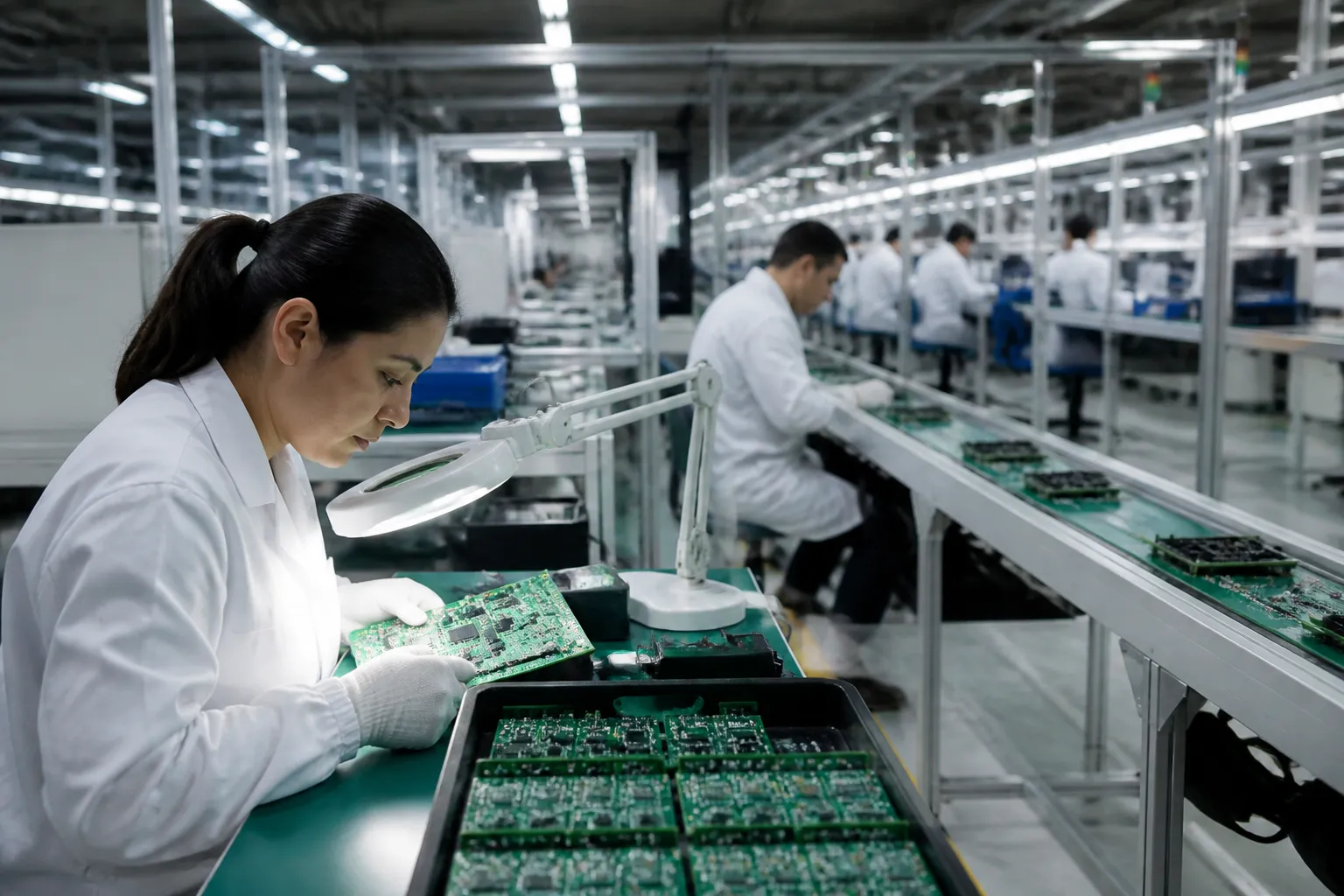
Mass Manufacturing Definition: What Every Global Sourcing Buyer Must Know
Mass manufacturing is the production of large quantities of standardized goods through mechanized, automated assembly lines — where each unit passes through sequential workstations, and the cost per unit drops as volume climbs. That is the core definition. Everything else in sourcing, pricing, lead times, and supplier selection follows from understanding what that actually means in practice.
Merriam-Webster's entry defines it as "production of goods in considerable quantities usually by machinery" — a definition first recorded in 1873. Simple on paper. Consequential in practice, especially if you are sourcing hardware, apparel, consumer electronics, or packaged goods from Chinese OEM/ODM factories.
This guide is written for overseas buyers and DTC operators who need to evaluate suppliers, negotiate MOQs, read factory capability statements, and make go/no-go decisions on production partners — not for business-school students collecting definitions.
What Is Mass Manufacturing? The Core Definition
Mass manufacturing — also called mass production — refers to any manufacturing process architected around three interdependent principles: division of labor, mechanization, and standardization of parts. Remove any one of those three legs and you no longer have mass manufacturing; you have batch production or job-shop work.
Division of labor means a single worker (or machine) performs one narrow task repeatedly rather than assembling a complete product from scratch. Mechanization means machines handle the repetitive, high-precision, or physically demanding portions of that task. Standardization means every component — a bolt, a capacitor, a zipper pull — is interchangeable, so the line never pauses to fit a custom part.
The result is predictable: economies of scale. As Wikipedia's treatment of economies of scale documents, the cost per unit falls as total output increases, because fixed costs (tooling, molds, line setup) are amortized across more units. This is why a factory quoting 500 units charges a very different per-piece price than the same factory quoting 50,000.
What Mass Manufacturing Is Not
It is not:
- Batch production — producing a defined quantity in a single run, then reconfiguring the line. Suitable for SKUs with moderate, variable demand. Lower tooling commitment; higher per-unit cost.
- Job shop manufacturing — custom or small-batch work where each order may be unique. Think precision machined parts, custom molds, prototype runs. High flexibility, high per-unit cost, slow throughput.
- Continuous process manufacturing — used for fluids, gases, and bulk materials (chemicals, cement, oil refining). Products are indistinguishable from one unit to the next; the "line" never stops.
Knowing which category a factory operates in directly affects your lead time expectations, MOQ requirements, and pricing model.
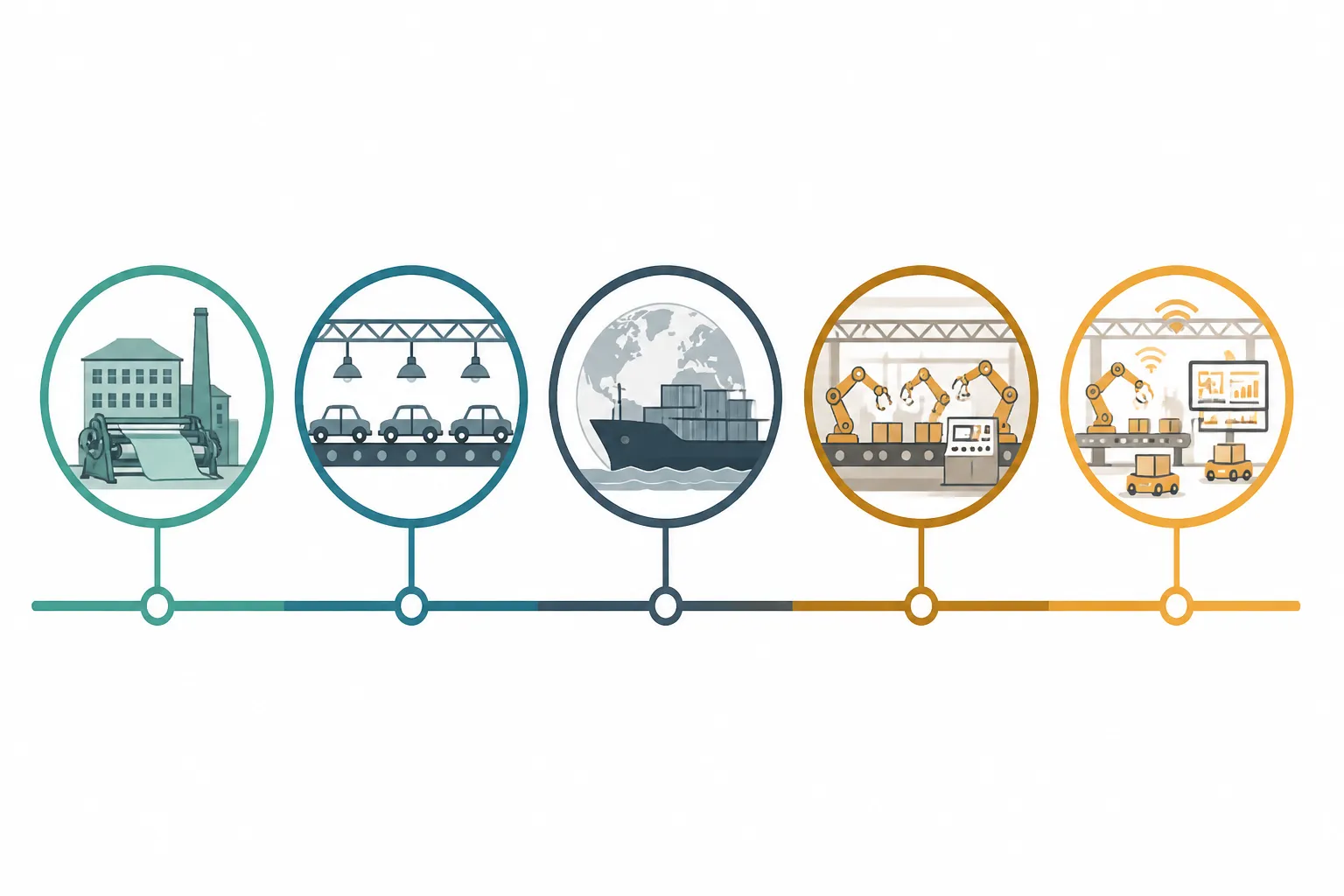
A Brief History: From Cotton Mills to Ford's Assembly Line
Mass manufacturing did not emerge from a single invention. It accumulated over a century of industrial iteration.
The Industrial Revolution in the United States accelerated what British textile mills had begun. Cotton clothing was among the first products manufactured at scale — mechanized looms replaced hand-weaving, and the factory displaced the cottage. That same wave produced the first synthetic textiles: nylon, rayon, and what Merriam-Webster describes as "a parade of synthetic fabrics" born from industrial-scale chemistry.
The single most cited milestone in mass manufacturing history is Henry Ford's application of the moving assembly line to the Ford Model T, starting in 1913. Ford's team recognized that bringing the work to a stationary worker — rather than moving the worker to the work — drastically reduced assembly time per vehicle. The Model T became affordable to the American public as a direct result. Ford did not invent the assembly line concept, but he industrialized it at scale and made the economics undeniable.
Mass manufacturing gained mainstream prominence during the American industrial revolution in the late 19th century and spread globally through the 20th century. Today, China leads in mass production capacity, supplies of hardware, and increasingly in harvesting of data for training industrial robots — a shift that signals the next structural evolution of the sector.
How Mass Manufacturing Works: The Core Mechanics
A mass production facility runs on a sequence of engineered decisions, not just machinery. Here is how a typical consumer electronics line at a Chinese OEM factory is structured:
1. Tooling and Mold Investment
Before a single unit ships, the factory builds injection molds, stamping dies, or PCB fixtures. This is where your tooling cost lives — typically $3,000–$15,000 per mold for plastic components, depending on complexity and steel grade. These are amortized over your production run. At 10,000 units, that $10,000 mold costs $1/unit in tooling. At 100,000 units, it costs $0.10/unit.
2. Line Configuration and Station Design
The production floor is divided into stations, each responsible for one operation: solder paste application, component placement, reflow, inspection, assembly, packaging. Cycle time at each station must be balanced — if station 3 takes 45 seconds but station 4 takes 20, station 4 sits idle half the time. Line balancing is an engineering discipline that directly affects your lead time.
3. Quality Control Checkpoints
Mass production's weakness is that defects replicate. A miscalibrated machine running 10,000 cycles produces 10,000 defects if no one catches the drift. Reputable OEM/ODM factories run IQC (incoming quality control), IPQC (in-process), and OQC (outgoing) checkpoints. Certifications like ISO 9001 or IATF 16949 (automotive) codify these checkpoints into auditable procedures. When evaluating a factory, ask which specific checkpoints exist and what their defect escape rate (DER) is — not just whether they have "quality control."
4. Minimum Order Quantities (MOQ)
MOQ is not arbitrary. It reflects the break-even point where the factory's fixed setup cost — line changeover, material procurement, QC calibration — is covered by the margin on units sold. A factory producing silicone phone cases may have an MOQ of 500 units per colorway. A factory producing injection-molded appliance housings may require 3,000 units before the tooling cost makes commercial sense. Understanding the MOQ's cost basis lets you negotiate intelligently rather than treating it as a fixed wall.
Mass Manufacturing vs. Other Production Methods
Choosing the wrong production model for your product category is one of the most common and expensive sourcing mistakes. Here is a direct comparison:
| Factor | Mass Manufacturing | Batch Production | Job Shop |
|---|---|---|---|
| Volume | 10,000+ units/run | 100–10,000 units | 1–500 units |
| Per-unit cost | Lowest | Medium | Highest |
| Lead time | Predictable, can be fast at scale | Moderate | Long, variable |
| Customization | Minimal | Moderate | High |
| MOQ | High | Medium | Low/None |
| Ideal for | Phones, appliances, apparel | Seasonal SKUs, regional variants | Prototypes, custom parts |
Mass manufacturing is ideal for products with high demand and little need for customization — consumer electronics, standard apparel sizes, household appliances. If your DTC brand sells a single hero product to a global audience and expects sustained volume, mass manufacturing is the right model from the start. If you are still in product-market fit testing, batch production protects you from over-committing to tooling.
Why the Mass Manufacturing Definition Matters for Sourcing Buyers
The definition is not academic. It has direct operational consequences.
It determines your pricing model. When a factory says it does mass production, it is signaling fixed-cost amortization over volume. That means your per-unit cost drops nonlinearly as you scale — but your first order carries disproportionate tooling risk.
It determines your lead time structure. A mass production line needs to be set up, balanced, and validated before it runs. Typical production lead times for Chinese OEM factories range from 30 to 60 days after sample approval. Batch production facilities may turn around faster for small quantities but slow down at volume.
It determines supplier fit. A job shop quoting your 50,000-unit consumer product will either turn you away or try to batch-manufacture it inefficiently. A mass production factory quoting your 200-unit custom prototype will charge you setup costs that make no economic sense at that volume. Matching production scale to production model is non-negotiable.
It determines your certification requirements. Mass-manufactured goods sold in the US, EU, or AU face mandatory certifications — FCC/CE for electronics, CPSC compliance for children's products, FDA registration for consumables. These apply at the product level, not the factory level, and they must be built into the production process, not bolted on after.
China's Role in Global Mass Manufacturing Capacity
China does not just participate in mass manufacturing — it defines the infrastructure baseline against which other production hubs are measured. As of 2025, China leads in mass production capacity, supplies of industrial hardware, and increasingly in the robotics and automation data that will power the next generation of smart factories.
For overseas sourcing buyers, this translates to concrete operational advantages:
- Supplier density: The Pearl River Delta alone clusters thousands of electronics, plastic, and metal component suppliers within a 100km radius of each other. This means a finished goods factory can source 80% of its BOM locally, reducing supply chain fragility and cutting component lead times.
- Tooling ecosystem: China's mold-making industry is mature and price-competitive. An injection mold that costs $30,000 in a German tooling shop costs $5,000–$8,000 in Dongguan or Taizhou — same P20 steel, same tolerances, faster delivery.
- Certification infrastructure: Major OEM/ODM hubs in Shenzhen, Ningbo, and Guangzhou have embedded third-party certification labs (SGS, Bureau Veritas, Intertek) within export processing zones. A factory exporting to the US or EU can get FCC/CE lab testing done within the same industrial park.
The tradeoff is distance and communication overhead. Factory communication latency — misunderstood specs, delayed sample approvals, ambiguous change orders — is the single largest source of quality failures and schedule slippage in cross-border sourcing. Not defective machinery. Miscommunication.
When to Choose Mass Manufacturing (and When Not To)
Mass manufacturing is the right choice when three conditions are met simultaneously:
- Demand is validated and stable. You are not guessing at volume — you have pre-orders, subscription commitments, or retailer POs that underwrite the MOQ.
- The product is standardized. The SKU count is manageable (fewer than 10 active variants), and customization is limited to surface-level changes (color, label, packaging) rather than structural BOM changes.
- Cost per unit is a competitive variable. Your pricing strategy depends on COGS below a specific threshold, and that threshold is only reachable at volume.
When any of these conditions is absent, push toward batch production first. Burn the MOQ in validation, then scale to mass production once you have velocity data.
The MOQ Negotiation Reality
Factories quote MOQs as a floor, not a ceiling. The real question to ask is: "What is the setup cost for a short run, and how does it amortize over quantity?" A factory with a $2,000 line change cost and a $0.50 per-unit margin on a product selling to you at $3.00 needs 4,000 units to break even on setup. That is their real MOQ floor — and knowing that gives you room to negotiate a 2,000-unit first run at a setup surcharge rather than walking away.
Lead times to build into your planning:
- Sample production: 7–21 days
- Sample revision cycle: 7–14 days per round
- Mass production run: 30–60 days post-approval
- Sea freight to US/EU: 20–40 days
- Customs clearance: 3–10 days
Total timeline from first supplier contact to landed inventory: 90–150 days for a first-time mass production engagement. Plan accordingly.
How AI Is Reshaping Mass Manufacturing Supply Chains
The assembly line principle has not changed since Ford. What is changing is the intelligence layer around it: how buyers find factories, how factories receive and process RFQs, and how communication overhead gets compressed.
For DTC operators and sourcing buyers working with Chinese manufacturers, the practical shifts are:
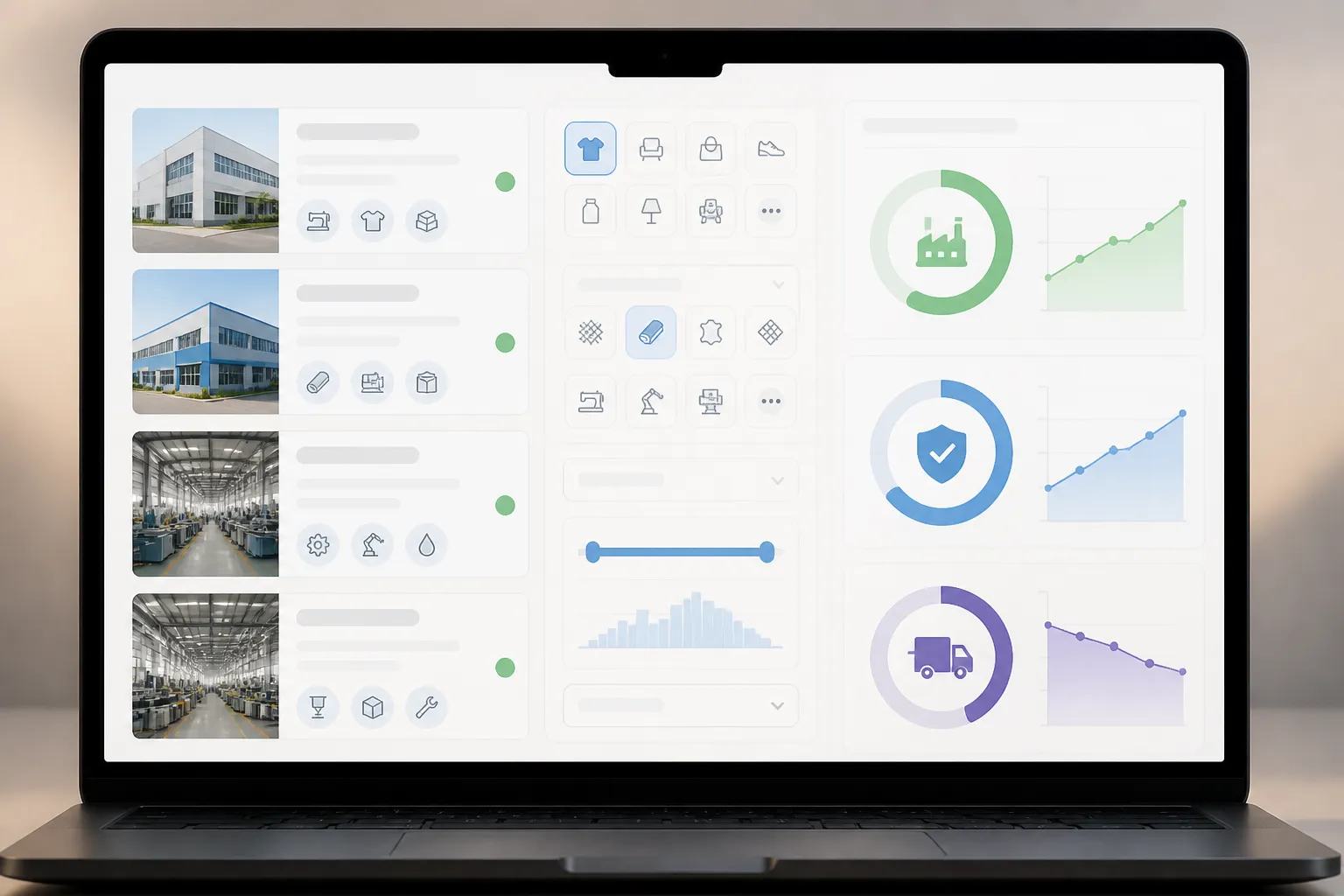
Supplier discovery used to require trade show attendance (Canton Fair, HKTDC), cold outreach through Alibaba, or paid sourcing agent fees. AI-native matchmaking tools now compress that discovery cycle dramatically. Link4a's Match engine, used by 300+ factories and with 1,400+ sites live, processes supplier-buyer matching in approximately 3 seconds — returning factory profiles with production type, MOQ, certifications, and capacity data rather than a list of unverified listings.
Inquiry handling is another friction point. A Chinese OEM factory receiving RFQs in English, German, Spanish, and Japanese simultaneously needs either a multilingual team or a system that handles first-response translation and qualification automatically. Link4a's Inbox product runs 24/7 multilingual inquiry processing — so an overseas buyer's RFQ submitted at 2 AM Shanghai time gets a structured, accurate first response before the sales team opens their laptops.
Site deployment matters because verified factories with professional English-language web presence convert sourcing inquiries at higher rates. Link4a's Sitebox deploys brand-ready, SEO-optimized supplier sites in under 30 minutes — giving factories a credible English-language touchpoint without a six-month web development project.
These are not marketing claims about "digital transformation." They are specific pipeline interventions at the points where cross-border sourcing most commonly breaks down: finding the right factory, getting a fast qualified response, and validating supplier credibility before committing to a sample order.

The Benefits of Understanding Mass Manufacturing Before You Source
Buyers who understand the mass manufacturing definition operationally — not just conceptually — make better decisions at every stage of the sourcing process:
- They write better RFQs. Specifying production type, expected volume, and certification requirements in the first inquiry filters out mismatched factories before any back-and-forth.
- They negotiate MOQs with context. Knowing that MOQ is a cost-coverage floor, not a rigid policy, opens room for phased commitments or setup surcharges.
- They set realistic timelines. A buyer who understands the 90–150 day first-run cycle builds that into their launch calendar instead of discovering it after signing a supplier agreement.
- They assess quality systems correctly. Asking about IQC/IPQC/OQC checkpoints and defect escape rates distinguishes factories with real quality infrastructure from factories with laminated ISO certificates on the wall.
- They scale efficiently. Once a mass production line is proven, incremental volume adds at declining marginal cost. The buyer who built this understanding into their sourcing model captures that cost curve; the buyer who did not is renegotiating from scratch every order.
What Buyers Should Do Next
Mass manufacturing definition is the starting point, not the destination. The operational questions that follow — which factory type fits your product, what your real MOQ floor is, how to structure a first-run sample approval process, which certifications apply to your target market — are where sourcing decisions get made and where margins get built or destroyed.
If you are an overseas buyer or DTC operator evaluating Chinese supply chains, the most useful next step is working with a supplier ecosystem that surfaces verified, capacity-confirmed factory partners — not directory listings — and that compresses the communication overhead between your RFQ and a factory's qualified first response.
Link4a (链上科技) builds that infrastructure: AI-native supplier matchmaking, multilingual inquiry handling, and verified factory sites — designed for the realities of cross-border sourcing at scale.
Explore the platform at link4a.com to see how it fits your sourcing workflow.
Frequently Asked Questions
What is mass manufacturing definition?
Mass manufacturing is the high-volume production of standardized goods using assembly lines, automated machinery, and division of labor to minimize per-unit cost. It relies on interchangeable parts, consistent process controls (e.g., ISO 9001, IATF 16949), and economies of scale — typically kicking in at MOQs of 1,000–10,000+ units depending on the product category. For sourcing buyers evaluating Chinese supply, this translates to factories running dedicated production lines with cycle times measured in seconds per unit, quoted lead times of 30–60 days for first production runs, and unit costs that drop 20–40% between sample pricing and full-run pricing.
How to mass manufacturing definition?
Mass manufacturing (also called mass production) is the high-volume fabrication of standardized products using assembly lines, automated machinery, and repeatable processes — optimized to minimize per-unit cost through economies of scale.
In a Chinese supply chain context, this typically means committing to MOQs of 1,000–10,000+ units per SKU, running dedicated production lines (e.g., injection molding, SMT PCB assembly, or cut-and-sew), with lead times of 30–60 days ex-factory and quality systems like ISO 9001 or IATF 16949 governing process control.
The key distinction from small-batch or sample runs is that mass manufacturing locks in tooling, BOM, and spec sheets upfront — changes mid-run trigger tooling fees and line stoppages — so buyers must finalize all product parameters before a production order is placed.
Why is mass manufacturing definition important?
Mass manufacturing definition matters because it sets the threshold that determines which production tier a factory quote actually belongs to — confusing "mass production" with "pilot run" or "small-batch" leads to mismatched MOQ expectations, wrong unit pricing, and suppliers quoting tooling amortization across volumes you never agreed to. For sourcing buyers evaluating Chinese supply, the definition also governs which certifications apply (e.g., CE/FCC type-approval vs. pre-compliance testing), since regulators and freight forwarders treat mass-produced goods differently from samples or limited runs. Operationally, a clear definition locks in the production process — injection molds, SMT lines, automated assembly — versus the hand-built methods acceptable at prototype stage, preventing quality drift when you scale.
When should I use mass manufacturing definition?
Use mass manufacturing when your product design is fully validated, demand forecasts exceed ~1,000–5,000 units per SKU, and unit economics require cost reduction through scale — typically after a successful pilot run (500–1,000 units) from a Shenzhen or Dongguan contract manufacturer confirms tooling stability and defect rates below 1–2%. It's the right mode when you need consistent output from dedicated injection molds, stamping dies, or SMT lines with agreed MOQs, fixed BOM costs, and lead times of 30–60 days ex-factory. Avoid triggering mass production before locking packaging specs, obtaining relevant certifications (CE, FCC, KC, etc.), and securing a 3PL or fulfillment buffer — rework at volume is 5–10× more expensive than catching issues at the prototype or pilot stage.
What are the benefits of mass manufacturing definition?
Mass manufacturing delivers three concrete advantages for sourcing buyers: unit cost reduction through economies of scale (tooling amortization across high volumes typically drops per-piece cost 40–70% versus small-batch production), process consistency enforced by statistical process control (SPC) and Cpk targets that keep defect rates under 500 PPM on mature lines, and predictable lead times once tooling is qualified — standard injection-molded or stamped components run 25–45 day production cycles at most Guangdong/Yangtze Delta factories with MOQs starting around 5,000–10,000 units. The tradeoff is front-loaded tooling cost (steel molds: $3,000–$30,000 depending on complexity) and limited design flexibility mid-run, so DTC operators should confirm tooling ownership clauses and ECO (engineering change order) costs before signing.