Plumbing Wholesale Distributors: The Complete 2026 Buyer's Guide
Plumbing Wholesale Distributors: The Complete 2026 Buyer's Guide
Who This Guide Is For
This guide is for contractors, commercial builders, property developers, facilities managers, and procurement leads evaluating plumbing wholesale distributors ahead of a real purchasing decision. Whether you're managing a full-spec commercial build—coordinating suppliers for everything from windows and doors to mechanical systems—or consolidating supply for a multi-site maintenance operation, you're not browsing for inspiration. You need a distributor relationship that holds up when a job stalls because a critical valve doesn't arrive on time. The wrong wholesale partner costs you in emergency markups, crew downtime, and compliance headaches. This guide gives you the framework to choose correctly, the first time.
What Plumbing Wholesale Distributors Actually Do
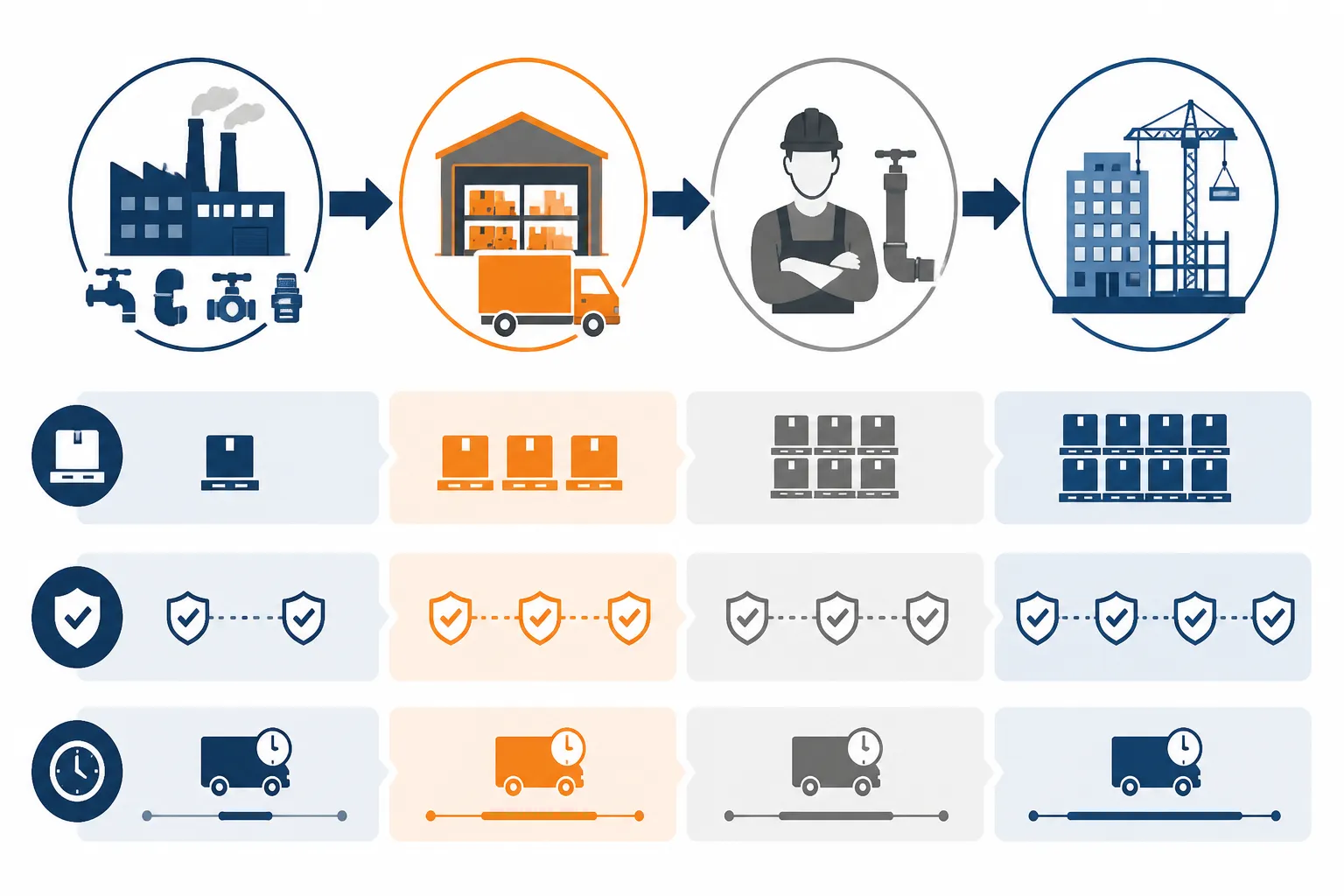
Plumbing wholesale distributors sit between manufacturers and trade buyers—contractors, builders, and facility operators—acting as inventory buffers, credit providers, and technical sourcing partners. They don't just sell pipe. The best ones stock thousands of SKUs across categories like pipe fittings, valves, water heaters, pumps, and bathroom fixtures. Ferguson, for example, covers over a dozen product categories including tools, heating & cooling, lighting & fans, and cleaning & hygiene supplies. They offer trade accounts with negotiated pricing, credit terms, and volume rebates that retail channels don't provide. They also bridge the gap between global supply—much of it manufactured in China—and local trade requirements, handling compliance verification, freight logistics, and returns processing that would otherwise fall on your team.
Key Decision Factors
1. Product Catalog Depth & SKU Coverage
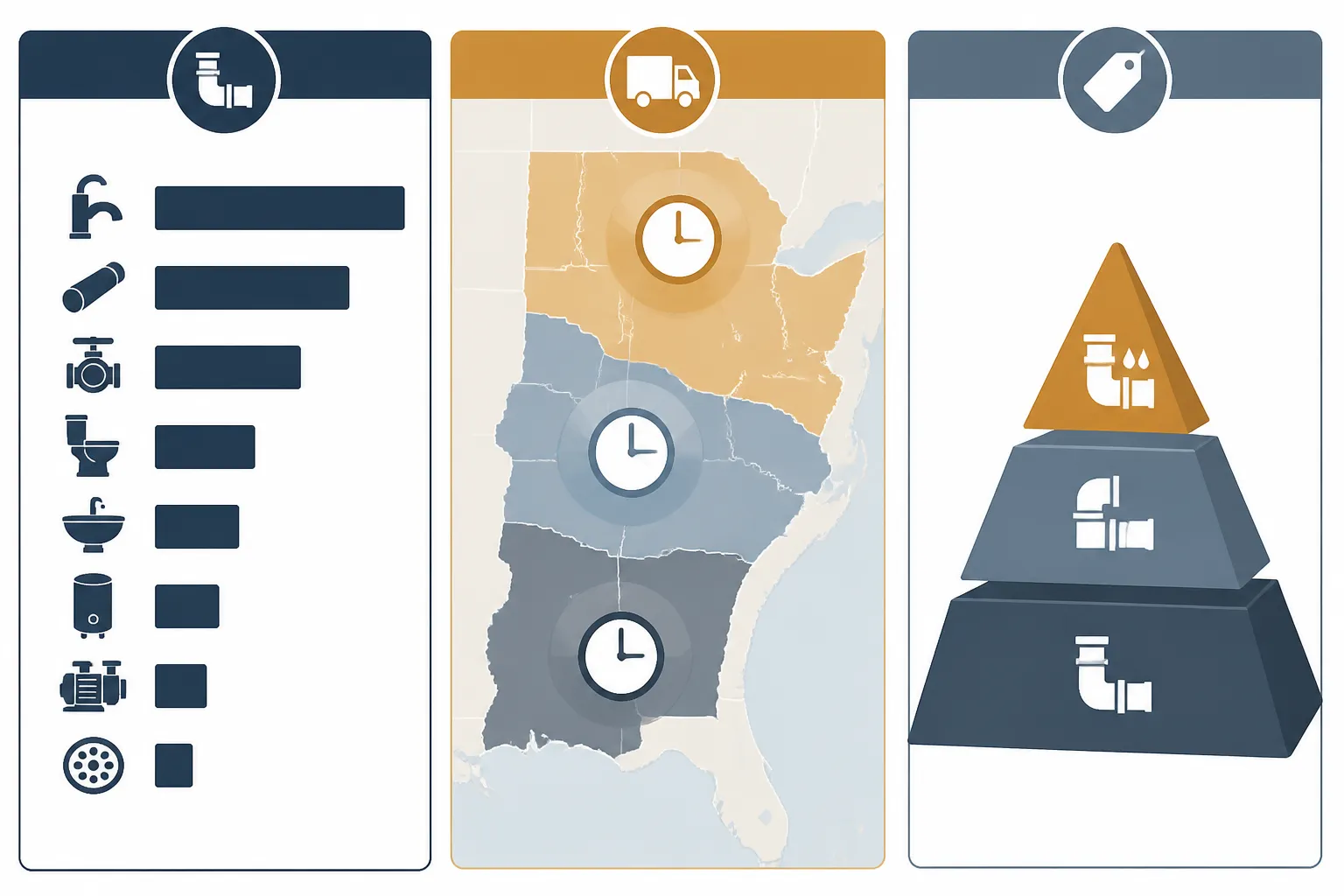
A distributor's catalog tells you whether they can be your single source of truth or just a spot-buy option. For a full commercial project, you need a partner stocking pipe and tubing, pipe fittings, valves, water heaters, pumps, and both residential and commercial-grade bathroom fixtures. Distributors that cover only residential lines will leave you scrambling for commercial toilets and urinals mid-build.
Evaluate also whether they carry the tool category—wrenches, pipe threading equipment, inspection cameras—because consolidating tool purchases under one account simplifies invoicing and rebate tracking.
What "good" looks like: The distributor stocks across all trade categories relevant to your project type, can special-order items outside their standard catalog, and shows real-time inventory availability online so your team isn't calling the branch to check stock.
2. Pricing Model & Credit Terms
Volume pricing structures vary widely. Some distributors publish tiered price lists tied to annual spend; others negotiate job-specific pricing per project. Key levers to evaluate: trade account discounts vs. list price, volume rebate thresholds (quarterly or annual), and net payment terms. Credit limits matter particularly on commercial jobs where materials are front-loaded against a draw schedule.
What "good" looks like: Transparent price tiers accessible through a trade portal, volume rebate thresholds documented in your account agreement, and credit limits that scale with account history rather than requiring renegotiation on every major project.
3. Geographic Reach & Delivery Logistics
A distributor with a single warehouse serves local projects but fails when you're managing builds across multiple sites or states. Evaluate warehouse network density, delivery frequency to your job sites, and whether they maintain physical branch locations for will-call pickup. Ferguson, for instance, provides a store locator feature for buyers who need same-day branch access.
For procurement teams sourcing from global suppliers—particularly from China—logistics complexity increases significantly. Lead times for imported plumbing components can stretch weeks to months; your distributor should either hold domestic buffer stock or give you reliable inbound freight visibility. If you're evaluating direct import from Chinese factories for items like crystal-glaze ceramic fixtures or OEM-branded valves, platforms like Link4a's Match engine identify verified factory suppliers in seconds, cutting the uncertainty out of cold sourcing.
What "good" looks like: Documented delivery SLAs per region, confirmed buffer stock for high-velocity SKUs, and branch coverage within practical reach of your primary job sites.
4. Minimum Order Quantities (MOQ) & Inventory Flexibility
MOQ thresholds determine whether a distributor fits your project scale. Large national distributors often carry no per-SKU minimum on standard catalog items but apply minimums on special-order or import buys. Regional distributors may require minimum invoice values per order—request current terms directly, as these thresholds shift with market conditions.
If you're sourcing directly from Chinese manufacturers for a major project—custom-spec pipe fittings, branded fixtures, or high-volume valve orders—MOQ conversations happen at the factory level and are typically separate from distributor MOQs. Understanding the difference prevents mid-project surprises. For a detailed breakdown of how domestic wholesale tiers typically stack, see our Wholesale Suppliers in USA: The Complete 2026 Buyer's Guide.
What "good" looks like: Clear MOQ documentation available before you request a quote, flexibility for mixed-SKU orders, and no hidden setup fees for non-standard items.
5. Certifications & Regulatory Compliance
Plumbing products installed in commercial buildings must meet code requirements—NSF/ANSI 61 for drinking water contact, UPC or IPC fixture compliance, and local jurisdiction approvals. A distributor selling non-compliant goods creates liability for your business, not theirs. This isn't a formality; it's a contract and permit risk.
For global trade sourcing, the stakes are higher. Chinese manufacturers producing for North American markets should hold NSF certification or equivalent third-party testing documentation. Request these certificates before committing to any import order. Ferguson's data privacy and compliance framework reflects the kind of structured compliance posture that enterprise buyers should expect across all operational dimensions—not just product specs.
What "good" looks like: Certifications listed at the product level in the catalog, not just claimed at the company level. A reputable distributor will provide a certificate of conformance for any SKU on request, same day.
6. Digital Ordering & ePro Integration
Your purchasing workflow shouldn't require phone calls for routine reorders. Modern distributors offer digital trade portals, EDI connections, and ePro integrations that connect directly to your procurement software. Ferguson's ePro system supports returning users with account-specific pricing and complete order history—a tool that saves hours per week on multi-line purchase orders across large projects.
For teams running high-volume operations, the ability to push a PO through an API or import a CSV job list is a real operational advantage. If a distributor's "digital" experience is a PDF catalog emailed on request, that signals broader underinvestment in operations.
What "good" looks like: A functional trade portal with account-specific pricing, order history, and shipment tracking as baseline. Bonus: EDI or punchout catalog support for enterprise procurement systems.
7. Supplier Reliability & Vendor Stability
A distributor that goes out of stock on core items mid-project forces emergency buys at retail prices—at significant premiums above trade pricing. Evaluate their supplier relationships: do they carry multiple brands per category, or do they depend on a single manufacturer for their valve or pipe line? Single-source dependencies create fragility that becomes your problem during supply disruptions.
Also assess the distributor's own stability. Regional distributors sometimes offer better service but carry more business risk. Check years in operation, affiliation with a national buying group, and references from contractors at a similar spend level.
What "good" looks like: Multiple brand options per product category, documented backup supplier arrangements, and a track record of at least five to ten years serving trade accounts in your market.
8. Total Cost of Ownership
Unit price is not total cost. Factor in delivery fees, fuel surcharges, restocking fees on returns, minimum order charges, and the hidden cost of stockouts—emergency purchases, crew downtime, project delays. A distributor with slightly higher unit prices but zero stockouts, free delivery above a threshold, and a clean return policy may cost you meaningfully less over a 12-month project cycle than the cheapest-quoted option.
What "good" looks like: Fee schedules disclosed upfront in your account agreement, a clearly stated return and credit policy, and a sales rep willing to walk through total landed cost across a sample order—not just highlight the line-item price.
Budget Tiers
| Tier | Typical Buyer | Annual Spend Range | What You Get |
|---|---|---|---|
| Entry / Small Trade | Small contractors, property managers | Under $75K/year | Trade account pricing, standard catalog access, branch pickup, Net 30 terms |
| Mid-Market | Regional builders, mechanical contractors | $75K–$500K/year | Negotiated volume discounts, dedicated account rep, job-site delivery, rebate eligibility |
| Commercial / Large Project | Commercial GCs, property developers | $500K–$2M+/year | Custom pricing agreements, quarterly rebates, ePro/EDI integration, priority fulfillment |
| Enterprise / National | National facilities groups, property chains | $2M+/year | National account pricing, centralized invoicing, custom catalog, dedicated procurement support |
Spend ranges are illustrative of typical market structure. Request current pricing, credit terms, and rebate thresholds directly from each distributor—rates shift with commodity markets.

Red Flags to Avoid
- No product-level certifications. A distributor claiming "all products meet code" without being able to pull a certificate of conformance for a specific SKU on request is a liability risk, not a supply partner.
- No functional trade portal. If account-specific pricing requires a phone call every time, your team will lose hours per week. This also signals underinvestment in inventory systems.
- Single-source supplier dependency. One valve manufacturer, one pipe brand—when that manufacturer has a supply problem, so do you.
- No written return and credit policy. Verbal promises become disputes. If restocking terms aren't in your account agreement, assume they don't exist.
- Evasive answers on delivery performance. "We do our best" is not an SLA. Ask for on-time, complete delivery rates before signing anything.
- Pressure to commit volume before a pilot. Legitimate distributors let you test service quality across a real order before locking in a spend commitment.
- Opaque global sourcing. If a distributor imports from China but can't identify the manufacturer or provide compliance documentation, you're absorbing unknown compliance risk on every imported SKU.
Buying Process Checklist
- Define requirements. Document your project scope: product categories needed, volume estimates by SKU, delivery locations, required certifications, and project timeline. Vague briefs produce vague quotes.
- Shortlist vendors. Identify three to five distributors with geographic coverage matching your job sites, catalog depth covering your categories, and trade programs appropriate to your annual spend.
- Request quotes. Submit a standardized RFQ with volume estimates across your key SKUs. Compare on total landed cost—delivery, fees, credit terms—not unit price alone.
- Evaluate digital tools. Do a live walkthrough of each distributor's trade portal. Test search, inventory visibility, and checkout with a sample order list.
- Run a pilot order. Place a real order across 10–15 representative SKUs. Evaluate accuracy, delivery time, and packaging condition before expanding the relationship.
- Conduct reference checks. Request two or three contractor references at a comparable spend level. Ask specifically about stockout frequency and how the distributor handles service failures.
- Negotiate contract terms. Lock in pricing tiers, rebate thresholds, delivery SLAs, return policy, and credit limits in writing before your main project begins.
Questions to Ask Vendors
- What is your on-time, complete delivery rate for trade accounts at my projected spend level?
- Can you provide certificates of conformance per SKU on request, and how quickly?
- What are your restocking fees, and under what conditions do credits apply?
- Do you offer ePro or EDI integration, and which procurement platforms have you already connected?
- How do you communicate backorder situations—proactively, or when the customer follows up?
- What volume rebate tiers are available, and when are rebates paid out?
- Who is my dedicated account contact, and what is the escalation path for urgent fulfillment issues?
- Do you source any products directly from international suppliers or manufacturers in China, and how do you verify compliance documentation for imported goods?
- What is the minimum order value for free job-site delivery in my region?
- How do you handle product recalls or compliance alerts for items I've already purchased and installed?
- Can I access real-time inventory levels across your full standard catalog through your trade portal?
- How do credit limits scale as the account matures, and what triggers a limit review?
Recommended Next Steps
Send the same standardized RFQ to your top three shortlisted distributors within the next five business days—before a project timeline forces a rushed choice. Parallel RFQs surface real pricing differences fast and reveal which distributors treat you as a strategic account versus a one-time transaction.
If your procurement strategy includes direct sourcing from Chinese manufacturers—for OEM-branded fixtures, custom-spec valves, or high-volume fittings where factory pricing is significantly better than distributor margins—build that supplier relationship in parallel with your domestic distributor selection, not after. Link4a's platform connects buyers with verified Chinese factory suppliers through a three-second matchmaking engine, with 24/7 multilingual inquiry handling so time-zone gaps don't slow your sourcing cycle. The platform is built for the kind of global supply chain that serious trade buyers need alongside their domestic distributor relationships.
Ready to find verified factory suppliers or request a global sourcing match? Get started at link4a.com — no commitment required.