Production Meaning in Manufacturing: What Every Sourcing Buyer Must Know
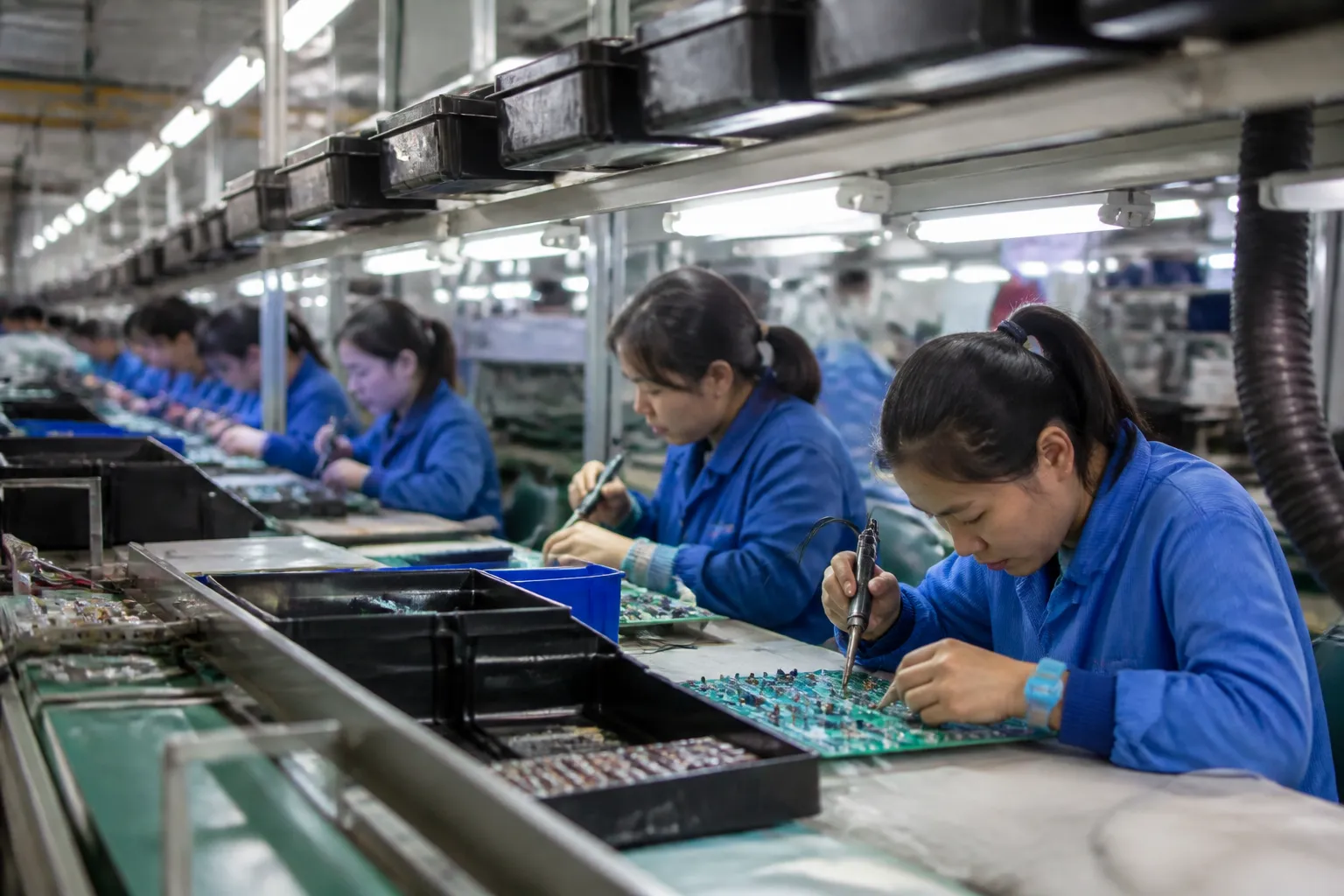
Production Meaning in Manufacturing: What Every Sourcing Buyer Must Know
Production is a noun with a precise meaning that shifts depending on context — and misreading it in a supplier conversation can cost you a full order cycle. At its core, production means the act or process of producing goods, or the total output of a commodity or industry. Every sourcing negotiation, factory audit, and purchase order hinges on understanding which sense a supplier is using.
Definition snapshot (40–55 words): Production refers to the process of making or growing goods to be sold, or to the volume of goods a factory or country outputs. It covers raw-material conversion, labor, and machinery. In trade contexts, the term also describes whether an item is mass-produced ("production model") versus a custom one-off.
What Is Production Meaning? The Full Breakdown
Merriam-Webster classifies "production" strictly as a noun, and its definitions span at least six distinct senses relevant to manufacturing and trade:
| Sense | Definition | Sourcing relevance |
|---|---|---|
| Process | The act of making goods | Refers to factory workflow and lead time |
| Output / total | Total goods made by a company or country | Capacity planning and MOQ discussions |
| Utility creation | Making goods available for use | Economic value added at the factory level |
| Product / yield | Something produced | The physical item itself |
| Artistic work | A stage or screen presentation | Irrelevant to trade — but trips up buyers reading industry press |
| Mass-produced descriptor | "Production car," "production housing" | Signals a standardized, non-customized SKU |
The sixth sense is the one that catches buyers off-guard most often. When a Chinese factory says "this is our production model," they mean the standard off-the-shelf version — not a customized OEM variant. Confusing the two wastes sampling budget.
The Cambridge Dictionary Perspective
Cambridge Dictionary splits "production" into two operational senses:
- MAKING — the process of making or growing goods to be sold. Example: "Coke is used in the production of steel."
- AMOUNT — the volume output by a country or company. Example: "A company expects to resume production of a vehicle after a two-month break."
The phrase "go into production" is a direct trade signal — it means manufacturing has started or is authorized to begin. Buyers who hear "we will go into production next quarter" should immediately clarify whether that means a pilot run or a full commercial batch, because those carry different minimum order quantities and lead times.
Why Production Meaning Matters to Sourcing Buyers
Miscommunication around the word "production" is more costly than it sounds. Three scenarios where it causes real friction:
Scenario 1 — Capacity vs. Process confusion. A buyer asks: "What is your production?" A Shenzhen electronics factory might answer with monthly unit output (capacity sense) while the buyer wanted a process description (workflow sense). The answer looks responsive but delivers zero useful data.
Scenario 2 — "Production sample" vs. "pre-production sample." A production sample is made on the actual production line using production tooling. A pre-production sample may use prototype tooling. Same word, completely different quality signal — and different cost.
Scenario 3 — "Production model" pricing. If a factory quotes a "production model" price, they are quoting a standard SKU with no customization. Requesting logo changes, color swaps, or packaging adjustments moves you into an OEM or ODM quote — which carries its own pricing structure and minimum run.
For a deeper look at how manufacturers describe their output using industry-specific vocabulary, the 50+ Manufacturing Synonyms Every Sourcing Buyer Must Know guide covers the full spectrum of terms factories use interchangeably with "production."
How Production Meaning Works in Economics
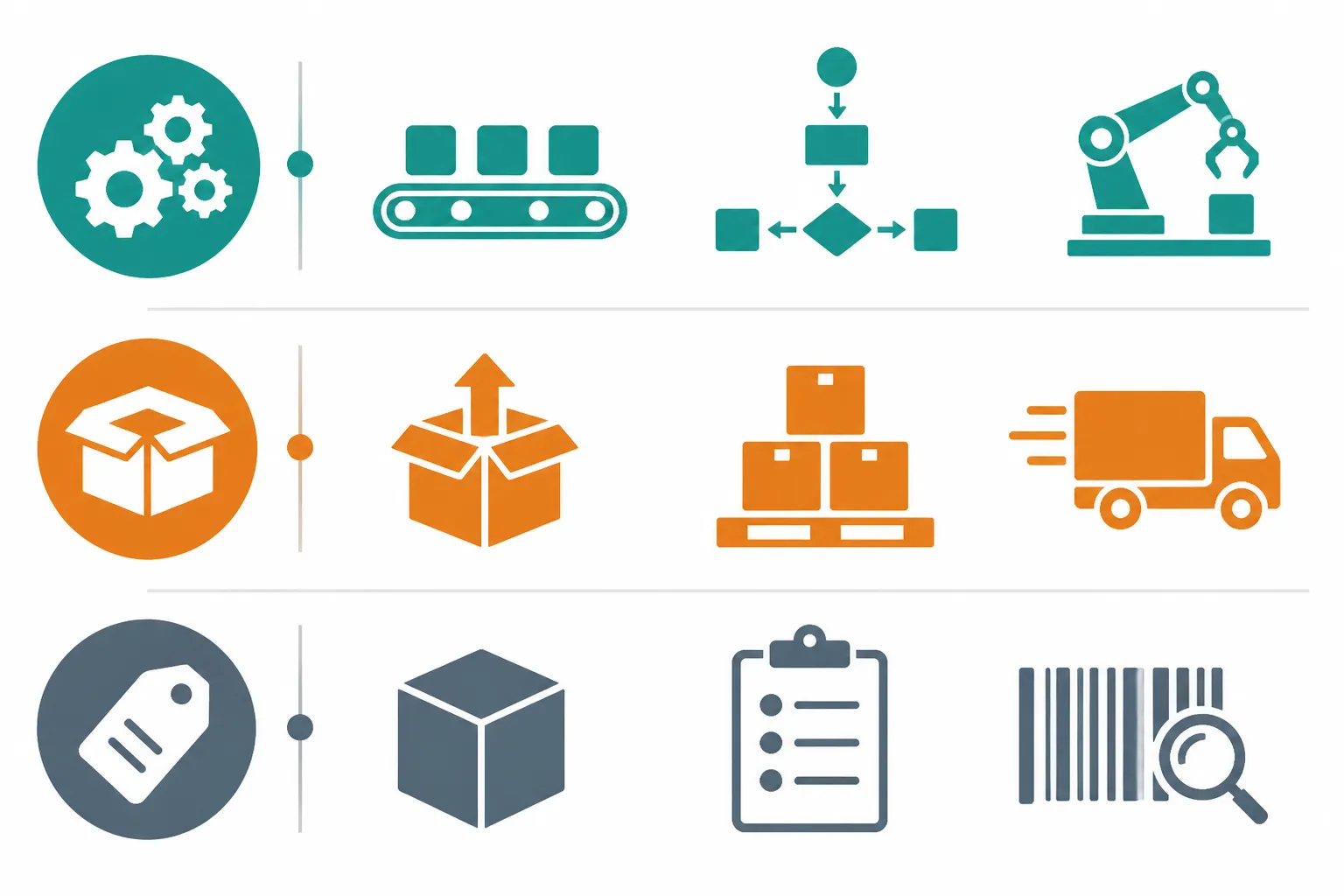
The Wikipedia article on Production (economics) frames production as the fundamental economic activity that creates utility — the conversion of inputs (raw materials, labor, capital) into outputs (goods and services). The article covers subtopics including efficiency, technological changes, pricing, the production function, and production growth models.
For a factory owner or sourcing buyer, the economic frame matters because it connects to productivity and cost structure:
- Production efficiency — how much output per unit of input. A factory with high efficiency can sustain lower unit prices and tighter delivery windows.
- Production function — the mathematical relationship between inputs and outputs. When a supplier says they can scale output by 30% with two weeks' notice, they are describing their production function in practical terms.
- Production income models — how factories price their output relative to fixed and variable costs. Understanding this helps buyers negotiate volume discounts intelligently: a lower per-unit price is only sustainable if the volume genuinely shifts fixed-cost amortization.
Cambridge Dictionary's example captures this precisely: "Prices of goods are governed by the cost of raw materials as well as by the cost of production and distribution." Buyers who internalize this fact negotiate from a stronger position — they know a supplier's floor price is anchored to real costs, not arbitrary margins.
Key Production Terms Every Cross-Border Buyer Must Know
The word "production" generates a cluster of compound phrases that appear in factory audits, purchase orders, and export documentation. Here are the ones with highest sourcing impact:
Production Run
A single, continuous manufacturing batch. Defined by quantity, time window, and consistent raw-material inputs. A buyer asking for a "production run of 500 units" is requesting a batch — not a prototype.
Production Capacity
Maximum output a facility can sustain over a period (usually monthly or annually). Critical for calculating whether a supplier can meet your demand without subcontracting. Always ask: "Is that theoretical capacity or demonstrated average output?"
Production Lead Time
Time from order confirmation to completed goods, not including shipping. Varies by product complexity, tooling requirements, and current factory load. For Chinese factories in peak season (Q3–Q4), lead times typically extend by two to four weeks beyond the factory's stated baseline.
Go Into Production
Authorization to begin manufacturing — typically after a pre-production sample has been approved and a deposit received. Cambridge Dictionary uses this phrasing directly: a drug still being tested will not go into commercial production for at least two years.
Production Model / Production Version
A standardized, mass-produced variant — as opposed to a prototype or customized build. Merriam-Webster explicitly notes that "production" used before another noun (e.g., "production car") refers to something "not specially designed or customized and usually mass-produced."
If you find yourself uncertain about which production-related term a supplier is using in a specific context, the guides on synonym manufacturing and 60+ Synonyms of Manufacturing Every Global Sourcing Buyer Needs provide comprehensive term maps that cover the full vocabulary overlap between "production," "manufacturing," "fabrication," "output," and related words.
Production Meaning in OEM and ODM Supply Chains
OEM (Original Equipment Manufacturer) and ODM (Original Design Manufacturer) relationships add another layer to production meaning. The distinction matters:
- OEM production — the buyer supplies specifications; the factory produces to those specs. Production meaning here focuses on compliance and consistency: is the factory replicating your design exactly, batch after batch?
- ODM production — the factory supplies the design; the buyer sources it. Production meaning here includes IP ownership: who owns the tooling, the molds, the design files?
In both cases, "production" is not a single event — it is a system: materials sourcing, tooling setup, trial run, first-article inspection, full batch, quality check, and packaging. Buyers who treat production as a black box between "order placed" and "goods shipped" lose control of quality and lead time.
Chinese factories serving cross-border trade typically use production milestones in their communication:
- Material procurement confirmed
- Tooling / mold ready
- Pre-production sample sent
- Buyer approves sample
- Full production run starts
- QC inspection (inline and/or final)
- Goods ready for loading
Mapping your PO timeline to these milestones prevents the single most common dispute in cross-border trade: both sides thinking "production is on track" while measuring against different milestones.
When Should You Clarify Production Meaning?
Four specific moments where asking for clarification pays off:
1. Initial supplier discovery. When a factory lists "production capacity," confirm whether that figure is for one shift or three, and whether it assumes full staffing or current headcount.
2. Before sample approval. Confirm whether the sample you're reviewing is a pre-production sample (made with prototype tooling) or a production sample (made on the actual line). Only the latter predicts what you'll receive at scale.
3. When reviewing a quotation. If the quote covers a "production model," confirm which SKU that maps to — and what the upcharge is to move to a customized OEM version.
4. After any production disruption. Cambridge Dictionary's example sentence is instructive here: a company expects to resume production of a vehicle after a two-month break. If a supplier tells you production has paused, ask for the specific restart milestone and the cause — supply chain disruption, regulatory hold, and capacity rebalancing each carry different risk profiles for your order.
Production Meaning and the AI-Native Sourcing Stack
Understanding production meaning is only the starting point. The harder problem for sourcing buyers is finding the right factory, communicating specs clearly across a language gap, and maintaining quality visibility across a multi-SKU sourcing program.
This is where AI-native infrastructure changes the workflow. Link4a / 链上科技 builds tools specifically for Chinese factories entering cross-border markets and for overseas buyers looking for verified Chinese supply:
- Match — a supplier matchmaking engine that surfaces factory-buyer fit in about 3 seconds, filtering on production capacity, certifications, and MOQ against the buyer's stated requirements.
- Inbox — a 24/7 multilingual inquiry AI that handles buyer questions in real time, reducing the miscommunication cycle around terms like "production sample," "production run," and "go into production."
- Sitebox — enables factories to deploy an independent branded site in under 30 minutes, giving buyers a verified supply point rather than a marketplace listing.
- Reach — an omni-channel content and SEO/GEO traffic engine that helps factories generate inbound inquiries from buyers who already understand what they need.
More than 300 factories have used this stack, with 1,400+ sites live — a scale that generates enough real buyer-factory interaction data to continuously improve the matchmaking and communication layers.
The goal is not to replace sourcing judgment. It is to eliminate the low-value friction — term confusion, delayed responses, unverified capacity claims — so buyers and factories spend their time on decisions that actually matter.
What Are the Benefits of Understanding Production Meaning?
Clarity on production terminology produces three measurable benefits in a sourcing workflow:
Faster RFQ resolution. When your inquiry uses the same production vocabulary the factory uses, back-and-forth clarification drops. A buyer who asks for "production lead time on a 1,000-unit production run of your standard production model" gets a direct answer — not a request for clarification.
Better sample management. Knowing the difference between pre-production and production samples prevents costly mistakes. Merriam-Webster's synonym list for "production" — product, yield, work, output — helps buyers recognize when a factory is describing the same concept with different words. A guide to manufacturers synonyms extends that vocabulary coverage to how supplier types are named across different trade documents.
Stronger negotiating position. Understanding that "prices of goods are governed by the cost of raw materials as well as by the cost of production and distribution" means you know which cost components are negotiable (margin, logistics choices) and which are structural (tooling amortization, material cost at current commodity prices).
Final Word: Production Is a System, Not a Step
The production meaning that matters for sourcing buyers is not the dictionary entry — it is the end-to-end system from raw material to finished goods. Every time a factory uses the word "production," they are pointing at some part of that system. Your job is to know which part.
Start by mapping your next supplier conversation to the six senses of "production" outlined above. Then pin down the specific milestone or metric your supplier is referencing. That two-minute habit eliminates the most common source of timeline and quality surprises in cross-border trade.
If you are evaluating Chinese supply partners or building a verified sourcing channel, Link4a provides the infrastructure to move from discovery to verified production faster — without the usual manual back-and-forth.
Further reading: 50+ Manufacturing Synonyms Every Sourcing Buyer Must Know — a practical vocabulary guide for buyers who want to communicate precisely with Chinese factories.
Frequently Asked Questions
What is production meaning?
Production meaning refers to the full lifecycle definition of how a product is manufactured — encompassing raw material specs, process flow (e.g., injection molding, SMT assembly, hand-finishing), QC checkpoints, and output tolerances that collectively determine what the finished unit is at factory level. For sourcing buyers, it is the contractual and technical baseline captured in documents like the BOM, tech pack, and golden sample, against which every production run is judged. In practice, agreeing on production meaning upfront — MOQ thresholds, acceptable AQL defect levels, lead time per batch — prevents costly misalignment between buyer expectations and what actually ships from a Guangdong or Zhejiang facility.
How to production meaning?
Production in a sourcing/manufacturing context refers to the full process of converting raw materials into finished goods at a factory — covering cutting, assembly, quality inspection, and packaging stages. For buyers working with Chinese suppliers, this typically means coordinating with CM (contract manufacturers) or ODM/OEM factories on a per-SKU build, with MOQs commonly starting at 500–5,000 units and lead times of 30–90 days depending on complexity and whether tooling is involved. Key milestones to track are PP sample approval, mass production kickoff, mid-line QC inspection (often via a third party like SGS or Bureau Veritas), and pre-shipment final inspection before freight booking.
Why is production meaning important?
Production meaning — knowing exactly what a product is, how it's made, and to what specification — is the foundation of every sourcing decision. Without it, buyers cannot align factory capabilities (e.g., injection molding vs. die-casting, ISO 9001 vs. BSCI audit scope) with actual product requirements, leading to costly sampling rounds, missed tolerances, or compliance failures at customs. For DTC operators in particular, production meaning drives accurate MOQ negotiation, realistic lead-time commitments, and defensible quality benchmarks before a single PO is placed.
When should I use production meaning?
Use "production" (as opposed to "sample" or "pre-production") when you are placing a confirmed bulk order with a factory — typically after golden sample approval, material inspections, and agreed-upon pricing. For Chinese suppliers, this signals you are ready for a full manufacturing run (MOQ-binding, lead time clock starts), so use the term only when PO terms, tooling sign-off, and quality specs are finalized. Misusing it prematurely — e.g., calling a trial run "production" — can lock you into MOQ commitments and lead times before you've validated output quality.
What are the benefits of production meaning?
Benefits of Production Meaning in Chinese Supply Chain Context
Production meaning — the clear definition of manufacturing intent, specs, and quality benchmarks before a factory run — reduces costly sampling cycles and rework: buyers who lock SKU specs, MOQ (typically 500–2,000 pcs for most Guangdong factories), and certification targets (e.g., CE, FDA, BSCI) upfront cut average lead times by 15–25% and defect rates at first inspection. For DTC operators, it aligns factory floor output directly with brand positioning, ensuring the physical product matches the promise made in performance marketing — critical when running tight inventory models with 30–45 day replenishment windows from Chinese ports.