How to Source Solid Gold Jewelry That Actually Sells
How to Source Solid Gold Jewelry That Actually Sells
Solid gold jewelry is made entirely from a gold alloy—typically 10k, 14k, 18k, or 24k—rather than a base metal coated with a thin layer of gold. For DTC store owners and overseas importers, sourcing it directly from vetted Chinese factories requires verifying alloy composition, negotiating minimum order quantities (MOQs), and confirming plating-free manufacturing processes before committing capital.
Retailers evaluating the market for solid gold jewelry face a specific set of procurement challenges. You are not buying fast fashion; you are purchasing an asset-grade material where alloy purity dictates both your retail price and your chargeback risk. Brands built on luxury positioning—from the aesthetic codes popularized by David Yurman to the charm-based ecosystems of pandoras—rely on supply chains that guarantee metallurgical consistency across thousands of units. If a factory substitutes 10k wire for 14k without disclosure, the resulting customer complaints will dismantle your store's reputation. For a broader look at procuring premium materials, consult our guide on luxury jewelry sourcing.
This guide breaks down how overseas buyers, importers, and online creators can evaluate Chinese manufacturers for solid gold pieces. It covers the technical definitions, the pricing benchmarks you need to know, the specific questions to ask factories about MOQs and lead times, and how managed sourcing operators like Link4a (链上科技) remove the gamble from marketplace listings by handling supplier shortlisting, sample coordination, and multilingual communication on your behalf.
What Is Solid Gold Jewelry? (And Why the Distinction Matters)
The term "solid gold" does not mean pure 24-karat gold. Pure gold is too soft for daily wear. Instead, solid gold jewelry refers to pieces cast, stamped, or machined entirely from a gold alloy mixed with strengthening metals like copper, silver, or zinc. The karat number indicates the ratio of pure gold to alloy. A 14k piece contains 58.3% pure gold; an 18k piece contains 75%. Our complete gold jewelry buying guide covers these alloy specifications in further detail for importers.
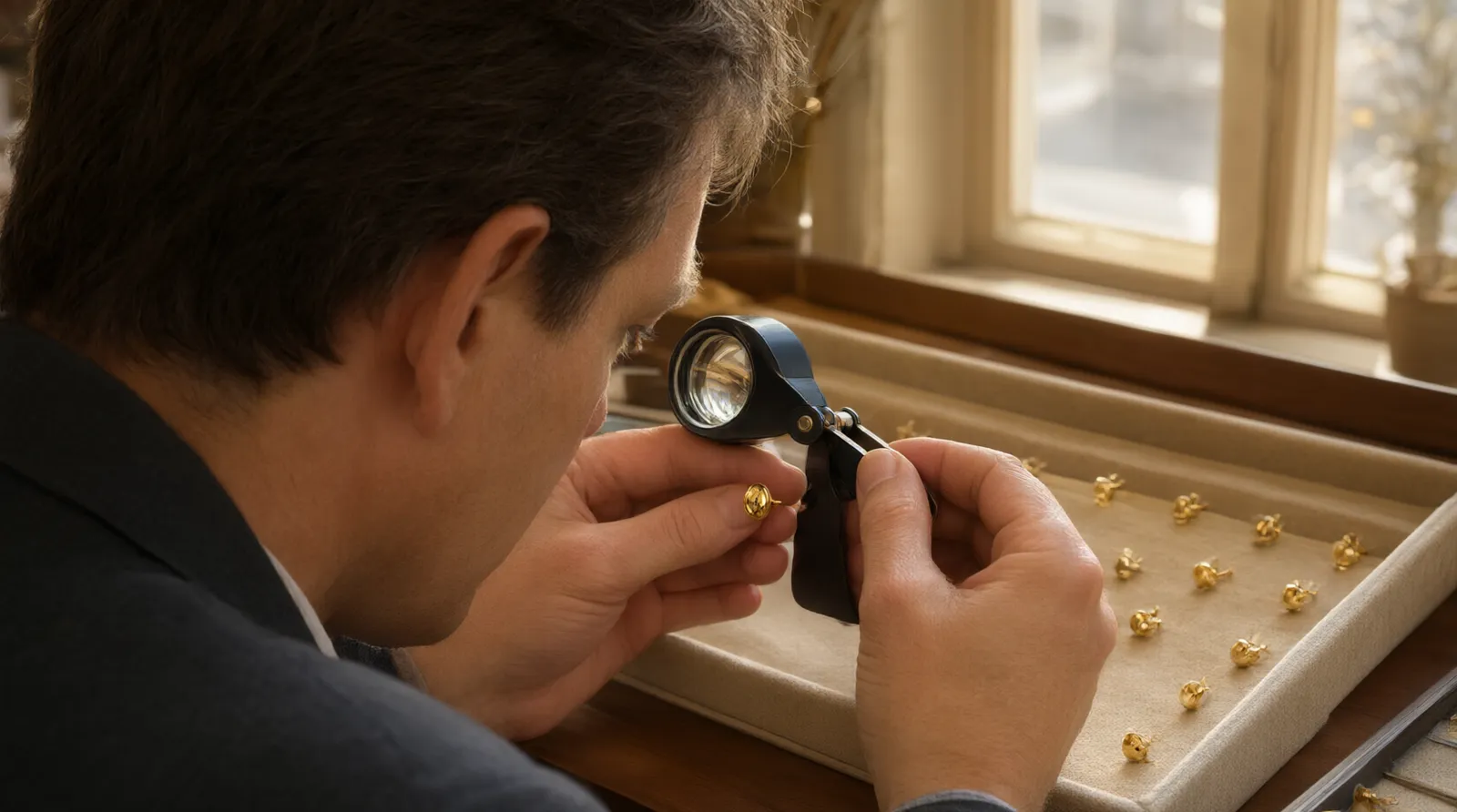
Understanding this distinction is critical when communicating with Chinese factories. Some suppliers use the term "solid" loosely to describe heavy gold-plated brass. True solid gold means the cross-section of the metal is uniform in its alloy composition. This differs fundamentally from vermeil jewelry, which is defined as gold plated over a sterling silver base [Source: https://www.shopseesea.com/14k-solid-gold-jewelry?srsltid=AU7gw4XizFtmLwhBJer46CVkuG2qM_eVcYkLXsqX4qj1zoxf6rMS89Yq]. When sourcing, you must request X-ray fluorescence (XRF) testing reports or third-party assay certificates to verify the alloy matches your purchase order.
How Does It Compare to Other Categories?
Buyers often weigh solid gold against alternatives based on their target demographic. If your audience shops at accessible brands reminiscent of kendra scott, they may expect lower price points, making 10k solid gold or high-quality vermeil more viable. However, if your brand competes in the permanent jewelry space—where pieces are welded directly onto the wearer and never removed—solid 14k gold is the baseline requirement because base metals cause skin reactions under constant contact.
The Benefits of Solid Gold Jewelry for Retail Buyers
Sourcing solid gold jewelry offers distinct advantages for DTC operators managing lifetime customer value and return rates.
- Durability and Waterproof Performance: Unlike plated jewelry that degrades upon contact with water or sweat, solid gold maintains its integrity. Specialists in waterproof jewelry rely heavily on 14K solid gold collections to guarantee longevity to their customers [Source: https://www.shopseesea.com/14k-solid-gold-jewelry?srsltid=AU7gw4XizFtmLwhBJer46CVkuG2qM_eVcYkLXsqX4qj1zoxf6rMS89Yq].
- Hypoallergenic Properties: High-karat alloys eliminate the nickel often found in cheap brass bases, reducing allergy-related returns.
- Margin Stability: Gold retains intrinsic commodity value. While your raw material cost fluctuates with the spot price, the perceived value to the consumer remains anchored in the luxury category.
To understand retail viability, look at current direct-to-consumer pricing for 14k solid gold stud earrings. Market data shows 14k Detailed Butterfly Studs priced at $78.00, while 14k Eternity Star Studs and Gem Star and Moon Studs sit at $72.00 [Source: https://www.shopseesea.com/14k-solid-gold-jewelry?srsltid=AU7gw4XizFtmLwhBJer46CVkuG2qM_eVcYkLXsqX4qj1zoxf6rMS89Yq]. Larger or heavier designs command more: 14k Ball Studs retail for $89.00, and Dangling Stars Studs for $80.00 [Source: https://www.shopseesea.com/14k-solid-gold-jewelry?srsltid=AU7gw4XizFtmLwhBJer46CVkuG2qM_eVcYkLXsqX4qj1zoxf6rMS89Yq]. As a buyer, your factory FOB (Free on Board) price needs to leave enough margin below these retail anchors to cover shipping, customs, marketing, and operations. Note that some retailers offer free standard shipping on orders over thresholds like $29 to drive conversion [Source: https://www.shopseesea.com/14k-solid-gold-jewelry?srsltid=AU7gw4XizFtmLwhBJer46CVkuG2qM_eVcYkLXsqX4qj1zoxf6rMS89Yq], meaning your landed cost per unit must be precise.
How to Source Solid Gold Jewelry from China (A Buyer’s Checklist)
Finding affordable pricing without sacrificing metallurgical accuracy is the core challenge for overseas importers. Gambling on a marketplace listing from an unverified vendor usually results in mismatched karats or delayed shipments. A structured procurement process requires evaluating five dimensions.
1. Supplier Shortlisting and Factory Vetting
Do not rely solely on platform badges. Request the factory’s business license and verify their registered scope includes precious metal manufacturing, not just trading. If you are building custom designs, confirm whether the factory operates its own CAD/CAM and casting equipment or subcontracts it. Subcontracting adds lead time and reduces your control over alloy mixing.
2. Negotiating MOQ and Pricing
Chinese factories typically have higher MOQs for solid gold than for plated brass due to the cost of raw materials and the setup required for casting trees. Ask specifically: "What is your MOQ per SKU versus per order?" A factory might require [your MOQ] units per design but allow you to mix styles to hit a total weight threshold. Pricing should be quoted based on the daily gold spot price plus a fixed making charge (labor and overhead). Never accept a static price quote valid for more than a few days; gold markets move constantly.
3. Sample Coordination
Before approving a bulk run, order physical samples. Test them. Weigh them. If possible, have them assayed locally. Some 14k solid gold collections feature intricate designs like bunny shapes or gemstone accents [Source: https://www.shopseesea.com/14k-solid-gold-jewelry?srsltid=AU7gw4XizFtmLwhBJer46CVkuG2qM_eVcYkLXsqX4qj1zoxf6rMS89Yq]; verifying that prongs hold stones securely and that delicate dangling elements do not snap during transit is mandatory. Whether you are evaluating studs or looking to source 14k gold hoop earrings, rigorous sampling prevents costly production errors.
4. Lead Times and Production Capacity
Ask for historical production data. "How many grams of 14k gold did you cast last month?" This reveals actual capacity better than asking "Are you busy?" Factor in time for polishing, stone setting, and quality checks.
5. Certifications and Compliance
Depending on your destination market, you may need compliance documentation (e.g., REACH in Europe, CPSIA in the US for children's items, or specific hallmarking laws). Confirm the factory understands and can provide the necessary test reports.
When Should You Use Solid Gold Jewelry in Your Catalog?
The decision to stock solid gold rather than vermeil or plated alternatives depends on your brand architecture and sales channel.
Permanent Jewelry Studios: If you supply studios offering welded bracelets, 14k solid chain is non-negotiable. The welding process melts the link shut; plated metals burn off and expose base metal, causing immediate corrosion.
Bridal and Fine Gifting: Customers purchasing engagement rings or anniversary gifts expect heirloom durability. Offering custom solid gold settings aligns with this expectation.
Everyday Essentials: Brands focusing on "never take it off" aesthetics—simple hoops, huggies, and studs—benefit from solid gold. The $72 to $89 retail range for 14k studs demonstrates that consumers will pay a premium for guaranteed tarnish-free daily wear [Source: https://www.shopseesea.com/14k-solid-gold-jewelry?srsltid=AU7gw4XizFtmLwhBJer46CVkuG2qM_eVcYkLXsqX4qj1zoxf6rMS89Yq].
If your catalog targets impulse purchases under $30, solid gold is likely the wrong material choice due to raw commodity costs. Reserve it for your core, high-margin collections.
Why Partner with a Managed Sourcing Operator?
For overseas buyers and DTC store owners, managing a Chinese supply chain remotely introduces friction. Time zone differences, language barriers, and cultural nuances in negotiation often lead to costly misunderstandings. This is where a China sourcing partner and managed export operator like Link4a changes the procurement math.
Instead of messaging dozens of factories on Alibaba and hoping for the best, Link4a shortlists manufacturers based on your exact specifications—karat purity, production capacity, and ethical compliance. They check the factories, negotiate the MOQ and price on your behalf, coordinate the sampling phase, and handle repeat orders. Every reply drafted to a buyer is based on the factory's actual in-stock catalogue, eliminating the common marketplace problem where vendors promise inventory they do not possess.
The Value for Chinese Factory Owners
The model also serves Chinese manufacturers who produce excellent solid gold jewelry but lack the infrastructure to sell overseas. Hiring an internal export sales team requires salaries, training, and multilingual software. Link4a provides a managed overseas storefront with localized keyword research rather than direct English translation.
Multilingual Communication and Quality Assurance
When sourcing fine jewelry, a mistranslated technical term regarding alloy ratios or clasp mechanisms can ruin a production run. A managed operator ensures that your requirements for custom designs or specific finishing techniques are communicated accurately to the factory floor, bridging the gap between your DTC brand standards and Chinese manufacturing realities.
Evaluating Your Next Order
Why is solid gold jewelry important to your bottom line? Because it shifts your business from competing on race-to-the-bottom pricing to competing on trust, durability, and brand equity. The benefits of solid gold jewelry compound over time through lower return rates, higher average order values, and stronger customer retention.
Procuring it correctly requires treating the transaction as a partnership rather than a point-purchase. Verify the alloy. Lock in the making charges. Test the samples. And if you lack the bandwidth to audit factories in Shenzhen or Guangzhou yourself, use an operator who ties their compensation directly to your successful order fulfillment.
Stop scrolling through unvetted marketplace listings. Define your karat requirements, calculate your target landed cost against the $72–$89 retail benchmarks for standard studs, and initiate a structured sourcing conversation. Request a Quote and Get MOQ & Pricing for your next solid gold collection today.
Frequently Asked Questions
What is solid gold jewelry?
Solid gold jewelry refers to pieces manufactured entirely from a uniform gold alloy (typically 14K, 18K, or 24K) throughout their cross-section, produced via lost-wax casting or CNC machining rather than electroplating over base metals. Shenzhen-based manufacturers like 宝福珠宝 (Baofu Jewelry) and 粤豪珠宝 (Yuehao Jewelry) supply these items with MOQs of 50–100 pieces per SKU, 15–25 day lead times, and NGTC or ISO 9001 certifications verifying alloy purity. DTC operators sourcing this category should require assay reports per batch to confirm karat weight, as solid gold pricing is pegged directly to the Shanghai Gold Exchange spot rate plus a making charge (工费).
How to solid gold jewelry?
Solid gold jewelry (14K/18K/24K) is typically sourced from Panyu and Shuibei-based manufacturers like 宝福珠宝 (Baofu) or Shenzhen factories integrated with 链上科技 for digital order tracking, using lost-wax casting or CNC machining with MOQs of 50–100 pieces per SKU and 15–30 day lead times. Ensure suppliers provide NGTC or SGS assay certifications verifying exact karat purity, which is critical for DTC operators importing Chinese supply into regulated overseas markets. For prototyping, expect 7–10 day turnaround before bulk production begins.
Why is solid gold jewelry important?
Solid gold jewelry is critical for DTC operators because it commands higher AOV and avoids plating-wear returns, requiring Chinese suppliers like 链上科技 or Shenzhen-based factories (e.g., BAOJIA) to execute precise lost-wax casting and CNC machining with verified material purity. Sourcing buyers should mandate ISO 9001-certified facilities that provide third-party assay reports (SGS or NGTC) for every batch, typically enforcing MOQs of 50–100 pieces per SKU with 25–35 day lead times from wax approval to FOB Shenzhen shipment. This concrete supply-chain rigor ensures the karat weight and alloy composition meet US/EU FTC standards, protecting your brand from customs seizures and consumer fraud claims.
When should I use solid gold jewelry?
Source solid gold jewelry (14K/18K) for DTC fine jewelry lines or high-AOV bridal SKUs, working with Panyu-based manufacturers like 宝福珠宝 (Baofu Jewelry) or 粤豪珠宝 (Yuehao) that hold RJC and ISO 9001 certifications. These factories use lost-wax casting and CNC machining with MOQs of 50–100 pieces per SKU and standard lead times of 25–35 days after mold approval. Specify 18K Au750 for premium markets requiring hallmarking, and ensure suppliers provide third-party assay reports (e.g., NGTC or SGS) per shipment to verify purity for overseas customs compliance.
What are the benefits of solid gold jewelry?
Solid gold jewelry (14K/18K) offers superior durability and hypoallergenic properties, reducing after-sales returns for DTC operators compared to plated alternatives. Shenzhen-based factories like 粤豪珠宝 (Yuehao) and 百泰集团 (Baitai) produce solid gold using lost-wax casting and CNC machining, typically requiring MOQs of 50–100 pieces per SKU with 25–35 day lead times. Ensure suppliers hold RJC (Responsible Jewellery Council) certification and provide NGTC or GIA assay reports to verify karat purity for overseas customs compliance.