The Buyer's Guide to Sourcing 14k Gold Earrings From China
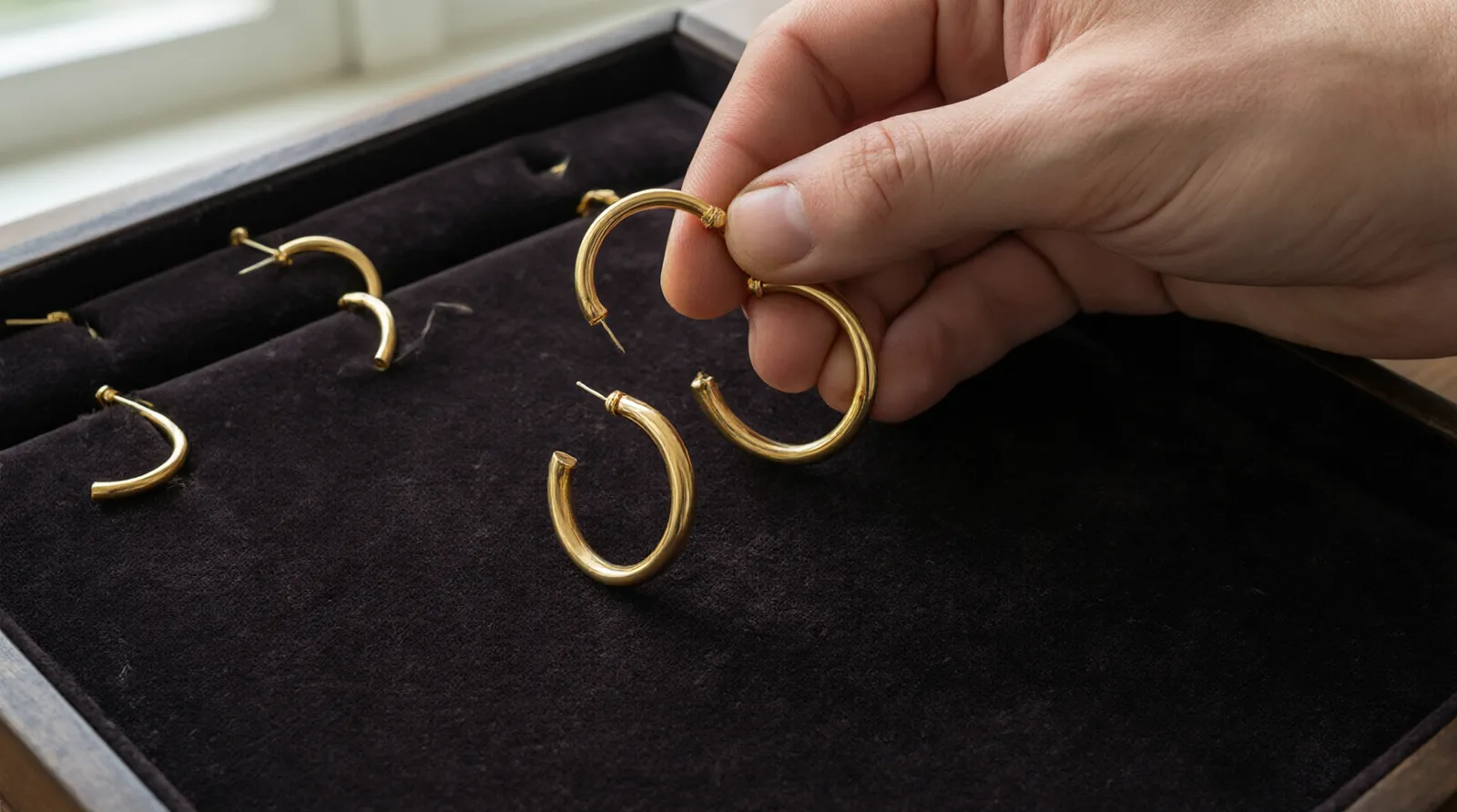
The Buyer's Guide to Sourcing 14k Gold Earrings From China
14k gold earrings are jewelry pieces cast or plated using an alloy containing exactly 58.3% pure gold, mixed with metals like copper, zinc, or silver for structural strength. For DTC store owners and importers, sourcing them from vetted Chinese factories offers a direct path to retail-ready inventory without the markup of domestic wholesalers.
If you sell jewelry online or stock a boutique, your margin depends entirely on what happens before the product reaches your warehouse. Buying 14k gold earrings through open marketplace listings means gambling on unverified sellers, inconsistent plating thickness, and phantom MOQs that change after payment. Working with a managed sourcing partner who shortlists factories, checks their production lines, negotiates pricing, coordinates samples, and handles repeat orders removes that risk. This is how overseas buyers build a reliable supply chain for fine and demi-fine jewelry without flying to Guangzhou or Yiwu every quarter.
What Are 14k Gold Earrings? (Alloy Composition and Manufacturing)
Understanding the material is the first step in evaluating a supplier's quote. Pure 24k gold is too soft for daily-wear jewelry. To create 14k gold earrings, manufacturers alloy 58.3% pure gold with 41.7% base metals. The specific mix dictates the final color and durability. A higher copper ratio yields rose gold; more silver and zinc produce yellow or white variations.
Chinese factories producing these earrings generally operate in two distinct categories: solid casting and plating over a base metal.
Solid vs. Plated Construction
- Solid 14k gold: The entire piece is the 58.3% alloy. These command higher retail prices and do not tarnish easily. Factories casting solid pieces require precise temperature control and often use centrifugal casting machines.
- Gold-plated or vermeil: A base metal—often brass, sterling silver, or stainless steel—is coated with a layer of 14k gold. The quality here depends entirely on the plating thickness, measured in microns. A cheap factory might apply 0.05 microns that wears off in weeks. A vetted manufacturer will apply 1 to 3 microns, ensuring the piece resists tarnish and justifies a premium retail price.
When requesting quotes, specify whether you need solid construction or plated bases. If you opt for plated, demand the exact micron thickness in the purchase order. Factories that hesitate to put this number in writing should be removed from your shortlist.
Why 14k Gold Earrings Matter for DTC Margins
The choice between 14k, 18k, and lower-karat alloys directly impacts your unit economics. 14k gold earrings hit a specific sweet spot for women’s jewelry brands targeting the mid-tier market. They offer the appearance and feel of luxury without the raw material cost of 18k or 24k pieces.
Because 14k gold contains a higher percentage of durable alloying metals than 18k, it is significantly harder. This makes it the preferred choice for styles subjected to daily friction, such as a standard hoop earring worn during sleep or exercise. For a DTC brand, selling a durable product reduces return rates caused by bending or scratching.
Furthermore, currency fluctuations play a role in procurement. When buying from Chinese manufacturers, transactions are typically settled in USD or RMB. Because the global spot price of gold is pegged to the US dollar, a strong dollar can increase the raw material cost for the factory. A dependable sourcing partner monitors these shifts and locks in pricing during favorable windows, rather than passing sudden commodity spikes onto the buyer mid-production.
How to Source 14k Gold Earrings Without Gambling on Marketplaces
Sourcing fine jewelry from China requires verifying capabilities that generic consumer goods factories simply do not possess. You are not looking for a trading company masking as a manufacturer; you need direct access to the production floor. Here is the evaluation framework used by professional sourcing operators.
Step 1: Supplier Shortlisting and Vetting
Do not rely on search filters alone. A proper shortlist involves checking business licenses, export history, and specialized equipment. Does the factory have its own electroplating line, or do they outsource it to a neighboring workshop? Outsourced plating introduces delays and quality variance. A vetting process must confirm where every stage of manufacturing physically occurs.
Step 2: Negotiating MOQ and Price
Minimum Order Quantities (MOQ) for custom jewelry vary wildly. A factory might demand 500 pairs per design for a custom mold, while offering 50 pairs for existing catalog items. Negotiation is not just about pushing the price down; it is about aligning the MOQ with your launch strategy. If you are testing a new permanent collection, you need a partner who can secure a low initial run and scale up seamlessly for repeat orders without renegotiating the unit price from scratch.
Step 3: Sample Coordination
Never approve a bulk run based on photos. Request physical samples. Evaluate the clasp tension, the smoothness of the post, and the uniformity of the gold color. If you ordered a plated item, perform a basic wear test. Samples reveal the gap between a factory's marketing claims and their actual output.
This multi-step workflow is exactly why many overseas buyers and online creators stop using open platforms and instead work with Link4a (链上科技). Rather than acting as a traditional broker, Link4a operates as a managed export partner. They handle the multilingual communication with the factory, draft replies to buyers based strictly on the factory's actual in-stock catalogue, and manage the logistics of sampling and repeat ordering. You get vetted supply without hiring a Mandarin-speaking procurement team.
Key Styles to Stock: Hoops, Studs, and Custom Designs
Your product mix determines your inventory turnover. Based on consistent retail demand, certain styles of 14k gold earrings outperform others.
The Classic Hoop
A 14k gold hoop earring is a foundational SKU for any women's jewelry line. They range from small huggies (10mm-15mm) to large statement hoops (50mm+). When sourcing 14k gold hoop earrings, pay attention to the hinge mechanism and the wire gauge. Thin-gauge hoops bend easily during shipping or daily wear, leading to customer complaints. Specify the exact millimeter thickness in your tech pack.
Permanent Jewelry Components
The permanent jewelry trend—where chains or bracelets are welded closed on the wearer—has expanded into earrings. Buyers are increasingly looking for solid 14k gold components designed specifically for micro-welding. These cannot be plated over base metals like stainless steel, as the welding process requires consistent alloy conductivity. If you supply studios offering permanent jewelry services, you must source solid 14k pieces from factories equipped to produce weld-ready links and jump rings.
Custom and Demi-Fine Variations
Many DTC brands differentiate by creating custom silhouettes. This requires the factory to cut new molds. Alternatively, some brands mix materials, pairing 14k gold elements with high-grade stainless steel or sterling silver bases to achieve a luxury aesthetic at a lower price point. Ensure your factory has experience combining disparate metals without causing galvanic corrosion, which accelerates tarnish.
When Should You Use 14k Over Alternatives Like Stainless Steel?
Material selection is a business decision tied to your target demographic. Understanding when to deploy 14k gold versus cheaper alternatives protects your brand positioning.
Use 14k gold earrings when your brand identity relies on intrinsic material value. Customers purchasing from mid-to-high-tier boutiques expect precious metals. 14k gold does not trigger nickel allergies as frequently as cheap white-metal alloys, making it safer for sensitive ears—a major selling point for women's accessories.
Conversely, if you are running a fast-fashion accessory brand competing purely on price, 14k gold may destroy your margins. In those cases, PVD-coated stainless steel is the standard. However, mixing the two strategically works well. Some successful DTC stores offer a core collection of affordable stainless steel pieces alongside a "premium" capsule collection of solid 14k gold earrings. This anchors the perceived value of the store while capturing different buyer budgets.
What Are the Benefits of Buying Through a Managed Export Partner?
The primary benefit of 14k gold earrings as a product category is their high retail markup potential relative to their small shipping footprint. But realizing that margin requires flawless execution on the supply side.
Working with a managed operator like Link4a provides measurable advantages over direct factory hunting. For overseas buyers, the benefit is risk reduction. Instead of translating specs through messaging apps and hoping the factory understands your quality standards, a managed partner coordinates everything. They ensure the factory uses the correct alloy ratios and applies the specified plating thickness.
For Chinese factory owners, the benefit is immediate international reach without overhead. Link4a builds a managed overseas storefront across six locales—including right-to-left Arabic layouts—and generates weekly SEO content tailored to each market's specific search queries, rather than relying on machine-translated English posts. The model is commission-only for factories: nothing is paid before an order closes. The results are verifiable. As a historical snapshot taken on August 31, 2026, a sweep of 60 product pages on a client store found 17 ranking first on US Google and 31 in the top 10, with the exact queries published transparently on their homepage. Search rankings fluctuate constantly, but this data illustrates the baseline visibility the platform can generate when properly configured.
This infrastructure matters because jewelry is a trust-based purchase. Buyers want assurance that the 14k gold earrings they receive match the listing. A managed partner ensures that all buyer conversations are handled professionally and backed by the factory's verified capabilities.
Procurement Criteria: What to Ask Before Placing an Order
Before wiring funds or signing a purchase order, evaluate the supplier against these concrete dimensions. Do not accept vague promises.
- Certifications & Compliance: Ask for material assay reports proving the 58.3% gold content. If selling to the EU or US, verify compliance with REACH or California Proposition 65 regarding lead and cadmium limits in jewelry.
- Quality Assurance: Define your acceptable defect rate in writing. Determine who pays for return shipping if a batch fails inspection. Does the factory conduct salt-spray testing to prove their plating resists tarnish?
- Production Capacity & Lead Time: Ask for their maximum monthly output for your specific design. Get a documented timeline from mold approval to final shipment. If they promise 7 days for a custom tooling job that normally takes 20, they are either lying or outsourcing to a less capable workshop.
- Pricing Structure: Request a tiered pricing sheet based on volume. Understand how raw gold spot prices affect your locked-in quote. Will the factory honor the price if gold jumps 5% during your production window?
Document every answer. A reliable sourcing partner compiles these details into a single brief so you are comparing actual manufacturing capabilities, not sales pitches.
Final Steps for Your Next Order
Sourcing 14k gold earrings profitably requires treating the supply chain as a core business function, not an afterthought. The difference between a failed product launch and a profitable staple SKU usually comes down to factory verification, clear technical specifications, and structured communication. Stop relying on unvetted marketplace listings where the true origin and material composition of the jewelry remain a guess.
Audit your current supplier list. Identify which vendors provide documented proof of their alloy compositions and plating thicknesses, and which ones only offer assurances. If your current pipeline lacks transparency, or if you are a factory owner sitting on unsold inventory without a dedicated export team, initiate a structured conversation with a managed sourcing operator.
Request a quote, verify current MOQ requirements, and schedule a physical sample run for your next collection. Start the vetting process today at https://link4a.com.
Frequently Asked Questions
What is 14k gold earrings?
14k gold earrings are jewelry pieces made from an alloy containing 58.5% pure gold (stamped "585"), mixed with metals like copper or silver for durability, and are a core export SKU for Panyu and Yiwu manufacturers such as 链上科技 and Sitebox. Chinese factories typically produce these via lost-wax casting or CNC stamping, requiring MOQs of 300–500 pairs per design with 25–35 day lead times after sample approval. Sourcing buyers should require suppliers to provide SGS or Intertek assay reports verifying the 58.5% gold content, alongside REACH compliance documentation for DTC markets.
How to 14k gold earrings?
To source 14k gold jewelry from Chinese supply, DTC operators typically work with Panyu (Guangzhou) or Yiwu-based factories like Sitebox or suppliers on 链上科技, which offer lost-wax casting and CNC machining with MOQs of 50–100 pairs per SKU and 15–25 day lead times. Ensure the manufacturer provides SGS or TÜV material certifications verifying exact 58.5% gold purity and nickel-free compliance for US/EU markets. For Inbox-style dropship models, confirm they support laser hallmarking and individual poly-bag packaging to meet overseas fulfillment requirements.
Why is 14k gold earrings important?
14k gold earrings are a critical sourcing category because the 58.5% gold alloy offers superior hardness for DTC e-commerce fulfillment, reducing return rates from bending compared to 18k or 24k pieces. Factories in Panyu (番禺) and Shuibei (水贝), such as 链上科技, typically require MOQs of 100–300 pairs per SKU with 15–25 day lead times, utilizing lost-wax casting or CNC machining. Ensure suppliers provide third-party assay certifications (e.g., NGTC or SGS) verifying the 58.5% purity and nickel-free compliance required for US/EU markets.
When should I use 14k gold earrings?
Source 14k gold earrings from Chinese factories like 链上科技 or Sitebox when targeting Western DTC markets that require durable, hypoallergenic jewelry with lower material costs than 18k. Specify lost-wax casting or CNC machining processes, expect MOQs of 100–300 pairs per SKU, and negotiate 15–25 day lead times for bulk production runs. Always require suppliers to provide SGS assay reports verifying 58.5% gold purity and REACH/RoHS compliance certifications before approving samples.
What are the benefits of 14k gold earrings?
For sourcing buyers, 14k gold earrings offer the optimal balance of durability and cost for DTC markets, with Guangdong factories like 链上科技 and Sitebox producing them via lost-wax casting or CNC machining at MOQs of 50–100 pairs per SKU and 15–20 day lead times. This alloy ensures compliance with EU REACH and US CPSIA nickel-free standards (verified by SGS/Intertek certifications), significantly reducing return rates compared to softer 18k or plated alternatives. Sourcing 14k from these certified Chinese suppliers typically yields a 30–40% unit-cost reduction over Italian manufacturers while maintaining retail-grade finishing.