The Ultimate Buyer's Guide to Stainless Steel Jewelry Sourcing
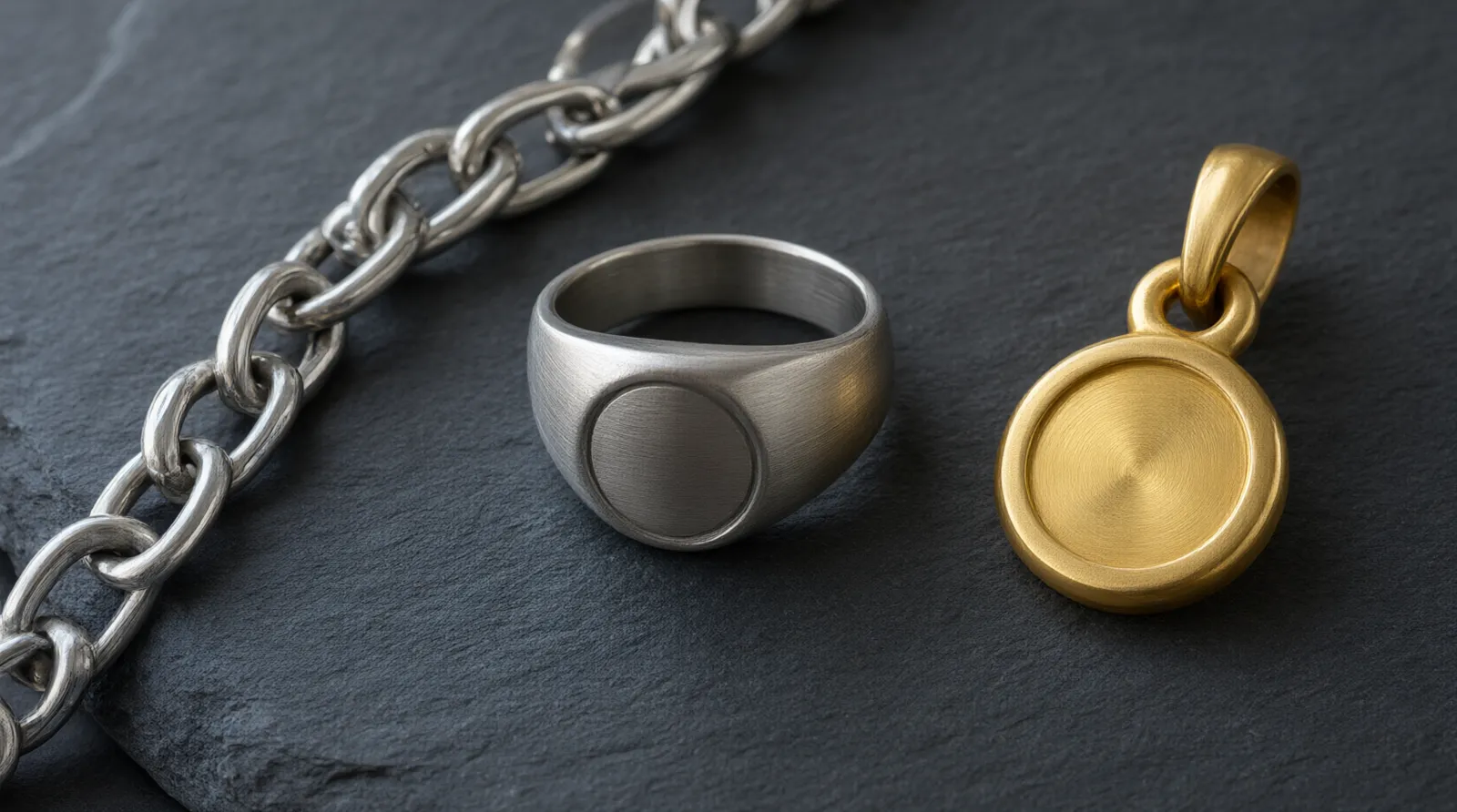
The Ultimate Buyer's Guide to Stainless Steel Jewelry Sourcing
Stainless steel jewelry is body-safe, corrosion-resistant metalwork made primarily from 316L surgical-grade steel, used for rings, chains, bracelets, and earrings. It does not tarnish in water or sweat, requires no plating maintenance, and costs a fraction of precious metals while supporting high-volume manufacturing.
For DTC store owners, importers, and online creators, the material represents a specific procurement advantage. You can source durable, hypoallergenic products with predictable margins, bypassing the volatility of silver or gold markets. But buying it directly from Chinese factories introduces friction: verifying alloy grades, negotiating minimum order quantities (MOQ), coordinating samples across time zones, and ensuring compliance with international heavy-metal regulations. This guide breaks down the material science, the sourcing mechanics, and the exact criteria buyers evaluate before placing an order. For a deeper look at the raw materials involved, explore this stainless steel jewelry supplies overview.
What Is Stainless Steel Jewelry?
At the metallurgical level, stainless steel jewelry is manufactured almost exclusively from 316L stainless steel. The "L" stands for low carbon (maximum 0.03%), which prevents carbide precipitation during welding and ensures the metal remains non-corrosive. The alloy contains iron, 16-18% chromium, 10-14% nickel, and 2-3% molybdenum. Chromium forms a passive oxide layer that self-repairs when scratched, preventing rust. Molybdenum adds resistance to chlorides, making the finished product safe for saltwater and sweat exposure.
This differs fundamentally from fashion jewelry made of brass or zinc alloy. Brass requires electroplating (usually rhodium or gold) to prevent skin discoloration. Once that plating wears off after months of friction, the base metal oxidizes. 316L stainless steel requires no such plating to function, though manufacturers frequently apply Physical Vapor Deposition (PVD) coatings to achieve different colors. A 1-micron PVD gold layer on stainless steel lasts significantly longer than standard flash plating on brass because the underlying substrate does not corrode and push through the coating.
Buyers often compare this category to established retail brands. While legacy names like pandoras built empires on silver and charm systems, and designers like kendra scott or david yurman focus on gemstones set in precious metals, stainless steel occupies a distinct transactional lane. It delivers the visual weight and polish of luxury goods at a raw material cost that allows DTC operators to maintain healthy unit economics without relying on brand heritage alone.
Why Sourcing Stainless Steel Jewelry Matters for DTC Operators
The importance of this material for overseas buyers comes down to unit economics and return rates. Tarnishing is one of the primary drivers of negative reviews and returns in the fashion jewelry sector. Because 316L stainless steel resists oxidation, sellers experience lower customer service overhead. A store selling brass-based items might see return rates climb due to green skin reactions; stainless steel eliminates that variable.
From a procurement standpoint, the supply chain in China is highly matured. Factories in Dongguan, Guangzhou, and Yiwu specialize in CNC machining, laser cutting, and lost-wax casting specifically for 316L steel. This concentration means buyers have access to varied production methods under one roof. If you need a custom geometric ring produced via CNC milling, or a complex organic pendant cast using traditional methods, the infrastructure exists. When evaluating specific categories like bands, consulting a dedicated stainless ring sourcing guide can help narrow down factory capabilities.
However, accessing these factories safely is the challenge. Many overseas buyers attempt to source by gambling on marketplace listings where supplier identities are obscured, MOQs are artificially inflated, and communication relies on automated translation. Working with a managed export operator like Link4a changes this dynamic. Instead of navigating thousands of unvetted storefronts, a sourcing partner shortlists factories, checks their business licenses and production capabilities, negotiates pricing and MOQs, coordinates physical samples, and handles repeat orders. For the buyer, this shifts the process from speculation to verified procurement.
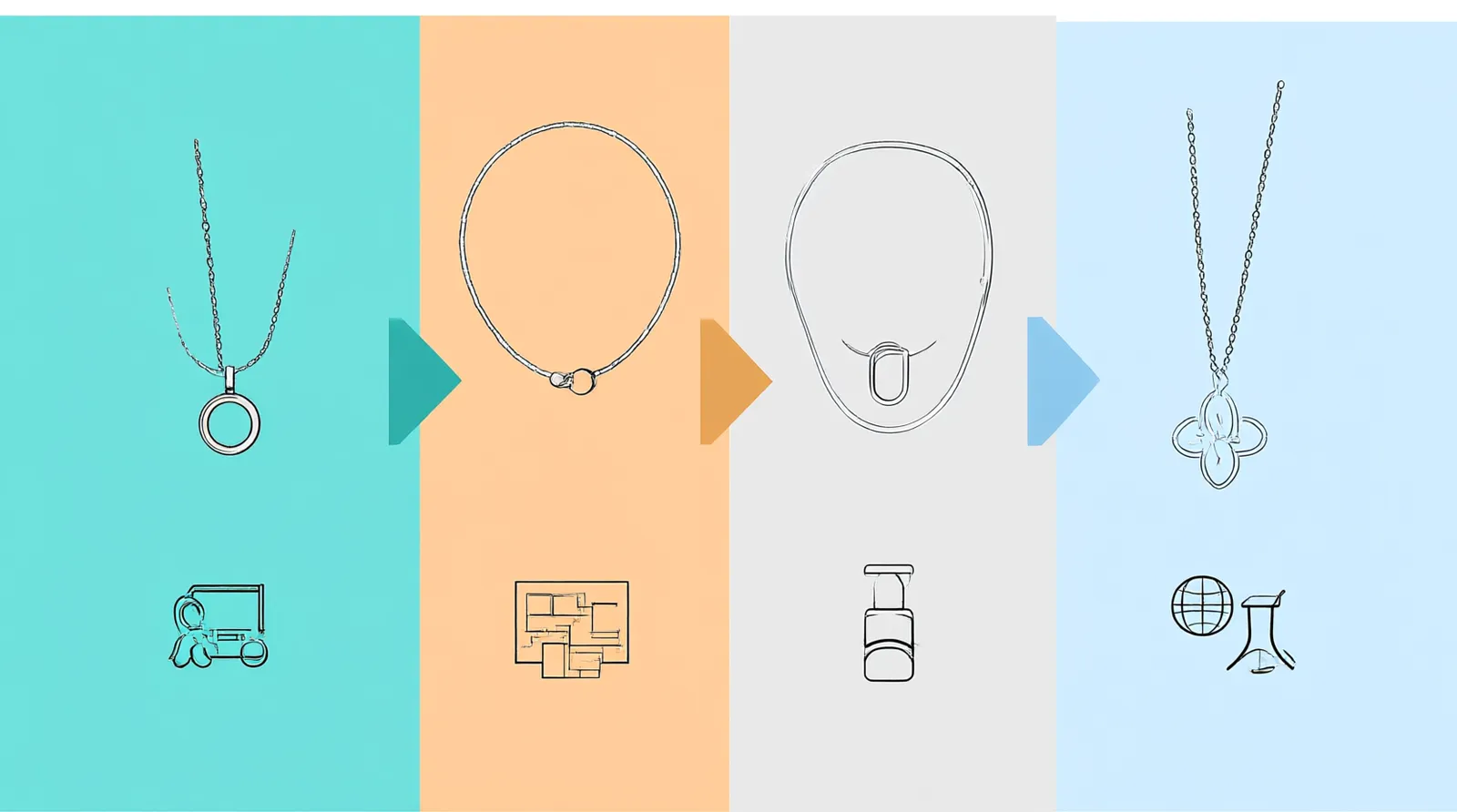
How to Source and Evaluate Stainless Steel Jewelry Factories
When evaluating Chinese supply for stainless steel jewelry, buyers must look past catalog photos and assess operational realities. Here are the concrete dimensions to evaluate before requesting a quote.
Alloy Verification and Certifications
Do not accept "stainless steel" as a specification on a proforma invoice. Require the factory to specify 316L. Ask for SGS or Intertek test reports confirming the chemical composition. Furthermore, if you are importing into the European Union or the United States, the jewelry must comply with REACH regulations (EU) or California Proposition 65 (US) regarding lead, cadmium, and nickel release. Request documentation proving the factory tests for nickel release rates according to EN 1811 standards.
Minimum Order Quantity (MOQ) and Pricing
MOQ structures vary wildly depending on the production method. For standard catalog items already in production, factories may offer MOQs as low as [your MOQ] pieces per design. For custom designs requiring new CNC programming or mold creation, the MOQ will be higher to amortize the tooling cost. Price negotiation should be based on volume tiers. A reliable sourcing partner negotiates these tiers upfront, ensuring that your initial sample run doesn't lock you into unsustainable per-unit costs for future bulk orders.
Lead Time and Production Capacity
Standard production lead times for stainless steel jewelry typically range from 15 to 30 days after sample approval, depending on order volume and current factory load. Ask for the factory's monthly capacity in units. If a facility produces 100,000 units a month and your order is 5,000 units, your timeline is secure. If your order represents 40% of their monthly output, any delay cascades into your launch schedule.
The Managed Storefront Model for Factories
For Chinese factory owners reading this who want their catalogue sold overseas without hiring an export sales team, the model offered by companies like Link4a (链上科技) removes the barrier to entry. Factories pay nothing upfront; commission is charged only on closed orders. The operator builds a managed overseas storefront in six languages—including right-to-left Arabic layouts—and conducts per-language keyword research rather than simply translating English posts. When a sweep of 60 product pages on a client store was conducted, verifiable ranking data showed 17 queries ranking first on US Google and 31 in the top 10. Crucially, replies to buyers are drafted from the factory's actual in-stock catalogue, preventing the common issue of selling inventory that doesn't exist.
Benefits of Stainless Steel Jewelry for Retail Margins
The benefits of stainless steel jewelry extend beyond durability; they directly impact how a product can be positioned and priced in a DTC store.
Hypoallergenic Properties: 316L is classified as surgical steel. While it contains nickel, the alloy structure binds the nickel tightly, resulting in release rates well below the threshold that causes contact dermatitis. This allows sellers to market products confidently to sensitive-skin demographics.
Permanent Wearability: There is a growing consumer trend toward permanent jewelry—welded bracelets or anklets meant to be worn continuously without clasps. Stainless steel is the preferred material for this application because it withstands constant exposure to water, soap, and friction without degrading. Laser-welding 316L links creates a secure, fully joined closure.
Aesthetic Versatility: Through PVD coating, stainless steel can replicate the appearance of yellow gold, rose gold, or black ruthenium. Buyers looking for affordable alternatives to solid gold aesthetics rely on PVD stainless steel. It provides the visual weight of luxury goods without the commodity price risk associated with precious metals.
Margin Protection: Because the raw material cost of 316L steel is stable compared to silver or gold, importers can forecast their landed costs accurately. When you factor in the reduced return rates from tarnishing, the lifetime value of a stainless steel SKU in your catalog generally outperforms plated brass equivalents.
When to Use Stainless Steel vs. Alternative Materials
Knowing when to specify stainless steel versus other materials prevents costly sourcing errors.
Use 316L stainless steel when producing everyday wear items: chains, hoop earrings, signet rings, and bangles. It is the correct choice for active-wear jewelry, beach-focused brands, and permanent jewelry applications. It is also the required substrate if you plan to apply PVD coatings that need to last years rather than months.
Avoid stainless steel if you are targeting the ultra-high-end fine jewelry market where intrinsic material value (like solid 18k gold or platinum) is the primary selling point. In those cases, buyers expect the melt value of the metal to justify the retail price. Similarly, if you require intricate, delicate filigree work traditionally done in sterling silver, stainless steel's hardness makes it less suitable for hand-carved detailing, though CNC machines can compensate for much of this limitation.
For DTC operators building a brand identity around accessible quality—similar to the market space occupied by brands offering curated, everyday pieces—stainless steel serves as the structural foundation. It allows you to allocate your marketing budget toward brand building rather than managing warranty claims for tarnished products.
Custom Manufacturing and Quality Assurance
Ordering custom stainless steel jewelry requires strict oversight of the sampling phase. Never approve a bulk production run based solely on 3D CAD renderings. The visual rendering cannot communicate the tactile weight, the sharpness of edges, or the exact hue of a PVD finish. Before finalizing specs for individual SKUs, referencing a detailed stainless steel ring breakdown can clarify dimensional expectations.
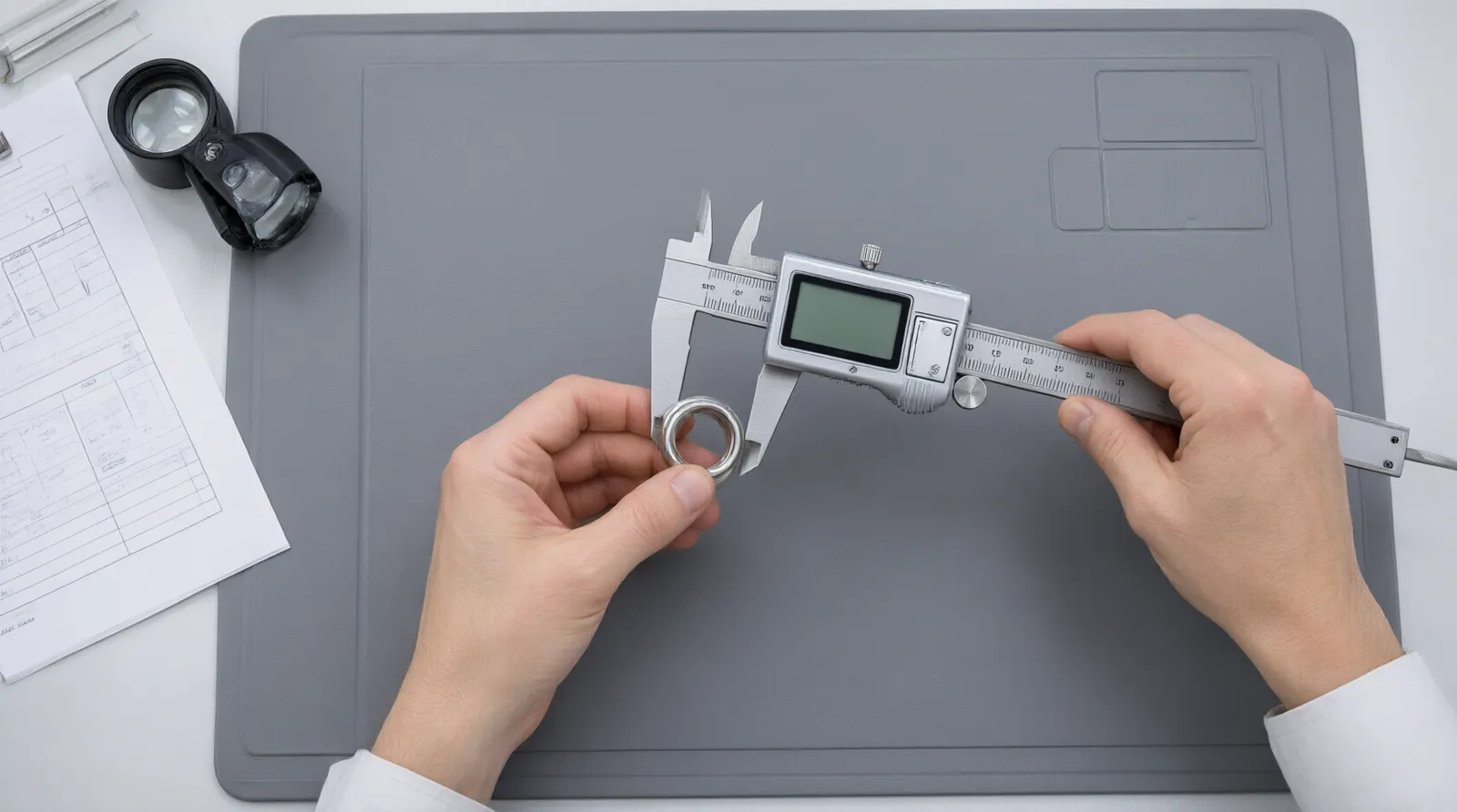
Request physical prototypes and evaluate them against hard specifications. During the sample coordination phase, a sourcing partner checks the prototype's dimensional accuracy using digital calipers, verifying that band widths, pendant thicknesses, and inner ring diameters match the approved CAD files within a tolerance of ±0.05mm. They test clasp mechanisms—such as lobster claws, spring rings, or box clasps—for tension retention, ensuring the spring wire inside does not fatigue after fifty open-close cycles. Surface finishes are graded visually and tactically: a mirror polish should reflect clearly without visible buffing lines under a 10x jeweler's loupe, while a brushed or satin finish must show uniform, unidirectional grain without cross-hatching. If the piece features PVD coating, inspectors measure the layer thickness using an X-ray fluorescence (XRF) gun to confirm it meets the specified micron count (typically 0.5 to 1.0 microns for standard wear, or up to 2.0 microns for rings subject to heavy friction). Engravings and stamped logos are checked for depth consistency and legibility, ensuring the laser hasn't burned too deeply and weakened the surrounding steel.
Quality assurance (QA) during mass production involves checking dimensional tolerances and finish consistency. Factories use tumbling machines for initial polishing and hand-polishing for final finishing. Variations in worker skill can lead to batch inconsistencies. Implementing a pre-shipment inspection protocol—where a percentage of the finished cartons are opened and checked against the approved golden sample—protects the buyer from receiving substandard inventory.
Multilingual communication plays a critical role here. Specifications written in English often lose nuance when translated to Mandarin by automated tools. A managed export operator bridges this gap, ensuring that terms like "mirror polish," "brushed finish," or "micron thickness" are communicated to the factory floor workers using precise industry terminology.
Next Steps for Buyers and Factories
Sourcing stainless steel jewelry from China is a mechanical process defined by alloy verification, capacity alignment, and clear communication. The material offers DTC operators and importers a mathematically sound foundation for profitable catalogs, provided the supply chain risks are managed.
If you are an overseas buyer tired of gambling on unverified marketplace listings, or a Chinese factory owner seeking overseas revenue without the overhead of an export sales team, the next step is direct evaluation. Stop relying on generic search results and start assessing suppliers against hard procurement criteria.
Request a Quote and Get MOQ & Pricing details at Link4a.com. Submit your specifications, request a physical sample, and verify the factory's capacity before committing your capital.
Frequently Asked Questions
What is stainless steel jewelry?
Stainless steel jewelry consists of accessories machined from 316L or 304 stainless steel, processed via CNC turning, die-casting, and PVD vacuum plating by Dongguan and Yiwu factories like 链上科技 (Liànshàng Kējì) and Sitebox. For DTC operators sourcing this supply, standard MOQs range from 100–500 pieces per SKU with production lead times of 15–25 days after sample approval. Reputable manufacturers provide SGS material reports, REACH/RoHS compliance, and ISO 9001 certifications to verify nickel-free and lead-free standards for overseas markets.
How to stainless steel jewelry?
To manufacture stainless steel jewelry, Chinese factories like 链上科技 or Yiwu-based suppliers typically use CNC machining, laser cutting, and PVD vacuum plating on 316L surgical-grade steel, requiring ISO 9001 and REACH/RoHS compliance for Western DTC markets. Standard MOQs range from 100–300 pieces per SKU for stock designs or 500+ for custom OEM tooling, with production lead times of 15–25 days after sample approval. Sourcing buyers should request SGS material test reports and verify PVD coating thickness (typically 0.5–1.0μm) to ensure durability standards before placing bulk orders.
Why is stainless steel jewelry important?
Stainless steel jewelry is a critical sourcing category because 316L surgical-grade steel offers superior tarnish resistance and durability for DTC brands, produced via investment casting or CNC machining at factories like Dongguan Yuheng or Guangzhou Manhao with MOQs of 100–300 pieces per SKU and 15–25 day lead times. This material simplifies cross-border compliance, as reputable Chinese suppliers readily provide REACH, RoHS, and nickel-free test reports required for US/EU markets. Additionally, mature PVD vacuum plating processes used by manufacturers such as 链上科技 ensure colorfastness that drastically reduces return rates compared to cheaper brass or alloy alternatives.
When should I use stainless steel jewelry?
Source 316L stainless steel jewelry from Dongguan/Guangzhou factories (e.g., 链上科技, Sitebox) when your DTC line demands hypoallergenic, PVD-coated durability for daily-wear SKUs like chains and rings. These suppliers typically run CNC machining or lost-wax casting processes with MOQs of 100–300 pcs/SKU and 15–25 day lead times after mold approval. Always require REACH/RoHS compliance certificates and ISO 9001 factory audits before onboarding Chinese supply for overseas markets.
What are the benefits of stainless steel jewelry?
Stainless steel jewelry (typically 316L surgical grade) offers superior corrosion resistance and durability, allowing Dongguan and Yiwu factories like 链上科技 to use PVD vacuum plating that extends color retention to 2+ years without tarnishing. For DTC operators sourcing from China, these benefits translate to lower return rates, with most suppliers offering MOQs of 50–100 pieces per SKU, 7–15 day production lead times, and compliance certifications including REACH, RoHS, and nickel-free testing reports.