Supply Chain Certification: The Complete Buying Guide for Exporters

Supply Chain Certification: The Complete Buying Guide for Exporters
Who This Guide Is For
You are a factory owner, OEM/ODM exporter, sourcing manager, or DTC brand operator at the moment of commitment — not casually browsing, but actively evaluating whether a supply chain certification is worth the investment before you sign anything. Maybe a major retailer just asked for your ISO audit documentation. Maybe a TikTok creator running a $2M channel wants verified product sourcing and your competitor already has BSCI. Maybe you're a Chinese factory preparing to go global and realizing that certification isn't a checkbox — it's a market access key. This guide will help you cut through the credential alphabet soup, evaluate vendors and bodies objectively, and make a defensible purchase decision with your procurement team.
What Supply Chain Certification Actually Does
Supply chain certification serves three commercial functions that matter at the point of purchase:
- Market entry gate. Retailers (Walmart, Amazon, IKEA) and platform marketplaces gate supplier relationships behind specific certifications. Without them, you are invisible to entire buyer segments — regardless of price or quality.
- Risk-transfer signal. Buyers use certified supply chains to shift liability. A SMETA or SA8000 audit tells the buyer's compliance team that labor and ethical sourcing risk has been independently verified — reducing their due diligence burden.
- Negotiation leverage. Certified factories command higher per-unit prices and longer-term contracts. Certification is not a cost; it is a pricing mechanism.
What it does not do: it does not guarantee product quality at the SKU level (that is what QC inspection and testing labs cover), and it does not replace relationship-based trust. It validates your system and processes to a defined standard at a point in time.
Key Decision Factors
1. Certification Scope and Standard Relevance
Not all supply chain certifications are equal in buyer perception. Before selecting a body or program, map the certification to the specific buyer or market segment you are targeting.
- What to evaluate: Does the standard address your buyers' actual compliance checklists? BSCI and SMETA cover social compliance. ISO 9001 covers quality management systems. ISO 14001 covers environmental management. CTPAT covers US customs security. C-TPAT, AEO, and similar programs are logistics and customs-focused.
- What "good" looks like: The certification body is recognized by your target buyers by name. You can pull a buyer's supplier code of conduct and cross-reference the required standards explicitly.
2. Audit Body Accreditation and Recognition
The certification is only as credible as the body issuing it. A self-issued "certificate" or one from an unaccredited local body will not pass procurement screening at serious buyers.
- What to evaluate: Is the body accredited by APSCA (for social audits), IAF (for management system certifications like ISO), or another internationally recognized accreditation framework? Is the auditor name on the report findable in the auditor database?
- What "good" looks like: The certification body appears on your target retailer's approved auditor list. Reports are uploaded directly to Sedex, amfori, or a buyer-mandated platform — not just emailed as PDFs.
3. Recertification Cycle and Maintenance Cost
Certification is not a one-time purchase. It is a subscription to ongoing compliance, with audit cycles, corrective action requirements, and renewal costs.
- What to evaluate: What is the initial audit cost vs. the annual surveillance or recertification cost? What happens if a corrective action plan (CAP) is triggered — what is the remediation timeline and cost? Who owns the internal compliance workload?
- What "good" looks like: The total cost of ownership over a 3-year horizon is documented before you sign. The vendor or certification body provides a CAP support process, not just a report and a goodbye.
4. Digital Integration and Data Portability
Modern supply chain compliance is increasingly digital. Your certification data needs to live in systems that buyers can query programmatically — not in a filing cabinet.
- What to evaluate: Does the body or platform integrate with Sedex, Open Supply Hub, the SGS database, or buyer-specific supplier portals? Can you export audit data in structured formats? Is the certificate machine-readable with a QR or verification URL?
- What "good" looks like: Your certificate is queryable by buyers in real time. Platforms like Link4a's Match engine can surface verified suppliers in seconds — but only if the underlying certification data is structured and accessible. A PDF-only certificate is a friction point in modern B2B discovery.
5. Buyer-Specific vs. Universal Certification
Some buyers operate proprietary audit programs (Target's SEAM, H&M's HIGG verification, Amazon's supply chain standards). Others accept universal third-party certifications. This changes your build vs. buy calculus significantly.
- What to evaluate: Do your top three target buyers accept BSCI/SMETA, or do they require a proprietary audit? If proprietary, can audit results be shared with other buyers (reducing duplicate audit costs)?
- What "good" looks like: You target certifications that are buyer-agnostic and accepted by multiple channels simultaneously, reducing per-buyer audit overhead. SMETA 4-Pillar and BSCI have broad multi-buyer acceptance in EU and North American retail.
6. Lead Time to First Certification
For exporters trying to unlock a buyer relationship quickly, lead time to certification is a commercial constraint, not just a planning detail.
- What to evaluate: What is the typical schedule from application to issued certificate? What are the pre-audit readiness requirements? Is a gap assessment included or a separate purchase?
- What "good" looks like: The body provides a clear timeline with milestones. Gap assessments are available before the formal audit to reduce first-attempt failure risk. For common standards, 60–120 days from engagement to certificate issuance is a reasonable benchmark; faster timelines should be scrutinized.
7. Geographic and Language Support
For Chinese factories and cross-border supply chains, the ability to conduct audits in Mandarin, manage documents in Chinese, and resolve issues with a local-language team is operationally significant.
- What to evaluate: Does the certification body have accredited auditors operating in mainland China? Is the pre-audit documentation process available in Chinese? Is there a local office or authorized local partner?
- What "good" looks like: You communicate primarily in Mandarin through the audit process. Local auditors with verifiable accreditation credentials conduct on-site visits. The report is bilingual.
8. Platform Ecosystem and Buyer Discoverability
Certification does not market itself. For Chinese exporters and OEM/ODM factories going global, the ROI on certification depends heavily on whether that certification is visible to the buyers who care about it.
- What to evaluate: Once certified, how does the credential reach potential buyers? Is the certification body's database buyer-searchable? Are there platform integrations that surface certified suppliers to overseas sourcing channels, DTC operators, and TikTok creators looking for verified Chinese supply?
- What "good" looks like: Your certification status feeds into supplier discovery platforms. Tools like Link4a's Match engine — which delivers verified supplier matchmaking in under 3 seconds — rely on structured compliance data to connect buyers with factories that meet their sourcing criteria. Certification without discoverability is underutilized infrastructure.
Budget Tiers
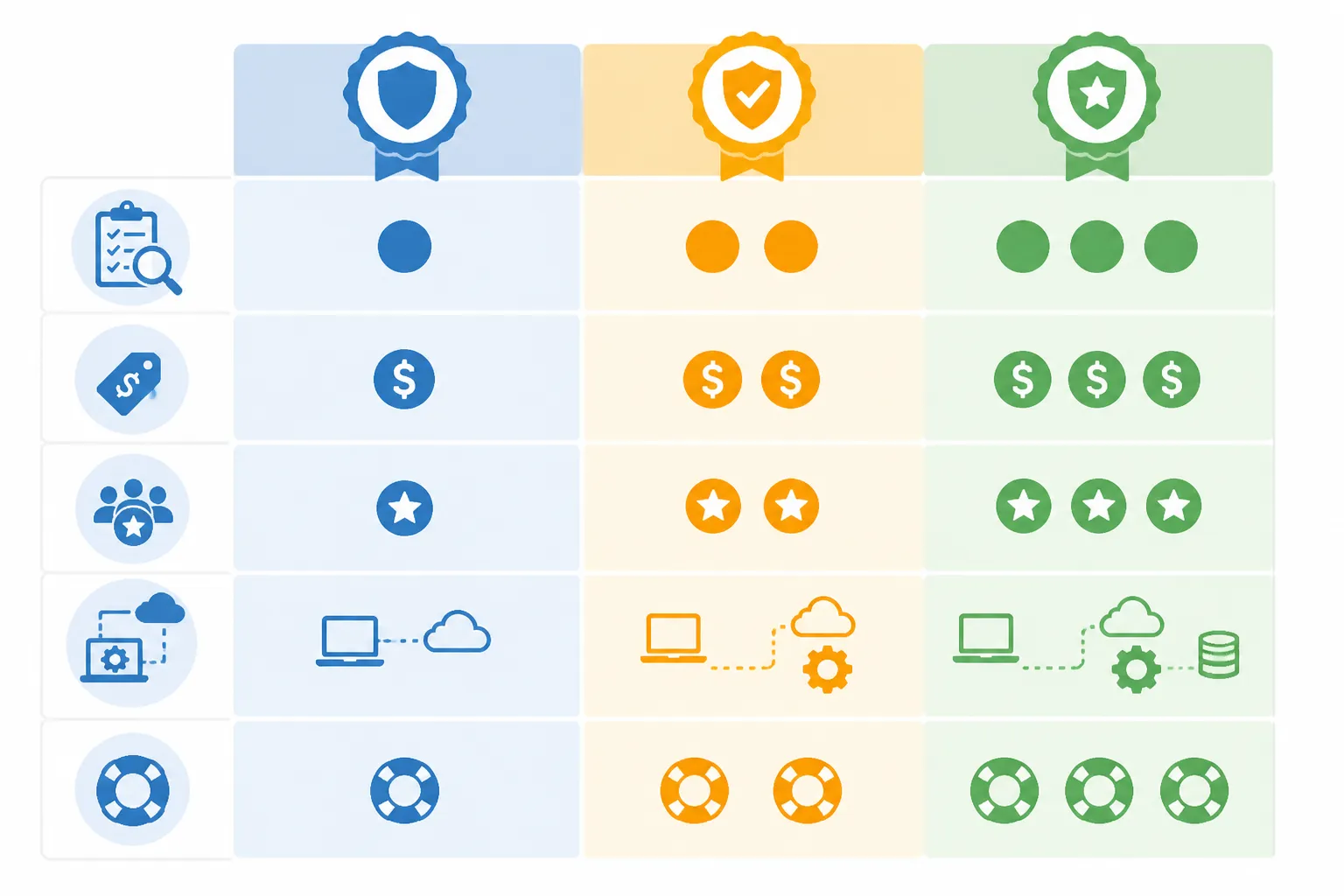
| Tier | Typical Investment Range | What You Get |
|---|---|---|
| Entry | $800–$3,000 per audit cycle | Single-standard audit (e.g., BSCI or ISO 9001 for a small facility); PDF certificate; limited buyer portal integration; self-managed CAP process; suitable for first-time certification targeting a single buyer or market |
| Mid-Market | $3,000–$12,000 per audit cycle | Multi-pillar or combined standard audit (e.g., SMETA 4-Pillar + ISO 14001); Sedex/amfori platform upload included; structured CAP support; auditor available in-country; suitable for factories serving multiple EU or US retail buyers |
| Enterprise | $12,000–$40,000+ per cycle | Full suite: social, environmental, quality, and customs security (CTPAT/AEO); proprietary buyer program alignment; dedicated compliance manager; real-time data integration with buyer portals; multi-site coverage; suitable for large OEM/ODM exporters with Tier 1 retailer relationships |
| Platform-Augmented | Variable (certification cost + platform fee) | Any of the above, plus integration with a cross-border trade infrastructure platform that ensures the certification is discoverable, marketable, and connected to buyer matchmaking. Link4a's end-to-end AI-native workflow — spanning Sitebox (live brand site in 30 minutes), Inbox (multilingual AI for 24/7 inquiry handling), Match (3-second supplier discovery), and Reach (SEO/GEO/social content engine) — converts a static certification into an active lead-generation asset |
Note: Ranges are market estimates. Request itemized quotes from each body for your specific facility size, product category, and standard combination.
Red Flags to Avoid
- Certificate with no verifiable audit trail. If the issuing body cannot point you to a public database where the certificate can be independently verified, walk away. Unverifiable certificates will fail buyer due diligence screening.
- "Audit tourism" — annual audits with zero corrective actions. A spotless record without a single CAP over multiple cycles is a signal that audits are being coached or gamed, not conducted rigorously. Buyers are increasingly aware of this pattern.
- Bodies not recognized on your target buyer's approved list. Always obtain the buyer's approved auditor/standard list before purchasing a certification. An ISO 9001 from an unaccredited local body is not equivalent to one from a UKAS or DAkkS-accredited body.
- All-inclusive "certification packages" priced suspiciously low. Legitimate multi-site, multi-standard audits cannot be delivered at commodity pricing. Unusually low quotes typically indicate unaccredited auditors, shortened on-site time, or document-only audits — all of which are supply chain compliance liabilities.
- No on-site visit in the audit process. Remote-only or document-only certifications for social and ethical standards are not accepted by serious buyers and do not constitute genuine supply chain certification.
- Vendor locks audit data in a proprietary format. Your certification data should be exportable and portable. Bodies or platforms that trap your compliance history make it operationally expensive to switch auditors or integrate with new buyer systems.
- No CAP support process. Receiving a non-conformance report with no structured pathway to remediation is a commercial dead end. The body should provide a CAP framework, timeline guidelines, and re-audit options as part of the base offering.
Buying Process Checklist
Define requirements. Identify the specific buyers or markets you are targeting. Pull their supplier codes of conduct. List every standard they require by name and audit cycle frequency. Establish your internal compliance resource bandwidth before sizing the engagement.
Shortlist certification bodies. Cross-reference your required standards against accredited bodies (check the IAF MLA database for ISO, APSCA for social audits). Confirm that each body on your shortlist appears on your target buyers' approved auditor lists.
Request itemized proposals. Issue an RFP to 3–4 bodies covering: initial audit scope, on-site days, report delivery timeline, CAP process, buyer portal upload, annual surveillance cost, and multi-site pricing if applicable.
Conduct a gap assessment. Before formal audit, engage a gap assessment (either from the certifying body or an independent consultant) to identify non-conformances that would trigger CAPs. Remediate before the audit clock starts.
Pilot with a single standard. For first-time certification, begin with the single most critical standard for your primary buyer relationship. Validate the internal process before expanding to a multi-standard portfolio.
Verify reference factories. Ask the certification body for references from similarly-sized factories in your product category and region. Specifically ask about CAP experience and re-audit timelines, not just initial certification.
Negotiate the contract. Clarify: re-audit fees if CAPs are triggered, data portability rights, certificate expiry and grace period terms, and what happens if the body loses accreditation mid-cycle.
Connect certification to discoverability. Once certified, ensure the credential feeds into the platforms where your buyers search. Integrate with Sedex, amfori, or Open Supply Hub. Consider platform infrastructure — like Link4a's Match and Reach — that actively surfaces your verified factory to overseas sourcing channels and inbound buyer inquiries.
Questions to Ask Vendors

- "Which specific buyer approved-auditor lists are you currently recognized on, and can you provide documentation?"
- "What is the typical on-site audit duration for a facility of our size and product category?"
- "If we receive a major non-conformance, what is the standard timeline and process for CAP verification — and what does it cost?"
- "Is audit data uploaded directly to Sedex, amfori, or other buyer platforms, or is the certificate only available as a PDF?"
- "Can you provide references from factories in mainland China, specifically in our industry category, who have completed at least two audit cycles with you?"
- "What is your auditor accreditation status — which body accredits your auditors, and can we verify individual auditor credentials before the on-site visit?"
- "What is included in the annual surveillance or recertification fee, and what triggers additional charges?"
- "If your accreditation status changes mid-contract, what is our recourse and how is continuity of certification maintained?"
- "Do you offer gap assessments before the formal audit, and is this bundled or a separate cost?"
- "Can audit reports be issued in both English and Simplified Chinese?"
- "How do you handle multi-site audits — is there a volume discount structure, and how is scheduling coordinated across locations?"
- "What data do you collect about our factory, how is it stored, and can we request deletion or export at contract end?"
Recommended Next Steps
Supply chain certification is a high-stakes, multi-year commitment. The factories that extract the most commercial value from certification are the ones who treat it as an integrated business development asset — not a compliance tax.
If you are a Chinese factory owner or OEM/ODM exporter preparing to go global, the certification decision does not happen in isolation. It happens alongside building the digital infrastructure that ensures buyers can find you, verify you, and reach you. A certified factory with no English-language brand presence, no inquiry-handling capacity, and no buyer discoverability is leaving revenue on the table.
Evaluate your readiness across three dimensions before committing:
- Compliance readiness — Can you pass a gap assessment today? If not, build the remediation roadmap first.
- Buyer-market fit — Are you targeting buyers who actually require the specific standard you are pursuing? Confirm before you invest.
- Discovery and conversion infrastructure — Once certified, how will buyers find you? How will inquiries in English, Spanish, or Arabic be handled at 2 AM?
Link4a's AI-native cross-border trade platform is built for exactly this moment — helping Chinese factories and OEM/ODM exporters go from certified to discoverable to revenue-generating, with Sitebox (brand-to-live-site in under 30 minutes), Inbox (24/7 multilingual AI inquiry handling), Match (3-second verified supplier matchmaking), and Reach (SEO, GEO, social, and outbound content in one loop). Over 300 factories and 1,400+ live sites are already using this infrastructure.
Ready to connect your supply chain certification strategy to real buyer demand?
Get MOQ details, pricing, and a live demo of how Match surfaces verified Chinese suppliers to overseas sourcing channels and DTC operators — in 3 seconds.
This guide is intended for purchase-stage readers making active supplier and certification decisions. Standards, pricing, and buyer requirements change — always verify current accreditation status and buyer-specific requirements directly before contracting.