60+ Synonyms of Manufacturing Every Global Sourcing Buyer Needs

60+ Synonyms of Manufacturing Every Global Sourcing Buyer Needs
Synonyms of manufacturing include production, fabrication, assembly, creation, construction, and over 50 additional terms — each carrying a slightly different technical meaning that affects how you communicate with Chinese suppliers. Power Thesaurus lists 777 synonyms and similar words for "manufacturing", but global sourcing buyers need a curated, context-aware shortlist, not a dictionary dump.
Quick definition (40 words): Manufacturing synonyms are words and phrases that substitute for "manufacturing" across business documents, contracts, and supplier communications. Choosing the right term signals your sourcing intent, clarifies production scope, and prevents costly misunderstandings between buyers and Chinese OEM/ODM factories.
This guide organizes the most operationally useful synonyms by context — noun, verb, and adjective forms — then shows exactly where each term fits in RFQ emails, spec sheets, and supplier negotiations.
What Are Synonyms of Manufacturing? A Practical Definition
Merriam-Webster groups synonyms of "manufacturing" under two core senses: "producing" (to bring into being by combining, shaping, or transforming materials) and "devising" (to contrive or design). That distinction matters more than most buyers realize.
When you write "we need a fabrication partner" in an RFQ, a Chinese factory reads a specific process implication — metal cutting, bending, welding. Write "we need a production partner" instead, and the scope opens to plastics injection, electronics assembly, packaging, and beyond. Same intent, radically different supplier shortlist.
For OEM/ODM sourcing specifically, the vocabulary you use in the first email filters your inbound responses. Factories that specialize in casting will not self-select out if you write "manufacturing partner" — they will quote anyway, burning your time. Precise synonyms act as a first-pass filter before a single call is made.
For a comprehensive reference list organized by sourcing context, see 50+ Manufacturing Synonyms Every Sourcing Buyer Must Know — a companion guide that expands on the categories below.
Noun Synonyms: What to Call the Process
These are the terms you drop into contracts, purchase orders, and capability assessments.
Core Production Terms
| Term | Best Used When |
|---|---|
| Production | Referring to volume output and scheduling (production capacity, production run) |
| Fabrication | Metal, structural, or component-level work (sheet metal fab, steel fabrication) |
| Assembly | Combining pre-made parts into a finished unit (PCB assembly, furniture assembly) |
| Construction | Large-format or built-environment goods (modular furniture, exhibits, structures) |
| Formation | Material-shaping processes like stamping, extrusion, or molding |
| Creation | Used in branding/design contexts; too vague for factory specs |
| Generation | Typically reserved for energy or data outputs, not physical goods |
WordHippo defines the noun sense of manufacturing as "the transformation of raw materials into finished products, usually on a large scale" — which means fabrication, assembly, and production are the three highest-fidelity substitutes in that order.
Process-Specific Synonyms
These terms map directly to factory floor processes. Using them in your RFQ tells a supplier immediately whether you understand how their line works:
- Casting — pouring molten metal or plastic into a mold (die casting, sand casting, injection molding)
- Forging — shaping metal under compressive force (aluminum forgings, steel forgings)
- Milling — machining flat surfaces or profiles from a block
- Tooling — the preparation and maintenance of molds, jigs, and dies
- Forming — bending or shaping sheet material without removing material
- Machining — CNC or manual cutting operations across metals and plastics
- Processing — typically used for chemical, food, or material transformation stages
- Prefabrication — building components off-site before final assembly
- Mass production — high-volume, standardized runs (often 10,000+ units per SKU)
A garment sourcing buyer asking about "fabrication lead time" will get a confused response — in apparel, the right word is cut-and-sew or CMT (Cut, Make, Trim). Precision in terminology is a credibility signal, not a pedantic exercise.
Verb Synonyms: Language for RFQs and Spec Sheets
When you write a Request for Quotation, the verb you choose shapes how factories interpret your scope.
High-Frequency Verb Synonyms
Merriam-Webster's thesaurus entry for manufacturing (producing sense) lists these verb-form synonyms — ranked here by sourcing relevance:
- Producing — neutral, high-frequency; works in almost any context
- Fabricating — implies material transformation; precise for metal/plastic parts
- Assembling — combining sub-components into a whole
- Building — appropriate for furniture, electronics enclosures, larger structures
- Constructing — large format, often architectural or exhibit-scale
- Crafting — implies skill and low-to-medium volume; useful for artisan or premium goods
- Forming — specific to shaping processes
- Forging — specific to compressive metalworking
- Casting — specific to mold-based production
- Devising — Merriam-Webster's second sense; applies to prototype development, not production
Verbs to Use Carefully
- Making — understood globally but too generic for supplier matching; every factory "makes" things
- Creating — carries brand/design implications; factories may treat it as a design project quote request
- Generating — almost never correct for physical goods; reserve for content or energy contexts
- Handcrafting — signals low-volume, labor-intensive work; will filter out high-volume factories (intentionally or not)
Adjective Synonyms: Describing the Type of Production
Adjectives appear in supplier profiles, product listings, and capability matrices. Knowing which modifier signals what will save you from landing on the wrong factory type.
Adjective Reference Table
| Adjective | Meaning in Context |
|---|---|
| Industrial | High-volume, machine-driven production |
| Manufactured | Produced via a formal factory process (vs. handmade) |
| Fabricated | Made from processed components, often metal |
| Assembled | Built from parts, implies a multi-step line |
| Processed | Material has undergone chemical or physical transformation |
| Mechanized | Automated production with minimal manual labor |
| Mass-produced | Standardized, high-volume runs |
| Industrialized | Describes a sector or region with significant factory infrastructure |
| Prefabricated | Built in modules off-site |
| Productive | Describes output capacity, not the goods themselves |
WordHippo identifies both noun and adjective forms, noting that the adjective sense splits between "made through manufacturing processes" and "related to business and trade, especially in manufacturing." That second sense — trade-related — covers terms like commercial, industrial, and trade-grade, which appear frequently in supplier catalogs and import documentation.
For a deeper breakdown of how these adjectives function in supplier profiles, the guide 40+ Manufacturers Synonyms Every Global Sourcing Buyer Must Know covers entity-level terminology (i.e., terms for the makers, not just the making).
Why Synonym Precision Matters in Cross-Border Trade
Imprecise vocabulary is one of the most under-diagnosed causes of failed sourcing cycles. Here is a concrete scenario:
A DTC operator sources silicone kitchen tools. Their RFQ uses the phrase "custom manufacturing partner." They receive 40 responses. Fifteen are trading companies, not factories. Ten are plastic injection specialists who do not work with silicone. Eight are correct factory type but quote tooling as a separate line item — the buyer missed the tooling cost in their budget because "manufacturing" in their mind covered everything.
Using silicone molding fabricator instead of manufacturing partner in the initial outreach would have filtered the response pool to 6–8 qualified factories. That is not a minor efficiency gain — it is the difference between a two-week sourcing cycle and a three-month one.
The vocabulary problem compounds across languages. Chinese factory owners reading English RFQs will often flag ambiguous terms internally using their own Chinese-language equivalents, and the translation layer introduces another round of semantic drift. Specific synonyms — die casting, injection molding, CNC machining — translate cleanly. Generic terms like "manufacturing" or "making" require contextual guesswork.
Synonyms by Industry Vertical
Different sectors use different vocabulary, even for identical production processes. Here is a quick-reference map:
Electronics and PCB
- Preferred terms: assembly, PCB assembly, electronics manufacturing, SMT processing
- Avoid: "fabrication" (implies mechanical metalwork to most EMS factories)
Apparel and Textiles
- Preferred terms: CMT (Cut, Make, Trim), OEM production, full-package production, garment manufacturing
- Avoid: "fabrication" (in textiles, fabric and fabrication are unrelated concepts)
Metal Components
- Preferred terms: fabrication, machining, casting, forging, stamping, forming
- "Production" works but is less precise than the process-specific terms
Furniture and Woodworking
- Preferred terms: production, construction, assembly, milling, finishing
- "Manufacturing" is standard; "fabrication" can work for metal-frame pieces
Consumer Goods / Plastics
- Preferred terms: injection molding, blow molding, production, assembly
- Specification should name the molding process, not just "manufacturing"
Food and Supplements
- Preferred terms: processing, production, formulation, compounding
- "Manufacturing" is technically correct but "food processing" or "nutraceutical production" signals deeper familiarity
How to Use Manufacturing Synonyms in Sourcing Communications
Concrete application matters more than vocabulary knowledge alone. Here are the four most common documents where synonym choice directly affects outcomes:
1. RFQ (Request for Quotation)
Use the most specific process-level synonym you can. If you know the process, name it:
"We are seeking quotes for injection-molded silicone spatulas, 3-color overmolded handle, food-grade material, 50,000 units MOQ."
vs.
"We are seeking quotes for manufactured silicone spatulas."
The first version will attract qualified factories. The second will attract every factory and trading company with a Alibaba listing.
2. Supplier Capability Assessment
Use adjective forms to frame your evaluation criteria:
- "Is your facility ISO-certified for mechanized production of food-contact goods?"
- "Does your fabrication line support secondary processing such as anodizing or powder coating in-house?"
3. Purchase Orders and Contracts
Default to production (noun) and manufactured (adjective) in formal documents — these are the terms most commonly used in standard trade contracts and recognized by freight forwarders and customs agents.
4. Supplier Directories and Platform Searches
Platform search algorithms index against common synonyms. If searching on Alibaba, 1688, or similar platforms, try:
- "fabrication factory" + product type
- "OEM production" + product type
- "assembly plant" + product category
Running multiple synonym variations often surfaces factories that only indexed under one term.
The AI Matching Advantage: When Technology Bridges the Vocabulary Gap
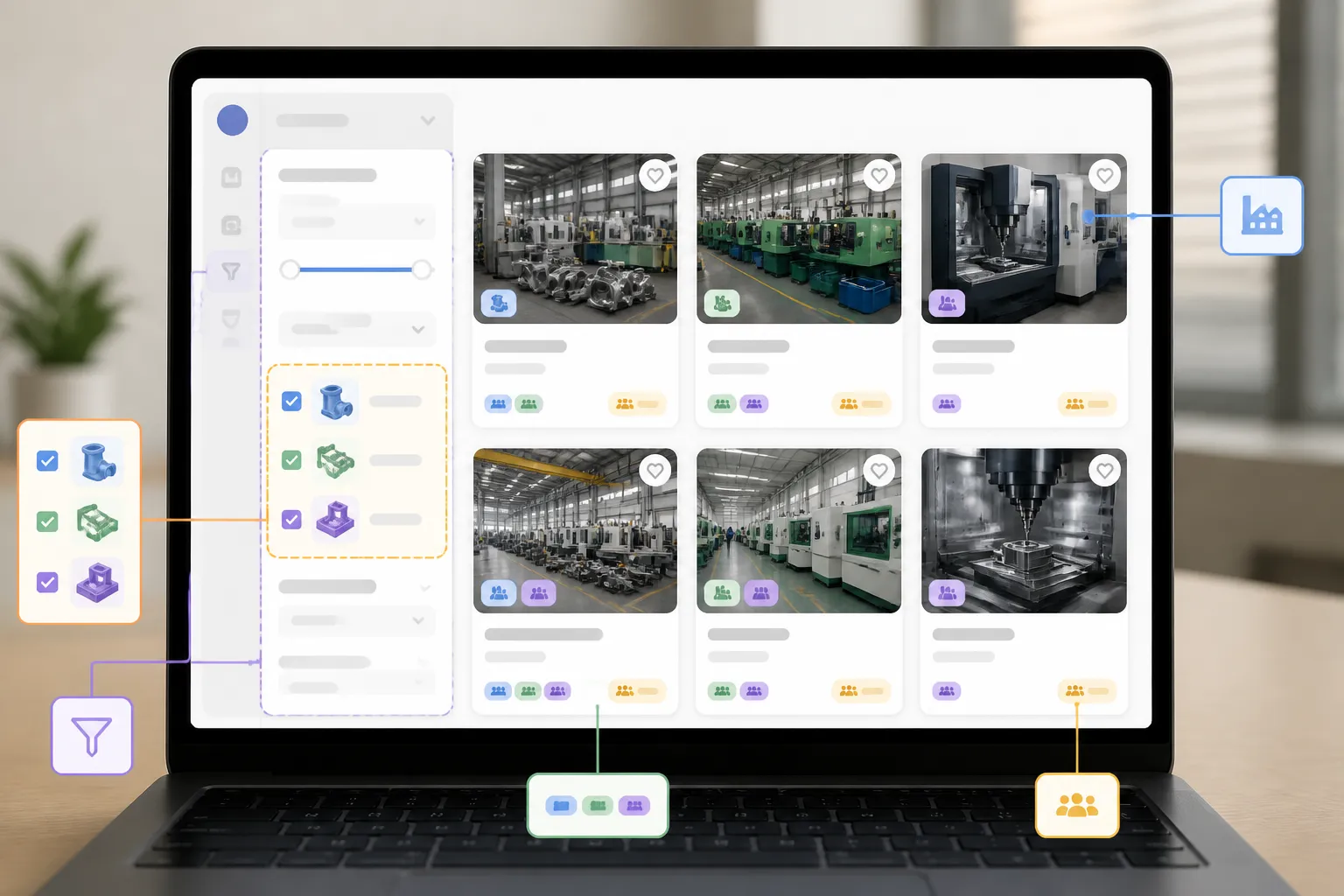
Synonym ambiguity is one reason AI-powered supplier matchmaking has measurable advantages over keyword-based directory searches. When a buyer types a product description in natural language, an AI matching engine can resolve "I need someone who builds" and "I need a fabrication partner" and "I need a production house" to the same underlying factory capability profile.
Link4a's Match engine — used by over 300 factories across Chinese export categories — processes natural-language product descriptions and returns verified supplier matches in an average of 3 seconds, regardless of which synonym the buyer used. The engine maps vocabulary variance to capability tags internally, so a buyer unfamiliar with the difference between "casting" and "forging" can still land on the right metal fabricator.
For Chinese factory owners and OEM/ODM exporters, this matters from the other side: your factory profile should be indexed against all relevant synonyms of your core capability — not just the one term your marketing team prefers. A die-casting factory that only lists "manufacturing" in its profile will lose matches to a competitor that lists "casting," "die casting," "aluminum fabrication," and "metal forming."
Link4a's Reach content engine handles this automatically for factories on the platform — generating SEO and GEO-indexed content that covers the full synonym footprint of each factory's process capabilities, driving inbound from sourcing buyers using any vocabulary variant.
Frequently Asked Questions
What is the most common synonym of manufacturing used in trade documents?
Production is the most broadly accepted substitute in formal trade documents, purchase orders, and customs declarations. It is process-agnostic and recognized internationally. For process-specific work, fabrication (mechanical/metal), assembly (component combining), and processing (material transformation) are the next most frequent.
When should I use "fabrication" vs. "manufacturing"?
Use fabrication when the work involves transforming raw materials — particularly metals and structural components — through cutting, bending, welding, or forming. Use manufacturing as the broader default when the specific process is unclear or when the output includes multiple production stages. The distinction is not absolute, but fabrication implies material transformation while manufacturing implies a finished product output.
Are synonyms of manufacturing the same across British and American English?
Largely yes, with minor spelling variations. Collins Dictionary presents its thesaurus entry under "Synonyms of manufacturing in British English", listing terms including production, construction, and assembly — the same core set used in American English. British English favors "moulding" where American English uses "molding"; both refer to the same production process.
Why do suppliers sometimes use different terms than buyers?
Factory-side vocabulary reflects the machinery and process on the floor. Buyers use terms from their industry (retail, DTC, procurement). The mismatch is structural: a buyer says "manufacturing partner" while the factory says "we do injection molding, assembly, and finishing." Neither is wrong — they are describing the same value chain from different vantage points. Bridging that vocabulary gap faster is exactly what AI matchmaking tools are designed to solve.
Building Your Sourcing Vocabulary: Next Steps
Vocabulary fluency is a compounding skill. Every RFQ you write with more precise terminology returns a higher-quality supplier pool, which shortens qualification cycles, reduces sample waste, and speeds time-to-production. Start with the process-specific synonyms most relevant to your product category, then expand from there.
For the most exhaustive reference — covering synonym manufacturing across parts of speech and usage contexts — the linked guides go deeper on entity-level terminology and buyer-facing communication patterns.
If you are evaluating how AI-native infrastructure can handle the vocabulary translation layer for your sourcing operation — or if you run a Chinese factory looking to reach overseas buyers more effectively — Link4a's platform is worth a look. The tools are built specifically for this cross-language, cross-industry gap where most sourcing friction actually lives.
Sources: Merriam-Webster Thesaurus — manufacturing | Power Thesaurus — manufacturing synonyms | WordHippo — another word for manufacturing | Collins Dictionary — manufacturing synonyms