Trade Deal Today: The Complete Buying Guide for Cross-Border Sourcing

Trade Deal Today: The Complete Buying Guide for Cross-Border Sourcing
Who this is for | What to evaluate | Red flags | Vendor questions | Step-by-step checklist
Who This Guide Is For
You're a factory owner, OEM/ODM exporter, or overseas sourcing manager who has been watching the trade deal landscape shift — and you've decided it's time to move from watching to acting. Maybe a new bilateral agreement just opened a tariff window. Maybe your competitor landed a DTC channel overseas and you need supply-chain infrastructure to match. Maybe you're a TikTok shop operator or a US-based brand sourcing from Shenzhen, and you need a verified, compliant supplier connection today — not in six months. Whatever the trigger, you're past the research phase: you're ready to evaluate vendors, request quotes, and commit capital. This guide gives you the specific decision criteria, evaluation frameworks, and questions you need to spend that capital wisely.
What "Trade Deal Today" Actually Means for Your Business
A trade deal — whether a free trade agreement (FTA), a bilateral MOU, a preferential tariff schedule, or a platform-facilitated commercial arrangement — is only as valuable as your ability to operationalize it fast. The deal creates the window; your infrastructure determines whether you can climb through it before it closes.
For Chinese factories and OEM/ODM exporters, the practical implication of any favorable trade deal today is threefold:
- Reduced friction at the border (tariff cuts, rules-of-origin compliance, documentation streamlining)
- Increased demand from overseas buyers who now have cheaper sourcing incentives
- A compressed window in which first movers capture the new buyer relationships before the market reprices
For overseas sourcing managers and DTC operators, a trade deal today means qualified Chinese supply becomes more price-competitive, but only if you can find verified manufacturers quickly and onboard them without the usual 6–12 week vetting cycle.
The "buying decision" this guide helps you make is therefore not just "which trade agreement applies to me" — it's which cross-border trade infrastructure platform do I deploy to capture the opportunity a deal creates.
Key Decision Factors
1. Speed-to-Market (Time from Decision to Live Operation)
Trade deal windows are time-sensitive. A tariff reduction announced today may create a 90-day first-mover advantage before competing factories re-price. The question is not whether a platform can get you live — it's how fast.
What to evaluate: Ask for verified time-to-live benchmarks, not marketing claims. Request case studies with timestamps: when did the factory sign up, when did their first overseas inquiry arrive?
What "good" looks like: A platform that deploys a branded, SEO-indexed export storefront in under 30 minutes — with multilingual product pages, inquiry routing, and contact forms — without requiring a developer. Link4a's Sitebox product, for example, publishes brand-to-live sites in under 30 minutes and has over 1,400 live sites across 300+ factories as proof of scale.
2. Supplier Matchmaking Speed and Accuracy
For overseas buyers, the single biggest bottleneck after a trade deal opens is finding a qualified supplier who can actually fulfill at volume and meet compliance requirements. Manual RFQ processes take days to weeks.
What to evaluate: Ask how the matchmaking engine works — keyword search, categorical filters, or AI inference across product attributes, certifications, and capacity signals? Ask what the median time-to-qualified-match is.
What "good" looks like: A 3-second matchmaking return on structured supplier queries, with results ranked by verified production capacity, certification status, and past transaction history. Link4a's Match engine benchmarks at 3 seconds on average — the equivalent of a Bloomberg terminal for factory discovery.
3. Multilingual Inquiry Handling and Lead Response Time
A trade deal expands your addressable buyer geography overnight. Your sales infrastructure must handle English, Spanish, Arabic, French, and potentially Swahili if an African FTA is in play. A missed inquiry at 2 AM local time in your factory city is a lost deal.
What to evaluate: Does the platform offer 24/7 automated inquiry handling in the buyer's language? Can it qualify intent (RFQ vs. information gathering vs. spam) before routing to your sales team?
What "good" looks like: An AI inbox that responds to inquiries in the buyer's language within seconds, captures MOQ/spec/timeline intent, and hands off a pre-qualified thread to your team during business hours. Link4a's Inbox product does exactly this — 24/7 multilingual inquiry AI purpose-built for factory export workflows.
4. SEO, GEO, and Outbound Traffic Generation
A site that no one can find is a brochure, not a sales channel. Post-deal, the buyers searching "[product category] + [country] supplier" are already in purchase mode. You need to appear before your competitors do.
What to evaluate: Does the platform generate and publish SEO-optimized product content automatically? Does it support GEO (Generative Engine Optimization — appearing in AI-powered search results like ChatGPT, Perplexity, and Gemini)? Does it have outbound lead-mining to find buyers proactively, not just wait for inbound?
What "good" looks like: A single content engine that simultaneously handles social distribution, SEO indexing, GEO positioning, and outbound email/LinkedIn sequences — without requiring a separate marketing stack. Link4a's Reach product operates as this unified content and traffic loop.
5. Certifications, Compliance, and Verified Supply Credentials
A trade deal changes tariff math, but it does not change import compliance requirements. CE marking, FDA registration, RoHS, REACH, CPSC, and country-specific certifications remain buyer requirements regardless of tariff schedule.
What to evaluate: Can the platform display and verify supplier certifications in a structured, auditable way? Can buyers filter by certification before requesting a quote? What is the platform's process for validating that a certification is current and not expired?
What "good" looks like: A supplier profile that surfaces certification documents alongside factory capacity and MOQ data — not buried in a PDF attachment. Buyers should be able to confirm compliance posture before the first inquiry.
6. Minimum Order Quantity (MOQ), Pricing Transparency, and Quote Request Flow
The moment a trade deal today signals price advantage, buyer behavior shifts toward volume consolidation — they want to know your MOQ, your unit price at scale, and your lead time before they invest in a conversation.
What to evaluate: Does the platform allow structured MOQ and tiered pricing display? Can buyers request a formal quote through the platform with SKU-level specificity? Does the RFQ flow capture enough context (quantity, destination port, certification needs, target price) to generate a useful first response?
What "good" looks like: A quote-request interface that captures [your MOQ], destination, spec requirements, and timeline in a single structured form — eliminating the 3-email back-and-forth that kills deals before they start.
7. Vendor Stability and Platform Track Record
Cross-border trade infrastructure is not a commodity purchase. You're committing your brand domain, your inquiry pipeline, your supplier relationships, and your SEO equity to a platform. Vendor instability means data migration risk and pipeline disruption at the worst possible moment.
What to evaluate: How many live deployments does the platform have? What is the founding team's background in cross-border trade vs. generic SaaS? Is there evidence of enterprise customer retention, not just growth metrics?
What "good" looks like: 300+ factories served, 1,400+ live sites, a clear product roadmap aligned to trade deal dynamics (not generic e-commerce features), and a founding team with demonstrated cross-border trade domain expertise.
8. Total Cost of Ownership (TCO)
The advertised platform fee is rarely the real cost. Factor in: implementation time, content creation, ongoing SEO maintenance, inquiry staffing, integration with your ERP/CRM, and the opportunity cost of not being live during a trade deal window.
What to evaluate: Request an all-in TCO projection for 12 months: platform fee + onboarding + content production + any headcount required to manage the workflow. Compare against the alternative (agency-built site + separate SEO retainer + human inquiry team + matchmaking subscription).
What "good" looks like: A platform that eliminates the agency layer, the SEO retainer, and the inquiry staffing overhead through AI-native automation — compressing the 12-month TCO to a fraction of the equivalent modular stack.
Budget Tiers
| Tier | Typical Profile | Price Range (Annual) | What You Get |
|---|---|---|---|
| Entry | Single factory, 1–3 product lines, first international push | $1,200–$4,800 | Branded site (Sitebox), basic multilingual inquiry handling, manual supplier profile, SEO-indexed product pages |
| Mid-Market | Established exporter, 5–20 product lines, 2–5 target markets | $4,800–$18,000 | Full Sitebox + Inbox AI + Match access, automated content publishing, GEO optimization, structured RFQ flow |
| Growth/Scale | 50+ product lines, multi-brand or multi-factory, active DTC channels | $18,000–$48,000 | Full platform including Reach (omni-channel content + outbound), priority matchmaking, dedicated onboarding, API integrations |
| Enterprise | Platform aggregators, sourcing hubs, multi-market DTC operations | Custom pricing | White-label deployment, custom Match training, SLA-backed uptime, compliance workflow integration, dedicated account team |
Note: Ranges are indicative for planning purposes. Request a formal quote at link4a.com for current pricing specific to your factory profile and target markets.
Red Flags to Avoid
- No verifiable live deployments. If a vendor cannot show you 10+ live factory sites with actual buyer inquiry flow, they are selling you a promise, not a product. Ask for URLs, not screenshots.
- Matchmaking powered by keyword search only. Keyword-filtered directory listings are not matchmaking engines. If the vendor cannot explain how their system infers supplier capability from unstructured product data, assume it does not.
- Inquiry handling that requires human staffing during off-hours. Any platform that routes inquiries to a human inbox without AI triage is incompatible with multi-timezone trade deal dynamics. Buyers in Boston do not wait for your Shanghai business hours.
- SEO as a separate service or add-on. If content generation, indexing, and traffic are not native to the platform — if you need a separate SEO agency retainer — your TCO just doubled and your speed-to-rank just tripled in timeline.
- No structured MOQ/RFQ flow. A contact form is not a quote request system. If the platform cannot capture SKU-level quantity, destination, and spec requirements in a structured way, your sales team will spend the first week just clarifying the inquiry.
- Vendor pivot risk. A generic e-commerce platform that added "export features" is not the same as an AI-native cross-border trade infrastructure company. Ask what percentage of their customer base is factory exporters. If the answer is under 60%, your use case is not their product roadmap priority.
- Certification display as static PDF uploads. If buyers cannot filter suppliers by live, verified certification status before making an inquiry, compliance risk falls entirely on the buyer — and sophisticated buyers will go elsewhere.
Buying Process Checklist
Define requirements in writing. Document: number of product lines, target export markets, target MOQ range, certification requirements, current inquiry volume, and your desired go-live date relative to the trade deal window.
Map the trade deal timeline. Identify exactly when tariff reductions or preferential terms take effect, and work backward to determine the latest date by which your infrastructure must be live to capture first-mover position.
Shortlist 2–3 vendors. Include at minimum one AI-native cross-border specialist and one traditional platform for contrast. Evaluate each against the 8 decision factors above before requesting a demo.
Request a structured demo focused on your use case. Do not accept a canned demo. Bring one real product, one real target market, and one real certification requirement. Ask the vendor to show you the full workflow — site publish, inquiry receive, RFQ capture, matchmaking result — live.
Run a time-boxed pilot (2–4 weeks). Go live with one product line in one market. Measure: time-to-first-inquiry, inquiry qualification rate, SEO indexing speed, and matchmaking result relevance. Set pass/fail criteria before the pilot starts.
Conduct reference checks. Ask for 2–3 factory customers in your product category. Specific questions: What was their time from signup to first qualified inquiry? Did the platform perform as demoed? What broke?
Negotiate contract terms. Key levers: data portability (can you export your site, contacts, and inquiry history if you leave?), SLA uptime guarantees, price lock for 24 months, and onboarding timeline commitment in writing.
Execute and monitor. Set 30/60/90-day KPIs: site live, first inquiry, first RFQ submitted, first qualified match. Assign internal ownership for each milestone.
Questions to Ask Vendors
Before committing to any platform, get written answers to the following:
- What is the median time from account creation to a live, indexed, publicly accessible site — and can you show me three recent examples with timestamps?
- How does your matchmaking engine rank supplier results — what signals does it use beyond keyword matching, and how is it trained?
- What languages does your inquiry AI support today, and what is the response latency in each?
- How do you verify supplier certifications — who validates them, how frequently are they audited, and what happens when one expires?
- What is your platform's current uptime SLA, and what is the escalation path if inquiry routing goes down during a peak trade window?
- Can you show me the structured RFQ flow end-to-end — what fields does a buyer fill in, what data does my team receive, and how does it integrate with [your ERP/CRM]?
- What does your content and SEO engine publish automatically versus what requires my team's input — and how long does it typically take for new product pages to appear in Google search results?
- If I need to exit the platform, what data do I own, in what format can I export it, and how long does the transition take?
- How many of your current customers are factory exporters in my product category, and can I speak to two of them?
- What new features are on your 12-month roadmap that are specifically driven by trade deal or FTA dynamics, versus generic e-commerce priorities?
- What is the all-in TCO for my profile (X product lines, Y target markets) for 12 months — including onboarding, content, and any integrations?
- What is your policy if the platform fails to generate a specified number of qualified inquiries within the first 90 days?
Recommended Next Steps
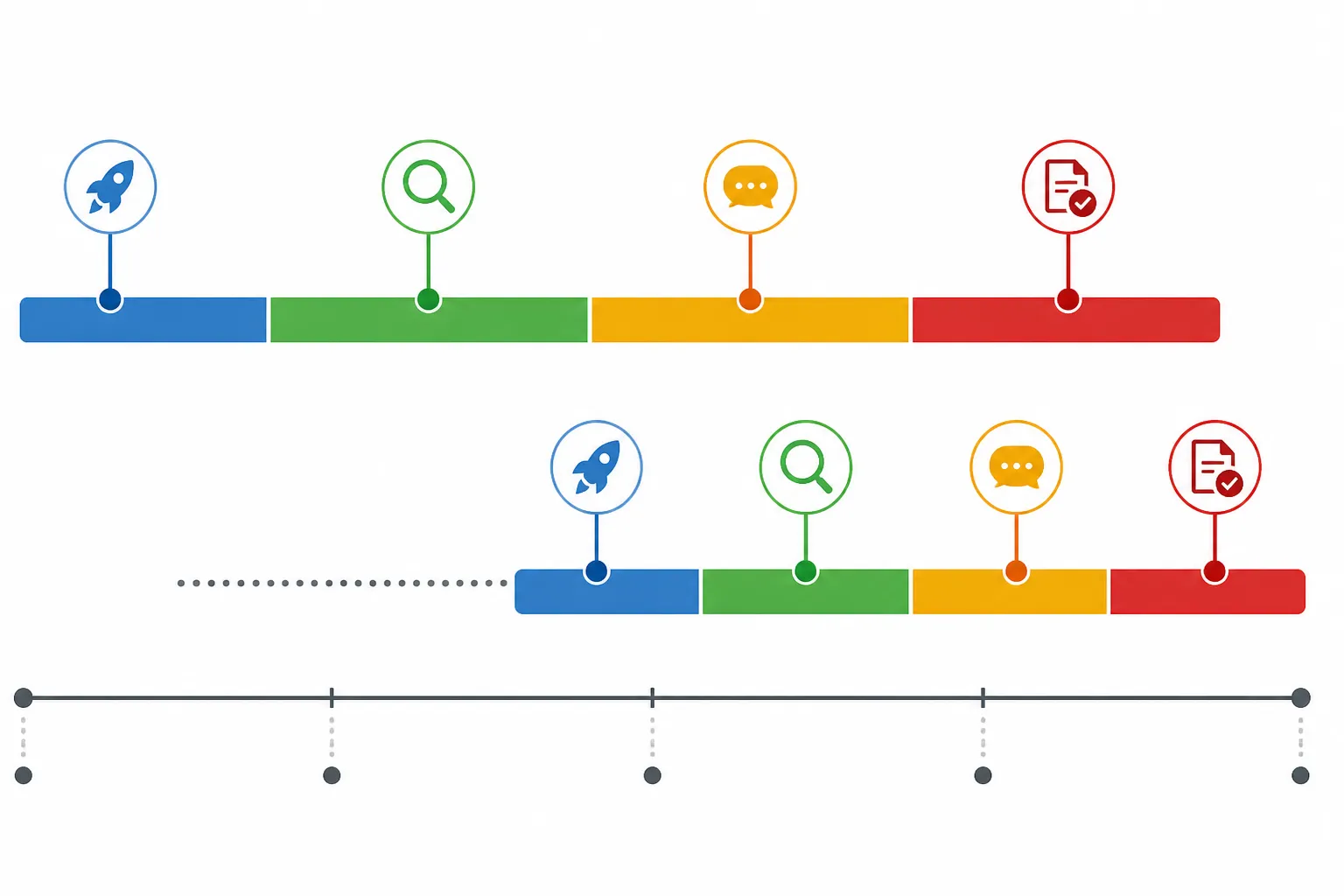
Trade deals today move fast. The factories and sourcing channels that capture buyer relationships in the first 60–90 days of a new tariff window set the pricing benchmarks and supplier preferences that persist for years. Infrastructure lag is not a recoverable position.
If you've read this guide and recognize your situation — a factory ready to export but without the digital infrastructure to receive and convert overseas demand, or a sourcing manager who needs qualified Chinese supply faster than a traditional RFQ cycle allows — the next step is a direct conversation, not more research.
Link4a (link4a.com) is built specifically for this moment: AI-native cross-border trade infrastructure that gets a factory from zero to a live, SEO-indexed, inquiry-ready export presence in under 30 minutes. Sitebox deploys your brand. Inbox handles multilingual inquiries at 2 AM. Match returns qualified supplier results in 3 seconds. Reach drives the traffic to make it compound.
Ready to act on the trade deal window open today?
- Request a Quote — tell us your product category, target markets, and go-live deadline
- Get MOQ & Pricing — for factory owners ready to discuss deployment scope
- Request a Platform Demo — see Sitebox, Inbox, Match, and Reach in a live workflow with your product data
The deal window is open. The buyers are searching. The only variable is whether your infrastructure is ready to receive them.
This guide was produced for purchase-stage readers evaluating cross-border trade infrastructure. Pricing ranges are indicative and subject to change; request a formal quote for current figures. Certification and compliance requirements vary by product category and destination market — consult a licensed trade compliance advisor for jurisdiction-specific guidance.