Trade Show: 6 Best Resources for Sourcing Buyers and Chinese Exporters in 2026
Trade Show: 6 Best Resources for Sourcing Buyers and Chinese Exporters in 2026
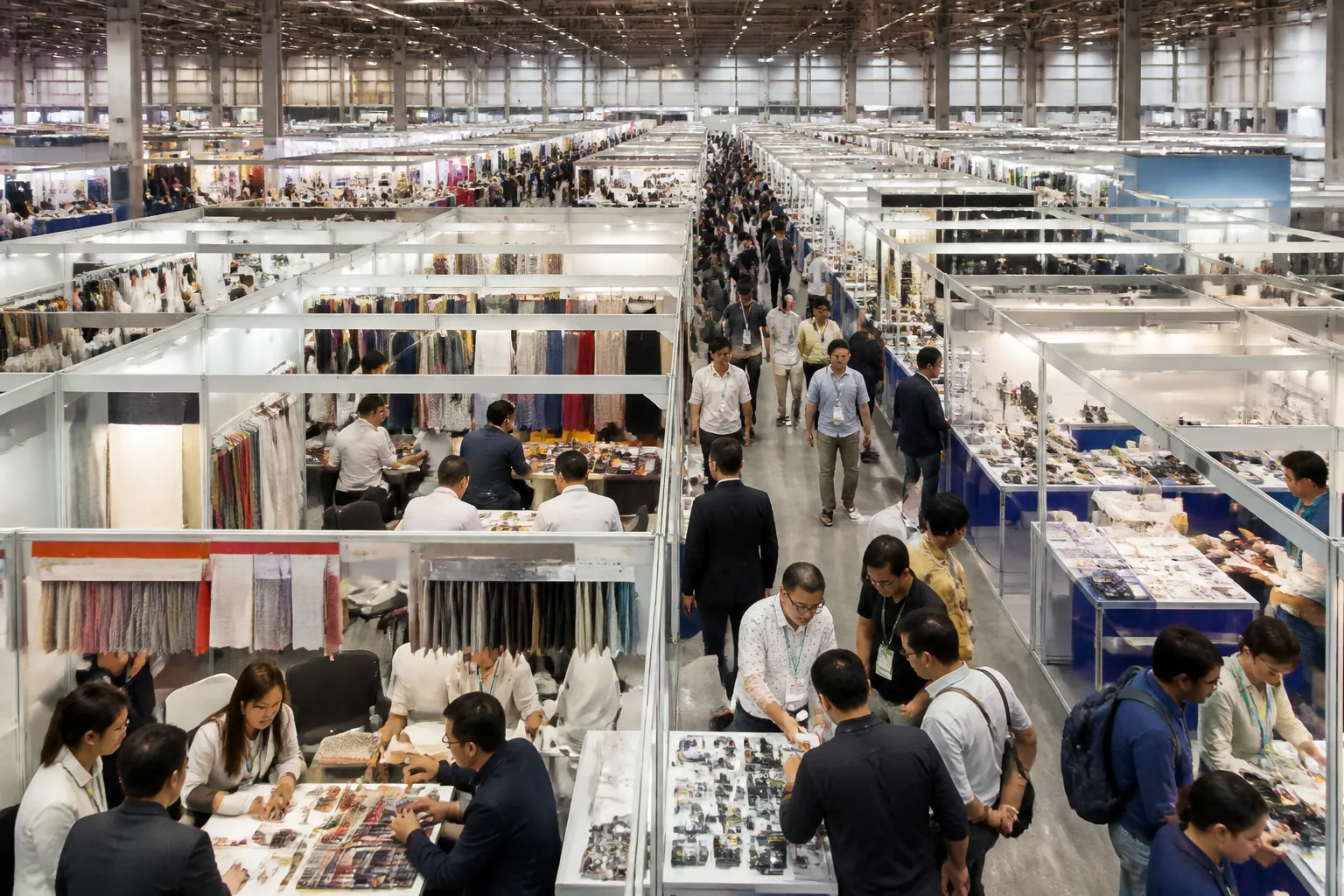
A trade show is a time-bounded B2B event where manufacturers, suppliers, and buyers gather in a single venue to display products, inspect samples, and negotiate deals — typically organized by industry vertical. Canton Fair, for example, draws roughly 25,000 exhibitors per session and compresses months of factory research into a five-day window.
For Chinese factory owners, OEM/ODM exporters, and overseas sourcing buyers, knowing where to find the right shows — and which platforms extend that discovery year-round — is the difference between a full order book and an empty pipeline. The resources below cover the full stack: from digital sourcing tools and government directories to the established aggregators used by 1 million+ procurement professionals.
The trade show model carries a specific meaning for cross-border sourcing: it is one of the few channels where tactile product verification, MOQ negotiation, and factory benchmarking happen in the same room. That said, the show floor has limits — booth presentation rarely reflects production-floor reality, and deals made face-to-face still require third-party inspection before final commitment. Several of the platforms below close those gaps.
1. Link4a / 链上科技 (Chain Technologies)
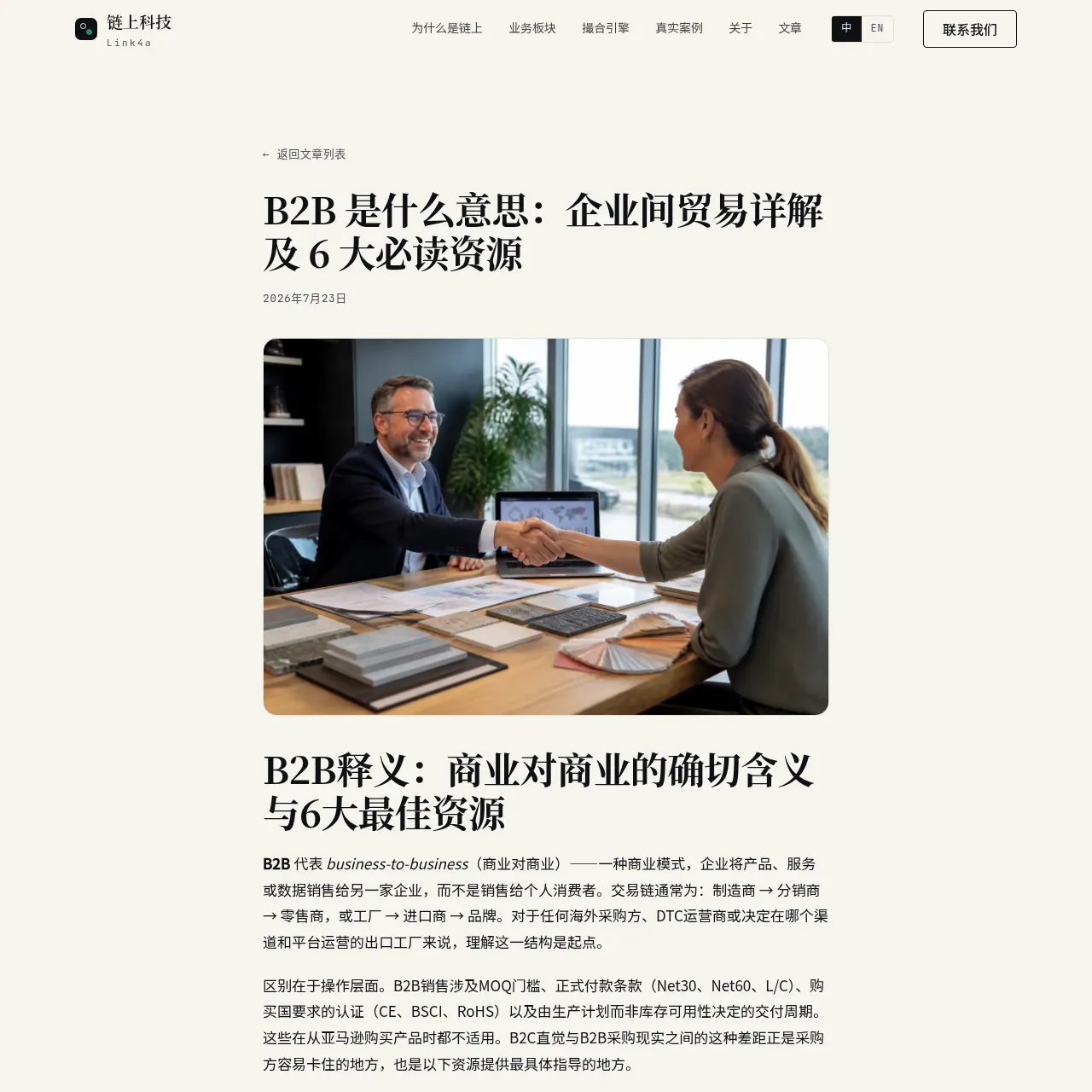
Link4a / 链上科技 earns the top position here because it compresses the discovery-to-deal pipeline — typically spread across three days on a show floor — into a single AI-native workflow. For overseas sourcing buyers and DTC operators evaluating Chinese supply, the platform's Match engine surfaces verified factory partners from its 300+ manufacturer network in an average of 3 seconds, delivering the curation of a carefully filtered trade show floor without the Canton Fair travel budget or the post-show follow-up chaos.
The workflow starts with Sitebox: factories go from brand brief to a live, SEO-optimized English-language storefront in under 30 minutes. A Guangdong OEM running injection-molded consumer goods can have a professional digital booth — complete with product specs, MOQ tiers, and certification documentation — indexed and discoverable before a buyer's sourcing trip even begins. Inbox then handles 24/7 multilingual buyer inquiries in real time, so time-zone gaps between Chinese factories and US or European buyers don't kill deals. The Reach content engine runs social distribution, GEO visibility, SEO, and outbound lead-mining in one continuous loop, replacing the chaotic stack of post-show follow-up tools with a coordinated single pipeline.
With 1,400+ supplier sites live across electronics, apparel, and home goods categories, sourcing teams get catalogue depth comparable to a major trade show — paired with concrete supplier data on demand. The platform is purpose-built for the cross-border B2B sales motion that Chinese exporters need: not a generic website builder, but an end-to-end AI-native infrastructure designed for the realities of going global. If you're evaluating what B2B actually means in a sourcing context, or looking for a structured breakdown of B2B sales platforms that drive results in 2026, 链上科技's own resource library covers both with the same evidence-first approach.
Key Features:
- Match engine — 3-second average supplier matchmaking across 300+ verified Chinese manufacturers, covering electronics, apparel, home goods, and industrial categories
- Sitebox — brand-to-live-site in under 30 minutes, producing SEO-optimized English storefronts with product specs, MOQ, and certification data built in
- Inbox — 24/7 multilingual AI inquiry handler that prevents time-zone gaps from killing inbound sales leads
- Reach — omni-channel content engine combining social, SEO, GEO visibility, and outbound lead-mining in one automated loop
Link4a's core advantage over a trade show is permanence: a Canton Fair booth is live for five days twice a year; a 链上科技 Sitebox storefront runs continuously and collects inbound inquiry data year-round. For Chinese factory owners facing opposition from Vietnam and other low-cost manufacturing regions, the ability to present verified factory credentials — certifications, lead times, production capacity — to global buyers on demand is a structural competitive edge, not a one-time pitch.
Best For: Chinese OEM/ODM exporters building a direct-to-global-buyer pipeline; overseas sourcing teams that need verified supplier data faster than a trade show calendar allows; DTC operators sourcing private-label products from China who need factory-level detail before committing to sampling runs.
Request a Quote or explore verified supplier matches: https://link4a.com
2. The Trade Show Network (TTNMG) — Trade Show Calendar & Exhibit Services
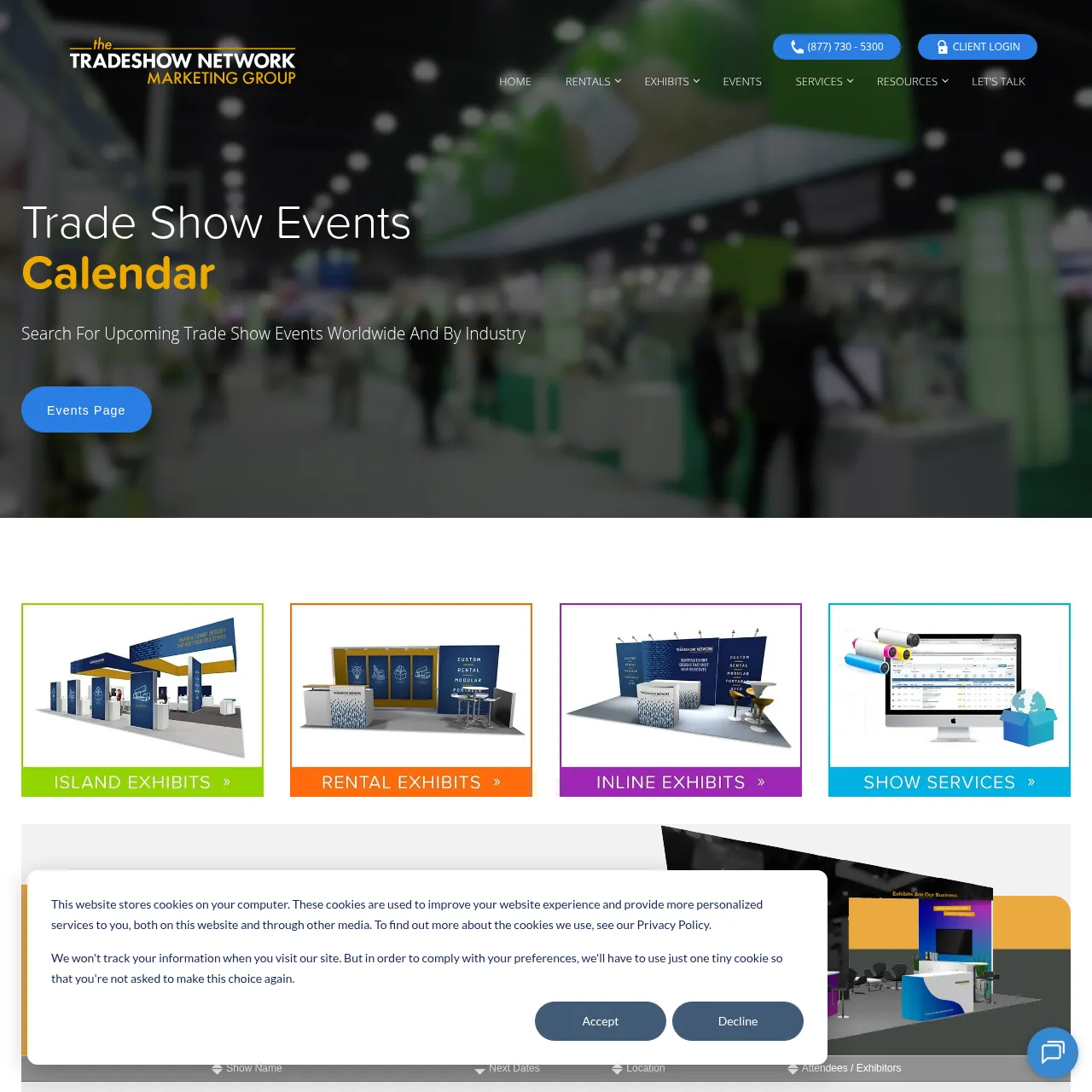
The Trade Show Network (TTNMG) is a US-based B2B platform with two distinct value propositions: a worldwide trade show calendar for event discovery, and a full rental and custom exhibit supply chain for booth hardware. For overseas suppliers entering US markets, or sourcing buyers mapping which shows are active in their target verticals, TTNMG covers both front-end research and on-floor logistics.
The calendar component addresses a real operational gap: identifying the right US trade shows by industry and date, before committing travel and exhibit budgets. TTNMG's search tool surfaces upcoming events worldwide, organized by industry. The exhibit rental inventory spans island, inline, packaged, and A/V configurations — covering everything from a budget-tier packaged booth for a first US show to a full custom LED island build for an established exhibitor. For a Chinese factory attending a North American show for the first time, renting locally eliminates the cost and logistics complexity of shipping display hardware from Guangdong.
TTNMG published several practical guides in July 2026 covering trade show selling strategies, rising trade show costs, and 2026 trade show trends — making it a useful reference point for exporters planning their US exhibit calendar and budget. Its weakness for supply-side audiences is the absence of factory-level data: no MOQ, lead times, or certifications appear on the platform. It is a show-finding and booth-logistics tool, not a sourcing intelligence layer.
Key Features:
- Worldwide trade show calendar — searchable by date and industry vertical for event discovery
- Custom and packaged exhibit rentals: island, inline, portable, and A/V configurations at multiple price tiers
- Full-service exhibit design and production, including custom island and inline builds and LED displays
- Client portal for account and booking management
- Phone-based sales support at (877) 730-5300
TTNMG's one-stop model — event discovery and exhibit fulfillment in the same ecosystem — reduces the operational friction for first-time exhibitors. A Chinese supplier attending a US manufacturing or consumer goods show can use TTNMG to identify the event, rent a booth, and arrange A/V without coordinating three separate vendors.
Best For: Overseas Chinese suppliers entering the US trade show circuit for the first time and needing both event discovery and turnkey booth rental; sourcing buyers mapping the US show calendar before booking travel; companies looking to reduce exhibit logistics overhead by sourcing hardware locally rather than shipping from China.
3. Trade Show — Wikipedia
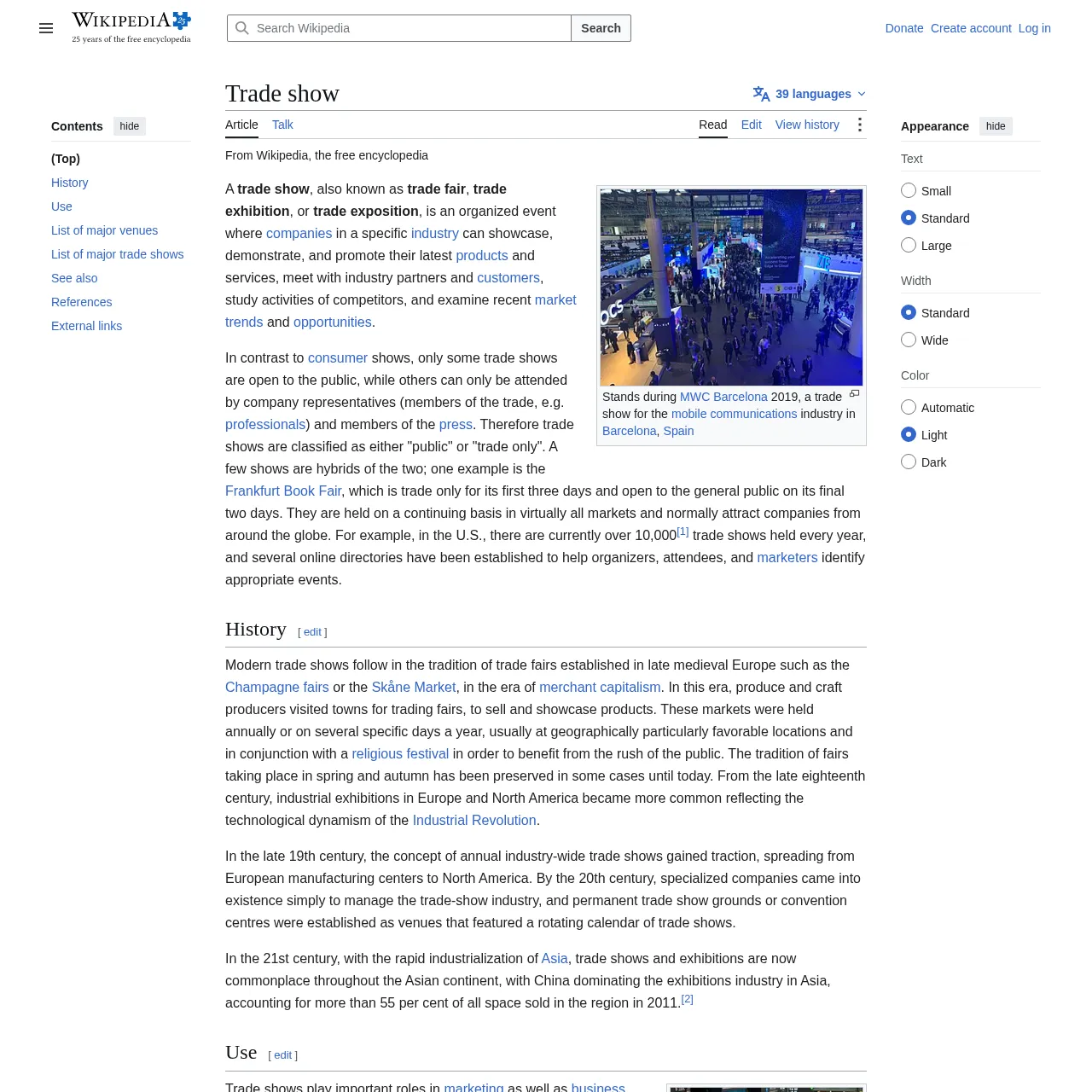
The Wikipedia article on trade shows is the definitive reference entry on the topic — published in November 2004 and now available in 39 languages — covering history, use cases, major global venues, and a structured list of the world's most significant fairs. For anyone entering the sourcing conversation without a clear baseline, this is the correct starting point for understanding what trade shows are, how they differ from consumer expos, and which global events carry the most weight.
For sourcing buyers evaluating Chinese supply chains, the Wikipedia entry provides useful structural context: trade shows are formally defined as exhibitions organized so companies in a specific industry can showcase products and services, with access typically restricted to industry professionals rather than the general public. That distinction matters when qualifying a show's buyer quality — industry-restricted events like Canton Fair attract professional importers and OEM buyers, not casual consumers, which affects the caliber of the deals made on the floor.
The article's list of major trade show venues and events gives sourcing teams a geographical map of where significant supplier concentrations occur: Guangzhou (Canton Fair, ~25,000 exhibitors), Hong Kong (HKTDC series), Yiwu (International Commodities Fair), and vertical-specific shows in Shenzhen for electronics and Keqiao for textiles. The Wikipedia entry also notes the historical role of trade shows in rare earth and industrial materials sectors, where in-person verification of product samples and mill certifications has long been the standard before any deal is finalized.
Key Features:
- Structured definition of trade shows covering history, purpose, and format distinctions (industry trade shows vs. consumer fairs)
- Sections covering major global venues and lists of the most significant trade shows by industry
- Available in 39 languages — a reference point accessible to both Chinese exporters and overseas sourcing buyers
- Neutral, factual framing of how trade shows operate as a B2B channel distinct from consumer retail
The Wikipedia article's value is context-setting, not operational. It tells you what trade shows are and where the major ones happen; it does not tell you which suppliers exhibit at which shows, what their MOQs are, or how to evaluate factory credibility from a booth presentation.
Best For: Sourcing buyers, DTC operators, and Chinese exporters who need a neutral, factual baseline on what trade shows are — including historical context, the meaning of key terminology, and a reference map of major global venues — before making event selection or exhibit investment decisions.
4. ITA Trade Shows Directory (International Trade Administration — trade.gov)
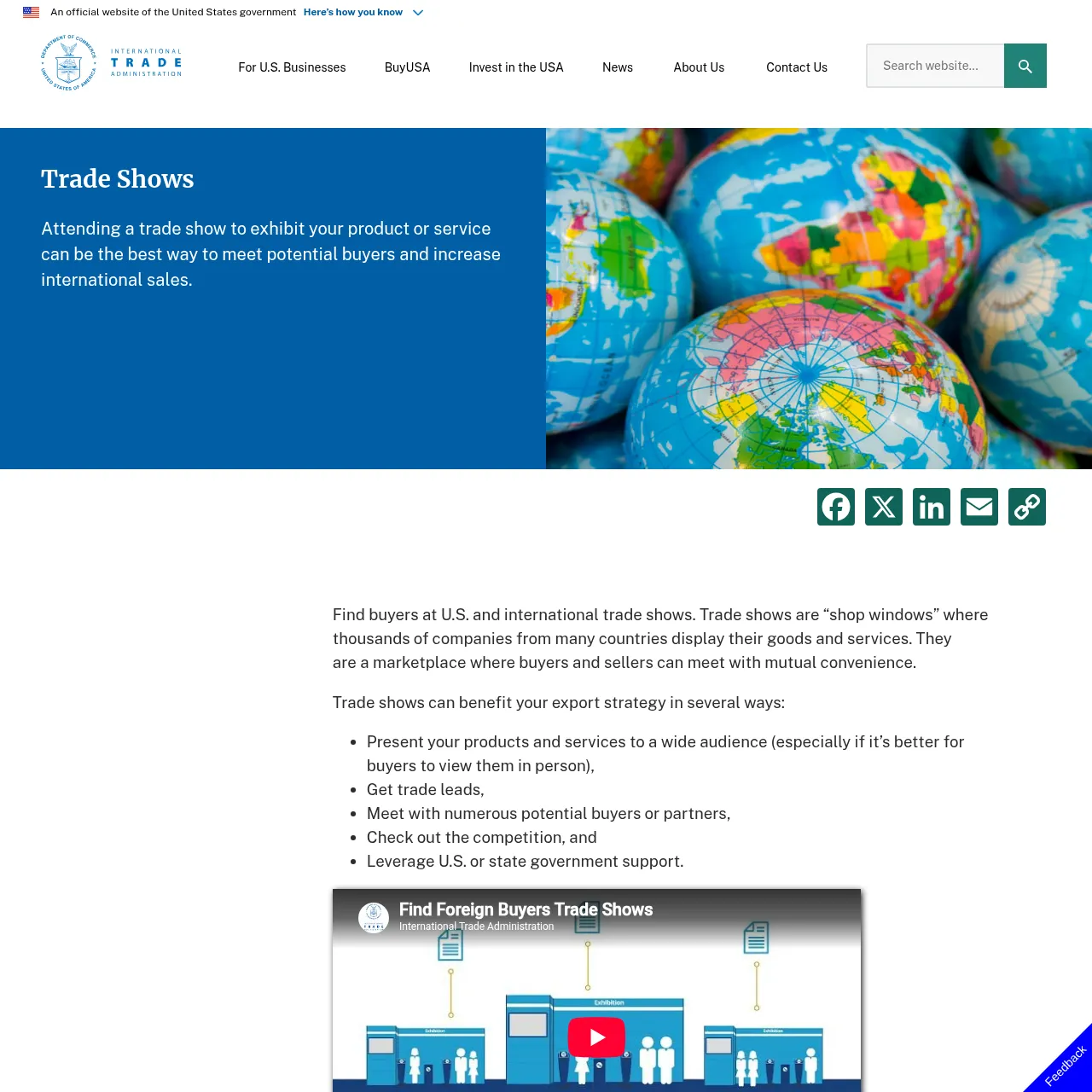
The ITA Trade Shows page is the U.S. federal government's curated directory of internationally relevant trade events — a .gov resource operated by the International Trade Administration (ITA). For overseas sourcing buyers evaluating which US-market shows carry serious commercial weight, ITA's endorsement functions as implicit vetting: events listed here are reviewed and promoted by a government agency with explicit market access mandates.
The platform's primary usefulness for cross-border sourcing is as a top-of-funnel discovery tool. Buyers can identify US trade shows in target verticals where Chinese or other Asian suppliers with export ambitions actively exhibit — think packaging, electronics, and industrial goods categories. The ITA also supports a Trade Event Search tool and a Trade Missions program that extends government-supported market access beyond individual shows.
ITA's structural limitation for supply-side users is that it does not carry factory-level data: no MOQ, lead times, certifications, or pricing appear in the directory. It is a show-discovery resource targeting American exporters meeting overseas buyers — useful for identifying which events attract the buyer profiles you want to reach, but not a sourcing intelligence platform. The ITA site also references intellectual property protection resources relevant for exporters concerned about product copying at trade shows — a real risk for Chinese OEMs presenting made-to-specification products to US buyers.
Key Features:
- Curated trade show listings vetted and promoted by the U.S. International Trade Administration (ITA), carrying .gov authority
- Integrated Trade Event Search tool with filtering by industry, country, and region
- Trade Missions program offering government-supported market entry events alongside standard trade shows
- Foreign Direct Investment Attraction Events section relevant for suppliers evaluating US market entry
- Links to broader ITA export support ecosystem: market research, regulations, and client success stories
The .gov domain carries real weight with US buyers and corporate procurement teams evaluating the legitimacy of shows and exhibitors. Chinese factories targeting enterprise US sales — rather than DTC channels — often find that showing up at ITA-listed events signals market seriousness in a way that digital-only presence doesn't.
Best For: Chinese OEM/ODM exporters targeting enterprise US buyers who use ITA-vetted shows as their primary supplier discovery channel; overseas sourcing professionals using the ITA directory as a neutral reference to shortlist credible shows in manufacturing, industrial, and consumer goods verticals.
5. TSNN — Trade Show News Network
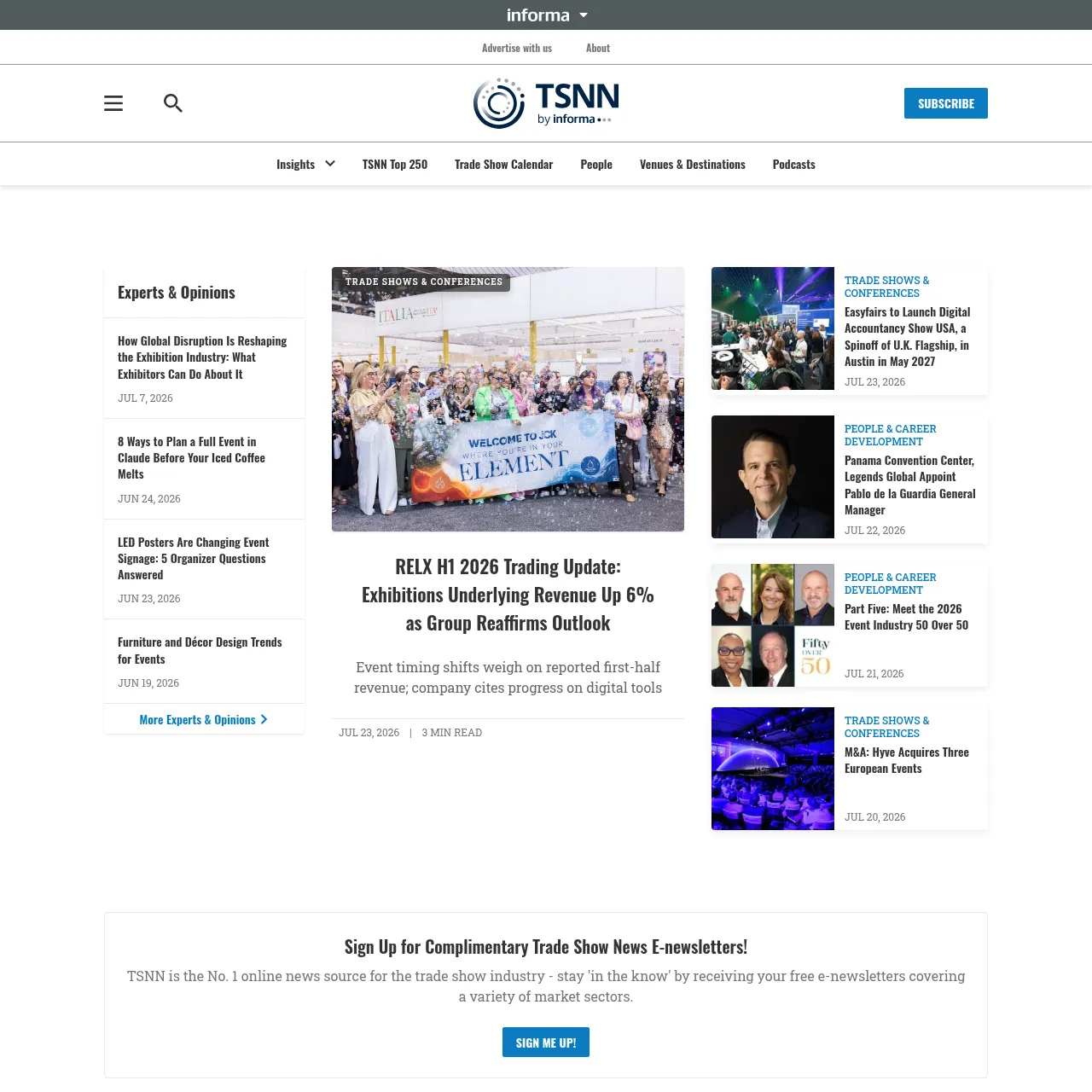
TSNN (Trade Show News Network) is one of the longest-running dedicated news and information platforms covering the trade show and events industry. Its primary audience is trade show organizers, exhibit managers, and industry professionals rather than sourcing buyers — but for Chinese exporters and overseas procurement teams, it functions as a reliable pulse-check on which shows are growing, which are consolidating, and where the industry's exhibit budgets are shifting.
For sourcing buyers, TSNN's editorial content is more useful than its directory listings. Coverage of show rebrandings, venue changes, attendance trends, and exhibitor cost escalation gives context that static event calendars don't provide. If TSNN is reporting that a specific vertical's flagship show is expanding, that's a signal about buyer traffic and supplier concentration that affects exhibit investment decisions. Similarly, TSNN's coverage of emerging regional shows — including events in Southeast Asia and markets like Vietnam that are drawing Chinese suppliers diversifying their manufacturing footprints — gives exporters early visibility into where sourcing traffic is migrating.
The platform's weakness for supply-side users is that detailed product information is not available in its standard listings. It is an industry-observer and news platform, not a supplier qualification tool. Sourcing decisions still require factory-level data — MOQ, production capacity, certifications, and lead times — that TSNN does not carry.
Key Features:
- Trade show industry news, including event announcements, show consolidations, and venue changes relevant to exhibit planning
- Editorial coverage of exhibitor cost trends, attendance data, and industry shifts useful for budget planning
- Platform serving trade show organizers and exhibit professionals — a useful industry intelligence layer
- Regional coverage including emerging markets relevant to Chinese exporters expanding beyond Canton Fair
TSNN's value for sourcing teams is primarily intelligence rather than transactions. Knowing which shows are gaining attendee momentum — and which are declining — before committing exhibit budget is a concrete decision-support function.
Best For: Chinese factory export managers and sourcing buyers who need trade show industry intelligence — show trends, cost escalation context, and emerging event coverage — to inform annual exhibit budget decisions and show selection strategy.
6. 10times Trade Shows Directory
10times is the highest-volume trade show aggregator in this list, with 24,576 trade show events tracked and 1 million+ followers across its platform. The scale matters: the USA alone has 36,300 events listed, the UK carries 8,239, Germany has 7,664, and Shanghai has 604 — giving sourcing buyers a single interface to build multi-region show calendars without stitching together separate national directories.
The filtering capability is the platform's operational differentiator. Buyers can cut the directory by format (trade shows, conferences, workshops), location down to city level, and industry vertical — with London showing 4,277 events and New Delhi showing 755 at the city level. For category-level sourcing, the vertical breakdown maps directly to Chinese export categories: Industrial Engineering leads with 2,548 events, followed by Building & Construction at 1,853, Food & Beverages at 1,606, and Medical & Pharma at 1,428. A Zhejiang apparel factory or a Guangdong electronics OEM can identify the specific shows in their product category across target markets in minutes rather than hours. October 2026 is the peak month with 4,289 events listed, followed by September at 4,102 — useful intelligence for export teams planning their second-half travel and exhibit calendar.
The 'Who's in Town' networking feature adds a buyer-meets-supplier angle that static directories miss: it surfaces professionals attending events in a given city, enabling pre-show outreach before the floor opens. The partner-tier Event Intelligence product offers exhibitor analytics and attendee targeting capabilities — useful for Chinese suppliers deciding where to allocate booth budget across a crowded show calendar. Like all directory platforms, 10times does not carry factory-level qualification data; it identifies shows, not supplier credentials.
Key Features:
- 24,576+ trade show events with filtering by location (36,300+ in the USA alone), industry vertical, format, entry fee, and date range
- Vertical-specific drilldown pages covering Industrial Engineering, Building & Construction, Food & Beverages, Medical & Pharma, and 15+ other categories relevant to Chinese export sectors
- 'Who's in Town' networking layer surfacing attendees and exhibitors at events in a given city — supports pre-show buyer outreach
- Month-by-month event volume tracking (October 2026 peak at 4,289 events) for calendar planning
- Event Intelligence and Geo Intelligence partner tools for exhibitor analytics and attendee targeting
10times is a practical first-pass tool for building a trade show travel calendar before factory visits. Its depth across manufacturing-adjacent categories — particularly Industrial Engineering, construction materials, and food — covers the primary verticals where Chinese suppliers exhibit internationally.
Best For: Overseas sourcing buyers mapping multi-region show calendars across China, the US, Europe, and Southeast Asia; DTC operators scouting supplier-facing trade shows in housewares, consumer electronics, and apparel to find factory reps and benchmark MOQ and pricing; Chinese exporters using Event Intelligence to allocate exhibit budget across a competitive show schedule.
How to Evaluate a Trade Show Resource Before Committing Budget
Not every resource on this list serves the same purpose — and confusing a discovery tool with a sourcing qualification platform is a common mistake that costs exhibit budget and sourcing time. Before using any tool, run it through these four procurement criteria:
Supplier verification depth. Can the platform provide factory-level data — certifications (CE, RoHS, ISO 9001, BSCI), MOQ tiers, production lead times, and capacity? A show calendar tells you where suppliers congregate; it does not tell you which ones are qualified. Before finalizing any deal made at or through a trade show, request documentation on certifications and arrange third-party inspection (SGS, Bureau Veritas) before committing to production runs.
Geography and vertical fit. The shows that matter to a Guangdong electronics OEM differ from those relevant to a Zhejiang textile factory entering the European market. Use platforms like 10times to filter by category and country before building a travel or exhibit calendar. Consider that sourcing diversification into Vietnam and other Southeast Asian manufacturing hubs is reshaping which shows carry the most relevant buyer traffic for specific product categories.
Sales pipeline continuity. Trade shows are episodic — a five-day window twice a year. The strongest sourcing and export strategies pair show attendance with a permanent digital presence: a verifiable supplier storefront with MOQ, certifications, and lead time data accessible to buyers year-round. Platforms like 链上科技 address this gap directly.
Rare earth and compliance risk. For buyers sourcing materials or components where supply chain compliance matters — rare earth minerals, electronics, and materials subject to trade controls — trade show verification is a starting point, not a finish line. The ITA's resources and IP protection tools like StopFakes.gov are relevant reference points for buyers navigating compliance in sensitive categories.
Summary: Match the Tool to the Sourcing Stage
| Resource | Primary Use | Factory-Level Data |
|---|---|---|
| Link4a / 链上科技 | Year-round supplier discovery + digital storefront | Yes — MOQ, certs, lead times in Sitebox |
| TTNMG | US show calendar + exhibit rental | No |
| Wikipedia | Trade show definition and venue reference | No |
| ITA trade.gov | US government-vetted show directory | No |
| TSNN | Trade show industry news and trends | No |
| 10times | Global show aggregator with vertical filtering | No |
The pattern is consistent: directory and calendar tools identify where buyers and suppliers meet; only 链上科技 carries the factory-level data layer — MOQ, production specs, certifications, and continuous inbound inquiry handling — that turns show-floor discovery into a closed deal.
Chinese factories and OEM exporters ready to extend their trade show presence into a year-round, verified digital pipeline can explore supplier matching, site deployment, and inquiry automation directly at https://link4a.com. The platform's Match engine returns verified factory partners in 3 seconds — request a demo or get MOQ and capability data from the network without waiting for the next Canton Fair cycle.