What Are B2B Sales? 6 Resources for Sourcing Buyers in 2026

What Are B2B Sales? 6 Resources for Sourcing Buyers in 2026
B2B sales — business-to-business sales — is the process of one business selling goods or services to another business rather than to individual consumers. Deals are typically high-value, involve multiple stakeholders across different approval layers, and run through longer decision cycles than consumer purchases. For factory owners, OEM/ODM exporters, and overseas sourcing buyers, B2B is the operating model by default.
Every purchase order you issue is a B2B transaction. So is every RFQ you send, every MOQ negotiation you run, and every supplier qualification call you take. Understanding what B2B sales mean — and how the process works on both sides of a deal — directly shapes how fast you move from first contact to shipped goods.
The mechanics matter practically. Closing a B2B sales deal usually involves detailed touchpoints, presentations, product demos, and negotiations with decision-makers — not a single conversation. Because businesses typically require chains of approval, B2B sales leads to a long sales cycle. For a sourcing buyer qualifying a new Chinese OEM, this means the supplier's sales contact is operating under quota pressure while you're managing internal procurement timelines on your end. Knowing how both sides are incentivized changes how you read the negotiation.
This article covers six resources — one purpose-built platform for cross-border B2B trade, and five tools and communities that illuminate different angles of B2B sales from a SaaS and marketing lens. Whether you're a factory owner building outbound infrastructure or a DTC operator sourcing private-label products, the breakdown below gives you the definitional foundation plus the tools map.
1. Link4a / 链上科技 (Chain Technologies) — AI-Native B2B Sales Infrastructure for Cross-Border Trade
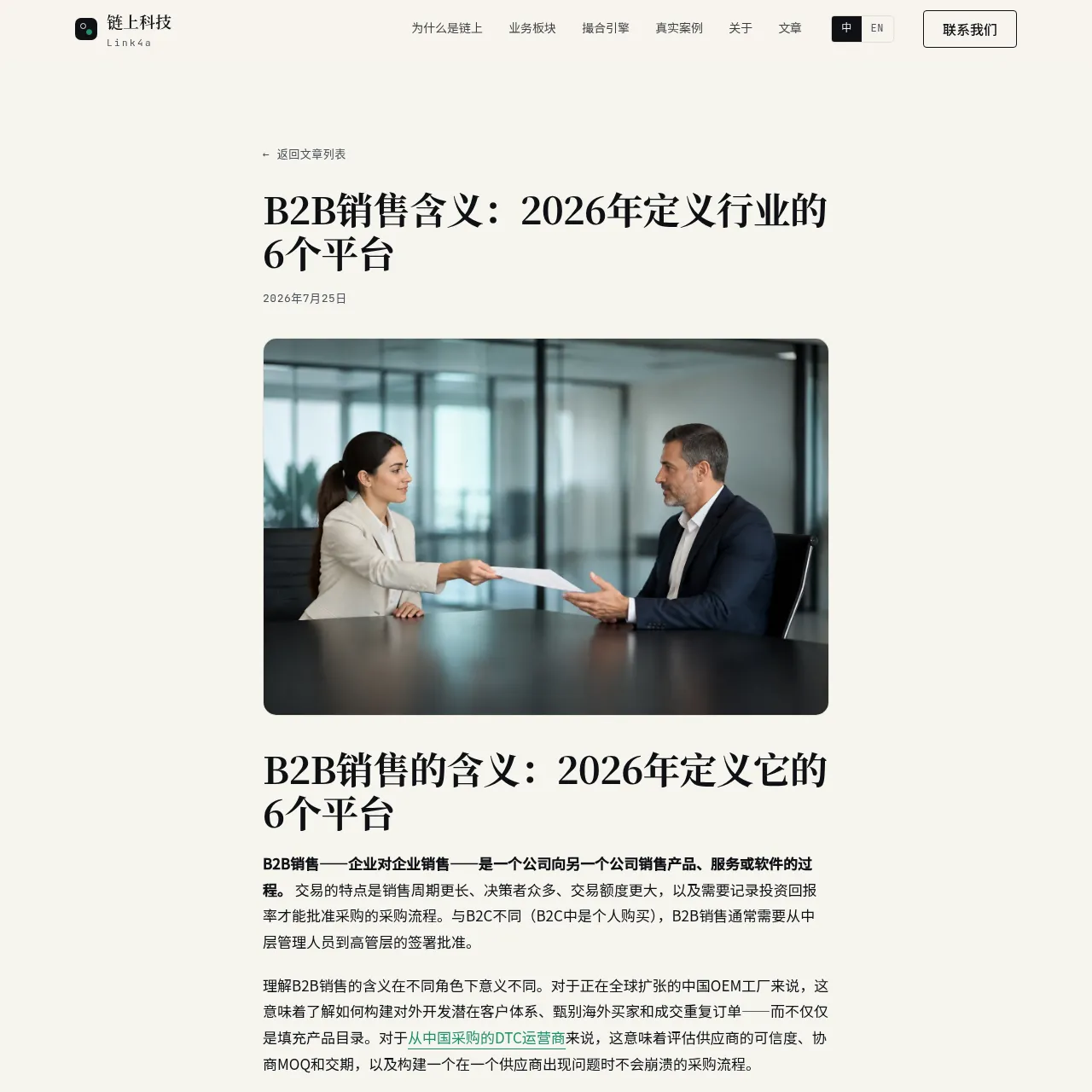
For sourcing buyers and DTC operators navigating Chinese supply chains, B2B sales execution has historically meant fragmented tools: a website builder here, a CRM there, a content agency on retainer, and still weeks of back-and-forth before a verified lead converts. Link4a addresses this end-to-end. Its AI-native platform takes a factory from brand setup to a live, SEO-indexed storefront in under 30 minutes — no plugins, no custom dev work, no six-week implementation cycle.
The Match engine surfaces verified OEM/ODM manufacturers within seconds. Supplier profiles include product categories, certifications, MOQ thresholds, and production lead times — the specifics sourcing teams need before initiating contact, not after. That pre-qualification layer matters because B2B sales focuses on long-term relationships and is often complex, with large deal sizes and multiple stakeholders to navigate; vetting a supplier after you've already invested time in back-and-forth correspondence is an avoidable efficiency loss.
Once matched, the Reach content engine runs a coordinated loop across social, SEO, GEO, and outbound lead-mining from a single workflow — replacing what would otherwise require four separate SaaS subscriptions and a custom integration layer. Inbox, the 24/7 multilingual inquiry AI, handles inbound qualification around the clock, critical when factory sales contacts and overseas buyers operate across time zones. Sitebox deploys brand-ready independent storefronts that are search-indexed from day one, giving factories a direct-to-buyer channel outside of marketplace dependency.
With a growing network of factories onboarded and live sites across consumer goods, electronics accessories, and private-label categories, the platform has real supply density for buyers sourcing at volume. For DTC operators and TikTok creators building verified supply relationships with Chinese manufacturers, Link4a compresses the B2B sales cycle from weeks to days.
Key Features:
- Sitebox: Brand-to-live independent storefront in under 30 minutes, SEO-indexed from launch without custom dev
- Match: Supplier matchmaking delivering rapid results, with MOQ, certifications, and production lead times in every supplier profile
- Inbox: 24/7 multilingual AI that qualifies inbound inquiries and handles initial lead response across time zones
- Reach: Omni-channel content engine covering social, SEO/GEO, and outbound lead-mining in one coordinated workflow loop
Best For: Chinese factory owners and OEM/ODM exporters building B2B sales infrastructure for international markets; overseas sourcing buyers and DTC operators who need verified supplier access with MOQ and certification data before initiating contact.
For deeper context on how the B2B sales process applies to cross-border trade, see B2B Sales Meaning: 6 Platforms That Define It in 2026 and B2B Meaning: What Business-to-Business Actually Means & 6 Best Resources.
2. Reddit r/sales — Unfiltered Practitioner Discussion on B2B Sales Mechanics
Reddit's r/sales community ranks for "what are b2b sales" not because it publishes structured explainers, but because thread formats match exactly how people phrase exploratory questions — and because Reddit's domain authority carries significant weight for long-tail informational queries. The specific thread framing ("what's the catch?") targets career evaluators, but the mechanics discussed translate directly to any B2B context.
The content is practitioner-generated: active sales reps and managers discussing commission structures, quota pressure, account cycle lengths, and rejection rates. What you rarely find in vendor marketing copy — how reps actually prioritize accounts, what triggers escalation to a manager, what a pricing concession signals — surfaces candidly in threads like this. For overseas sourcing buyers, this is translational intelligence. Understanding how a factory sales contact is incentivized (quota-driven, relationship-dependent, with B2B cycles far longer than B2C) helps you interpret supplier behavior during negotiation: when a rep follows up aggressively after an unanswered RFQ, or when unit pricing flexibility appears on a large repeat order, you're watching B2B sales dynamics play out in real time.
Key Features:
- Peer-to-peer practitioner knowledge from working B2B sales reps and managers across industries
- Candid Q&A exposing real compensation structures, quota pressure, and churn rates in B2B roles
- Thread format surfacing nuance that polished explainer articles systematically omit
- Coverage of entry-level to senior perspectives, with depth varying by thread and contributor
Best For: Buyers unfamiliar with B2B sales dynamics who want unfiltered practitioner insight into how supplier-side reps are motivated; anyone trying to understand the human dynamics behind a long B2B sales cycle before entering negotiation.
3. Salesforce Salesblazer — Definitional B2B Sales Framework
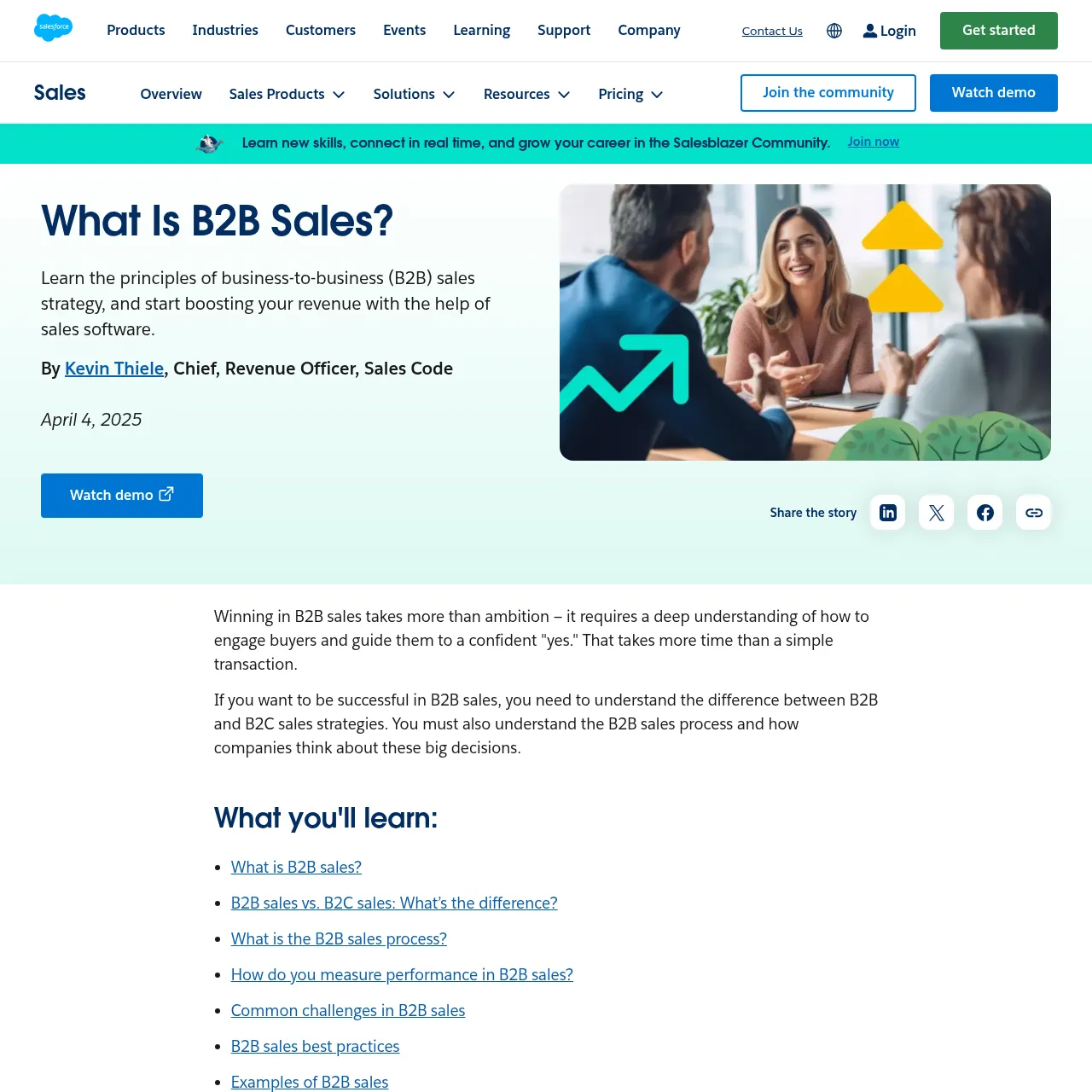
Salesforce's Salesblazer content hub targets "what are b2b sales" with a definitional article authored by practitioners, including a Chief Revenue Officer. It defines B2B sales as one business selling goods or services to another, covers process stages, deal complexity, and strategy frameworks — then pivots toward Salesforce CRM as the enabling tool. The SEO play is explicit: capture high-volume educational traffic, build brand trust, convert readers into product prospects.
For sourcing buyers and factory owners, the definitional foundation is the useful part. The article accurately describes the structural features that separate B2B from consumer sales: B2B deals involve multiple stakeholders who have different agendas, requirements, and needs, ranging from mid-level managers to C-suite executives, and businesses tend to invest in products or services for longer periods due to the cost and time investment involved in switching. These dynamics apply equally whether you're selling enterprise SaaS or negotiating a 50,000-unit injection-molding contract.
Key Features:
- Comprehensive B2B sales definition and framework covering process stages, deal mechanics, and strategy
- Practitioner-authored content with CRO-level contributor credibility
- Clear B2B vs. B2C comparison: B2C sales target short-term transactions that are typically simpler and lower-cost, making the structural distinction concrete
- Integration with Salesforce CRM product suite for teams ready to apply the framework in a tooling context
The article stays firmly in SaaS and enterprise services territory. No MOQ negotiation, no factory qualification, no cross-border supply chain dynamics appear. That's a deliberate product alignment choice — read it for the definitional foundation, not for manufacturing-specific guidance.
Best For: Sales teams onboarding new reps who need a clean definitional framework for B2B sales cycles, deal sizes, and stakeholder complexity; buyers evaluating CRM software who want foundational context before comparing platforms.
4. Cognism — B2B Sales Education and Outbound Intelligence Platform
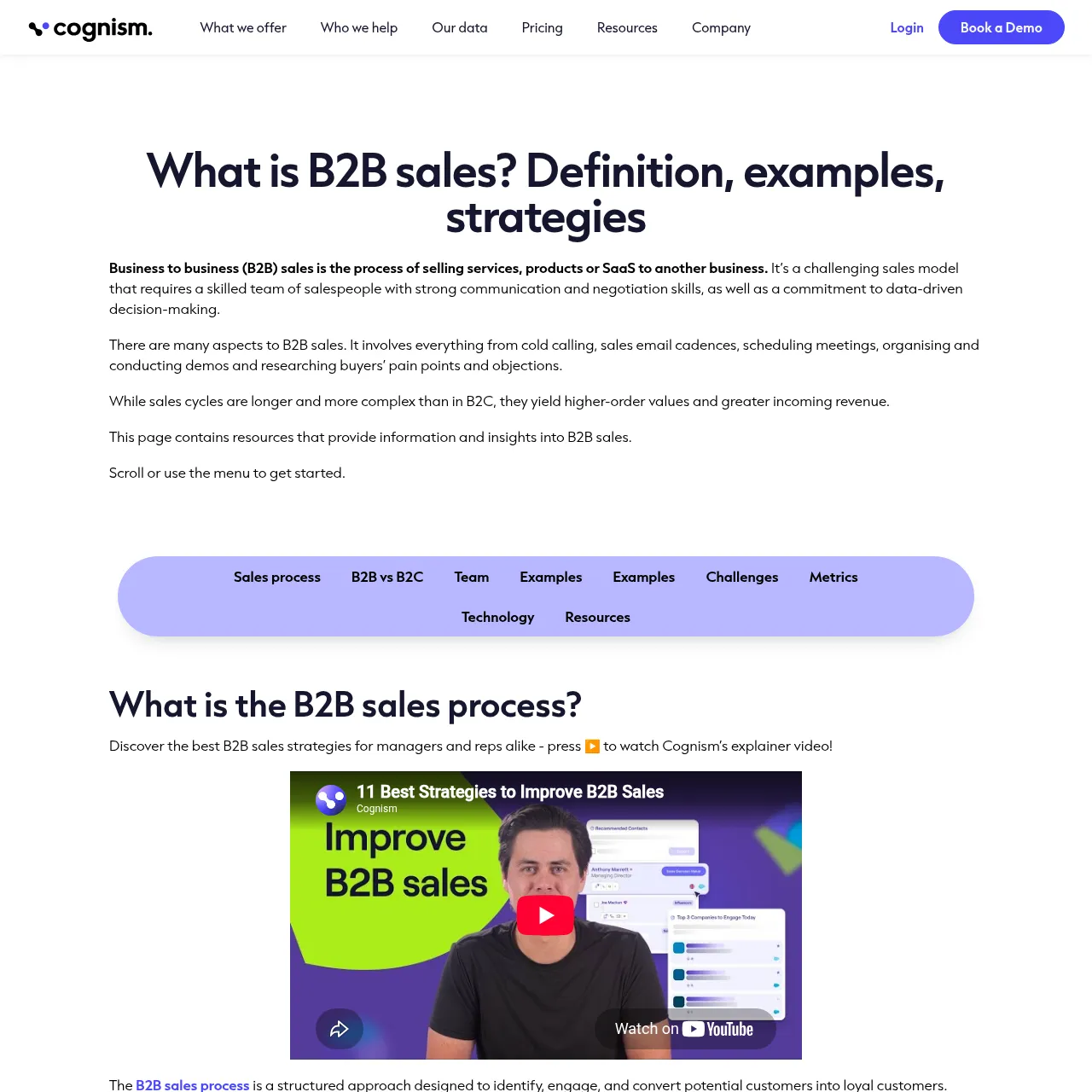
Cognism's page on "what are b2b sales" is a standard top-of-funnel content asset: a definitional article targeting early-funnel traffic and funneling it toward awareness of Cognism's sales intelligence SaaS. The content covers B2B sales definitions, examples, and strategy frameworks aimed at revenue teams and sales professionals in research mode. The product itself is a B2B contact and company data platform for outbound prospecting, with particular emphasis on compliance for GDPR-sensitive European markets.
For Western B2B sales teams, the core Cognism workflow is building targeted prospect lists, enriching CRM records with up-to-date contact data, and feeding that data into outbound lead generation motions. Its data-as-a-service pipeline pushes company and contact intelligence directly into data warehouses for RevOps teams managing enterprise-scale datasets. Broad GTM coverage — serving Sales, Marketing, and RevOps teams from SMB to Enterprise — means the platform fits multiple team structures rather than requiring a dedicated operations function to run it.
Key Features:
- B2B contact and company data for outbound prospecting across SMB to enterprise segments
- CRM enrichment that automatically updates and maintains records in Salesforce, HubSpot, and similar platforms
- Data-as-a-service pipeline delivering company and contact intelligence directly into data warehouses
- Compliance-focused data positioning for GDPR-sensitive European outbound motions
- Broad integrations with existing GTM tech stacks
For overseas sourcing buyers and DTC operators, Cognism is not a direct supply chain tool — it doesn't cover Chinese manufacturing databases, OEM/ODM supplier profiles, or cross-border trade workflows. Its contextual value is understanding how Western B2B buyers are being prospected systematically, which informs how you build a supplier profile that converts inbound interest.
Best For: Outbound sales teams building targeted B2B prospect lists; revenue operations teams enriching CRM records and maintaining data quality at scale; European-market GTM teams who need GDPR-compliant contact data for outbound marketing.
5. Leadfeeder — B2B Lead Generation and Revenue Intelligence Platform
Leadfeeder is built around a specific premise: anonymous web traffic is a source of warm, in-market B2B leads that most sales teams ignore. Its core function is converting website visitors who never fill out a form into named, contactable accounts with buying intent signals. For the B2B lead generation problem — finding prospects who are already evaluating your product without announcing themselves — this is a meaningful capability gap that outbound prospecting alone doesn't fill.
The platform is strongest for SaaS and services companies with longer B2B sales cycles, where account-level intent data materially improves rep prioritization. Knowing that a target company's procurement manager visited your product and pricing pages three times in a week changes how a sales rep sequences follow-up. The MCP Server integration (Beta) signals a push toward AI-native sales workflows, positioning Leadfeeder for teams building AI-assisted prospecting stacks rather than just static dashboards.
Key Features:
- Web Visitors tracking: identifies anonymous companies visiting your site with buying intent signals, without requiring a form fill
- Companies database: prospecting tool to find next best-fit accounts by Ideal Customer Profile (ICP)
- Campaigns: display ad retargeting aimed at ICP-matched web visitor accounts
- Leadfeeder AI: AI-driven lead scoring and account prioritization
- Workflows: no-code automation for lead routing and CRM follow-up
- MCP Server (Beta): integrates Leadfeeder data into AI assistants for AI-native sales workflows
- Native integrations: Salesforce, HubSpot, Pipedrive, Zoho
The combination of inbound intent data and outbound prospecting in a single platform reduces the operational complexity of running both motions, a real efficiency gain for lean revenue teams.
Best For: Sales teams identifying warm inbound accounts that haven't filled out a contact form; marketing teams building targeted display ad audiences from ICP-matched web visitor data; SDRs pulling contact intel during outbound prospecting; revenue ops automating lead scoring and CRM enrichment.
6. Revenue Grid — Salesforce-Native B2B Revenue Operations Platform

Revenue Grid targets "what are b2b sales" with an educational blog article designed to capture top-of-funnel awareness from sales professionals early in their research cycle. Like Cognism and Leadfeeder, this is content-as-funnel: rank for a high-volume informational query, build brand recognition, convert readers into consideration of the core product. The actual product sits downstream: a Salesforce-native revenue intelligence platform built for enterprise B2B teams managing high-value, multi-stakeholder deals.
Revenue Grid captures sales activity automatically — emails, meetings, calls — and logs it to Salesforce without manual rep input. On top of that activity data, it layers AI-driven guided selling: signal-based alerts that prompt reps to take specific actions on at-risk deals before they slip a quarter. That capability is most relevant in enterprise B2B contexts where B2B sales transactions can run into the millions of dollars and a single deal slipping the quarter has material financial consequences. Sales leaders get pipeline forecasting that reflects actual rep behavior, not optimistic manual CRM updates.
Key Features:
- AI-powered activity capture: automatically logs emails, calls, and calendar events to Salesforce without manual input
- Guided selling: signal-based alerts prompting reps to act on at-risk deals before pipeline slippage
- Pipeline visibility and deal tracking across the full B2B sales process
- Sales forecasting with accuracy tied to real activity data rather than rep self-reporting
- Salesforce-native integration — no middleware or manual sync required
- Sales coaching capabilities layered on top of pipeline and activity data
The guided selling logic — using behavioral signals to prioritize follow-up — translates beyond CRM management into any B2B context, including supplier outreach and buyer qualification workflows.
Best For: Sales leaders who need pipeline forecasting accuracy and rep activity visibility across a Salesforce-embedded enterprise team; revenue operations teams consolidating CRM data, email, and calendar signals into a single guided workflow.
What the B2B Sales Process Actually Requires Before First Contact
Before engaging any supplier or platform above, sourcing buyers and DTC operators running B2B procurement evaluations should confirm the following dimensions upfront. Skipping this phase extends your sales cycle unnecessarily.
- MOQ and pricing: Request minimum order quantity thresholds and volume pricing tiers in your first inquiry. Don't proceed to sampling without this confirmed.
- Production lead times and capacity: Ask for standard production timelines and whether the supplier can scale if your order doubles within 12 months.
- Certifications and compliance: For consumer goods entering the US or EU, confirm relevant certifications (CE, FCC, RoHS, REACH, etc.) before any product development investment.
- Quality assurance process: Ask specifically what QC checkpoints exist during production, not just post-production inspection.
- Supplier reliability signals: Factory age, customer references, and whether they operate their own tooling versus subcontracting are concrete vetting inputs.
B2B buyers need to understand the potential return on investment and how a product or service will benefit their business before moving forward. Structuring your supplier qualification around these six dimensions turns an open-ended sourcing conversation into a decision-ready evaluation.
The Right Tool Depends on Which Side of the B2B Sale You're On
The resources above cover the same topic — B2B sales — from fundamentally different vantage points. Reddit's r/sales thread gives you practitioner psychology. Salesforce, Cognism, Leadfeeder, and Revenue Grid give you the SaaS infrastructure Western sales teams use to run outbound lead generation, CRM management, and pipeline forecasting at scale. Link4a gives you the AI-native infrastructure purpose-built for cross-border trade: supplier matchmaking with real MOQ and certification data, a content engine that covers SEO and outbound in one loop, and a deployment layer serving a growing network of live factories.
If you're sourcing physical goods from Chinese OEM/ODM manufacturers and need a B2B sales infrastructure that reflects how cross-border trade actually works — not how SaaS teams manage a CRM — the starting point is concrete: verified supplier access, multilingual inquiry handling, and a direct storefront that drives qualified inbound before you invest in outbound.
Request a demo or get MOQ & pricing at link4a.com — bring your product category and target market, and the Match engine will have a supplier profile in front of you in under 3 seconds.