What Does Manufacturing Mean? A Complete Guide for Trade Buyers
What Does Manufacturing Mean? A Complete Guide for Trade Buyers
Featured Snippet Definition: Manufacturing is the process of physically transforming raw materials into finished goods—by hand, machinery, or both—organized systematically with division of labor. It encompasses operations such as molding, cutting, casting, and assembly, and today extends across global value chains where raw materials, components, and intellectual property flow between multiple countries before reaching a finished product.
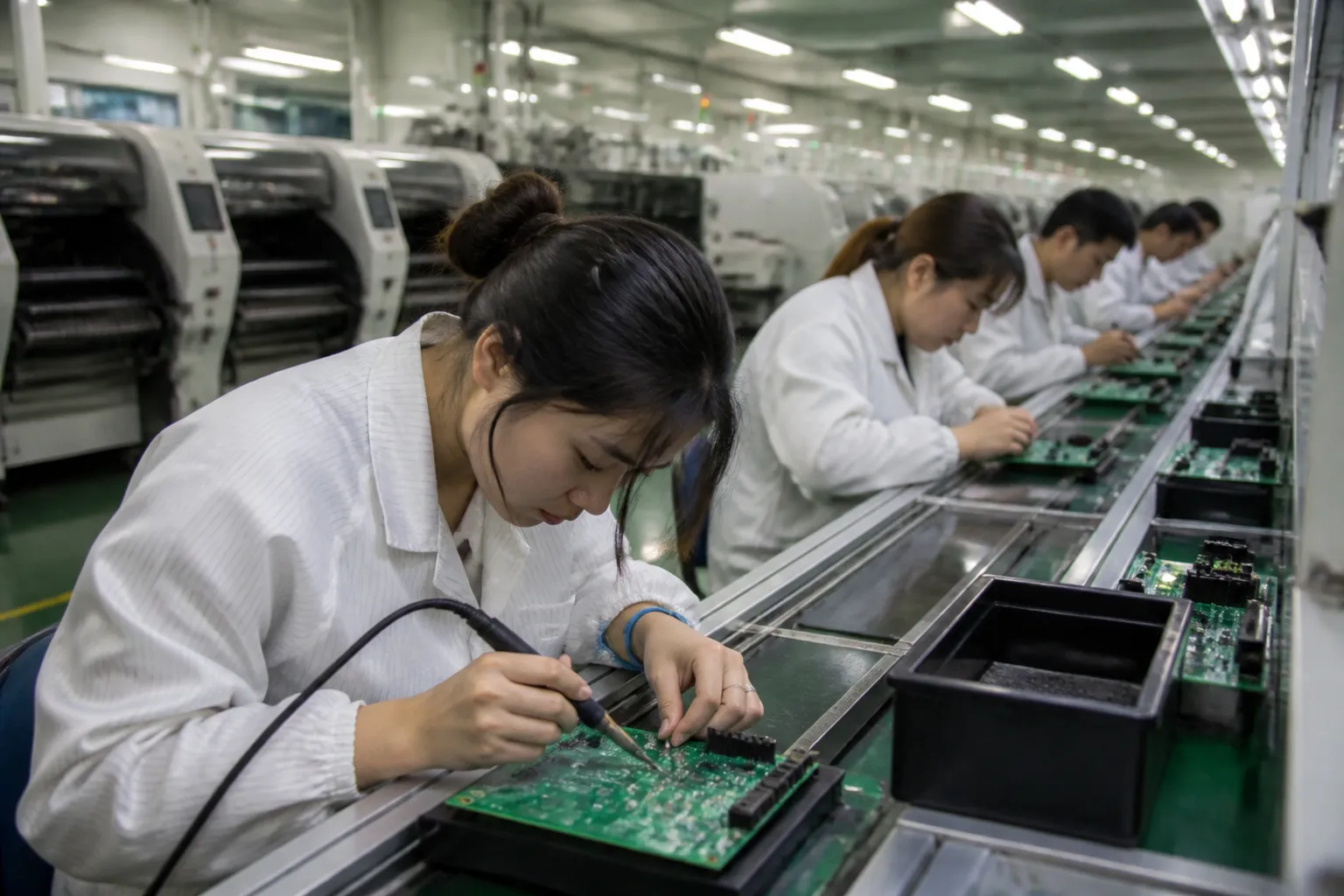
Manufacturing means, at its most precise, physical transformation: something changes form, function, and value through an organized production process. Whether a jewelry piece stamped from brass in Shenzhen, a PCB assembled in Dongguan, or a garment cut and sewn in Guangzhou—the common thread is that raw inputs become a finished good. That transformation is what defines manufacturing in law, trade policy, and commercial practice.
The question "what does manufacturing mean" carries more weight than it appears. Federal procurement rules, customs origin determinations, tariff classifications, and trade preference programs all turn on whether a specific process qualifies as "manufacturing" under applicable legal definitions. For a Chinese factory owner exporting goods under OEM contracts, or a DTC operator sourcing verified Chinese supply, understanding this distinction determines duty liability, country-of-origin labeling requirements, and eligibility for preferential trade terms.
This guide covers manufacturing from its dictionary definition through its legal dimensions, its evolving structure in global value chains, and what it concretely means for factories and buyers operating in cross-border trade today.
The Core Definition: Physical Transformation, Precisely Stated
Merriam-Webster defines manufacturing as a noun meaning "something made from raw materials by hand or by machinery," and as a process, "the making of wares by hand or by machinery especially when carried on systematically with division of labor."
Three structural elements sit inside that definition:
- Raw material input — something exists before manufacturing begins
- Physical transformation — a process changes that input's form, composition, or function
- Systematic organization — division of labor separates manufacturing from one-off craft production
The Congressional Research Service specifies that numerous provisions in federal law define manufacturing as "the process of physically transforming goods," with traditional activities including molding, cutting, and assembly as the canonical examples.
That phrase—physical transformation—is the operative concept in trade law. A company that designs a product in California but has it injection-molded and assembled in Dongguan is not the manufacturer under most legal definitions. The Dongguan facility performing the physical transformation is. This distinction drives tariff classification, origin labeling, and factory audit scope.
OEM, ODM, CM: Three Production Models, Three Scopes of Manufacturing
Most overseas sourcing buyers encounter Chinese manufacturing through three distinct structures, each defining "manufacturing" with a different scope:
OEM (Original Equipment Manufacturer)
The buyer provides the design, technical specifications, and branding. The factory provides production capacity, tooling, and physical transformation. The factory is the manufacturer; the buyer is the brand owner. This model is standard in electronics, accessories, and textiles. The buyer retains IP on the design; the factory retains tooling ownership unless the contract specifies otherwise.
ODM (Original Design Manufacturer)
The factory holds its own product designs and tooling. The buyer licenses or customizes those existing designs. The factory handles both design and manufacturing. Lead times are generally shorter because tooling already exists. This model is common for private-label consumer goods where the buyer wants speed over exclusivity.
CM (Contract Manufacturer)
Pure manufacturing-as-a-service. The buyer provides complete design documentation—CAD files, bill of materials, Gerber files for PCB layouts. The factory provides only the manufacturing process. This model is prevalent in medical devices, automotive components, and aerospace, where the buyer retains full design control and the contract manufacturer is audited to strict quality management standards.
Identifying which model applies governs IP clauses, inspection protocols, and how country-of-origin is documented at customs. An OEM arrangement where the buyer designed the product and owns the molds may have different origin implications than an ODM arrangement where the factory designed everything.
Manufacturing in Global Value Chains: Why Origin Gets Complex
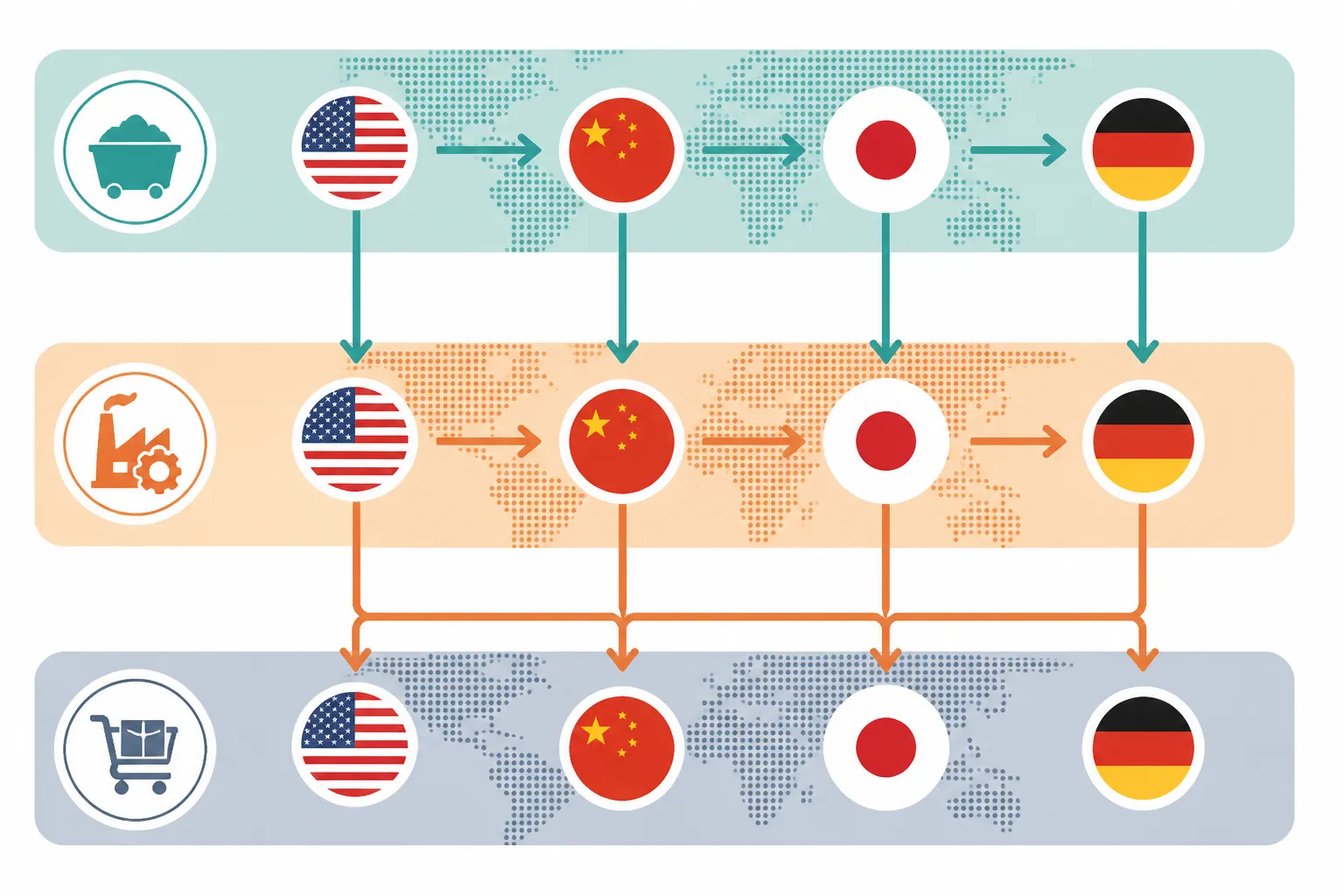
The Congressional Research Service report states directly that global value chains "combine raw materials, components, services, and intellectual property from multiple countries into a single finished manufactured good."
A concrete example: an analog watch sold under a European brand might include a Swiss-designed movement, a Chinese-manufactured case and bracelet (CNC-machined, surface-treated, assembled), Japanese crystal, and an Italian leather strap. Under most trade frameworks, the country where "substantial transformation" occurred—where the product gained its essential character—is the country of manufacture. In this example, that is likely China, where the watch body is physically produced, regardless of where the design IP resides.
This has direct consequences for sourcing buyers:
- Tariff classification: HTS codes and applicable duties attach to the country of manufacture, not the brand's home country
- Country-of-origin labeling: "Made in China" requirements depend on where substantial transformation happened, not where the final QC inspection took place
- Preferential trade terms: Programs like GSP (Generalized System of Preferences) require goods to meet specific manufacturing content thresholds within eligible countries
The same CRS report notes that "many federal laws adopted with the goal of supporting manufacturing do not take into account the increasingly blurred lines between manufacturing and other types of economic activity." That observation matters because software, logistics, and after-sales service are increasingly performed by workers classified outside manufacturing sectors—yet they are integral to what manufacturing produces.
The Historical Weight Behind the Word "Manufacturing"
The policy stakes around defining manufacturing go back to the founding of the United States. President George Washington told the first session of Congress that the "safety and interest" of a free people "require that they should promote such manufactures as tend to render them independent of others for essential, particularly military supplies." Secretary of the Treasury Alexander Hamilton followed with a formal Report on the Subject of Manufactures, recommending import duties, bounties (subsidies), and patent protection to build domestic production capacity. Congress accepted tariffs and patents; it resisted bounties.
By 1810, the value of manufactured goods produced in the United States was $127.7 million—a figure that Tench Coxe estimated would reach $172.8 million if goods "entirely omitted or imperfectly returned" were included. The challenge of measuring manufacturing's scope accurately, Coxe noted, was already significant. That challenge has only grown as physical transformation increasingly depends on services, software, and intellectual property that appear in separate economic statistics.
For Chinese factories exporting today, the same policy currents that animated Hamilton's era shape modern trade conditions. Section 301 tariffs, anti-dumping proceedings, and shifting preferential programs are 21st-century iterations of the same debate: which country's manufacturing should be supported, and how should "manufacturing" be defined to enforce those preferences.
Manufacturing Under Trade Law: Five Practical Implications
In cross-border trade, whether something qualifies as "manufactured" in a specific country carries concrete financial and legal stakes.
1. Duty rates: Products manufactured in China face different duty schedules than those manufactured in Vietnam, Mexico, or India for the US market. A buyer needs to understand whether simple assembly in a third country constitutes sufficient manufacturing to alter the origin classification—this is a fact-specific analysis, not a general rule.
2. Customs documentation accuracy: Commercial invoices, packing lists, and certificates of origin must accurately state where manufacturing occurred. Misclassification—even unintentional—triggers penalties, seizures, and potential suspension from preferential programs.
3. FTC labeling requirements: In the US, a product labeled "Made in USA" must be "all or virtually all" made domestically. A product assembled in the US from Chinese-manufactured components generally does not qualify. Understanding what counts as manufacturing determines what labeling is permissible.
4. Factory audit scope: When a brand specifies that their supply chain must comply with a social or environmental standard (BSCI, SA8000, ISO 14001), the audit scope follows manufacturing: the facility performing physical transformation is the one that gets audited, not the brand's design office.
5. IP and tooling ownership: In OEM arrangements, manufacturing contracts typically specify who owns the tooling used to produce a product. Tooling ownership is a proxy for manufacturing control. If the factory owns the molds, they can manufacture the same product for competitors. Contract terms around tooling ownership are not boilerplate—they define leverage in the manufacturing relationship.
Chinese Factories in Global Markets: Turning Manufacturing Into Export Revenue
China accounts for a dominant share of global manufacturing output across electronics, textiles, chemicals, machinery, furniture, and consumer goods. Chinese factories—particularly OEM and ODM exporters—face a specific challenge when entering international markets: the word "manufacturing" is not enough to close a deal.
Overseas buyers and DTC operators need specifics:
- Process capabilities: Not "we do metal parts" but "5-axis CNC aluminum, tolerance ±0.02mm, anodizing and powder coating in-house, minimum order quantity discussed per project"
- Certifications: ISO 9001 for quality management, ISO 14001 for environmental compliance, product-specific marks (CE, FCC, RoHS, FDA registration for applicable product categories)
- Quality control protocols: AQL inspection standards accepted, in-line versus final inspection practice, third-party audit history (SGS, Bureau Veritas, Intertek)
- IP protection framework: NDA terms, tooling ownership clauses, export restrictions on tooling
A factory that communicates these specifics clearly in English—and makes them findable to overseas buyers efficiently—has a structural advantage over one that cannot. This is where the distance between "manufacturing" and "international trade" becomes commercially decisive.

How AI-Native Infrastructure Closes the Gap Between Manufacturing and Export
The gap between "we manufacture this" and "overseas buyers can find us, evaluate us, and place orders" used to require trade show attendance (Canton Fair, Hannover Messe), a local agent network, or expensive platform subscriptions with no guarantee of qualified buyer traffic.
That gap is now addressable with purpose-built infrastructure. Link4a / 链上科技 (Chain Technologies) is an AI-native platform built specifically for Chinese factories and OEM/ODM exporters going global. Its product suite is structured around the actual steps a factory needs to convert manufacturing capability into international orders:
- Sitebox: Deploys a branded independent site in under 30 minutes, eliminating the web agency engagement that previously took weeks and significant budget
- Inbox: 24/7 multilingual inquiry AI that handles inbound questions in English, Arabic, Spanish, and other languages without requiring a dedicated multilingual sales team
- Match: A 3-second supplier matchmaking engine connecting verified Chinese factories with overseas sourcing channels and DTC operators actively seeking supply
- Reach: An omni-channel content and traffic engine that covers SEO, GEO positioning, social distribution, and outbound lead mining in a single integrated workflow
A growing base of factories and live sites use this infrastructure. The underlying insight is structural: for Chinese manufacturers, production capability is rarely the bottleneck. The bottleneck is visibility, trust signaling, and inquiry conversion—the steps that sit between manufacturing and revenue. AI-native tools built for cross-border trade close that specific gap without requiring a factory to build an in-house export team from scratch.
For overseas sourcing buyers, this expands the discoverable supplier base beyond the small set of factories large enough to fund multilingual sales operations.
Manufacturing, Services, and the Blurring Boundary
The Congressional Research Service report makes an observation that is increasingly important for buyers auditing supply chains: "A growing share of workers whose jobs are related to manufacturing are employed in economic sectors not directly involved in physical transformation, including business services, software development, and after-sales service."
This means that modern manufacturing is not just what happens on a factory floor. A CNC machine is programmed by software. Quality control is managed by a digital system. Export documentation is generated by ERP software. Customer service for manufactured products is handled by a service team that appears in "services" economic statistics, not "manufacturing" statistics.
For buyers, this has a practical implication: auditing a manufacturing supplier means looking at the whole system, not just the production line. A factory with excellent CNC capability but poor documentation, slow inquiry response, and no English-language customer support is a more difficult sourcing partner than one with equivalent production capability and strong systems around it.
Applying the Definition: A Sourcing Buyer's Manufacturing Checklist
By the time a DTC operator or procurement professional asks what manufacturing means, the real question is usually more specific: does this supplier's manufacturing process meet my requirements?
That question resolves into a practical checklist:
- Physical transformation capability: Can this factory perform the specific process my product requires? Ask for process capability documentation, not just a product catalog.
- Origin documentation: Can the supplier provide a certificate of origin that accurately reflects where manufacturing occurred, sufficient for your customs broker?
- Capacity and scalability: What is monthly production capacity? Can volume scale without subcontracting to unaudited facilities?
- Quality system: What inspection regime is in place? Does the factory accept third-party audits?
- IP protection: What NDA and tooling ownership terms are standard? Does the factory have documented experience with overseas clients?
- Communication infrastructure: Can the factory respond to inquiries in your language, with technical accuracy, within a reasonable time window?
The last point is underweighted in most sourcing frameworks. Manufacturing capability without communication capability creates friction at every stage of the sourcing relationship: sampling, specification review, quality disputes, and repeat orders all depend on clear, fast, accurate communication between factory and buyer.
Conclusion: Manufacturing Defined, Manufacturing Applied
Manufacturing means physical transformation—raw materials converted into finished goods through systematic, organized processes. That definition, grounded in Merriam-Webster and codified across federal trade law, determines tariff obligations, labeling requirements, and eligibility for preferential trade programs.
For Chinese factory owners and OEM/ODM exporters, the definition establishes the baseline. The competitive opportunity is in communicating manufacturing capability clearly to overseas buyers—in their language, with verified documentation, through channels those buyers actually use. For DTC operators and sourcing professionals, the abstract definition resolves into an operational checklist: process capability, quality system, origin documentation, IP terms, and communication infrastructure.
The factories closing more international business are not necessarily those with the most advanced production lines. They are the ones that have closed the distance between their manufacturing floor and the overseas buyer's sourcing decision.
If you're evaluating Chinese manufacturing partners or looking to surface your factory's capabilities to a verified global audience, see what AI-native cross-border trade infrastructure can do for your workflow at https://link4a.com.
Frequently Asked Questions
What is what does manufacturing mean?
Manufacturing is the process of transforming raw materials or components into finished goods through mechanical, chemical, or manual processes — typically at scale in a factory setting. It encompasses everything from sourcing inputs and tooling/molding to assembly, QC inspection, and packaging for shipment.
For sourcing buyers evaluating Chinese supply, "manufacturing" specifically implies process ownership: a factory that controls its own production lines (injection molding, SMT, cut-and-sew, etc.) rather than a trading company that brokers third-party output — a critical distinction when negotiating MOQ, lead times (typically 30–60 days for first production runs), and certifications like ISO 9001, CE, or FDA compliance.
How to what does manufacturing mean?
Manufacturing is the process of transforming raw materials or components into finished goods through mechanical, chemical, or manual processes — typically at scale in a factory setting.
For sourcing buyers evaluating Chinese supply, this means understanding the specific production process (e.g., injection molding, SMT PCB assembly, cut-and-sew, die casting), since each has distinct MOQ thresholds (commonly 500–5,000 units for first runs), lead times (30–90 days ex-factory depending on complexity), and certification requirements (CE, FCC, RoHS, REACH for export).
The practical distinction for DTC operators is that manufacturing (make-to-spec) differs from trading or wholesale: you control the BOM, tooling, and quality checkpoints — but you absorb tooling costs (often ¥3,000–¥50,000+ per mold) and carry inventory risk.
Why is what does manufacturing mean important?
Manufacturing refers to the process of transforming raw materials or components into finished goods using labor, machinery, and industrial processes at scale. Understanding what manufacturing means matters because it is the foundation of physical product supply chains — without clarity on which processes (injection molding, SMT assembly, die casting, etc.) a factory actually performs, buyers cannot accurately assess lead times (typically 30–60 days for tooling + production), MOQ requirements, cost structures, or quality control checkpoints. For overseas sourcing buyers evaluating Chinese suppliers, knowing whether a factory is a genuine manufacturer (OEM/ODM with owned production lines and certifications like ISO 9001, BSCI, or CE) versus a trading company posing as one is critical to negotiating pricing, avoiding middleman markups, and ensuring audit-ready supply chain documentation.
When should I use what does manufacturing mean?
Use "manufacturing" (as a concept) when you need to distinguish between sourcing from a trading company vs. a factory direct (厂直). If a supplier says they manufacture in-house, verify with audit: look for owned machinery, in-house QC lines, and production scheduling — not just an OEM label.
For DTC operators evaluating Chinese supply, manufacturing specifics that matter are: process type (injection molding, die casting, CNC, SMT assembly, etc.), MOQ (typically 500–5,000 units depending on category), lead time (sample: 7–15 days; bulk: 30–45 days), and certifications (ISO 9001, CE, RoHS, BSCI depending on your target market).
Invoke the term precisely when writing supplier briefs, audit checklists, or RFQ specs — e.g., "we require Tier-1 manufacturing with owned tooling and in-house surface treatment" signals to a 1688 or Global Sources supplier that you won't accept subcontracting without disclosure.
What are the benefits of what does manufacturing mean?
Manufacturing is the process of transforming raw materials or components into finished goods through labor, machinery, and industrial processes — ranging from injection molding and CNC machining to electronics assembly and textile production. For overseas sourcing buyers and DTC operators evaluating Chinese supply, the core benefits are cost efficiency (lower labor and tooling costs in hubs like Guangdong, Zhejiang, and Jiangsu), vertical integration (factories often handle material sourcing, fabrication, and QC under one roof, compressing lead times to 15–45 days for most SKUs), and scalability (most contract manufacturers accommodate MOQs from 500–5,000 units with capacity to scale to six-figure runs without retooling). Certifications like ISO 9001, CE, RoHS, and BSCI are widely available at established factories, reducing compliance friction for EU and US market entry.