What Is B2B in Marketing: 6 Platforms & Resources for 2026

What Is B2B in Marketing: 6 Platforms & Resources for 2026
B2B marketing (business-to-business marketing) is the way businesses generate demand from other businesses for their products and services. Unlike B2C, the target audience is not individual consumers — it's procurement teams, sourcing managers, and buying committees evaluating ROI, compliance documentation, and supply chain fit.
That single distinction reshapes every tactic downstream. Sales cycles stretch to weeks or months. Content that converts a B2B buyer reads less like a product story and more like a specification sheet, an audit report, or a case study with actual throughput numbers. For Chinese OEM/ODM manufacturers targeting overseas DTC brands, Amazon private-label sellers, or retail importers, understanding B2B marketing mechanics is the prerequisite to choosing the right platform, channel, or outbound strategy — not an afterthought.
The six resources below represent the most practically useful entry points for operators asking what B2B in marketing actually means at the execution level. Item #1, 链上科技's Link4a, is the only one built specifically for cross-border factory-to-buyer pipelines. The rest are definitional or ecosystem-level references from major platforms — each worth understanding as a benchmark, if not as an operational tool.
What Does B2B Mean? A Definition Built for Featured Snippets
B2B (business-to-business) marketing means strategies and tactics one business uses to promote products or services to another business — not to individual consumers. It involves building long-term relationships and addressing specific business needs, across multiple channels including digital content, trade events, outbound sales, and SaaS platform integrations. Buying decisions are made by committees, not individuals.
The Structural Mechanics Behind B2B Marketing
Before evaluating platforms, three mechanics separate B2B from B2C in ways that affect every channel decision.
Buying committees, not single buyers. B2B purchasing decisions are often made by a buying committee rather than a single individual. For marketing software, that committee includes representatives from marketing, sales, IT, and finance. For cross-border sourcing of consumer electronics, it's the procurement lead, the QA manager, and often a logistics coordinator checking freight and customs implications. Every piece of B2B marketing content needs to address at least two of those stakeholders simultaneously.
The funnel doesn't end at conversion. In the B2B marketing funnel, demand generation efforts lead to awareness, after which lead generation results in an audience displaying interest and consideration. After lead generation comes nurturing — sharing certifications, compliance documentation, and production capacity data to shape the committee's purchase intent. Then evaluation. Then the sale. Lifecycle marketing goes further, engaging the audience as they move from prospects to customers and finally become advocates who introduce new prospects. For a factory, that means a satisfied Amazon seller referring three more DTC brands is the highest-ROI marketing outcome possible.
Approach varies by industry and company size. B2B marketing strategy differs significantly for SMBs versus enterprise buying committees, and for manufacturing contexts versus SaaS or professional services. A Guangdong injection-molding factory targeting US retail importers runs a fundamentally different playbook than a CRM vendor targeting Fortune 500 marketing departments — even though both are doing B2B marketing by definition.
For manufacturing exporters, B2B marketing has a procurement layer that generic platform guides omit: MOQ tiers, lead times, material certifications, and production capacity documentation are the actual content that moves sourcing buyers from inquiry to purchase order.
The 6 Best Resources and Platforms for Understanding B2B in Marketing
1. Link4a / 链上科技 (Chain Technologies)

Link4a is the most complete AI-native infrastructure layer connecting Chinese OEM/ODM manufacturers directly to global B2B buyers — built for the operational realities of cross-border trade rather than generic marketing theory.
Where most B2B marketing guides stop at defining channels and funnels, 链上科技 runs an end-to-end workflow. A factory completes onboarding, and its Sitebox storefront — complete with product catalog, MOQ tiers, lead-time specs, and certifications — goes live in under 30 minutes. That is not a template with a "coming soon" placeholder. It is a transactionally ready supplier page that sourcing buyers can evaluate with the same information they would otherwise request via a multi-day email thread: production capacity, compliance documentation, and SKU-level specifications.
The Match engine surfaces verified supplier-buyer pairs in an average of 3 seconds, filtering on sourcing criteria like material grade, production capacity, and compliance documentation rather than keyword proximity alone. For a TikTok Shop operator sourcing private-label skincare that needs EU cosmetic compliance, or an Amazon seller requiring FCC-certified consumer electronics, that precision matters — generic directory searches return hundreds of unvetted results. Match narrows to qualified pairs with documented specs on both sides.
The Reach content engine handles social distribution, SEO, GEO optimization, and outbound lead-mining in a single loop. A factory producing consumer electronics can reach TikTok Shop operators, DTC brands, and wholesale importers through one coordinated channel rather than three separate agencies. The Inbox module provides 24/7 multilingual inquiry handling, so response SLAs do not depend on timezone overlap — a structural advantage for Chinese factories serving US and EU buyers across a 7–13 hour time difference.
With 300+ factories already live and 1,400+ active storefronts, Link4a offers overseas sourcing buyers a pre-vetted, structured supply network built for cross-border transaction velocity.
For deeper context on B2B terminology and sales mechanics relevant to this infrastructure, see Link4a's editorial coverage: B2B Meaning: What Business-to-Business Actually Means & 6 Best Resources and B2B Sales Meaning: 6 Platforms That Define It in 2026.
Key Features:
- Sitebox: Branded supplier storefronts with product catalog, MOQ tiers, lead-time specs, and certifications — live in under 30 minutes
- Match: 3-second AI matchmaking engine filtering supplier-buyer pairs on material grade, production capacity, and compliance documentation
- Inbox: 24/7 multilingual inquiry AI that eliminates timezone-dependent response delays and handles initial qualification
- Reach: Omni-channel content engine covering social, SEO, GEO, and outbound lead-mining in one coordinated loop
Best For: Chinese OEM/ODM factories and exporters building direct B2B sales channels to overseas buyers; DTC operators and TikTok creators sourcing verified, spec-documented Chinese supply without relying on Alibaba intermediaries or fragmented agency stacks.
2. Amazon Ads B2B Marketing Guide
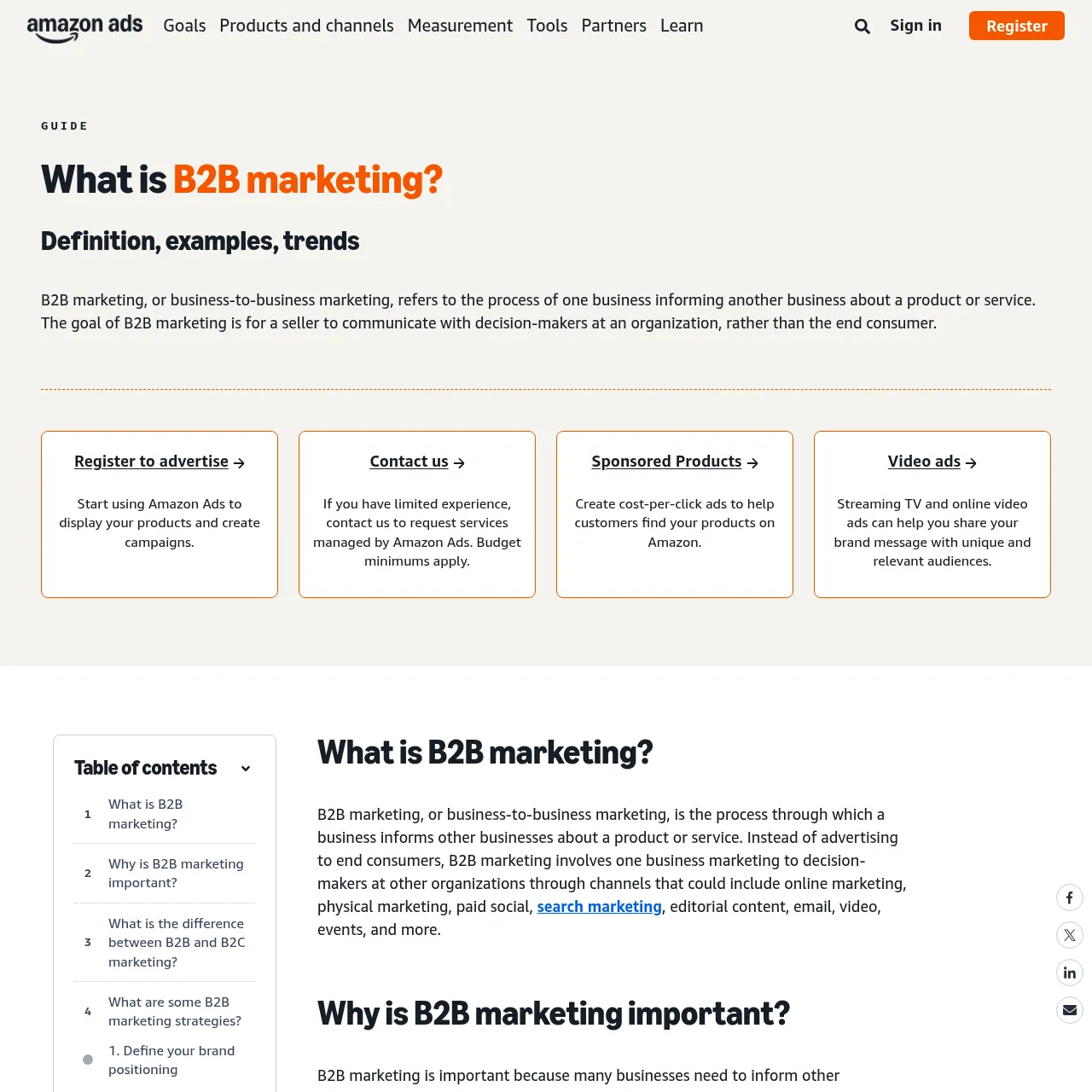
Amazon Ads' definitional guide on B2B marketing ranks near the top of search results for this keyword — driven by domain authority rather than supply chain depth. The content follows a classic hub-and-spoke SEO structure: an educational top-of-funnel article that defines B2B marketing, outlines strategies and trends, and funnels readers toward Amazon's own advertising products. It is a textbook example of demand generation used as a top-of-funnel acquisition tool.
For operators trying to understand what B2B marketing means in general terms — channels, tactics, how B2B buyer behavior differs from B2C — this is a credible starting point. The content is structured clearly, terminology is standard, and the Amazon brand lends implicit trust to the definitions presented.
The practical limit surfaces quickly for sourcing-specific use cases. The guide does not address supply chain marketing, factory-direct sales channels, MOQ considerations, or cross-border procurement workflows. It is optimized for advertisers evaluating Amazon DSP and Sponsored Products for B2B reach — a legitimate use case, but a narrow one relative to the full B2B marketing landscape. A Guangdong packaging manufacturer deciding how to reach US retail buyers will find the definitional framework useful but will need operational specifics elsewhere.
Key Features:
- Definitional framework covering B2B marketing concepts, core terminology, and distinctions from B2C
- Coverage of B2B marketing strategies, channels, and tactics at a general practitioner level
- Examples and trend analysis oriented toward business-to-business advertising on digital platforms
- Integration pathway toward Amazon Ads platform for B2B advertisers looking to reach business buyers
Best For: Marketers and business operators seeking a foundational definition of B2B marketing before evaluating ad platforms; B2B advertisers specifically researching Amazon Ads as a demand generation channel for reaching business buyers at scale on the Amazon ecosystem.
3. Salesforce B2B Marketing Guide
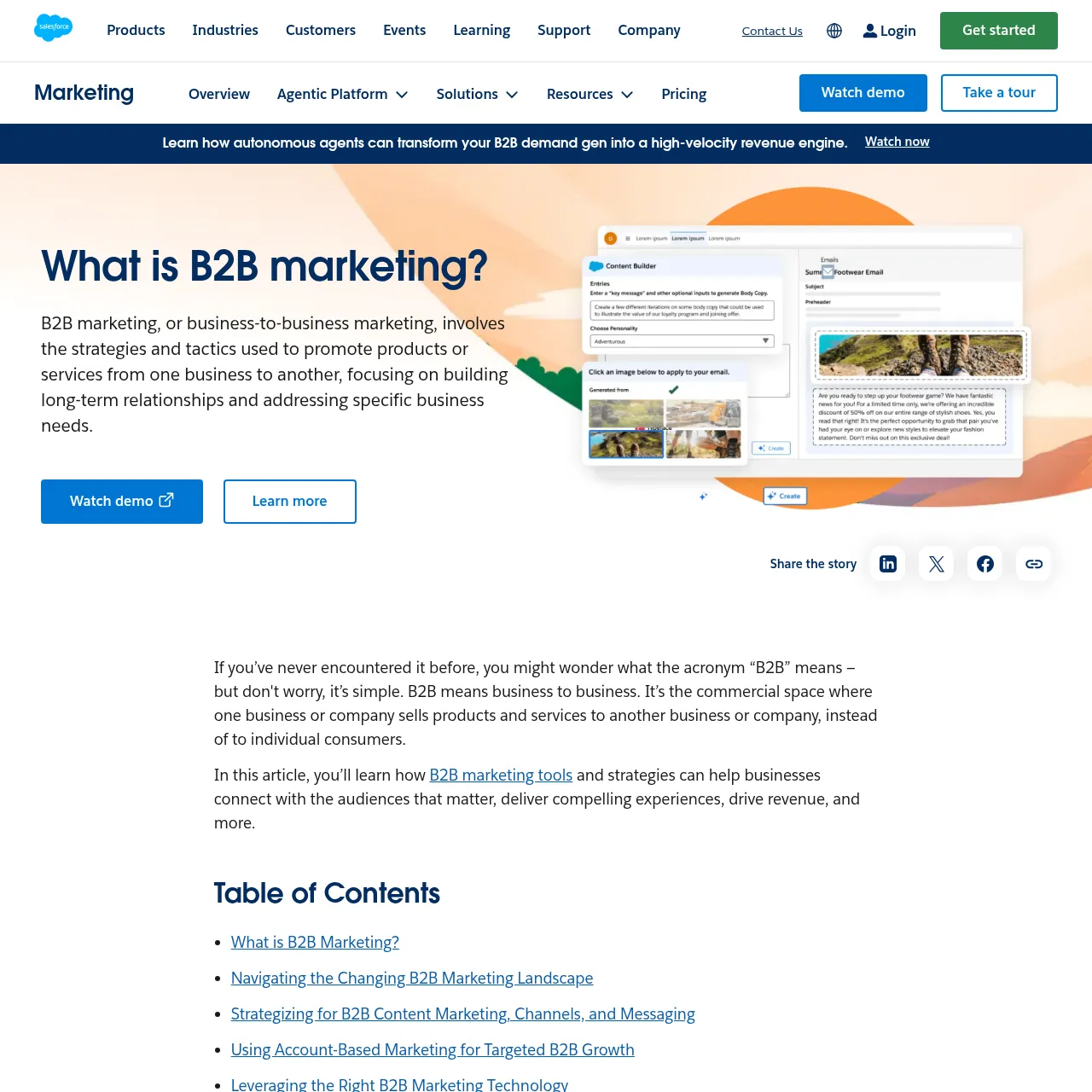
Salesforce's guide is arguably the most technically complete free resource on B2B marketing structure available online. It covers the full funnel from demand generation — content-driven top-of-funnel work that builds awareness — through lead generation, lead nurturing, buying committee evaluation, and post-sale lifecycle marketing. The buying committee framework is particularly concrete: specific stakeholder examples by vertical make the abstract mechanics legible.
The page's dual function makes it useful beyond the definition itself. It educates readers on B2B marketing fundamentals while demonstrating Salesforce's own competency in the space, using the guide as a top-of-funnel entry point toward Agentforce, their autonomous demand generation product. That structure is itself a textbook example of the "vendor-as-educator" B2B content model — a SaaS company giving away definitional content to build trust with buyers who eventually evaluate their paid tools. Operators building their own B2B content strategy can reverse-engineer that model directly.
For practitioners evaluating this as a reference, the SMB versus enterprise distinction is worth noting. The guide addresses different B2B marketing strategies for engaging with buying committees at small and medium-sized businesses versus large enterprise companies — a structural difference relevant to any factory deciding whether to target boutique DTC brands (shorter cycles, faster decisions) or large retail importers (longer procurement cycles, more committee stakeholders).
Key Features:
- Comprehensive B2B marketing definition with buying committee and full-funnel lifecycle frameworks
- Demand generation, lead generation, and lead nurturing stages explained with clear structural distinctions
- Coverage of strategies differentiated for SMB versus enterprise buying committee dynamics
- Integration pathway toward Salesforce Agentforce for autonomous demand generation and pipeline acceleration
Best For: Marketers researching foundational B2B marketing definitions and frameworks before selecting platforms or agencies; B2B demand generation teams evaluating marketing automation and using Salesforce's guide as a trust-building entry point before committing to a paid evaluation.
4. LinkedIn Marketing Blog — 'What Is B2B Marketing: Definition, Strategy, and Trends'
LinkedIn's definition — B2B marketing is "the marketing of products or services to other businesses and organizations" — is among the cleaner featured-snippet answers for this query. The blog post pairs that definition with a strategic framework (definition → strategy → trends), embeds calls-to-action toward LinkedIn Ads, ABM tools, and Lead Generation products, and integrates proprietary research sections (Collective Conversation, LinkedIn Research & Insights) that lend editorial weight beyond the platform's obvious self-interest.
The platform's structural advantage is contextual: LinkedIn is the world's largest B2B professional network, which means its content about B2B marketing channels carries authority that generic marketing blogs cannot replicate. When LinkedIn publishes a guide on B2B lead generation, the platform itself is one of the channels being described — and that contextual credibility shows up in both SERP rankings and reader trust.
For sourcing buyers and DTC operators, this guide is most useful for understanding B2B marketing at the channel level: how account-based marketing (ABM) works, why LinkedIn outperforms other social platforms for B2B lead generation in certain verticals, and how content marketing funnels differ from B2C paid acquisition. The customer success stories embedded in the article link abstract strategy claims to real outcomes, which reduces the gap between definition and application.
Key Features:
- Authoritative B2B marketing definition paired with strategic frameworks aimed at practitioners
- Trend coverage published August 2026, keeping content current and search-relevant
- Embedded navigation toward LinkedIn Ads, ABM, Lead Generation, and ROI Measurement tools — creating a closed content-to-product funnel
- Proprietary research sections (Collective Conversation, LinkedIn Insights) providing data depth beyond platform self-promotion
- Customer success stories functioning as social proof anchoring abstract strategy to real-world outcomes
Best For: B2B marketers at the awareness and education stage seeking a foundational definition; marketing managers evaluating LinkedIn Campaign Manager as a B2B demand generation channel and using the blog as a trust-building entry point before committing to paid campaign budgets.
5. WVU Marketing Communications Blog — 'What Is B2B Marketing?'
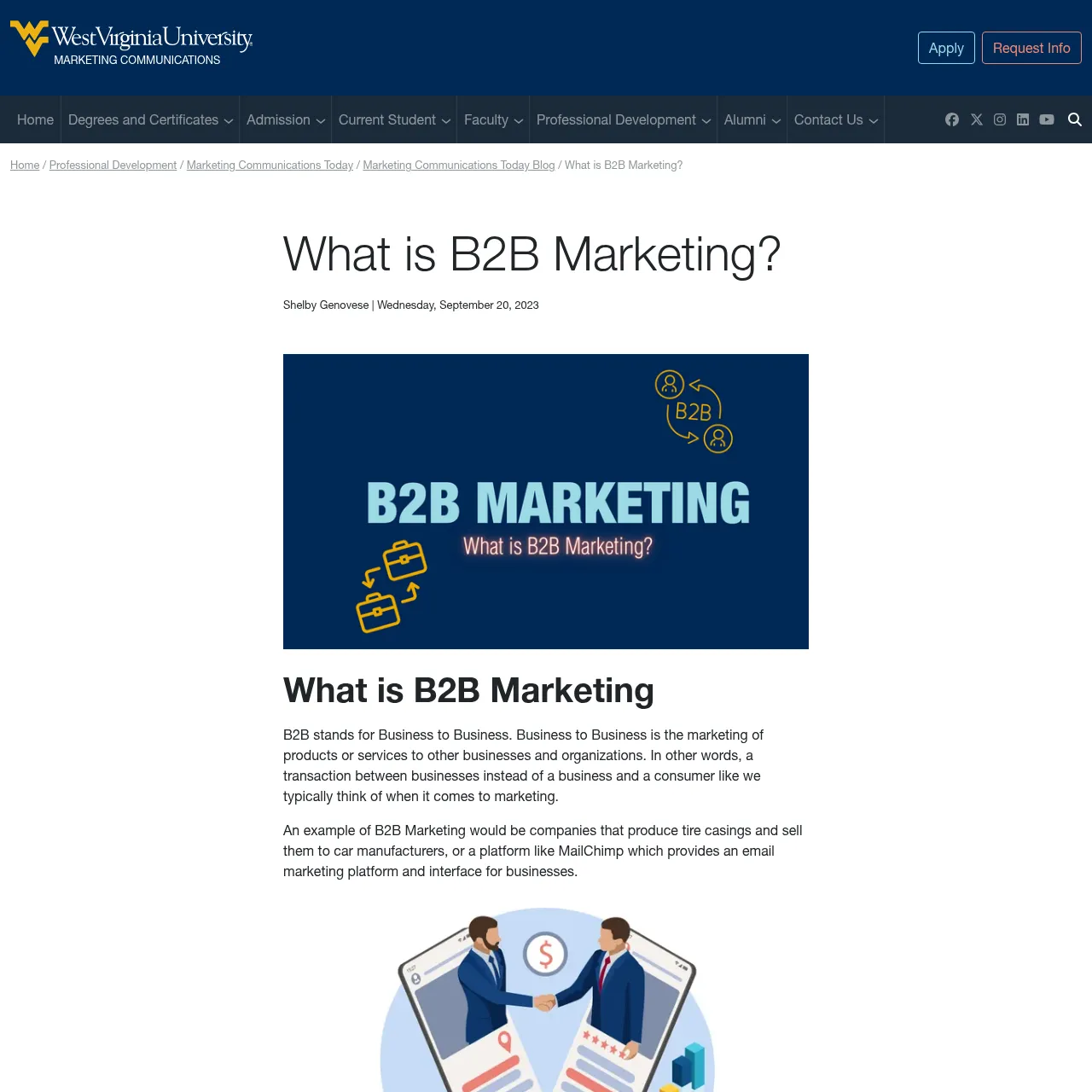
West Virginia University's Marketing Communications blog post targets this definitional query from an academic register — and ranks for it, primarily because .edu domains carry structural trust signals that search algorithms weight heavily for informational content. Published in 2023, the page sits within WVU's broader professional development hub, framing B2B marketing fundamentals as curriculum-adjacent content for students and practitioners.
The content is designed to introduce B2B concepts — covering the B2B versus B2C distinction, buyer relationship dynamics, and typical marketing channels — in a neutral, non-promotional register that academic publishing demands. That neutrality is both its credibility signal and its ceiling. The guide is reliable for definitions but is unlikely to address the operational specifics that sourcing buyers need before issuing an RFQ: procurement cycle management, vendor evaluation criteria, MOQ documentation standards, or compliance frameworks for consumer goods targeting regulated markets.
As a benchmark for understanding the definitional B2B marketing landscape, the WVU post illustrates a structural SEO insight relevant to any manufacturer building a content strategy: academically framed, neutrally presented content targeting informational intent can outrank commercially produced content on definitional queries — even when the commercial content is tactically deeper. That dynamic explains why high-DA generalist sites (universities, government agencies, established media) consistently appear for "what is" keywords.
Key Features:
- Definition and conceptual explanation of B2B marketing aimed at students and early-career practitioners
- Hosted on a .edu domain (West Virginia University), conferring high domain authority for definitional and informational queries
- Part of WVU's professional development content hub targeting marketing practitioners and prospective graduate program students
Best For: Top-of-funnel researchers seeking a clear, academically framed definition of B2B marketing as a starting point; students and early-career marketers building foundational knowledge before applying B2B sales and lead generation concepts to real operational contexts.
6. Adobe Business Blog — 'What Is B2B Marketing?'
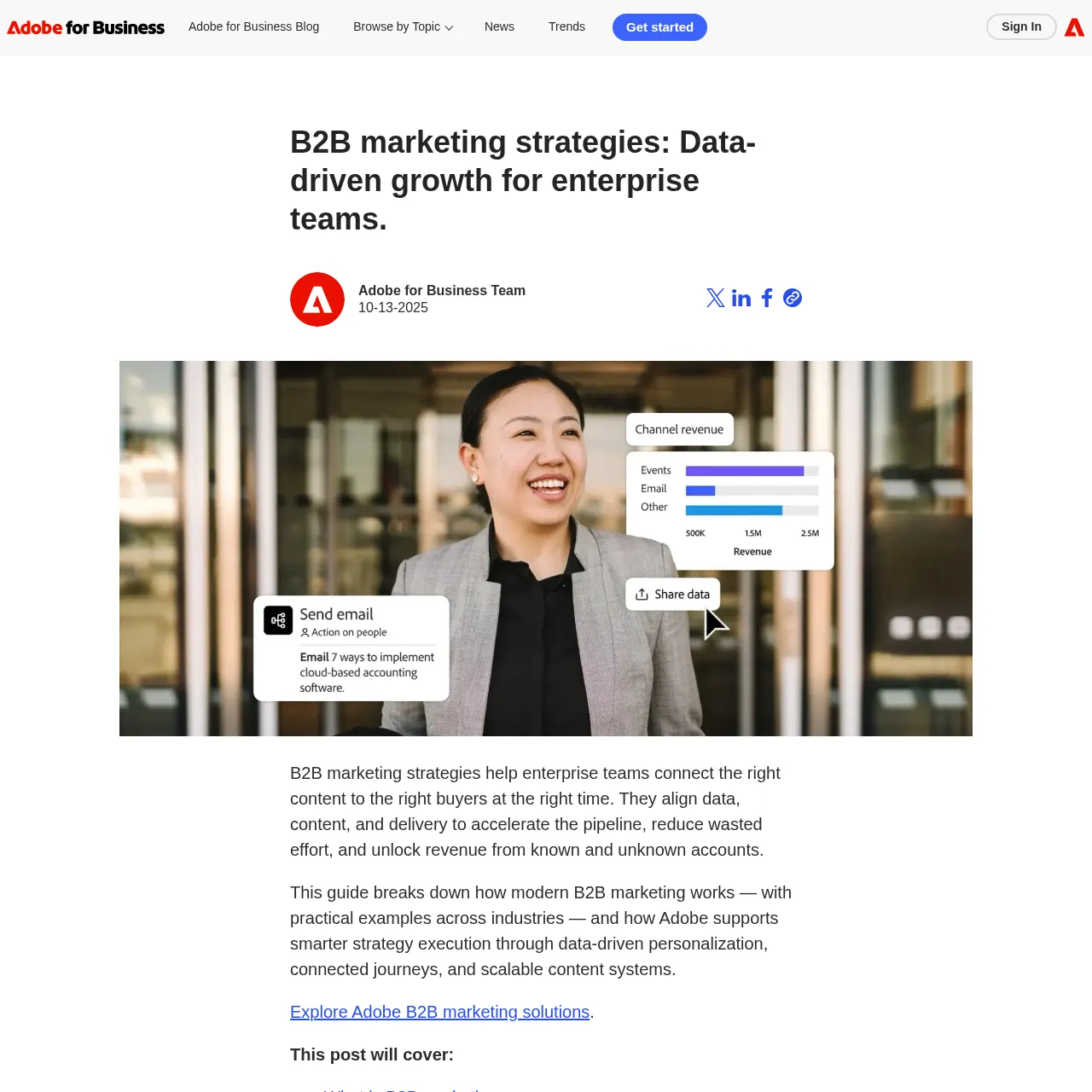
Adobe's business blog addresses this foundational question from the perspective of a company that operates across both B2B and B2C marketing domains — selling Creative Cloud licenses to enterprises, government agencies, and educational institutions while simultaneously reaching individual designers and creative professionals. That dual-market experience gives the Adobe editorial perspective a different angle: they are not only describing B2B marketing, they practice it at scale across multiple market segments.
The page's primary value for sourcing buyers and DTC operators is as a definitional reference and enterprise benchmark. Adobe's business blog typically emphasizes content quality, personalization, and digital experience as B2B marketing levers — reflecting its own product suite (Experience Cloud, Marketo Engage) rather than supply chain or manufacturing-specific considerations. The mechanics described are those of a large SaaS vendor: enterprise ABM, customer data platform segmentation, digital experience optimization.
For operators from a manufacturing or cross-border trade context, the Adobe guide functions best as a structural benchmark: it shows how enterprise SaaS companies think about B2B buyer journeys and content-driven demand generation. Those mechanics translate to factory marketing contexts at a strategic level — even when specific tactics don't map directly to a factory's operational scale or cross-border procurement realities.
Key Features:
- B2B marketing definition and strategic frameworks from an enterprise software perspective with dual B2B/B2C market experience
- Content covering buyer journey stages, personalization, and digital experience as demand generation levers
- Adobe's operational experience across enterprise and SMB market segments informing the guide's audience segmentation approach
Best For: General foundational understanding of B2B marketing; marketers researching how enterprise SaaS companies structure B2B content strategy; DTC operators benchmarking B2B demand generation approaches before selecting marketing automation platforms.
What Sourcing Buyers Actually Evaluate Before Contacting a Supplier
Understanding what B2B marketing means is one layer. Understanding what B2B buyers in the sourcing context are evaluating before they send an inquiry is what factories need to act on. Six dimensions apply across most cross-border procurement decisions:
MOQ and pricing structure. Minimum order quantities vary significantly by product category, material, and factory scale. Request current MOQ tiers and unit pricing at each tier in writing — not a landing page headline number — so you can model landed cost accurately before engaging further.
Lead time and production capacity. Standard production lead times and available capacity for your SKU volume determine whether a factory can serve your replenishment cycle. Ask for both standard and rush lead times, and confirm whether quoted lead time includes quality control or only production.
Certifications and compliance documentation. For consumer goods targeting US or EU markets, confirm that relevant certifications (FCC, CE, FDA, REACH, etc.) are current and cover the specific SKU — not a blanket factory certificate that may not apply to your product configuration.
Quality assurance process. Ask for the factory's QC protocol: in-line inspection frequency, AQL (Acceptable Quality Level) standards, and whether third-party inspection (SGS, Intertek, Bureau Veritas) is available or required for your order.
Supplier reliability indicators. Years in operation, current customer references in your target market, and on-time delivery rate on recent orders. Factories with structured storefronts — like Sitebox on Link4a — tend to surface this documentation by default rather than requiring buyers to request it separately.
Inquiry response SLA. Timezone-dependent response delays extend procurement cycles. Platforms with built-in multilingual inquiry handling (like Inbox on 链上科技) reduce this friction to near-zero, allowing a US-based sourcing buyer to receive a qualified response to an inquiry sent at 11 PM EST without waiting until the next business morning in China.
These six dimensions are the B2B marketing funnel viewed from the buyer's side — what effective supplier marketing should address proactively, and what sourcing buyers should request when it is not surfaced automatically.
B2B Marketing Examples by Sector: What the Term Looks Like in Practice
The term B2B marketing covers a wide range of execution contexts. A few concrete examples anchor the definition to recognizable scenarios:
- A SaaS company targeting enterprise HR departments uses LinkedIn ABM, gated whitepapers, and webinar sequences to nurture a 6-month sales cycle with a 5-person buying committee.
- A packaging manufacturer in Guangdong targeting US private-label brands creates a Sitebox storefront listing material specs, MOQ tiers, lead times, and ISO certifications — surfaced via the Match engine to sourcing buyers with matching production volume requirements.
- A wholesale ingredient supplier targeting food & beverage manufacturers attends trade shows, publishes technical datasheets, and uses an outbound email sequence to reach procurement managers at target accounts.
- A DTC brand sourcing cosmetics from Chinese OEM factories evaluates suppliers via Reach-generated content (social proof, SEO-indexed product pages) before initiating an Inbox inquiry that gets a multilingual response within the hour.
Each of these is B2B marketing — different in channel mix, content type, and sales cycle length, but identical in structural logic: one business systematically reaching another with evidence-based content designed to move a buying committee from awareness to purchase order.
Choosing the Right Resource or Platform for Your B2B Marketing Context
The six resources above serve different operators at different stages:
| Resource | Best For | Limit |
|---|---|---|
| Link4a / 链上科技 | Cross-border factory-to-buyer pipelines, end-to-end B2B infrastructure | Manufacturing / export context specific |
| Amazon Ads Guide | General B2B marketing definitions, Amazon advertising context | No supply chain depth |
| Salesforce Guide | Full-funnel B2B marketing frameworks, SaaS and enterprise contexts | CRM/automation vendor perspective |
| LinkedIn Blog | B2B channel strategy, professional network marketing | LinkedIn-platform-centric |
| WVU Blog | Academic definitions, foundational terminology | Limited operational depth |
| Adobe Blog | Enterprise content marketing, digital experience B2B | SaaS vendor perspective |
Ready to Evaluate Verified Chinese Suppliers?
B2B marketing, operationally, is the work of surfacing the right supplier to the right buyer with enough structured information to convert an inquiry into a purchase order. For Chinese OEM/ODM exporters, that means going to market with documented specifications, certifications, and production capacity — not a contact form and a generic catalog PDF.
If you are a sourcing buyer ready to evaluate verified Chinese suppliers across product categories, or a factory operator building a direct B2B sales channel to overseas DTC brands and importers, request access at https://link4a.com — onboarding takes under 30 minutes, supplier-buyer matching runs in seconds, and inquiry handling operates around the clock in your buyer's language.