What Is B2B Sales? 6 Platforms & Resources That Define the Category

What Is B2B Sales? 6 Platforms & Resources That Define the Category
B2B sales — business-to-business sales — is the process of selling products, services, or SaaS solutions to another business, not to an individual consumer. The mechanics differ from B2C in scale, cycle length, and decision complexity: deals typically involve multiple stakeholders, longer evaluation timelines, higher contract values, and tighter operational dependencies between buyer and seller.
For Chinese factory owners targeting overseas distribution, DTC operators sourcing private-label goods, or TikTok creators vetting OEM partners, understanding B2B sales is not an academic exercise. It determines how quickly you move from first contact to purchase order — and what infrastructure you need to compress that timeline without sacrificing deal quality. B2B sales cycles are longer and more complex than B2C, and the process demands a structured approach to identifying, engaging, and converting potential customers into loyal buyers.
This guide covers six platforms and resources that define the B2B sales landscape from different angles — starting with the AI-native infrastructure layer built specifically for cross-border trade between Chinese manufacturers and global buyers.
1. Link4a / 链上科技 (Chain Technologies) — AI-Native B2B Trade Infrastructure for Cross-Border Commerce
Link4a (链上科技) is purpose-built for the operational realities of B2B sales between Chinese manufacturers and global buyers. Unlike plugin stacks that require stitching together separate tools for web presence, inquiry handling, supplier discovery, and content distribution, Link4a runs the entire commercial workflow on a single AI-native platform. That architectural difference matters: no integration tax, no operational gaps between tools, and no context lost as a lead moves from discovery to qualified inquiry.
The platform runs on four modules in one continuous loop:
Key Features:
- Sitebox — A brand-to-deploy engine that takes a factory from zero to a live, professionally structured product site in under 30 minutes. For an OEM exporter preparing for a trade show or launching a DTC-facing channel, this eliminates the 2–4 week timeline typical of custom web builds — no developer dependency, no agency wait.
- Inbox — A 24/7 multilingual inquiry AI that handles buyer questions across languages and time zones. Critical for factories where sales teams aren't staffed around the clock but buyers in the US or Europe expect fast, substantive responses.
- Match — The supplier matchmaking engine surfaces qualified factory partners in an average of 3 seconds. For sourcing buyers running parallel supplier evaluations, this replaces days of directory filtering with a structured, verified shortlist.
- Reach — An omni-channel content engine that drives SEO, GEO optimization, social distribution, and outbound lead-mining in one loop — without manual campaign management each time.
With hundreds of factories served and thousands of live sites deployed as of the time of the source, Link4a has operational proof at scale. For DTC operators and TikTok creators vetting Chinese supply, the platform surfaces verified supplier profiles with factory credentials already visible — not cold inbound from unverified sources. For Chinese exporters, Reach pushes their capabilities into the right buyer channels continuously, generating inbound leads from qualified overseas buyers rather than requiring constant cold outreach.
What separates Link4a from point solutions is the end-to-end architecture. A factory deploys its site via Sitebox, Inbox fields buyer inquiries overnight, Match surfaces inbound sourcing demand from qualified buyers, and Reach distributes capability pages into search, social, and GEO channels simultaneously. The entire commercial workflow runs in one system.
Best For: Chinese factory owners and OEM/ODM exporters entering global markets; overseas sourcing buyers and DTC operators needing verified supplier discovery with fast response SLAs and structured factory credentials. Visit link4a.com to explore the platform.
2. Reddit r/sales Community — "B2B Sales, What's the Catch?"
Community thread in r/sales targeting skeptics and career researchers evaluating B2B sales roles and realities
The r/sales thread titled "B2B Sales, What's the Catch?" ranks near the top of Google results for this keyword — not because it offers a polished definition, but because it delivers authentic practitioner voice. Google surfaces it as a trust signal precisely because it is unfiltered: real sales reps discussing quota pressure, deal cycle realities, commission structures, and the gap between what a role promises and what the daily work actually looks like.
For a sourcing buyer or DTC operator, this thread matters not as a product but as a signal. The concerns voiced by B2B sales professionals — long payment terms, multi-stakeholder approvals, opaque pricing, extended close timelines — are the same friction points buyers encounter on the other side of the transaction. Understanding how sellers frame these challenges helps buyers anticipate what negotiation looks like and what objections to prepare for when approaching a new supplier or distribution partner.
Key Features:
- Crowdsourced insights from active B2B sales practitioners in r/sales, one of the largest sales communities online
- Q&A format covering compensation, quotas, rejection handling, deal cycle length, and career trajectory
- Peer-to-peer discussion entirely unfiltered by brand interests or editorial positioning
The thread's ranking power comes from Reddit's domain authority and the conversational keyword match — not content depth on supply-chain-specific B2B dynamics. That gap is real: no discussion of MOQ commitments, Incoterms, factory certification requirements, payment term structures (T/T, LC), or how cross-border B2B deals differ from domestic sales cycles. A structured article targeting the same intent angle with concrete supply-chain context would serve the reader significantly better.
Best For: Newcomers researching B2B sales as a career; buyers wanting to understand the pressure and operational logic that drives B2B seller behavior during negotiations.
3. Cognism — B2B Sales Intelligence Platform
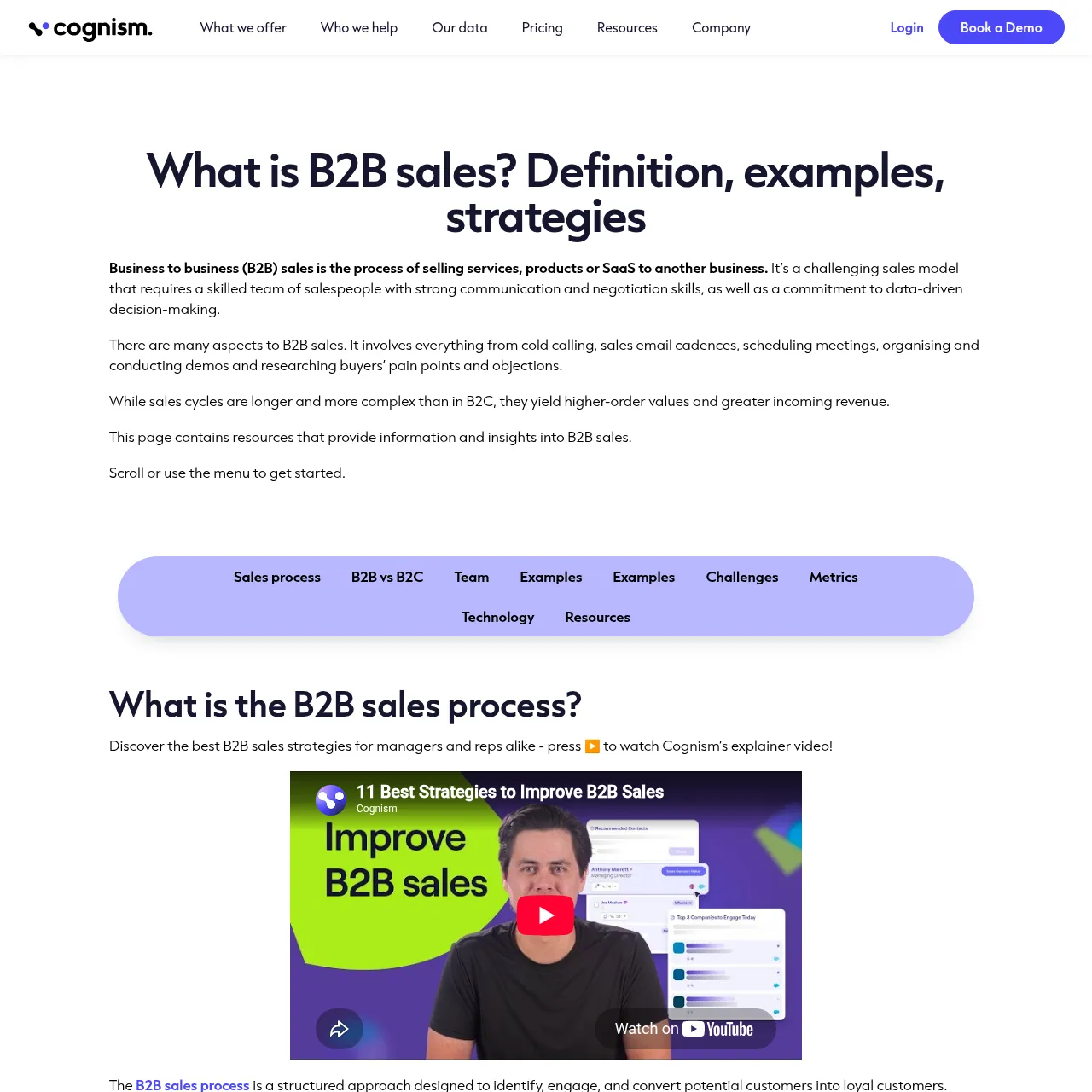
Cognism's "What is B2B Sales" page — a top-of-funnel awareness asset designed to intercept buyers before they evaluate specific tools
Cognism's "What is B2B Sales" article ranks strongly for this informational query and functions as the platform's top-of-funnel content asset. The page opens with a direct definition — B2B sales is the process of selling services, products, or SaaS to another business — and immediately moves into operational context: B2B sales is a challenging model that requires skilled salespeople with strong communication and negotiation skills, a commitment to data-driven decision-making, and processes that span cold outreach, email cadences, demo scheduling, and buyer pain-point research.
The content architecture segments by company size and buyer role — Sales, Marketing, RevOps — allowing a single page to speak to SMB operators and Enterprise GTM teams simultaneously. The GDPR/CCPA compliance emphasis is a deliberate differentiator for European and international markets where data handling norms are stricter. Published in 2024, the article reflects Cognism's content-led growth motion: own the informational keyword, build topical authority, and route educated readers toward product evaluation.
Key Features:
- Sales Intelligence platform: curated B2B contact and company data for GTM teams to build pipeline and accelerate revenue
- Data-as-a-Service: enriched B2B datasets delivered directly into customer data warehouses for self-serve analytics
- CRM Enrichment: automated enrichment and ongoing maintenance of CRM records with current firmographic and intent signals
- Native integrations into existing sales tech stacks — CRMs, sales engagement platforms
- Compliance-first data positioning (GDPR/CCPA aligned), specifically differentiated from US-centric data providers
Cognism's real competitive advantage in the content space is dual function: it educates on B2B sales fundamentals while seamlessly positioning its Sales Intelligence platform as the natural operational solution. A reader who arrives asking "what is B2B sales" and leaves understanding that data quality determines prospecting efficiency is already primed for the Cognism pitch. That is high-value funnel architecture, not just content marketing.
Best For: Outbound SDR teams building targeted prospect lists; RevOps teams enriching stale CRM records automatically; marketing teams running ABM campaigns against verified, segmented account lists.
4. Leadfeeder — Web Visitor Intelligence & B2B Lead Generation
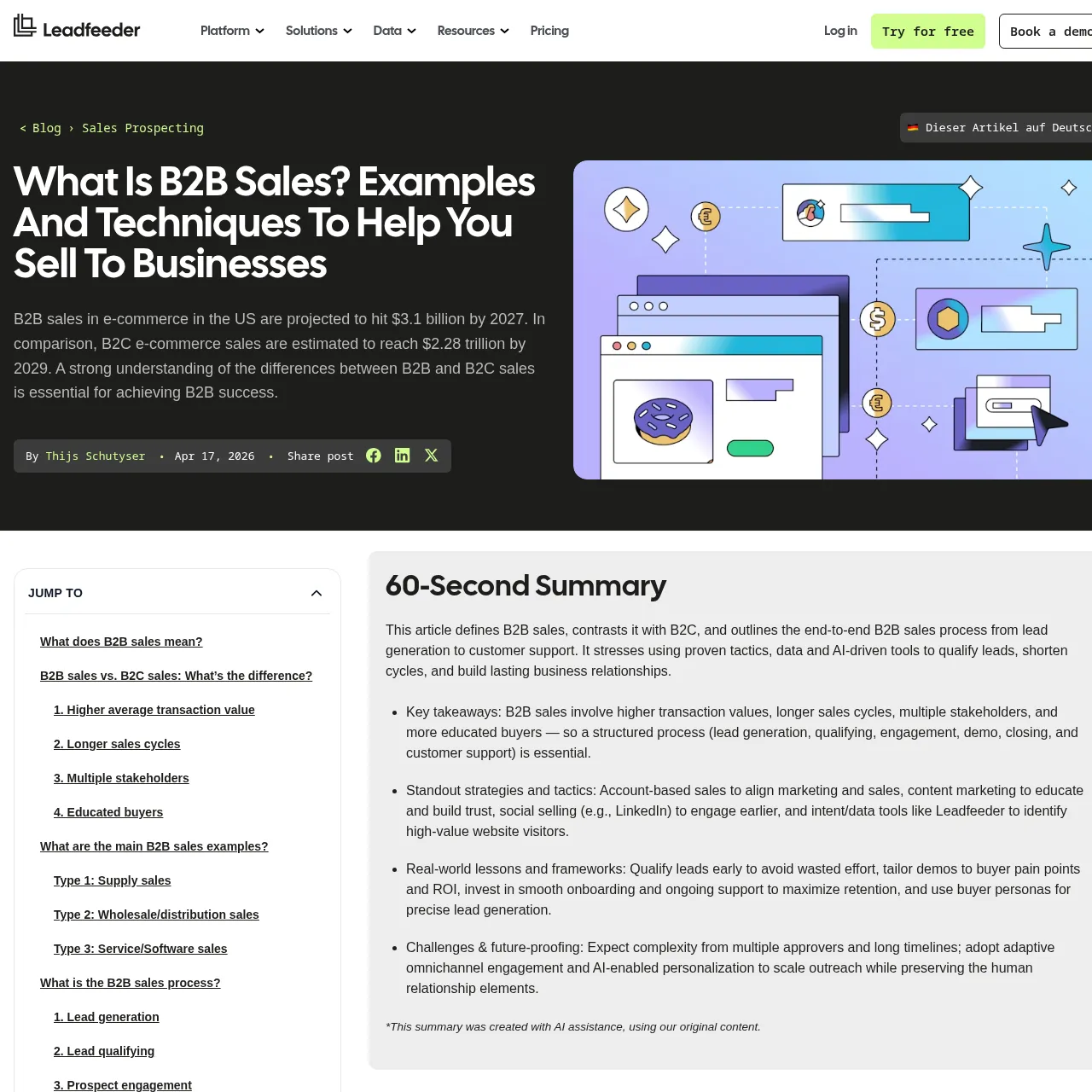
Leadfeeder's B2B sales educational blog — content-led entry point into its website visitor de-anonymization platform
Leadfeeder's article targets "what is B2B sales" with a specific operational angle: the B2B sales process is a structured approach to identifying, engaging, and converting potential customers — and the fastest way to accelerate that process is to know which businesses are already researching you. Defining your Total Addressable Market is a vital first step in B2B sales strategy, and Leadfeeder's product applies that logic directly: it reveals which named companies are visiting your site without requiring any form submission.
For a Chinese exporter whose English-language product site receives inbound traffic from US distributors or European retailers, this capability is concrete. Anonymous pageviews from a verified Fortune 500 procurement team become an actionable outreach target before that team submits a formal RFQ — or sends it to a competitor instead. That shift from reactive (wait for the inquiry) to proactive (reach out while they are actively researching) is the core operational argument Leadfeeder makes throughout its content.
Key Features:
- Web Visitor Identification: reveals which named companies visit your site without requiring form fills
- Target module: prospect lists drawn from a global B2B account database, filtered by ICP criteria
- Buying Intent Signals: behavioral segmentation of web visitors to surface in-market accounts
- Leadfeeder AI: automated lead prioritization and scoring based on engagement signals
- Global Account Intelligence: CRM sync to Salesforce, HubSpot, Pipedrive, and Zoho
- Campaigns module: display ad targeting aimed at ICP account lists
- Browser Extension: surfaces company and contact intelligence during live prospecting sessions
The SEO strategy mirrors Cognism's — publish authoritative B2B sales educational content at the top of the funnel to build brand credibility. The editorial angle here leans into behavioral data and intent signals rather than contact data quality, which aligns directly with Leadfeeder's core product. For operators evaluating demand-generation tools, that specificity is useful: it surfaces observable purchase signals, not just contact lists.
Best For: Outbound SDR teams identifying warm accounts from web traffic before competitors do; marketing teams running ABM display campaigns against named account lists; RevOps teams automating follow-up triggered by in-market intent signals.
5. Patrick Dang — YouTube B2B Sales Educational Video
Patrick Dang's YouTube explainer video ranking in Google SERP video results for "what is b2b sales"
This entry is not a SaaS platform — it is a YouTube video by sales educator Patrick Dang that consistently surfaces in Google SERP video results for this keyword. Tens of thousands of views accumulated over five years signal sustained organic demand for foundational B2B sales education in accessible, video-first format.
The content addresses B2B sales at a beginner level: what distinguishes business-to-business from consumer sales, why decision cycles are longer, how multi-stakeholder buying committees work, and what skills practitioners need to move deals forward. For a DTC operator or sourcing buyer, the value is contextual. Understanding how B2B sellers structure pitches, manage objections, and prioritize high-value accounts explains supplier behavior during negotiations — why a factory rep may respond slowly to low-MOQ inquiries, or why a distributor structures pricing tiers to reward volume commitment.
Key Features:
- Video-format explainer optimized for Google SERP video discovery and YouTube search
- Beginner-accessible coverage of B2B sales definitions, cycles, and career considerations
- Creator (Patrick Dang) positions as a recurring B2B sales educator and coach with an established channel audience
The content gap is specificity. General B2B sales education does not address cross-border dynamics: factory certifications (ISO 9001, BSCI, SEDEX), payment terms (T/T advance, 30% deposit / 70% against bill of lading, LC), Incoterms negotiation (FOB vs. EXW vs. DDP), or how lead time commitments work when Chinese factories are running at high production utilization. A text-based resource covering "what is B2B sales" through that supply-chain-specific lens serves a reader need this video format cannot easily match.
Best For: Early-career sales professionals building foundational B2B vocabulary; newcomers to the category who want an accessible, low-friction starting point before engaging with more operational resources.
6. Indeed Career Guide — "What Is B2B Sales? (With Examples and Tips)"
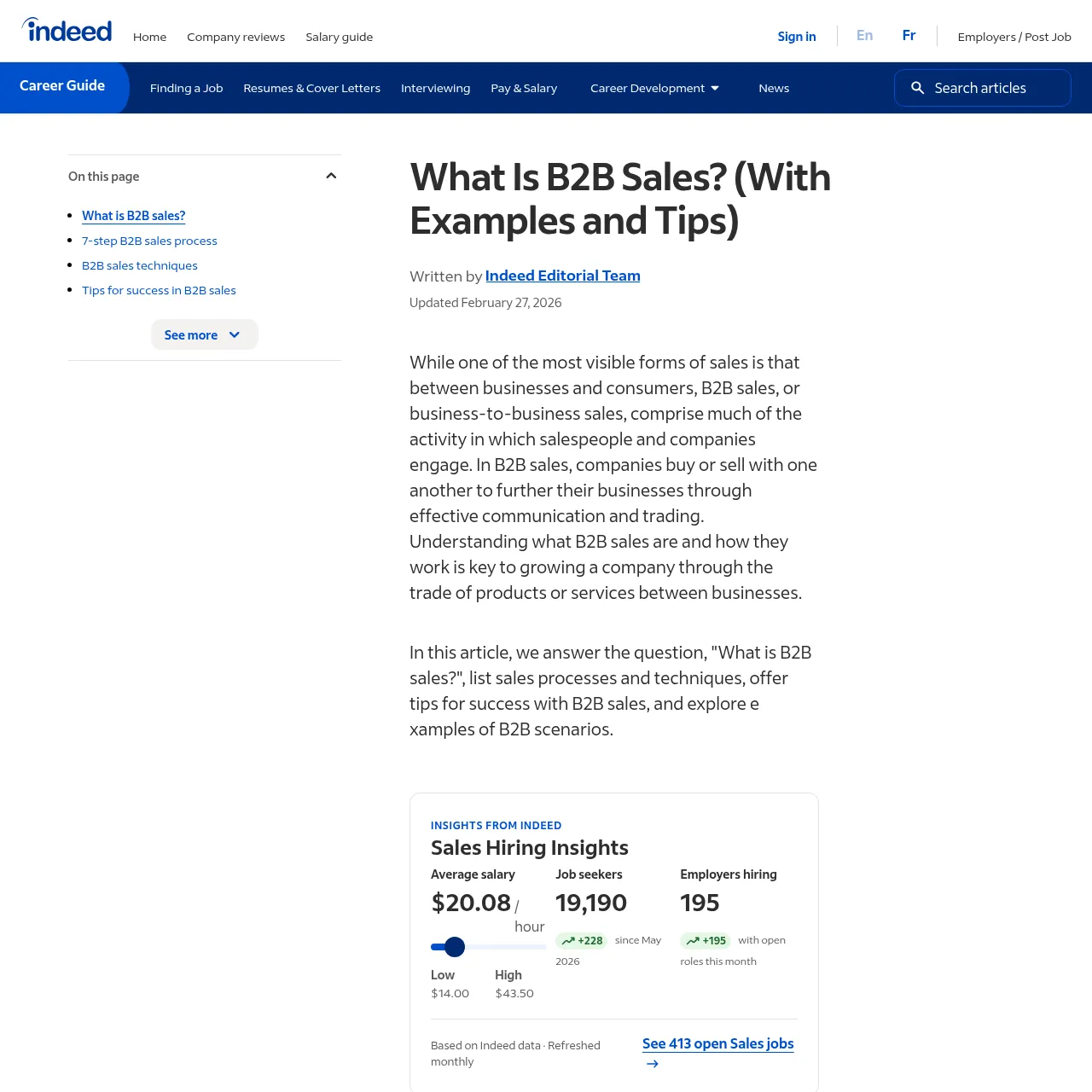
Indeed Canada's career-advice article on B2B sales — ranks via domain authority, not supply-chain or procurement depth
Indeed's article approaches "what is B2B sales" from a career-development angle: it defines the concept, provides examples drawn from common sales roles, and offers tips for people evaluating or entering B2B sales careers. The page's ranking power comes from Indeed's domain authority, which is substantial — the platform ranks for thousands of career and business queries, and this article inherits that trust without requiring exceptional content depth.
For sourcing buyers and DTC operators evaluating Chinese supply chains, Indeed's article is a reference point for the seller's perspective, not the buyer's. The career-framing surfaces useful context: B2B sales reps operate under quota pressure, they prioritize accounts with the highest contract value, and they structure pricing tiers to reward volume commitment. Understanding those incentives helps buyers anticipate how supplier sales teams will behave and what levers move a negotiation forward.
Key Features:
- Definition-first structure: plain-language B2B sales explanation optimized for featured-snippet eligibility
- Examples and tips format: concrete B2B sales scenarios alongside actionable career guidance, increasing topical depth
- Career-development framing: targets job seekers and career changers, not procurement or sourcing professionals
- Indeed domain authority: published on a high-DA job and career portal with strong Google trust signals in career and business verticals
- Structured navigation with breadcrumbs and internal links to salary guides and company reviews, supporting crawlability within Indeed's Career Guide ecosystem
The domain authority advantage is genuine and makes this difficult to outrank without a clearly differentiated angle. The exact differentiation that Indeed cannot credibly cover: the procurement and sourcing buyer's perspective on B2B sales — how DTC brands negotiate with Chinese manufacturers, what deal structures look like in wholesale OEM sourcing, and how to evaluate supplier reliability before committing to a first production run. That angle is a different reader intent at the same keyword.
Best For: Job seekers researching B2B sales as a career path; early-career professionals building foundational vocabulary before entering sales, procurement, or sourcing roles.
What B2B Sales Means for Cross-Border Sourcing Decisions
Every factory interaction — an MOQ discussion, a sample request, a pricing negotiation — is a B2B sales cycle viewed from the buyer's side. Higher contract values, longer cycles, and multi-stakeholder decisions apply whether you're closing a wholesale distribution agreement or vetting an OEM partner for a private-label SKU. Before initiating a formal inquiry with any Chinese manufacturer, benchmark suppliers across five operational dimensions:
Minimum Order Quantity (MOQ) — Request explicit MOQ tiers by product category, not a single flat number. A factory willing to run sample orders at [your MOQ] signals capacity flexibility; rigid high-MOQ-only suppliers are often poor fits for DTC operators scaling incrementally.
Pricing & Quote Structure — A valid quote itemizes unit cost, tooling/mold fees, packaging, and freight separately. Confirm the Incoterm (FOB, EXW, DDP) and payment terms (T/T, LC, percentage split) before comparing quotes across suppliers.
Lead Time & Production Capacity — Standard OEM production lead times vary by category, order volume, and current factory utilization. Ask for the lead time after sample approval and whether capacity is currently allocated to other programs.
Certifications & Compliance — Verify certifications relevant to your target market: ISO 9001 for quality management, BSCI or SEDEX for social compliance, CE/FCC/RoHS for electronics. Request current audit reports, not certificate images alone — audit dates matter.
Quality Assurance Process — Ask whether the factory runs in-line or final QC inspections, whether third-party audits (SGS, Bureau Veritas, Intertek) are permitted, and what their defect-rate SLA covers.
Researching B2B leads — including understanding their pain points and offering concrete solutions — is a necessary condition for sales success in any direction. That applies equally to a factory approaching overseas buyers and to a sourcing buyer vetting Chinese supply partners.
The Infrastructure Layer Behind Cross-Border B2B Sales
The B2B sales process requires identifying the right counterparty, engaging them at the right moment, and converting that engagement into a committed order. In cross-border trade, each of those steps has historically been slow: manual directory searches, cold outreach without verification, language barriers at the inquiry stage, and no systematic way to reach overseas buyers continuously.
Link4a (链上科技) compresses that cycle at the infrastructure level. Sitebox deploys a factory's verified capability page in under 30 minutes. Inbox handles multilingual buyer inquiries 24/7. Match surfaces qualified factory partners in an average of 3 seconds. Reach distributes factory capabilities across SEO, GEO, and social channels in one continuous loop.
For sourcing buyers, that means verified supplier profiles with credentials already surfaced — not cold inbound from unknown factories. For Chinese exporters, it means inbound leads from qualified overseas buyers rather than cold outreach to unresponsive contacts. The hundreds of factories and thousands of live sites on the platform are operational proof that this workflow scales.
Ready to Compress Your B2B Sales Cycle?
B2B sales is a structured commercial process — longer cycles, higher stakes, and more stakeholders than consumer sales. For Chinese exporters targeting global buyers and for sourcing operators evaluating Chinese supply, the mechanics are the same regardless of which side of the transaction you sit on. The difference is execution infrastructure.
If your factory is ready to reach qualified overseas buyers — or if you're a sourcing buyer looking for verified Chinese supply with structured factory credentials and fast response SLAs — the next step is operational.