Wholesale Lumber Suppliers: The Complete 2026 Buyer's Guide

Wholesale Lumber Suppliers: The Complete 2026 Buyer's Guide
Wholesale lumber suppliers sell dimensional lumber, sheet goods, and specialty wood products in bulk quantities directly to builders, manufacturers, and trade buyers — bypassing retail markup entirely. If you're sourcing lumber for a construction project, millwork operation, or global export business, choosing the wrong distributor can mean missed lead times, grading disputes, and cost overruns that are hard to recover from.
Who This Guide Is For
This guide is written for procurement managers, general contractors, millwork shop owners, furniture and flooring manufacturers, and independent builders who are actively evaluating wholesale lumber suppliers and need to make a vendor decision in the next 30–90 days. It also applies to global trade operators and overseas sourcing managers who import North American lumber or who need to evaluate competitive hardwood and softwood alternatives from China and Asia-Pacific supply chains. If you're past the introductory research stage and ready to request quotes, negotiate terms, and sign contracts, read on.
What Wholesale Lumber Suppliers Actually Do
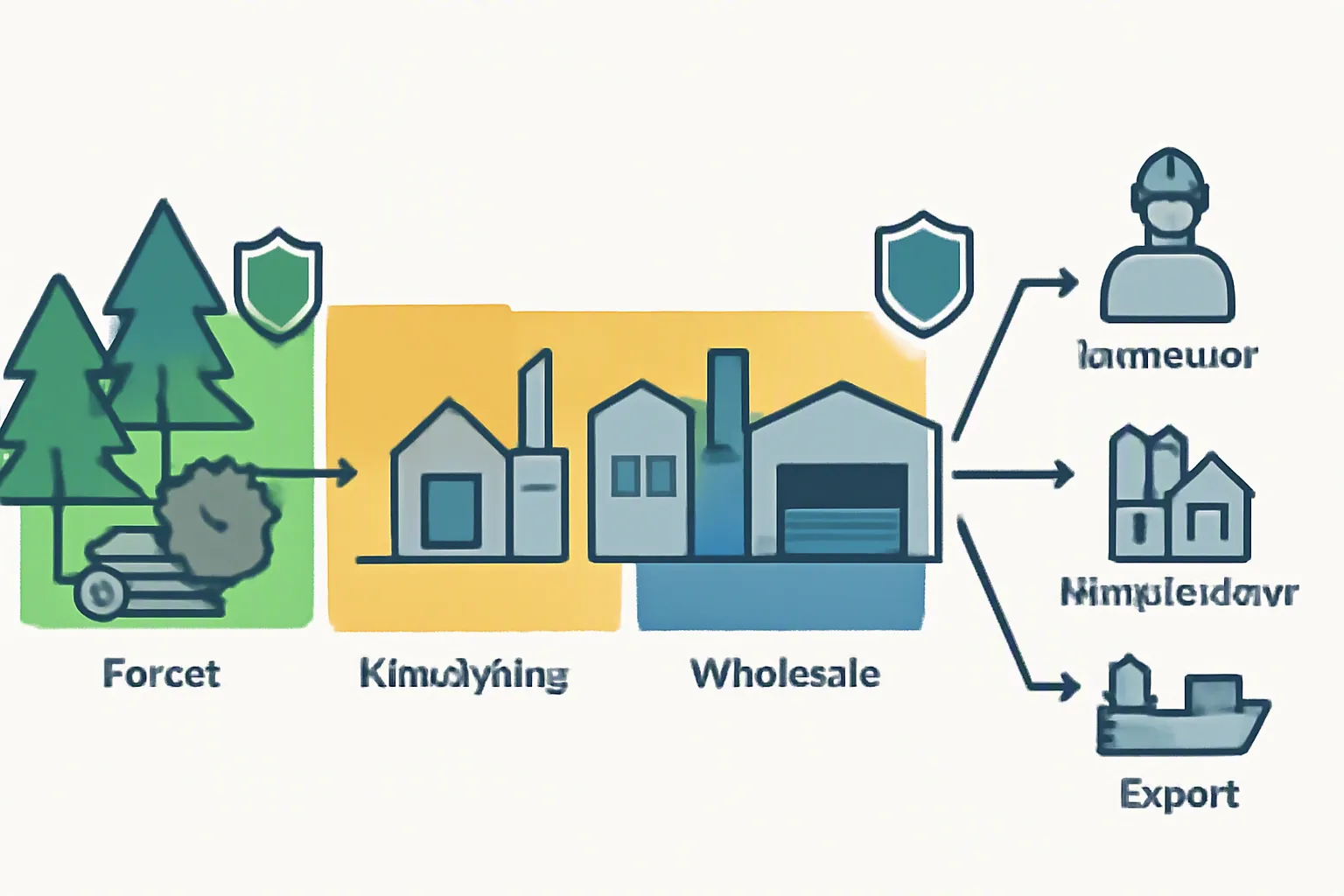
A wholesale lumber supplier is not a retail lumberyard — they operate at a fundamentally different scale and with a different service model. At the wholesale level, distributors maintain large inventories of both domestic and imported species and sell to trade buyers in volume, typically with minimum order requirements. Most also provide value-added processing: Rex Lumber, for example, offers blanking, cabinet planing, cut-to-length, custom glue-up, end-matching, kiln drying, resawing, ripping, and sanding as part of its wholesale service offering — all services that compress your production timeline.
Beyond stocked inventory, most serious wholesale distributors will source materials they don't carry if you contact them directly. Suppliers like Menominee Tribal Enterprises (MTE), which manages the Menominee Forest in Wisconsin and operates a sawmill in Neopit, WI, control their supply chain from forest to delivery — a structurally different model from a broker who simply moves inventory on margin. That distinction matters when markets tighten.
Key Decision Factors
1. Species Range and Inventory Depth
The first test of any wholesale supplier is whether they stock what you need — and whether it's actually on the shelf. Rex Lumber's catalog contains 101 total lumber products, split across 55 imported hardwoods, 26 domestic hardwoods, 17 domestic softwoods, and 3 imported softwoods. Of those, 43 are in-stock; 58 are custom order only. Knowing that distinction upfront prevents project delays.
Ask for a current stock list, not just a marketing catalog — then confirm lead times on custom-order items before you commit. A supplier with 100 SKUs but only 40 in stock is a different vendor than one with 60 SKUs fully warehoused.
What "good" looks like: A supplier who clearly distinguishes in-stock from special-order products, publishes realistic lead times per SKU, and will proactively source species outside their standard range when you contact them.
2. Certifications and Sustainability Credentials
For commercial builders and global trade buyers, certification is not optional. FSC® (Forest Stewardship Council) certification is the internationally recognized third-party standard for responsibly sourced timber — and increasingly required for municipal, institutional, and government-contracted projects. LEED Green Certification matters for projects pursuing green building credits under the U.S. Green Building Council's framework. MTE holds both designations.
Rex Lumber offers FSC® Certified options on 34 of its 101 products. If your project has sustainability requirements — a LEED submission, ESG reporting obligation, or government procurement compliance — verify certification at the product level, not just the company level.
What "good" looks like: Per-SKU FSC documentation available on request; chain-of-custody numbers provided per lot; LEED-compatible species clearly flagged in the catalog.
3. Value-Added Processing Capabilities
Raw lumber is rarely enough on its own. Millwork shops, furniture manufacturers, windows and doors fabricators, and flooring producers need pre-processed material. The right supplier is a one-stop source, not a supply chain with extra steps.
Capabilities to evaluate: kiln drying, cut-to-length, resawing, ripping, custom moulding, sanding, priming, end-matching, and custom glue-up. Rex Lumber offers all of these, plus custom millwork including CAD drawings and custom profiles. MTE supplies kiln-dried hardwood directly to window manufacturers, flooring manufacturers, furniture manufacturers, and basketball flooring producers — a useful signal that they can handle precision specifications at scale.
What "good" looks like: Processing capabilities are documented with tolerances and moisture content specs, not just listed as bullet points. Ask whether they can produce to a custom CAD profile, and whether processing is done in-house or subcontracted.
4. Geographic Coverage and Logistics Reach
A supplier's warehouse footprint determines your delivered cost and lead time. Rex Lumber operates locations in Connecticut, Massachusetts, New Jersey, and Virginia — well-positioned for the Northeast U.S. corridor. MTE operates from Wisconsin with service areas including Milwaukee. If your job sites or manufacturing facilities are outside these regions, evaluate freight costs carefully — they can erode the unit-price advantage of a wholesale buy quickly.
For buyers with global sourcing needs or cross-border trade operations, the equation changes. Lumber sourced through China or Asia-Pacific distributors may offer competitive pricing on certain species but requires careful vetting of grading standards, phytosanitary compliance, and import documentation. Platforms like Link4a's Match engine — which performs 3-second supplier matchmaking across verified factory networks — can compress the research phase when evaluating global supply alternatives.
What "good" looks like: The supplier confirms delivery to your ZIP code or port of entry; freight terms (FOB, CIF, DDP) are specified in writing; for global trade, compliance documentation is provided as standard.
5. Grading Standards and Quality Assurance
Lumber grading is where wholesale purchases most often go sideways. NHLA (National Hardwood Lumber Association) grades, WWPA softwood grades, and proprietary systems like Rex Lumber's Grad® System all have specific defect tolerances. A supplier who can't tell you which grading standard applies to a given SKU is a liability before you've even placed an order.
For imported hardwoods — particularly material sourced through China or other overseas supply chains — verify that the grading conforms to recognized North American or international standards, or negotiate a pre-shipment inspection as a contract condition. Using a comparison tool (a simple scoring matrix works) to evaluate grading transparency across shortlisted suppliers is one of the most reliable ways to filter out weak vendors early.
What "good" looks like: Grading certificates available per lot; moisture content tested and documented; third-party inspection available for large orders; clear defect policy and returns process for off-grade material stated in writing.
6. Minimum Order Quantities and Pricing Structure
Wholesale pricing is not posted online — you request a quote. But the MOQ (minimum order quantity) is what determines whether a given supplier fits your volume. High-volume distributors may require full truckload quantities; regional suppliers may work with smaller orders at tighter margins.
Ask for tiered pricing structures: what's the price per board-foot at 1,000 BF versus 5,000 BF versus full container quantities? For international buyers, factor in currency terms and payment structure — net 30, letter of credit, and wire transfer terms vary significantly across domestic and global suppliers.
What "good" looks like: Transparent pricing tiers shared in writing before negotiation; MOQ clearly stated per species and dimension; price locks available for project duration on large orders.
7. Specialty and Niche Products
Commodity lumber (SPF, yellow pine, Douglas fir) is available from dozens of distributors. Where suppliers differentiate is in specialty products — modified woods, exotic hardwoods, and certified sustainable species. Rex Lumber carries Accoya, Tricoya, and Kebony — modified wood products with enhanced durability specifically engineered for exterior applications. It stocks 2 products rated for exterior use only, 56 for interior use only, and 43 suitable for both.
If your project involves exterior cladding, marine applications, or high-performance doors and windows that require long-term dimensional stability, specialty modified woods may justify a premium supplier relationship over a commodity distributor.
What "good" looks like: Technical datasheets for specialty products; clear application suitability flags (interior vs. exterior, structural vs. finish); documented experience with the product in your specific application.
8. Supplier Stability and Chain-of-Custody
A wholesale supplier is a long-term business partner, not a one-time vendor. Verify operating history, check whether they manage their own timber supply (MTE manages the Menominee Forest directly, which insulates them from spot market volatility), and whether they hold government-recognized certifications such as the USDOI Notice of Availability.
For buyers in the building trades — plumbing rough-ins, framing, structural applications — supply continuity matters as much as unit price. A supplier who can't guarantee availability when your project is mid-frame is more expensive in real terms than one who charges slightly more and ships on schedule.
What "good" looks like: Verifiable operating history; references from buyers in your specific trade; documented forest management or procurement policies available for review.
Budget Tiers
Wholesale lumber pricing is quote-based and varies by species, volume, processing, and logistics. The table below describes buyer profiles and what each tier typically receives — not published prices.
| Tier | Buyer Profile | Volume Range | What You Typically Get |
|---|---|---|---|
| Entry / Small Trade | Independent contractors, small millwork shops, DTC builders | < 5,000 BF per order | Standard commodity species (SPF, yellow pine); limited processing; near minimum order threshold; few specialty options; standard lead times |
| Mid-Market / Regional | Regional builders, furniture producers, flooring manufacturers | 5,000–50,000 BF per order | Broader species selection; value-added processing (kiln drying, ripping, cut-to-length); FSC-certified options; better freight terms; account rep access |
| Commercial / High Volume | GCs, large manufacturers, distributors | 50,000 BF+ or full truckload | Full species catalog including specialty/modified woods; custom moulding and CAD profiles; dedicated account rep; multi-tier pricing; project-duration price locks; priority stock allocation |
| Global / Export | OEM manufacturers, cross-border trade operators, exporters | Container quantities | Import/export documentation support; phytosanitary compliance; grading to international standards; FOB/CIF/DDP freight term negotiation; multi-currency payment options |
Red Flags to Avoid
- No distinction between in-stock and custom-order items. If a supplier lists everything as "available" without specifying lead times, project delays are virtually guaranteed.
- Grading standards not specified in writing. Vague language like "select and better" without a reference to NHLA or WWPA standards leaves you exposed to every grading dispute.
- All processing outsourced. A supplier who subcontracts everything has less quality control and longer lead times than one with in-house milling and kiln drying.
- Certifications claimed at the company level but not traceable to the product. FSC certification is a chain-of-custody document, not a company badge — demand per-lot documentation before you accept any sustainability claim.
- No references in your specific trade. A supplier serving window manufacturers, builders, and furniture producers should be able to connect you with buyers in your sector. A refusal to provide references is a serious signal.
- No written defect or returns policy. Off-grade and damaged material appear in bulk shipments. A supplier with no stated recourse process will cost you time and money when it happens — and it will happen.
- Pricing significantly below market. Lumber has real input costs: timber, milling, drying, freight. A quote that's materially below competitive bids usually signals compromised grading, undisclosed species substitutions, or a distributor who can't deliver on volume.
Buying Process Checklist
- Define requirements — Specify species, grade, dimension, volume (BF or MBF), moisture content, processing needs (kiln dried, S4S, cut-to-length), certifications required (FSC, LEED), and delivery timeline. Document this before any vendor conversation.
- Shortlist suppliers — Identify 3–5 candidates based on geographic coverage, species range, and processing capabilities. For global alternatives, use a matchmaking tool like Link4a Match to surface verified factory-level suppliers quickly.
- Submit identical RFQs — Send the same spec to all shortlisted suppliers so you're comparing equivalent quotes. Variations in the RFQ make comparison impossible.
- Verify certifications independently — Confirm FSC chain-of-custody numbers and LEED eligibility directly from the certifying body, not from the supplier's marketing materials.
- Request a sample lot — For large orders or specialty species, inspect a sample for grading conformance, moisture content, and dimensional accuracy before committing.
- Check references in your trade — Ask for 2–3 references from buyers in your specific sector (builders, doors and windows fabricators, furniture manufacturers). Ask directly about on-time delivery and how disputes were handled.
- Negotiate contract terms — MOQ, pricing tiers, price locks, payment terms, freight terms, lead times per SKU, defect policy, and returns process — all in writing before you sign anything.
- Confirm supply continuity — For multi-month projects, confirm inventory allocation or standing order terms so you're not competing on spot supply mid-project when prices may have moved.
Questions to Ask Wholesale Lumber Suppliers
Before you commit to a purchase agreement or long-term relationship, get concrete answers to these:
- What is your current in-stock quantity for [species/dimension], and what is the replenishment lead time when stock runs low?
- Which grading standard applies to this species, and can you provide a grading certificate per lot?
- What is your minimum order quantity for standard items versus custom-order items?
- Do you offer FSC-certified options on this species? Can you provide the chain-of-custody certificate number?
- Which value-added processing services do you perform in-house versus outsource to a third party?
- What are your standard payment terms, and do you offer project-duration price locks for large orders?
- What are your freight terms — FOB, delivered, or CIF — and who arranges shipping?
- What is your process when a shipment contains off-grade or damaged material?
- Can you provide 2–3 references from buyers in [builder / manufacturer / exporter — specify your trade]?
- What is your current lead time for [specific species and dimension]?
- Do you support international shipping, and can you provide phytosanitary certificates and export documentation as standard?
- How do you manage supply continuity if your primary timber source is disrupted?

Recommended Next Steps
Start by locking down your specification sheet before you contact anyone — species, grade, volume, processing requirements, and certifications. A vague RFQ produces a vague quote, and vague quotes make vendor comparison impossible.
For domestic sourcing, shortlist suppliers with in-house processing, documented FSC certification at the product level, and verifiable references in your trade. For buyers evaluating cross-border or China-based supply chains alongside North American alternatives, the matchmaking and vetting phase is where most procurement time is lost. Link4a's platform is built specifically for this intersection — connecting global trade operators with verified suppliers through AI-native tools that compress sourcing cycles from weeks to hours.
If wholesale lumber is one category in a broader procurement strategy, the Wholesale Suppliers in USA: The Complete 2026 Buyer's Guide covers the full landscape of U.S. wholesale distribution across building materials and beyond. Buyers in adjacent trades will find the Plumbing Wholesale Distributors: The Complete 2026 Buyer's Guide applies the same decision framework to plumbing supply chains.
Lumber markets are price-volatile and inventory-sensitive. The sooner you have competing quotes in writing, the better your negotiating position — and the less exposure you carry if prices move before your project breaks ground.